The post Why Ed-Tech Industry appeared first on Test.Evelyn.
]]>According to Fortune Business Insights, the market size of global ed-tech and classrooms was valued at USD 88.82 billion in 2021 and is expected to increase to USD 319.65 billion by 2029. This growth forecast is exceptional.
Throughout the world, States and institutions are investing heavily in educational infrastructure to leverage the holistic potential of the sector. Technology advancement has eased education delivery, curriculum development, and assignment/homework management.
Distance learning has improved with technology integration and has helped students in remote areas to access course knowledge. Ed-tech is helping learners and educators consummate the real purpose of education.
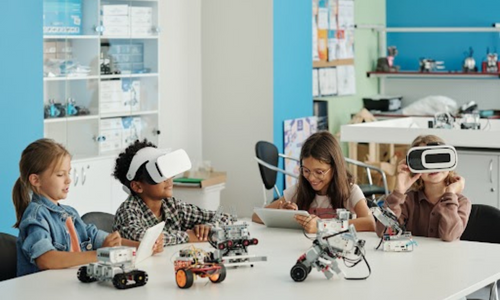
Today, with the inundation of ideas due to the increased usage of artificial intelligence in education, the ed-tech space will only advance. It will look forward to an improved learning experience where customized learning will break the gaps of teacher-student interaction, curriculum management will be an easy task and whatnot.
Education is one of the spaces where technology is vastly and amicably accepted and implemented.
With investors brewing their thoughts to invest in education, this industry is brimming to expand in a blink of an eye.
The post Why Ed-Tech Industry appeared first on Test.Evelyn.
]]>The post Censorship in Schools: Will They Hurt the Core Purpose of Learning? appeared first on Test.Evelyn.
]]>Similar situations may crop up soon if certain proposed bills become laws in multiple states in the USA. Recent stories talk about how the State governments want to ban certain words, topics, and books from being taught in schools. Some people in America are also terming this exercise to be anti-public education.
But is it an act of prudence to dictate what the children will learn in schools, or should the education department become an independent body without bias?
Censorship in Schools
Many state governments have seen a rise in the number of proposed bills restricting what can be taught in classrooms to children. Political interference is causing discomfort to many teachers. It is becoming one of the main reasons why teachers want to exit the profession.
PEN America, a non-profit organization, observed that in 2022, 36 States introduced around 137 bills that put restrictions on teaching themes, like sexuality, race, gender, or the history of the United States. Additionally, many books face bans and are out-shelved by the school and other libraries.
Texas, for instance, has banned more than 700 books from the libraries of public schools. Teachers and superintendents have been tasked with reviewing all the books to check if their content is censorship-worthy.
According to the report, many of these bills have the potential to become laws before the end of this year. In all, such statements, termed ‘censorship in education,’ have increased to 250% in the last year.
39% of the bills introduced in 2022, the report mentions, are focused on higher education and many of them also include punishments for violations. The similarity between these laws is that they come from Republican legislators.

Data: PEN America, Chart: K-12 Dive
Understanding the intent on the other end of the stick
In a diverse society like America, some people support moves like book bans and curriculum restrictions. In their view, discussing ideas like sexuality, and slavery in American history, can unpleasantly influence students.
This partially comes from parents’ concerns about school lessons as a part of SEL. It is one of the reasons why many parents are also switching to homeschooling.
Parents are concerned that teachers might be trying to influence their children and teaching them to follow the so-called ‘Un-American’ culture. In addition, parents worry when their children are encouraged to come out of the closet and accept their natural sexual orientations at a young age.
So, what can be done to counter this?
This negative perception can be avoided if parents are invited to understand what the curriculum is all about. Parents can be encouraged become active in learning their child’s syllabus and then choose if this is right for them or not. Schools should communicate healthily with parents and explain the curriculum’s intent and content. If something is found outrageous by a majority, it should be excluded.
Reactions from Americans
Since these censorship in education have come into the picture in the last year, surveys have been conducted to understand the citizen perspective.
A majority of parents supported the following topics to be taught in schools. For instance, 87 percent of parents support teaching the Civil Rights movement, 74 percent of parents support teaching the history of Slavery, and 59 percent of parents agree to teaching the concept of Systemic Racism in American institutions and society.
Student Mental Health
The students have suffered due to the Covid-19 pandemic, which has disrupted regular school life. Following this, the narrative around the teaching shortage emerged, which spoke of this phenomenon affecting the quality of education in schools. And now, we see public schools coming under the radar for teaching specific topics while omitting others. These educational hiccups can affect students’ learning interests and make them emotionally vulnerable.
Students need stability and discipline to learn. If teachers are constantly in fear that them saying something might turn into legal action against them, no actual teaching would be taking place.
Partial or Uneven Learning
Learning can be partial if students learn about one part of history and not the other part of it.

CAP Data: PEN America
It would be a rather peculiar scenario if parents have learned certain things about history and their children have learned completely different things about the past. Learning should be even and truthful. Suppose the government opposes the idea of teaching concepts like critical race theory to younger children. In that case, they should be allowed to learn this in higher classes when they start understanding the credos of a prosperous society.
Conclusion
It is never really possible to ban information, because even though books can be banned and teachers’ behavior can be controlled, there is a technology where only some things are filtered. Students can still learn from the internet, which by large, contains only some authentic and accurate information. Legitimate books can portray ideas in a more sophisticated and acceptable manner.
The post Censorship in Schools: Will They Hurt the Core Purpose of Learning? appeared first on Test.Evelyn.
]]>The post Animation Techniques For Effective Content appeared first on Test.Evelyn.
]]>A thousand words can be written to convey a message, but a short animation film is significantly more powerful. Perhaps this is why they are preferred for educational, business, and presentation purposes, among other things. However, before animators begin creating their own, it is necessary to have a fundamental awareness of the numerous animation techniques used in multimedia. After all, it is likely that a 3D approach will appeal to their audience more than a 2D approach or stop motion, or vice versa.
The goal of this article is to guide readers through the complexities of various animation styles and approaches. It also covers the fundamentals of color coding, as well as the ideal quantity of text to include in an animation.
What To Choose: 2D v/s 3D
There are several aspects animators must consider when determining whether to create a 2D video animation or a 3D animation. Although both are fantastic in their own right, there are several differences that may lead animators to prefer one over the other.
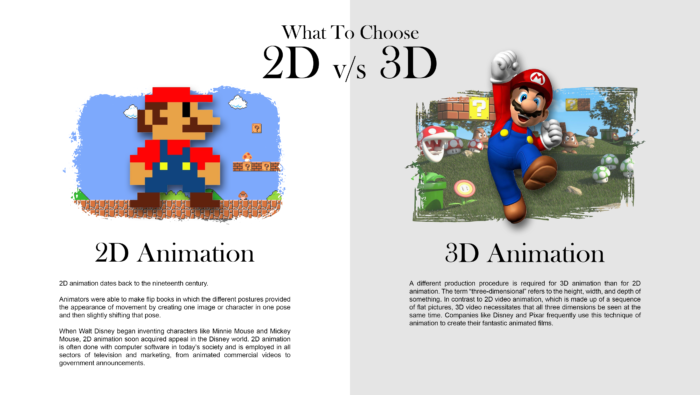
So, what should animators think about when determining whether to make a 2D or 3D animated video?
-
Target Audience
The target audience should be the first thing to think about. If animators have a topic they need to convey, a 2D explainer movie is the most digestible and enjoyable way to do so.
3D videos, on the other hand, are considerably more realistic. So, if animators want to showcase a new product, such as a smartphone, a 3D video would be an excellent choice.
-
Pricing
Pricing is another element animators should think about when deciding on the proper video animation path for them.
2D video animation is typically far more cost-effective than 3D animation. This is due to the fact that 3D animation is far more sophisticated than 2D, requiring an animator to devote significantly more time to the process. When it comes to creating video animations, time truly is money.
-
Turnaround Time
Following up on the previous point, animators can create 2D videos far more quickly than 3D animations. The average turnaround time for a 2D video is roughly six weeks.
Due to the more difficult animation process, creating a 3D video might take months or even years, depending on the length and complexity of the animation.
Color Coding
Animators must think carefully about the colors they employ in their animations and why they do so. When animators do not handle color correctly or in the right context, it might become a distraction for users, lowering their performance.
It is crucial to think about the associations people have with particular hues (e.g. red and green). On the website, animators may be able to use red to color code a subject, but it will likely have to be a darker shade that does not feel alarming.
The color red, for instance, in a US safety handbook implies “warning” or “danger.” Users with an American background will notice the red signaling cue right away and will most likely read the material.
Differentiating Information Sections Using Color
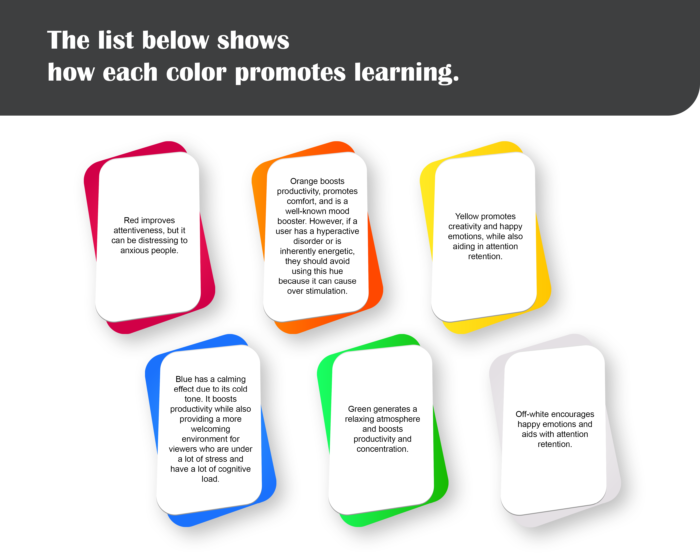
With so much information to digest, colors are able to provide the ideal environment for learning to take place.
Each hue has its own wavelength, which is thought to have various effects on our brain. This means that when it comes to learning, the colors animators choose will have an impact on the user’s feelings, behaviors, and attention.

Humans are sensitive to visual cues, and color has been demonstrated to boost the likelihood of information being encoded, retained, and retrieved when compared to black and white. As a result, viewers can process information faster with color because it visually organizes information in ways that are relevant to them.
Color should be utilized to distinguish between distinct pieces of information in a program or on a website. Color should be utilized to give each area of the website a distinct look if there are numerous pages of content that might be arranged into certain sections (subjects, chapters, sub-sections, etc.). Each part may have its own distinct look and feel.
Color-coding sections makes it easier for users to figure out where they are in the app’s navigation. As they become more familiar with the colors, they will construct a mental map of where different pieces of content are located.
Optimum Amount Of Text In Animation
When it comes to adding text to animations, animators must keep two things in mind:
a. Aesthetics
Yes, the goal is not to overpower the animation with too many words. It can be counter-intuitive to include too much text in an animation. Instead of aiding audience retention, it detracts from the aesthetics and elegance of the animated content.
The words animators add must blend in with the animation’s theme and contribute to its artistic appeal.
b. Legibility
While it is necessary to maintain the animation’s aesthetics, the primary reason for having text on it is to improve the audience’s capacity to retain the information.
Bearing this in mind, it is vital to arrange the text in a readable manner. For this purpose, animators can use proper text qualities, such as color, font, and size. The number of words on the screen at any given time has a significant impact on one’s ability to read. Some people can only read a few paragraphs at a time. Animators can employ split text online tools to easily divide big volumes of text into bite size bits, as well as other tools to make readable chunks of video text.
The animator ultimately decides how much text the video needs. It is no longer difficult to strike a nice balance between aesthetics and legibility when adding text to animations. However, animators should avoid making obvious errors when doing so. A handful of the most typical mistakes individuals make while adding text to animations are listed below.
-
Color
The text animators add to a video should have a color that contrasts nicely with the video’s subject. It is critical that the reader be able to grasp it without difficulty.
The aim is to put the text on top of something that contrasts effectively with the text color. It is also crucial to make the backdrop object slightly transparent (opacity 0.7 to 0.8) so that the animated content behind it is not obscured.
-
Size
This is a simple task. Animators must determine the significance of the text. If it is a subtitle, they may put it toward the bottom and keep the font size tiny. Animators can increase the font size of a title by 3-4 times. Unlike a subtext, the audience should never overlook it.
Many people believe that keeping text tiny will impair the animation’s output. If animators believe the message is significant, they should prominently display it in the animation.
-
Position
One can never overstate the importance of text placement. Animators should always place crucial text, such as titles, in the middle of their frame. They should have no reservations about doing so. If it is an assistance annotation, they can place it at the bottom 2/3 of the animation on the left or right side, toward the top.
-
Duration
When animating text, animators should always ensure that their audience has enough time to read and grasp the text they have added to the video. If they fail to do so, the whole point of putting text to video is moot.
It is a good idea to keep the text open for 2 seconds longer than the typical reading time. There are certain exceptions to this rule, such as when the text must appear in sync with specific sequences. Animators can ignore this regulation in certain instances.
To conclude, design is more than just a matter of aesthetics. Interaction is at the heart of design. Communication necessitates the use of animation. Animators must embrace the interactive nature of the web from the start and consider it a natural element of their work.
Image Sources: Shutterstock and Unsplash
For more information on animation techniques for effective content, visit our blog.
Create. Engage. Inspire.
The post Animation Techniques For Effective Content appeared first on Test.Evelyn.
]]>The post Digital Learning, E-Learning, Online Learning: What’s the Difference? appeared first on Test.Evelyn.
]]>What is Digital Learning?
Digital learning is the most broad term. Any learning that is supported by technology or by instructional practices that fully utilize technology can be considered digital learning. An aspect of digital learning involves learning the use of technologies in an effective way, the use of features such as blended or virtual learning, etc. Besides, digital learning involves the use of technology, digital content, and instructional methods. Of course, digital learning includes online courses as well. Besides, using digital tools like interactive whiteboards and tablets in a classroom also involves students conducting Internet research or watching online videos.
What is Online Learning?
Online learning is a term that is similar to digital learning, but slightly narrower. The benefit of online learning is that it allows you to study and teach from anywhere in the world. As a result, there is no need to commute from one place to another or maintain a rigid schedule. The majority of online coursework will be conducted through forums, shared files, email, chat, etc. Nevertheless, it does not imply that a teacher and student do not interact face-to-face. As long as the primary means of communication is online, coursework can be conducted in a classroom or at a distance.
What is E-Learning?
The term ‘e–Learning‘ describes a formalized teaching system that uses electronic resources. It should be noted that, while teaching can take place in or out of the classroom, the use of computers and the Internet is one of the main components of eLearning. In some cases, neither the teacher nor the student meets in person. Furthermore, the course material and communication are handled via email, forums, chat, or video conference. Occasionally, this type, of course is referred to as a “fully online” course.
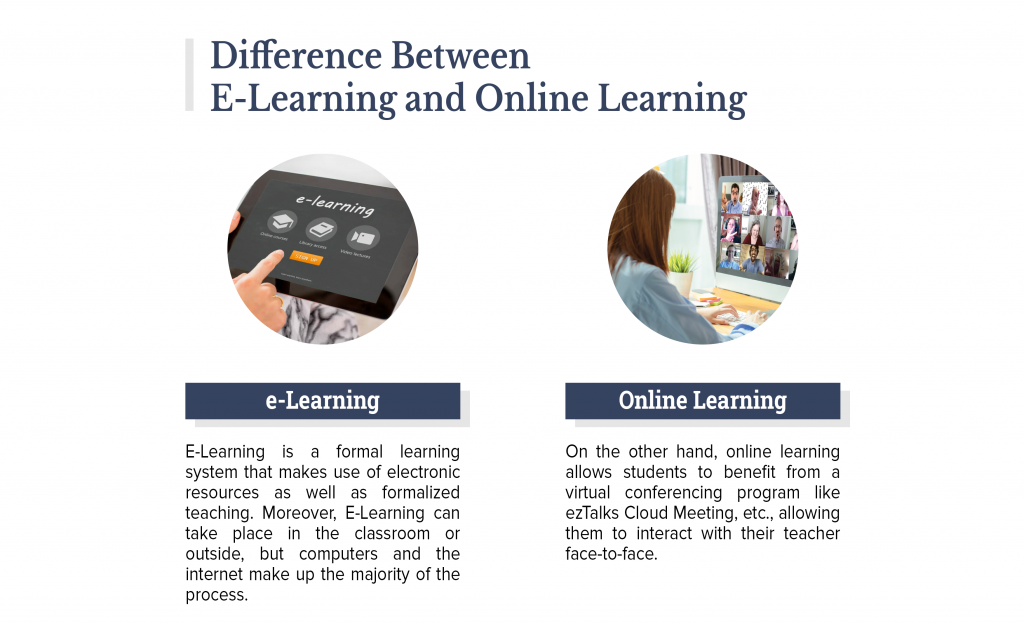
Difference Between E-Learning and Online Learning
Features of E-Learning:
- A typical e-Learning course may contain PowerPoint slides and/or Word documents as well as a pre-recorded video lecture.
- Students are expected to review a substantial amount of information independently.
- PowerPoint slides typically contain textual explanations of the theory.
- Usually, video lectures are pre-recorded by teachers and show them browsing through PowerPoint slides while lecturing or simply talking.
- Such materials do not encourage students to think while simultaneously learning.
Features of Online Learning:
- A professional online tutor or teacher is available to assist online learners.
- Instead of watching a pre-recorded video lecture, the course is conducted live.
- A tutor or teacher discusses the materials with a student during a live session (such as worksheets, test papers, homework).
- With the help of the tools and features presented on the online platform, the learning and teaching platform can help both tutor and student communicate what they want to say. A common feature of online learning platforms is an interactive whiteboard, on which tutors and students can upload materials (e.g. textbook questions, test paper questions, theory to be explained).
- The features of the platform allow tutors and students to point out the information they are looking at easily.
- Additionally, students can ask questions or state their thoughts during the live lesson with online learning. Besides, teachers or tutors can answer all of their questions and clarify their doubts on the spot.
The main difference between eLearning and online learning is the amount of interaction. Students and instructors interact more during online learning, while eLearning is more self-paced.
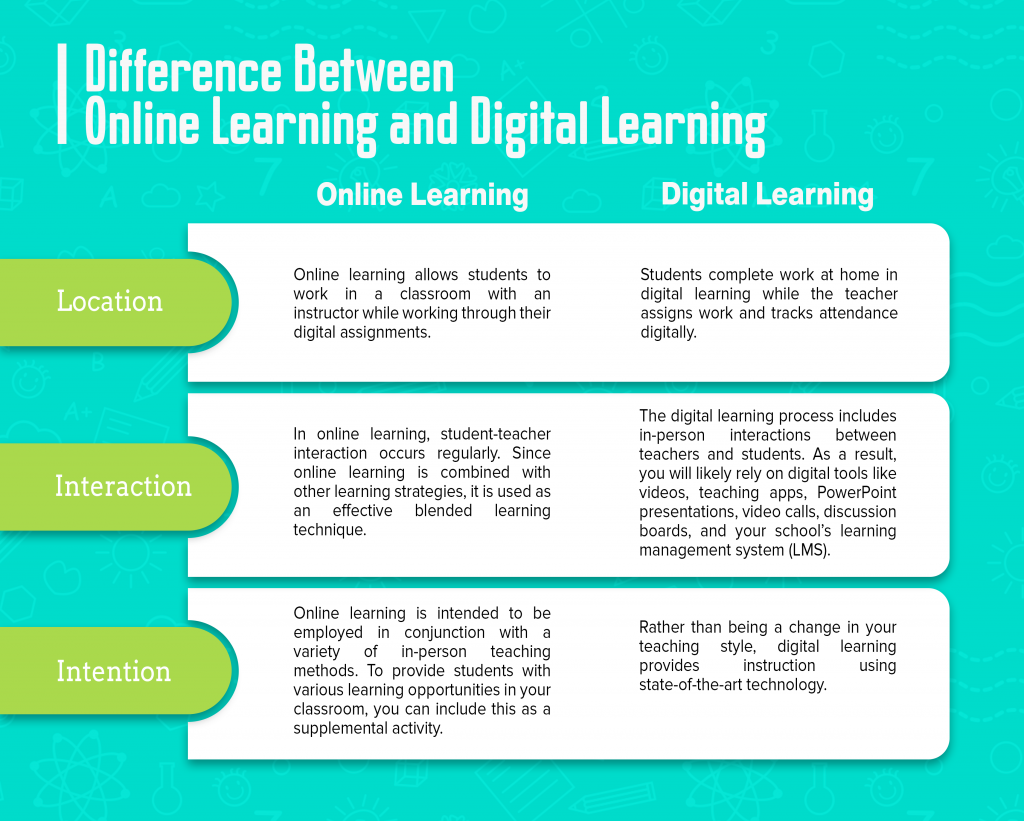
Difference Between Online Learning and Digital Learning
As a new social process, online learning is now replacing both distance learning and traditional face-to-face classes. With a digital learning approach, you are learning using technology such as a computer, mobile device, internet, etc., which can provide you with a wide range of solutions for enhancing your knowledge and performance in real life.
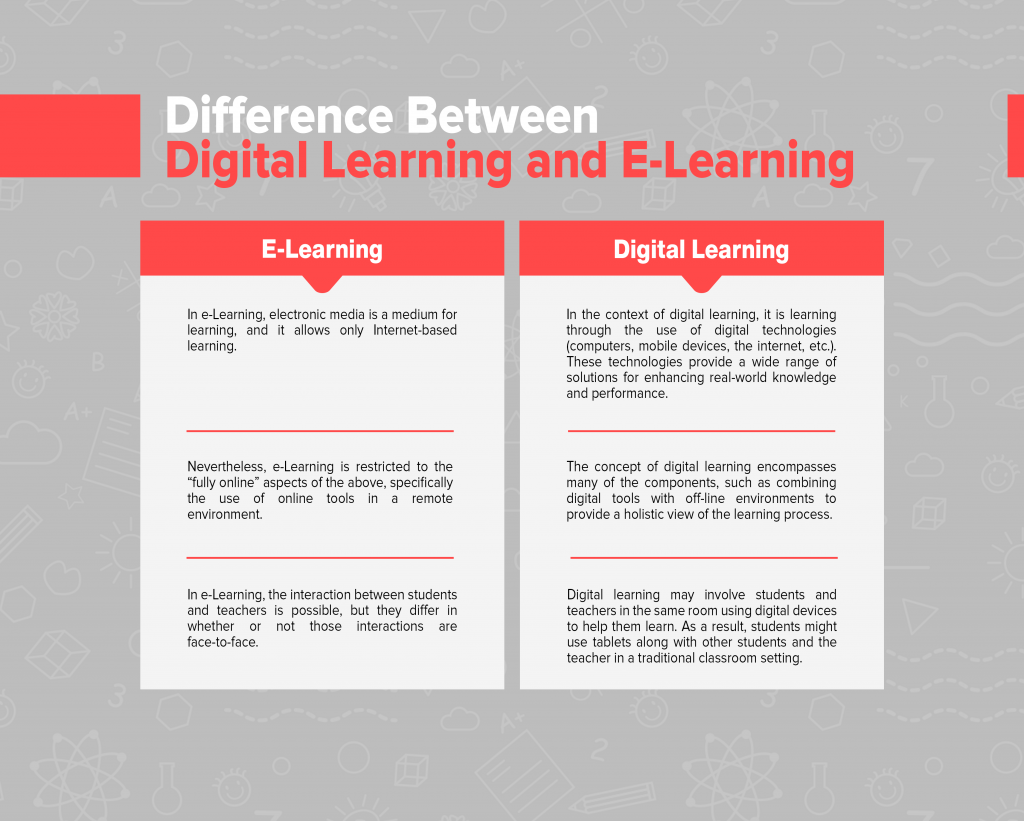
Difference Between Digital Learning and E-Learning
Despite sounding similar, there are subtle differences between them.
In recent years, education and the mediums of education have undergone a significant change. An individual can determine which educational method works best for him or her. Increasingly, students are becoming more independent and less hesitant to seek education on their own. Thanks to the internet and other modern advancements, students can receive education from anywhere in a variety of ways.
For more information on preparing for the LSAT, visit our blog.
Create. Engage. Inspire.
The post Digital Learning, E-Learning, Online Learning: What’s the Difference? appeared first on Test.Evelyn.
]]>The post Move Over Metaverse, Eduverse is Bringing About an Education Revolution appeared first on Test.Evelyn.
]]>What is Metaverse?
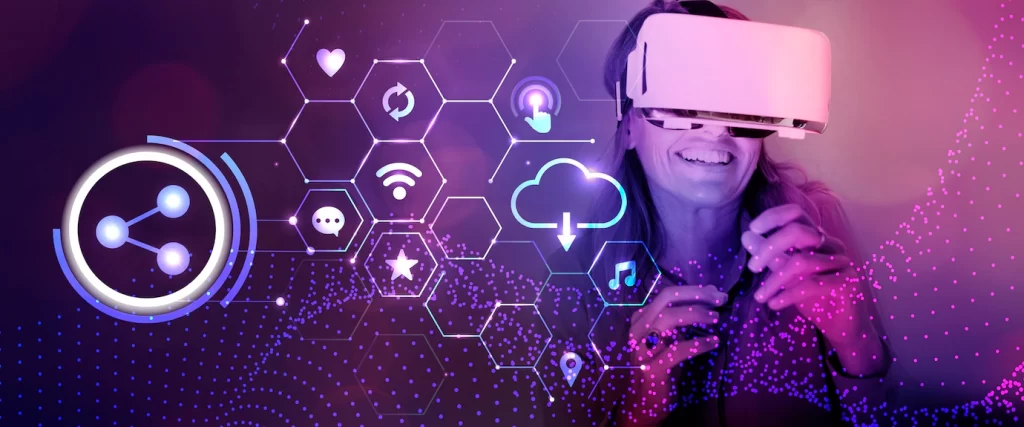
Metaverse is a concept of an alternate 3D reality that exists in a virtual world, one that can connect users across several aspects of lives and across multiple platforms. Driven through latest technologies like Artificial Intelligence, Augmented Reality, and Virtual Reality, users can access the virtual world through VR headsets or web browsers. Besides supporting gaming and social interaction, Metaverse is also expected to combine education, economies, digital identity, decentralized governance, and other applications, bringing multiple aspects of our lives together.
Why Do We Need Metaverse in the Education Sector?
All industries have been adversely affected by the Covid-19 pandemic. All organizations, including educational institutions, have turned to online communication. As online learning lacks collaboration and hands-on learning experiences, it may have a significant impact on students’ performance and motivation to study. However, metaverse allows students to immerse themselves entirely in the experience of a digital classroom environment. As a result, the students learn in an interactive environment and closely interact with instructors. Every activity, including classes, workshops, projects, experiments, and seminars, takes place in real-time, maximizing student involvement.
Using VR in education is an excellent way to deliver theoretical and practical knowledge. Through virtual reality, abstract problems are made tangible. It boosts students’ operational skills, offers an immersive learning experience, and promotes active class participation, thereby making learning more enjoyable and engaging.
How Will the Metaverse Change Online Education?
As the popularity of online learning increases, educators, instructors, and institutions are seeking correct ways to make it more engaging and interactive. Identifying how the four crucial aspects of the metaverse affect education is required to answer the central question about your priorities for this discussion. A brief description of the technological capabilities connected with every factor of the metaverse for education can give an impression of how the metaverse could impact education. Below is a brief impression of how the metaverse can assist education:
- Augmented Reality Uses in Education

AR technology makes it possible to create digital overlays over real-world objects that can create the illusion of three-dimensionality. With augmented reality in education, you can explore various educational applications of the metaverse. Using AR, for example, can help visualize invisible parts and solve problems rapidly.
- Lifelogging Uses in Education
With the help of lifelogging, one can record their daily life and thoughts productively. Most importantly, focusing on self-learning experiences can encourage the use of the metaverse in education. It is possible to review and reflect on the daily events in an individual’s life. Thus, the metaverse can serve as a valuable tool to represent and implement feedback and learning from life in the real world. Additionally, it offers the opportunity to analyze different types of information critically.
- Promoting Communication
Metaverse allows instructors to create rooms where they can organize internal meetings in order to counteract feelings and encourage interaction. Meanwhile, learners can construct study rooms where they can collaborate, study together, and socialize. All users can connect using their avatars, easily share files, interact with the same objects, or play games using the same avatar. Through these features, learners are encouraged to connect with classmates and instructors, which enhances the learning experience.
- Mirror World & Education

A mirror world is another crucial component for answering “How will the metaverse change education?” owing to the immersive nature of virtual learning spaces. Through the use of mirror worlds, education and learning would be able to overcome environmental limitations and physical limitations. For example, video conferencing tools can represent mirror worlds for performing online real-time classes.
- Virtual Reality in Education
When researching educational applications of the metaverse, you need to think about the educational implications of virtual reality. Using VR to simulate practical affirmations in digital environments can serve as a milestone in the advancement of the education industry. As an example, firefighting training can be expensive in the real world. Nonetheless, a virtual reality simulation of firefighting exercises could be a very cost-effective alternative.
Benefits of Using Metaverse in the Educational Field
Using the metaverse can transform the education sector and provide a host of benefits to students. Find out the topmost vital benefits of the metaverse in education:
- Interactive Curriculum & Practical Application of Concepts

Students having fun with VR headset at home – Virtual reality and metaverse gaming concept with people having fun on 3D videogames – Shape of technologic gears has been modified – Bright filter
Educators can offer an interactive curriculum that incorporates real-time experience by using metaverse. For example, normally, students can’t witness rocket launches or track satellite movements in space. In the metaverse, students can experience the launch room, minute-by-minute separation of each rocket stage, and the final orbit of the rocket. In addition, students can learn about the various stages of a rocket launch.
The use of technology like Eduverse in the classroom has proved beneficial to many students. Metaverse represents the next phase of this evolution. As a result, students will be able to learn concepts virtually in real-world situations and enjoy enhanced access. Besides, virtual reality/Metaverse can be used to teach practical tasks like performing advanced medical surgeries and carrying out astrophysics experiments.
- Gamification
It is possible to make learning fun with metaverse. When students are given an objective, learning automatically becomes more engaging. With gamification elements such as badges and quests, students can be encouraged to finish tasks, stay focused, and complete all their work.
As an example, students might find it beneficial to explore flora and fauna through a virtual rainforest. After the discovery of the fauna and flora in the rainforest, students can create their own forests by selecting avatars of the species discovered. This allows them to learn about the plants in greater detail.
- Enhanced Test Results
Despite the fact that metaverse facilitates students’ acquisition of knowledge and mastery of specific fields by involving them in interactive experiences, its true effectiveness can only be measured by the outcomes it produces. Students who get high grades can make this a convincing and easily acceptable argument to teachers, parents, and other members of the teaching fraternity.
It was determined through a study that immersive virtual reality learning was effective in improving test scores. Compared to the control groups, most students who participated in the VR program scored higher. In conclusion, immersive virtual reality learning has been established as a viable alternative for educational storytelling.
Regardless of how skeptical people may be, the metaverse is truly the next stage of the internet, and it has already arrived. The gaming industry has been there first in terms of exploring its capabilities. It will eventually find its way into other areas as well. As for eLearning, it will benefit significantly from the metaverse’s immersive capabilities, making virtual learning environments more lifelike and making learning itself more engaging and experiential. Through the Eduverse, students can experience the aspects of a metaverse in education with animation, storytelling, 3D design, etc. Most importantly, by using emerging technologies, EduVerse aims to tackle education industry challenges.
The post Move Over Metaverse, Eduverse is Bringing About an Education Revolution appeared first on Test.Evelyn.
]]>The post Singapore Edtech Startup ‘Geniebook’ Raises $16.6M in Series A Funding appeared first on Test.Evelyn.
]]>Founded in 2017 by professional educators, Alicia Cheong and Neo Zhizhong, Geniebook is an online learning platform for English, Maths, and Science (EMS) that is powered by a combination of machine learning and manual teachers. The platform is divided into three core areas that follow a Singapore-based curriculum. The first feature is GenieSmart which has AI-tech customized worksheets. The second feature is GenieClass which has live online classes that can host up to 900 students. And the third, GenieAsk is largely a doubt session where a teacher and teaching assistant takes up doubts and problems in batches of 50 students or so.
As per the founders, the platform has been exponentially profitable and its revenue has grown over 2,000% since the beginning of 2019. With a user base of around 150,000 students- the platform has over 350 tutors and employees from Singapore, Malaysia, Indonesia, and Vietnam. While most of the students are based in Singapore and Vietnam, Geniebook plans on starting to expand in other Southeast Asian countries with a part of its funding. But major parts of the fund will be used to continually innovate and better its existing products for its existing users.

This funding comes after more than 2 years of $1.1M pre-Series A funding that was led by multi-asset investment fund Apricot Capital. Aside from the venture capital firms, the private individuals who participated in the latest Series A funding are John Danner (Dunce Capital), Gaurav Munjal & Roman Saini (Unacademy), Kunal Bahl & Rohit Bansal (Snapdeal), Alvin Tse (Xiaomi), Linh Pham Giang (Hocmai). Since 2019, Geniebook has already expanded its team 5x and is at 350 employees today.
Picture Credits: Techcrunch
To read other interesting posts about technology, education, and research, visit our blog.
Create. Engage. Inspire
The post Singapore Edtech Startup ‘Geniebook’ Raises $16.6M in Series A Funding appeared first on Test.Evelyn.
]]>The post Doodling: An Innovative and Effective Way of Teaching appeared first on Test.Evelyn.
]]>It turns out that both pupils and teachers are unaware of the educational benefits that doodling can provide. It does not have to be a hindrance to learning.
Teachers and parents always view doodling as a frivolous activity that diverts attention from the learning process. Doodling, however, stimulates creativity, intellectual engagement, and attention retention in pupils. Continue reading to learn the role of doodling as an effective learning tool and how it can help you study more effectively.
Advantages of Doodling as an Effective Learning Tool
To begin with, doodling can keep the brain engaged when there is not enough stimulation to keep it interested. Consider doodling as a way to fill in the blanks in your stimulation. Yes, it could be a student’s approach of dealing with uninteresting material. However, it does not imply that the learner is tuning out. In fact, studies demonstrate that doodlers remember material better than non-doodlers.
However, there is another approach to use doodling as an effective learning tool to encourage children to become more active learners.
Educators can encourage pupils to doodle or sketch what they are learning
We already know that the more senses we use, the more we learn. For instance, if students are studying photosynthesis, they may take notes to keep the material verbal. They could, however, make diagrams of the procedure. This would aid their verbal and visual learning of the knowledge by allowing them to listen to what the teacher is saying and create drawings of the process. The drawing process would also aid in their assimilation of the knowledge, resulting in effective learning.
• Encourages the Use of Imagination
The very first benefit of using doodling as an effective learning tool is that it can help students who struggle with verbal reasoning and text-based classes come up with new ideas and kick-start the creative process. It is a low-risk practice that allows pupils to experiment with new material without having to worry about being judged or failing.
Doodling avoids the mistake of critiquing as you go, which every poet or writer knows is the easiest way to stifle the creative process. Students who doodle recruit deeper brain connections than those who only use words, resulting in a stronger bond with the content.
• Maintains Brain Activity
Even the best teachers will not be able to keep all of their students’ attention at all times. Individualized education has recently attracted a lot of attention since varied presentations appeal to various students. Doodling can keep the mind active and on task for kids who are not engaged by a lesson. It also allows doodlers to customize the session’s meaning.
When the student does not stimulate the brain enough, it creates its own content, diverting thoughts into fantasy. Doodling helps to keep the mind focused on the present moment and the activity at hand.
• Additional Senses are Recruited
Doodling counts as a visual learning tool, and educators have long recognized the benefits of multimodal learning. For instance, it can aid in the rapid and concise capture of extremely complex and subtle information. Drawing an animation of mitosis, for example, might be more beneficial to a biology student than reading about it for hours.
Similarly, studies demonstrate that the more senses used in learning, the better the concept is remembered. Doodling helps to engage the brain by activating the senses of sight and sound. Although doodling still has a negative reputation in schools, attitudes are changing. The scientific evidence in favor of doodling in the classroom is substantial. It has numerous benefits ranging from improved memory to increased attention span.
• Improves the Recollection of Memories
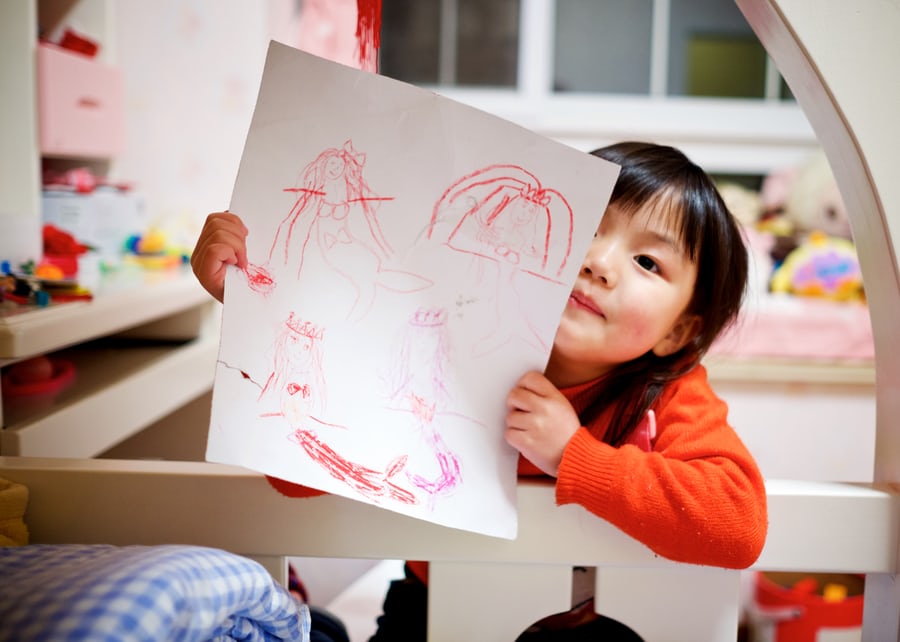
Numerous studies show that doodling boosts the memory of the subject a student is learning while drawing. This is an additional advantage of using doodling as an effective learning tool. The University of Plymouth, for instance, had participants listen to a long, tedious voicemail message detailing the names of those attending a party. On an unanticipated memory quiz, the group told to doodle while listening remembered 29 percent more than the group that merely listened.
Academic Benefits of Doodling
The investigation is not through yet. As per a Huffington Post article, Jackie Andrade, a psychology professor at Plymouth University who researched doodlers, “Doodling uses the brain’s executive resources – processes that help us strategize, multi-task, and focus.”
While we are listening to a lecture or are on the phone, using drawings to engage our executive resources ensures that they do not wander off to ponder about the shopping list or our plans for the weekend. Encouraging pupils to doodle while taking notes may really help them remember more.
Jesse Prinz, a philosophy professor at City University of New York Graduate Center who examined doodling in the context of art study, discovered that the technique is best suited for oral learning, according to the same article. Doodling, he claims, allows people to be in a condition of “pure listening.” That appears to be knowledge that teachers should be aware of and employ.
Concluding Remarks
You will discover a flood of diaries and sketch pads in your neighborhood gift or bookshop that promise to help stressed-out individuals reconnect with their creative side. People are more overwhelmed than ever before in the modern world. There is a wealth of information and opportunities available. This abundance, on the other hand, might contribute to tension and a lack of focus.
Doodling, according to research, can help us relax, process information, and solve problems creatively. Serious doodling affects your physical and neurological states in measurable ways.
This brings to mind a phrase from Pablo Picasso: “All children are artists. The issue is how to stay that way as we get older.” Doodling is one technique for everyone, whether or not they are artistically inclined, to stay visual thinkers. A blank sheet can act as an extension of the brain’s playing field. It allows people to rewrite and develop their creative ideas and thoughts.
Image Sources: Shutterstock and Unsplash
For more information on doodling as an effective learning tool, visit our blog.
Create. Engage. Inspire.
The post Doodling: An Innovative and Effective Way of Teaching appeared first on Test.Evelyn.
]]>The post Pedagogical Practices To Suit Various Learning Styles appeared first on Test.Evelyn.
]]>To Begin, what exactly are Learning Styles?
Almost all educators would be familiar with the concept that everyone has a preferred method of absorbing knowledge. Students will learn more easily if an educator teaches them in their chosen style. This concept has been around since the 1970s and well-intentioned teachers and dedicated students who want to learn effectively still carry it forward. It is no wonder that everyone wants to learn faster and more efficiently.
Unfortunately, there is no convincing proof that there are different learning styles.
In truth, the best evidence points in the opposite direction. The notion that people perform best when trained in a way that corresponds to their unique “learning style” — Auditory, Kinesthetic, Visual, or a combination of the three — is generally dismissed. According to multiple studies, learners do not profit from their own learning style. Teachers and students have different ideas about what learning styles work best for them, and we have no insight into how much we learn from various approaches.
The Myth of Learning Styles
Every student will differ in terms of skill, interest, and prior experience, but not in terms of learning styles. According to research, when people have a favorite style of presentation, it is typically for a task or topic in which they have a high level of talent and already feel good.
One may think they are an Auditory learner if they are good at music, or a Visual learner if they are creative. While one can prefer a certain method of learning, there is no proof that it can help them learn more effectively.
The myth of learning styles appears to be as widespread as ever. The learning styles paradigm can also be harmful to education in a variety of ways, according to various previous studies. Even though all students will profit from learning by multiple methods, educators expend time and money tailoring lessons to specific learning styles for different students. Even if it will not help them excel, students study in ways that correspond to their perceived learning style.
However, it is not obvious why educators want to believe in them. It is possible that the theory is heavily reinforced during teacher training; it is also possible that teachers are dealing with their students in the same way that their teachers interacted with them. Alternatively, it is possible that efforts to dispel the theory have become close to zero, struggling to reach educators.
Best Teaching Practices to Suit Various Learning Styles
Educators are well aware that no two students are alike, and that there is a wide range of learning styles. As a result, an educator’s teaching style may have a significant effect on a student’s ability to understand and comprehend. This is why teachers must be familiar with a variety of learning styles.
Is Shawn’s preferred method of learning pictures and graphics? It is possible that he is a Visual learner.
Is it true that Kevin learns best by attending seminars, asking questions, and engaging in group discussions? He may be an Auditory learner.
Is it more convenient for Jack and Katie to collect knowledge by reading, taking notes, and writing reports or essays? They may be Reading/Writing learners.
What about Joel, for instance? She is very hands-on and seems to love disassembling and reassembling items in order to learn by doing. It is possible she is a Kinesthetic learner.
That is one common breakdown of the learning styles continuum, but it is by no means the only one. Most teaching types fall into one of two categories: Teacher-Centered or Student-Centered. Here is a breakdown of the differences between teacher-centered and student-centered instruction:
• Teacher-Centered Approach:
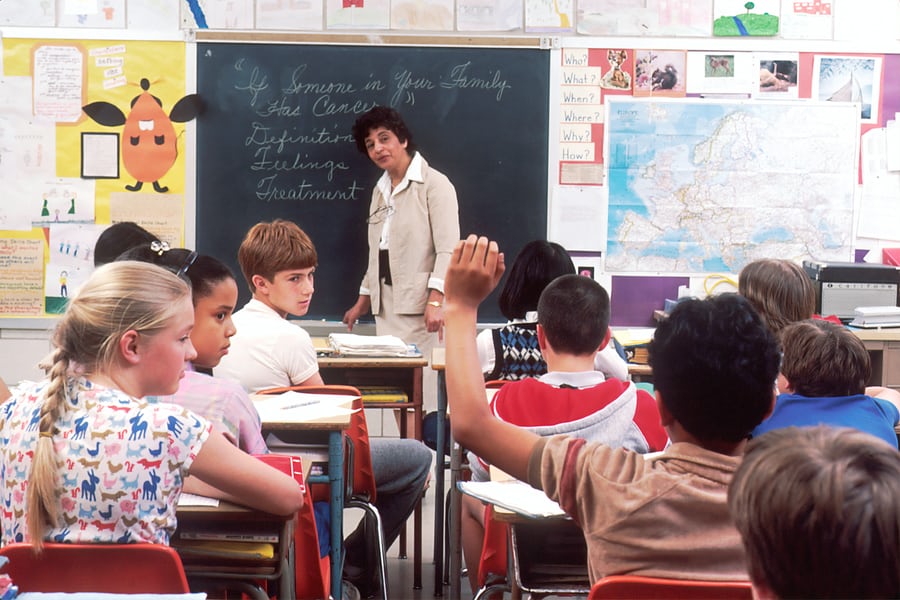
The Teacher-Centered approach to education is a teaching style that views the teacher as the authority in charge of imparting information to students through lectures or direct instruction. Students are passive actors or “empty vessels” in this approach (also known as “sage on the stage”). They listen and absorb information.
This Teacher-Centered approach to teaching is the most common, but it is not always the strongest. And, as educators learn more about how to involve students of all learning styles, the teacher-centered approach is becoming less common.
• Student-Centered Approach:
The Student-Centered approach is a teaching style that fosters greater harmony between the instructor and the student by allowing both to participate in the learning process. The instructor is often referred to as the “guide on the side” in this strategy.
While the teacher retains authority, he or she is more likely to serve as a facilitator, coaching and assisting students in their studies. This method promotes student autonomy while also allowing students to engage with one another. Under the student-centered approach to teaching, there are a few styles to consider:
• Approach Based on Inquisitiveness
Students lead the way and receive instruction from their teachers in this Student-Centered learning style. Moreover, this approach promotes flexibility, autonomy, and hands-on learning.
• Approach Based on Co-operation
Cooperative learning is a Student-Centered method of instruction that emphasizes group work and social development. The cooperative model, like the inquiry-based style, promotes individuality and hands-on learning, but places a premium on peer-to-peer collaboration and culture.
Many teaching resources categorize the best teaching styles into the five key categories mentioned below:
1) Authoritative or Lecturer Style
The Authoritative teaching style is based on the conventional Teacher-Centered approach. This includes lecture sessions and one-way presentations. Students are expected to pay attention, process information, take down notes, and ask questions in this approach (also known as the “chalk and chat” style).
2) Coach or Demonstrator Style
The Demonstrator style, which is common in math, science, and music, emphasizes “showing” rather than “telling,” with teachers more likely to back up their points with examples, tests, demos, or multimedia presentations.
3) Activity Style or Facilitator
The facilitator/teacher is focused on encouraging students to learn for themselves and assisting them in developing critical thinking and learning skills. It is a Student-Centered approach that entails designing learning plans. It includes classes that enable students to explore and discover course material in unique and innovative ways.
4) Group or Delegator Style
The Delegator style of teaching is well-suited for curricula that include or emphasize group activities, as it places much of the responsibility for learning on the students, who are motivated to collaborate on projects related to the lesson themes (think science labs, debates, etc.). The instructor is an involved spectator in this style, guiding students in the right direction.
5) Blended or Hybrid Style
The Hybrid approach combines elements of the above-mentioned models, often blending the teacher’s personality and interests with the students’. While this method is considered inclusive because it allows teachers to adapt their teaching styles to the needs of their students within the subject matter, some educators claim it risks diluting the learning process by putting less emphasis on in-depth research than a single, concentrated approach.
Final Thoughts
The aim of the discourse above is not to categorize the organic practice of classroom teaching into tidy categories. We do not wish to label educators as one “type” of teacher or another, but rather to investigate various methodologies in order to improve our collective understanding of the teaching experience.
It all comes down to getting to know the students and using the respective skills and intuition to figure out the best ways to involve individual students and whole classes with the curriculum. What works for one student or community may or may not work for another.
That is why, in order to be the most successful instructor possible, educators must have a clear understanding of the various student learning styles. They must have a solid grasp of the various teaching styles and strategies available.
Image Sources: Shutterstock and Unsplash
For more information on different teaching practices, visit our blog.
Create. Engage. Inspire.
The post Pedagogical Practices To Suit Various Learning Styles appeared first on Test.Evelyn.
]]>The post Formative Assessment Tools For Classroom Learning appeared first on Test.Evelyn.
]]>Features Of Good Formative Assessment Tools
The following features should be present in a good formative assessment tool:
- It should be goal-oriented and based on what we do daily. A good formative assessment is precise, tangible, and measurable since it is intended to assist students in performing well.
- Formative assessment tools need to concentrate on higher-order thinking abilities. We are not just concerned about the nuts and bolts but also need to know if the students are using the higher levels of resources to submit, analyze, evaluate, and develop.
- It should keep students responsible for their results. In and of itself, group evaluation is beneficial. Furthermore, pinpointing the specific needs of the person will provide you with direction in which to guide your teaching, ensuring that the students are successful.
- Good formative assessment tools should be smooth, and you should not have to alter your daily routine to accommodate the exam. Some formative assessment tools have a steep learning curve, while others are simple to understand even though you have no prior experience. You may need to incorporate formative evaluation into your lesson. Some of it can be done on the fly, but others will need planning.
Top Formative Assessment Tools For Classroom
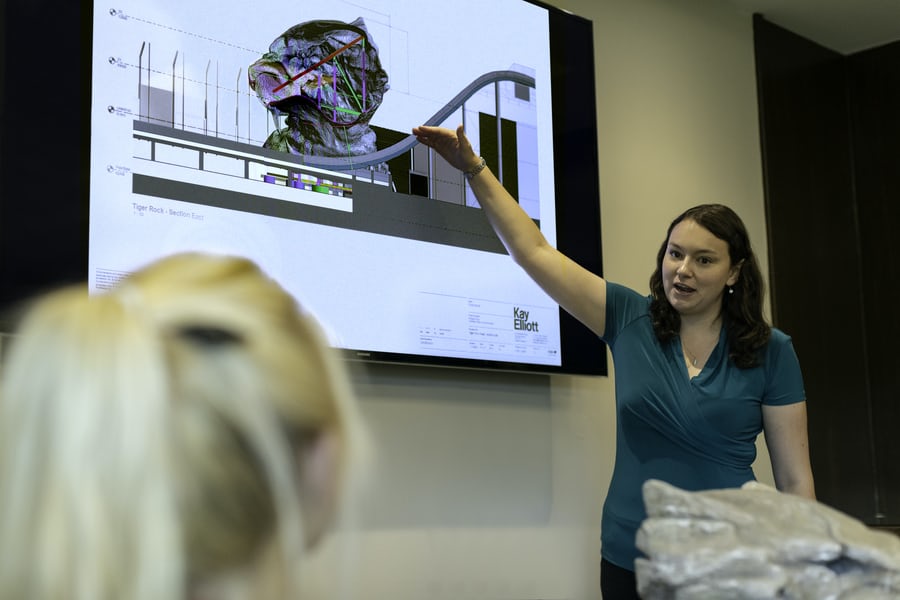
Students can be motivated to pursue learning goals as a regular and continuous part of their everyday routine using digital formative assessment tools. Here are five free formative assessment tools to assist you in integrating technology into your classroom. The list includes a wide range of features and alternatives to aid in the development of your formative assessment strategy.
1) Socrative:
Socrative offers real-time scoring on quizzes and questions. According to various online reviews from teachers and qualified reviewers alike, Socrative is one of the top-rated formative assessment tools for teachers. It is an immersive digital platform that allows you to quiz, score, and test on the fly; “learning at the speed of light.” Fast queries for immediate input, class counts to see who is logging in, and complete quizzes for deeper comprehension are all available to teachers.
Build surveys, activities, and shuffle questions with or without student names using this powerful method. Quizzes are graded in real-time and can be saved for later use for different classes. It operates on MS Windows, Android and iOS phones, tablets, laptops, and other computers. It is completely free for students, apart from being straightforward, adaptable, and aligned with Common Core.
2) Padlet:
Padlet is a virtual wall where students can share their thoughts on a given subject. You may embed audio and video in addition to written speech and have students answer in the form of a structured discussion. It is also possible to create separate Padlet for different classes or groups of students using password protection. For instance, using Padlet, you might have students identify keywords and address areas of agreement and disagreement with what their classmates have written.
3) Google Forms:
Google Forms is an easy-to-use, COPPA/FERPA-compliant tool. What is the best reason to use Google Forms as an educational formative assessment tool? The ease with which it can be used. Even if it is your first time using Google Forms, it is a favorite among teachers because it is fast and easy to build and automatically grade quizzes.
Make multiple-choice or short-answer quizzes with a simple answer key that includes point assignments for each problem. Students can quickly respond to questions by selecting an option from a drop-down menu, typing a quick text response, or uploading a short YouTube video to Google. For a fast bird’s-eye view of the class as a whole, teachers can view graphs and summaries of often missed responses.
4) Mentimeter:
Among evaluation instruments used in the classroom, professional reviewers and teachers give Mentimeter a high rating. It includes a listening skills assessment, icebreakers, formative tests, post-lecture surveys, and polls, as well as other educational models for the classroom. Create quizzes and assessments, monitor academic standards, engage students, and even lead a teacher training session.
Mentimeter not only gives everyone a voice but also has a handy feature that allows you to silence extra-loud students. It is completely free to use and allows you to build and host live quizzes using templates or from scratch. For a few dollars a month, schools and universities can get a Pro edition that includes unlimited question slides per presentation, exports, unlimited quizzes, and help. The user interface is easy on a 101 basis, with tech support available to smooth out the kinks.
5) Kahoot:
Kahoot‘s game-based approach to learning and evaluation is a hit with students. Teachers can select from over 40 million ready-to-use learning games or quickly build their own. Organize games in real-time or as tasks.
Students may also make their own “kahoots” to share with their peers, making the activity more social. In minutes, you can create a quiz game, import questions from spreadsheets, and check their 500-million question bank. Want to incorporate sketches from your iOS device or merge multiple mini-kahoots into a single assessment? That is something Kahoot can do, besides incorporating YouTube videos into your questions.
Teachers can apply multiple choice or true/false questions to the evaluation games, which students can schedule individually or in groups. The games are paced and graded, with the instructor establishing point scales. You can also download basic spreadsheet reports.
Concluding Remarks
In the physical classroom, it is simple to measure student success. We take for granted that paper assessments, quizzes, and spot questions are among the instruments used in the evaluation. For personalized virtual learning, the best online evaluation tools for teachers provide the same degree of input.
Formative assessment has the advantage of being completed when students are still learning. Formative evaluation methods that are fast and enjoyable are ideal for checking in on certain learning journeys. One final piece of advice is to choose one formative appraisal and personalize it. Do not attempt too many at once. Use one before the students have figured out how to do it and you have figured out how to interpret the data.
Read more about assessments on other blogs.
Image Sources: Shutterstock and Unsplash
For more information on formative assessment tools, visit our blog.

Create. Engage. Inspire.
The post Formative Assessment Tools For Classroom Learning appeared first on Test.Evelyn.
]]>The post Online Teaching V/S Traditional Teaching appeared first on Test.Evelyn.
]]>Online teaching for overall learning has become exceedingly common in recent years, with an increasing number of institutes and businesses offering it. Despite the prevalence of online education, a sizable portion of the population actively avoids it, mostly due to misunderstanding. The aim of the online education model is to solve the drawbacks of conventional education while also offering additional benefits. Students in a typical teaching model listen to long lectures, take notes, and memorize information by rote.
In the classroom, this leaves little to no space for constructive participation. On the other hand, online education promotes classroom engagement and peer-to-peer communication. Students can communicate with their courseware and acquire information in a far more engaging manner now that numerous types of online study tools are accessible.
While the current choices are limitless, let us face it: not all of them are appropriate for all students. As a result, in this article, we will compare the benefits and drawbacks of online and conventional teaching so that each of you can choose the choice that best suits your needs.
Benefits of Online Teaching For Overall Learning
- Lessons are usually taught in small groups and on an individual basis. This strategy, which is becoming increasingly popular, allows the teacher to learn about their students’ strengths and weaknesses in order to maximize class time. This is a means for students to establish their own learning pace and discover a safe area to connect with the instructor openly and freely.
- Distance education gives you the freedom to attend classes whenever and wherever you desire. The schedule is adaptable, allowing students to build a personalized study plan that meets their specific needs. There is no reason to sacrifice anything due to a lack of time.
- Online learning systems have a large range of courses to choose from. There is a course for everyone, from university to high school. Students can even earn a degree without ever visiting a university. Online teaching for overall learning also has a wide range of approaches to fulfill the demands of all types of students.
- In traditional education, every lesson requires the student to be present in the classroom. As a result, individuals must commute from one location to another, which takes time and money.
- There is no need to waste time commuting. Students can create a relaxing environment in their homes where they can concentrate. A classroom is no longer necessary. It is up to us to build the ideal environment for studying quietly and without distractions.
- The pedagogic resources for the lessons are accessible at any time and from any location. They can be accessed at any time, thanks to the digital format. These costs are eliminated with online education, and there is no need to waste resources.
Drawbacks Of Online Teaching
- It is insufficient to have a notebook and a pencil case on hand. A computer with a webcam, headphones (ideally), and a good internet connection are all students will need.
- In online teaching, there are more stimuli that can cause distractions: this can happen if the study location is inadequate. The student’s education is in his or her hands, thus it is critical to have a good area away from any potential distractions. The virtual environment is insufficient to keep the student’s entire concentration.
- Some students struggle to find time to study without a predefined schedule. Although self-discipline can be taught, some students are born with it. Online teaching for overall learning necessitates a compromise with the tasks.
- Not every subject can be taught online. A few subjects, primarily those requiring practice, are better learned in person. Nevertheless, there is a way to mix the two for the best outcome.
Online teaching for overall learning is a cost-effective and underappreciated option that allows students to study at their own speed. It also allows you to balance your studies and personal life. All of this comes from a single commodity: a house. Without sacrificing your education, you can learn while traveling throughout the world.
Furthermore, it saves you both time and money. There is no need to pay for transportation, the courses are generally more economical, and there are no geographical constraints.

Benefits Of Traditional Or Conventional Teaching
- Conventional education allows for group projects and student contact in general. As a result, they can learn from one another and share their problems and uncertainties. These social links can aid in the generation of new ideas and the stimulation of creativity.
- Traditional schooling can help students feel less lonely by instilling a sense of sociability and togetherness. The student may feel less alone in their academic struggles and may gain confidence as a result.
- Pupils who struggle with self-discipline appreciate a study plan that is both reliable and simple to follow. Traditional education requires students to attend class and study when necessary.
Drawbacks Of Traditional Or Conventional Teaching
- Traditional education’s pedagogical formats are more constrained. Pictures, movies, and forums are not always available 24 hours a day, seven days a week. This feature may impede learning and make it difficult to stick to a study schedule.
- There is no way to design a personal calendar that allows you to balance your education with your personal or professional life.
- It is difficult for a teacher to create a personalized study schedule that meets the needs of each student in the class.
- As previously said, commuting is an economic cost. Time is also a consideration if the classroom is a long distance away. You must decide whether or not the trip is worthwhile.
Traditional education dates back thousands of years. We do not advocate closing schools and colleges and simply providing online teaching for overall learning. The traditional technique provides advantages such as face-to-face connection, interpersonal skills development, and group learning, all of which are important abilities for a student’s overall growth.
However, it is impossible to deny that, when used properly, technology may play a significant role in education. Instead of substituting online education for traditional education, you can combine the two to provide a more effective, efficient, and engaging learning environment.
Parting Note
There is no right or wrong solution when it comes to online teaching for overall learning vs. traditional or conventional teaching. Much of it boils down to personal preference and understanding your preferred learning style. Regardless of your learning style or environment, any of these learning forms can be quite effective.
In the end, the decision is yours to make. It is critical to consider carefully what you require and desire from your schooling. Make a decision based on what is most essential to you.
Image Sources: Shutterstock and Unsplash
For more information on traditional and online teaching, visit our blog.
Create. Engage. Inspire.
The post Online Teaching V/S Traditional Teaching appeared first on Test.Evelyn.
]]>