The post Content Development for Test Prep | Test Prep Solutions appeared first on Test.Evelyn.
]]>What is Content Development for Test Prep?
The purpose of test preparation for exam preparation is to increase students’ performance on standardized tests by providing educational courses, tutoring services, educational materials, or learning tools. The design of tests is an important part of assessing students’ level of understanding and competency in applying what they have learned. A carefully designed test, whether it is low-stakes and frequent – a quiz – or high-stakes and infrequent – a midterm and a final – will increase the accuracy of results.
What to Consider in Developing Content for Test Prep?
Here are some key guidelines to help companies get started with the content development for test prep solutions:
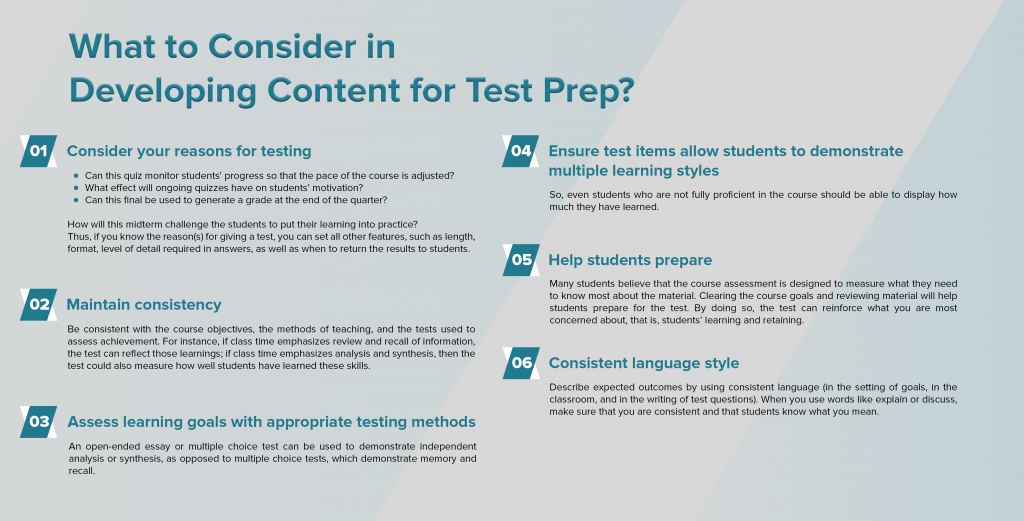
How to Develop Content for Test Prep?
- When are test prep exams appropriate?
- Whenever you are assessing students’ analytical, synthesizing, or evaluating skills
- If you have taught at this level (that is, college-level writing courses, undergraduate seminars, graduate courses), the content lends itself to critical analysis rather than simply recalling facts.
- What is the right way to design a test prep exam?
- Be specific.
- If you are expecting students to think critically, use terms that indicate your expectations; for instance, identify, compare, and critique.
- By using points (or time limits), estimate how much time and detail students ought to devote to each question.
- Practice taking the test yourself or have a colleague review the questions.
- What is the process of grading test prep exams?
- Determine the appropriate response to each question.
- Create a scoring guide that explains what you expect from each response and how much credit you will be giving each part.
- After reading through the responses to question 1, proceed to question 2, and so on. In this way, you will obtain a more comprehensive picture of how the class answered each question.
- What is the best way to help students succeed on test prep exams?
- Prepare study questions which ask students to think in the same way they will be tested.
- Explain how to approach a test prep exam using examples which you can use during the lecture or discussion.
- Include practice tests and sample questions.
- Demonstrate how to answer questions successfully.
- Assessing the test
Whatever type of test you use, you can evaluate its effectiveness by considering some of these questions:
- Are you testing for what you thought you were testing for?
In the event that you would like to find out whether students can apply concepts to new situations, but ask questions primarily to determine whether they can label parts or define terms, you would test recall rather than application.
- Are you testing everything that was being taught?
In some cases, your question may have served as a test of the students’ understanding of surface properties or procedures, when you had typically been lecturing on causation or relationships-not necessarily what the names of the bones of the foot are, but how they work together when we walk.
- Is everything emphasized in the course covered in the test prep?
Don’t forget to ask most of the questions about the material that you feel is the most important, particularly if they were emphasized in the course. It is best to avoid questions that are weighed the same as questions on crucial material.
- Was the material tested truly what students were supposed to know?
It might be better to use true-false and multiple-choice questions requiring inference rather than true-false questions requiring a non-inferential recall, particularly if you want students to use analytical skills such as recognizing patterns or drawing inferences.
As a result of this information, you may be able to identify areas in which students require additional focus. In addition, you may be able to evaluate the test itself: Are the questions framed clearly? Are the questions of an appropriate level of difficulty? For example, if scores are uniformly high, it is likely that you are doing everything right or have an unusually successful class.
The post Content Development for Test Prep | Test Prep Solutions appeared first on Test.Evelyn.
]]>The post Best Places to Find Textbook Solutions appeared first on Test.Evelyn.
]]>- The solutions are comprehensive and easy-to-understand solutions that leave no room for doubt.
- The solution eliminates unwanted double-checks and is error-free.
- Makes proper use of the latest technology and a range of software to deliver visually rich, ready-to-use textbook solutions.
Places to Find Textbook Solutions Online
Below are the top online textbook solutions providers as well as their features and USPs:
Solution Manuals
Solution manuals that are printed offer one significant advantage over the majority of digital alternatives. This is because they are written and published by the same professionals who are directly involved in writing textbooks. In addition, students seeking homework help might consider printed solution manuals as “safer” alternatives to any other solutions available for revision.
Is there a downside? Public access to solution manuals is not always possible since publishers usually release them only to schools, although the great news is that you can still find solution manuals online. All you need to know is where to look online.
Chegg Study
Chegg Study covers more than 9,000 books with more than 21 million textbook solutions. For subjects like science, math, and engineering, you can find detailed, step-by-step solutions by searching for your book by title or ISBN. Apart from that, Chegg Study lets you review solutions for five textbooks a month online or via Android and iOS apps. If you need additional help with your homework, you can also get up to 20 questions answered by experts every month.
Slader
Slader provides answers to nearly 3 million homework problems, covering subjects like math, science, social sciences, foreign languages, and literature. Aside from textbook solutions, Slader allows you to ask questions and get answers from subject experts – though there’s no guarantee you’ll receive a response. Although you can get access to many textbook solutions for free, you must subscribe to access unlimited expert-verified textbook solutions. Besides, subscribers can also download one-sheets, which provide comprehensive textbook solutions in one printable document.
Course Hero
Over 1,000 textbooks are covered by Course Hero, which has verified solutions for subjects such as biology, chemistry, physics, accounting, math, and psychology. Unlike other platforms, this one allows users to solve problems on their own before viewing solutions. As a result, you can extensively work through problems step-by-step and check your answers.
As you navigate through the solutions, you can find hints and videos that will help you learn. Moreover, students can submit study resources on Course Hero, including course notes, study guides, literature infographics, and tutor questions.
Bartleby
Schools often promote Barnes & Noble-owned Bartleby, another resource that lets you search for step-by-step answers by textbook, chapter, section, and question number. In addition to instant tutoring and writing help, Bartleby provides grammar and plagiarism checking tools, as well as formatting citations. Hence, the platform can surely assist students with clarifying any doubts and reaching their full learning potential.
OneClass
Over 3.7 million homework answers and many expert-led videos are available on OneClass. In fact, the platform makes it possible for students to collaborate and share their own lecture notes and study guides. More than 3 million students participate in this community-driven service to submit and rate textbook solutions. Additionally, it provides class notes, study guides, “booster” courses, and document tracking services.
Crazy For Study
In addition to providing step-by-step solutions, Crazy For Study claims to offer solutions for more than 50 million textbooks, including those in business, engineering, math, science, law, and social science. Moreover, CFS also offers 24/7 subject-expert homework help and essay writing services. According to its website, Crazy For Study offers a “best price guarantee,” but it doesn’t provide details. Nevertheless, it is one of the most affordable custom textbook solution platforms.
ScholarOn
On ScholarOn, you can find solutions for more than 300,000 textbook problems. The first three solutions are offered for free, so you can sample the material before you purchase. Besides textbook solutions, ScholarOn provides 24/7 live help with your homework, writing services, study documents, and flashcards. Moreover, a unique feature of ScholarOn is its pricing model, which offers one-day and three-day passes alongside monthly subscriptions and long-term memberships.
Today, you can find homework answers for specific textbooks by using book solution websites, apps, and manuals. Most provide step-by-step instructions so you can learn while you solve problems. While these resources can help students save time and improve their grades, they must not be abused.
A trusted textbook solutions platform can provide your educational institution and students with relevant content on time, at the right price, within budget, in both print and digital formats. All you need to do is search for your textbook with title, edition, author, or ISBN, and you will find reliable solutions.
The post Best Places to Find Textbook Solutions appeared first on Test.Evelyn.
]]>The post How Much Does It Cost To Create An Online Course In 2022? appeared first on Test.Evelyn.
]]>What Does the Cost to Create an Online Course Depend On?
Budgets cannot be calculated on the spot for an eLearning course. Developing an estimate for the costs of online courses is not an easy process as multiple factors affect the price. Hence, be prepared for some hefty prices if your course includes interactive elements, practical tasks, plus videos.

In contrast, if you decide to do most of the tasks yourself, you will save considerably on costs compared with outsourcing. In addition, you can save significantly using free online course creation tools. In most cases, these decisions will be based on your skillset, your budget, and the amount of time that you have available to you.
Components of an Online Course
In case you intend to develop the e-course, the following cost components need to be considered:
- Scenario
For motivational courses and training, a detailed script is essential. A complex subject can easily be explained, and learners can be engaged if storytelling techniques are used. A literal “scenario” is not necessary if all you need to do is, for example, inform companies’ sales reps about the release of a new product.
Instructional designers, who create training programs, usually create scenarios for courses in eLearning. The writers of e-courses are not only experienced screenwriters but also educated in pedagogy and the psychology of learning since the storyline should be both entertaining and educational.
How much does it cost?
It is reported that instructional designers earn an hourly rate starting at $50 on Upwork. With a simple plot and central character, a simple scenario can be written in 20 hours. So, the work is at least $1,000. It gets more expensive as the task becomes more challenging. Make sure to allow for extra time for editing and proofreading the text because when you see the first version of the scenario, you will likely have some ideas for improving it.
- Design Cost
Design elements that are often overlooked, such as the font or color scheme, contribute to supporting an idea. So, putting the design in the same category as pictures would be a mistake. It is possible to make your text easier to read, highlight the points to remember, and manipulate the learners’ attention, even if it is mostly text.
The design and illustrations for branded materials are usually expensive because such materials form the company’s image, such as onboarding courses. For example, Alpina Publisher designed The Young Alpinist Course, an intro course for new employees that includes information on the history of the company, its structure, published books, a detailed office guide, and a FAQ section – all beautifully crafted and interactive.
How much does it cost?
In general, freelance designers charge around $40 per hour. Besides, the design of a slide-based course on the brand book of a company might take about five hours, adding up to $200. Creating illustrations and drawing characters and locations, depending on the style of artwork you need, will increase the cost of the project. The cost may be as much as five times greater if you need to create illustrations. Typical charges for this type of online course creation begin at about $1,000.
- Course Development Cost
In general, instructional designers do not just send pictures to their clients; they create complete slide presentations. As part of this process, course developers must customize the navigation and add buttons, an interactive menu, as well as practical tasks such as quizzes, training games, and interactive simulations.
How much does it cost?
Normally, course developers are paid on an hourly basis, starting at $60. Within five hours, you can complete a course on your company’s product line and take a test including 20-25 questions.
For example, creating a business simulation that boosts working with software, dialogue simulations for learners to practice communication skills, or a serious game with multiple difficulty levels, characters, and rewards needs a lot more time and programming skills. It is possible for someone with this skill set to charge up to $80 an hour.
- Quality Assurance Cost
The final rehearsal before finalizing an online course creation is called quality assurance (QA). As an alternative to getting employees to start training right away, you test the course on a small group first. These employees will provide feedback, identify errors, and help to improve the course. In order to do so, participants complete a questionnaire that consists of five criteria:
- Suggestions for improvement: Is the course easy to understand? Does all the information make sense? Is there any additional information that should be included? Does it contain any typographical errors?
- Relevance of the course: What did students learn? Does the material apply to their everyday lives?
- Illustrations and photos: Are they able to understand the subject faster if they see illustrations and pictures?
- Structure: Is the information presented in a logical and consistent manner? Does it contain any errors or inaccuracies?
- Practical tasks: How realistic are the tasks? Can feedback be provided when simulating? Does any task seem difficult?
Final Cost Of The Online Course Creation
As a result, it is recommended to include this cost in your budget, not for the testing itself, since you don’t have to hire additional people for it. Instead, include this cost for processing the QA results and fixing bugs. Consider it like an insurance policy: you might not use it, but it’s essential to have.
If you intend to create your first online course, be clear about your goals, the potential audience, and the value it will bring. Most importantly, a good course without a good design can be a waste of time and resources. Developing an online course is a multi-step and complex process, so it is impossible to determine the cost in advance. Hence, the final cost of the online course creation is subject to several variables.
Image sources: Cost vector created by studiogstock at Freepik
The post How Much Does It Cost To Create An Online Course In 2022? appeared first on Test.Evelyn.
]]>The post E-Learning Video Solution Providers for Quality Video Content appeared first on Test.Evelyn.
]]>To get video based solutions, visit our page here.
What is Video-Based Learning?
Video Based solutions are the roadmap towards modern-day education. With the advancement of time and technology, the attention span of an average student is recorded to be rapidly decreasing. The solution to this is video based solutions which can not only improve the retention rate but can also make a particular topic interesting and fun to understand. With animated cartoons and engaging videos, students are more likely to be more attentive in their studies.
How to Ensure an Effective Video-Learning Solution? Step by Step Lessons Development
E-learning video service providers maintain a certain flow chart for the development of the lessons. With the help of these steps, they are catering to the very needs of the students. Here are the briefings of the steps of the process flow.
- Requirements are the key to starting. It is essentially what the students need. That is why assessing requirements is the first step to take.
- Identification is crucial. Why is that, though? Without that, the provider will not cater to the students’ needs in the long term. By identifying which are essential lessons, they can easily channelize the video.
- Assigning the SME is probably the most critical point because they are the video’s driving force anyway. With the help of an experienced SME, the video will capture attention.
- E-learning service providers now have to look for the video category. Then comes the documentation and scripting. Three of these are essential. First, every video is made for a purpose, and these steps will decide that purpose. It will also settle down the target audience of the video.
- Designing and developing alongside the screenplay is an essential step. Designing and development will give an edge to the video. A bright and precise screenplay will help the providers to engage the students for a long time.
- The shooting of the video is a great option and has a no-brainer. But, again, shooting with a quality crew and equipment is essential.
- Last but not least, QnA. Now there are debates over these issues of question and answers. But in the long run, it is important. Students will get the opportunity to interact with the teachers during this segment. That will allow them to find their doubts wash away.
How Did Video Solutions Help Model E-Learning?
In the modern world of technology, video solutions are the best way to move forward. E-learning is a platform where students can come and join instantly. Rather than providing them with text-based solutions, it is better to put up a video. The video solution revolutionized the modeled e-learning for the long term. It made it easy, simple, and authentic.
Factors to Effectuate the Learning Process with E-Learning
There are three crucial things to remember before implementing the video solutions. Firstly, are the students comfortable with it? If not, then it will be of no use. This is because the students need to learn and study simultaneously for their betterment. Secondly, the videos should not be heavy.
Now, what does that mean? That means that e-learning service providers need to produce videos that are not boring and fun to watch. Last but not least, the videos are well crafted. SME or the subject matters expert will have a huge role here. The videos should be well documented and engaging to watch.
Final Thought
So here we have listed the best practices and developments for good video solutions creation. You can use this as a checklist or integrate it in your video solutions creation services. In case you want video solutions for any curriculum, you can get in touch with us at info@evelynlearning.com or visit our page here.
The post E-Learning Video Solution Providers for Quality Video Content appeared first on Test.Evelyn.
]]>The post Content Editing: An Itemized Breakdown Of Its Meaning And Levels appeared first on Test.Evelyn.
]]>Editors oversee the final stage of the content creation process before it goes live. So, content editing transforms a piece of academic content writing into a compelling presentation, but where does one begin? Here is a step-by-step guide to content editing, encompassing its meaning and different levels.

What Is Content Editing?
Content editing is a component of the editing process that looks for persuasive, cohesive, and intelligible arguments in written content. The step examines misspellings, comma splices, and poor word choice, apart from other grammar faults. Poor material quality with typos and grammatical errors can erode any faith customers have in your brand. Hence, content editing is essential to the online publication process.
Keyword research and optimization employing structural features such as H2 and H3 headings are all part of high-quality content creation. So are internal links, and a variety of long-tail keywords. However, optimizing content is only the beginning. One should also ensure that the material is easy to read and understand, which is where content editing comes in.
Content Editing vs. Copy Editing
Here is a quick rundown of the distinctions between content and copy editing. Content editing ensures that writing is clear, concise, and effective. This entails examining the argument’s strength and logic, the quality of the sources or examples, the piece’s fit with your brand language, and the piece’s scope.
Copy editing, on the other hand, seeks for and corrects more minor errors. This includes double-checking spelling, grammar, punctuation, syntax, and compliance with style guides. Double-checking graphs, charts, and image placement, as well as proofreading the title, meta descriptions, and captions, are all examples.
Dos And Don’ts Of Content Editing
To become a successful content editor, one must first learn the rules of the game. In light of this, here are a few content editing dos and don’ts for modern creatives.
Dos Of Content Editing
Here are four effective editing tactics for content editing that editors can use to turn their drafts into memorable content.
• Understanding What They Are Up Against
Editors must first assess what they are editing before they begin. Is it a quick SEO post aimed at ranking for a specific keyword? Is it an infographic-enhanced long-form guide? Are they displaying confidential survey results? This will prepare them for what to expect and what to look out for. The word count must also be considered by editors. Content editing is more productive when the editor has a rough notion of what they are altering before they start.
• Making A Style Check
Moving on, editors must identify the client for whom they are editing. As a content editor, you may work with a variety of clients, ranging from lifestyle and wedding magazines to finance and insurance firms, each with their own distinct voice, branding, and style rules.
Some clients prefer the traditional approach, while others supply editors with their own set of rules. Editors must always set aside time to get into the zone for that particular client. If a client is new to the agency or to the editor, the editor will need to spend more time learning about their guidelines.
• Avoiding Cliches, Slang Or Clunky Prose
There will always be a statement that sounds cliched or does not resonate with the audience. This is where a content editor comes in helpful. They might see something that the writer missed since he or she is so close to the work. Editors choose what works and what does not at the first read.
• SEO Retouching
Search engine optimization is one of the last tasks in the proofreading and editing process. When editors develop material for their target audience that is useful, instructive, or entertaining, they want readers to be able to locate it on Google, Bing, or another search engine.
Editors must ensure that they have suitable header tags and that they are employing phrases that their target audience would use – keywords — in step. This is also a good moment to compose the title, URL slug, and metadata, which should include the terms and phrases that your target audience is likely to look for.
Don’ts Of Content Editing
Understanding what not to do is almost as important as learning what to do with online content. With that in mind, here are a few things to avoid in content editing at all costs.
• Using Software For Editing
Editing software, such as the built-in spell-check on an editor’s word processor, are all excellent tools for catching faults in a writer’s work. They should not, however, rely on them to correct all of their errors.
That is not to suggest editors should not utilize them; they are wonderful for saving time and catching errors as they happen so they do not have to correct them later. However, editors should be cautious about how much they rely on them.
• Inconsistency
Readers may not care how a writer refers to someone or something, but they will notice if the writer cannot decide whether to refer to someone or something one way or the other. An editor must always ensure that a piece of writing has one point of view and sticks to it throughout all of the information.
• Excessive Usage Of Pronouns
When writers start mixing and matching pronouns, the meanings are not always obvious, at least in print. Editors must be very careful to identify who or what a pronoun refers to, and to clarify if necessary. Better to have a name repeated twice in the same line than a reader puzzled about who is who.
• Sentences That Are Extremely Long And Wordy
It is possible that sentences with a lot of commas, semicolons, dashes, and conjunctions are excessively long. There is no key word count for what constitutes a run-on sentence, but editors must divide it up if they feel they have been in the same sentence for a long time or have just become lost. In order to connect the new sentences and guide readers from one notion to the next, they must utilize transitional words like hence, nevertheless, or furthermore.
• Assuming The Writer Is Correct At All Times
If copy editors see facts that do not seem quite right while copy editing other writers, they should investigate more. The information is usually correct, but even the most conscientious writers can lose attention for a moment and type something they did not plan to say. Rather than allowing a severe error to appear on the website, editors must send a quick email or leave a note in the copy for review, asking for clarification.
• Common Grammatical Errors
It is likely that a complete post could be written regarding typical use errors that editors can easily spot when modifying. Compliment or complement, effect or affect, and ensure or insure are only a few examples.
Levels of Content Editing
While no single “ideal” version of any piece of writing exists, there are numerous tactics and possibilities for refining a text. Knowing all the ways an editor can respond to a draft is beneficial, since a skilled editor will recognize all the possibilities of content editing–even if the author does not.

So, here is how an editor should determine what a piece of academic content writing requires:
Grammatical Edits (Level 1)
The author is comfortable with the material at this point and simply wants small and obvious faults in spelling, grammar, and punctuation corrected.
Fact Checking (Level 2)
This level of content editing encompasses Level 1 as well as difficulties of consistency and accuracy for some finer aspects. Is the use of numbers and abbreviations coherent, the wording acceptable for the audience, and the structural layout (headings, etc.) consistent and practical?
Stylistic Editing (Level 3)
The editor begins identifying the writer’s style at Level 3 of content editing. Wordiness, overuse of certain words or phrases, shortage of transitional phrases (which highlight the piece’s organizational structure), tone appropriateness, and even sentence rhythm (are all the sentences the same length?) are all examples of this.
If the article is to be published, the publisher may have its own “style manual” or intended style, which can influence sentence length, tone formality, and even grammar formality.
Structural Editing (Level 4)
At Level 4, the editor begins to think about the piece beyond the sentence level, which is a significant change. Internal paragraph structures (are ideas thoroughly and rationally explained?), paragraph organization (too many, too few, are transitions appropriately marked?), sequence of material, and type and structure of headings may all be addressed at this level. This includes how things look in the table of contents, if there is one. Nevertheless, the editor is still working with what is already on the page and does not address broader issues that require rewriting at this level.
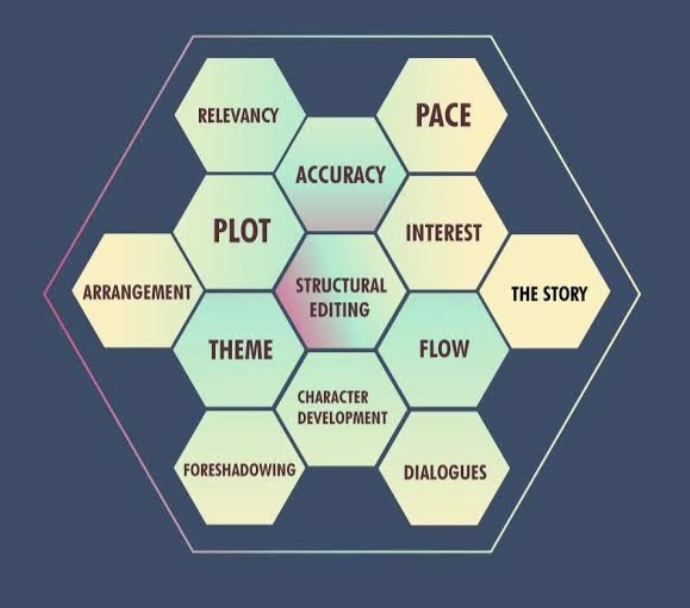
Substantive Editing (Level 5)
Level 5 talks about the context for a piece of academic content writing, rather than just dealing with what the author has provided on the page:
- Who is the intended audience?
- What is the piece’s point of view?
- When and where will the writer publish it?
- What does the author hope to achieve with the article (which may or may not be the obvious goal)?
At level 5, an editor can remark things regarding additional specifics, illustrations, examples or even incorrect writing approaches. The editor or author may need to undertake some minor rewriting. They could even add a bit of additional substance to what is currently there at this level.
Revision Editing (Level 6)
Since it makes no sense to edit or proofread until a new version is complete, other types of editing come to a halt when a piece requires revision. As an editor, one can prepare a list of questions to ask in response to a piece that needs to be revised, as well as a critique of what works and what does not in the piece as a whole.
The word “re-vision” means “re-seeing,” which implies the author must go back and evaluate decisions made in the first draft. It may necessitate redefining one’s audience or goal, altering the piece’s structure, or substantively rewriting the piece’s content.
Rewriting (Level 7)
An editor’s work at this stage moves from modifying what the author wrote to rewriting it for them. This could entail altering the writing style, tone, structure, or even a significant section of the content. It may be necessary to go back to the original source materials and perform new research. In any case, this is not an attempt to fix the author’s work, but rather a fresh start on it (or a section of it).
Final Proofreading (Level 8)
Proofreading is the process of checking the final draft of a piece of writing for grammar, spelling, punctuation, and formatting consistency and accuracy. Proofreading is the process of identifying little and big errors that were either overlooked or made during the editing process. At this point, editors must guarantee that the document’s final draft is free of grammatical, formatting, and typographical faults (e.g., subject–verb agreement issues, inappropriate word selections, improper punctuation, and erroneous spelling). They must also ensure that the article follows the style guide that has been chosen.
All in all, content editing is the process of going over a piece of online writing to make sure it is clear, succinct, and targeted to the reader’s needs. While this is all there is to it for now, Part-2 of this article will go over the steps of content editing. It will also introduce readers to some of the most effective content editing tools. This will help them turn their drafts into memorable and quality content.
Image Sources: Shutterstock and Unsplash
Also Read: Recent Trends In Educational Publishing
For more information on content editing, visit our blog.
Create. Engage. Inspire.
The post Content Editing: An Itemized Breakdown Of Its Meaning And Levels appeared first on Test.Evelyn.
]]>The post Recent Trends in Educational Publishing appeared first on Test.Evelyn.
]]>To this end, this piece aims to concentrate on some topics that are making the industry tick. They range from introducing new learning formats to the best techniques for promoting one’s teaching materials.
New Possibilities in the Digital Era
Publishing, like many other industries, has undergone various disturbing changes because of the digital revolution. Interestingly, many people have speculated that the book does not have a future at all, as the internet continues to conquer the planet.
Fortunately, the fear is absolutely unfounded. The publishing industry has transformed in the last decade, and the balance is moving toward digital goods in all aspects of life. Although it has not been easy, there have been tremendous opportunities for publishing houses that have helped them adapt and prosper.
Present State of Educational Publishing
To enumerate, reforms have been especially significant for educational publishers. It is unsurprising that printed information distribution is struggling to keep up, particularly as digital learning emerges as a strong contender. Obviously, certain ideas and theories are timeless, but education works best when it applies to current events. This has been more acute in recent years.

Significantly, changes in customer behavior and the increased incorporation of technology in the classroom (and at home) have resulted in new learning experiences. Although this provides publishers with a plethora of new opportunities, it also requires some significant adaptation.
Apparently, even though some have failed, there are many educational publishers that are eager to take advantage of the new opportunities presented by the digital era. What is clear is a desire to reconsider market strategies and concentrate on how to safeguard capital in the new reality.
Further, publishers have had to adapt in order to take advantage of the opportunities presented by an increasingly connected world. Businesses must be agile enough to consider and satisfy ever-changing consumer expectations. In the same vein, they must be able to deal with unexpected challenges when they arise in the new setting.
New Windows of Opportunity
It is essential to make learning enjoyable. Additionally, it should also be important to those that consume it, and failing to accept digital ways of functioning risks jeopardizing that importance, whether or not one likes it. Working solely on paper is, arguably, a thing of the past. Most learning materials will, in the not-too-distant future, subsequently have an online or digital portion.
As a result, educational publishers have increased their efforts to include high-quality instructional materials as downloadable software and web-based applications. These learning resources are available on tablets, handheld devices, and desktop computers. The learning experience will get enhanced by bringing education to life in fresh and exciting ways.
Consequently, students and educators now have instant access to immersive assessments, tasks and games. There is much more to this when combined with conventional curriculum-based teaching methods.
Tips to Write, Publish and Market Teaching Materials
Some teachers are now selling their lesson plans online for six figures. Nevertheless, when one has got papers to grade and benchmarks to follow, organizing, uploading, and promoting all of their teaching materials may seem like a lot of work. However, there are a few tricks to make the process go faster.
Foremost, most people concerned about how to publish and sell their teaching material have not even finished writing it. They stash away untold numbers of half-completed manuscripts in desk drawers. Anything else is a moot point before one has a well-written (and well-edited) copy in hand.
At any rate, one must keep their attention on the task at hand. With the publishing industry is changing at such a rapid pace, it is becoming easier to publish teaching materials with each year. Moreover, there is no need to worry about how to publish something that one has not even written yet.
How does one decide what to write about?
Generally, every teacher has an educational idea or viewpoint that they must share with the rest of the world. One should not be be afraid to believe in themselves! In fact, they should just write whatever is on their mind.
Worksheets, lesson plans, study guides, assignment cards, outlines, graphic organizers, posters, flashcards, bulletin board ideas, classroom forms, exams/quizzes, rubrics, learning kits, games, syllabi, e-books, and lecture presentations are among the various resources customers seek.
One can use an e-book or a full-fledged eLearning course to deliver their educational content. To this end, they must ensure that it is worth the users’ time to learn. Here are some pointers for creating successful content:
- The production of e-books must be in the same way as conventional books are: by gathering questions from the target customers and then delivering responses as e-books or online courses.
- Customer personas will help one find out what their customers really want, and then they can tailor their e-book content to meet their needs.
- One should make the content well-structured. For this purpose, they can organize it in a tidy manner.
Publishing the Teaching Materials
Individuals can now write and publish outstanding teaching materials without having to pay large fees to designers, editors, and publishers using platforms like Amazon’s Kindle, Apple’s iBookstore, or self-publishing sites like Lulu or Blurb. In addition, if one uses Amazon’s GoCreate website, they can get attractive print-on-demand copies of their book.
Making an informed decision about the publishing format
Educators will determine a lot by the publishing format they choose. What interactive features, for instance, will they try to include, as well as the types of annotations? They can choose from the following formats:
- HTML5
- PDF converted to Flash
- Interactive PDF
- XML version with a player
- ePub For Education
Techniques for sales and promotion
1. Decide on a price
Most teachers base their rates on the amount of time it took them to produce the resource and how often other teachers charge for similar materials.
2. Social media
Teachers Note-book, for instance, provides widgets for one’s blog or website and allows them to post to their Pinterest or Twitter boards. To advertise their materials, educators can make their own Twitter, Pinterest, or Facebook post. With this in mind, they can use one of the pages they built as a graphic to go along with a Facebook, Twitter, Instagram, or Pinterest post revealing that their resource is for sale once they have finished creating it.
It is important to have a strong landing page. Readers will only enter their email address to download an e-book if the landing page is interesting enough to pique their interest. Besides, it also aids in creating a strong email list that will pay off in the future.

Moreover, influencer marketing, when done correctly, is extremely effective. Educators can engage with relevant influencers who can help them sell more and work hard to get their content featured on their platforms.
3. Daily Promotions, Sales, And Giveaways
Educators may not want to have a sale until they have a few assets fully operational and have seen some cash flow. Once they do have the resources, they can follow this up by setting up a sale and hosting a giveaway. In the same vein, they can try bidding on a regular offer and engaging with members.
4. Collaboration with other educators
Why not spread the joy? Educators can join forces with someone whose tools they admire and agree to support each other’s work on their pages. This may be useful if one teaches a variety of topics, such as math and language arts.
5. Photographs of your lessons in motion
One can take pictures of students interacting with their materials and include them with their product if they want to stand apart. The beauty of these online markets is that other teachers can enjoy the added confidence that these resources, indeed, work.
6. Refurbishing materials responsibly
Educators must check with their school to see what the resource use protocol is. There could certainly be intellectual property rules they need to follow if they work at a school and use the resources they plan to sell in class.
The Future Of Educational Publishing
Without a doubt, digital publishing has transformed the face of modern education. However, where is this movement going? It has been on the rise recently, but who knows how long this period will last? If one believes and studies some of the most recent educational publishing surveys and figures, they will see that eLearning is here to stay.
In today’s world, one cannot overstate the value of educational publishing. Publishers profit from educational electronic book publishing in the following ways:
- Improve efficiency.
- Reduce the expenses.
- Bring the product concept to life, allowing them to take over the industry.
In sum, both students and teachers aspire to a method of learning that is not only fast but also successful. Not to mention the higher level of commitment, which is a requirement for most eLearning courses. Besides, the production of dynamic digital-learning tools presents a bigger opportunity for publishers.
On the whole, educational publishing can be a lucrative endeavor, especially now that most teachers and students recognize the value of digital material. As a publisher, what one needs is a coherent plan that will benefit them and help their bottom line.
Image Sources: Shutterstock and Unsplash
For more information on educational publishing and its recent trends, visit our blog.
Create. Engage. Inspire.
The post Recent Trends in Educational Publishing appeared first on Test.Evelyn.
]]>The post Avoiding Plagiarism In Academic Content appeared first on Test.Evelyn.
]]>Many copywriters are forced to write about subjects that have previously been explored on other websites. And, no matter how hard they try, coming up with a completely new story angle isn’t always easy. Generating plagiarism-free content becomes much more challenging in sectors where reputable sources are limited to a single hand.
Plagiarism is defined as the use of another person’s words or ideas without properly attributing the creator. Plagiarism can be intentional, such as when someone steals another’s work, but it is more commonly unintentional, such as when someone forgets something. When writing an academic paper, writers build on the work of others and gather information and evidence from a variety of sources. They must properly include these sources into their text to avoid plagiarism.
We’ll give you some content writing ideas as well as plagiarism tools in this article to assist you avoid plagiarism in academic content. They’ll help you write remarkable, plagiarism-free content that attracts high-quality traffic.
The Importance of Academic Integrity
Integrity entails believing in the community’s beliefs and standards and acting in accordance with them. A person with integrity is somebody who is genuine and sincere. An individual’s personal principles and ideals reflect their character and trustworthiness as a student. Maintaining academic integrity indicators when pursuing a degree at university indicates a student’s actual academic achievements.
Students with dignity will study and complete tasks diligently in order to acquire their degrees in a fair and honest manner. When a student purposefully cheats his or her way through university, the integrity of the degree and the individual’s morals are jeopardized. This lack of trustworthiness follows a student into the workplace and might have a negative impact on their career.

Key Reasons why Academic Integrity is Important
Academic integrity is essential for a variety of reasons.
- To begin with, academic integrity implies that others can put their faith in the writer. People who do business with such a person know they can count on them to be professional. Additionally, trust is one of the most critical characteristics of a great leader. Successful people are fully aware of the benefits of acting with integrity. Our ability to trust each other is the foundation of our entire environment. As a result, it’s critical to develop strong ethical practices.
- Second, academic integrity is essential since it adds worth to one’s diploma. Employers seek graduates with a high level of personal integrity. They would rather focus on developing the human capital of someone who will have a good impact on the firm and whom they can entrust with carrying out the company’s objective.
- Finally, academic integrity is crucial because it can provide an individual with peace of mind knowing that they believe in doing the right thing and that they constantly attempt to act in accordance with those convictions. Integrity can help one live a happier, healthier, and more productive life by reducing unnecessary stress.
Key Tips to Avoid Plagiarism in Academic Content
It might be difficult to preserve the uniqueness of information when writing, especially when the topic is unfamiliar to the writer. Maintaining uniqueness in their writing is a problem for every content writer. One thing a writer should know about Google is that it despises plagiarism. So, aside from everything else, if a writer wants their work of art to stand out and trend on Google, they must first focus on keeping it original.
To avoid plagiarism in academic content and develop good plagiarism-free material that attracts high-quality visitors, we’ll list out some content writing tactics as well as plagiarism tools below.
1. Start from Scratch
That is, after all, the way to go. A writer must always begin their piece of writing with their own unique ideas. That is when they’re no longer at risk of being accused of plagiarism. You are probably thinking how to come up with something unique on a topic you’ve never heard of before.
To avoid plagiarism in academic content, a writer should always begin by researching the issue thoroughly, gathering all necessary material, studying it thoroughly, and comprehending it completely. Following this, they will be able to compose it on their own. And, if the subject is relevant to a writer’s field of competence, they can rapidly lose their reputation as a profound and brilliant writer.

2. Evaluate the Context Properly
A writer must take the time to comprehend the concepts they will be discussing in their essay while conducting the study. Also, if they’re drawing inspiration from precise published resources, they must read them numerous times to grasp the primary ideas and concepts. They’ll gain a better understanding of the context and be able to come up with a fresh structure for the article or blog post this way. When a writer has clear concepts, their piece of content will be clear as well.
Even if a writer highlights and copies passages from other articles into their draft, none of these should appear in the final product. They must try to demonstrate the concepts, try to describe everything in their own words, using synonyms and even case studies and instances.
Instead of repeating facts and data from other articles, a simple approach to avoid plagiarism in academic content and add more value to the work is to hunt for current facts and data. Academic content should always be written from the writer’s own perspective. This way, they will still have an original article even if the material reflects the same thoughts as another website.
3. Make use of Synonyms
Although Google dislikes plagiarism, one must regard it as their best friend while writing original content. It aids a writer in a variety of ways. It is also one of the finest places to look for synonyms when writing. As a result, writers should make the most of Google to identify synonyms and incorporate them into their writing in order to avoid plagiarism in academic content. In the event that another choice is required, Microsoft Word can be used.
4. Learn when to quote and how to quote effectively.
When a writer can’t paraphrase, they must use quotation marks to reproduce the exact words from the respective source. It comes in handy when they need to rewrite someone else’s precise words to give their essay more weight. Copywriters should also acknowledge the source of any data, assertions, or facts used to support their work.
Using quotes and references to shield themselves and their webpage from plagiarism charges can be very successful. Filling the content with quotation marks, on the other hand, isn’t going to improve the SEO. So, to keep both the readers and the search engines interested, a writer must strike a balance between original content and quotes. As a general rule, a writer should resist using cited information that doesn’t add value to the issue or doesn’t provide enough context for readers to comprehend what they’ve just read.
5. Employ Plagiarism Checking Software
Only a writer understands the benefits of drawing inspiration from other articles. Many people even suffer as a result of doing so. They end up writing content that is plagiarized heavily.
So, what’s the best method to deal with this issue and avoid plagiarism in academic content? Plagiarism Detection Tools and Software. When a writer has taken ideas from other papers, using a plagiarism checker is the simplest way to ensure that their material is unique. Such a tool scans the material for duplicate content using powerful algorithms that compare it to search engine results, books, journal articles, and other online sources.
When a writer examines the content for plagiarism before publishing it on the internet, they are able to post fully original content. They escape search engine penalties, as well as litigation for copyright infringement and public shame, by doing so. The ability to examine the constructs and phrases that match what the other author wrote is one of the benefits of employing a plagiarism checker. It’s useful when a writer wants to create unique material because they don’t have to rewrite the complete post and can concentrate solely on the parts.
Best Plagiarism Checking Tools to Avoid Plagiarism in Academic Content
An allegation of plagiarism can do a huge amount of damage to a writer’s reputation and academic record. Even the implication of a charge can have a negative impact on one’s grades or career, so it’s critical to provide plagiarism-free content and assignments. While the majority of problems are inadvertent, inaccurate citations and quotes might be considered plagiarism.
A Plagiarism Checker is an internet program that can detect plagiarized or identical content in a document or a section of it. These programs look for duplicates of content or documents on the internet. Many of these programs let you check the URL of a website or add material from documents.

The top three Plagiarism Checkers are listed below, along with their most popular characteristics.
1. CopyScape
CopyScape is a cloud-based tool that allows you to look for plagiarism and other forms of content theft, making it very easy to avoid plagiarism in academic content. It is straightforward to use by simply typing the URL of the original material. It is one of the finest free plagiarism checkers that enables you to scan for web page copies indefinitely.
Characteristics:
- Batch search the content.
- It lets everyone compare two pieces of content side by side.
- This plagiarism checker has a private index that allows you to check for duplicates in the text.
- Allows for case administration and tracking.
- This plagiarism checker website allows one to filter out results from sites they’re already familiar with.
- It has a user-friendly interface.
2. Grammarly
Grammarly offers both premium and free plagiarism detection, in addition to the site’s well-known proofreading features. Anyone can use Grammarly to avoid plagiarism in academic content and to proofread their paper, docx Word file, or web page for free. This program can detect plagiarism on a variety of online pages. It allows one to determine whether or not their text contains duplicate content.
Characteristics:
- This program allows everyone to search the material in batches.
- When text aligns with online content or in the database, Grammarly generates plagiarism alerts.
- It detects plagiarism by comparing the text to more than eight billion web pages.
- It includes a variety of writing styles as well as grammar, vocabulary, and syntax tips.
- The Grammarly instant report will tell a writer how many content duplication concerns there are.
- The program also calculates a document’s total originality score.
3. ProWritingAid
ProWritingAid is a multipurpose tool comes with a couple extra functions that make it ideal for any type of writing and make it very easy to avoid plagiarism in academic content. While working in popular programs, writers can use this copyright checker to scan their work. Alternatively, they can just upload a file containing their writing. However, in order to conduct a plagiarism report on a piece of writing, writers will need to purchase credits.
Characteristics:
- It assists in self-editing.
- More than 20 in-depth writing reports are available from ProWritingAid.
- It works with Word, Chrome, Google Docs, Gmail, and other programs.
- The tool is simple to operate.
- Supports a large number of file types.
- It assists in locating facts, questions, ideas, phrasing, and other aspects of the work.
- ProWritingAid allows the writers to preserve control over their words.
Parting Note
Unintended plagiarism can happen to anybody, especially if they copy words and ideas from other authors without properly citing them, or when citing them incorrectly. A writer may not notice they’re duplicating someone else’s work since they read so much before writing.
That’s why, while gathering information, it’s best to jot down the sources so the writer can recall where they received their ideas. Any uncomfortable situations can be avoided by using a plagiarism checker. It can also help one modify the draft more quickly and make it more creative by highlighting the exact structures that need to be rephrased.
This may increase the editing time, but it’s worth it in the end if writers want to provide more value to their readers and increase their search engine ranking.
Image Sources: Shutterstock and Unsplash
For more information on avoiding plagiarism in academic content, visit our blog.
Create. Engage. Inspire.
The post Avoiding Plagiarism In Academic Content appeared first on Test.Evelyn.
]]>The post Best Practices for E-Learning Localization appeared first on Test.Evelyn.
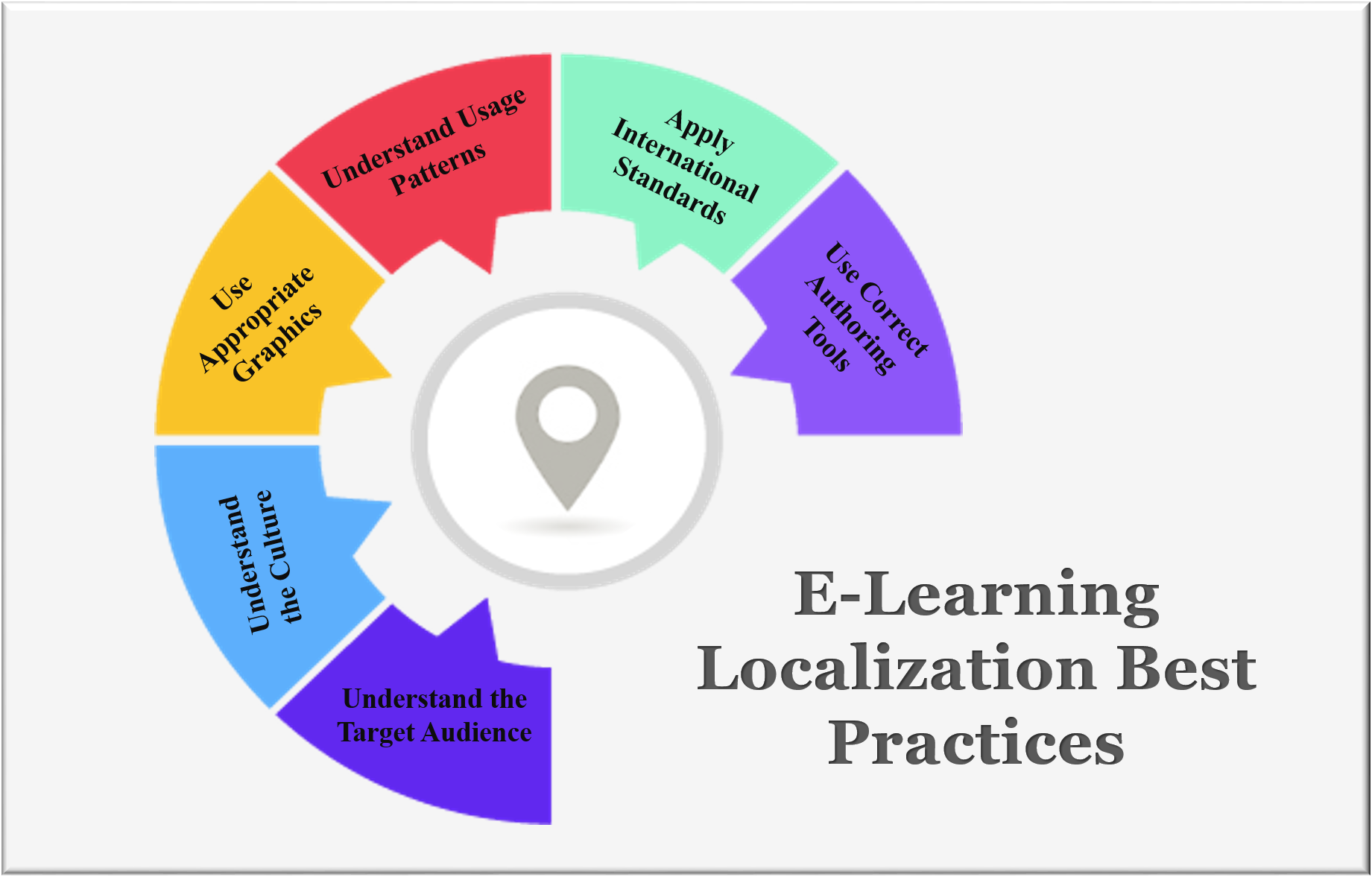
]]>a) Understanding the Target Audience
Understanding the target audience is the first and most important step in localization. An analysis of the audience based on their language, country, and culture helps identify the preferences of the learners around the world. This would give an e-learning course a wider scope in the international market. Moreover, it boosts the usability and growth of the course.
b) Understanding the Culture
Culture is the culmination of thoughts and beliefs of a community. It helps understand what shapes the people. Moreover, it is a way of identifying the needs and requirements of the community. Therefore, culture is important because it helps enhance the content of the course to promote better understanding and retention. Thus, localization provides a better learning experience with culturally enhanced content.
c) Use of Graphics
Graphics play a pivotal role when it comes to e-learning content. Graphic representations in the form of images and videos work to promote better understanding, as they allow the learners to relate the concepts with real-life situations. Learners associate the visuals with certain thoughts and beliefs. Also, images signify different meanings in different cultures. Thus, graphics must be carefully embedded in an e-learning course while localizing it.
d) Content Usage Pattern
Content usage pattern implies the format in which the learners are accustomed to learning. It includes layouts, fonts, visuals, etc. For instance, many countries follow a right-to-left text orientation. So, the learners belonging to those regions would prefer reading text in the same format. Similarly, the color preferences of people also differ in different regions. For instance, black color signifies mourning in some parts of the world, unlike other places. Similarly, yellow represents envy in Germany and happiness and good fortune in Egypt.
e) Apply Internationalization Standards
E-learning content designers should be well-informed about the international standards and adhere to them while designing a course. These standards mainly include the UI, the date format, and the currency display format. Poorly designed content may confuse the learners. Therefore, instructional designers must use the correct formats and user-friendly design to make an e-learning course easily accessible to the learners, thus promoting its use worldwide.
f) Using Correct Authoring Tools
Authoring tools determine the ease of usage of a document. They also make the content localization-friendly by providing options to change it into the desired format. For instance, Adobe Captivate allows instructional designers to create mobile-friendly e-learning courses in various formats.
Benefits of E-Learning Localization
The localization of e-learning content prepares it for global use. It provides both, the developers and the users, with many benefits. A localized e-learning course is cost-effective. The cost of setting up online training is comparatively less. Moreover, it eliminates the need to create separate content for different users as the core design of the course remains the same while localized elements are added to it.
Furthermore, a localized e-learning course gives consistent information to the global audience. Another benefit of e-learning localization is that it provides relatable content to the users, which increases understanding. Additionally, learning through a localized e-learning course promotes better retention.
Conclusion
With the ever-growing use of the Internet, e-learning has become a significant term. E-learning courses are being employed globally to learn various things. Thus, e-learning providers must focus on developing user-friendly courses that work for the users worldwide, irrespective of the language and culture they belong to.
As a result, e-Learning localization is an excellent way of promoting an e-learning course in the global market. Moreover, it has numerous benefits that work in favor of the developer as well as the user. Following the best practices mentioned above would render an excellent e-learning course that benefits one and all.
Websites used for research EI Design
Images from Shutterstock and Freepik
Visit our blog to learn more about e-learning localization.

Create. Engage. Inspire
The post Best Practices for E-Learning Localization appeared first on Test.Evelyn.
]]>The post E-Learning Localization appeared first on Test.Evelyn.
]]>What is E-Learning Localization?
E-Learning localization incorporates the process of converting an e-learning course into a different language so that it can cater to the learning needs of the masses. This implies that an e-learning course produced in any language can be translated into various target languages for global use. Therefore, translation is an essential part of e-learning localization.
Translation refers to the process of converting a text from its source language into a new language. For instance, a course available in English requires translation into French and Spanish, so, English is the source language of the text, and French and Spanish are the target languages.
Moreover, e-learning localization does not apply only to written text. Rather, it focuses on localizing all the elements. These elements include images, fonts, colors, audios, videos, case studies, etc. Additionally, localizing these elements of an e-learning course incorporates the cultural nuances of that specific region into the text. However, these elements do not require changes in every case and can be kept in their original form.
Localization vs Translation
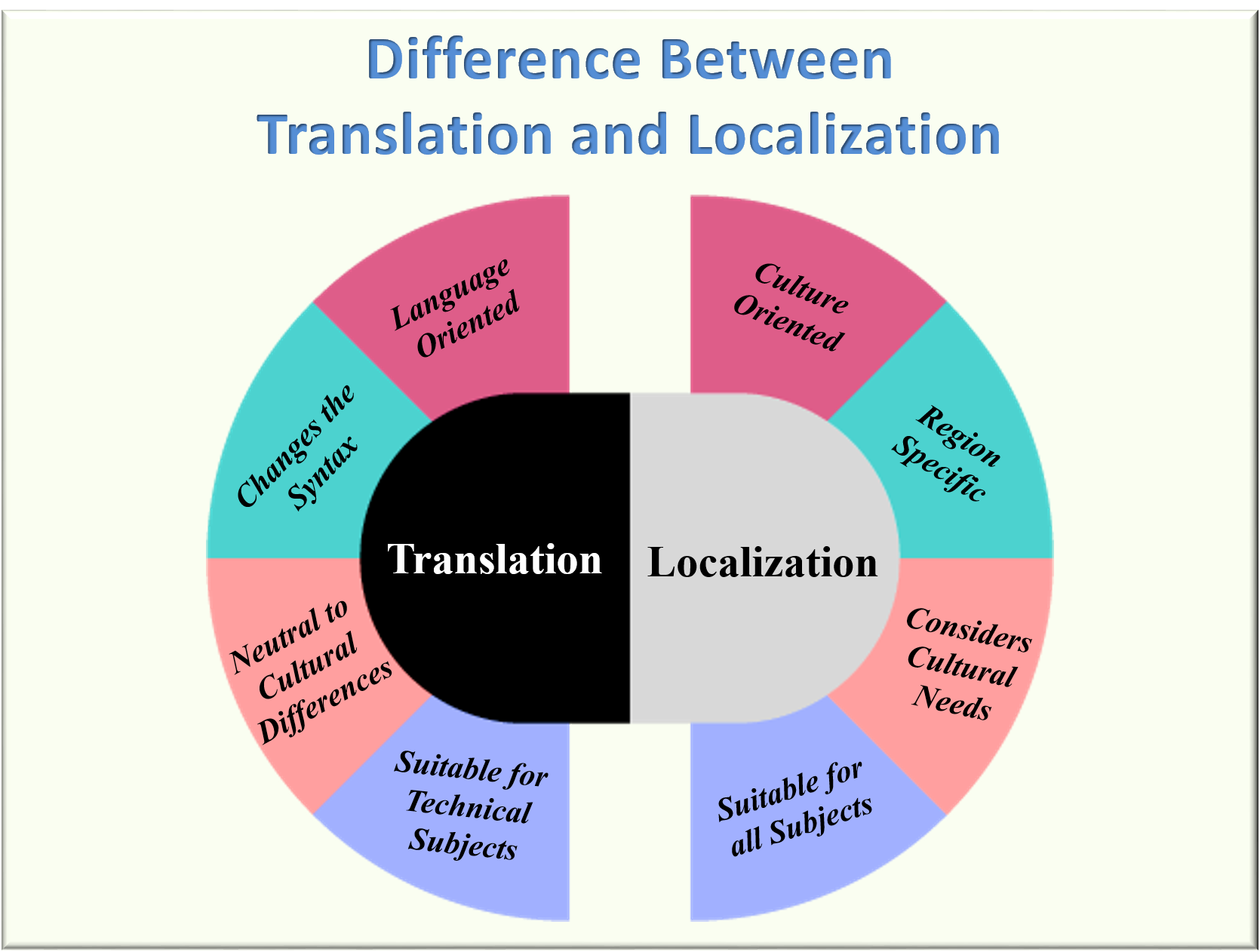
Language and culture are intertwined. Every language has a unique cultural identity associated with it. This cultural identity finds roots in the hearts of the people. Therefore, to sell a product, say an e-learning course, the content marketing strategy must include the use of local language and culture to establish a connection with the consumers. Incorporating the local language within the product through translation lays the foundation of localization.
Moreover, once an e-learning course steps into the global market, it is available to a larger audience belonging to various linguistic and cultural backgrounds. Merely translating the course cannot provide for the learning needs of a large proportion of learners. A course requires the addition of cultural elements as well to promote effective learning. Thus, a localized e-learning course gives learners the freedom to learn and understand the concepts by placing them in their own language and cultural contexts.
Additionally, localization encompasses translation and at the same time, addresses other aspects such as local idioms, local connotations of words and their cultural contexts, measurement units, date formats, page sizes, etc. Thus, localization is more than just translation.
Need for E-Learning Localization
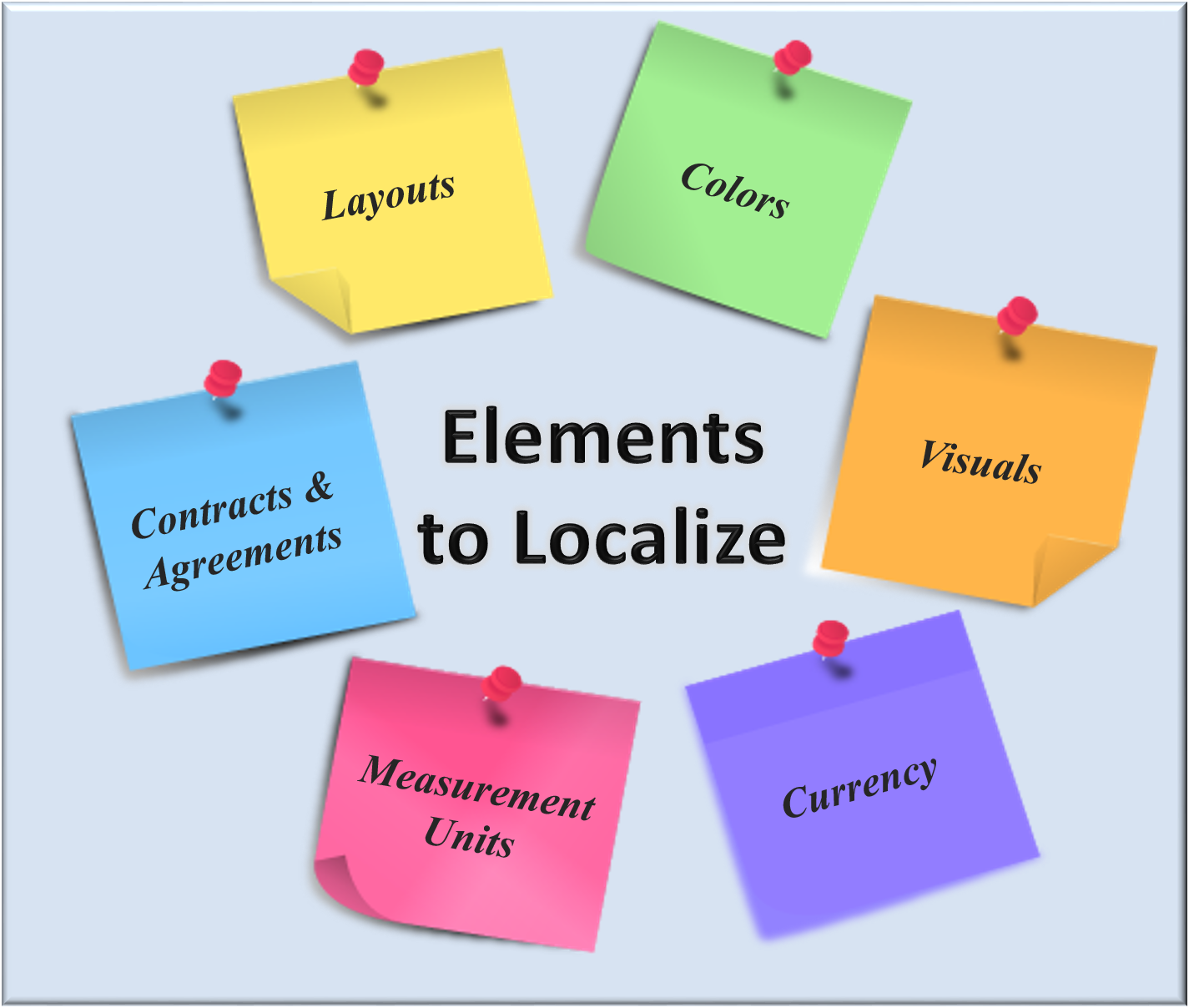
As it is clear by now that localization is a long process that includes translation as a small step, an important question that requires attention here is, ‘What needs to be localized in an e-learning course?’.
While localizing an e-learning course, the slightest details of the culture and language need recognition. Grammar and syntax are important, but so are the details that help break the barriers of language and culture to improve the usability of the e-learning course. Thus, cultural aspects play an equally important role in the complex process of localization along with the translation.
Besides translation, the elements that need to be localized include colors, layouts, visuals, measurement units, currency, contracts, and agreements, etc. Different colors signify a distinct meaning as we switch between places and cultures. Similarly, various languages require different layouts as they might have a different orientation. Also, the units of measurement and currency vary across borders and cannot be kept uniform for the global audience. The local laws of every region need to be considered while writing contracts and agreements.
Final Note
E-learning localization is a complex process that prepares an e-learning course for the global market. A localized e-learning course not only involves translation, buts also addresses the cultural aspects of the region it is localized for.
Moreover, a localized e-learning course works differently for different learners and is more effective than a non-localized one. This is because it creates familiarity between what the learner knows and what the course teaches by placing the concepts in their cultural contexts, promoting better understanding.
To know more about localization and its best practices, refer to the next blog in this series.
Further reading: Clear Words Translation
Images: Shutterstock and Freepik
Visit our blog for more information on Content localization.

Create. Engage. Inspire.
The post E-Learning Localization appeared first on Test.Evelyn.
]]>The post Localization: An Introduction appeared first on Test.Evelyn.
]]>A product or content that is globally available must connect with consumers to meet their demands. The best way to establish a relationship with consumers is to incorporate the use of their language and cultural aspects into the marketing strategy. This is what localization means. In other words,
‘Localization is a way of making a product or content available in different markets in their respective languages and cultural contexts.’
It is also referred to as L10N.
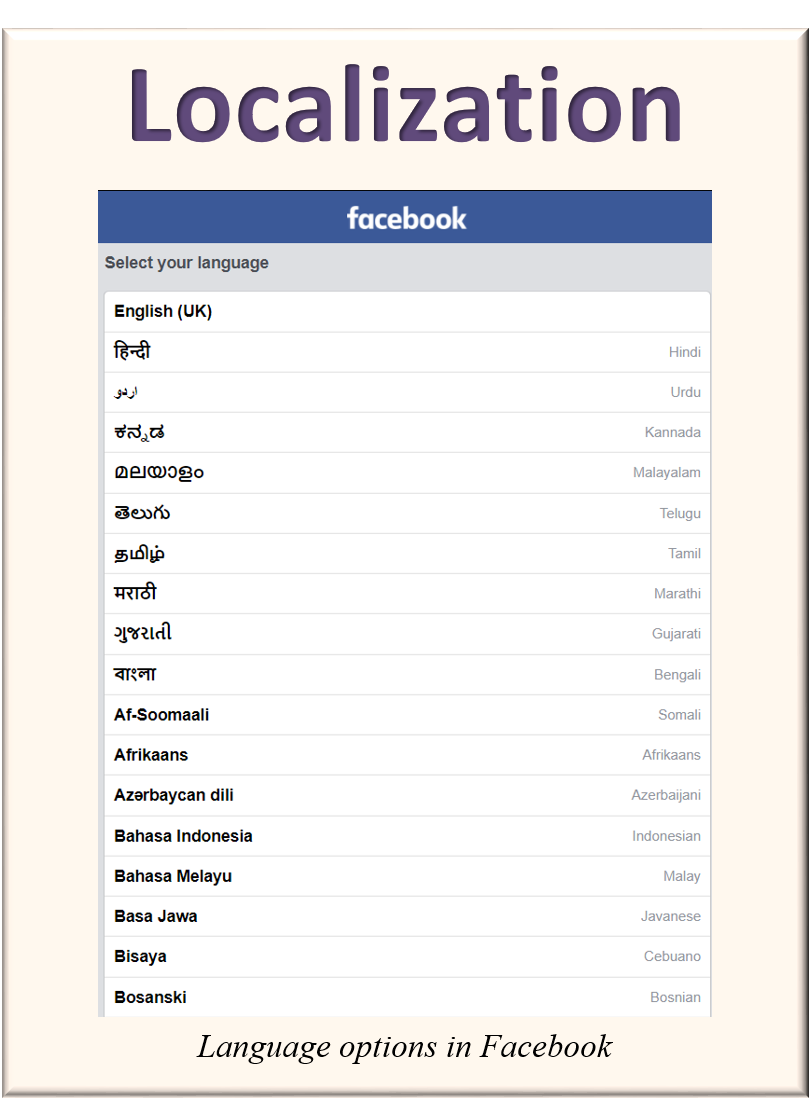
Localization is a part of the larger processes called Internationalization and Globalization. All these processes together aim at spreading the business across the world. Different languages are spoken in different parts of the world and thus having a uniform language would not work. Therefore, it is important to adopt a local language for every intended market. Translation plays an important role here. It is necessary to localize a product or service for each country to get more consumers, resulting in more profits. At the same time, it is also important to have a unique voice for the product/service. Altogether, localization is a cultural approach that not only involves translating but also reshaping a product/service so that it appeals to the local public.
Although translation seems to be an easy task, certain aspects call for special attention. While translating, it is necessary to address the cultural diversity of the region. Possibly, certain words/phrases with positive connotations in one culture might be derogatory for the other. Thus, a translator must be familiar with the local culture along with the language.
Translation as a part of the localization strategy boosts the growth of a business. Have a look at some instances of localization in practice.
Case Study
Coca-Cola
Coca-Cola, one of the oldest brands in the world maintains its brand’s voice with its signature colors. To expand its business, the company had to change its name in China as a part of the localization strategy. Thus, ‘Coca-Cola’ became ‘Kekou Kele’, literally, ‘delicious happiness’ as a part of the local marketing strategy to adopt local culture.
Facebook is the best example of website localization. Since 2008, it has come up with different language versions with the help of crowdsourcing. Despite being available in various languages, the overall user experience and brand remain uniform across cultures. Moreover, localization is not only visible in the text, but also in the date & time format on Facebook.
What is Internationalization?
To understand localization, there is a need to understand the concept of Internationalization as well because both these terms are often used interchangeably. Internationalization is a process of preparing a digital product/service for localization. It involves separating the content codes so that localization can be performed without hampering the inner workings of the product/service each time while translating. This takes place after a localized set of content is loaded in the software which translates and displays the content to the user in a local language.
Case Study
Coca-Cola
Let’s look at the internationalization of Coca-Cola to understand it.
Coca-Cola adopted a strategy of gradually investing in foreign markets and forming franchises in nations across the world. To begin with, it established trade with local brands and either acquired them completely through a partnership or merged with them later. As a result, Coca-Cola could peek into the local markets worldwide and figure out the taste and preferences of the local customers.
What is Globalization?
Another term often interchangeably used with localization is Globalization. Globalization refers to the process of integrating the culture and policies of a country to the rest of the world. It works to bring various people, economies, and cultures together. Moreover, it is an important factor that generates the need for localization.
Globalization is somewhat similar to Internationalization. Altogether, it is a strategy of expanding business across the national borders.
Case Study
Netflix
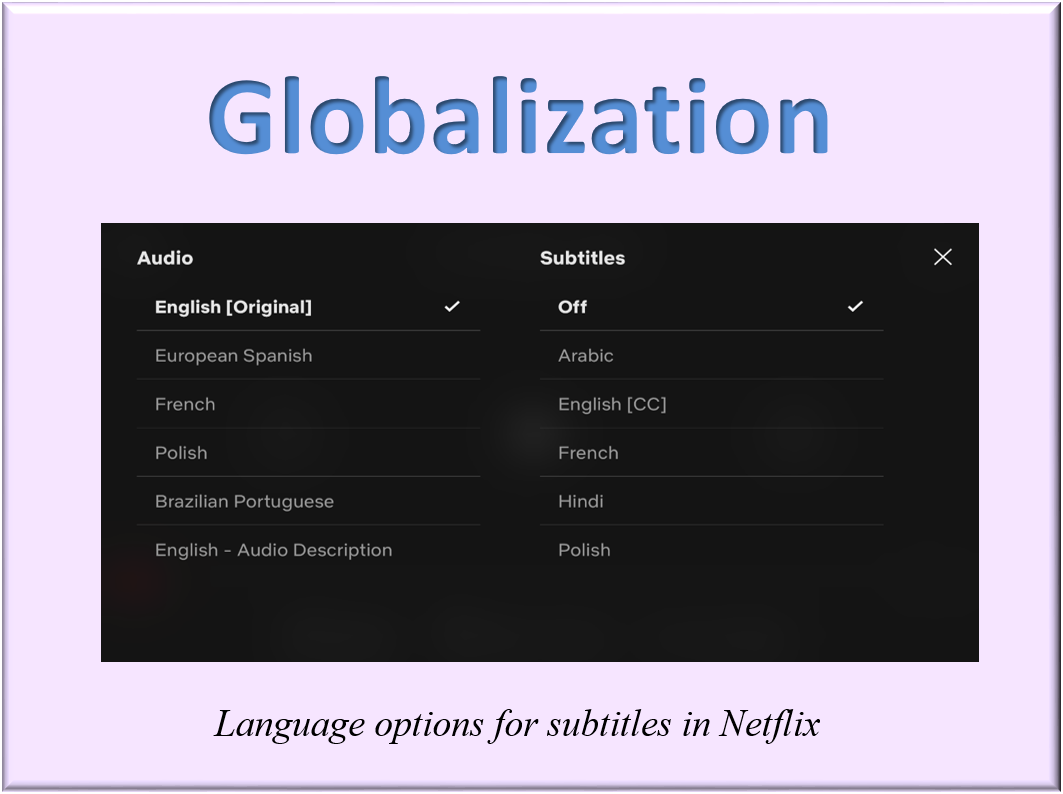
Netflix, the widely used video streaming app, has captured the global audience through a well-planned globalization strategy. It allows the users to view subtitles in the desired language or watch the dubbed versions of shows from all over the globe. At present, Netflix functions in over 190 countries with customized content offerings as per local languages and cultures.
Nike
Nike follows a globalization policy where it partners with various athletes who play a variety of sports and belong to different countries. Further, it uses these endorsements for expanding the business worldwide. A note-worthy factor here is that the logo of the brand, that is a ‘swoosh’, remains the same for every country. Consequently, the brand enjoys a global market and at the same time, maintains a unique identity.
Conclusion
Localization, Internationalization, and Globalization are three interchangeable yet slightly different terms. Moreover, all three concepts are inter-dependent and cannot exist individually in the global market. Any form of content/product that is to be internationalized or globalized needs a localization policy to meet the required marketing standards.
Moreover, localization plays a very role in creating value for the brand being promoted. It acts as an umbrella term that incorporates translation as one of the key elements. In conclusion, adopting the local language and cultural aspects increases the demand for a product/service in the market.
Follow our next blog in the series to know more about localization.
Websites used for research: Lionbridge and Technitrad
Images from Shutterstock
For more information, visit our blog.

Create. Engage. Inspire
The post Localization: An Introduction appeared first on Test.Evelyn.
]]>