The post Why Ed-Tech Industry appeared first on Test.Evelyn.
]]>According to Fortune Business Insights, the market size of global ed-tech and classrooms was valued at USD 88.82 billion in 2021 and is expected to increase to USD 319.65 billion by 2029. This growth forecast is exceptional.
Throughout the world, States and institutions are investing heavily in educational infrastructure to leverage the holistic potential of the sector. Technology advancement has eased education delivery, curriculum development, and assignment/homework management.
Distance learning has improved with technology integration and has helped students in remote areas to access course knowledge. Ed-tech is helping learners and educators consummate the real purpose of education.
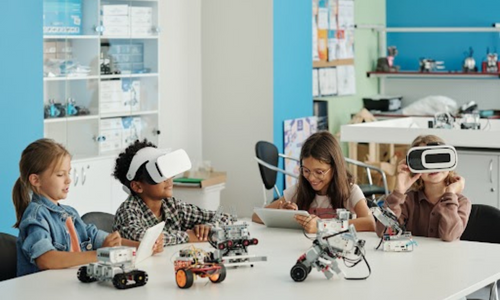
Today, with the inundation of ideas due to the increased usage of artificial intelligence in education, the ed-tech space will only advance. It will look forward to an improved learning experience where customized learning will break the gaps of teacher-student interaction, curriculum management will be an easy task and whatnot.
Education is one of the spaces where technology is vastly and amicably accepted and implemented.
With investors brewing their thoughts to invest in education, this industry is brimming to expand in a blink of an eye.
The post Why Ed-Tech Industry appeared first on Test.Evelyn.
]]>The post Administrators need to have a vision and understand its value in learning: Jaime Donally on AR/VR appeared first on Test.Evelyn.
]]>Jaime is an educational consultant and technology enthusiast. She started her professional journey as a Math teacher and soon moved to instructional consulting.
Jaime is the founder of ARVRinEdu and Global Maker Day. She is also a persuasive author who has written extensively about immersive technologies in her books: ‘The Immersive Classroom: Create Customized Learning Experiences with AR/VR’ and ‘Learning Transported’.
I had the honor of speaking with Jaime Donally in our series of ‘Ed-Insights by Evelyn’.
In this series, we have a brief interaction with leaders and experts from the Education industry to help us get a wide and assorted perspective on various themes.
Jaime Donally joined us to talk about AR/VR in Education.
Also read about Influencing the Future of Education with AR/VR
She enlightened us on how AR/VR can be evolutionary for education and how important and easy it is to incorporate immersive learning into our learning methods. Here is the brief of what she had to say:
How can we include AR/VR technology in education given the resourcefulness of the schools?
It depends on how you’re using it. I am an advocate of using the technology we already have in schools first and then identifying if there’s a need later to expand that. I think oftentimes people think they have to go out and have a big budget and buy these high-end devices when that’s not the best place to start. It would typically not give you the biggest bang for your buck.
In addition to that, I do agree with its equitable access. Many of our students struggle to have the latest and greatest device on a personal side, and certainly, our classrooms are even behind that.
A lot of the tools that I share are available on older devices, and on devices that are mobile. The problem that we run into in education is the school district having an access to those devices, their owning them, and protecting them.

But we can maximize the idea by using the tools that our students are already bringing into the classroom, and tools they are already familiar with. We can leverage the tools that students (some of them if not all of them) do have access to, like Chrome books, computers, or iPads. So there’s a way to be resourceful about it.
Who, according to you (teachers, parents, or students) are more inclined or reluctant to include AR/VR in learning styles and why?
Well, the older you are, the higher probability that you’re not going to be as gung-ho ready to jump in. I am in my forties and I can understand how it feels to learn something new.
I think some of the problems that our teachers or administrators face is understanding what they are accountable for. So, are they accountable for bringing AR/VR into their district? Unlikely! They need to really have a vision for bringing that and understand the value of it. They can analyze how it meets students’ needs, and what students are building or capable of building with technology tools and then have some win over it, believe in it and buy into it, and that is only where the conflict mostly arises.
You may also like Technology in Education: An overview
On the other hand, students are really drawn to immersive experiences. That’s just naturally part of what they’re experiencing right now, including their social media and how they’re using technology. We have to give students an opportunity to deeply engage with technology and keep their enthusiasm spot-on with the learning outcomes.
The parents’ reactions are mixed. Some are excited about how technology affects every aspect of our lifestyles. Others express concerns related to privacy and data usage and I completely agree with that. Parents and students should be mindful of what information we are giving, who owns that information, and how it would be used. But we are slowly heading in that direction, which protects our data and privacy for students.

Students are excited for technology but some parents carry concern for privacy as well
How do you evaluate if the use of technology (AR/VR) has actually helped in achieving learning outcomes for students?
When it comes to what tool is valuable and what isn’t, I really think it depends on what our goal is. So for example, my husband who is a science teacher told me about a student with autism. The student comes with a person to support him in the classroom.
One day, that person could not accompany the child, so the child was all over the place that day. My husband gave him the incentive to use merge cubes if he finished writing and then let him understand the science concepts through the use of merge experience on iPad and the student was blown away. He was completely involved.
What we can learn from this is that we need to have sustainable technology around that can transform how students are learning.
Watch the Full Interview
The post Administrators need to have a vision and understand its value in learning: Jaime Donally on AR/VR appeared first on Test.Evelyn.
]]>The post Censorship in Schools: Will They Hurt the Core Purpose of Learning? appeared first on Test.Evelyn.
]]>Similar situations may crop up soon if certain proposed bills become laws in multiple states in the USA. Recent stories talk about how the State governments want to ban certain words, topics, and books from being taught in schools. Some people in America are also terming this exercise to be anti-public education.
But is it an act of prudence to dictate what the children will learn in schools, or should the education department become an independent body without bias?
Censorship in Schools
Many state governments have seen a rise in the number of proposed bills restricting what can be taught in classrooms to children. Political interference is causing discomfort to many teachers. It is becoming one of the main reasons why teachers want to exit the profession.
PEN America, a non-profit organization, observed that in 2022, 36 States introduced around 137 bills that put restrictions on teaching themes, like sexuality, race, gender, or the history of the United States. Additionally, many books face bans and are out-shelved by the school and other libraries.
Texas, for instance, has banned more than 700 books from the libraries of public schools. Teachers and superintendents have been tasked with reviewing all the books to check if their content is censorship-worthy.
According to the report, many of these bills have the potential to become laws before the end of this year. In all, such statements, termed ‘censorship in education,’ have increased to 250% in the last year.
39% of the bills introduced in 2022, the report mentions, are focused on higher education and many of them also include punishments for violations. The similarity between these laws is that they come from Republican legislators.

Data: PEN America, Chart: K-12 Dive
Understanding the intent on the other end of the stick
In a diverse society like America, some people support moves like book bans and curriculum restrictions. In their view, discussing ideas like sexuality, and slavery in American history, can unpleasantly influence students.
This partially comes from parents’ concerns about school lessons as a part of SEL. It is one of the reasons why many parents are also switching to homeschooling.
Parents are concerned that teachers might be trying to influence their children and teaching them to follow the so-called ‘Un-American’ culture. In addition, parents worry when their children are encouraged to come out of the closet and accept their natural sexual orientations at a young age.
So, what can be done to counter this?
This negative perception can be avoided if parents are invited to understand what the curriculum is all about. Parents can be encouraged become active in learning their child’s syllabus and then choose if this is right for them or not. Schools should communicate healthily with parents and explain the curriculum’s intent and content. If something is found outrageous by a majority, it should be excluded.
Reactions from Americans
Since these censorship in education have come into the picture in the last year, surveys have been conducted to understand the citizen perspective.
A majority of parents supported the following topics to be taught in schools. For instance, 87 percent of parents support teaching the Civil Rights movement, 74 percent of parents support teaching the history of Slavery, and 59 percent of parents agree to teaching the concept of Systemic Racism in American institutions and society.
Student Mental Health
The students have suffered due to the Covid-19 pandemic, which has disrupted regular school life. Following this, the narrative around the teaching shortage emerged, which spoke of this phenomenon affecting the quality of education in schools. And now, we see public schools coming under the radar for teaching specific topics while omitting others. These educational hiccups can affect students’ learning interests and make them emotionally vulnerable.
Students need stability and discipline to learn. If teachers are constantly in fear that them saying something might turn into legal action against them, no actual teaching would be taking place.
Partial or Uneven Learning
Learning can be partial if students learn about one part of history and not the other part of it.

CAP Data: PEN America
It would be a rather peculiar scenario if parents have learned certain things about history and their children have learned completely different things about the past. Learning should be even and truthful. Suppose the government opposes the idea of teaching concepts like critical race theory to younger children. In that case, they should be allowed to learn this in higher classes when they start understanding the credos of a prosperous society.
Conclusion
It is never really possible to ban information, because even though books can be banned and teachers’ behavior can be controlled, there is a technology where only some things are filtered. Students can still learn from the internet, which by large, contains only some authentic and accurate information. Legitimate books can portray ideas in a more sophisticated and acceptable manner.
The post Censorship in Schools: Will They Hurt the Core Purpose of Learning? appeared first on Test.Evelyn.
]]>The post Influencing the Future of Education with AR/VR appeared first on Test.Evelyn.
]]>Likewise, teachers try hard to make their teaching lessons interactive, exciting, and engaging. The teachers do that so that they are well-received by their students.
Generation Y was easier. They have grown up seeing technology transitions. But, on the other hand, Generation Z has taken birth in the lap of technology, while generation alpha has been talking about technology since infancy!
This is the age of augmented reality and virtual reality. We are all over the notion of building a super Ed-Tech system that breaks the ordinary. Our parents learned from books, we learned from e-books, pdfs, and now kids learn from an environment that blends the virtual world with the real world.
What is Augmented Reality Vs. Virtual Reality
It is a phenomenon where the imagination or elements pop out to the real world and give a real-life experience to an individual.

Source: Google
Like a fish can be seen in a person’s garden through digital technology by overlaying the fish(digital world) onto the person’s garden(real world). Likewise, virtual reality can be experienced by putting a VR device on the eyes.

Virtual reality is the concept of incorporating oneself into a digital world. It is a virtual world far away from reality. Augmented reality is reality going one step further, while virtual reality is a step into a different world.
How AR/VR can affect Education
Research shows that the Ed-tech industry is growing annually by approximately 18%.
This means that people are thinking about education in ways that could only have been expected almost a decade ago.
Learning about the human body through an augmented human body structure that can be seen from all sides is way more interesting than learning from a 2-D image in a book. Every body part can be extracted, magnified, and understood precisely.
Students in a design class can see which decor piece can look good in a particular corner by superimposing different digital decor pieces in a real corner on a digital device.

Bringing computer-generated graphics into reality can give students a real yet highly immersive experience. In fact, it can break their effort to imagine how something would look.
Virtual reality can take learning to another level. It can prevent the effort to go anywhere and learn simply through an eye-wear device.
Virtual reality does not bring a fish out of the ocean into our garden like augmented reality. Instead, it takes the person into the sea to see all the fish.
You may also like Virtual Reality Widening the Scope of Education
The extent of technology can go so far; we could only imagine it as kids. AR/VR can help students in a small town see the world virtually without going anywhere.
Why AR/VR is the answer to teaching the Next-Gen
Attention span is already compromised. Students can focus less on the text and carry shorter spans on visuals. AR/VR makes learning more colorful and closer to reality. Students like to learn through experiences rather than memorization.
Also Read How to Make Content for Students with Short Attention Spans
They would love to see how a man used to walk in the early days and write perfect answers on tests. On the other hand, they would detest learning how an early man looked and then describing it in detail.
Visual memory is considered better and longer than verbal memory. So, for the students, especially the Gen alpha, AR/VR is one of the best ways to teach.
Tools for students to incorporate AR/VR in their learning
Students can choose from various tools from the digital libraries that can help them get an immersive experience in education.
Apps like Quiver help students color objects and see object animation. Tools like Arloon Chemistry help to arrange and rearrange the molecules to understand chemical reactions and formulae.
Certain apps can induce an augmented reality experience for students, like the Blippar app. This app allows students to bring an object in a picture alive digitally.
Medical students can benefit from HoloAnatomy, the application that helps to learn medical circumstances through AR simulation. It allows the students to understand the human body in depth with the visual experience.
Investment in AR/VR
There are specific free tools that students can conveniently use in their classes. However, some devices come with costs, and every student might be unable to afford these apps. However, a school might be able to invest in some of these AR applications, which enhance the learning and teaching experience. Schools can think of this as an investment. A teacher’s job would become less complicated as it would become more accessible for teachers to explain concepts to students and have all their attention.
It would only come to reason when the school districts and the administration care to unleash the power of technology and make it accessible to students to improve teaching methods.
The post Influencing the Future of Education with AR/VR appeared first on Test.Evelyn.
]]>The post How to Make Content for Students with Short Attention Spans appeared first on Test.Evelyn.
]]>The user swiped up and nothing mattered.
Everyone is vying for the attention of that consumer, whose attention span is considered to be less than that of even a goldfish. We are all in this together. But the concern of lack of attention is more bothersome for kids than for adults in the workforce. Children are in their learning stage and focus, undistracted attention ought to be their thing! Isn’t it?
If we let parents answer this question, they would say, yes, students need to increase their attention spans, because that would help them learn and memorize.
But if we let technology answer this question, it would say, let’s make content that suits the attention span of the child. And we couldn’t agree more.
Why the Attention Span is Decreasing
The latest knowledge tells that the attention span of people has come down to 8 seconds. We live in an era where the trends are fads and news is brief. So how do we expect the younger generation, those who are born in the lap of technology, to learn from long, video-based, mundane educational content?
Ways of entertainment and engagement have changed. The short videos of Tik Tok, the reels of Instagram, and the stories on Facebook have raised different expectations from the current generation. They prefer everything in brevity. I believe we all do too!
Social media content has undergone incredible evolution and has changed the way the consumers absorb content. This Deloitte study found out how millennials and Gen Z are more involved in online content and may even be influencing the way the content is delivered.

It is basically not just because of these videos or apps. People have developed a certain tech-lifestyle where people tend to focus less on information which hardly holds any relevance for them.
Online Content and Education
Ed-tech companies have tried to bring in newer and better ways of keeping the student engaged with their websites or apps. Myriad Ed-tech companies saw a colossal rise during the pandemic and many others were born since then. But we also know that e-Learning companies have faced losses since the reopening of the schools in 2022 and the pandemic withdrawal.
During the pandemic, students were compelled to go online. Now they have grown tired of the online learning content, most of which owes to the bad quality of the content or poor app/website services and features.
How to Create Content for Students with Short Attention Span
Students are required to study and they have plenty of choices online. They would want to choose a service that gives them not only a good learning experience but also one that is interesting.
So, what can these Ed-tech companies do to make students more interested in learning?
How can these companies cater to their brief attention? Here are some ways:
Create Short Learning Videos
There are many platforms that create short videos for the purpose of learning. EdTech companies can take a cue from such videos and include them in their educational content. Websites like Socratica or The kids should see this, make excellent content to inspire a curious young mind on various topics.
Short videos are trendy, engaging and easy to consume information from. This is why the short videos on various social media platforms became a viral trend and are running to date.
Go for Educational Podcasts
If screen fatigue is an issue, one can switch to listening tools. A study by the American Psychological Association tells how technology contributes to stress, blood pressure, and other physical problems.

Students use their screens for most of their work and entertainment and multitask all the time. This can also be one of the causes of decreasing attention spans. So, one can go the way to the podcast.
Educational podcasts are good as they help students focus on listening sense and not on seeing. It is well known that while an individual might read an article for 2 to 3 minutes, they may listen to an interesting podcast for half an hour. It can be the most beneficial for students who find reading a tedious exercise.
Immersive Technology Applications

The illustrations in a book might not interest a student as much as moving illustrations!
Educators can opt for applications that use immersive technology or augmented reality features. These can make the students more engaged in the content and help them learn in a better way too. A blend of educators, students and technology can make learning interesting and interactive.
Multiple applications like the Halo AR, timelooper.com can help students to get immersive experience and learn effectively.
The Responsibility of Learning
As much as we are moving towards the idea of creating engaging and consumable content for the students, we should ponder as to why we are doing all of this. We want children to learn, but don’t they want to learn? Should it not be their responsibility to try to focus on gaining knowledge?
Another school of thought is that if they want to learn, students should make efforts to increase their attention spans and ditch certain habits. Parents can be mindful to develop a reading habit among the children before teaching them how to browse. The responsibility of learning is on students, teachers, and parents equally.
The post How to Make Content for Students with Short Attention Spans appeared first on Test.Evelyn.
]]>The post What is Homeschooling and other FAQs appeared first on Test.Evelyn.
]]>Kirk Cameron is an actor, filmmaker, and the maker of the documentary. He says, ‘this movie is a deep dive into the normal lives of American homeschool families who are on the mission of putting faith, family, and freedom back into learning.’
Now that sounds serious and like an upcoming movement!
Homeschooling gained traction during the pandemic for obvious reasons. But what intrigues us is that it has still not gone back to the pre-pandemic levels. This means that parents are not backing out of homeschooling. They are still unsure about sending their children back to school. They actually like it this way!
It has been this way for quite some time, except that the reasons may differ now. For example, parents in earlier cases may have homeschooled their children for religious or pecuniary reasons. However, they prefer Homeschooling now, even when they can afford to send their children to these schools.
What is Homeschooling?
Homeschooling is not a new concept, but it is demanding the limelight now. To homeschool children is to educate them at home with tutors or parents, without sending them to public or private schools. It is an exciting notion to keep your children away from school. Parents can teach them whatever they feel is good and important for their children.
The idea of Homeschooling was put forth approximately in the 1970s by John Holt, an educational theorist. He had an ideology of teaching children at home for the first few years of their academic life. This ideology came from the traditional school system fatigue, a system where memory and stressful learning were common. He urged the parents to ditch the regular school system and homeschool their children. His ideology spelled that the automobile of education can be chosen, but the paths of schooling can be different.

Homeschooling for children can be self-paced and stress-free.
Why do people homeschool their children?
The US Census revealed that the number of parents who homeschool their children increased by 63% in 2020-2021. Data finds that some of the parents who had homeschooled their children during the pandemic are considering continuing it even after the reopening of schools.
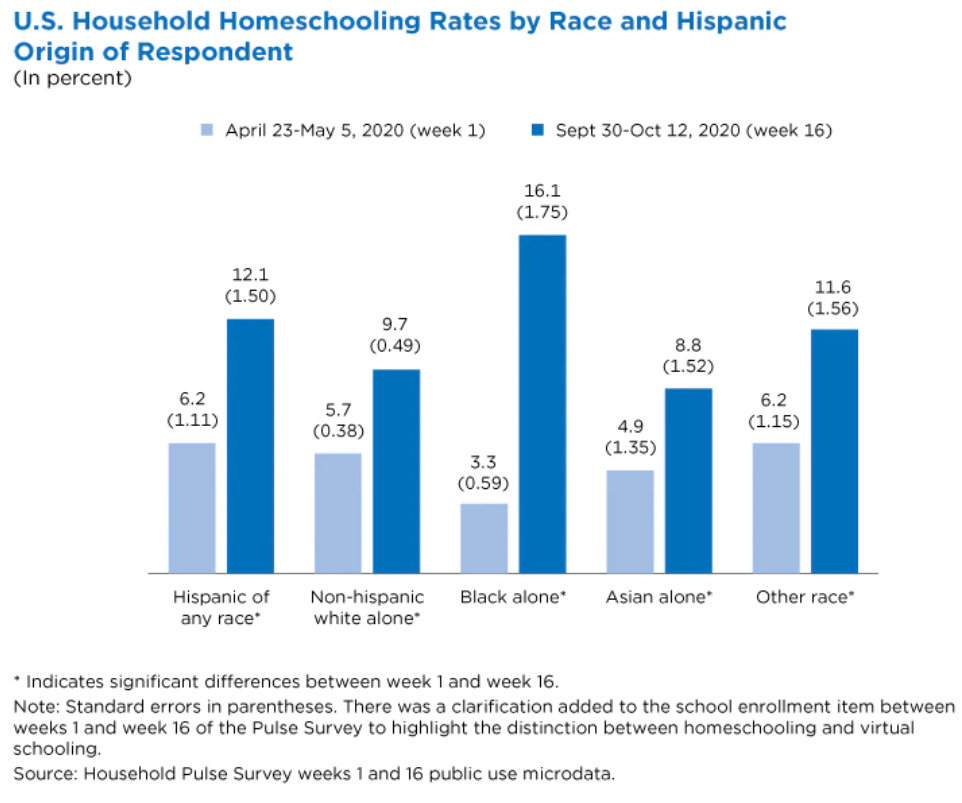
Source: US Census
The trend shows that not all parents are happy with their children’s schooling. Be it sex education, SEL education, or any other part of the general curriculum, parents want to take control of what their children learn in their lives, including knowledge about their faith and history.
Homeschooling parents keep their children out of typical school life for multiple reasons, some of which are:
- Disliking the school curriculum and teaching methods
- Financial burden of expensive schools
- A desire to spend more time with kids and get travel flexibility too
- Keeping kids away from bullying or discrimination at school
- Religious reasons
What homeschool programs can parents use to teach children?
Homeschool families consider the world to be their children’s school and life to be their curriculum.

Parents can also give social values to their children effectively
Homeschooling parents need to be aware of the state laws before they can start teaching their children at home. They can consider what kind of curriculum they want for their children. For example, biblical learning like Bob Jones homeschool curriculum or a free, online one like Easy-Peasy curriculum.
Parents can find homeschool coops to interact with families with similar homeschool interests and take help from one another.
Some parents can teach their children, and others can hire dedicated homeschool educators. Families can either purchase or create a homeschool curriculum through different resources. Some agencies and online platforms act as resource pools having the courses and curriculum for grades ranging from kindergarten to high school.
Ed-tech companies also play a pivotal role in homeschooling children from remote areas. Online Ed-tech platforms like Study.com help provide tutors, online courses, and video lessons that help in distance learning.
Are Homeschooled children less social?
Kirk Cameron, through ‘Homeschool awakening,’ advocates that homeschooling is not just reasonable but also healthy for children. He believes that there is nothing a child cannot learn at home in the presence of their family.
Pro-homeschool parents feel that their children are not learning in a restricted campus environment, as it is in everyday schools, but in a real-world environment.

Homeschool co-ops are becoming popular and help students to socialize
They interact with members of their families, neighbors, friends, and other people, and the question of becoming antisocial is practically irrelevant to them.
Learning Pods
Learning pods are like micro-schools. Homeschool families create small groups of their own to share learning experiences and cross-teach or hire a facilitator to teach their students the same subjects. It relieves the parents of the burden of teaching all subjects to their children, increases their socialization time with same-age groups, and helps kids learn from subject experts.
Is Homeschooling the Best for Our child?
When it comes to children, everyone wants to have the best school, the best food, and the best life for them. This is a natural parental desire. Parents are beginning to realize what they want their children to learn and not what the government-recommended syllabus is.
On the other hand, many parents feel that what the public schools teach is suitable for their children and their guidance. They do not have the time or the influence to take the entire school education of their children into their own hands. These parents believe that if they did well after learning in school, their children would too.
Which way of schooling should be given depends on multiple factors. As we said before, there is not just one way to education!
The post What is Homeschooling and other FAQs appeared first on Test.Evelyn.
]]>The post The Best Online Q&A Platforms For Students To Ask Questions appeared first on Test.Evelyn.
]]>It is interesting how students can leverage digital technology to learn from various books, scholarly material, and professors anywhere in the world; a practice that can transcend learning beyond classrooms.
Ed-tech companies have developed interactive platforms where the technology has left every study resource at the student’s disposal. This, in turn, has promulgated self-study among students. Online content is a good source of study but the students might also have some doubts while studying, which gives rise to the need for a mentor. Using online Q&A(questions and answers) platforms, students can ask questions or clarify their doubts.

Q&A with Experts on Chegg’s Website
Importance of Q&A Platforms
Q&A platforms prove to be quite helpful for the students in multiple ways-
- Online Q&A platforms deliver answers to the academic queries of students from anywhere in the world via subject experts, which helps them understand a topic from different perspectives.
- Q&A platforms are not time-specific. A student can ask questions at any time and tutors or subject experts can answer at any time. There are also some platforms that promise to get quick or instant answers.
- Q&A platforms help students to ask any number of questions on any subject that the website offers.
There are other Online Q&A platforms through which one can ask questions to other individuals in a community. These platforms are open to the public eye and scrutiny, where anyone can ask and answer those questions. Platforms like Quora and Stack exchange fall under this category.
However, these platforms contain more generic than academic questions because of who responds to them. Not all people answering these questions are subject experts. This is the raison d etre that students seeking an academic solution, find it challenging to be sure of the credibility of their answers.
The Deciding Factors
Other platforms offer solutions from experts. These services are often provided by Ed-tech companies with online learning portals and courses. We would rate some of the renowned Q&A platforms on the five factors mentioned below:
- Do the eLearning platforms that offer Q&A services proofread or moderate their content before sending it to the students?
- One question can have multiple answers, such as in subjects like Management. Allowing only one answer can affect the quality of the content. The platform should allow multiple answers to one type of question to support content breadth.
- Do the answers to the questions get feedback from other qualified educators or just the students? Content that students rate cannot be an appropriate practice. They may not have the complete knowledge to judge an answer, which is why they ask questions in the first place.
- Do the platforms harbor an honor code that takes appropriate action when the students use the study material for unethical reasons like cheating?
- Do they have an instant chat service or just a ‘Post a question’ service?

*24HourAnswers allows students to post their questions to connect with the tutors. The tutors quote a price for the question and give the answer in the time that the student demands.
Content moderation is a complex question because platforms only mention that the answers that the subject experts give; they hardly explicitly mention anything about quality-checking the answers of the experts themselves.

Q&A display box on CourseHero homepage
Chegg, CourseHero, Brainly, and Numerade give verified material for studying. But, they don’t offer a ‘live chat’ feature which the students could use to clarify their doubts in real time.

Q&A feature on Bartleby
Answer Scope
There are some questions where more than one answer is possible as they are subjective in nature, such as human resources or humanities. However, some platforms like Chegg allow different answers for similar questions posted twice on the website. Websites like Numerade allow students to have further discussions on the same question as they allow everyone to see the comments on the topic of discussion.
Brainly is like a crowd-work platform where the students can also contribute by giving answers to other students and is just like a classroom discussion.
Who Rates The Posted Solutions?
Solutions that are posted on the platforms are mostly rated by students as part of their feedback. If the students give a red flag or a thumbs down to a solution, meaning that they are not satisfied with the answer, it can reduce the credibility of the subject expert.
Where Is The Honor!
Not all platforms play an active role in prohibiting the use of their website for cheating in class or getting ready-made homework. Some websites have an investigative order but some just put a disclaimer in the name of honor code, expressing that making wise use of the website is the student’s responsibility.
It is true that students should use content responsibly, but as these websites are used by younger students as well, the platforms should ensure that their content is not used for unscrupulous purposes like cheating.
Considering the parameters mentioned and the customer reviews evaluated, we believe that the Educational companies still have a long way to go as far as successful Q&A platforms are concerned.
The post The Best Online Q&A Platforms For Students To Ask Questions appeared first on Test.Evelyn.
]]>The post Consequences Of Plagiarism In Academic Writing appeared first on Test.Evelyn.
]]>This simple copy-paste is plagiarism. If you are encountering this term for the first time, you may face confusion in your mind.
Here is a helpful guide about plagiarism and how it is harmful to you and your academic writing. So let’s get started.
What is Plagiarism?
Plagiarism is the incorporation of someone’s content into your piece of writing. It does not only mean simple copy-pasting. If you are taking images from a website, producing false citations, or not giving the author proper credit, you are plagiarizing.
What are the types of Plagiarism in Academic Writing?
Based on the usage of text, there are different types of plagiarism. If you are copying a whole paragraph or quoting an entire segment in your material, it is direct plagiarism.
If you are taking a whole article on a topic, it is complete plagiarism. If you are adding chunks in different paragraphs at different places, it is mosaic plagiarism.
All kinds are strictly prohibited during academic writing and are considered a serious offense.
What are the Consequences of Plagiarism?
Plagiarism can have harmful effects on your academic and professional career. The list of its deadly consequences is very long. Some of the significant results are as follows:
Plagiarism can destroy a student’s reputation
Plagiarism can destroy a student’s reputation in many ways. The assignments and projects can be canceled on a small scale, or a penalty can be charged, such as remaking assignments.
At the college and university level, it can be more dangerous. The student’s thesis can be canceled, and the student can be expelled.
A poison to an academic career
If a student is expelled from an institution due to plagiarism, the student may not be admitted to another university or college. The student will become unable to write something as it has no credibility.
It can put a full stop to the learning and education process. Due to this, a student can become a victim of depression, which may lead to severe results.
Monetary penalty can be charged
If a person steals the work of an author, journalist, or professional writer, it can also lead to a monetary penalty. This depends on the sensitivity of the content a person is stealing.
This rule has been applied in various educational institutions, where a monetary penalty is charged besides the rejection of the paper. This penalty is a burden to the pocket.
With this penalty, the publication process can also be stopped.
Legal issues can be raised
It is the responsibility of every writer to give the author credit or at least cite the author’s name in both in-text citations and bibliography.
If the person making a new paper uses resources of others and does not do citations properly, the person can be accused of copyright claim. According to copyright laws, an academic paper can be canceled and an inquiry will proceed.
It can hinder the learning process
Academic writing is a whole procedure in which a person selects a topic. After that, the person conducts primary and secondary research on it and then forms it on the paper.
This process gives knowledge and creates ideas that can help a student with their exams. Through academic writing, a student can make their concepts clear.
If the student does not try by themselves and copy-pastes the material of other students or authors, the student will not get proper knowledge. The student will ultimately fail at the time of exams or during the evaluation of their thesis.
Quality of Content Decreases
A student can find data related to their topic on the internet. However, this data may or may not be helpful for them.
If the student copies that material without going through it, they might add something irrelevant. Irrelevant data can harm the quality of content.
If a teacher reads a thesis on respiratory diseases and goes through some information about the anatomy of bones, the teacher will suspect the student.
Not only will the content quality be destroyed but also the reputation.
Ways to Avoiding Plagiarism In Academic Writing
It is an excellent way to read other people’s work as it can help create ideas and concepts. At the same time, there is a danger of unintentional plagiarism.
There are many ways by which you can avoid plagiarism. Some ways are:
- Research yourself for your topic and collect information. In this way, the entire material will be yours, and there will be no copied text.
- If you are using someone’s concept, always paraphrase it. You can do so by reading the original material two to three times and then reproducing it in your own words. Alternatively, you can use an online paraphrasing tool to paraphrase text without typing a single word. The tool will rephrase the text you upload in no time. The generated text will be flawless and have no traces of duplication at all.
Online Tool For Help
There are many online tools by which you can check the plagiarism percentage. These tools are suitable for maintaining academic integrity. As for teachers, there are several plagiarism-checking tools available which provide descriptive reporting and grading on assignment papers.
However, learners and thesis writers can use a plagiarism checker for students to perform self-evaluation before submitting the final copy to teachers. Such tools allow students to learn and improvise their writing abilities.

They have bundled tools, and you can also use them to paraphrase and rephrase. They will make your content better and help make it SEO-optimized.
Conclusion
Copying material from sources and not giving credit is plagiarism. It has many harmful consequences, such as the loss of productivity, academic integrity, cancellation, and penalties.
These consequences are difficult for students and those who earn through writing. To avoid such consequences, many ways are discussed above.
A brief introduction of online tools is given, which you can check and use for assistance in academic writing. In a nutshell, this is the complete guide on plagiarism and its removal.
The post Consequences Of Plagiarism In Academic Writing appeared first on Test.Evelyn.
]]>The post Challenges in writing Math for the web – using LaTeX and KaTeX appeared first on Test.Evelyn.
]]>When it comes to technical writing or documenting scientific papers, the content contains texts but there is also a frequent requirement of using mathematical symbols, formulae, or equations. TeX accomplishes this because it is a typesetting system for digital use that enables the utilization of mathematical notations, logos, or equations. TeX constitutes the shapes of symbols and letters and their writing mannerisms.
LaTeX is a typesetting system that was built so that we could create technical documents and include in them mathematical equations, statistical calculations, or scientific formulae used in subjects like astronomy, computer science, physics, etc. LaTeX helps researchers and academicians to write content in TeX language, which is then rendered into a format like the one we see in books or journals.
KaTeX is a modified version inspired by LaTeX typesetting developed by the Khan Academy. Although both LaTeX and KaTeX are writing languages based on the TeX typeset, they also have contrasting features.
Benefits of using KaTeX and LaTeX
With the advent of educational technology, online content production has increased multi-folds. Students and teachers are now dependent on online study material, which often obviates the need for taking physical classes. Ed-tech has made learning so simple and accessible that it is already making space in the indexes of future chapters.
With the increase in usage of digital learning, the need to write digital content in all subjects has increased, which elongates the relevance of KaTeX and LaTeX systems. Some advantages of using these documenting typesets are given below:
· LaTeX and KaTeX are a complete package system, through which one can write and prepare a document in any subject and then save it in a .pdf extension.
· LaTeX contains the ability to create documents with multiple types of mathematical symbols or calculations. With LaTeX, there is no need to focus on editing documents because it takes care of the margin editing, the citations editing, or heading and subheadings when code conversion into a textual format occurs.
· KaTeX works faster than LaTeX rendering and can independently embed itself on all types of platforms or any website. Any browser can use the KaTeX typesetting, and it would render similar results, making it widely and practically usable.
Is KaTeX better than LaTeX?
There is no space for complacency in technology. There will always be newer versions of technology depending on the industry’s needs.
LaTeX is more enhanced in function, and KaTeX is faster. There is no one way to conclude which one is better because both are popular among academicians. One can compare both as per user discretion, but there is no single winner.
| LaTeX | KaTeX |
| LaTeX takes time to load when rendering output. | KaTeX is faster when rendering output and does not require web page reloading. |
| LaTeX is a comprehensive system for creating technical documentation. | KaTeX has lesser features and contains a proportion of mathematical notations contained in LaTeX. |
| LaTeX comes with an installation bundle. | KaTeX is independent and easy to use. One can install it on any website. |
Since KaTeX is faster and less complex, it has gained wider acceptance throughout the world of technical writers and in the Ed-Tech industry, which is why I tend to extract the major concerns that a KaTeX user faces when they are solving mathematical problems.
Issues that students encounter while using KaTeX:
Neither adaption to the technology nor the usage of KaTeX is free from challenges. Content writers or other users of typesetting, such as students, have faced particular difficulties while operating the TeX writing systems. The points highlighting some of the issues that come as disadvantages for the technical writers using KaTeX are given below:
· Learning to use KaTex takes time because it is not as simple as a document-creating system like Microsoft Word. In MS Word, we only type the content, and it is produced just as it is written. In a KaTeX, the writing part is different, similar to coding, then there is processing, and the rendered document is different.
· Rendering KaTeX documents is slightly challenging as it throws errors (coding-related issues) when rendering a document, which can be time-consuming.
· A preview of the processed KaTeX codes is not available on some KaTeX applications, making it challenging to make changes to the code if the need arises.
· There are some exceptions in KaTeX, because of which improper alignments and errors appear while rendering certain code. For instance, while creating long divisions in Math.

· KaTeX coding is quite sensitive, just like any other coding language, and it often delivers errors on minor syntactical mistakes while using some KaTeX tools instead of showing previews so that the user can make corrections.

How is Evelyn responding to KaTeX concerns?
Developers at Evelyn have come up with an application called Auto-KaTeX, a faster KaTeX rendering tool that does not face the concerns experienced with other KaTeX tools.
Some of the concerns addressed by the Auto-KaTeX application are described below:
· Evelyn’s Auto-KaTeX tool fixes the KaTeX code entered so as to correct the alignment and other issues while rendering KaTeX, such as for long-division problems. It fixes common errors like occurring unwanted symbols, alignment issues, or brackets and renders the code correctly.

The Auto-KaTeX application is used to process all types of KaTeX codes, and these processed codes are compatible with all the authoring platforms and websites.
The Auto-KaTeX application shows the previews of the rendered code, which helps the user analyze the mistakes before they can be used on the authoring platforms.
The Auto-KaTeX application also displays an alternate form of the same input code in the ‘Alternates’ text area, even in cases where the ‘Generated AT code’ does not work on a client tool or LMS. This could happen for various reasons depending on which platform and rendering agent is being used to render the KaTeX code. For instance, there may be rendering agents that want the entire code in one single line.

Using the Auto-KaTeX, one can copy inline and block copy without modifying the code, saving time.
Conclusion
LaTeX and KaTeX are the go-to systems for document preparation because of their easy accessibility, wide acceptance, and text and symbol facilitative features. LaTeX is complex but broader in scope, whereas KaTeX is faster and more effortless. For this reason, the latter is more attractive for users in the Ed-Tech industry. Nevertheless, while using specific KaTeX tools, some challenges remain in the use of mathematical symbols and numerical calculations.
Evelyn has endeavored to create Auto-KaTeX as an alternative to those existing platforms that delivered different errors in their outputs. Evelyn developed the Auto-KaTeX tool to give a smooth writing experience to the content developers and high-quality content for viewing and learning to the content consumers.
The post Challenges in writing Math for the web – using LaTeX and KaTeX appeared first on Test.Evelyn.
]]>The post Introduction To Proportion: Explained With Examples appeared first on Test.Evelyn.
]]>There are several kinds of problems in our daily life that are solved by using the ratio and proportions. In this article, we will study the definition, formula, types, and examples of proportion.
What is Proportion?
In algebra, an equation that is equal to two ratios is known as proportion. The proportion is a part from the whole of several things. The ratio plays a vital role in it because proportion is totally dependent on ratios.
In simple words, a proportion is the comparison of two numbers, fractions, or ratios. The set of ratios can be increasing or decreasing. When both sets are increasing or decreasing, it is called a direct proportion.
If the set of ratios is increasing and decreasing, in the same way, it is said to be inverse proportion. The set of ratios is separated by “: :” to denote a proportion. Proportions are also denoted with an equality sign “=” among the fractions.
For example, a bus that covers a distance of 35 kilometers per hour is equal to the distance covered by a car covering 90 kilometers per hour, that is, 35 kilometers/per hour = 85 kilometers/per hour.
The Formula of Proportion
You must be familiar with the equation of ratio to use the formula of proportion. Below is the general equation of the ratio.
a : b or a/b
Here, a & b are the integers. The ratio can be written in the form of a fraction by taking the first term of the ratio as a numerator and the second term as a denominator. In algebra, the first term of the ratio is known as antecedent.
The other term is known as consequent. The formula of the proportion can be written by using two sets of ratios or two ratios. Let the ratios be a : b & c : d. Write these ratios with the proportion sign “: :” between them.
a : b : : c : d
The formula of proportion can also be written in the form of fractions with an equality sign between them.
a/b = c/d
In proportion, there are two kinds of terms. The inner terms b & c are known as mean terms. The outer terms a & d are known as extreme terms.
Different methods to write the formula of proportion
Here are some methods or ways to write the formula of proportion.
- a/b = c/d ⇒ ad = bc
- a/b = c/d ⇒ b/a = d/c
- a/b = c/d ⇒ a/c = b/d
- a/b = c/d ⇒ (a + b)/b = (c + d)/d
- a/b = c/d ⇒ (a – b)/b = (c – d)/d
Types of Proportion
Proportion is of two types, that is, direct proportion & inverse proportion. Let’s discuss these types of proportions briefly.
1. Inverse proportion
The proportion in which an increase in the first term causes a decrease in the second term or a decrease in the first term causes an increase in the second term is called inverse proportion. In other words, a proportion that is not direct is known as an indirect proportion.
2. Direct proportion
The proportion in which an increase in the first term causes an increase in the second term or a decrease in the first term causes a decrease in the second term is said to be a direct proportion.
For example, if the speed of a car decreases, it covers less time in the fixed time.
How to solve the Problems of ratio & proportion?
The problems of ratios and proportion can be solved easily either by using formulas or a proportion calculator. This tool finds the result of the given problem in a fraction of seconds with steps.
Follow the below examples to learn how to solve the problems of proportion & ratios.
Example I
If 28 buses are required to bring the workers of a factory in a week, how many buses are required to bring the same number of workers in five days?
Solution
Step I: Write the given data of buses and days.
Buses required to bring the workers of a factory in a week = 28
Buses required to bring the workers of a factory in five days = x
Step 2: Write the formula of proportion and write the data of buses & days according to the formula.
a : b : : c : d
buses : days : : buses : days
28 : 7 : : x : 5
Step 3: Write the ratios in the form of fractions and put an equality sign between them.
28/7 = x/5
Step 4: Simplify the above expression to find the value of x.
28/7 = x/5
(28/7) * 5 = x
(4/1) * 5 = x
4 * 5 = x
X = 4 * 5
X = 20
Hence, 20 more buses are required to bring the same number of workers.
Buses required to bring the workers of a factory in five days = 28 + 20 =48
Example II
In a wooden box, there are 30 vegetables. From these 30 vegetables, 8 are carrots, 4 are tomatoes, 6 are cabbage, and 12 are turnips. Find the ratio of:
- Carrot to tomatoes
- Cabbage to total vegetables
- Turnip to tomatoes
- Cabbage to tomatoes
Solution
Step I: First, write the number of vegetables.
Total vegetables = 30
Tomato = 4
Carrot = 8
Cabbage = 6
Turnip = 12
Step II: Now, find the ratio of carrots to tomatoes.
Number of carrots = 8
Number of tomatoes = 4
The ratio is
8 : 4 ⇒ 4 : 2 ⇒ 2 : 1
or
8/4 ⇒ 4/2 ⇒ 2/1
Step III: Determine the ratio of cabbage to total vegetables.
Number of total vegetables = 30
Number of cabbage = 6
Subtract the total vegetables from cabbage to find the difference = 30 – 6 = 24
Now, the ratio is
6 : 24 ⇒ 3 : 12 ⇒ 1 : 4
or
6 / 24 ⇒ 3/12 ⇒ 1/4
Step IV: Now, find the ratio of turnips to tomatoes.
Number of turnips = 12
Number of tomatoes = 4
The ratio is
12 : 4 ⇒ 6 : 2 ⇒ 3 : 1
or
12/4 ⇒ 6/2 ⇒ 3/1
Step V: Now, find the ratio of cabbage to tomatoes.
Number of cabbage = 6
Number of tomatoes = 4
The ratio is
6 : 4 ⇒ 3 : 2
or
12/4 ⇒ 3/2
Summary
You can grab all the basics of ratio and proportions from this post. We have mentioned all the basics of proportion in this post. After reading the above post, you can easily solve any kind of problem related to ratios and proportions.
The post Introduction To Proportion: Explained With Examples appeared first on Test.Evelyn.
]]>