The post Online Teaching V/S Traditional Teaching appeared first on Test.Evelyn.
]]>Online teaching for overall learning has become exceedingly common in recent years, with an increasing number of institutes and businesses offering it. Despite the prevalence of online education, a sizable portion of the population actively avoids it, mostly due to misunderstanding. The aim of the online education model is to solve the drawbacks of conventional education while also offering additional benefits. Students in a typical teaching model listen to long lectures, take notes, and memorize information by rote.
In the classroom, this leaves little to no space for constructive participation. On the other hand, online education promotes classroom engagement and peer-to-peer communication. Students can communicate with their courseware and acquire information in a far more engaging manner now that numerous types of online study tools are accessible.
While the current choices are limitless, let us face it: not all of them are appropriate for all students. As a result, in this article, we will compare the benefits and drawbacks of online and conventional teaching so that each of you can choose the choice that best suits your needs.
Benefits of Online Teaching For Overall Learning
- Lessons are usually taught in small groups and on an individual basis. This strategy, which is becoming increasingly popular, allows the teacher to learn about their students’ strengths and weaknesses in order to maximize class time. This is a means for students to establish their own learning pace and discover a safe area to connect with the instructor openly and freely.
- Distance education gives you the freedom to attend classes whenever and wherever you desire. The schedule is adaptable, allowing students to build a personalized study plan that meets their specific needs. There is no reason to sacrifice anything due to a lack of time.
- Online learning systems have a large range of courses to choose from. There is a course for everyone, from university to high school. Students can even earn a degree without ever visiting a university. Online teaching for overall learning also has a wide range of approaches to fulfill the demands of all types of students.
- In traditional education, every lesson requires the student to be present in the classroom. As a result, individuals must commute from one location to another, which takes time and money.
- There is no need to waste time commuting. Students can create a relaxing environment in their homes where they can concentrate. A classroom is no longer necessary. It is up to us to build the ideal environment for studying quietly and without distractions.
- The pedagogic resources for the lessons are accessible at any time and from any location. They can be accessed at any time, thanks to the digital format. These costs are eliminated with online education, and there is no need to waste resources.
Drawbacks Of Online Teaching
- It is insufficient to have a notebook and a pencil case on hand. A computer with a webcam, headphones (ideally), and a good internet connection are all students will need.
- In online teaching, there are more stimuli that can cause distractions: this can happen if the study location is inadequate. The student’s education is in his or her hands, thus it is critical to have a good area away from any potential distractions. The virtual environment is insufficient to keep the student’s entire concentration.
- Some students struggle to find time to study without a predefined schedule. Although self-discipline can be taught, some students are born with it. Online teaching for overall learning necessitates a compromise with the tasks.
- Not every subject can be taught online. A few subjects, primarily those requiring practice, are better learned in person. Nevertheless, there is a way to mix the two for the best outcome.
Online teaching for overall learning is a cost-effective and underappreciated option that allows students to study at their own speed. It also allows you to balance your studies and personal life. All of this comes from a single commodity: a house. Without sacrificing your education, you can learn while traveling throughout the world.
Furthermore, it saves you both time and money. There is no need to pay for transportation, the courses are generally more economical, and there are no geographical constraints.

Benefits Of Traditional Or Conventional Teaching
- Conventional education allows for group projects and student contact in general. As a result, they can learn from one another and share their problems and uncertainties. These social links can aid in the generation of new ideas and the stimulation of creativity.
- Traditional schooling can help students feel less lonely by instilling a sense of sociability and togetherness. The student may feel less alone in their academic struggles and may gain confidence as a result.
- Pupils who struggle with self-discipline appreciate a study plan that is both reliable and simple to follow. Traditional education requires students to attend class and study when necessary.
Drawbacks Of Traditional Or Conventional Teaching
- Traditional education’s pedagogical formats are more constrained. Pictures, movies, and forums are not always available 24 hours a day, seven days a week. This feature may impede learning and make it difficult to stick to a study schedule.
- There is no way to design a personal calendar that allows you to balance your education with your personal or professional life.
- It is difficult for a teacher to create a personalized study schedule that meets the needs of each student in the class.
- As previously said, commuting is an economic cost. Time is also a consideration if the classroom is a long distance away. You must decide whether or not the trip is worthwhile.
Traditional education dates back thousands of years. We do not advocate closing schools and colleges and simply providing online teaching for overall learning. The traditional technique provides advantages such as face-to-face connection, interpersonal skills development, and group learning, all of which are important abilities for a student’s overall growth.
However, it is impossible to deny that, when used properly, technology may play a significant role in education. Instead of substituting online education for traditional education, you can combine the two to provide a more effective, efficient, and engaging learning environment.
Parting Note
There is no right or wrong solution when it comes to online teaching for overall learning vs. traditional or conventional teaching. Much of it boils down to personal preference and understanding your preferred learning style. Regardless of your learning style or environment, any of these learning forms can be quite effective.
In the end, the decision is yours to make. It is critical to consider carefully what you require and desire from your schooling. Make a decision based on what is most essential to you.
Image Sources: Shutterstock and Unsplash
For more information on traditional and online teaching, visit our blog.
Create. Engage. Inspire.
The post Online Teaching V/S Traditional Teaching appeared first on Test.Evelyn.
]]>The post Online Learning over Traditional Learning appeared first on Test.Evelyn.
]]>Benefits of Online Learning
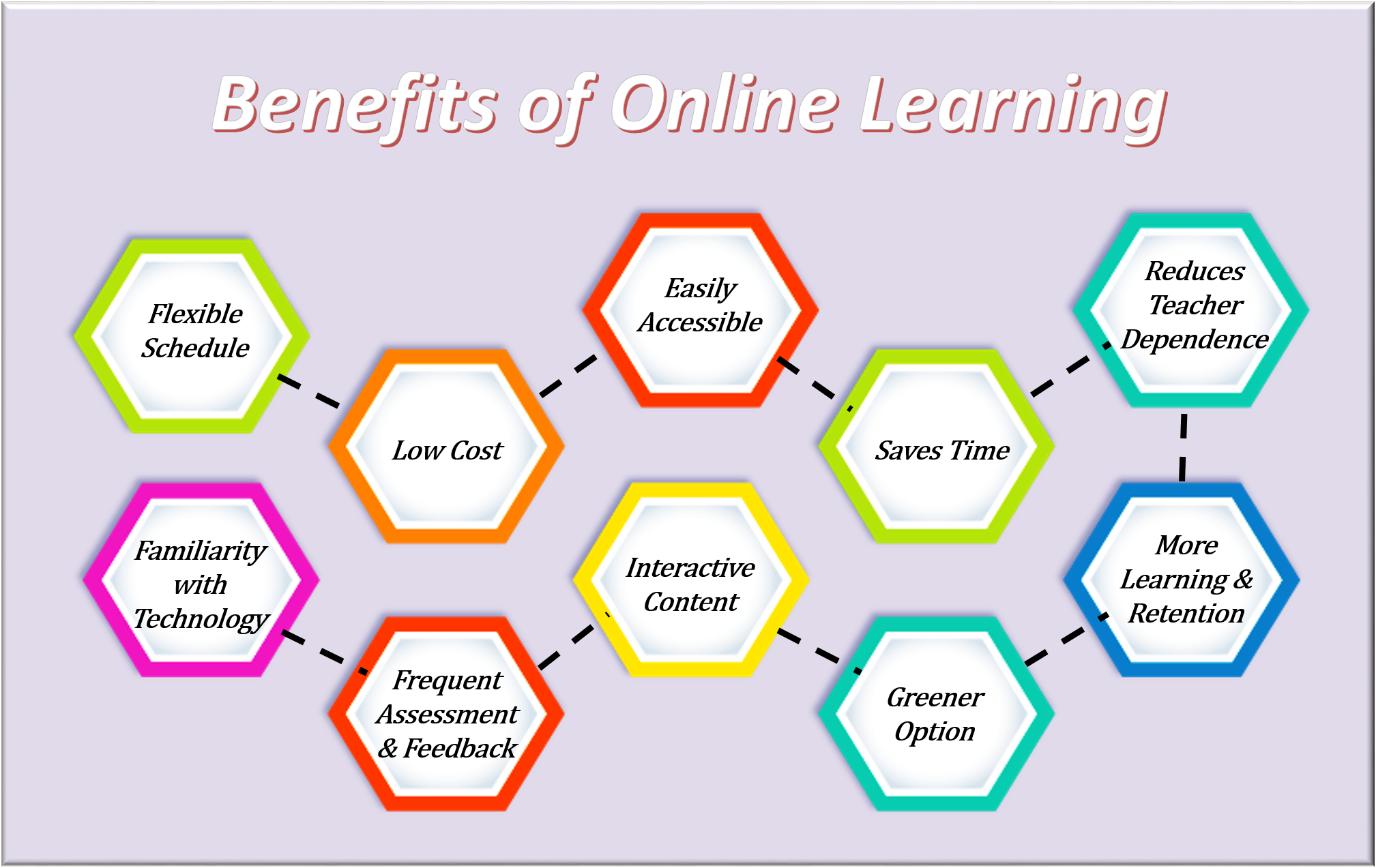
Online learning is being widely accepted as a new technology-based approach to learning. The potential benefits it provides to the participants are what makes it stand out in comparison to the traditional learning method. Following are some of the benefits of online learning.
1. Flexible Schedule
Unlike traditional learning, online learning classes are flexible in schedule. The participants are free to access a course whenever they want, without having to commute to the class. Moreover, it gives them the freedom to move ahead with the course at their own pace.
2. Low Cost
Online learning is a cost-effective approach compared to traditional learning. It does not require specific infrastructure for setting up a class. In fact, participants can access the courses and learn from the comfort of their homes.
3. Easily Accessible
An online course is open and available to all. There’s no constraint on the participants to opt for a certain subject. The learners can freely choose from a wide range of courses. This allows them to pursue their interests and develop skills. Moreover, participants can revisit an online class in case they miss any.
4. Saves Time
The participants can access a class in no time without having to waste time traveling. Also, all the learning material and notes are available in digital format, so there is no need to waste time jotting down everything. Consequently, participants can pay complete attention to the course content.
5. Reduces Teacher Dependence
With all the learning materials available online, dependence on the teacher lessens. Participants can access a course on their own and learn through interactive content even without the guidance of a teacher.
6. Familiarity with Technology
With the Internet placing everyone on a global stage with high levels of competition, familiarity with technology becomes very important. Thus, acquiring as many skills increases the chances of selection for a job.
7. Interactive Content
Digital content works better at engaging the learners. Content designed with LMS is much more interactive and can be used to learn various concepts, which cannot otherwise be taught in a traditional learning classroom setting.
8. More Learning & Retention
Multimedia content allows the learners to move ahead in learning at their own pace. It also allows them to quickly cover the concepts they are already familiar with, without having to wait for other learners to reach that level. Additionally, multimedia content provides experiential learning by witnessing situations in a virtual setting, thus promoting better retention.
9. Frequent Assessment & Feedback
Learning Management Software (LMS) is programmed to incorporate tests, quizzes, and other assessment exercises at regular intervals in the course content. The LMS records and stores the results of the tests digitally. It further helps in quick and easy assessment and feedback for the learners.
10. The Greener Option
Online learning makes use of the Internet and other digital resources for every purpose. It eliminates manual pen and paperwork and uses technology to create and store content. Thus, it works as a sustainable approach to learning and helps make the earth greener by eliminating the use of stationery.
Is Online Learning Better?: A Final Note
So, the answer to the question, ‘Is online learning better than traditional learning?’ can be summed up as follows:
Online learning undoubtedly proves to be better than traditional learning in many ways. It caters to the different learning needs of the participants and provides a personalized learning experience. Moreover, it opens endless possibilities for learners to explore different subjects and topics in a free learning environment, where there is never a dearth of information and resources.
Along with this, it is beneficial particularly for the learners who want to spread their wings and dive into the ocean of opportunities by learning as many things as possible at once, without having to spend time searching and traveling to a class. Additionally, the fact that it works much better at engaging learners and provides longer retention in comparison to traditional learning adds another reason to the list for considering it as an alternative.
While online learning is beneficial in many ways, we must not regard traditional learning as an old and unfruitful method of learning. It has its own benefits which cannot always be found in online learning. Conventionally, educators and Instructional Designers consider online learning to be an additive to traditional learning and not a replacement.
Read more about online and traditional learning here.
Website Referred for Research: Nitrocollege
Image Credits: Freepik and Shutterstock
For more information, visit our blog.

Create. Engage. Inspire.
The post Online Learning over Traditional Learning appeared first on Test.Evelyn.
]]>The post Online Learning Vs Traditional Learning appeared first on Test.Evelyn.
]]>Learning has become easier with access to different courses available at a click. The traditional form of learning is slowly slipping into the online mode, owing to its various advantages. Both Online Learning and Traditional Learning have their own advantages and disadvantages. Their effects are thus registered accordingly. Let’s have a look at the comparison between the two.
What is Traditional Learning?
Traditional Learning refers to a setting where a teacher communicates with a group of students in a typical brick and mortar classroom set-up. The students attend the class for a fixed time duration and learn about specific topics and subjects, and they often get hands-on experience for a job. Although many schools/institutions make use of technology, the teaching-learning process still involves hand-written notes, assignments, tests, etc. The curriculum follows a standardized pattern using textbooks approved by the government and the education board. Moreover, the students are completely dependent on the teacher for acquiring knowledge of the subject.
Advantages and Disadvantages of Learning
Traditional Learning has been there since time immemorial. It is the first and foremost approach to learning considered by educators for imparting knowledge. Though it is a primary approach to learning in contemporary times, it has certain advantages and disadvantages which make it unique.
|
Advantages |
Disadvantages |
|
|
What is Online Learning?
Online Learning refers to a process where the students and the teacher are connected via the Internet. This implies that they are not bound by time or space. Moreover, the study material is digitally shared by the teacher, and the students also have access to varied information sources through the Internet. Unlike a traditional classroom, students get a wide range of subjects in an online learning format and are free to opt for any of them depending on their interests.
Advantages and Disadvantages of Online Learning
Online Learning is a comparatively new and emerging approach that is setting the ground for endless opportunities. Let’s take a look at some advantages and disadvantages of online learning.
|
Advantages |
Disadvantages |
|
|
Online Learning vs Traditional Learning might seem like a highly debated topic with two opposing and fervent sides, but a deeper understanding of both gives an entirely different impression. Taking into account the different perspectives of learning, both methods have certain pros and cons that make them unique as well as effective in different learning situations. While the wide accessibility of online learning may excite the interest of learners, the in-person attention provided in traditional classrooms may be preferred by the supporters of traditional learning. It is difficult to make a conclusive remark as to which mode of learning is better than the other as both weigh equally on the scale of effectiveness.
All learners have different styles and preferences of learning. There is no one specific methodology that can fit all learners. Educators must design curriculums that allow the learners to learn their own way. Adopting different modes of learning may prove helpful in doing so. Offering lessons through online as well as offline mode may allow the students to learn comfortably as per their style of learning. However, be it online or offline, it is necessary to design engaging and effective lessons as the ultimate aim of both modes is to fulfil the lesson objective and foster learning.
Refer to our next article in this series for a response to this question.
For more information, visit our blog.

Create. Engage. Inspire.
The post Online Learning Vs Traditional Learning appeared first on Test.Evelyn.
]]>