The post Creating Video-Based Educational Courses appeared first on Test.Evelyn.
]]>Steps to Create a Video-Based Education Course
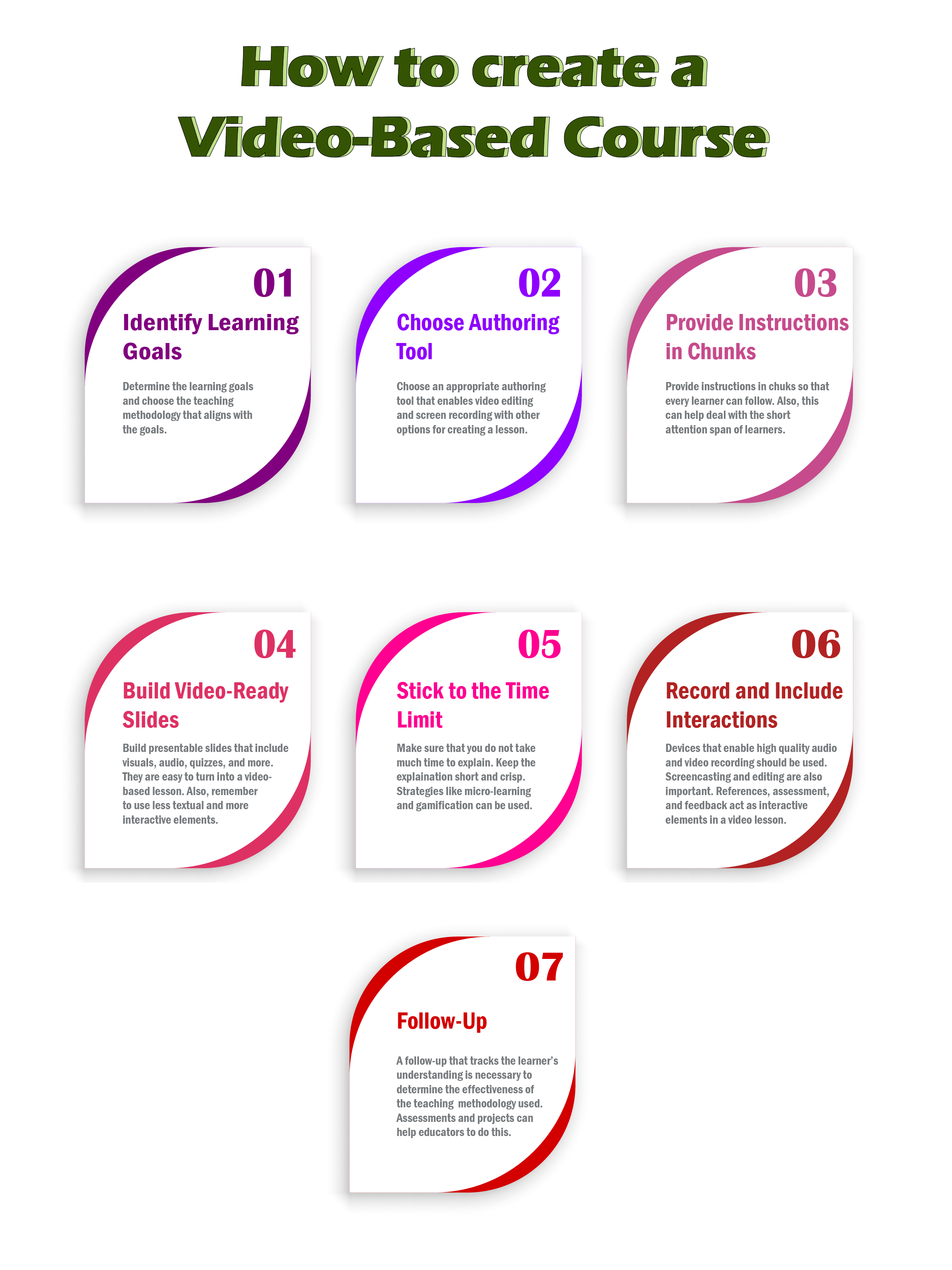
Step-1: Identify the Learning Goals
Identification of the learning goals is the first step for creating a video-based course or lesson. Educators must first determine what the learners wish to achieve through a lesson/course. This helps identify the appropriate teaching methodology that aligns with the teaching and learning goals.
Educators can also consult a subject-matter expert or a graphic designer for professional advice on creating a video-based course.
Step-2: Choose the Correct Authoring Tools
To use the video-based education method, educators must be familiar with different authoring tools and their use. These authoring tools assist in creating digital content for various purposes. They also allow educators to develop various forms of digital content with ease. This digital content covers everything from a simple MS Word document to video lessons on complex STEM concepts. Thus, choosing the correct authoring tool that enables video editing along with screen recording becomes essential.
Several authoring tools on the Internet offer these features for free or with a minimum fee to access certain features. For instance, Camtasia Recorder allows educators to create different types of videos with pre-built templates. It also provides video recording and editing. Khan Academy uses Camtasia Recorder to create and edit educational videos.
Other options include SmoothDraw3, Articulate 360, Adobe Captivate, Lectora, and so on.
Step-3: Provide Instructions in Chunks
An average learner’s attention span is about 8 seconds, which is a short period. Expecting young learners to sit for a 90-minute video lesson is out of the question. Also, learners find it difficult to follow a large set of instructions in one go. A well-organized class with crisp and meaningful chunks of information works better to engage learners.
Moreover, learners prefer several small videos instead of a single long video. Some platforms that offer video-based learning include Khan Academy, Lynda, Udemy, Coursera, TED-Ed, and more.
Step-4: Build Video-Ready Slides
Presentation is the key to engaging learners. It provides better learning outcomes as learners immerse themselves in the learning process. Educators often use digital means to supplement in-class learning. However, presentations are not sufficient for video-based education because the supplementary material contains more textual information, which the teacher explains. However, in video-based education, educators do not involve themselves directly in the class. The entire process of learning takes place through on-screen videos. Thus, it becomes difficult to capture learner attention with text-only slides. Therefore, educators must include more visuals and other interactive elements like quizzes and puzzles instead of text.
For instance, a science lesson on Resonance Structures of Benzene containing visuals that include chemical compound structure is easier to understand than just plain text. Text-only information on such complex topics can confuse the learners. Also, learners are likely to be uninterested in learning such complicated concepts through text. As a result, video-based courses also affect learning outcomes.
Step-5: Stick to the Time Limit
As mentioned earlier, a typical learners’ attention span is small. This signifies that they cannot sit and watch educational videos for long. Consequently, it is crucial to stick to the time limit while creating video-based lessons. Educators can use different strategies like micro-learning and gamification to improve learner engagement. Additionally, eLearning localization is an excellent strategy to cater to the learning needs of diverse learners.
Moreover, several small videos with digestible chunks of information are better than longer ones. Khan Academy presents the most significant example of this form of learning. They offer lessons in the form of short videos with relevant information about the topic.
Step-6: Record and Include Interactions
Recording a lesson is an essential part of creating a video-based course. Various tools available on the Internet allow educators to perform different functions of video-based education. These functions range from recording and screencasting to video editing.
Additionally, including interactions in the form of references, assessments, and feedback is essential. Such forms of interaction help create a link between learners and the concepts they are learning. It eventually renders better learning outcomes.
Step-7: Follow Up
The final step is to follow up with learners about what they have learned. This step includes tracking the results based on their performance in the assessment tests. Also, follow-up helps educators decide whether the teaching methodology applied is fruitful or not. Moreover, it provides a clear picture of the learner’s performance throughout the course.
The steps and guidelines mentioned for creating video-based education courses can help educators establish useful video-based lessons/courses. Above all, a crucial step to follow is to be genuine while delivering the lesson. The impact of the educator’s personality leaves a significant mark on learners and their learning.
Moreover, educators must know the essentials of delivering an e-lesson before they work with video-based education. This can help provide the initial experience required to teach a lesson/course effectively.
Reference Websites: Edutopia and ELearning Industry
Images: Shutterstock and Freepik
To explore more e-learning options, visit our blog.
Create. Engage. Inspire.
The post Creating Video-Based Educational Courses appeared first on Test.Evelyn.
]]>The post Benefits of Video Based Learning appeared first on Test.Evelyn.
]]>What are the Benefits of Video-Based Learning?
a) Learner Engagement
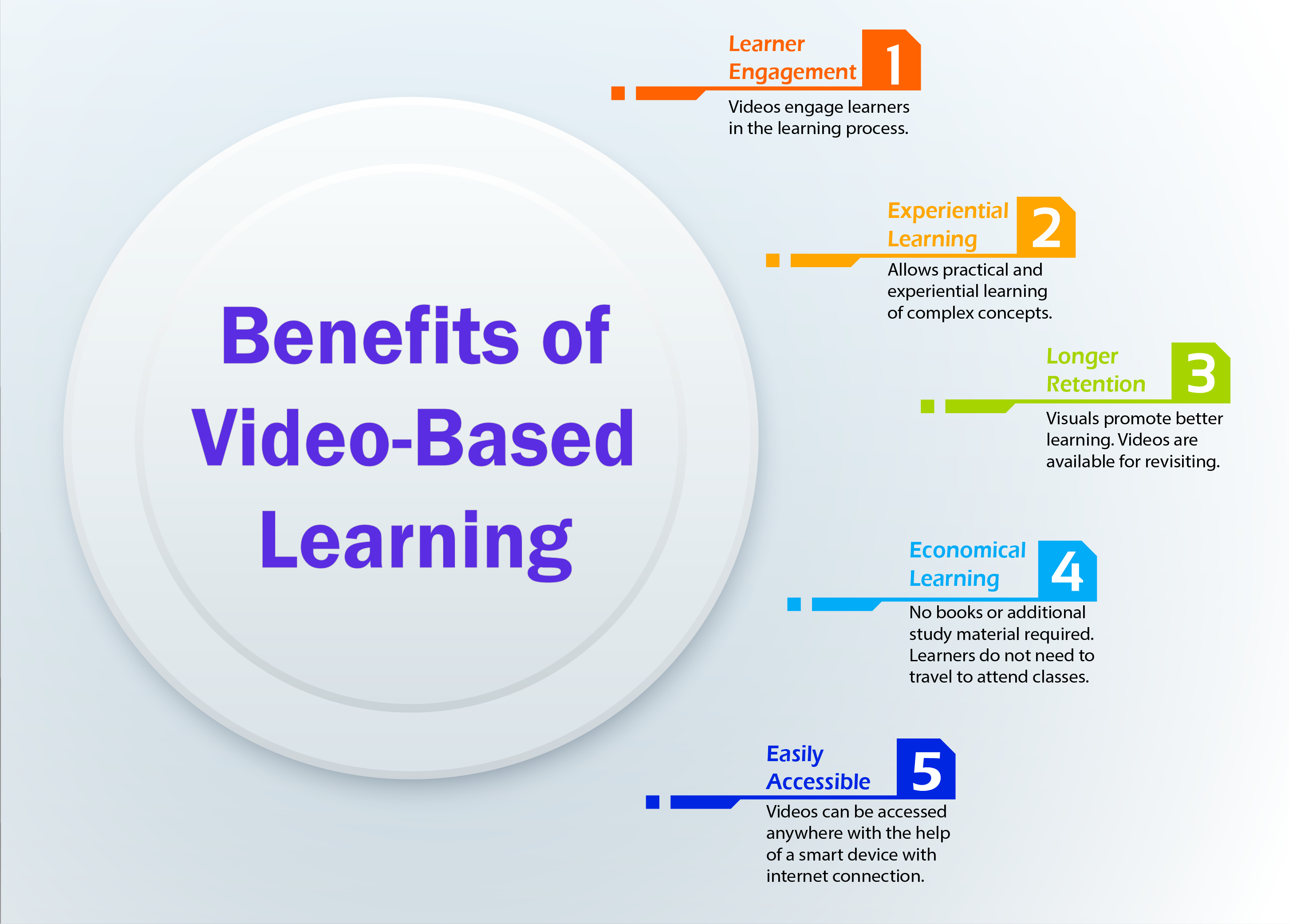
Videos are an interactive way of learning. Learners are likely to engage more with videos in contrast to text-only content. This is because videos include visuals that paint a clear picture of concepts. Also, educators can use non-verbal cues to their benefit in such type of courses. Non-verbal communication such as intonation when combined with questioning skills promotes engagement. This strategy is not only effective for in-class teaching but also works for video-based learning.
Moreover, videos grasp learner attention with the help of colorful and interactive visuals. As a result, learners remain constantly engaged with the visuals while learning.
b) Experiential Learning
Learning by doing is the key to achieve the best learning outcomes. The practical knowledge of a concept is necessary along with theoretical knowledge, but this practical knowledge is limited to certain subjects. For instance, learners cannot dissect a human body by themselves to study human anatomy. However, videos provide a solution for such situations that limit learning. Learners can learn about anatomy through videos that show the human body through virtual reality. In this way, the actual practical learning takes place with the help of videos.
c) Longer Retention
Videos are an amalgamation of text, visuals, and sounds. All these form the basis of learning. Studies suggest that the average adult retains 10% of what they hear, 20% of what they read, and 80% of what they see. This is because the human brain processes visual information better than verbal or written information. Consequently, when the brain receives information in a combination of text, visuals, and sounds, it becomes easier to retain.
Furthermore, videos are much more engaging than mundane classroom lectures. Learners interact with the content on the screen and are free to revisit the lessons/courses at their will. This means that they are free to practice the concepts based on their convenience. This eventually leads to better learning and retention.
d) Economical Learning
Video-based learning is an economical learning solution. Learners have access to various educational videos available on the Internet. Most of these videos are available for free or at minimum charges. Also, video-based learning does not require traveling or attending classes physically. This helps learners save time and money that would otherwise be utilized.
Moreover, there is no requirement for books and other study material. Only a good Internet connection and a smart device can serve as the tools for receiving knowledge.
e) Easily Accessible
Videos are one of the most easily accessible resources in the current era. This is thanks to technology and the Internet, which provide easy access to all online services. Learners can access any videos on the concepts they wish to learn without having to spend much time finding a teacher. Moreover, videos are always available for reviewing to recapitulate a lesson/concept.
Additionally, technology enables educators to create learning videos on their own. There are various tools available on the Internet that help create an e-learning course.
(Read our blog on Creating a Video-Based Learning Course for more information.)
Future of Video-Based Learning
Auditory learning is gradually becoming a thing of the past. The Internet presents various new learning possibilities. Consequently, eLearning is gradually becoming a go-to learning method. It serves learners with different e-learning styles with an amalgamation of various teaching/learning methods. Video-Based Learning is a great way of administering knowledge. This is because videos immediately grasp the learners’ attention.
Although videos are a part of eLearning, they also supplement in-class learning. Various forms of blended learning (including the flipped classroom) use eLearning to supplement in-class learning. This yields better learning outcomes and also promotes better retention.
Video-based learning will have more consumers in the future, which is due to its ease of usability and application in a wide gamut of industries. It is not only useful for learning but also serves various corporate training and learning needs. Additionally, with technology and resources gradually becoming available to all, creating educational videos will be much easier in the future. As a result, it has great potential to play a prominent part in the future of eLearning.
Research Website: ELearning Industry
Images: Shutterstock and Freepik
To explore more e-learning options, visit our blog.
Create. Engage. Inspire.
The post Benefits of Video Based Learning appeared first on Test.Evelyn.
]]>The post Video-Based Learning: Definition, Emerging Trends, and Usage appeared first on Test.Evelyn.
]]>A study has proven that the human mind retains more information when imparted via visual means. Therefore, video-based learning is becoming an effective tool for learning and is yielding better results than traditional learning. Through this article, we will explore video-based learning and its various dimensions in detail.
What is Video-Based Learning?
Video-based learning, put simply, refers to the learning that takes place with the help of videos. Nowadays, the physical presence of a teacher and students is not necessary for learning. Video-based learning is one such means of learning that supports this newly found global dimension of learning.
Since these video lessons are easily available over the internet, creators need to put together easily comprehensible lessons with more retention rates and the least possibility of deviation. They should include eye-catching graphics, clear audio with great intonation, and error-free content in their videos to yield the best results.
Emerging Trends in Video-Based Learning
Although technology eases learning, it becomes a distraction as well. The internet brings everything to a screen with a click, but it has many disadvantages as well. The biggest of these is the decreasing attention span of learners, especially that of the millennials. Millennial learners need quick bites of information and cannot stand long hours of lectures. Therefore, video-based learning proves to be one of the most effective ways to learn.
Various innovations in this type of learning make it a game-changing learning method. Some of these trends are as follows:
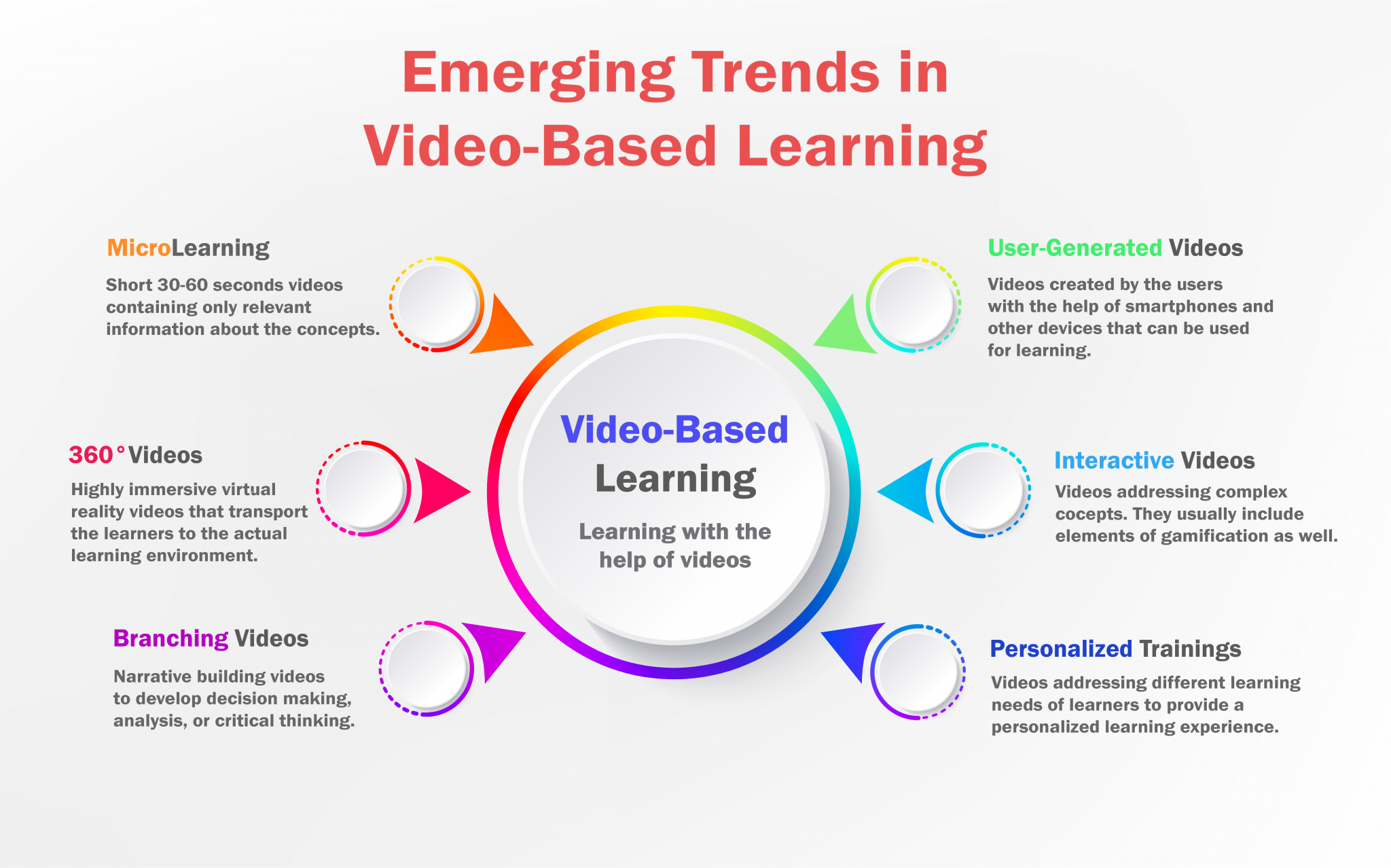
a) Microlearning Videos
Microlearning videos include short videos addressing the main concept. Such videos are shorter, approximately 30-60 seconds, and give brief information about a concept. Therefore, learners do not have to sit for long hours and cram unnecessary information in the name of learning.
Moreover, microlearning videos are target-specific and prove to be an effective training method.
(Refer to our blog on Micro-Learning for more information.)
b) Interactive Learner Experience
Interactive learning is a way of engaging learners in the lesson/course. This promotes better learning and retention. This trend emerges with the acknowledgment of the fact that learners cannot remember everything included in a lesson/course. Also, long hours of learning are usually boring. Thus, making a lesson/course interactive is necessary.
Some methods to make an interactive lesson/course include gamification, inserting annotations, quizzes, and more.
c) Video-Based Branching Narratives
Video-based branching narratives focus on building a story. Learners decide how the story unfolds by perceiving its negative and positive consequences. As a result, this video-based learning trend provides a multitude of choices and interactive points for better learning.
Why Use It?
Videos are the most influential consumer engagement method. There are endless possibilities that only videos can achieve. They help create comparatively more engaging, interactive, and fun lessons/courses. Additionally, learners prefer videos over lengthy articles. This alludes to the fact that we retain visual information for a longer time. Also, concepts sound more appealing in the visual form. Thus, learners develop stronger mental connections with the engagement of multiple senses.
Furthermore, this innovative method is useful for both education and corporate training purposes. This feature makes it an even more dynamic way of learning.
Research websites: Next Day Animations and CommLab India
Images: Shutterstock and Freepik
To explore more e-learning options, visit our blog.
Create. Engage. Inspire.
The post Video-Based Learning: Definition, Emerging Trends, and Usage appeared first on Test.Evelyn.
]]>The post Micro-Learning: Effectiveness and Best Practices appeared first on Test.Evelyn.
]]>This article delves deeper into micro-learning and discerns how effective micro-learning is, and what are the best practices to follow while employing this method.
Is Micro-Learning Effective?
Learning outcomes not only depend on the method employed but also on the learner’s concentration level. Modern learners have a comparatively small attention span compared to adults. Eventually, this raises a need to employ a strategy that does not strain the concentration level too much yet yields effective results. Micro-learning fits these constraints perfectly. Also, the use of entirely digital content eliminates the need for manual note-taking and engages learners without any distractions. Besides, the availability of content on various platforms, in the form of interactive videos, audios, games, and quizzes that are accessible through all devices, gives freedom to learn or revisit any module as and when required, making it easy for everyone to learn.
As a result, micro-learning is an effective method of learning for contemporary learners, and it is suitable for education as well as corporate training. However, it must be noted that this method is only applicable for teaching simple concepts as it provides crisp information that might confuse the learners while learning about broader concepts.
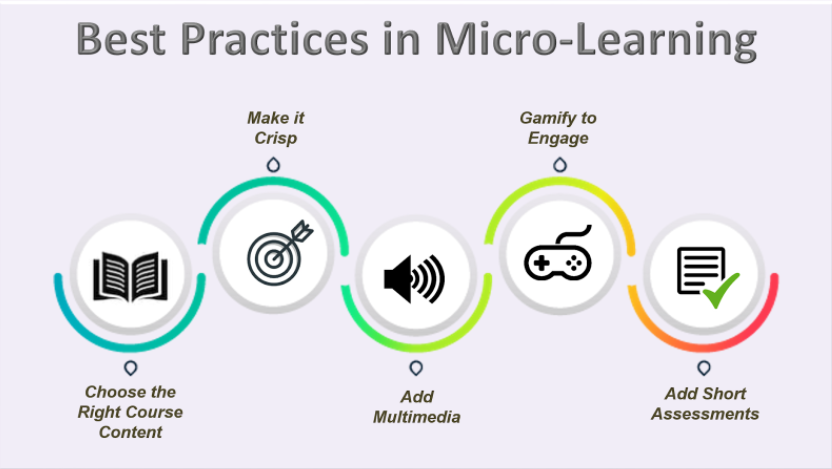
Some of the best practices to follow while designing a micro-learning module are:
1. Choose the Right Course Content
Broader concepts that require detailed study are often difficult to present as chunk-sized information. Therefore, one must choose a course content that is easy to present as it promotes quick learning and reduces the chances of causing confusion.
2. Make it Crisp
With a fast-paced lifestyle and distractions all around, no one wants to sit and learn for long hours. Therefore, a module must be as crisp as possible, such that it caters to the short attention span of modern learners and promotes quick learning.
3. Add Multimedia
Interactive multimedia boosts learner engagement. Therefore, the course must include multimedia in the form of images, audio, videos, etc. to make it interactive.
4. Gamify to Engage
Gamification is one of the best engagement strategies for any eLearning course. Using gamification puts learners in a game-like situation, which eventually develops interest and promotes better learning.
5. Add Short Assessments
Assessments measure the level of understanding of the course content. So, it is necessary to include assessment tests and quizzes at small intervals in an eLearning course. Micro-learning, as a form of eLearning, also requires the same.
Reference iSpring Solutions
Image credits: Maxpixel
For more information on teaching methodologies, visit our blog.

Create. Engage. Inspire
The post Micro-Learning: Effectiveness and Best Practices appeared first on Test.Evelyn.
]]>The post Micro Learning: An Introduction appeared first on Test.Evelyn.
]]>Micro-Learning is gradually becoming an essential component of educational and corporate training. This is so because the technology-driven learning process, which often involves Gamification, makes extensive use of this component. But what is micro-learning? How does it work? What are its advantages and disadvantages? These queries are answered through this blog.
What is Micro-Learning?
It is a skill-based approach that aims to deliver information by breaking it into bite-sized chunks. This information mainly contains highly focused points which give a complete idea of the concept. Additionally, instead of using long statements, it employs text as well as multimedia to deliver information in the form of texts (phrases), images, short video/audio, games, etc.
Furthermore, this approach works well to quickly train employees in the in corporate sector. Certain key features that contribute to make it an effective choice for designing training modules include the following:
a) It is a quick form of learning as the modules are short.
b) Only relevant points are emphasized.
c) Also, content is produced in a variety of forms such as images, videos, podcasts, games, etc.
d) The content is accessible through any device, irrespective of place and time.
Key Benefits of Micro-Learning
Micro-learning, as skill-based learning, is the go-to method for designing content to cater to the needs and objectives of training with less time consumption. Therefore, more educational institutions are turning towards this strategy of producing and delivering information quickly. The key benefits that contribute to its growth are mentioned here.
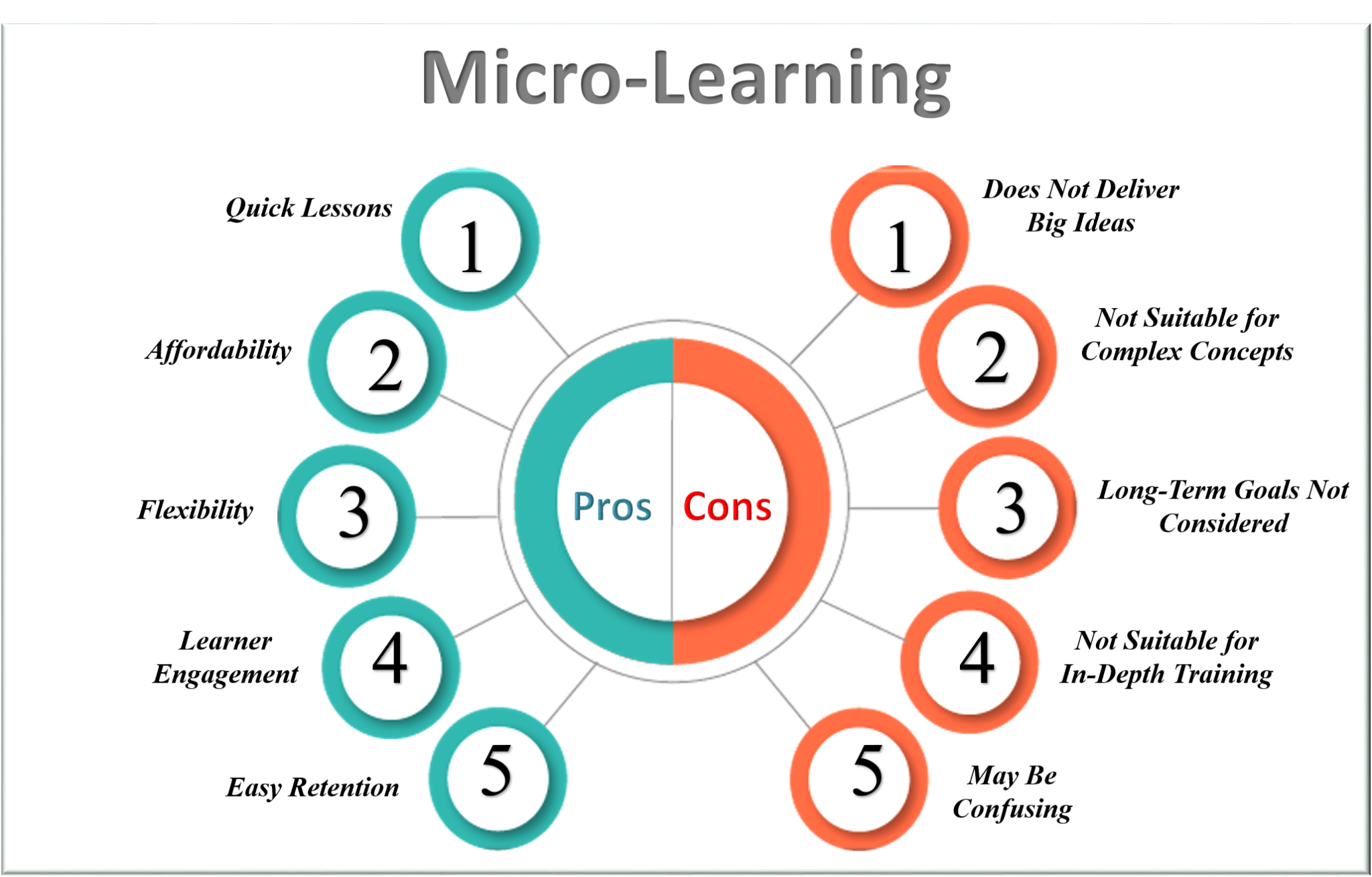
I. Quick Lessons
Micro-learning involves delivering crisp information on a topic. Thus, a micro-training lesson can be built in a very short duration of time, eventually reducing lesson delivery time as well.
II. Affordability
Micro-training courses are inexpensive to produce. Due to its crisp form, it does not require any specific tools, rather, a regular LMS works well to fulfill the purpose.
III. Flexibility
Micro-training courses extensively cover any subject just like a regular e-learning course. Moreover, it can deliver complex information by breaking it down into small bits for easy learning and memorization.
IV. Learner Engagement
A micro-training module is interesting and engaging as compared to other modules. Moreover, it is available on all devices and gives an experience similar to any social media application.
V. Optimized Lessons
Micro-learning works on optimizing the lessons. This implies that the lessons are less time-consuming and thus, can fit easily into a busy schedule. Moreover, it is accessible through mobile phones which gives freedom to learn.
VI. Easy Retention
An interactive lesson is always easy to retain. Micro-learning modules interact with the learners as they indulge in gaming, visuals, and audio. Also, the modules are available in various formats and allow revisits to recall the information.
Limitations of Micro-Learning
Although micro-learning is an effective approach for optimized learning, it is not an appropriate method for every learning environment. Certain limitations of this method are presented below:
I. Does Not Deliver Big Ideas
The chunk-sized information targets only certain points. Although this is a quick method to learn, a larger piece of information remains out of sight.
II. Not Suitable for Complex Concepts
Micro-learning modules are the best fit to deliver simple information, but it certainly cannot be applied to complex concepts easily. It may require extensive research and labor to produce a micro lesson for complex concepts.
III. Long-Term Goals Not Considered
Micro-learning accomplishes short-term goals with small pieces of information. So, it does not aim to accomplish long-term learning goals.
IV. Not Suitable for In-Depth Training
It is not possible to conduct deep research and learning through this method. Thus, chunks of information presented in the modules are only useful for giving a brief idea of the concepts.
V. May Be Confusing
It often becomes difficult for learners to connect fragmented bits of information to learn wider concepts. Also, micro lessons are often too short to familiarize learners with broader concepts. Eventually, this leads to confusion in understanding as well as the application of skills.
Conclusion
Micro-learning focuses on the inculcation of skills through short lessons. Micro lessons fulfill the skill requirements for a specific purpose. Moreover, it is a quick method of learning, which gives learners the freedom to learn at their own pace without adding to their hectic schedule. Additionally, its capsule learning design helps promote better retention of information. Certainly, this method can be regarded as a worthy approach to achieve short-term learning objectives.
Refer to our next blog in this series for further information on the effectiveness and best practices to follow in Micro-Learning.
Refer to Elearning Industry for additional reading.
Images: Shutterstock and Freepik
For more information, visit our blog.

Create. Engage. Inspire
The post Micro Learning: An Introduction appeared first on Test.Evelyn.
]]>