The post Why the Education Expenses are Rising and How to Deal with it? appeared first on Test.Evelyn.
]]>Providing college education to their children is still a utopia for many American families. College affordability is the most important yet scariest factor faced by these families when their child completes their high school graduation.
When making a decision about which college to attend, there are numerous factors to take into account, such as tuition fee, available courses, extracurricular activities, and more. However, many students find themselves stuck on the cost and perceive it as the primary determinant of their access to education.
Now, what can be done to eliminate the financial barrier to the path of acquiring an education? It appears that there may be a shortage of available resources to obtain accurate information regarding the diversity of universities, their tuition fee, and the process of applying for scholarships and grants at these universities.
Reasons for Hike in Education Expenses
According to the 2017 research report of College Board, tuition fee in colleges at four-year private and public colleges have increased by 36%.
Here are a few factors responsible for this problem of rising education costs, which are taking away the rights of students and making education a luxury.
- Rising Demand
The cost of education and students enrolling into universities are two sides of the same coin.
According to the Education Data Initiative, enrollment peaked in the year 2010 at 21.02 million students. Since then, education has gotten more expensive, with tuition fee increasing every year.
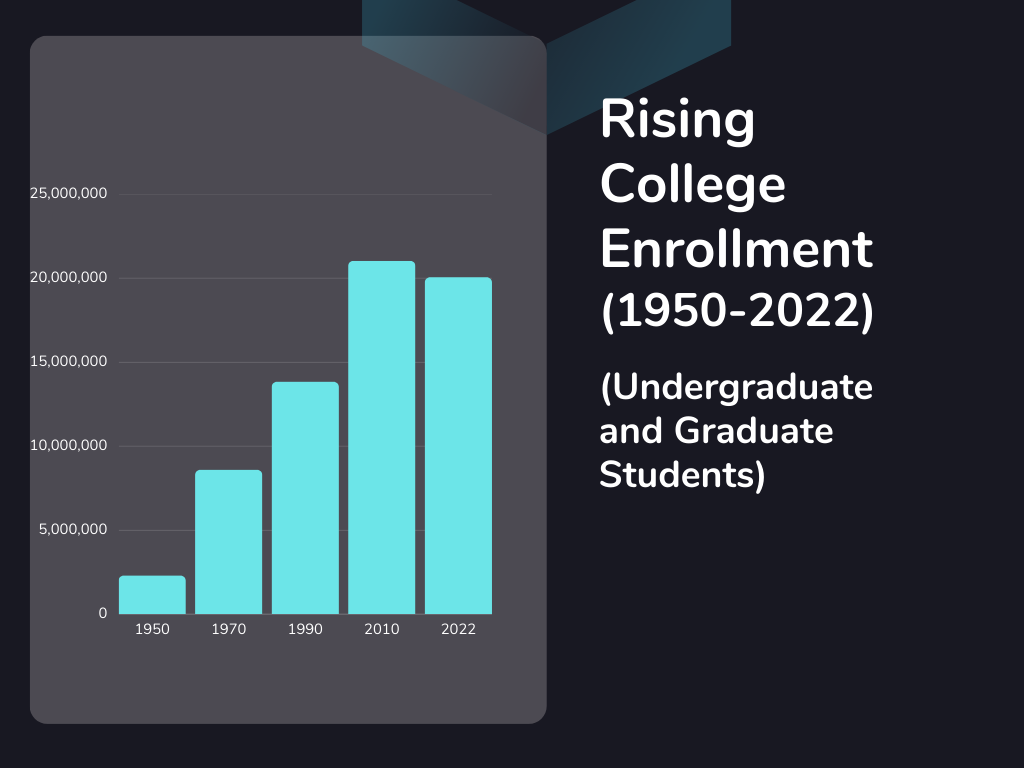
Rise in Education Expenses are Associated with the Cycle of Demand and Supply
In the above graph, we can see a slight decrease in enrollment numbers in the year 2022. This is because of the shift in thinking of students, who are losing trust in college education.
Is a College Degree Worth It?
Our society is divided into two parts. One believes in the education system, and the other believes that it is a waste of money and effort. We have some really great examples of billionaires and geniuses who do not have a college degree.
Bill Gates dropped out of college at the age of 20 and made a revolutionizing company, “Microsoft”. Walt Disney ended his schooling in the 8th grade and moved on to open the world’s eyes to see animation at its best.
Today’s generation is inclining more toward becoming social media influencers, stock market traders, etc. They are finding it fun and a way to make money with minimal effort.
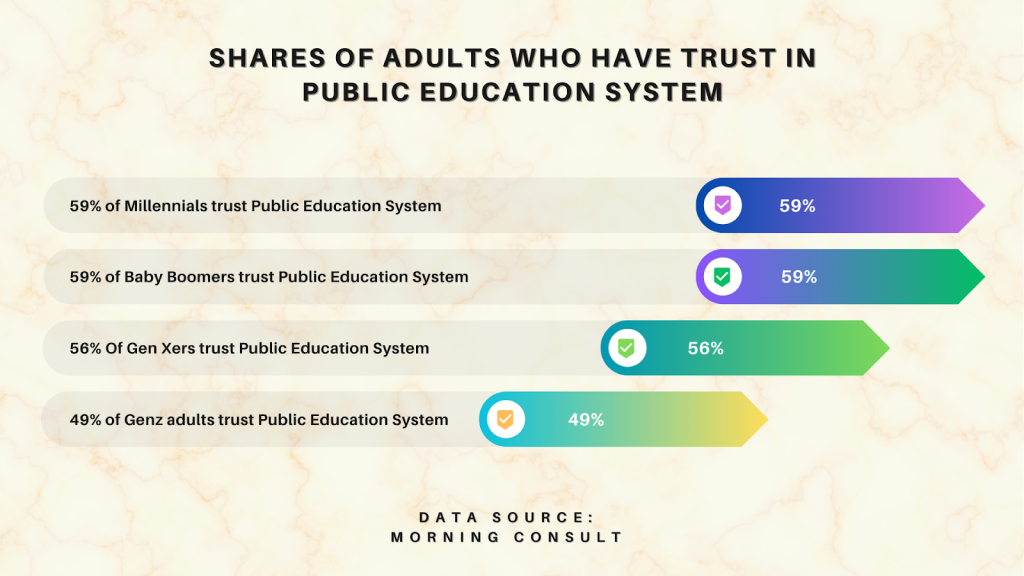
People Losing Trust in College Degrees
According to the data collected by Morning Consult, Gen Z has the lowest trust in the education system of public colleges or universities. They also revealed that in October 2020, 62% of adults supported the public education system, and now, as of May 2023, the numbers have decreased to 52.5%.
- Lower State Funding
Another reason for increased tuition fee is the decreasing financial support from the states. According to the data from the College Board, there is a correlation between the state’s funding and education costs. In the academic year 2015-16, the state’s funding was reduced by 11% as compared to the last 10 years, which is the result of a hike in education expenses.

Lack of State Funding Means the Burden of High Education Expenses Is Shifted to Students and Their Parents
At the same time, state funding is only related to public universities, as these colleges and universities are affiliated with the government. So, a reduction in state funding would have little impact on private universities but more on public universities and scholarships for college students.
- Operational Cost
Gone are the days when the things required to impart education were just different subject books, a professor, a blackboard, chalk, desks, and students. Now, the time has changed. Universities and colleges are no longer just institutions of learning and teaching. A classroom has become an e-classroom, with tablets on each and every desk.
Online learning is now the primary focus, with learning resources readily accessible on the internet, surpassing the significance of traditional learning methods.
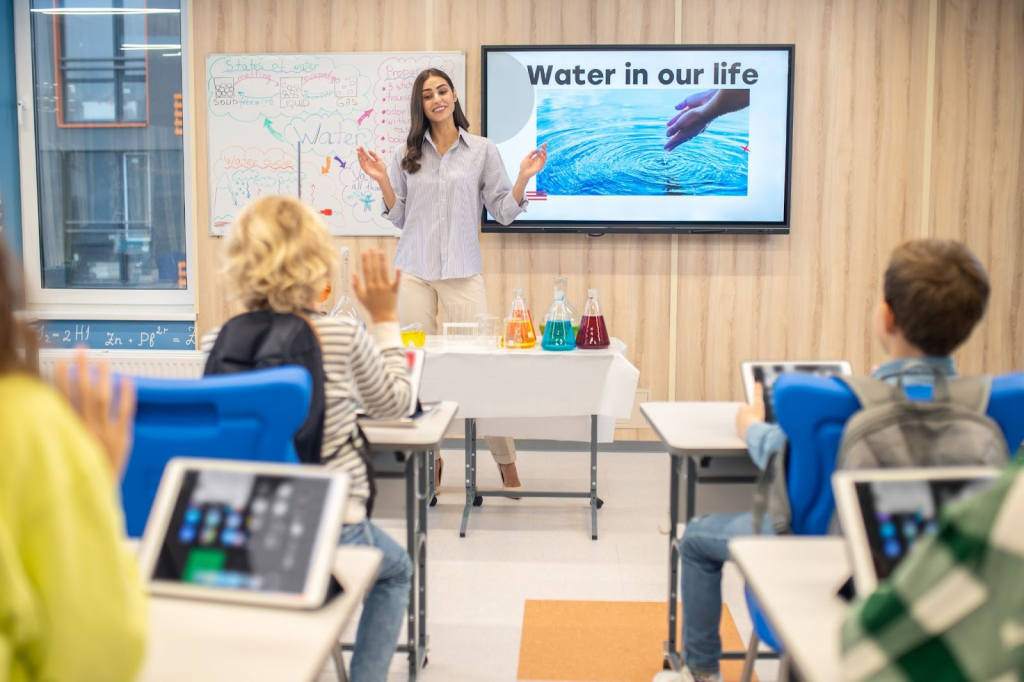
High-Quality Education Comes With High Education Costs
Many institutions now have full facilities and services like healthcare, technological devices, counseling, research, dormitories, and institutional support. These facilities and services take a major chunk of money from the university’s budget, which in turn leads to skyrocketing tuition fee. Moreover, universities provide quality education, so they have to hire highly educated people, which means high salaries.
You may also like to read: Challenges in the Current US Education System
Student Loan Statistics 2023
The ballooning education costs and student loans go hand in hand. According to Forbes Advisor, there is around $1.75 trillion student loan debt as of now, including federal and private loans. On average, one borrower owes $28,950. Moreover, 55% of public university students have educational debt, whereas 57% of private non-profit institution students take loans.
If we look at the statistics, student loan borrowers aged between 24 and 35 years owe around $500 billion to federal banks. Unfortunately, for some people, these loans do not leave the borrower’s side even after middle age. Not only this, people feel the pressure of repaying loans even after retirement.
Taking out a student loan is inevitable unless you have a scholarship or come from a financially strong family.
“Borrowing to pay for college used to be an exception; now it’s the rule.” – Arne Duncan, Formal United States Secretary of Education.
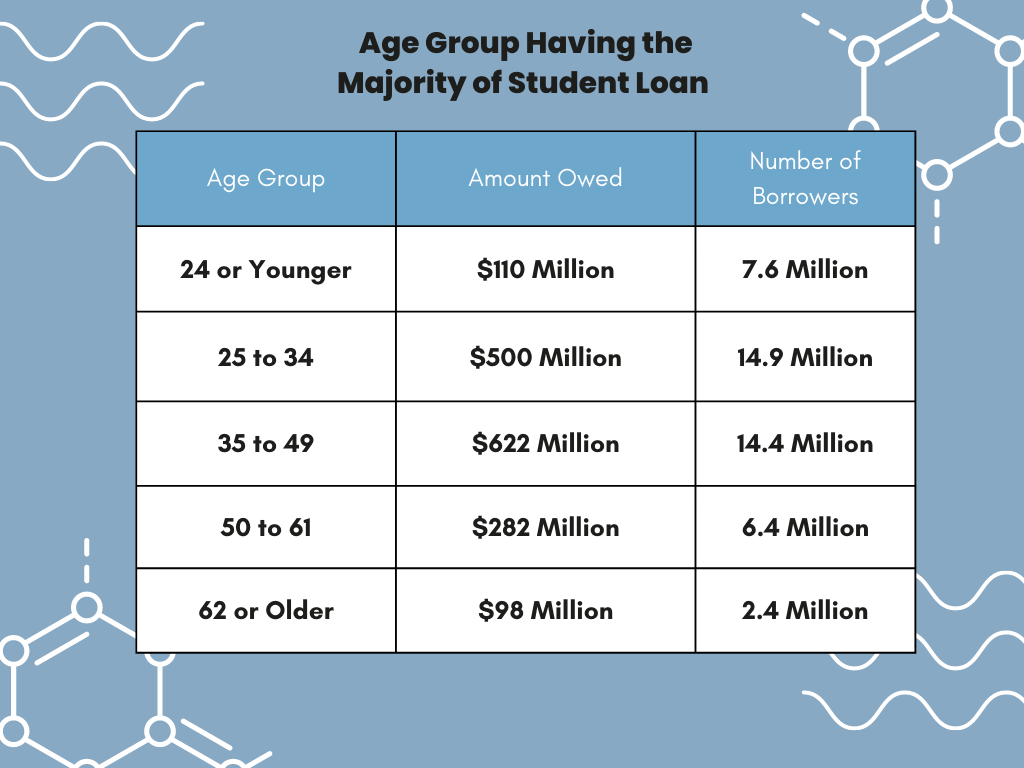
The Burden of Student Loan Remains With Individuals Even Beyond Their Retirement.
Federal Aid for Student Loan
In the year 2007, the Federal Government introduced the Public Service Loan Forgiveness Program (PSLF) under the act of College Cost and Reduction. Under the PSLF program, people who make 120 loan repayments while working for a non-profit organization or public service institution can get a portion of their student loans excused or forgiven.
According to the U.S. Department of Education, as of May 2023, more than 6,15,000 borrowers had successfully had their loans forgiven. PSLF has approved a total of $42 billion since October 2021.
The Public Service Loan Forgiveness Program is one of the most brilliant programs established by the government. It supports public employees, including professors, doctors, and policemen, as well as members of nonprofit organizations, by giving them relief from the headache of the installments of student loans.
How to Make Education Affordable?
In our January’s Industry Discussion, “How to Make Education Equitable and Affordable”, we got an amazing opportunity to invite and interact with brilliant speakers, Dr. Danny Barnes, Dr. Audrey Peek, and Lucas Kavlie.
Dr. Danny Barnes is a renowned Data Scientist and Cybersecurity Professor from Augusta University. Dr. Audrey Peek is a Senior Government Policy and Data Analyst from ACE University. Last but not least, Lucas Kavlie is a Vice President of Western Governors University.
All of these speakers made some really interesting points about how to make education affordable.
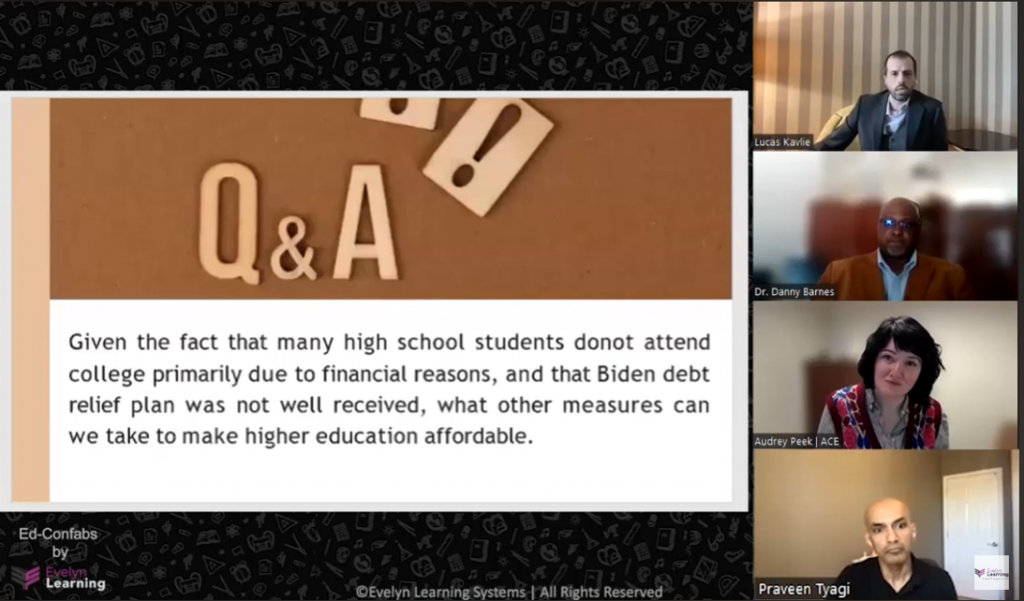
Dr. Danny Barnes. Dr. Audrey Peek, and Mr. Lucas Kavlie during an industry discussion co-hosted by Evelyn Learning’s CEO and Founder Praveen Tyagi and Content Analyst Tavleen Kour
Dr. Danny Barnes gave a great idea about opening a corporate education construct in a college where students can go to work as well as to classes. So, when they graduate, they’ll have a degree as well as work experience.
“A lot of problems are going around related to social-economic aspects, historical aspects, digital divide, etc. These problems are impacting the cost of education. There are two ways to overcome this situation. Schools should focus on e-books more which will help to cut down the cost of books from the cost of tuition. We can also guide students to take their early courses or generic courses at community colleges”.
On the other hand, Dr. Audrey Peek pointed out that there is an affordable college that’s right for every student. There are colleges that put students first and make sure they have minimal debt.
She advised everyone to use The Federal Government College Scorecard, which helps students to make their choice among the many options that fit their budget best.
“We have to help future students to avoid taking debt and struggling to repay it and that’s where we have to be innovative as well. The Federal Student Loan Program is broken and we need to fix it. There are some areas where a lot of improvement is needed like lowering student rate and improving student loan services. On the other hand, we want our states to increase funding to colleges or universities so that the education expense is reduced”.
Lucas Kavlie addressed that the problem of public relations is more than the problem with people being able to go to college, and there is always an ability to pursue tertiary or post-secondary education.
“When it comes to financial reasons, it should never be finance that eliminates somebody’s access to post secondary education. Individuals, who want money to attend colleges, there is money available but we’ve not done a good job of helping to guide them. We’ve figured out a way to reduce the tuition fee many decades ago in the United States by subsidizing primary and secondary education. But, tertiary and post secondary education are subsidized to a certain extent”.

Can We Afford Universities With Skyrocketing Education Costs?
How to Deal With the Problem of Cost of Education?
The increasing tuition costs and fees cannot be attributed to a single reason. There are a lot of factors that are responsible for this spiraling problem. Technological advancements, increasing inflation, reducing state funds, and certain economical challenges are causing this inevitable problem of the rising cost of education.
Now that we have somewhat understood the problem, it is important to find some backup plans and other options.
As said by Audrey Peek, students have to make their research game strong and find some colleges or universities providing scholarships, grants, or cheaper tuition fee. There is always an affordable college available for every student that fits right into their budget. Try finding resources online and gain as much information as you can.
According to Lucas Kavlie, there is always the ability to pursue education in a way that is either minimal or at no cost.
Also, if someone is ready enough to take a student loan, there are many schemes and programs started by the U.S. government to reduce the burden of repayment of loans. The information is out there, and you just have to grab it and seize the opportunity.
Lastly, a college degree is not the only criterion for judging whether a person will be successful in their career or not. If you’re interested in acting, singing, painting, designing, etc., you can make a career out of these fields too. You just need to be passionate about the career path that you’re choosing.
The post Why the Education Expenses are Rising and How to Deal with it? appeared first on Test.Evelyn.
]]>The post Gauging Student Knowledge Using Bloom’s Taxonomy and DOK appeared first on Test.Evelyn.
]]>Educators must use the most effective teaching pedagogies and types of assessments to help the students learn and succeed.
Comparison of Bloom’s Taxonomy and Depth of Knowledge.
Bloom’s Taxonomy and Depth of Knowledge are theories that guide ways to assess student learning. These are like standards that help teachers worldwide assess students on common parameters.
Bloom’s Taxonomy is a framework for categorizing educational goals and objectives based on their level of complexity and specificity. It was first introduced by Benjamin Bloom in 1956 and has since been updated and modified by other educators.
Bloom’s Taxonomy levels
There are six levels of bloom’s taxonomy
Level 1: Remember
Assessments in the remembering level are intended to check the student’s knowledge of the recently learned concepts and to know if they can recall what they have learned.
Level 2: Understand
Assessments in the second level of Bloom’s Taxonomy take recalling what was learned to the next level. It evaluates if the student can describe the learned concepts in more detail and in different ways.
Level 3: Apply
In the next level of Bloom’s Taxonomy, the teachers can gauge the students’ knowledge through their ability to practically apply it in real-life situations and solve problems using the concepts.
Level 4: Analyze
In the fourth level of Bloom’s Taxonomy, teachers can assess the student’s understanding of the various variables within the concept. The students are asked to analyze, classify and explain the relationship among the different parts of the learned concept.
Level 5: Evaluate
At the evaluation level, the assessment is based on the idea of understanding the students’ ability to make decisions and judgments based on the problems and situations of a learned concept. The student should be able to evaluate the lesson’s thoughts and uniquely critique their understanding.
Level 6: Create
In the last level of Bloom’s Taxonomy of learning , a student is assessed on the ability to create something new out of the learned concept. For example, a student can be asked to create a thesis statement or a new music composition, draw, organize, or produce a new piece of art.

Each level builds upon the previous one and represents a different level of thinking and cognitive complexity.
Levels in Depth of Knowledge
Depth of Knowledge, or DOK, is a framework that categorizes the complexity of cognitive processes that students must use to answer questions or complete tasks. DOK ranges from level 1, which requires simple recall of facts or information, to level 4, which requires students to engage in complex reasoning and analysis.
The four levels of Depth of Knowledge are:
Level 1: Recall
The first level assesses the student’s ability to recall information and lessons learned in classrooms.
Level 2: Skills and Concepts
In the second level of DOK, the teacher assesses the deeper understanding of the concept by asking them to answer various questions which use the knowledge of the learned concept. The students can be asked to do basic reasoning using the concept and compare the information.
Level 3: Strategic Thinking
In the third level of DOK, a student’s advanced skills of conceptual understanding are used to create situations, critical thinking, and problem-solving.
Level 4: Extended Thinking
In the extended thinking level, the student has the knowledge to use the concept to create a different idea, prove a situational impasse, critique the idea, and apply the concepts.

Concept: Webb, Norman L. and others. “Web Alignment Tool” 24 July 2005. Wisconsin Center of Educational Research. University of Wisconsin-Madison. 2 Feb. 2006.
Guidelines to use Bloom’s Taxonomy and Depth of Knowledge for creating Assessments
Using both Bloom’s Taxonomy and DOK together can help teachers create more effective lesson plans and assessments, as they can more accurately gauge the levels of thinking required of their students. For example, a level 1 question might ask students to recall a fact or definition, while a level 4 question might ask them to analyze, evaluate, and synthesize information from multiple sources.
Evelyn has created several assessment sheets and worksheets to help gauge student knowledge.
Evelyn developed the following worksheet, which is drafted so that teachers can check the memory of the lesson taught in the class. The questions in the worksheet are created to assess the remembering power of the students.

The Math worksheet below is an assessment that helps to gauge the student’s understanding of the concept. The stage from Bloom’s taxonomy concept is ‘understanding’; the worksheet is a level 1 question from the DOK’s concept.

Incorporating Bloom’s Taxonomy and Depth of Knowledge into Classroom Learning
One way to incorporate Bloom’s Taxonomy and DOK into classroom instruction is through learning objectives. Teachers can understand what a classroom wants and draft the learning objectives accordingly. These objectives can guide a teacher on how they want to pursue their lessons and how they would assess the students’ learning.
Learning objectives should be clear and specify the needs they are intended to meet. A well-written learning objective should be specific, measurable, achievable, relevant, and time-bound (SMART).
By incorporating Bloom’s Taxonomy and DOK into the learning objective, teachers can create goals targeting specific thinking and cognitive levels of complexity.
Assessment is another area where Bloom’s Taxonomy and DOK can be helpful. Teachers can use both frameworks to create assessments that measure students’ knowledge and understanding at different levels. This helps teachers identify areas where students may need additional instruction or support.
Another way to use Bloom’s Taxonomy and DOK in the classroom is through open-ended questions and tasks. Open-ended questions allow students to engage in higher-level thinking and can help them develop critical thinking skills. Similarly, open-ended tasks require students to use various cognitive processes to complete them successfully.
Conclusion
Incorporating Bloom’s Taxonomy and DOK into classroom instruction can help teachers create effective lesson plans and assessments and gauge student knowledge and understanding at different levels. Using both frameworks, teachers can ensure they provide their students with opportunities to engage in higher-level thinking and develop critical thinking skills. Ultimately, this can lead to better student academic outcomes and a more effective and rewarding teaching experience for educators.
The post Gauging Student Knowledge Using Bloom’s Taxonomy and DOK appeared first on Test.Evelyn.
]]>The post Types of Assessments: Online Vs. Offline Assessments appeared first on Test.Evelyn.
]]>Well, this is why we have assessments.
Assessments do not imply only tests. There are various ways for educators to analyze the learning standpoints of students and gauge their growth.
What are Assessments?
The book Learner-Centered Assessment on College Campuses: shifting the focus from teaching to learning by Huba and Freed 2000, explains assessment as:
Assessment is the process of gathering and discussing information from multiple and diverse sources to develop a deep understanding of what students know, understand, and can do with their knowledge as a result of their educational experiences; the process culminates when assessment results are used to improve subsequent learning.
Assessments Vs. Tests
There is a broad range of differences between assessing and testing a student.

Types of Assessments: Online and Offline
As instruction methods have turned online, teachers can also assess students online by leveraging the benefits of technology. There are many applications and tools available to help teachers assess students. For example, teachers can create online quizzes, game-based questions, open/close-ended questions, fill-in-the-blanks, drag-and-drop questions, polls, and so on.
Online assessments help teachers check the answer accuracy and deliver results in real-time in a shorter timeframe.


On the other hand, offline assessments are done in schools or any other physical location.
Offline assessments use pen, paper, and the physical presence of students and teachers in the classrooms.
Why are Online Assessments better than Offline Assessments?
There has always been a comparison between online and offline assessments, with one being convenient for some and inconvenient for others. Let’s understand how assessments in the online mode fare better than offline mode:
- Creating Multiple copies
Online assessments are easier to copy and send to all the students. There is no need for the teachers to make separate prints for individual students, unlike offline assessments.
- Flexibility in conducting assessments
Teachers can create and conduct online assessments from anywhere; they only need a computer and an internet connection. On the other hand, offline assessments are less flexible, as they usually require teachers to be physically present.
- Speed of Evaluation
Online assessments are easier to evaluate since artificial intelligence can help us analyze the correct answers and the results of the students in the class.

Offline assessments, on the other hand, require the teacher to mark all the individual tests on her own, which is time-consuming. It can contribute to teacher fatigue and delayed results.
- Record Keeping
When teachers conduct online assessments, they are not worried about where to store the information and care less about losing papers. One of the biggest benefits of conducting online assessments is having an organized record of everything. Teachers can keep records of individual students and their results and analyses using appropriate learning management systems and test tools.
However, when conducting assessments offline, teachers often use papers that have to be organized manually and stored.
Offline Assessments also have Benefits
While there is skewed support for online assessments, one cannot overlook how offline assessments beat the technology product in specific ways.
- Human Touch
In a classroom test, a teacher can assess whether a student understands a concept but got the answer wrong. In this case, a teacher can give some score to the student for using the correct process and not entirely failing the students’ answers.
However, this is not possible with online assessments, since students only submit their answers online, and the process of deriving the answer cannot be shown.
- Writing speed
Students may be fast at writing an answer, but not as fast as a bullet when using a keyboard. For some students, essay-type questions can be harder to complete when given online assessments, whereas students can work on their writing using pen and paper because it is easily accessible and every student can afford to get one. It is not easy for every student to get a computer system in their home so they can practice typing on the keyboard.

- Smooth Discussions
In a physical classroom, teachers can assess students based on their behavior and class response. They can talk more freely, and the teacher can even go close to the students and explain concepts to them.

It is challenging to interact with students in an online setting. Students may not feel the presence of their peers, so it would derive less of a feeling of a class for them. They may not feel interested in responding to the teacher, and their assessment score on class responses can go down.
Taking Blended Learning to the next level
Teachers can teach online and offline in a hybrid mode. They can teach using online tools in an offline location, which is also referred to as blended learning.
The teachers can also use the idea of blended learning and conduct assessments in different ways as there are various types of assessments. It can be a blend of fewer assessments being offline and the rest being online.
Teachers can plan their assessment types for different periods and curate which tests are more suitable when taken online or offline. For example, essay questions can be conducted offline during the summative assessment. In contrast, fill-in-the-blanks and gamified tests can be conducted online after every lesson is completed in the form of a formative assessment.
The post Types of Assessments: Online Vs. Offline Assessments appeared first on Test.Evelyn.
]]>The post Top 5 Advantages of Timed Worksheets for Kids appeared first on Test.Evelyn.
]]>Worksheets are sheets of paper that contain concepts of what is learned in the classroom presented in a fun and engaging way. In these worksheets, questions can be put in different forms like a game, quizzes, fill-in-blanks, and more.
Timed worksheets are also a way of designing worksheets where the students are challenged to complete the questions in a limited time. Parents and teachers have realized that there is a great advantage for children if they learn with the help of timed worksheets.
Books Vs. Worksheets
Learning and books are complementary to one another. Books are a set of compiled concepts about a particular subject or topic. They have lessons divided into chapters to make instruction easy and a step-by-step procedure.
Books are the primary source of knowledge for younger children.
On the other hand, worksheets supplement the books that enable active learning among students. Worksheets for kids have exercises to scrutinize the level of understanding that the students might have achieved from reading the books.
It would not be appropriate to say that we can substitute books with worksheets because worksheets can help the students and teachers achieve a particular learning objective (gained through books).
Advantages of Timed Worksheets for Kids
Young students may need help communicating effectively about their doubts, misunderstanding of concepts, and other gaps in the learning process.
These worksheets are like assessments to help teachers understand the gray areas where students find themselves snarled up.
Active learning through worksheets, help the teachers assess where the students need help understanding the lessons.

Worksheet created by Evelyn Learning for Grade 6 students to learn the concepts of addition with 4-digit numbers

Worksheet created by Evelyn Learning for Grade 6 students to learn the concept of multiplication by 10, 100, and 1000.
Apart from this, the advantages of worksheets for Kids are explained as follows:
Finishing work in a fixed time.
Students can learn with worksheets. We know young children are not very keen on sitting for a fixed time to devote themselves to a particular activity. Most of them loiter around, showing little interest in revising what they learned at school.
Worksheets for kids with fixed time can ensure that children finish the work exercises in a limited span. It can help parents to convince their children to sit and study effectively for a short time.
Engage Students in a Game
Teachers can design worksheets like a game.
Just as a video game has a time limit and some challenges that make it enjoyable, teachers can also design the worksheets like a paper game with knowledge concepts to work on.
Example: The below sheet shows a worksheet designed to develop children’s logical thinking and remembering skills through a shadow-matching game. Students may not find this boring because it is designed to be colorful and game-based. A student who practices such sheets in a timed-based manner can develop practical fast-thinking skills.

Develops Self-Study habits
Lower-grade students usually need their parents’ help with their homework. With worksheets, parents can engage children by explaining how to solve exercises, and then the children can do it independently. It helps to develop students to work independently and use logic.
Example: Students can complete their worksheets once they understand the working pattern. For example, in the following pattern, a parent can explain how to complete a worksheet for number 7, but later they can do the rest of the number sheets on their own. Their parents can supervise their timing, but they can complete the exercise independently.

Assessing Knowledge
Evelyn designs worksheets using the concepts of bloom’s taxonomy and depth of knowledge. In both these ideologies, the assessments focus on remembering the learned concepts, understanding them, and exploring their applicability in real-life situations.
These are among the most common and best ways to create worksheets for students to test their knowledge. Time-based worksheets are additionally helpful because they put a timer on a student’s mind, which helps them to think fast and intelligently.
Example: Students can answer questions related to identifying shapes and sizes that they might have learned in their geometry class.
Worksheets like these can help students to revise their lessons. However, a time-based worksheet can help them think fast, improving their cognitive skills and helping them to think, not just fast but also smartly.

Prepare Students for the Future
All competitive or regular exams have a time limit. A timer puts positive pressure on students’ minds and brings out the best in them. Timed worksheets for kids can help them to prepare for exams and increase their operating speed.
It is easier to shape a young child’s mind to train them to think effectively in less time. This not only helps them to prepare for their exams but also helps students to make timely decisions. Decision-making quality is essential in every individual’s life, and timely decision-making can be learned through practical training.
Just Another Learning Style
Worksheets are one of the ways that teachers can assess the student’s knowledge and, at the same time, engage students in active learning.
Worksheets help students to think logically and revise what they have learned through the books. Worksheets with a time limit can propel smart decision-making based on what they have learned. They have exercises, so they inculcate the habit of brainstorming, fast thinking, remembering, and applying learned skills in the students, depending on the worksheet’s intent.
The post Top 5 Advantages of Timed Worksheets for Kids appeared first on Test.Evelyn.
]]>The post Challenges in Education System: PJ Caposey interview appeared first on Test.Evelyn.
]]>An accomplished educator and motivational speaker, PJ has written around eight books, and his work has been featured in several notable spaces, including Washington Post, NPR, CBS This Morning, ASCD, Edutopia, the Huffington Post, etc.
It was enlightening and an honor speaking with PJ Caposey about the challenges in education. PJ gave us a glimpse of the ways how we can change the education system for the good of the students.
You have often talked about teachers reaching out to children for effective learning; how do recent teaching restrictions and salary concerns affect teacher morale?
The issue with teacher morale is both overstated and understated. We are in a time with a dramatic teacher shortage, particularly in the United States.
You may like to read: Things That We Should Know About the Teacher Shortage in America
Many people point to teacher morale as both a result of that and a precursor to that, and both can be true. The issue is that this is not a new or pandemic-related issue.

The teacher shortage is a decades-old problem and not a new concern
Multiple studies show that a cliff like that happened in 2008 when teacher responses to questions like, ‘Hey, I like my job’, or ‘I’m very likely to recommend’; all of that kind of fell off a cliff in 2008. So, it’s been on this downward spiral for a while. When I say this is not a new problem, I mean, this is literally a decades-old problem.
Morale, to me, is almost always like a climate issue that’s dictated by culture. So, when someone says hey, the morale is low, my question is, so let’s define the culture. Are we recognizing, appreciating, honoring, Valuing, or collaborating with?
If you’re doing those things, even if morale is low, it’s most likely to bounce back, if you’re not doing those things, and the morale is low, then we’ve got a serious problem that we need to address.
Your book ‘Students Voice-from Invisible to Invaluable.’ discusses the importance of students’ voices in learning. Do you think post-covid, the student approach to learning has changed?
I think that people are changing. Students are reflective of society. And I think, in some ways, they are demanding a greater voice in their learning, and there are positives and negatives to that.
I believe, every school wants to create community contributors that can communicate and able to think critically. I think that’s pretty universal, whether in Country A, Country B, or whatever.
If we want to create people that will make society better and be able to think critically, there is such a thing as experts, and I believe most of our teachers and leaders have expertise.

Students’ voices in learning is important for effective learning
So, for lack of a better term, even though I don’t know if one exists like a democratic model of education, it might not be what’s best.
That doesn’t mean that students shouldn’t have some choice in how they demonstrate their knowledge or the things they may study to practice the skills we say they need to master.
One of my all-time best examples of this is- we had a foreign exchange student early in my career that came from Bosnia.
And we were discussing the antecedents and causes of war, and the teacher wanted the class to focus on the United States Civil War. This person, a foreign exchange student, came from a war-torn country that had just experienced war and wanted to practice and master all the same skills but with a different prompt.
In my view, if we don’t listen to student voices in a case like that, that’s almost educational malpractice. But, that said, those types of examples are only sometimes there, which means that if we want students to research a classic novel and they want to do it on our recent publication in a magazine, those are two different things.
So, there’s this ray spectrum between trying to maximize and emphasize students’ voices. And then also saying there’s a right and wrong way to do things.
What do you think is the biggest gap in classroom teaching today: access technology, teacher shortage, classroom environment, or any other?
The most significant gap still exists between what is being measured in terms of how schools are reported. Some countries are considered successful in terms of education and what is likely to put kids in the best position to succeed tomorrow. So, for instance, in our district, we are very fortunate to have a lot of students that go to Ivy League schools and go to the most prestigious schools.
We also have many students in our area that enter directly into the workforce, the military, or whatever. Our desire to remediate any possible gap so that our test scores would look great sometimes run counterintuitive to what we could best provide for kids.
The second gap for me is geography. To explain, we are a small rural school, which means that my students live 60 miles to the East. They would have a much, much larger variety of offerings to take both on this-the advanced academic side and the excellent education side, simply because the schools are bigger and the volume of money that flows through, and the number of classes that can be offered are dramatically different.
Correspondingly, if you go 20 miles north, we have an urban center where education is much further because the school environment is different, where, you know, we might have a fight or two a year, they might have a fight or two an hour.
These students are having these vastly different experiences, So, when I look at education holistically, the biggest concern is that there’s just inequity by geography.
Would you like to give a message to our readers?
It’s to make sure that we’re doing meaningful work. If you ever find yourself in the throes of the day, the week, or the month and you’re wondering ‘why’, don’t ever lose that question of’ why’. If we lose that question, then the status quo is just going to be pervasive.
If we keep asking ‘why’, finding better solutions, and trying to make meaningful use of every hour of every day. We can do really good work on behalf of kids and our communities.
Watch the Full Interview:
The post Challenges in Education System: PJ Caposey interview appeared first on Test.Evelyn.
]]>The post Should I go to College? We Let Our Experts Answer appeared first on Test.Evelyn.
]]>Sonya, who hails from a family of highly educated (with postgrad degrees and PhDs) individuals, says, ‘I can’t accept this; she should at least get a graduate degree!’
So the teenager is now in a dichotomy and wonders, ‘ Should I go to college? Why is a college degree important? Is a college degree necessary to be successful?’
We got a similar audience question during our October webinar, “Learning Beyond College Studies,” and our speakers gave their expert opinions. You can watch the webinar here.
People Are Losing Trust In College Degrees
Society is divided into people who trust the education system and those who do not. But it does not mean that those who attend college necessarily believe in education or a degree system. They merely see it as a means to a promising job/career. But, unfortunately, this is what has been projected on us since our childhood.
School>College>Job>Money
This is a more conventional way our society has worked since the industrial revolution.
Then we had billionaires who were college drop-outs running the world’s biggest companies. This had people questioning, Is a college education worth it?
A global decision intelligence company named Morning Consult regularly researches how people think and behave, which helps leaders to make appropriate decisions. For example, in one of its recent surveys, Morning Consult found a trend in people’s trust in the public education system.

According to its data, Gen Z has the lowest trust in the public education system; the trend has been falling with every generation since Baby Boomers.
The survey also revealed that in Oct 2020, 62% of US adults parked their trust in the public education system, and today that number stands at 57%.
With time and technological advancement, people, such as social media influencers, stock market traders, or software developers, figured out ways to make money at home. These people needed education and some learning but not necessarily a college degree to pursue their passion.
You may like to read Why students should learn beyond college subjects and three ways to do that
Is College Education Worth it?
Our real-life experience starts once we are out of school life. Then, we enter the adulthood phase. We have to manage not only our expenses but also ourselves.

In our recent webinar, ‘Looking Beyond College Studies’, the experts spoke about the importance of college education.
Alok Jain, co-founder and CEO of an EdTech startup Moonpreneur.com has the following opinion on college education:
A college education is indispensable in specific streams; for instance, an individual has to study college to become a doctor.
There are other streams, like a software developer who might not need to attend the entire four years to get a good job and might only need a high school education and some training to get into the work industry. However, our schools need to prepare more to give industry-ready knowledge to their students to make them directly employable.
Here is an excerpt from Annette Ethcuit, a Coach and Mentor based in the UK and adept at understanding personalities and skill requirements at every level.
I think one should go for a college education. I am glad that I got a college degree even though my job was not based on my degree. But am I glad that I went to college? Yes.
I got to learn so much during that time. I learned several life skills living away from my family. Although a person never stops learning throughout their lives, studying in college lends you an environment to build confidence and a strong personality that helps you when you get into the workforce.
Here is another excerpt from Praveen Tyagi, former educator and the founder and CEO of Evelyn Learning Systems.
The question of a college education has many faces. It’s interesting how, recently, tech companies like Tesla and Facebook have been telling people that they do not need an actual degree to get a job in their companies.
But we see that when people apply to these companies and give interviews, there is a bias towards people who hold degrees. So those interviewers will look at what college you went to and what your CGPA is.
In my opinion, it is critical that we attend college. I agree when Annette says that college is an experience in itself. I had one of my best days when I was studying engineering.
But coming to another aspect of this question, do we have to have a degree to succeed? No. But college prepares us for our future endeavors and is a good investment.
Gen Z: Lack of Motivation for College Degree
Gen Z comprises young adults who want to ditch the traditional education path and follow their dreams.

Caption: Majority of Gen Zs do not find college education relevant
In a new Multiverse Survey, we learned that 72% of Gen Z believed college education did not give them the required skills needed to start their careers.
They mentioned the skills gap between college education and the industry, which is a demotivating factor in studying college.
Nearly 75% of Gen Z adults believe that it would be their first choice if they could get a chance to pursue their dreams without having to attend college.
They (60%) want to work (internships, apprenticeships, etc.) and gain experience rather than study in a 4-year program and start from the base.
The Fault in the Education System
There is a lot to be done with a college education. The cost of Education is escalating, which is cited as one of the top reasons for students not wanting to go to college.
For most of them, it is a cycle of working to study and studying to get work!
The modern adult says, ‘Ditch that college education and let me find jobs without the degree’.
If this is a reason, then in that case, the education system should be fixed in a way that can make college education more accessible and feasible. For example, we know that only some qualify for a grants program or a scholarship.
Making the Right Choice
The students must evaluate, and they need guidance. Proper counseling from parents and educators at the right time (probably high school) can help students understand what they want to do in life.
Randomly applying for courses can be a waste of time and money if the student wishes to pursue something other than a career in the subjects studied in college. Instead, parents, educators, or counselors can counsel students to understand what they want to do and their preferred career choice and then choose the career path accordingly.
A college education is an experience in itself. It gives us a brief glimpse into the real world of work and self-management.
A doctor might want to study medicine in college and cannot do without it. Another example can be a child who wants to be a musician and may or may not like to learn music through college.
Not only this, but as a society, we need to reduce the biases based on formal degrees and become open to skill-based hiring, which can give equal opportunities to individuals who are skilled and have experience.
The post Should I go to College? We Let Our Experts Answer appeared first on Test.Evelyn.
]]>The post Administrators need to have a vision and understand its value in learning: Jaime Donally on AR/VR appeared first on Test.Evelyn.
]]>Jaime is an educational consultant and technology enthusiast. She started her professional journey as a Math teacher and soon moved to instructional consulting.
Jaime is the founder of ARVRinEdu and Global Maker Day. She is also a persuasive author who has written extensively about immersive technologies in her books: ‘The Immersive Classroom: Create Customized Learning Experiences with AR/VR’ and ‘Learning Transported’.
I had the honor of speaking with Jaime Donally in our series of ‘Ed-Insights by Evelyn’.
In this series, we have a brief interaction with leaders and experts from the Education industry to help us get a wide and assorted perspective on various themes.
Jaime Donally joined us to talk about AR/VR in Education.
Also read about Influencing the Future of Education with AR/VR
She enlightened us on how AR/VR can be evolutionary for education and how important and easy it is to incorporate immersive learning into our learning methods. Here is the brief of what she had to say:
How can we include AR/VR technology in education given the resourcefulness of the schools?
It depends on how you’re using it. I am an advocate of using the technology we already have in schools first and then identifying if there’s a need later to expand that. I think oftentimes people think they have to go out and have a big budget and buy these high-end devices when that’s not the best place to start. It would typically not give you the biggest bang for your buck.
In addition to that, I do agree with its equitable access. Many of our students struggle to have the latest and greatest device on a personal side, and certainly, our classrooms are even behind that.
A lot of the tools that I share are available on older devices, and on devices that are mobile. The problem that we run into in education is the school district having an access to those devices, their owning them, and protecting them.

But we can maximize the idea by using the tools that our students are already bringing into the classroom, and tools they are already familiar with. We can leverage the tools that students (some of them if not all of them) do have access to, like Chrome books, computers, or iPads. So there’s a way to be resourceful about it.
Who, according to you (teachers, parents, or students) are more inclined or reluctant to include AR/VR in learning styles and why?
Well, the older you are, the higher probability that you’re not going to be as gung-ho ready to jump in. I am in my forties and I can understand how it feels to learn something new.
I think some of the problems that our teachers or administrators face is understanding what they are accountable for. So, are they accountable for bringing AR/VR into their district? Unlikely! They need to really have a vision for bringing that and understand the value of it. They can analyze how it meets students’ needs, and what students are building or capable of building with technology tools and then have some win over it, believe in it and buy into it, and that is only where the conflict mostly arises.
You may also like Technology in Education: An overview
On the other hand, students are really drawn to immersive experiences. That’s just naturally part of what they’re experiencing right now, including their social media and how they’re using technology. We have to give students an opportunity to deeply engage with technology and keep their enthusiasm spot-on with the learning outcomes.
The parents’ reactions are mixed. Some are excited about how technology affects every aspect of our lifestyles. Others express concerns related to privacy and data usage and I completely agree with that. Parents and students should be mindful of what information we are giving, who owns that information, and how it would be used. But we are slowly heading in that direction, which protects our data and privacy for students.

Students are excited for technology but some parents carry concern for privacy as well
How do you evaluate if the use of technology (AR/VR) has actually helped in achieving learning outcomes for students?
When it comes to what tool is valuable and what isn’t, I really think it depends on what our goal is. So for example, my husband who is a science teacher told me about a student with autism. The student comes with a person to support him in the classroom.
One day, that person could not accompany the child, so the child was all over the place that day. My husband gave him the incentive to use merge cubes if he finished writing and then let him understand the science concepts through the use of merge experience on iPad and the student was blown away. He was completely involved.
What we can learn from this is that we need to have sustainable technology around that can transform how students are learning.
Watch the Full Interview
The post Administrators need to have a vision and understand its value in learning: Jaime Donally on AR/VR appeared first on Test.Evelyn.
]]>The post Importance of cross-cultural programs in schools appeared first on Test.Evelyn.
]]>However, we can’t find the whole world in our neighborhoods. Children attending schools might meet people from diverse backgrounds and cultures. This is another exposure to their understanding of different cultures in their society.

On May 14, 2022, Japan Day organized the first-ever Japan Parade in New York City.
Remember, there are more international cultures than we might think, and they might not be present in our classes or neighborhoods. So it would only be good for students to learn about global cultures to help them envisage the variety of human beliefs and practices.
What are Cross-cultural Programs
Cross-cultural programs and exercises are common around the world. These programs, also called virtual international exchanges, are a part of a global understanding initiative. Students in schools interact with students from the same age group in another part of the world. Such an interaction can be in an extended course form that can be virtual, offline, or hybrid. They share their common cultural knowledge with their student counterparts and answer questions from each side.
This cross-cultural communication is essential for students to learn the fundamental differences between people from different backgrounds. It is another way of giving practical lessons to students rather than trying to read out to them. For example, an elementary school child might not understand how people from Asian countries have different accents until they talk to them through a virtual meeting.
Diversity is different from Cross-culture.
Diversity within schools is different from cross-cultural communication. We know America is a culturally diverse country. Various racial and culturally diverse groups form a large part of the American population.

American schools representing the diversity in their society.
A school might be called a diverse school when it represents the variety of demographics present in society in a good proportion.
Diversity in schools would mean an equal opportunity to students and educators from different societal backgrounds in educational institutions. On the other hand, cross-culture communication is a term that includes interaction and understanding between different cultures. It is broader because it comprises interaction with persons from different cultures within the neighborhoods and from other parts of the world.
Importance of Cross-Cultural Education
Understanding human behavior is not easy, but the awareness of different human practices can be a start. Immersing in gaining knowledge of another culture can make a student more aware as everyone might not get a chance to travel in different countries.
Knowing about different cultures helps us become sensitive to their common beliefs, traditions, and practices and generate genuine respect for them. Children who have learnt about different cultures can grow up to be more respectful and less stereotypical of others’ cultures.
It is just like learning a foreign language. It can be useful in future interactions with people who speak that language. Learning about another culture can make us more empathetic and behaviorally sensitive.
Additionally, it can open economic opportunities in other countries in the future. It can also help us work harmoniously with people from other cultures in our workplace.
Cross-cultural education, like diversity inclusion, can help students be more accepting toward others, irrespective of their backgrounds. Growing up among diverse groups and learning about different cultures can make students not only knowledgeable but also responsible as cosmopolitan citizens.
Why should cross-culture education be taught at the school level?
It is well known that young minds learn better. Schooling is when students learn about the basics because they have curious minds. They might ask relevant and irrelevant questions at this age, but they will learn and remember.
Some contrasting voices say that children are too young to learn about other cultures because they are still learning about their own. They believe that students should first understand their own culture in depth and value and then get a taste of the cultural practices of others.
Nowadays, with the help of social media and culturally-diverse programs on various channels, children can learn about cultures in different countries. While this is true, not every program is child-friendly, and often, those programs have stereotypes that can render misrepresentation.
With the help of cross-cultural interactions organized by different organizations, students can interact with other students of the same age. This can help them connect better with one another.
Conclusion
Global educators who promote equity in education also promote the idea of cross-cultural education. It is like value education, instilling values to know and accept people from other backgrounds. Global education can bring global understanding and act as a catalyst for international peace in the future. It can propel global collaboration among educators.
The post Importance of cross-cultural programs in schools appeared first on Test.Evelyn.
]]>The post Censorship in Schools: Will They Hurt the Core Purpose of Learning? appeared first on Test.Evelyn.
]]>Similar situations may crop up soon if certain proposed bills become laws in multiple states in the USA. Recent stories talk about how the State governments want to ban certain words, topics, and books from being taught in schools. Some people in America are also terming this exercise to be anti-public education.
But is it an act of prudence to dictate what the children will learn in schools, or should the education department become an independent body without bias?
Censorship in Schools
Many state governments have seen a rise in the number of proposed bills restricting what can be taught in classrooms to children. Political interference is causing discomfort to many teachers. It is becoming one of the main reasons why teachers want to exit the profession.
PEN America, a non-profit organization, observed that in 2022, 36 States introduced around 137 bills that put restrictions on teaching themes, like sexuality, race, gender, or the history of the United States. Additionally, many books face bans and are out-shelved by the school and other libraries.
Texas, for instance, has banned more than 700 books from the libraries of public schools. Teachers and superintendents have been tasked with reviewing all the books to check if their content is censorship-worthy.
According to the report, many of these bills have the potential to become laws before the end of this year. In all, such statements, termed ‘censorship in education,’ have increased to 250% in the last year.
39% of the bills introduced in 2022, the report mentions, are focused on higher education and many of them also include punishments for violations. The similarity between these laws is that they come from Republican legislators.

Data: PEN America, Chart: K-12 Dive
Understanding the intent on the other end of the stick
In a diverse society like America, some people support moves like book bans and curriculum restrictions. In their view, discussing ideas like sexuality, and slavery in American history, can unpleasantly influence students.
This partially comes from parents’ concerns about school lessons as a part of SEL. It is one of the reasons why many parents are also switching to homeschooling.
Parents are concerned that teachers might be trying to influence their children and teaching them to follow the so-called ‘Un-American’ culture. In addition, parents worry when their children are encouraged to come out of the closet and accept their natural sexual orientations at a young age.
So, what can be done to counter this?
This negative perception can be avoided if parents are invited to understand what the curriculum is all about. Parents can be encouraged become active in learning their child’s syllabus and then choose if this is right for them or not. Schools should communicate healthily with parents and explain the curriculum’s intent and content. If something is found outrageous by a majority, it should be excluded.
Reactions from Americans
Since these censorship in education have come into the picture in the last year, surveys have been conducted to understand the citizen perspective.
A majority of parents supported the following topics to be taught in schools. For instance, 87 percent of parents support teaching the Civil Rights movement, 74 percent of parents support teaching the history of Slavery, and 59 percent of parents agree to teaching the concept of Systemic Racism in American institutions and society.
Student Mental Health
The students have suffered due to the Covid-19 pandemic, which has disrupted regular school life. Following this, the narrative around the teaching shortage emerged, which spoke of this phenomenon affecting the quality of education in schools. And now, we see public schools coming under the radar for teaching specific topics while omitting others. These educational hiccups can affect students’ learning interests and make them emotionally vulnerable.
Students need stability and discipline to learn. If teachers are constantly in fear that them saying something might turn into legal action against them, no actual teaching would be taking place.
Partial or Uneven Learning
Learning can be partial if students learn about one part of history and not the other part of it.

CAP Data: PEN America
It would be a rather peculiar scenario if parents have learned certain things about history and their children have learned completely different things about the past. Learning should be even and truthful. Suppose the government opposes the idea of teaching concepts like critical race theory to younger children. In that case, they should be allowed to learn this in higher classes when they start understanding the credos of a prosperous society.
Conclusion
It is never really possible to ban information, because even though books can be banned and teachers’ behavior can be controlled, there is a technology where only some things are filtered. Students can still learn from the internet, which by large, contains only some authentic and accurate information. Legitimate books can portray ideas in a more sophisticated and acceptable manner.
The post Censorship in Schools: Will They Hurt the Core Purpose of Learning? appeared first on Test.Evelyn.
]]>The post Influencing the Future of Education with AR/VR appeared first on Test.Evelyn.
]]>Likewise, teachers try hard to make their teaching lessons interactive, exciting, and engaging. The teachers do that so that they are well-received by their students.
Generation Y was easier. They have grown up seeing technology transitions. But, on the other hand, Generation Z has taken birth in the lap of technology, while generation alpha has been talking about technology since infancy!
This is the age of augmented reality and virtual reality. We are all over the notion of building a super Ed-Tech system that breaks the ordinary. Our parents learned from books, we learned from e-books, pdfs, and now kids learn from an environment that blends the virtual world with the real world.
What is Augmented Reality Vs. Virtual Reality
It is a phenomenon where the imagination or elements pop out to the real world and give a real-life experience to an individual.

Source: Google
Like a fish can be seen in a person’s garden through digital technology by overlaying the fish(digital world) onto the person’s garden(real world). Likewise, virtual reality can be experienced by putting a VR device on the eyes.

Virtual reality is the concept of incorporating oneself into a digital world. It is a virtual world far away from reality. Augmented reality is reality going one step further, while virtual reality is a step into a different world.
How AR/VR can affect Education
Research shows that the Ed-tech industry is growing annually by approximately 18%.
This means that people are thinking about education in ways that could only have been expected almost a decade ago.
Learning about the human body through an augmented human body structure that can be seen from all sides is way more interesting than learning from a 2-D image in a book. Every body part can be extracted, magnified, and understood precisely.
Students in a design class can see which decor piece can look good in a particular corner by superimposing different digital decor pieces in a real corner on a digital device.

Bringing computer-generated graphics into reality can give students a real yet highly immersive experience. In fact, it can break their effort to imagine how something would look.
Virtual reality can take learning to another level. It can prevent the effort to go anywhere and learn simply through an eye-wear device.
Virtual reality does not bring a fish out of the ocean into our garden like augmented reality. Instead, it takes the person into the sea to see all the fish.
You may also like Virtual Reality Widening the Scope of Education
The extent of technology can go so far; we could only imagine it as kids. AR/VR can help students in a small town see the world virtually without going anywhere.
Why AR/VR is the answer to teaching the Next-Gen
Attention span is already compromised. Students can focus less on the text and carry shorter spans on visuals. AR/VR makes learning more colorful and closer to reality. Students like to learn through experiences rather than memorization.
Also Read How to Make Content for Students with Short Attention Spans
They would love to see how a man used to walk in the early days and write perfect answers on tests. On the other hand, they would detest learning how an early man looked and then describing it in detail.
Visual memory is considered better and longer than verbal memory. So, for the students, especially the Gen alpha, AR/VR is one of the best ways to teach.
Tools for students to incorporate AR/VR in their learning
Students can choose from various tools from the digital libraries that can help them get an immersive experience in education.
Apps like Quiver help students color objects and see object animation. Tools like Arloon Chemistry help to arrange and rearrange the molecules to understand chemical reactions and formulae.
Certain apps can induce an augmented reality experience for students, like the Blippar app. This app allows students to bring an object in a picture alive digitally.
Medical students can benefit from HoloAnatomy, the application that helps to learn medical circumstances through AR simulation. It allows the students to understand the human body in depth with the visual experience.
Investment in AR/VR
There are specific free tools that students can conveniently use in their classes. However, some devices come with costs, and every student might be unable to afford these apps. However, a school might be able to invest in some of these AR applications, which enhance the learning and teaching experience. Schools can think of this as an investment. A teacher’s job would become less complicated as it would become more accessible for teachers to explain concepts to students and have all their attention.
It would only come to reason when the school districts and the administration care to unleash the power of technology and make it accessible to students to improve teaching methods.
The post Influencing the Future of Education with AR/VR appeared first on Test.Evelyn.
]]>