The post What is Homeschooling and other FAQs appeared first on Test.Evelyn.
]]>Kirk Cameron is an actor, filmmaker, and the maker of the documentary. He says, ‘this movie is a deep dive into the normal lives of American homeschool families who are on the mission of putting faith, family, and freedom back into learning.’
Now that sounds serious and like an upcoming movement!
Homeschooling gained traction during the pandemic for obvious reasons. But what intrigues us is that it has still not gone back to the pre-pandemic levels. This means that parents are not backing out of homeschooling. They are still unsure about sending their children back to school. They actually like it this way!
It has been this way for quite some time, except that the reasons may differ now. For example, parents in earlier cases may have homeschooled their children for religious or pecuniary reasons. However, they prefer Homeschooling now, even when they can afford to send their children to these schools.
What is Homeschooling?
Homeschooling is not a new concept, but it is demanding the limelight now. To homeschool children is to educate them at home with tutors or parents, without sending them to public or private schools. It is an exciting notion to keep your children away from school. Parents can teach them whatever they feel is good and important for their children.
The idea of Homeschooling was put forth approximately in the 1970s by John Holt, an educational theorist. He had an ideology of teaching children at home for the first few years of their academic life. This ideology came from the traditional school system fatigue, a system where memory and stressful learning were common. He urged the parents to ditch the regular school system and homeschool their children. His ideology spelled that the automobile of education can be chosen, but the paths of schooling can be different.

Homeschooling for children can be self-paced and stress-free.
Why do people homeschool their children?
The US Census revealed that the number of parents who homeschool their children increased by 63% in 2020-2021. Data finds that some of the parents who had homeschooled their children during the pandemic are considering continuing it even after the reopening of schools.
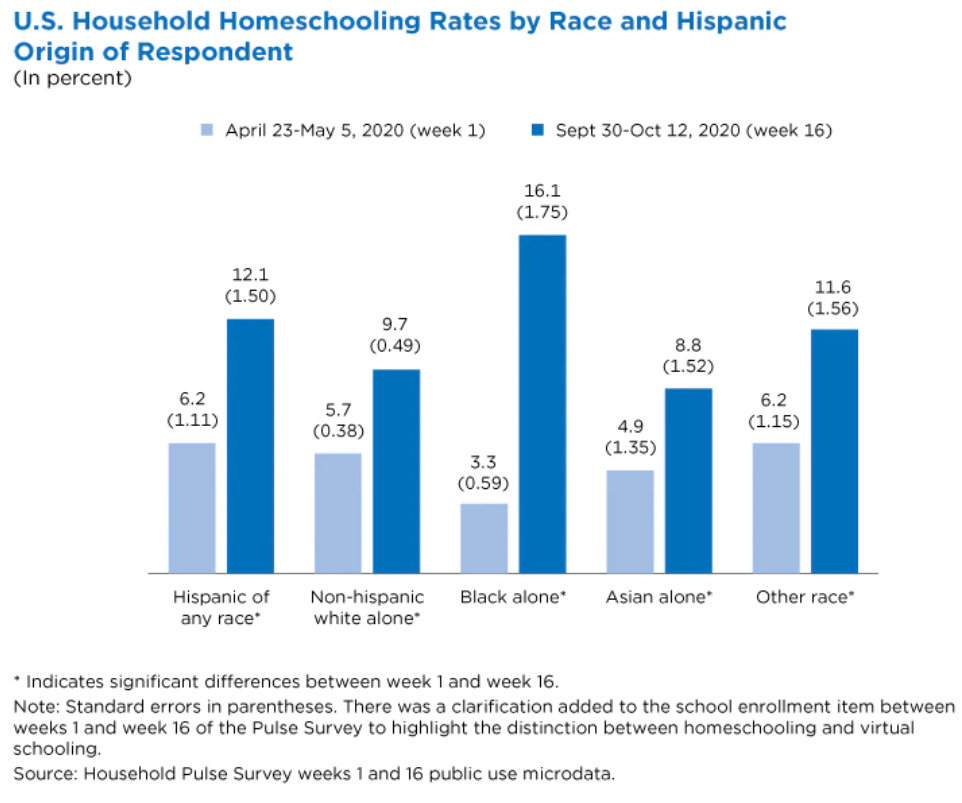
Source: US Census
The trend shows that not all parents are happy with their children’s schooling. Be it sex education, SEL education, or any other part of the general curriculum, parents want to take control of what their children learn in their lives, including knowledge about their faith and history.
Homeschooling parents keep their children out of typical school life for multiple reasons, some of which are:
- Disliking the school curriculum and teaching methods
- Financial burden of expensive schools
- A desire to spend more time with kids and get travel flexibility too
- Keeping kids away from bullying or discrimination at school
- Religious reasons
What homeschool programs can parents use to teach children?
Homeschool families consider the world to be their children’s school and life to be their curriculum.

Parents can also give social values to their children effectively
Homeschooling parents need to be aware of the state laws before they can start teaching their children at home. They can consider what kind of curriculum they want for their children. For example, biblical learning like Bob Jones homeschool curriculum or a free, online one like Easy-Peasy curriculum.
Parents can find homeschool coops to interact with families with similar homeschool interests and take help from one another.
Some parents can teach their children, and others can hire dedicated homeschool educators. Families can either purchase or create a homeschool curriculum through different resources. Some agencies and online platforms act as resource pools having the courses and curriculum for grades ranging from kindergarten to high school.
Ed-tech companies also play a pivotal role in homeschooling children from remote areas. Online Ed-tech platforms like Study.com help provide tutors, online courses, and video lessons that help in distance learning.
Are Homeschooled children less social?
Kirk Cameron, through ‘Homeschool awakening,’ advocates that homeschooling is not just reasonable but also healthy for children. He believes that there is nothing a child cannot learn at home in the presence of their family.
Pro-homeschool parents feel that their children are not learning in a restricted campus environment, as it is in everyday schools, but in a real-world environment.

Homeschool co-ops are becoming popular and help students to socialize
They interact with members of their families, neighbors, friends, and other people, and the question of becoming antisocial is practically irrelevant to them.
Learning Pods
Learning pods are like micro-schools. Homeschool families create small groups of their own to share learning experiences and cross-teach or hire a facilitator to teach their students the same subjects. It relieves the parents of the burden of teaching all subjects to their children, increases their socialization time with same-age groups, and helps kids learn from subject experts.
Is Homeschooling the Best for Our child?
When it comes to children, everyone wants to have the best school, the best food, and the best life for them. This is a natural parental desire. Parents are beginning to realize what they want their children to learn and not what the government-recommended syllabus is.
On the other hand, many parents feel that what the public schools teach is suitable for their children and their guidance. They do not have the time or the influence to take the entire school education of their children into their own hands. These parents believe that if they did well after learning in school, their children would too.
Which way of schooling should be given depends on multiple factors. As we said before, there is not just one way to education!
The post What is Homeschooling and other FAQs appeared first on Test.Evelyn.
]]>The post Learning Experience Design or LXD appeared first on Test.Evelyn.
]]>What is Learning Experience Design (LXD)?

LXD is the acronym for learning experience design and best refers to the process of creating learning experiences. The focus of creating such designs is to make the approach human-specific and goals inclined so the best outcome ventures from it.
Specifying LXD, it has several design disciplines at its core with the prime objective of the field of learning. Some key design principles used in LXD are interaction design, user experience design, experience design, graphic design, and game design. Let us get a clear picture of LXD by breaking the concept into 3 parts.
Experience
Knowledge comes to us from experience and might be in multiple forms, not limited to education. Knowledge gathered from home, any outdoor areas, or work and experience obtained from any place is worthy of a shot. These experiences are what matter. Hence, LX designers need to integrate such experiences.
Design
LX design is all about the creative design discipline, the applied form of art. Research, experimentation, ideation, conceptualization, prototyping, iteration, and testing goes toward the process of LX design. Designs of the process have one objective – provide value or provide elegant solutions. Here, the design discipline denotes a design detail that teaches.
Learning
Defining LX design is about how the candidates learn, not the teaching pattern or the training schedule. The catch is to know the designs and efficient approaches of using the design that endorses learning. The end game is to curate a learning experience that works and lets the learner absorb much.
Other facets to this concept as we already know are human-centered and goal-oriented.
Elements of Learning Experience Design
The success of the eLearning courses of LXD depends on four key elements as described. Before we go through the elements, let us brush up on the basics, that is, the difference between UXD and LXD.
UXD or user experience design is used to enhance user experience and is used in the product development field. On the other end, LXD leverages the UXD principle to provide an enhanced learning experience in eLearning courses. LXD makes technology in favor of the learners.
Now, let us get started with discussing the elements.
Understanding Learners
Learners do not necessarily begin from the same origins as others do. Some learners are newbies, while others have already built up the base level and wish to go advance. The experience curve that LX designs create does not have the same origin for everyone.
LX designers, with the help of multiple tools, learn about the experience level of the candidates. Then, they get started with creating the design and add facilitation of skipping a few sections. This allows learners with some knowledge to skip past the sections they already know about.
Experiential Learning
One of the primary reasons why traditional corporate training fails is because they are inclined toward tasks and not experience. Though mainstream training seems reliable, it may not essentially be of value and fun.
LX designs leverage the traditional aspects such as functionality, usability, and convenience and add the missing parts. LX designs let learners move past the traditional offerings and engage them in a great way. The learning has the end course of action where learners find the solutions themselves.
Engagement and Motivation
Content competence apart, LX designs must indeed design a course for humans. The idea should be to create a design that learners would find entertaining, engaging, and valuable. Learners must feel they are getting a lot more in return for taking up the course and there is no compromise.
Sensory Layer
While crafting the learning course, another aspect that LX designs consider is the sensory experience of learners. Each and every aspect of the learning program must be in line with the sensory experience of learners. Designers should ensure they collect from the learner’s senses and amplify the materials and instructions accordingly.
Phases of Learning Experience Design
When you want to create a learning experience design, you need to set for a journey of uncertainty and adventure. The approaches that LX designers use often reciprocate that journey and there is a streamlined process to it. There are 6 collective steps or a rough draft of how the design phases go:
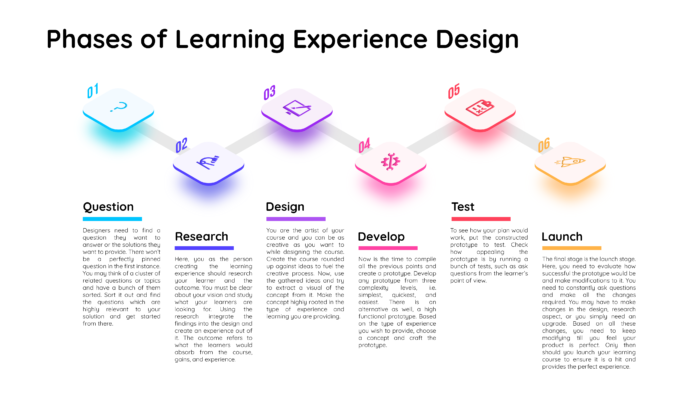
Learning Design v/s Instructional Design
Confusion between LX design and instructional design is an obvious phenomenon. The look of it might be the same, but they are entirely different concepts when you dive deep into them both. Precisely, instructional design is teacher and teaching-oriented, while learning design is learning and learning outcome-oriented.
For more information on preparing for the LSAT, visit our blog.
Create. Engage. Inspire.
The post Learning Experience Design or LXD appeared first on Test.Evelyn.
]]>The post Online Learning Challenges & Solutions: For Teachers appeared first on Test.Evelyn.
]]>Students and educational staff are seeking solutions to the challenges associated with digital learning, such as staying focused while studying at home or having limited access to the internet and reliable devices. Fortunately, unexpected times demand creative problem-solving, and many have proposed innovative ways to overcome the challenges associated with digital schools.
Here are some challenges and solutions for making learning at school possible and effective for both teachers and students:
1. Engaging Students During Online Class
Teachers may find it difficult to adapt to a brand-new learning platform as students are moving toward online learning from traditional classrooms. In some cases, online teaching can be less effective in influencing and engaging students for longer periods of time. Students are most likely to become distracted or lose concentration during live sessions.
How to Overcome the Challenge?
In terms of tools and platforms to engage students in studying, online learning has a lot of advantages. Consider using these tools and multiple learning approaches such as podcasts, videos (teaching channel, own videos, live classes), discussions, various forms of text (articles, blog posts), various assessment methods (tests, quizzes, assignments, and projects), as well as collaborative learning activities.
2. Lack of Right Teaching Methods in Online Learning
The majority of teachers follow traditional classroom-style teaching methods, using only a blackboard and a book to instruct. Most importantly, some teachers find it difficult to adapt to completely virtual and technology-driven teaching methods.
How to Overcome the Challenge?
The most significant factor is to become comfortable with a virtual classroom. Teachers should identify different types of tools that facilitate teaching and assessment. There are many teaching methods that can be implemented to improve students’ learning, such as conducting different activities, making models, debating, participating in group activities, taking virtual tours, discussing in groups, and performing role play.
3. Teacher Communication Problem During Online Learning Class
Having a detailed syllabus makes it easier for teachers to communicate with students. Some teachers do not have enough time to prepare content for their students. Also, students avoid communicating with teachers when they are learning online. The absence of body language in online teaching causes students to misunderstand, which can further cause them to underperform. Occasionally, students will request extensions or give reasons for their delays.
How to Overcome the Challenge?
Allow students to ask for a flexible deadline if they fail to meet their deadlines. Keeping in touch with the students is imperative, and teachers must know what kind of activities will accomplish their goals. Engage students in discussions about specific content and provide them with the opportunity to learn effectively. Also, allowing students to discuss practical questions can reduce frustration, increase problem-solving skills, and assist in handling technical issues. Provide students with a communication and collaboration platform that will allow them to communicate with each other.
4. Learning Management Systems
Teachers often have problems explaining their content to students, especially when it comes to assignments and assessments. In terms of the content of the courses, there has been confusion among students regarding the level of difficulty. In online learning, teachers report that they are not able to take advantage of the incidental interaction opportunities that happen in face-to-face communication.
How to Overcome the Challenge?
It is imperative to understand the importance of learning management systems and web technologies to help you in your teaching. Be sure to take advantage of all the workshops and training sessions you attend during teacher training. Learn effective ways of teaching and managing your classroom. In addition, you can speak with other teachers who are familiar with the online learning management system.
5. Comprehensive Course Content Issue in Online Learning
The course content was developed earlier in comparison to traditional classrooms. However, the shift from on-campus to online learning means that courses need to be redesigned, a process that takes a significant amount of effort and time. Having started well in advance would have resulted in more effective learning outcomes. Online courses generally fail to meet the needs of these courses’ needs compared to traditional classroom settings. Online assignments, content-related activities, and projects cannot be completed when this occurs.
How to Overcome the Challenge?
Understanding the course content and its relation to your online course is essential. Ensure you make a few modifications in terms of activities and assignments so that the concepts are better understood.
6. Assessment Challenge in Online Learning
Students and teachers alike emphasize the importance of assessment in online learning. At times, it can be stressful for students. Teachers may have to deal with a lot of questions from students whenever they have assignments or projects. Since students and teachers do not communicate as often, expectations for students’ performance also differ. Students can experience less homework, fewer assignments, or lack of exams from time to time. When this happens, teachers may have difficulty assessing students.
How to Overcome the Challenge?
Prepare FAQs for the common questions students might ask and understand the type of questions they have. Ensure regular tests and assignments are given. By doing so, you can assess students’ performance.
7. Time Commitment Issue in Online Learning
When the course is taught in person, you might not fully appreciate the time commitment. The process of converting those learnings to an online format is still challenging. For teachers, there should be enough time to properly plan the content and methods they will use to teach the students. Otherwise, they will not be able to provide students with useful information on time. It is said that online teaching takes longer than face-to-face teaching. In the case of students exceeding their deadlines for submitting projects or assignments, it can lead to more work for them.
How to Overcome the Challenge?
Communicate with your students in a friendly tone to establish rapport. A learning management system can be used to set deadlines for assignments. Inform your students a week before the due date.
Students today demand greater freedom in their education as opposed to rigid curriculums and limited subject choices. Today’s learners may be digital natives, but the use of technology for online learning can be overwhelming and challenging to motivate. However, when instructors provide the right support, learners can succeed within these online classes.
For more information on preparing for the LSAT, visit our blog.
Create. Engage. Inspire.
The post Online Learning Challenges & Solutions: For Teachers appeared first on Test.Evelyn.
]]>The post Digital Learning, E-Learning, Online Learning: What’s the Difference? appeared first on Test.Evelyn.
]]>What is Digital Learning?
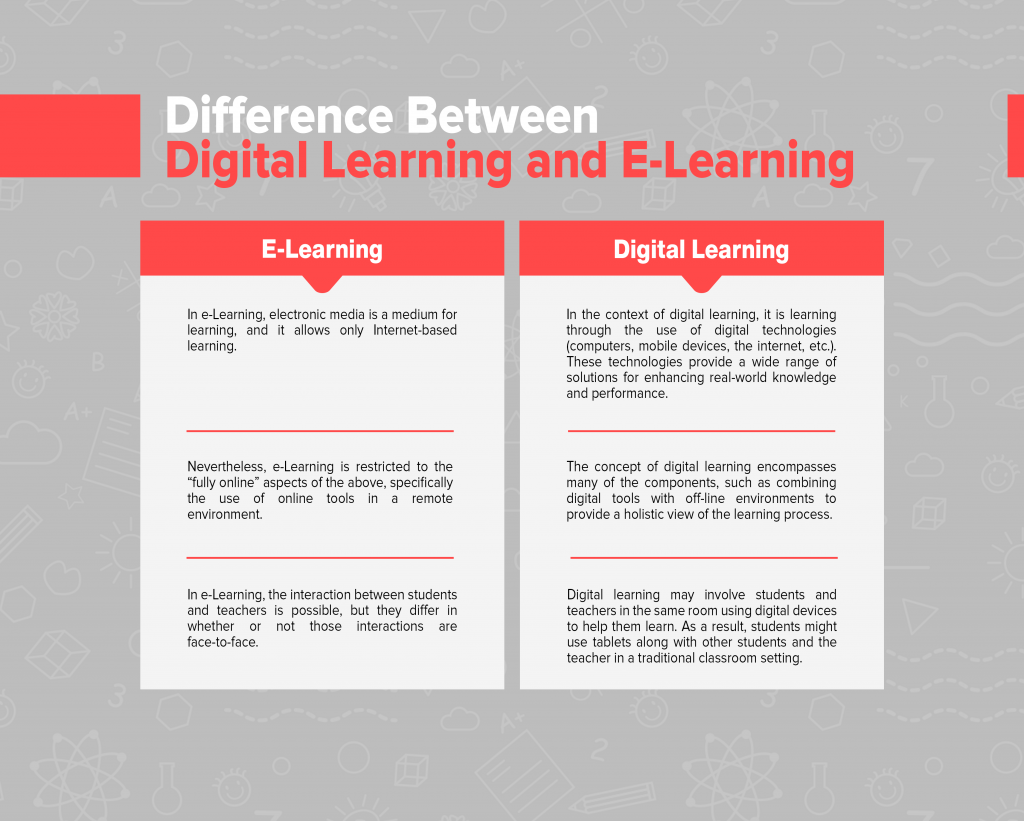
Digital learning is the most broad term. Any learning that is supported by technology or by instructional practices that fully utilize technology can be considered digital learning. An aspect of digital learning involves learning the use of technologies in an effective way, the use of features such as blended or virtual learning, etc. Besides, digital learning involves the use of technology, digital content, and instructional methods. Of course, digital learning includes online courses as well. Besides, using digital tools like interactive whiteboards and tablets in a classroom also involves students conducting Internet research or watching online videos.
What is Online Learning?
Online learning is a term that is similar to digital learning, but slightly narrower. The benefit of online learning is that it allows you to study and teach from anywhere in the world. As a result, there is no need to commute from one place to another or maintain a rigid schedule. The majority of online coursework will be conducted through forums, shared files, email, chat, etc. Nevertheless, it does not imply that a teacher and student do not interact face-to-face. As long as the primary means of communication is online, coursework can be conducted in a classroom or at a distance.
What is E-Learning?
The term ‘e–Learning‘ describes a formalized teaching system that uses electronic resources. It should be noted that, while teaching can take place in or out of the classroom, the use of computers and the Internet is one of the main components of eLearning. In some cases, neither the teacher nor the student meets in person. Furthermore, the course material and communication are handled via email, forums, chat, or video conference. Occasionally, this type, of course is referred to as a “fully online” course.
Difference Between E-Learning and Online Learning
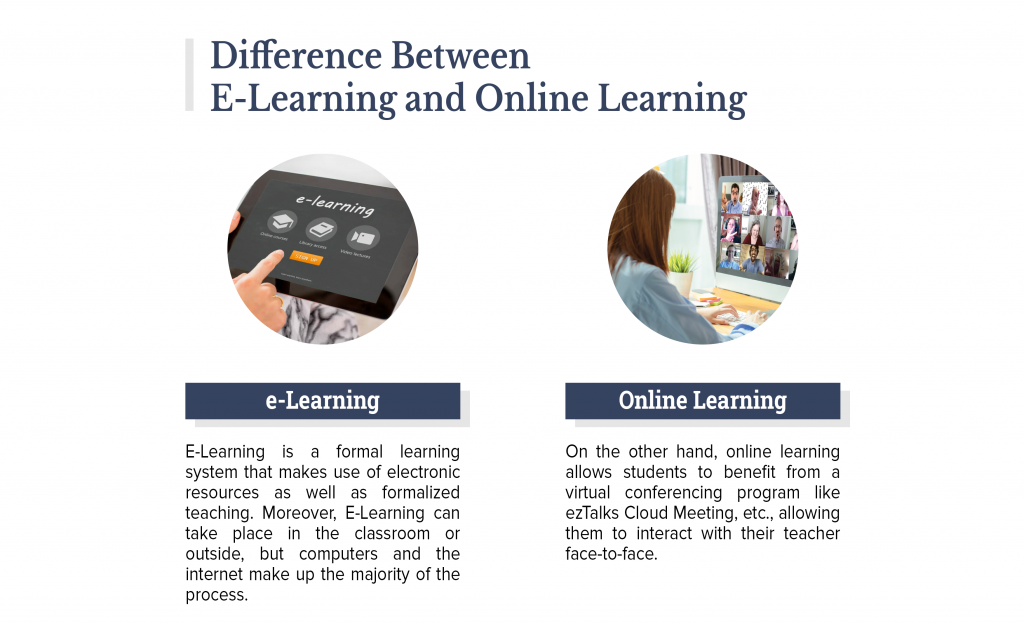
Features of E-Learning:
- A typical e-Learning course may contain PowerPoint slides and/or Word documents as well as a pre-recorded video lecture.
- Students are expected to review a substantial amount of information independently.
- PowerPoint slides typically contain textual explanations of the theory.
- Usually, video lectures are pre-recorded by teachers and show them browsing through PowerPoint slides while lecturing or simply talking.
- Such materials do not encourage students to think while simultaneously learning.
Features of Online Learning:
- A professional online tutor or teacher is available to assist online learners.
- Instead of watching a pre-recorded video lecture, the course is conducted live.
- A tutor or teacher discusses the materials with a student during a live session (such as worksheets, test papers, homework).
- With the help of the tools and features presented on the online platform, the learning and teaching platform can help both tutor and student communicate what they want to say. A common feature of online learning platforms is an interactive whiteboard, on which tutors and students can upload materials (e.g. textbook questions, test paper questions, theory to be explained).
- The features of the platform allow tutors and students to point out the information they are looking at easily.
- Additionally, students can ask questions or state their thoughts during the live lesson with online learning. Besides, teachers or tutors can answer all of their questions and clarify their doubts on the spot.
The main difference between eLearning and online learning is the amount of interaction. Students and instructors interact more during online learning, while eLearning is more self-paced.
Difference Between Online Learning and Digital Learning
As a new social process, online learning is now replacing both distance learning and traditional face-to-face classes. With a digital learning approach, you are learning using technology such as a computer, mobile device, internet, etc., which can provide you with a wide range of solutions for enhancing your knowledge and performance in real life.
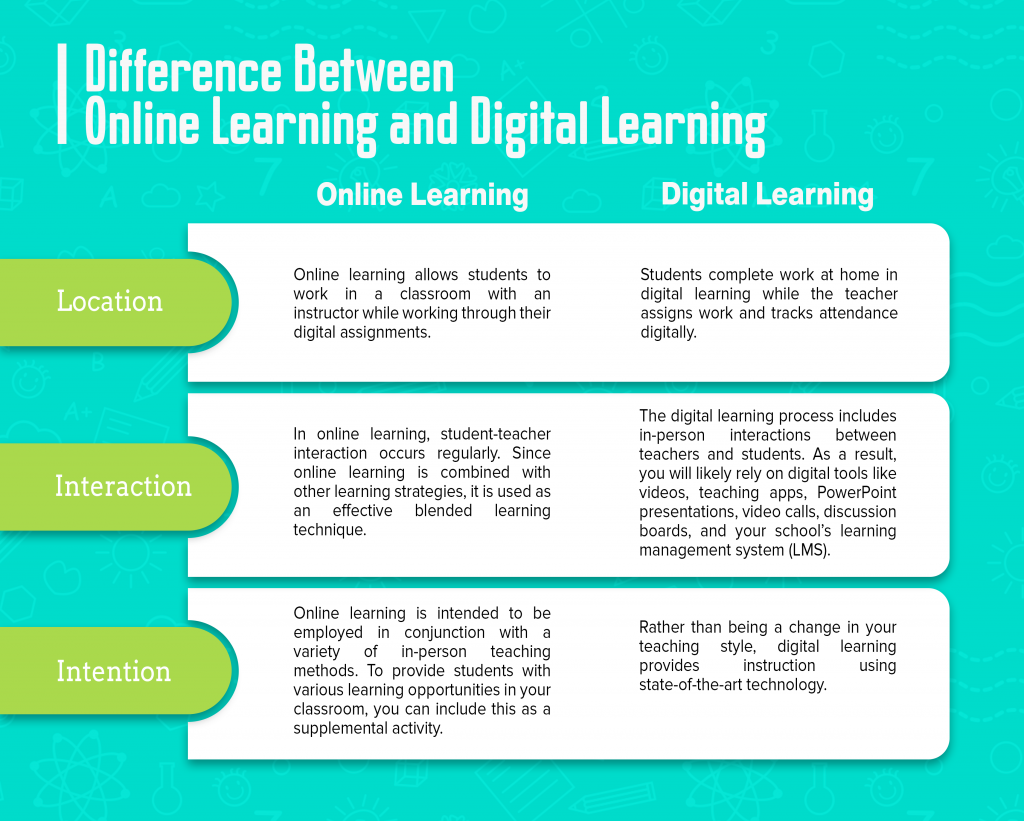
Difference Between Digital Learning and E-Learning
Despite sounding similar, there are subtle differences between them.
In recent years, education and the mediums of education have undergone a significant change. An individual can determine which educational method works best for him or her. Increasingly, students are becoming more independent and less hesitant to seek education on their own. Thanks to the internet and other modern advancements, students can receive education from anywhere in a variety of ways.
For more information on preparing for the LSAT, visit our blog.
Create. Engage. Inspire.
The post Digital Learning, E-Learning, Online Learning: What’s the Difference? appeared first on Test.Evelyn.
]]>The post Formative Assessment Tools For Classroom Learning appeared first on Test.Evelyn.
]]>Features Of Good Formative Assessment Tools
The following features should be present in a good formative assessment tool:
- It should be goal-oriented and based on what we do daily. A good formative assessment is precise, tangible, and measurable since it is intended to assist students in performing well.
- Formative assessment tools need to concentrate on higher-order thinking abilities. We are not just concerned about the nuts and bolts but also need to know if the students are using the higher levels of resources to submit, analyze, evaluate, and develop.
- It should keep students responsible for their results. In and of itself, group evaluation is beneficial. Furthermore, pinpointing the specific needs of the person will provide you with direction in which to guide your teaching, ensuring that the students are successful.
- Good formative assessment tools should be smooth, and you should not have to alter your daily routine to accommodate the exam. Some formative assessment tools have a steep learning curve, while others are simple to understand even though you have no prior experience. You may need to incorporate formative evaluation into your lesson. Some of it can be done on the fly, but others will need planning.
Top Formative Assessment Tools For Classroom
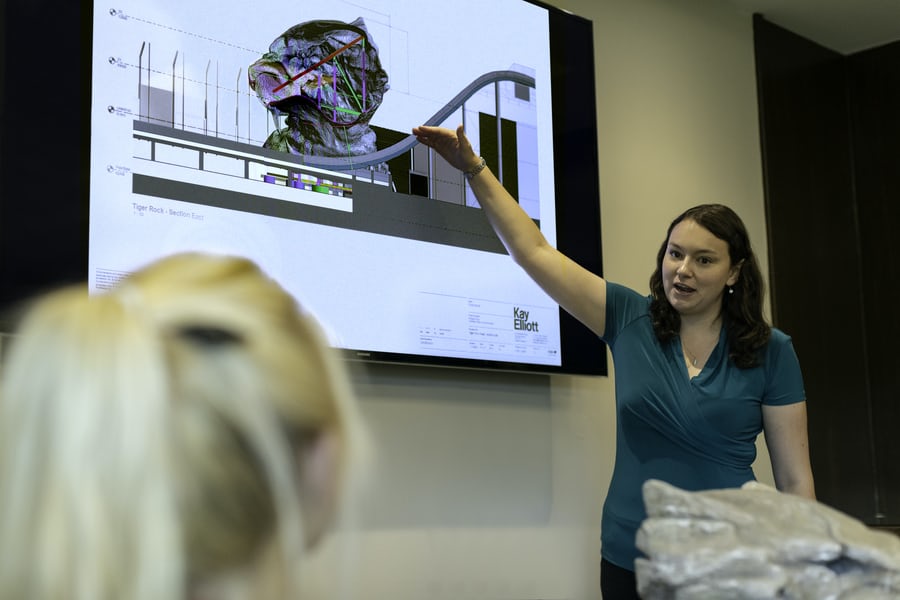
Students can be motivated to pursue learning goals as a regular and continuous part of their everyday routine using digital formative assessment tools. Here are five free formative assessment tools to assist you in integrating technology into your classroom. The list includes a wide range of features and alternatives to aid in the development of your formative assessment strategy.
1) Socrative:
Socrative offers real-time scoring on quizzes and questions. According to various online reviews from teachers and qualified reviewers alike, Socrative is one of the top-rated formative assessment tools for teachers. It is an immersive digital platform that allows you to quiz, score, and test on the fly; “learning at the speed of light.” Fast queries for immediate input, class counts to see who is logging in, and complete quizzes for deeper comprehension are all available to teachers.
Build surveys, activities, and shuffle questions with or without student names using this powerful method. Quizzes are graded in real-time and can be saved for later use for different classes. It operates on MS Windows, Android and iOS phones, tablets, laptops, and other computers. It is completely free for students, apart from being straightforward, adaptable, and aligned with Common Core.
2) Padlet:
Padlet is a virtual wall where students can share their thoughts on a given subject. You may embed audio and video in addition to written speech and have students answer in the form of a structured discussion. It is also possible to create separate Padlet for different classes or groups of students using password protection. For instance, using Padlet, you might have students identify keywords and address areas of agreement and disagreement with what their classmates have written.
3) Google Forms:
Google Forms is an easy-to-use, COPPA/FERPA-compliant tool. What is the best reason to use Google Forms as an educational formative assessment tool? The ease with which it can be used. Even if it is your first time using Google Forms, it is a favorite among teachers because it is fast and easy to build and automatically grade quizzes.
Make multiple-choice or short-answer quizzes with a simple answer key that includes point assignments for each problem. Students can quickly respond to questions by selecting an option from a drop-down menu, typing a quick text response, or uploading a short YouTube video to Google. For a fast bird’s-eye view of the class as a whole, teachers can view graphs and summaries of often missed responses.
4) Mentimeter:
Among evaluation instruments used in the classroom, professional reviewers and teachers give Mentimeter a high rating. It includes a listening skills assessment, icebreakers, formative tests, post-lecture surveys, and polls, as well as other educational models for the classroom. Create quizzes and assessments, monitor academic standards, engage students, and even lead a teacher training session.
Mentimeter not only gives everyone a voice but also has a handy feature that allows you to silence extra-loud students. It is completely free to use and allows you to build and host live quizzes using templates or from scratch. For a few dollars a month, schools and universities can get a Pro edition that includes unlimited question slides per presentation, exports, unlimited quizzes, and help. The user interface is easy on a 101 basis, with tech support available to smooth out the kinks.
5) Kahoot:
Kahoot‘s game-based approach to learning and evaluation is a hit with students. Teachers can select from over 40 million ready-to-use learning games or quickly build their own. Organize games in real-time or as tasks.
Students may also make their own “kahoots” to share with their peers, making the activity more social. In minutes, you can create a quiz game, import questions from spreadsheets, and check their 500-million question bank. Want to incorporate sketches from your iOS device or merge multiple mini-kahoots into a single assessment? That is something Kahoot can do, besides incorporating YouTube videos into your questions.
Teachers can apply multiple choice or true/false questions to the evaluation games, which students can schedule individually or in groups. The games are paced and graded, with the instructor establishing point scales. You can also download basic spreadsheet reports.
Concluding Remarks
In the physical classroom, it is simple to measure student success. We take for granted that paper assessments, quizzes, and spot questions are among the instruments used in the evaluation. For personalized virtual learning, the best online evaluation tools for teachers provide the same degree of input.
Formative assessment has the advantage of being completed when students are still learning. Formative evaluation methods that are fast and enjoyable are ideal for checking in on certain learning journeys. One final piece of advice is to choose one formative appraisal and personalize it. Do not attempt too many at once. Use one before the students have figured out how to do it and you have figured out how to interpret the data.
Read more about assessments on other blogs.
Image Sources: Shutterstock and Unsplash
For more information on formative assessment tools, visit our blog.

Create. Engage. Inspire.
The post Formative Assessment Tools For Classroom Learning appeared first on Test.Evelyn.
]]>The post Online Teaching V/S Traditional Teaching appeared first on Test.Evelyn.
]]>Online teaching for overall learning has become exceedingly common in recent years, with an increasing number of institutes and businesses offering it. Despite the prevalence of online education, a sizable portion of the population actively avoids it, mostly due to misunderstanding. The aim of the online education model is to solve the drawbacks of conventional education while also offering additional benefits. Students in a typical teaching model listen to long lectures, take notes, and memorize information by rote.
In the classroom, this leaves little to no space for constructive participation. On the other hand, online education promotes classroom engagement and peer-to-peer communication. Students can communicate with their courseware and acquire information in a far more engaging manner now that numerous types of online study tools are accessible.
While the current choices are limitless, let us face it: not all of them are appropriate for all students. As a result, in this article, we will compare the benefits and drawbacks of online and conventional teaching so that each of you can choose the choice that best suits your needs.
Benefits of Online Teaching For Overall Learning
- Lessons are usually taught in small groups and on an individual basis. This strategy, which is becoming increasingly popular, allows the teacher to learn about their students’ strengths and weaknesses in order to maximize class time. This is a means for students to establish their own learning pace and discover a safe area to connect with the instructor openly and freely.
- Distance education gives you the freedom to attend classes whenever and wherever you desire. The schedule is adaptable, allowing students to build a personalized study plan that meets their specific needs. There is no reason to sacrifice anything due to a lack of time.
- Online learning systems have a large range of courses to choose from. There is a course for everyone, from university to high school. Students can even earn a degree without ever visiting a university. Online teaching for overall learning also has a wide range of approaches to fulfill the demands of all types of students.
- In traditional education, every lesson requires the student to be present in the classroom. As a result, individuals must commute from one location to another, which takes time and money.
- There is no need to waste time commuting. Students can create a relaxing environment in their homes where they can concentrate. A classroom is no longer necessary. It is up to us to build the ideal environment for studying quietly and without distractions.
- The pedagogic resources for the lessons are accessible at any time and from any location. They can be accessed at any time, thanks to the digital format. These costs are eliminated with online education, and there is no need to waste resources.
Drawbacks Of Online Teaching
- It is insufficient to have a notebook and a pencil case on hand. A computer with a webcam, headphones (ideally), and a good internet connection are all students will need.
- In online teaching, there are more stimuli that can cause distractions: this can happen if the study location is inadequate. The student’s education is in his or her hands, thus it is critical to have a good area away from any potential distractions. The virtual environment is insufficient to keep the student’s entire concentration.
- Some students struggle to find time to study without a predefined schedule. Although self-discipline can be taught, some students are born with it. Online teaching for overall learning necessitates a compromise with the tasks.
- Not every subject can be taught online. A few subjects, primarily those requiring practice, are better learned in person. Nevertheless, there is a way to mix the two for the best outcome.
Online teaching for overall learning is a cost-effective and underappreciated option that allows students to study at their own speed. It also allows you to balance your studies and personal life. All of this comes from a single commodity: a house. Without sacrificing your education, you can learn while traveling throughout the world.
Furthermore, it saves you both time and money. There is no need to pay for transportation, the courses are generally more economical, and there are no geographical constraints.

Benefits Of Traditional Or Conventional Teaching
- Conventional education allows for group projects and student contact in general. As a result, they can learn from one another and share their problems and uncertainties. These social links can aid in the generation of new ideas and the stimulation of creativity.
- Traditional schooling can help students feel less lonely by instilling a sense of sociability and togetherness. The student may feel less alone in their academic struggles and may gain confidence as a result.
- Pupils who struggle with self-discipline appreciate a study plan that is both reliable and simple to follow. Traditional education requires students to attend class and study when necessary.
Drawbacks Of Traditional Or Conventional Teaching
- Traditional education’s pedagogical formats are more constrained. Pictures, movies, and forums are not always available 24 hours a day, seven days a week. This feature may impede learning and make it difficult to stick to a study schedule.
- There is no way to design a personal calendar that allows you to balance your education with your personal or professional life.
- It is difficult for a teacher to create a personalized study schedule that meets the needs of each student in the class.
- As previously said, commuting is an economic cost. Time is also a consideration if the classroom is a long distance away. You must decide whether or not the trip is worthwhile.
Traditional education dates back thousands of years. We do not advocate closing schools and colleges and simply providing online teaching for overall learning. The traditional technique provides advantages such as face-to-face connection, interpersonal skills development, and group learning, all of which are important abilities for a student’s overall growth.
However, it is impossible to deny that, when used properly, technology may play a significant role in education. Instead of substituting online education for traditional education, you can combine the two to provide a more effective, efficient, and engaging learning environment.
Parting Note
There is no right or wrong solution when it comes to online teaching for overall learning vs. traditional or conventional teaching. Much of it boils down to personal preference and understanding your preferred learning style. Regardless of your learning style or environment, any of these learning forms can be quite effective.
In the end, the decision is yours to make. It is critical to consider carefully what you require and desire from your schooling. Make a decision based on what is most essential to you.
Image Sources: Shutterstock and Unsplash
For more information on traditional and online teaching, visit our blog.
Create. Engage. Inspire.
The post Online Teaching V/S Traditional Teaching appeared first on Test.Evelyn.
]]>The post Technology in Education: An overview appeared first on Test.Evelyn.
]]>With the evolution of technology, new technologies for teaching started developing. From abacus to handheld calculators, from slide projectors to virtual reality tools, artificial intelligence, from books to kindle. Most of all, the effective use of these digital learning tools in eLearning has helped to facilitate personalized learning experiences which couldn’t have been possible in the past in a traditional classroom setting. This has extended learning beyond the classroom and a person can virtually reach anywhere just with the click of a button.
There are various aspects to incorporating technology in the education sector .This article will further evaluate the role and benefits of using the right technology in classrooms.
Role of technology in education
Just a couple of decades ago, finding technology in classrooms was not a very common sight. Today, technology is a fundamental part of the learning process.
According to a recent study, evidence has shown about 70% of all primary and secondary schools in the UK use tablet computers to deliver learning content.
Although technology is essential, it may not be enough to integrate technology alone in online classrooms. Undoubtedly, with lack of good teaching practices, individual tools are destined to fail in providing effective learning experiences.

Why is the use of technology in education essential?
1. Automating everyday tasks
If technology is incorporated effectively into the learning process, it can become a teacher’s best friend and a trusted teaching assistant.
For instance, a number of apps are designed to help teachers take attendance so their time is utilized in other important tasks. Students can mark their attendance through a tablet, even if the teacher is busy preparing for class. And voice assistant tools such as Alexa, Siri, Cortana can help teachers to multitask, find information to share with students, set up appointments, make phone calls, etc.
Meanwhile, as students browse information and access everything online, it eliminates the need to perform basic everyday tasks such as making notes, photocopying or stapling.
2. Greater accessibility
In the past, students and teachers had to be physically present to conduct lectures or exams. Similarly with the use of technology in eLearning, this process can be shifted online avoiding any distance barriers.
Educational technology opened doors to exciting possibilities such as distance learning, virtual field trips, gamification and many more. Established traditional schools now provide online courses, while other schools have shifted their operations online completely. This proves incredibly useful for students who like being flexible and learn at their own pace.
3. Increased collaboration
Educational technology provides endless possibilities for immersive learning practices. Not only are teachers involved with students during lectures, but, students also communicate with each other. Through online lessons and activities, students can interact among themselves to share ideas and work in a team. For example, teachers could hold extra doubt solving classes, by being available via instant messaging or video calls to help students as they go about with the day’s homework.
4. Real time feedback
Using technology for providing real-time feedback can take a great many forms. But, overall, technology can enhance assessment by providing the means to gauge a wide range of student competencies. For instance, schools may opt for an LMS software to assess the leaner’s progress and provide immediate feedback. This can help in healthy engagement of the students. In short, providing real time feedback can foster communication within the classroom.
5. Personalized learning
Technology provides 24/7 access to learning tools and resources. This, in turn, helps the learners utilize their time in a much better way. Through online videos, learners can easily comprehend difficult concepts as it is laid out in bite-sized chunks . Adopting methods such as blended learning in eLearning can also be a great tool to personalize lessons for students with different learning needs. An added benefit is students can complete a course at their own pace and time. Similarly, teachers offer their support by monitoring and assessing the students at every stage.
Technology is here to stay
It is impossible to deny that technology has become an inseparable part of our lives. Today, digital technologies make it easy to find and share information. As well as, people can reach any part of the world through just a screen. Similarly, most classrooms depend on technology to provide personalized learning experiences that results in collaboration. Tech tools give the ability to make teaching easier and eliminate challenges otherwise faced in a non-tech traditional classroom setting.
Above all, it helps to eliminate any geographical barriers, making learning more accessible. Whether you’re a student or an educator, it’s crucial to integrate the right technology by assessing the benefits it will bring in the classroom.
Image credits: Freepik
For more such content on technology and e-learning, visit our blog.
Create. Engage. Inspire
The post Technology in Education: An overview appeared first on Test.Evelyn.
]]>The post Virtual Reality Widening the Scope of Education appeared first on Test.Evelyn.
]]>VR as a Game-changer in Education
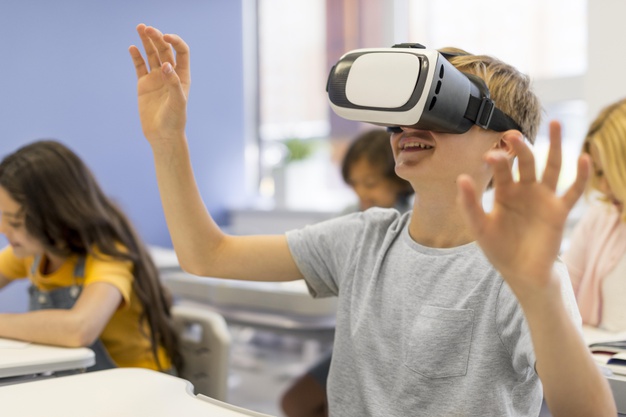
A study conducted by National Survey showed that 90% of teachers believed that VR in education was an effective tool to provide immersive learning for students.
Tablets and lightweight computers emerged first in classrooms, but as you might guess, there was still a lack of room for interaction. This is how virtual reality is differentiated from every learning practice.
By combining advanced technology with knowledge, it has been possible to create a learning environment by projecting different versions of reality.
Application of VR in Education
-
Distance Learning
One of the best things is that virtual reality in school education helps students and teachers overcome geographical boundaries and produces natural interactions in classrooms. Similarly, one can attend any interesting event on Earth with just a press of a button. For instance, the London School of Business and Finance is a great example of combining VR with distance learning in the courses they offer to postgraduate students.
-
Virtual Field trips
The capability of VR to offer deeply immersive experiences can be useful for teaching subjects such as history, geography, and art with the help of a virtual field trip. This technology promotes students with the freedom to explore and learn at their own pace. Some of the biggest universities are already offering these trips to students, and the best part about virtual field trips is that they can be distributed on a massive scale.
What Makes VR in Education Beneficial?
1. Engaging
A great deal of time and resources are spent by teachers to engage students through interactive projects, public speaking, and a variety of other ways. Oftentimes, their efforts go in vain.
On the other hand, virtual reality makes it easier to create immersive experiences which bring lessons to life. By gaining hands-on skills, students also become prepared for the future.
2. Technology
It’s incredible how digital technology has changed the way classrooms are taught. The move from passive learners to active learners has changed the game. Especially today in the 21st century, students need to be proficient in technological skills to adapt to the world.
3. Language Roadblock
International education can be a problem for the learner, considering the differences in culture and languages. With virtual reality, every possible language can be included within the software. Therefore, language will no longer be a barrier.
4. Safe Learning Environment
Sometimes, making mistakes during learning can make the students scared of the possible outcome. Gaining skills without the fear of failure makes virtual reality a preferable tool for training to build the student’s confidence. Therefore, students can try different approaches and choose what’s best for them.
5. Practicality
Regarding the practicality of education, students often need special tools and the application of theory in real-life scenarios for learning. Difficult concepts in subjects can be hard to comprehend due to the lack of practical application. And that is how just by using VR in education, students get a chance to learn by doing rather than simply reading. By visualizing complex topics or mechanisms, the cognitive load to process the information is highly reduced.
Final Thoughts
Undoubtedly, we can say that VR is the best fit for modern education. It creates an immersive learning experience and offers a favorable environment for every student out there. Therefore, VR keeps reshaping the way we view the world. It can be said that the young learners of tomorrow are truly in good hands with technology. They will employ it to its full potential.
Reference: Immersion VR
Image credits: Freepik
For more such content on technology and e-learning, visit our blog.
Create. Engage. Inspire
The post Virtual Reality Widening the Scope of Education appeared first on Test.Evelyn.
]]>