The post Gauging Student Knowledge Using Bloom’s Taxonomy and DOK appeared first on Test.Evelyn.
]]>Educators must use the most effective teaching pedagogies and types of assessments to help the students learn and succeed.
Comparison of Bloom’s Taxonomy and Depth of Knowledge.
Bloom’s Taxonomy and Depth of Knowledge are theories that guide ways to assess student learning. These are like standards that help teachers worldwide assess students on common parameters.
Bloom’s Taxonomy is a framework for categorizing educational goals and objectives based on their level of complexity and specificity. It was first introduced by Benjamin Bloom in 1956 and has since been updated and modified by other educators.
Bloom’s Taxonomy levels
There are six levels of bloom’s taxonomy
Level 1: Remember
Assessments in the remembering level are intended to check the student’s knowledge of the recently learned concepts and to know if they can recall what they have learned.
Level 2: Understand
Assessments in the second level of Bloom’s Taxonomy take recalling what was learned to the next level. It evaluates if the student can describe the learned concepts in more detail and in different ways.
Level 3: Apply
In the next level of Bloom’s Taxonomy, the teachers can gauge the students’ knowledge through their ability to practically apply it in real-life situations and solve problems using the concepts.
Level 4: Analyze
In the fourth level of Bloom’s Taxonomy, teachers can assess the student’s understanding of the various variables within the concept. The students are asked to analyze, classify and explain the relationship among the different parts of the learned concept.
Level 5: Evaluate
At the evaluation level, the assessment is based on the idea of understanding the students’ ability to make decisions and judgments based on the problems and situations of a learned concept. The student should be able to evaluate the lesson’s thoughts and uniquely critique their understanding.
Level 6: Create
In the last level of Bloom’s Taxonomy of learning , a student is assessed on the ability to create something new out of the learned concept. For example, a student can be asked to create a thesis statement or a new music composition, draw, organize, or produce a new piece of art.

Each level builds upon the previous one and represents a different level of thinking and cognitive complexity.
Levels in Depth of Knowledge
Depth of Knowledge, or DOK, is a framework that categorizes the complexity of cognitive processes that students must use to answer questions or complete tasks. DOK ranges from level 1, which requires simple recall of facts or information, to level 4, which requires students to engage in complex reasoning and analysis.
The four levels of Depth of Knowledge are:
Level 1: Recall
The first level assesses the student’s ability to recall information and lessons learned in classrooms.
Level 2: Skills and Concepts
In the second level of DOK, the teacher assesses the deeper understanding of the concept by asking them to answer various questions which use the knowledge of the learned concept. The students can be asked to do basic reasoning using the concept and compare the information.
Level 3: Strategic Thinking
In the third level of DOK, a student’s advanced skills of conceptual understanding are used to create situations, critical thinking, and problem-solving.
Level 4: Extended Thinking
In the extended thinking level, the student has the knowledge to use the concept to create a different idea, prove a situational impasse, critique the idea, and apply the concepts.

Concept: Webb, Norman L. and others. “Web Alignment Tool” 24 July 2005. Wisconsin Center of Educational Research. University of Wisconsin-Madison. 2 Feb. 2006.
Guidelines to use Bloom’s Taxonomy and Depth of Knowledge for creating Assessments
Using both Bloom’s Taxonomy and DOK together can help teachers create more effective lesson plans and assessments, as they can more accurately gauge the levels of thinking required of their students. For example, a level 1 question might ask students to recall a fact or definition, while a level 4 question might ask them to analyze, evaluate, and synthesize information from multiple sources.
Evelyn has created several assessment sheets and worksheets to help gauge student knowledge.
Evelyn developed the following worksheet, which is drafted so that teachers can check the memory of the lesson taught in the class. The questions in the worksheet are created to assess the remembering power of the students.

The Math worksheet below is an assessment that helps to gauge the student’s understanding of the concept. The stage from Bloom’s taxonomy concept is ‘understanding’; the worksheet is a level 1 question from the DOK’s concept.

Incorporating Bloom’s Taxonomy and Depth of Knowledge into Classroom Learning
One way to incorporate Bloom’s Taxonomy and DOK into classroom instruction is through learning objectives. Teachers can understand what a classroom wants and draft the learning objectives accordingly. These objectives can guide a teacher on how they want to pursue their lessons and how they would assess the students’ learning.
Learning objectives should be clear and specify the needs they are intended to meet. A well-written learning objective should be specific, measurable, achievable, relevant, and time-bound (SMART).
By incorporating Bloom’s Taxonomy and DOK into the learning objective, teachers can create goals targeting specific thinking and cognitive levels of complexity.
Assessment is another area where Bloom’s Taxonomy and DOK can be helpful. Teachers can use both frameworks to create assessments that measure students’ knowledge and understanding at different levels. This helps teachers identify areas where students may need additional instruction or support.
Another way to use Bloom’s Taxonomy and DOK in the classroom is through open-ended questions and tasks. Open-ended questions allow students to engage in higher-level thinking and can help them develop critical thinking skills. Similarly, open-ended tasks require students to use various cognitive processes to complete them successfully.
Conclusion
Incorporating Bloom’s Taxonomy and DOK into classroom instruction can help teachers create effective lesson plans and assessments and gauge student knowledge and understanding at different levels. Using both frameworks, teachers can ensure they provide their students with opportunities to engage in higher-level thinking and develop critical thinking skills. Ultimately, this can lead to better student academic outcomes and a more effective and rewarding teaching experience for educators.
The post Gauging Student Knowledge Using Bloom’s Taxonomy and DOK appeared first on Test.Evelyn.
]]>The post Types of Assessments: Online Vs. Offline Assessments appeared first on Test.Evelyn.
]]>Well, this is why we have assessments.
Assessments do not imply only tests. There are various ways for educators to analyze the learning standpoints of students and gauge their growth.
What are Assessments?
The book Learner-Centered Assessment on College Campuses: shifting the focus from teaching to learning by Huba and Freed 2000, explains assessment as:
Assessment is the process of gathering and discussing information from multiple and diverse sources to develop a deep understanding of what students know, understand, and can do with their knowledge as a result of their educational experiences; the process culminates when assessment results are used to improve subsequent learning.
Assessments Vs. Tests
There is a broad range of differences between assessing and testing a student.

Types of Assessments: Online and Offline
As instruction methods have turned online, teachers can also assess students online by leveraging the benefits of technology. There are many applications and tools available to help teachers assess students. For example, teachers can create online quizzes, game-based questions, open/close-ended questions, fill-in-the-blanks, drag-and-drop questions, polls, and so on.
Online assessments help teachers check the answer accuracy and deliver results in real-time in a shorter timeframe.


On the other hand, offline assessments are done in schools or any other physical location.
Offline assessments use pen, paper, and the physical presence of students and teachers in the classrooms.
Why are Online Assessments better than Offline Assessments?
There has always been a comparison between online and offline assessments, with one being convenient for some and inconvenient for others. Let’s understand how assessments in the online mode fare better than offline mode:
- Creating Multiple copies
Online assessments are easier to copy and send to all the students. There is no need for the teachers to make separate prints for individual students, unlike offline assessments.
- Flexibility in conducting assessments
Teachers can create and conduct online assessments from anywhere; they only need a computer and an internet connection. On the other hand, offline assessments are less flexible, as they usually require teachers to be physically present.
- Speed of Evaluation
Online assessments are easier to evaluate since artificial intelligence can help us analyze the correct answers and the results of the students in the class.

Offline assessments, on the other hand, require the teacher to mark all the individual tests on her own, which is time-consuming. It can contribute to teacher fatigue and delayed results.
- Record Keeping
When teachers conduct online assessments, they are not worried about where to store the information and care less about losing papers. One of the biggest benefits of conducting online assessments is having an organized record of everything. Teachers can keep records of individual students and their results and analyses using appropriate learning management systems and test tools.
However, when conducting assessments offline, teachers often use papers that have to be organized manually and stored.
Offline Assessments also have Benefits
While there is skewed support for online assessments, one cannot overlook how offline assessments beat the technology product in specific ways.
- Human Touch
In a classroom test, a teacher can assess whether a student understands a concept but got the answer wrong. In this case, a teacher can give some score to the student for using the correct process and not entirely failing the students’ answers.
However, this is not possible with online assessments, since students only submit their answers online, and the process of deriving the answer cannot be shown.
- Writing speed
Students may be fast at writing an answer, but not as fast as a bullet when using a keyboard. For some students, essay-type questions can be harder to complete when given online assessments, whereas students can work on their writing using pen and paper because it is easily accessible and every student can afford to get one. It is not easy for every student to get a computer system in their home so they can practice typing on the keyboard.

- Smooth Discussions
In a physical classroom, teachers can assess students based on their behavior and class response. They can talk more freely, and the teacher can even go close to the students and explain concepts to them.

It is challenging to interact with students in an online setting. Students may not feel the presence of their peers, so it would derive less of a feeling of a class for them. They may not feel interested in responding to the teacher, and their assessment score on class responses can go down.
Taking Blended Learning to the next level
Teachers can teach online and offline in a hybrid mode. They can teach using online tools in an offline location, which is also referred to as blended learning.
The teachers can also use the idea of blended learning and conduct assessments in different ways as there are various types of assessments. It can be a blend of fewer assessments being offline and the rest being online.
Teachers can plan their assessment types for different periods and curate which tests are more suitable when taken online or offline. For example, essay questions can be conducted offline during the summative assessment. In contrast, fill-in-the-blanks and gamified tests can be conducted online after every lesson is completed in the form of a formative assessment.
The post Types of Assessments: Online Vs. Offline Assessments appeared first on Test.Evelyn.
]]>The post Top 5 Advantages of Timed Worksheets for Kids appeared first on Test.Evelyn.
]]>Worksheets are sheets of paper that contain concepts of what is learned in the classroom presented in a fun and engaging way. In these worksheets, questions can be put in different forms like a game, quizzes, fill-in-blanks, and more.
Timed worksheets are also a way of designing worksheets where the students are challenged to complete the questions in a limited time. Parents and teachers have realized that there is a great advantage for children if they learn with the help of timed worksheets.
Books Vs. Worksheets
Learning and books are complementary to one another. Books are a set of compiled concepts about a particular subject or topic. They have lessons divided into chapters to make instruction easy and a step-by-step procedure.
Books are the primary source of knowledge for younger children.
On the other hand, worksheets supplement the books that enable active learning among students. Worksheets for kids have exercises to scrutinize the level of understanding that the students might have achieved from reading the books.
It would not be appropriate to say that we can substitute books with worksheets because worksheets can help the students and teachers achieve a particular learning objective (gained through books).
Advantages of Timed Worksheets for Kids
Young students may need help communicating effectively about their doubts, misunderstanding of concepts, and other gaps in the learning process.
These worksheets are like assessments to help teachers understand the gray areas where students find themselves snarled up.
Active learning through worksheets, help the teachers assess where the students need help understanding the lessons.

Worksheet created by Evelyn Learning for Grade 6 students to learn the concepts of addition with 4-digit numbers

Worksheet created by Evelyn Learning for Grade 6 students to learn the concept of multiplication by 10, 100, and 1000.
Apart from this, the advantages of worksheets for Kids are explained as follows:
Finishing work in a fixed time.
Students can learn with worksheets. We know young children are not very keen on sitting for a fixed time to devote themselves to a particular activity. Most of them loiter around, showing little interest in revising what they learned at school.
Worksheets for kids with fixed time can ensure that children finish the work exercises in a limited span. It can help parents to convince their children to sit and study effectively for a short time.
Engage Students in a Game
Teachers can design worksheets like a game.
Just as a video game has a time limit and some challenges that make it enjoyable, teachers can also design the worksheets like a paper game with knowledge concepts to work on.
Example: The below sheet shows a worksheet designed to develop children’s logical thinking and remembering skills through a shadow-matching game. Students may not find this boring because it is designed to be colorful and game-based. A student who practices such sheets in a timed-based manner can develop practical fast-thinking skills.

Develops Self-Study habits
Lower-grade students usually need their parents’ help with their homework. With worksheets, parents can engage children by explaining how to solve exercises, and then the children can do it independently. It helps to develop students to work independently and use logic.
Example: Students can complete their worksheets once they understand the working pattern. For example, in the following pattern, a parent can explain how to complete a worksheet for number 7, but later they can do the rest of the number sheets on their own. Their parents can supervise their timing, but they can complete the exercise independently.

Assessing Knowledge
Evelyn designs worksheets using the concepts of bloom’s taxonomy and depth of knowledge. In both these ideologies, the assessments focus on remembering the learned concepts, understanding them, and exploring their applicability in real-life situations.
These are among the most common and best ways to create worksheets for students to test their knowledge. Time-based worksheets are additionally helpful because they put a timer on a student’s mind, which helps them to think fast and intelligently.
Example: Students can answer questions related to identifying shapes and sizes that they might have learned in their geometry class.
Worksheets like these can help students to revise their lessons. However, a time-based worksheet can help them think fast, improving their cognitive skills and helping them to think, not just fast but also smartly.

Prepare Students for the Future
All competitive or regular exams have a time limit. A timer puts positive pressure on students’ minds and brings out the best in them. Timed worksheets for kids can help them to prepare for exams and increase their operating speed.
It is easier to shape a young child’s mind to train them to think effectively in less time. This not only helps them to prepare for their exams but also helps students to make timely decisions. Decision-making quality is essential in every individual’s life, and timely decision-making can be learned through practical training.
Just Another Learning Style
Worksheets are one of the ways that teachers can assess the student’s knowledge and, at the same time, engage students in active learning.
Worksheets help students to think logically and revise what they have learned through the books. Worksheets with a time limit can propel smart decision-making based on what they have learned. They have exercises, so they inculcate the habit of brainstorming, fast thinking, remembering, and applying learned skills in the students, depending on the worksheet’s intent.
The post Top 5 Advantages of Timed Worksheets for Kids appeared first on Test.Evelyn.
]]>The post SAT vs ACT: Differences appeared first on Test.Evelyn.
]]>It is important to note that no institution would favor SAT over ACT, or vice versa.
These exams are meant to evaluate the student’s general knowledge in several areas. The goal for both the exams is the same: to determine college readiness.
First, this article breaks down the differences between the SAT and the ACT. Further, it puts light on the factors to consider while choosing an exam.

SAT vs ACT: Key Differences
Vocabulary
As far as the critical reading section of SAT goes, vocab is the first requisite to excel. Generally, SAT questions are believed to be trickier and less direct compared to the ACT.
In contrast, the ACT eases out on vocab and contains a separate section for science instead. It can be said that the ACT is more curriculum based while the SAT is focused on problem solving.
Therefore, learners who struggle with vocabulary may often perform better with the ACT. However, students cannot judge a test on this single aspect.
Time per Section
Another biggest difference is the time allocation between these two tests. The SAT offers more time for each question, whereas the ACT requires pacing quickly through the questions.
On top of that, the ACT has additional questions, but the SAT questions are quite tricky and lengthy (so they might take longer to complete).
Given below is the section-wise distribution of time:
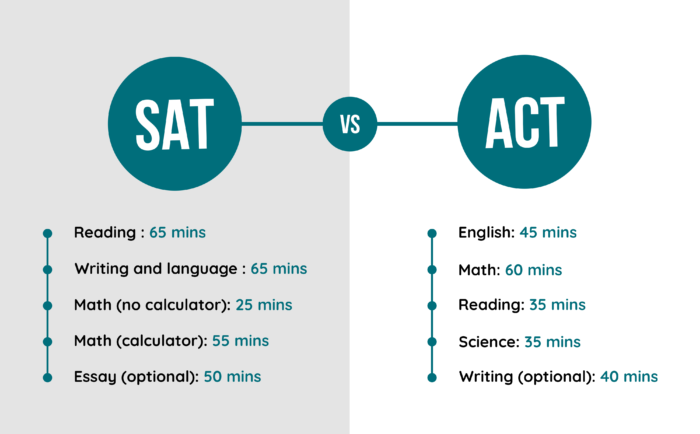
Therefore, students who can stay focused and work under pressure will be better off with taking the ACT test.
Scoring
The scoring is also vastly different between these tests. The ACT is scored on a scale of 1-36, whereas the SAT ranges between 400-1600.
Mainly, the overall score on the ACT is an average of the four sections (that is, English, Math, Reading, Science). On the other hand, the SAT tends to weigh the score on the basis of each section individually.
Most importantly, there is no penalty for wrong answers (no minus points) on both the tests. So, test-takers have the freedom to turn to guessing when their time is running out.
Essay
The essay section is optional on both the tests, but many colleges still require the SAT or ACT essay scores to judge the student’s potential.
The SAT asks students to read a full written essay and analyze the author’s argument. Further, the student’s essay should dissect the argument using evidence and reasoning. In short, the students cannot present their own opinion.
Similarly, on the ACT, the student is supposed to analyze the different perspectives in the passage and mainly present their own opinion, unlike the SAT essay.
Science Section
The ACT has a separate science section unlike the SAT. The ACT science section provides 35 minutes to answer 40 questions. In this case, a science wizard who loves to analyze scientific data, graphs, and charts the ACT might be a better fit.
That being said, the SAT does test scientific knowledge, though not with the use of a separate science section. With the complexity in questions, the students have to interpret graphs and charts in a way similar to the ACT.
For more information on preparing for the LSAT, visit our blog.
Create. Engage. Inspire.
The post SAT vs ACT: Differences appeared first on Test.Evelyn.
]]>The post Learning Experience Design or LXD appeared first on Test.Evelyn.
]]>What is Learning Experience Design (LXD)?

LXD is the acronym for learning experience design and best refers to the process of creating learning experiences. The focus of creating such designs is to make the approach human-specific and goals inclined so the best outcome ventures from it.
Specifying LXD, it has several design disciplines at its core with the prime objective of the field of learning. Some key design principles used in LXD are interaction design, user experience design, experience design, graphic design, and game design. Let us get a clear picture of LXD by breaking the concept into 3 parts.
Experience
Knowledge comes to us from experience and might be in multiple forms, not limited to education. Knowledge gathered from home, any outdoor areas, or work and experience obtained from any place is worthy of a shot. These experiences are what matter. Hence, LX designers need to integrate such experiences.
Design
LX design is all about the creative design discipline, the applied form of art. Research, experimentation, ideation, conceptualization, prototyping, iteration, and testing goes toward the process of LX design. Designs of the process have one objective – provide value or provide elegant solutions. Here, the design discipline denotes a design detail that teaches.
Learning
Defining LX design is about how the candidates learn, not the teaching pattern or the training schedule. The catch is to know the designs and efficient approaches of using the design that endorses learning. The end game is to curate a learning experience that works and lets the learner absorb much.
Other facets to this concept as we already know are human-centered and goal-oriented.
Elements of Learning Experience Design
The success of the eLearning courses of LXD depends on four key elements as described. Before we go through the elements, let us brush up on the basics, that is, the difference between UXD and LXD.
UXD or user experience design is used to enhance user experience and is used in the product development field. On the other end, LXD leverages the UXD principle to provide an enhanced learning experience in eLearning courses. LXD makes technology in favor of the learners.
Now, let us get started with discussing the elements.
Understanding Learners
Learners do not necessarily begin from the same origins as others do. Some learners are newbies, while others have already built up the base level and wish to go advance. The experience curve that LX designs create does not have the same origin for everyone.
LX designers, with the help of multiple tools, learn about the experience level of the candidates. Then, they get started with creating the design and add facilitation of skipping a few sections. This allows learners with some knowledge to skip past the sections they already know about.
Experiential Learning
One of the primary reasons why traditional corporate training fails is because they are inclined toward tasks and not experience. Though mainstream training seems reliable, it may not essentially be of value and fun.
LX designs leverage the traditional aspects such as functionality, usability, and convenience and add the missing parts. LX designs let learners move past the traditional offerings and engage them in a great way. The learning has the end course of action where learners find the solutions themselves.
Engagement and Motivation
Content competence apart, LX designs must indeed design a course for humans. The idea should be to create a design that learners would find entertaining, engaging, and valuable. Learners must feel they are getting a lot more in return for taking up the course and there is no compromise.
Sensory Layer
While crafting the learning course, another aspect that LX designs consider is the sensory experience of learners. Each and every aspect of the learning program must be in line with the sensory experience of learners. Designers should ensure they collect from the learner’s senses and amplify the materials and instructions accordingly.
Phases of Learning Experience Design
When you want to create a learning experience design, you need to set for a journey of uncertainty and adventure. The approaches that LX designers use often reciprocate that journey and there is a streamlined process to it. There are 6 collective steps or a rough draft of how the design phases go:
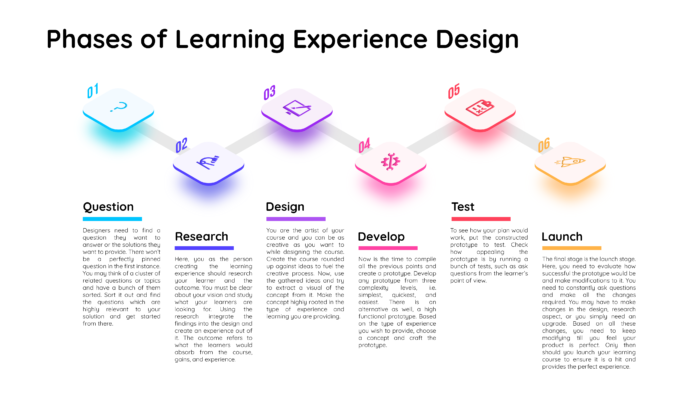
Learning Design v/s Instructional Design
Confusion between LX design and instructional design is an obvious phenomenon. The look of it might be the same, but they are entirely different concepts when you dive deep into them both. Precisely, instructional design is teacher and teaching-oriented, while learning design is learning and learning outcome-oriented.
For more information on preparing for the LSAT, visit our blog.
Create. Engage. Inspire.
The post Learning Experience Design or LXD appeared first on Test.Evelyn.
]]>The post Preparing For The LSAT – Law School Admission appeared first on Test.Evelyn.
]]>The Law School Admission Test (LSAT) is unlike any other exam a candidate has ever taken in their life. The LSAT is a skills-based exam. It assesses critical reading and analytical thinking abilities that are essential for law school success. Before they start preparing for the LSAT, aspirants should familiarize themselves with the exam’s ins and outs. This will help them prepare for what will be on the exam.
Let us start with a definition of the LSAT, as well as its eligibility and prerequisites. Following that, we will move on to how to study for the LSAT, the exam format, and the cost of taking it.
What is LSAT?
In the United States, Canada, and a rising number of other countries, the Law School Admission Test (LSAT) is a requirement for admission to law school. The LSAT is designed to assess the skills needed to succeed in the first year of law school. These skills include reading comprehension, thinking, and writing. The exam results provide vital insight into law school readiness for both admissions decision makers and candidates.
The LSAT is the single strongest predictor of first-year law school achievement, even better than undergraduate grade-point average, according to studies. The LSAT, according to LSAC, should be simply one component of a comprehensive admissions process that takes into account each candidate’s skills and life experience.
Eligibility and Prerequisites of LSAT
Most law schools require applicants to take the Law School Admission Test, which is a form of standardized test. Candidates must take the LSAT before applying to a law school in the same manner in which they would take the ACT or SAT before applying to college.
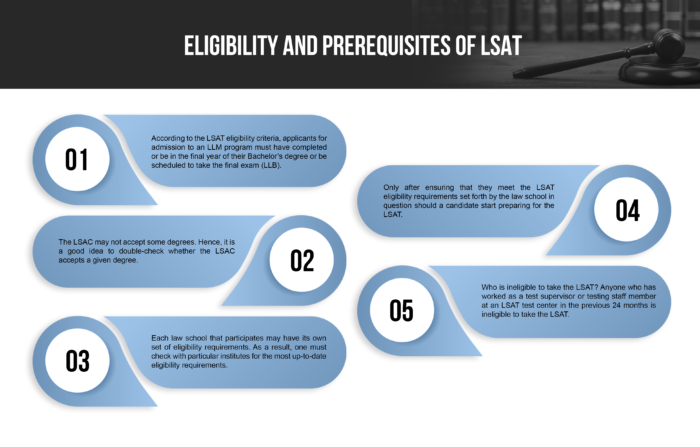
Candidates preparing for the LSAT can take the exam three times in a single LSAC year (June to May), five times in five years, or seven times in a lifetime. Tests taken prior to September 2019 are not a part of these totals. All of one’s results from the previous five years are submitted. Moreover, depending on the concerned law school’s policy, either their greatest score or an average of their scores is used.
How to go about preparing for LSAT?
If a candidate is considering taking the exam or has already begun preparing for the LSAT, they may be feeling overwhelmed. That is fine; everyone studying for the LSAT experiences this at some point. All an aspirant needs to do is stick to a few LSAT study tips, and they will be fine on the test day.
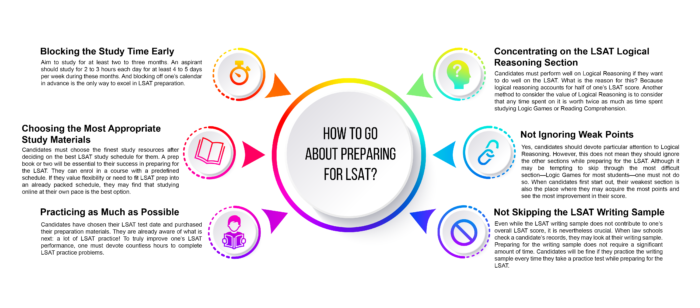
LSAT Exam Pattern
The LSAT is divided into six sections: one unscored essay section and five 35-minute digital multiple-choice sections administered at the testing center on a tablet. Four of these sections will be graded, while the fifth (or variable) section will be left ungraded. Test takers have no idea which sections are unscored until the day of the test. As a result, mentors advise that the candidate responds to all the questions on the LSAT question paper. To prevent cheating, sections are given in a varied sequence to various test takers.

Sections of the LSAT include:
- Two 25-question logical thinking sections entail dissecting and analyzing a short argument or set of data to find the main assumption, other conclusions, errors and omissions, comparable arguments, and components that strengthen or weaken the argument.
- One reading comprehension section with 26–28 questions is divided into four 400–500-word passages with five to eight related questions each. Test takers must identify the primary idea, particular information, inferences, and/or writing structure for topics such as law, arts and humanities, physical sciences, and social sciences.
- One analytical reasoning section of 22 to 24 questions consists of four logic games that require grouping, matching, and ordering elements based on a premise and a set of conditions and relationships between subjects that serve as the foundation for conclusions based on the statements. Although there is no single correct answer, the LSAC assesses test takers on their analytical abilities. Aspirants widely regard this as the most challenging section of the LSAT. It is where many test takers devote the most of their preparation time.
- Administrators test new questions for future tests in the variable section, and the results do not factor toward the final score. However, candidates must keep in mind that they will not be able to discern which section is the variable while taking the test.
- Finally, utilizing secure proctoring software, the written exam is done separately on the test taker’s own computer. Test takers get 35 minutes to read a decision prompt or problem, as well as the criteria for making decisions, and then write an essay advocating for one of two solutions. The emphasis is on the writer’s ability to argue both for and against the chosen viewpoint. This portion is not graded. However, a scan of the essay is sent to applicants’ prospective law schools along with the scaled numerical score.
The Cost of Taking LSAT
The LSAT costs $200, and applicants get one free score report with it. In addition, most law schools require a subscription to the Credential Assembly Service (CAS) in order to apply. This $195 subscription also comes with one free score report. The cost of additional score reports is $45. LSAC provides waiver forms for the LSAT and CAS fees. The aspirants can access these from the LSAC website.
If candidates fantasize about making the ideal opening statement or banging the gavel, this includes making space and preparing for the LSAT. The Law School Admission Test is a difficult exam that assesses candidates’ readiness for a legal career. Yes, it sounds overwhelming, but one need not get too worked up about it. Aspirants will be ready to go with their hard preparation and commitment, on their way to making a courtroom their new abode.
Image Sources: Shutterstock and Unsplash
For more information on preparing for the LSAT, visit our blog.
Create. Engage. Inspire.
The post Preparing For The LSAT – Law School Admission appeared first on Test.Evelyn.
]]>The post Stealth Assessment: Meaning, Principles, Design And Model appeared first on Test.Evelyn.
]]>The term “stealth assessment” was first brought into use in 2005 to describe a method of assessing innovation in video games. When a person engages in complicated, goal-oriented tasks while playing video games, the abilities and tactics he employs to overcome hurdles and obstacles are motivated entirely by the thrill of accomplishment. In this regard, the skills used at the time were the most accurate in assessing non-evaluable attributes such as persistence, ingenuity, and strategic thinking. Educators refer to this type of skill evaluation as Stealth Assessment.
What Is Stealth Assessment?
The phrase “stealth assessment” was brought into use by Valerie Shute in 2005 to characterize the automated assessment procedure of a system called Smithtown that was designed to teach microeconomic principles. Valerie Shute and Matthew Ventura study a method for embedding performance-based assessments in digital games in their book Stealth Assessment.
Simply put, stealth assessment is evidence-based evaluation. Educators dub this method of continuously monitoring a person’s progress while offering automatic responses “Stealth assessment.” It is now used in educational games and simulations. Assessors can seamlessly integrate it into the structure of learning experience. Pupils naturally develop rich sequences of actions while accomplishing complicated tasks during gameplay. In doing so, they rely on the precise skills or competencies that educators want to evaluate.
Basic Principles Of Stealth Assessment
Stealth Assessment is when testing is smoothly woven into the fabric of the learning or gaming environment to the point where it is nearly undetectable. This, in turn, blurs the line between learning and evaluation. It is designed to be imperceptible and continuing, to support learning and reduce test anxiety without jeopardizing validity and consistency.
The following are the basic principles of Stealth Assessment:
- The software examines pupils’ actions in a computer game or simulation.
- The system adjusts the game’s structure to help students learn. For instance, it introduces new hurdles and obstacles based on their performance.
- Rather than having distinct stages or tests, the strategy keeps the game running by integrating instruction and assessment within the game.
- The technology creates a dynamic representation of the learners to show their skills and talents.
- By blurring the boundaries between assessment and learning while performing a complete diagnostic, it reduces test anxiety among students.
Design And Model Of Stealth Assessment
Evidence-centered design is the methodology that underpins stealth assessment. Robert Mislevy, Linda Steinberg, and Russell Almond coined the term “evidence-centered design” in the late 1990s to describe an assessment design approach. In general, the goal of any assessment is to gather data that allows an assessor to make accurate conclusions about what students know, think, and can accomplish, and to what extent they can do it. Precise conclusions about competency states improve educational decisions that promote learning.
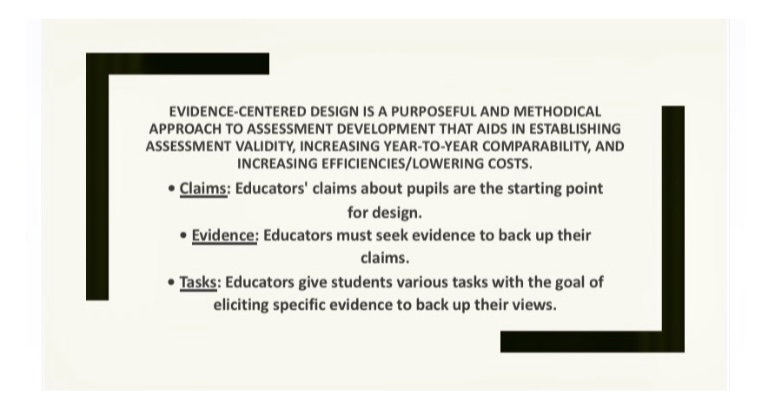
Evidence-based design is a framework that comprises numerous interconnected conceptual and computational models. According to the framework, an assessor must:
– define the claims they make about the abilities of learners.
– determine what constitutes admissible evidence in support of the claim.
– identify the types of tasks or situations that elicit the evidence.
The article will now describe each of these models in detail below:
1. Competency Model
The Competency Model always asks, “What set of knowledge, skills, and other characteristics should be assessed?”
Competencies are broad in scope since they include both technical and necessary skills. Moreover, they include soft skills, such as knowledge, behaviors, and abilities. The competency model comprises a collection of competencies. The variables in the competency model indicate the set of human traits that assessors use to draw conclusions.
2. Evidence Model
The evidence model, on the other hand, asks, “What behaviors or performances should indicate the structures defined and organized in the competency model?”
An evidence model explains how educators can use a student’s interactions with and reactions to a specific challenge to support competency model variables. The evidence model addresses two questions:
(a) How do distinct competencies manifest themselves in actions or performances?
(b) In terms of statistics, what is the link between such behaviors and the competency model variable(s)?
In a nutshell, an evidence model explains why and how we can use observations from a specific task setting (that is, student performance data) to back up claims about competency model variables.
3. Task Model
Finally, the task model always asks, “What are the types of tasks or scenarios that assessors can develop in order to elicit evidence-gathering behaviors?”
A task model is a framework for describing and constructing situations in which a learner might participate in order to provide evidence for particular aspects of knowledge or skill associated with competencies. As they interact with tasks or difficulties during the problem-solving process, learners supply a continuous stream of data to the evidence model. The model converts data (such as scores) into probabilistic assessments of competency. The competency model then updates the assertions about relevant competencies based on the evidence model’s findings.
In short, evidence-centered design is a way for developing assessment tasks that are explicitly related to assertions about human capabilities through a chain of evidence. As a result, they are appropriate for their intended use.
Opportunities And Challenges
When the assessment tactics, game, and simulated world are all built together through an evidence-based design process that includes not only the assessment but also the gameplay, stealth assessment works well. However, adding dynamic assessment to a pre-existing game or simulation is a less successful strategy.
Learners can get rapid feedback on their actions using stealth assessment approaches. Moreover, teachers can get information on how each student is developing inquiry, critical thinking, decision-making, and creativity abilities. This work is still in its early stages, and it is unclear whether stealth assessment methods must be designed from scratch for each game and topic, or whether common design principles may be used.

Stealth Assessment Explained In A Practical Scenario
The non-intrusive nature of stealth assessment, which has roots in gaming, is the key to its success. The idea is that a player’s decisions and strategies inform them of their progress and success on a regular basis. When it comes to education, stealth assessment is an effective way to reduce and eventually close the teaching and learning urgency loop. Because of the stealth assessment principle, current and future technologies should create a fundamental shift in training, not merely a slight tweak.
As previously said, both the teacher and the learner have the ability to observe, provide, and receive rapid feedback. In addition, they are capable of participating in the thoughts, insights, and observations of learning as they happen. The “student as worker, teacher as guide” approach, in which learners are primary architects of their own learning, requires participatory learning and assessment. They co-author, co-construct, and co-produce knowledge, meaning, and application. Furthermore, in the twenty-first century, critical thinking, study, and assessment of ideas, concepts, and structures are necessary abilities.
Educators limit their existing capacity to assess children by basing it on a very small number of test items. They are able to more accurately assess pupils when they move to a seamless assessment paradigm. This is because they have access to a significantly larger collection of pupils’ learning data. Educators can better support student learning across a range of essential educational topics with more accurate evaluations.
Image Sources: Shutterstock
Also Read: Formative Assessment Tools For Classroom Learning
For more information on Stealth Assessment, visit our blog.
Create. Engage. Inspire.
The post Stealth Assessment: Meaning, Principles, Design And Model appeared first on Test.Evelyn.
]]>The post Confirmative Evaluation: Meaning, Scope, Purpose And Model appeared first on Test.Evelyn.
]]>Confirmative evaluation builds on the results and suggestions made during formative and summative evaluations. It allows evaluators to confirm the value of performance improvement packages and performers over time. Moreover, it aids organizations in deciding how to manage ongoing performance improvement activities. This article will go over the confirmative evaluation process, its scope, and purpose in depth. It will determine what it is and is not. Additionally, it will discuss the confirmative evaluation model, as well as how it can help with learning and teaching.

What Is Confirmative Evaluation?
Confirmative evaluation is the process of gathering, analyzing, and interpreting facts and information to evaluate whether learners are still competent or whether the instructional materials are still effective. It urges educators to abandon linear models in favor of incorporating the evaluative process into every phase of the program.
Confirmative assessment is a new approach to continuous quality improvement. Under this approach, students take assessments even after the educator finishes executing the instruction in the classroom. The ultimate purpose of confirmative evaluations is to determine whether the instruction is a success after a year. In addition, it also determines whether the technique the educators are using for teaching is still effective.
Confirmative Evaluation: Its Scope And Purpose
Confirmative evaluation identifies, explains, and confirms the value of a performance improvement program over time. Performance improvement refers to measuring the output of a specific educational process, and then adjusting the process accordingly to enhance its output and increase its efficiency. It is typically conducted after the summative evaluation has been completed for a period of time, with the goal of ensuring that the training is still effective weeks, months, or even years afterward.
Formal schooling rarely does this, and there are a variety of reasons for it, including (but not limited to) practical considerations. The main goal of confirmative evaluation is to ensure that the quality of a performance improvement program is maintained throughout its life cycle. It also aims to figure out how well each learner’s skills have been retained. It also determines if the learner’s competencies are still sufficient or whether they require extra training or some other sort of intervention.
When Should One Use Confirmative Evaluation?
When it comes to confirmative evaluation, there are two schools of thought. The first sees confirmative evaluation as an extension of formative evaluation. On the other hand, the second sees it as a different and independent form of assessment. This form extends beyond formative and summative assessment.
- The first point of view emphasizes the importance of confirmative assessment as “an iterative effort intended to ‘take a pulse’ prior, throughout, and after an intervention is implemented.” Confirmative evaluation must be incorporated into an intervention’s fabric. After the freshly installed intervention has been in place for some time and its novelty has worn off, a long-term formative evaluation is done. This assessment should ideally be done every six months or so.
- The second, more traditional opinion is that the time factor is the most important characteristic that differentiates confirmative evaluation from formative and summative evaluation. Following implementation, educators conduct a confirmative evaluation. Confirmative evaluation should take place six months to a year after the performance improvement package is implemented, according to the rule of thumb.
- The three criteria of criticality, difficulty, and recurrence can also be used to determine when confirmative evaluation is necessary. If the criticality, difficulty, or recurrence of a performance is rated as eight or higher on a scale of one to ten by the performers and the organization, confirmative evaluation of any intervention to improve that performance should be conducted every six months after implementation.
The Confirmative Evaluation Model
The US Department of Health and Human Services’ second annual report, Performance Improvement, documented the evaluation activities of all Health and Human Services agencies and offices. A model of Confirmative Evaluation—a new paradigm for continuous improvement—was published in this report in 1997.
The model divides confirmative evaluation into four phases by the model: planning, doing, assessing, and improving. The concept is based on the principle of continual improvement. The following table lists the tasks that teachers should complete in each phase of the confirmative evaluation model.
| The Phase | The Task |
| Planning | The educator focuses upon and designs the evaluation during this phase. |
| Doing | The second phase deals with the collection of information through a variety of methods, including questionnaires, interviews, observations and focus groups. Educators can also use work samples and performance analysis, context studies, peer-supervisor-self reports, and cost-benefit analysis. |
| Assessing | This phase focuses on data collection and interpretation. |
| Improving | In this phase, educators consider the intervention’s impact, value added, and effectiveness. Following this, they recommend whether to continue, improve, or end the intervention. |
Confirming the Long-Term Effects of a National Reading Program-A Case Study
• Situation
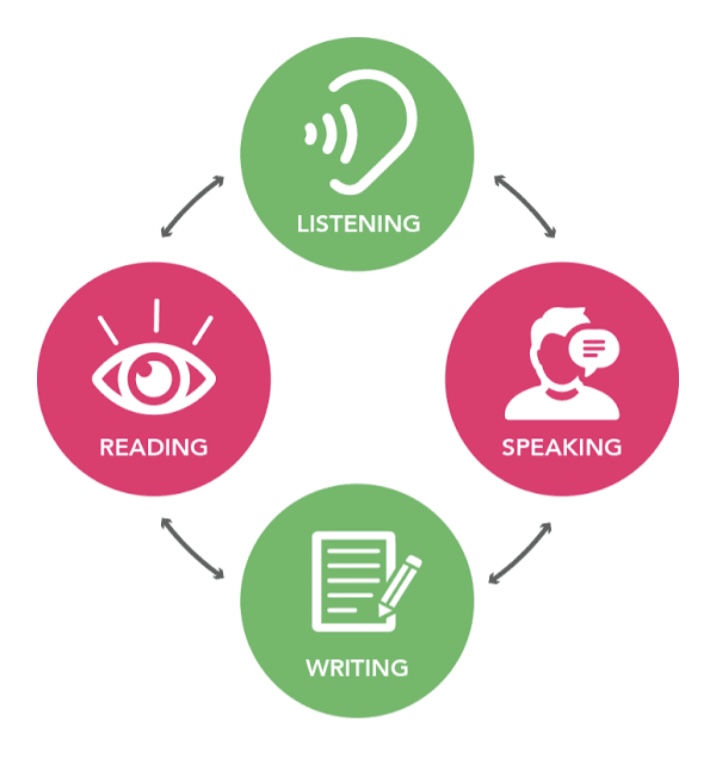
In the 1990s, there was a push to incorporate kindergarten and even preschool reading and writing skills into the K-12 curriculum. This is an instance of how confirmative evaluation contributed to the development of national educational policy. Several school districts around the United States introduced the Listening, Speaking, Reading and Writing (LSRW)/Ginn Beginning Reading Program in their kindergartens in 1973.
Several years later, Hanson and Siegel published a technical study that detailed how a subset of these pupils compared to the students from the same district who had different kindergarten experiences. The assessment used to compare the pupils was created expressly to assess both existing reading abilities and the kindergarten reading program’s prospective benefits. In addition, the confirmative evaluation was based on significant summative evaluation data collected from a broad national sample of kindergarten teachers who used the curriculum.
• Intervention
Instead of first grade, participating school districts offered a formal beginning reading program in kindergarten. The idea was to improve the reading abilities of K-12 children by introducing them to basic reading concepts and skills at a younger age than that allowed by standard school curricula. Moreover, the program’s goals were to improve reading skills, reduce the need for remediation, and create a good attitude toward reading.
• Results
As a result of receiving regular reading instruction in kindergarten, the high school students demonstrated a clear and consistent trend of enhanced reading ability. Those high school pupils who participated in the kindergarten reading program were better readers than those who did not.
Students who participated in the program also had better grades and greater attendance. In addition, they had a more positive attitude toward reading and less remediation needs. The findings of this confirmative study matched those of similar long-term evaluations of early intervention programs in scientific curricula.
• Deductions
This study supports the use of confirmative assessment to make policy in the field of education. In addition, one can apply it to other settings such as business and industry. The research shed light on a variety of confirmative evaluation goals, including the following:
– It aids policymakers in developing policies that have long-term benefits. This includes the policy of incorporating reading skills into the kindergarten curriculum based on evidence of improved student performance.
– Secondly, it provides a reasonable foundation for program improvement, throughout its life cycle.
– It aids in the resolution of any discrepancies that exist between declared aims and actual outcomes.
– Finally, it improves the cost-benefit ratio. For instance, a school district’s requirement for less remediation may result in lower expenses.
Who Should Perform Confirmative Evaluation?
Confirmative evaluation necessitates a unique perspective as well as excellent analytical abilities. One method is to use a group of impartial evaluators to see if the performers have retained their level of proficiency after the program was implemented and if the program itself still meets the intended outcomes. Another option is to utilize an outside evaluator in conjunction with a subject matter expert who is familiar with the performance or the environment in which the participants work.
Image Sources: Shutterstock and Unsplash
Also Read: Stealth Assessment: Meaning, Design And Model
For more information on Confirmative Evaluation, visit our blog.
Create. Engage. Inspire.
The post Confirmative Evaluation: Meaning, Scope, Purpose And Model appeared first on Test.Evelyn.
]]>The post Formative Assessment Tools For Classroom Learning appeared first on Test.Evelyn.
]]>Features Of Good Formative Assessment Tools
The following features should be present in a good formative assessment tool:
- It should be goal-oriented and based on what we do daily. A good formative assessment is precise, tangible, and measurable since it is intended to assist students in performing well.
- Formative assessment tools need to concentrate on higher-order thinking abilities. We are not just concerned about the nuts and bolts but also need to know if the students are using the higher levels of resources to submit, analyze, evaluate, and develop.
- It should keep students responsible for their results. In and of itself, group evaluation is beneficial. Furthermore, pinpointing the specific needs of the person will provide you with direction in which to guide your teaching, ensuring that the students are successful.
- Good formative assessment tools should be smooth, and you should not have to alter your daily routine to accommodate the exam. Some formative assessment tools have a steep learning curve, while others are simple to understand even though you have no prior experience. You may need to incorporate formative evaluation into your lesson. Some of it can be done on the fly, but others will need planning.
Top Formative Assessment Tools For Classroom
Students can be motivated to pursue learning goals as a regular and continuous part of their everyday routine using digital formative assessment tools. Here are five free formative assessment tools to assist you in integrating technology into your classroom. The list includes a wide range of features and alternatives to aid in the development of your formative assessment strategy.
1) Socrative:
Socrative offers real-time scoring on quizzes and questions. According to various online reviews from teachers and qualified reviewers alike, Socrative is one of the top-rated formative assessment tools for teachers. It is an immersive digital platform that allows you to quiz, score, and test on the fly; “learning at the speed of light.” Fast queries for immediate input, class counts to see who is logging in, and complete quizzes for deeper comprehension are all available to teachers.
Build surveys, activities, and shuffle questions with or without student names using this powerful method. Quizzes are graded in real-time and can be saved for later use for different classes. It operates on MS Windows, Android and iOS phones, tablets, laptops, and other computers. It is completely free for students, apart from being straightforward, adaptable, and aligned with Common Core.
2) Padlet:
Padlet is a virtual wall where students can share their thoughts on a given subject. You may embed audio and video in addition to written speech and have students answer in the form of a structured discussion. It is also possible to create separate Padlet for different classes or groups of students using password protection. For instance, using Padlet, you might have students identify keywords and address areas of agreement and disagreement with what their classmates have written.
3) Google Forms:
Google Forms is an easy-to-use, COPPA/FERPA-compliant tool. What is the best reason to use Google Forms as an educational formative assessment tool? The ease with which it can be used. Even if it is your first time using Google Forms, it is a favorite among teachers because it is fast and easy to build and automatically grade quizzes.
Make multiple-choice or short-answer quizzes with a simple answer key that includes point assignments for each problem. Students can quickly respond to questions by selecting an option from a drop-down menu, typing a quick text response, or uploading a short YouTube video to Google. For a fast bird’s-eye view of the class as a whole, teachers can view graphs and summaries of often missed responses.
4) Mentimeter:
Among evaluation instruments used in the classroom, professional reviewers and teachers give Mentimeter a high rating. It includes a listening skills assessment, icebreakers, formative tests, post-lecture surveys, and polls, as well as other educational models for the classroom. Create quizzes and assessments, monitor academic standards, engage students, and even lead a teacher training session.
Mentimeter not only gives everyone a voice but also has a handy feature that allows you to silence extra-loud students. It is completely free to use and allows you to build and host live quizzes using templates or from scratch. For a few dollars a month, schools and universities can get a Pro edition that includes unlimited question slides per presentation, exports, unlimited quizzes, and help. The user interface is easy on a 101 basis, with tech support available to smooth out the kinks.
5) Kahoot:
Kahoot‘s game-based approach to learning and evaluation is a hit with students. Teachers can select from over 40 million ready-to-use learning games or quickly build their own. Organize games in real-time or as tasks.
Students may also make their own “kahoots” to share with their peers, making the activity more social. In minutes, you can create a quiz game, import questions from spreadsheets, and check their 500-million question bank. Want to incorporate sketches from your iOS device or merge multiple mini-kahoots into a single assessment? That is something Kahoot can do, besides incorporating YouTube videos into your questions.
Teachers can apply multiple choice or true/false questions to the evaluation games, which students can schedule individually or in groups. The games are paced and graded, with the instructor establishing point scales. You can also download basic spreadsheet reports.
Concluding Remarks
In the physical classroom, it is simple to measure student success. We take for granted that paper assessments, quizzes, and spot questions are among the instruments used in the evaluation. For personalized virtual learning, the best online evaluation tools for teachers provide the same degree of input.
Formative assessment has the advantage of being completed when students are still learning. Formative evaluation methods that are fast and enjoyable are ideal for checking in on certain learning journeys. One final piece of advice is to choose one formative appraisal and personalize it. Do not attempt too many at once. Use one before the students have figured out how to do it and you have figured out how to interpret the data.
Read more about assessments on other blogs.
Image Sources: Shutterstock and Unsplash
For more information on formative assessment tools, visit our blog.

Create. Engage. Inspire.
The post Formative Assessment Tools For Classroom Learning appeared first on Test.Evelyn.
]]>The post Using AI For Personalized Learning appeared first on Test.Evelyn.
]]>Personalized learning is a learning experience tailored to the individual needs of each student. Learning elements such as speed of learning, material, series, technologies, quality, instructional approach, instructional materials, and other facets of personalized learning can be adjusted to meet the needs and learning goals of each child.
Personalization at large, nevertheless, could be unlikely without artificial intelligence technology. Learners can access training opportunities at their speed and convenience by using AI for personalized learning. AI technology aids in the prediction of learning outcomes, allowing you to produce content that is tailored to each learner’s goals and past success.
Advantages of Using AI for Personalized Learning
You will increase the efficacy of your training material by providing customized learning to your learners and using AI technology for personalized learning. Here are a few advantages of offering a fully automated learning experience to your students.
1. Enhances Involvement and Outcomes
While using AI to personalize learning for your students, you increase their interest as well as their learning outcomes.
Machine learning algorithms predict results, allowing you to tailor content to a learner’s experience and personal objectives. For example, online learners who articulate a specific ability gap receive tailored recommendations that help them fill in the gaps in their experience in a more personalized way. This may involve situations where the system recognizes that a learner might be able to skip a few modules to take a more extensive and less sequential learning journey than someone who lacks the fundamental skills needed for that subject.
2. Helps to Raise ROI
One of the advantages of using AI for personalized learning is that it will allow you to achieve a full increase in your training ROI. However, to reap this advantage, you must have a better learning environment for your students. One way to do this is to provide them with customized, high-quality, and appropriate training that can be completed in a limited amount of time.
You can easily provide personalized and just-in-time training to your learners using artificial intelligence technology. AI will assist in tracking individual learners’ previous results, making one-size-fits-all training a breeze. Also, within an online training course, AI can help to monitor the employees’ progress, making it easier to recognize their learning gaps. Through doing so, you will be able to provide top-notch training that makes them more profitable for the company.

3. Provides Mentorship
Another advantage of using AI for personalized learning is that it will act as a coach for employees. Learners frequently have questions about ambiguous topics and need responses that are relevant to them at the appropriate time. Learners can now ask bothersome questions at any time and in any location thanks to AI. Artificial intelligence technology will serve as a mentor for workers. It will provide them with timely responses and accurate information on ambiguous topics.
4. Allocate Resources to High-Value Tasks
Pupils get the specific online tools they need to fill in the gaps and meet their learning objectives, resulting in fewer seat time and training payroll hours. Employees, on the other hand, get the details they need easily because online training tools are customized to their personal and professional goals. In addition, L&D administrators and support staff spend less time reviewing metrics and reports and more time creating high-quality learning material. The framework handles Big Data with AI, allowing the L&D team to focus their time and resources on more important tasks.
5. Produce New Material
One of the advantages of AI technology is that it can assist in the creation of new content. As a result, you can always get refreshing content that meets your students’ requirements by using AI for personalized learning. This not only saves time and resources but also relieves the instructional designers of a significant amount of work.
6. Content Distribution and Appropriate Scheduling
Another advantage of using AI for personalized learning is that you can properly schedule and deliver information. You can conveniently plan your coursework through your learning portal using AI technology. You may also deliver learning tools based on an individual’s performance and evaluation results. Moreover, AI allows you to predict course maps for your students and make appropriate changes as required.
Make True Personalized Learning a Possibility
Using AI for personalized learning entails allowing learners some influence over how they move through their learning and development activities.
- The learner has more influence throughout their learning with AI than with pre-determined frameworks.
- AI collects data to assess a learner’s ability level and then establishes a continually changing learning route for him or her to follow.
- Using AI for personalized learning not only improves the learning platform but also makes it more open to learner needs by intelligently adapting to their requests.
Concluding Remarks
AI can be used to monitor other important educational issues. With a persistent teacher shortage, using AI for personalized learning will help close some of the gaps in providing high-quality education. Personalized learning is all about giving the learners control over their learning preferences and accessing learning opportunities at their speed and convenience. Learners can choose their preferred learning paths because it is delivered through artificial intelligence.
Furthermore, using AI for personalized learning allows you to quickly assess your learners’ prior knowledge of specific skills. Additionally, you can evaluate what they want to learn.
Image Sources: Shutterstock and Unsplash
For more information on using AI for personalized learning, visit our blog.

Create. Engage. Inspire.
The post Using AI For Personalized Learning appeared first on Test.Evelyn.
]]>