The post Online Learning appeared first on Test.Evelyn.
]]>Online Learning is a broad umbrella term that we apply to any kind of education that happens over the Internet. Online courses may follow synchronous or asynchronous modes of instruction. E-Learning is a popular trend in learning, and it involves complex information and communication technologies such as Moodle, MOOCs, Virtual Reality, and others. Above all, Online learning is significantly more beneficial than traditional learning because students can learn in their chosen time, proceed at a comfortable pace, and learn from anywhere in the world. Learners may choose to take an online course for a variety of reasons:
- as enrichment courses to acquire skills such as marketing & PR, writing or public speaking courses
- in the form of full-fledged graduate/post-graduate courses under popular universities to earn degrees via distance learning
- as training courses for honing the skills required at the workplace such as pedagogy for teachers, customer service, lead generation, and others
Top Platforms Today
Currently, a plethora of online learning platforms exist. They boast of robust Learning Management Systems (LMS) that help learners track their progress, provide progress reports, and allow institutions to upload study material for remote access. Moreover, these platforms also offer several free courses while other advanced courses are paid and certified.
According to a Forbes survey dated April 2020, the top three online learning platforms today are Udemy, Skillshare, and Coursera. These platforms and others (LinkedIn Learning, Edx, Teachable, LearnWorlds) offer thousands of online courses pertaining to areas of business, writing, photography, history, mythology, literature, and music to name a few. Users can learn in their native languages and download study materials offline from most of these platforms.
Implications in the Education Scenario
With the advent of web-based learning, the role of a teacher has undergone a change. Rather than posing as the “sage on the stage”, they are becoming a participant along with the students in a dynamic learning atmosphere. A teacher in an online setup is more like a “guide on the side”. What is happening in effect is that the top-down approach is being replaced by collegial pedagogy. The philosophy of online education can be categorized under three broad headings:
Constructivism
Just because online learning takes place on mobile devices, it does not mean that group projects are not involved. Learning over the Internet is essentially a group effort. In this respect, constructivism dictates that the students share ideas and construct knowledge together1. Unlike traditional teaching where students are involved in passive learning, online education permits them to take control of their learning and become active learners who co-create their knowledge.
Constructionism
It emphasizes on the importance of constructing something for others to critique or experience. In an online course, learners are frequently asked to create something of meaning, such as an original essay/slideshow/photograph, which is then analyzed by their classmates to invite discussion, criticism, and also to foster deeper understanding.
Collaboration
Instead of notes being handed out in a class, online learning operates in a two-way mode. Learners interact with the learning systems via simulations, quizzes, polls, and storyboards. These are individual as well as group activities. In this way, online learning ensures that the knowledge is a fruit of collaborative effort and that each student enrolled in the class gains mastery equitably.
Types of Online Learning
Based upon mode of instruction, Online Learning can be categorized under three broad headings:
Synchronous online learning
In this mode, instructors conduct real-time classes that students from all over the world attend. Synchronous classes are conducted in the form of webinars/videoconferencing. This technique emphasizes student-teacher interaction; they communicate via audio and video and through online chats. This is the most popular form of online education as it strengthens the teacher-student relationships. Therefore, it comes closest to the look and feel of a traditional classroom.
Asynchronous online learning
In this mode, there is no real-time interaction between the instructor and the learners. Students can learn at their chosen time at a comfortable pace. The entire coursework is uploaded to a cloud-based platform (for instance, Google Classroom, MOODLE, and others). Schedules, assignments, and tests are available for learners to take at any time and pass the course. In this regard, asynchronous learning is more student-centered as it provides them more control over their learning.
Blended online learning
This mode features a combination of online lectures several times throughout the course and the availability of course material. Consequently, this is a hybrid mode that allows for real-time classes and also asynchronous learning. The instructor ideally reserves the online classes for the explanation of concepts and the clarification of the learners’ queries. And the assignments and tests are uploaded in a course management system (CMS) for students to access whenever they wish to.
With regards to various types of Online Learning, a quasi-experimental study2 revealed the following:
- In a contrasted study between blended learning and synchronous learning, learning outcomes are usually comparable across both.
- Educators can enhance Online Learning by giving learners some control over their interactions with embedded media in the courses.
- When groups of students learn together (collaborative learning), tools such as guiding questions, quizzes, and polls generally influence how they learn, but have no overall effect on the amount of learning.
The Present State of Online Learning – a Case Study
Organization: US Department of Education
Methodology: 1) Contrasting between online and traditional education.
2) Measuring the learning outcomes.
3) Using a rigorous research design.
4) Providing adequate information to track an effect size.
Key Findings:
-
- Students who took an online course performed better than those taking the same course offline.
- Effect sizes were greater for online courses where there was collaborative effort or teacher-intervention than in the ones where students worked independently.
- Variations in the modus operandi of Online Learning did not affect learning outcomes significantly.
- The effectiveness of Online Learning is evident across learning styles and content types.
So the takeaway from the above case study is simple: Online learning trumps traditional methodology in terms of wide reach, flexibility, and popularity. However, teacher intervention remains crucial in online education despite teaching roles having undergone a radical change in this mode. Owing to several benefits, its growth has been substantial and rapid. To clarify, let us refer to this set of statistics about the growth of Online Learning.
- 63 percent of institutions surveyed said that online learning was certainly an essential part of their future strategy.
- Almost 30 percent of all enrollments now are in online courses.
- Nearly three-quarters of institutions report that the economic downturn has increased the demand for online courses and programs.
- More than three-quarters of academic leaders at public institutions report that online instruction is as good as or better than face-to-face instruction.
- The reported year-to-year enrollment changes for fully online programs by discipline show maximum growth, but with a sizable portion seeking steady enrollments.
References
https://learn-u.com/lesson/piagets-constructivism/
https://www2.ed.gov/rschstat/eval/tech/evidence-based-practices/finalreport.pdf
Allen, E., & Seaman, J. (2010). Class Difference$: Online Education in the United States. (From http://sloanconsortium.org/publications/survey/class_differences.)
For more ideas on Online education, refer to our blog.

Create. Engage. Inspire.
The post Online Learning appeared first on Test.Evelyn.
]]>The post Adaptive Learning in The Classroom appeared first on Test.Evelyn.
]]>As mentioned in our previous article, Adaptive Learning systems provide personalized learning experience for students by first adjusting to their learning styles and paces. Following this, instructional designers perform unique course sequencing and evaluation methods. In this way, educators can secure equitable learning on a scale of 100-200 pupils per class. This article explains how to start implementing Adaptive Learning in the course curriculum.
-
Designed Adaptivity
Using this method a teacher designs the course, sequences its components, and includes assessments to guide learners through the learning process. The system operates based on the instructor’s design and accordingly offers feedback to students based on a variety of parameters called the Adaptivity Factors. To clarify, these factors have been described in-detail here.
This method tells the technology what alternative course content to offer in unique situations following the “if-this-then-that” approach. For instance, if a student is facing difficulty grasping the concept of Bubble sorting technique in Java, then the system directs them to more quizzes on coding bubble sort rather than pushing them towards the next content (i.e., selection sort).
Consequently, this method rejects linear course sequencing, provides remediation to struggling students, and brings up advanced materials for educating learners. It gives the teacher much needed agency and control over the learning process so as to ensure equity in teaching.
-
Algorithmic Adaptivity
A method in which one or more algorithms answer the following two questions:
- What previous knowledge does the learner have?
- What should they learn next?
Based on these answers, the algorithm can adjust the path and pace so that students learn the right thing at the right time. One benefit reaped from adaptive learning as emphasized on our previous blog is that it respects and utilizes learners’ prior knowledge.
One such algorithm, for instance, is Bayesian Knowledge Tracing (BKT) which measures such parameters as the probability of students demonstrating a skill correctly or incorrectly, and other such parameters.
Adaptivity Factors
In order to personalize the syllabi, adaptive learning systems take a variety of inputs about the learners. These factors help the system/educator adapt to learners’ styles and needs and these are called Adaptivity factors. Some common adaptivity factors are:
-
Performance
Measuring a learner’s accuracy over a series of tasks, sequenced in an increasing order of difficulty.
-
Content preferences
Discerning whether the student learns better with audio-visual content or prefers printed material.
-
Demographics
Collecting a learner’s background information: where the learner has grown up, their cultural background, and other such data points contribute to their prior knowledge. For instance, a learner based in the US is expected to excel in a module on US polity while a student hailing from another country might need added course material.
-
Level of knowledge
Checking the level of mastery/skill demonstrated by learners in various topics.
-
Misconceptions
Evaluating the learning prejudices or misconceptions that might be embedded in learners.
-
Behaviour
Discerning how long learners take to complete a test or what their feedback was of the same.
Education technology uses a combination of any of these adaptivity factors to readjust course sequences. For instance, a combination of Misconceptions and Demographics is chosen, and the system then tests a learner’s gaps in learning due to misconceptions, and aims to fill them by offering alternative reading lists and/or tutorials.
Since Adaptivity factors generate unique responses from each learner, they enable educators to re-route the learning experience by taking into account the learners’ experiences, instead of blindly moving forward with a set course structure.
Overall Method in which Adaptive Learning Works
The overall learning algorithm involved in Adaptive Learning has been shown below:
Adaptive Content
[Students answer questions along with feedback as to why they chose that option]
Course Sequencing
[Continuous analysis of student feedback and skills to reorder what the student learns next]
Adaptive Assessment
[Changing questions based on the student’s responses to the previous ones. The difficulty will increase if the students have been answering with ease. If they have been struggling, the questions will get easier]
Research Report
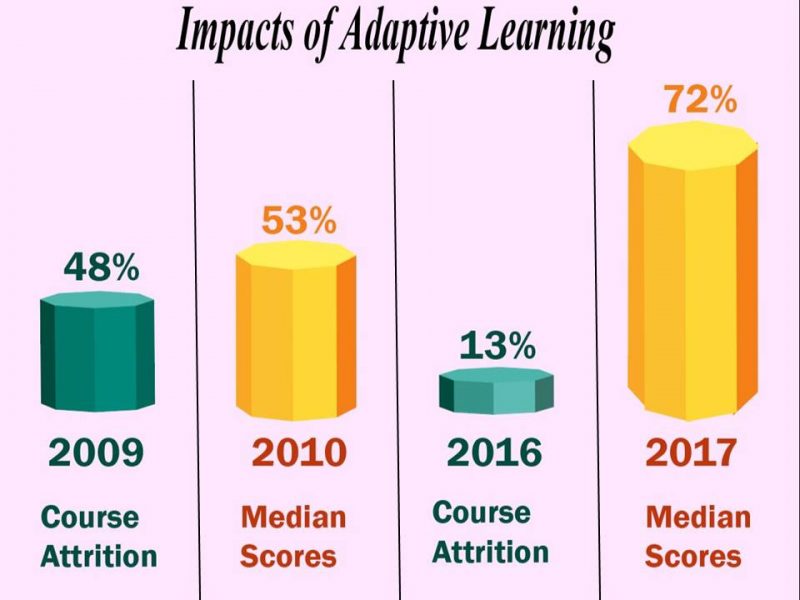
A five-year study conducted at the University of California, Los Angeles revealed the real-life benefits of Adaptive Learning. Scholars incorporated an interactive interface called Courselets as a resource where instructors collaborated to design courses. The algorithm measured Misconceptions and Course attrition when compared between traditional lectures and Adaptive Learning. To clarify, course attrition refers to the pressure experienced by learners that compels them to lose potential and interest in learning.
The results of the study were:
- Median score measured at 53% increased to 72% over a 5-year stretch
- The course attrition decreased four-fold, from 48% to a staggering 13%.
The following chart illustrates how Adaptive Learning systems dramatically improve academic performances:
Final Thoughts
Just as the said statistics suggest, numerous advantages are attached to the adoption of an adaptive learning technique in an institution. Implementing Adaptive learning opens up opportunities for individualized learning experiences, where students stay on focused pathways and work at their chosen pace.
The post Adaptive Learning in The Classroom appeared first on Test.Evelyn.
]]>The post Effective E-learning Tools: Determinants and Options appeared first on Test.Evelyn.
]]>What are Authoring Tools?
Authoring tools are applications that help design eLearning courses. Authoring tools contain crucial instructional tools, templates, and audio-visual aids to take forward the process of online learning. Popular examples of authoring tools are WordPress, Adobe Captivate, Active Presenter, and others. Currently, there are two primary authoring tools in the eLearning industry:
- Desktop apps: These are available as applications on the web that can be directly installed on a computer, and most of them work offline. PowerPoint add-ins are unique desktop authoring tools that enhance the functionality of PowerPoint and are available exclusively within that software.
- Cloud-based apps: Most new authoring tools are cloud-based. Instead of occupying space on a computer, these apps operate over the cloud and are dependent on a fast internet connection. Another advantage of cloud-based authoring tools is certainly that the course-makers can design content remotely.
If we design courses on interactive platforms and incorporate media, assessments, and animation, they will engage learners. This article, therefore, aims to guide course-makers through the vast array of authoring software based on their features and usability.
Determinants of Choosing an Authoring Tool
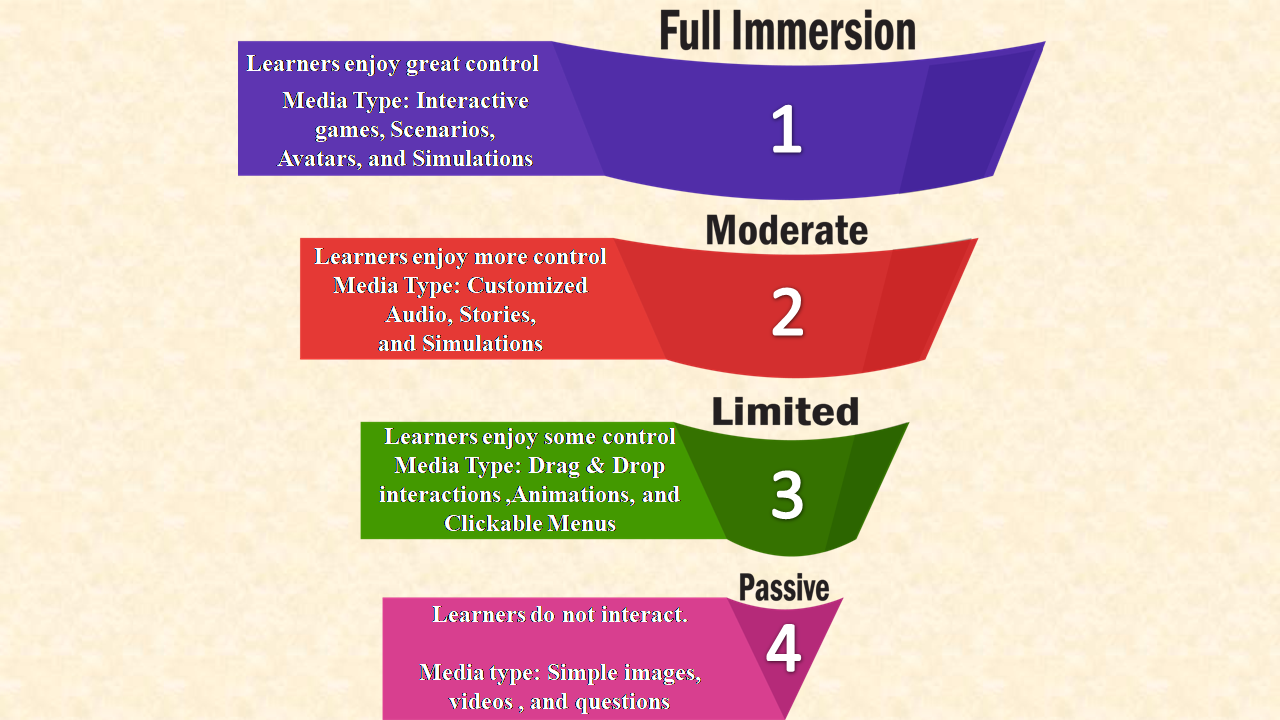
- Level of Interactivity: Online education should essentially be dialogic learning, that is, there must be an exchange of ideas between the instructor and the learners. This enables learners to form original ideas, track progress, and provide feedback. Learner interactions take the shape of quizzes, simulations, and videos; all of which assess knowledge. Course-makers typically decide on the level of interactivity that an eLearning module should incorporate. Ranging from passive engagement to maximum interaction, there are four levels of interactivity. The diagram below summarizes them:
2. Budget and Ease of Usage: It is crucial to consider how much money is going to be spent while purchasing a specific authoring tool. Therefore, to avoid incurring losses with the purchase, one must weigh in the following points:
- Which features are on offer?
- Does the software have built-in templates and audio-visual aids?
- Is technical support readily available?
- Does the company offer tutorials and other resources to enable ease of usage?
A recent review report of costs and pricing run by PcMag showed that among the most expensive eLearning tools are Elucidat and Shift eLearning, whereas software like Camtasia and Active Presenter are comparatively inexpensive, with a host of free features.
The usability of software is additionally determined by the availability of resources, readymade templates, and video tutorials. All of these certainly allow technologically inept users to design courses with ease. For starters, choosing software that have a convenient user interface (UI) is recommended. However, other tech-savvy course-makers may want more creative control. In that case, they may opt for software that offers a complex and customizable user interface, where the user controls every aspect of the product.
3. Publishing Format: A novel feature of online learning that tells it apart from traditional learning is the option to upload content over an LMS (learning management system). To clarify, the obvious advantage of LMS is that remote learners can access assets and also keep a track of their learning without geographic barriers. While selecting the right authoring tool for an online course, we must consider whether we will be uploading the course to an LMS or make them available personally to clients. Finally, to publish the course to an LMS, a software that permits publishing to SCORM, TinCan API, or AICC is necessary.
Some eLearning Authoring Tools Suited for Different Purposes
A curated list of authoring tools according to a variety of media requirements, for instance, graphics, assessments, audio, and so on, is available below.
Free Software for Graphics:
Graphics cover charts, infographics, or visual aids. The use of informative graphics can effectively make a course come alive. Some of the best free graphics tools ordered according to the ease of usage are:
- Canva: Create collages, charts, marketing promotions, or infographics with their easy-to-use software.
- Easel.ly: Design and share visual infographics online.
- Gliffy: Create up to five public diagrams, flowcharts, or charts a month for free.
- Google Charts: Turn the data into powerful charts and graphs.
- Pixlr: Edit any photos or graphics for free.
Free software for audio:
Audio tools allow users to record, mix, edit, and also to download audio clips. We can add them to eLearning courses to enhance the power of text-heavy courses. Some free tools, for instance, are:
- Ardour: To record, edit, and mix audio files on all platforms
- Audacity: This software has been in the market for years due to its resilient build. In the same vein, it is an open-source recording, editing, and sharing tool.
- Voki: Incorporating speaking characters into teaching courses is made easy with customizable avatars on offer at Voki.
- vozMe: An immensely useful text-to-speech tool
Free eLearning tools for animation:
To make eLearning courses come alive, animation is the key. Incorporating video clips is also a great idea to elucidate complex ideas. Some popular choices in this domain include:
- Camtasia: Videos are created using their drag-and-drop video editing tools. Moreover, special effects and graphics can be added to them.
- Screencast-O-Matic: It allows the recording of voice-overs of up to 15 minutes for on-screen activities or short tutorial videos.
- Snagit: It enables the creation and editing of videos or converting them into GIFs.
Free eLearning authoring software:
Some exceptional authoring tools allow the creation of customized eLearning courses. A few of these software provide all the necessary tools. For instance, screen casting, adding videos/images, including interactive features, publishing options, and others.
- iSpring: It links PowerPoint presentations to learning management systems or content management systems to publish them.
- Easygenerator: If users do not wish to buy a paid subscription for this software, the free option allows users to create up to ten online courses that come with pre-installed packages and the option to publish over cloud.
- Udutu: It offers a host of options, such as ready templates, assessment tools, interactive features, and the option to convert courses to the SCORM format. Moreover, this eLearning tool is absolutely free.
- LCDS by Microsoft: It offers users Microsoft Silverlight Learning Snacks, which is a free browser plug-in that offers interactive media experience, business, and mobile applications.
Our previous blog “steps of creating e-learning courses” in the eLearning archives sets out precise objectives that every online course should be able to fulfil.
To explore more about e-learning, visit our blog.
Create. Engage. Inspire.
The post Effective E-learning Tools: Determinants and Options appeared first on Test.Evelyn.
]]>The post Creating an E-Learning Course as per Learner-Needs appeared first on Test.Evelyn.
]]>What is eLearning?
eLearning is any form of learning that one undertakes on a digital device. Be it an educational video of half an hour or a month-long course on digital marketing, all of it comes under the wide umbrella of eLearning. In other words, one of the reasons why students, professionals, and companies are switching to eLearning courses is their convenience. In the past decade, the online education industry has witnessed a sweeping reorganization in terms of service, user-friendly interface, and availability of downloadable study material. Therefore, considering the demand for online courses, steps for creating eLearning courses count as implicit knowledge.
The Popularity of Online Courses
Today, premier institutions like Harvard University, Penn State University, and the University of Michigan have aligned themselves with the online education sector. Numerous courses offered by these esteemed universities, both paid and free, can be found on EdX, Coursera, and other such platforms. Private corporations such as LinkedIn Learning have enhanced the employability of interns and professionals through their flexible courses on SEO, language courses, Python, C++, animation, and numerous others.
The popularity of online courses is only expected to increase soon as reported by the research conducted by Ambient Insight, which indicates that the global eLearning market is expected to multiply by 5% yearly.
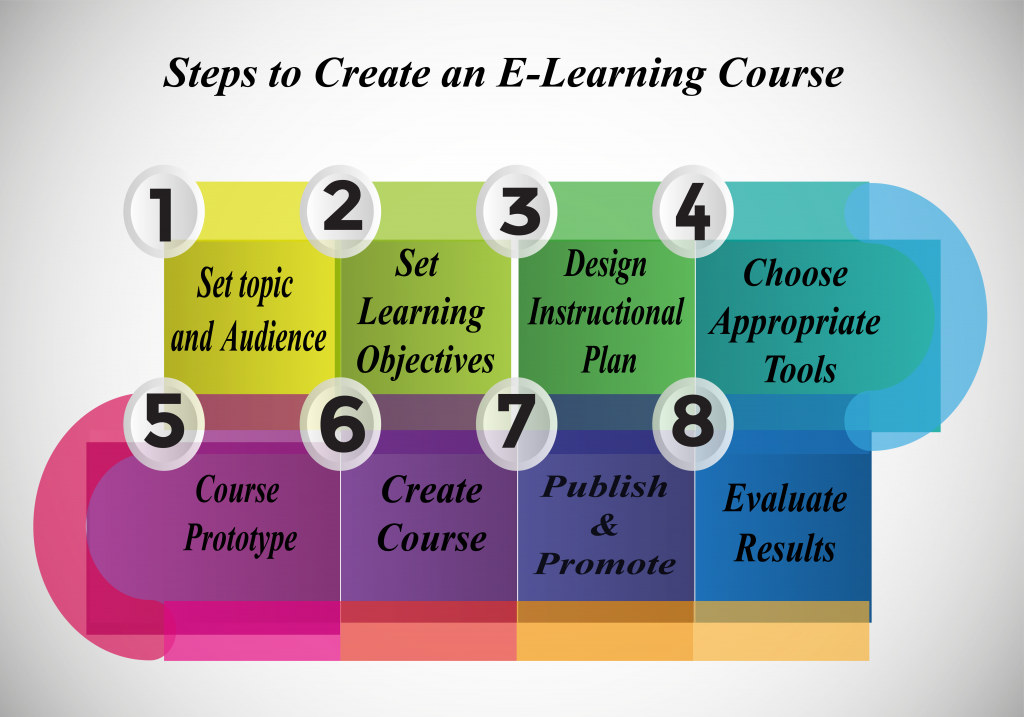
Considering the vast reach of online learning courses, one can independently design modules – a daunting task ultimately made easy in this explanatory blog. Consequently, a step-by-step analysis of the process of creating eLearning courses is summarized below:
Points to Remember while Creating eLearning Courses
1. Analyze the Topic and Set the Audience:
We must note that eLearning typically addresses the gaps in knowledge and helps employees acquire valuable skills. However, it ranks rather low on the scale when a job design plan or a requirement of practical experience is concerned. Companies with dynamic work atmospheres adopt eLearning, and the courses undertaken pertain to product description, code of conduct, software usage, customer satisfaction, and so on. Likewise, retail, banking, and pharmaceutical industries frequently conduct eLearning courses to bring employees up to date with newer requirements on the job.
Knowing the audience allows online course makers to design courses that are relevant, precise, and well-rounded. Surveys, polls, and focus groups within the office or the class generate individual responses about learner expectations from the course, availability, and technical know-how. As a result, this prevents course makers from designing “one-fits-all” modules that leave important gaps in knowledge.
There are several determinants to consider about the target audience before creating eLearning courses:
- Demographics: This involves parameters such as age, educational background, languages spoken, and country of residence.
- Prior Knowledge: An online course may be taken by a small group of learners. Each learner may have varying degrees of prior knowledge. Consequently, an assessment at the beginning of the course is a helpful idea. It informs the designers of specific skills that learners already have. As a result, any and all knowledge gaps are bridged.
- Context: Several psychological and professional factors contextualize a course. Additionally, contextualizing generates maximum learner satisfaction and wide outreach among audiences. Driving questions that help one to decide the context are:
- How much time beyond office/school hours can the learners devote to online learning?
- What are some of the frequent challenges/frustrations in the workplace?
- What are the causes of low productivity, disinterest, or procrastination?
Other factors that help decide the target audiences for creating eLearning courses are learning preferences, group behavior, technical skills, and accessibility.
2. Set the Learning Objectives for the eLearning courses:
To design relevant online courses, it is best to have a comprehensive understanding of learning objectives. Learning deliverables are supposed to fulfill a set of goals by the end of a course. For instance, a statement on the learning objectives of a poetry appreciation course can be –
“By the end of this course, the learner shall be able to critically analyze poetry, measure feet, syllable, and scan for prosodic rhyme. The learner will be able to pinpoint the said text to the specific school of poetry it belongs to.”
This statement at once clarifies the goal(s) of the course for learners to decide whether taking it will benefit them. In the same vein, this set of objectives helps the course maker not stray from the path while designing it.
The SMART mnemonic code helps us to decide on some objectives:
- Specific – specificity of target audience and course outcomes
- Measurable – a variety of means to measure learner progress (tests, quizzes, and peer review)
- Achievable – to ensure that the learning goals are realistic and achievable
- Relevant – the target audience must find the course relevant to their needs.
- Time-bound – can the learners realistically achieve all the teaching goals by the end of the course? The answer decides the necessity of the course.
3. Choose the Appropriate Tools:
The right authoring tools can make or break an online course. The technological know-how of the target audience helps the course maker decide on the tools. For instance, learners with basic technical skills may select an authoring tool with a user-friendly interface and ready templates. On the other hand, a tech-savvy group of learners can adjust to a complex UI, interactive platform, and dynamic simulations. Company budget, software and hardware support, and server maintenance are important factors to consider before selecting the tools.
4. Design an Instructional Plan:
A crucial part of designing an online course is to devise an instructional plan. Most importantly, learners typically do not express interest in a tedious course without audience interaction/participation. At this step, the course maker should consider how to strike a balance between audience engagement and knowledge delivery. Even then we have more to do. The Instructional Plan contains the most effective, engaging, and fruitful method of knowledge dissemination.
If the course deliverable is more fact-based, teachers can represent such knowledge through graphs, charts, and printable study material. However, if the course is about explaining a concept, consider audio-visual content and frequent quizzes to ensure understanding, and encourage e-discussion panels. Instructors may design homework and practice tests in such a manner that they are goal-oriented and evenly spread throughout the course. Above all, coursework should ideally not pile up at the end.
5. Course Prototype:
A task in fine-tuning an online course is prototyping it. Making a prototype entails designing a small-scale version of the course to check its look and feel before launching it formally. This step is a basic simulation task. It checks whether the technical functions are running smoothly, whether the course sequence is correct, and all in all, how promising it looks. Course makers may take the help of other subject matter experts by taking feedback on the prototype before launching it for learners.
6. Create the eLearning Course:
After running a successful prototype that is duly approved, course-makers may take up the task of actually creating the eLearning course. Moreover, one must keep in mind whether the course aligns with the original objectives and take care to design it in a model that enhances learner engagement.
7. Publish and Promote:
After creating an engaging course, contact the marketing team of the said organization to duly promote it. In addition, course makers may promote their work externally through a PR team or adopt an internal promotion plan.
8. Evaluate the Results:
A conscious educator knows that their responsibility extends beyond completing a course; they take learner feedback and measure its effectiveness. In addition, from an end-of-course survey, one may gather valuable tips on how to improve or discern whether the course has delivered on all its objectives.
[Evelyn Learning can help create an eLearning course for you. For more information, click here.]
Creating eLearning Courses: Final Thoughts
To sum up, we have attempted to provide a theoretic guide to creating eLearning courses that are both interactive and engaging. Subsequently, in our next articles on the topic, we shall look into the vast array of eLearning authoring tools on offer today and attempt to draw up a checklist of what makes an effective eLearning course.
References
*Sam S. Adkins. The Worldwide Market for Self-paced eLearning Products and Services: 2010-2015 Forecast and Analysis. July 2011.
Will Erstad. Online By Design. November 2020. Accessed at https://www.rasmussen.edu/student-experience/college-life/quality-online-education-experience/s
For more cues on creating E-Learning courses, visit our blog.
Create. Engage. Inspire
The post Creating an E-Learning Course as per Learner-Needs appeared first on Test.Evelyn.
]]>The post Adaptive Learning as a New-Age Teaching Methodology appeared first on Test.Evelyn.
]]>Traditional teaching presents a rigid course material to fit all the students. Adaptive Learning makes use of frequent assessments, exchanges feedback with learners, and opens alternative learning paths that help students gain content mastery before moving onto other steps of learning.
Case Study
Let us say a group of 5 students are undertaking a module which includes sections such as Logical Reasoning, Quantitative Aptitude, Statistics and Language skills. If the teacher applies conventional methodology, he will hand out course material and then evaluate the students through tests. The learning outcomes are understandably poor. The teacher finds that among the 5, one is especially conversant in language skills while being weak in statistics. He may find still others who are well versed in all the sections of the module.
Yet the common evaluation generates an average result for all five, which is as good as false data. Going by this data, some students fail in select sections, some excel in all, while others move on with insufficient depth of knowledge in a section where they had begun to show promise.
Problems with the Case Study
The concerns regarding with the aforementioned case study are evident.
- Sample Size: While monitoring a small group of 5 students, the teacher is able to alter the course depending on the areas which each student seems to struggle with. This option however limits itself to a small sample size. The teacher cannot single-handedly design unique learning pathways for say, a batch of 100 students.
- Inequitable teaching outcome: This method only pools the knowledge shared in the classroom to a handful of average students, while the high-performing students and those who fall behind get left out of the equation.
- False data: A “one-fits-all” evaluation technique for learners with differing abilities generates false data, leading to failing the term or causing drop-outs.
Adaptive Learning as a Ready Solution
Adaptive Learning addresses all these problems. It offers interactive systems that measure performances of each student. Additionally, based on similarity of demographic or ability, they offer customized learning paths and course materials.
Students communicate with programs, provide feedback, and complete quizzes – all of which helps the system learn or adapt to their unique learning style. This also presents content in a set sequence, adjusting to the students’ learning path and pace. Adaptive learning systems take on the task of restructuring the course sequence from the teacher. Consequently, we can apply it to a greater sample size with ease.
Traditional classroom teaching does not rule out certain drawbacks such as failure to clear assignments and drop-outs, which Adaptive Learning does help with.
School systems have been infamous for “teaching to the middle”, where there are no provisions to encourage excellent performers with more challenging material, or support lagging students with customized content. This leads to failing the classes or dropping out of the system.
This methodology ensures that students gain mastery over individual topics before moving on to the next. It also generates assessments based on the performance of the learners, caters to the under-performers, and bolsters the excellent students, with more complex tasks.
Benefits of Adaptive Learning
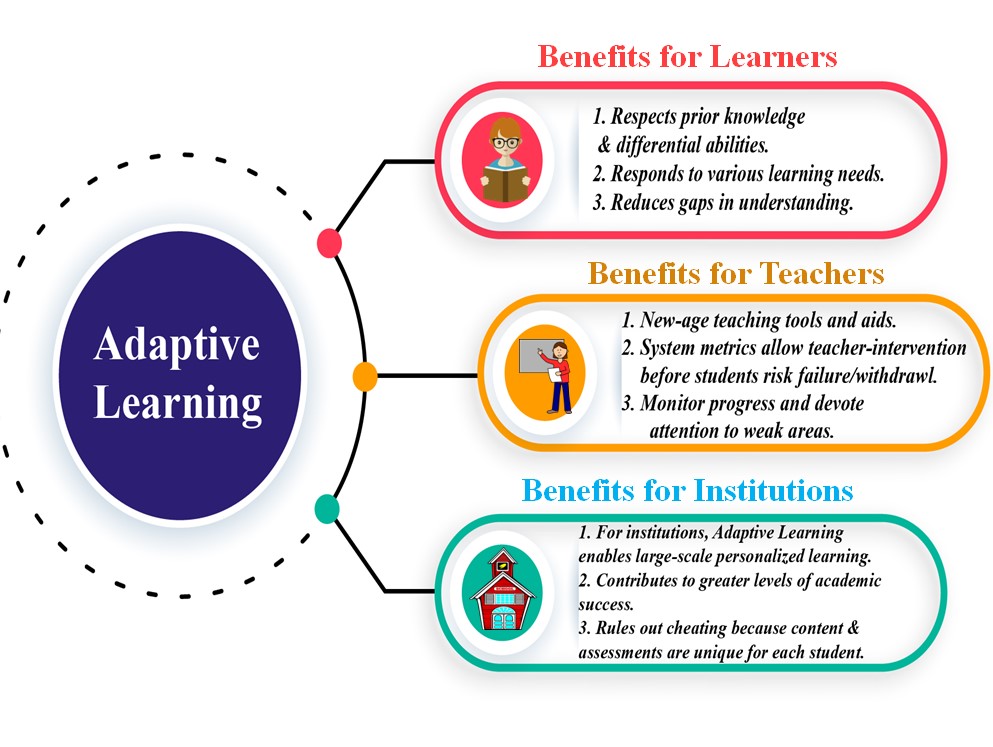
Adaptive Learning has three-fold advantages for students, teachers, and institutions as illustrated by the chart:
Challenges of Adaptive Learning
- Costly and Time-consuming: Adaptive Learning systems come at a steep cost to institutions. However, in most cases, it is a one-time investment. It also requires content-mapping and objective designing to support diverse learning styles and stages of mastery. This is a strenuous and time-consuming task.
- Not suited for some courses: Adaptive Learning is typically unsuited for courses that demand high-level critical thinking and evaluation.
- Not immediately effective: System algorithms need time to adapt to students’ learning needs by way of prolonged feedback and interaction. Systems also collect course materials over time before suggesting learning paths, so Adaptive Learning cannot be effective immediately.
Adaptive Course Samples
The great thing about Adaptive Learning system is that it can be applied to all levels of learning. Let’s look at some popular adaptive platforms and find out about sample course-ware.
- Quizalize is an adaptive platform which breaks down difficult concepts into fun, interactive quizzes. It promotes gamification in learning, and even allows for tracking students’ progress.
- Fulcrum Labs incorporates A.I to model a personal instructor for every learner who signs up. This platform takes the help of Artificial Intelligence, not only to track progress but also to make predictions about weak points and errors. It extends beyond academic subjects and helps students to cultivate real-world skills as well
- Elevate supports adult learning while entertaining learners at the same time. The platform includes a host of games, quizzes and alternate learning arcs to help adults improve upon math, reading, writing and speaking abilities. An added advantage of Elevate is that it is backed by significant research.
Taking a tour through these websites and looking at their course descriptions reveals how Adaptive Learning encourages students to choose their own path in online learning. In all these platforms we see how systems depend heavily on feedback, interaction and adaptation to learners and instructors as is the essential feature of this model.
In conclusion, Adaptive Learning though uniquely tailored for all learning needs, has its own limitations as well. By implementing it correctly, teachers hold the capability to maximize its benefits. We shall explain the different kinds of Adaptive Learning in this (placeholder) article.
For more information, visit Evelyn Learning blog.

Create. Engage. Inspire.
The post Adaptive Learning as a New-Age Teaching Methodology appeared first on Test.Evelyn.
]]>The post Teachers’ Role in Project-based Learning appeared first on Test.Evelyn.
]]>Projects enhance deeper learning because students must acquire and apply concepts and ideas. Additionally, PBL has the potential to improve competence in thinking (learning and metacognition). This is because students need to formulate plans, track progress, collaborate with others. They also evaluate solutions to real-world problems.
However, the drawbacks of this teaching methodology become immediately apparent to educators when they try to adopt this model in classrooms.
Challenges for Learners
1. Problems of Collaboration: PBL fosters teamwork and cooperation if done well. Problems arise when the group efforts are pooled to a few members who do most of the work while others do not get involved. Participation in the learning process becomes inequitable and disrupted. This may lead to false data while grading students who did not do much work, did not develop conceptual knowledge, and yet received high grades without true performance.
2. Lack of engagement: Students feel left out of the process when projects are designed in conventional ways and teachers instruct traditionally, rather than collaborating with the class to design projects. PBL proves fruitful when students develop the driving question and design solutions that will benefit an individual/organization.
3. Gaps in Active Learning: Students who are used to traditional classroom teaching feel that passive learning is the norm and struggle to take the lead in the learning processes of PBL.
4. Problems of Evaluation: It is difficult to evaluate a learner’s theoretical knowledge in the PBL framework.
A University of Michigan-led research in educational psychology revealed the responsibilities of teachers in PBL, and the challenges that they typically struggle with. Results of the case study indicated that the responsibilities of a teacher in PBL are the same as those in traditional learning. They are:
- To provide access to information and resources.
- Conduct the learning process by scaffolding instruction and guiding students to make tasks more manageable. (Blumenfeld, et al, 1991)
- Encourage students to use varied learning and meta-cognitive processes.
- Assess progress, detect problems, provide objective feedback, and evaluate overall results.
Challenges for Teachers
At the outset, teachers may encounter various complications while executing PBL.
- Teachers find it difficult to decide which parts of the curriculum to convert into projects. Not every academic discipline responds equally well to the PBL restructuring. For instance, it is comparatively easier to model computer science PBL than it is to model the literature PBL framework.
- Teachers might have incompetent knowledge and insufficient training. This could debar them from converting volumes of course material into the PBL model.
- A lack of conclusive learning outcomes and teaching goals often confuses and divides educators.
Solutions for Teachers’ Role in Project-Based Learning
PBL entails a paradigm shift because the teacher’s role in project-based learning is now to participate in the learning process with the students, lend insight, feedback, and guidance, while also eliciting ideas and approaches from the students. This is called Collegial Pedagogy in education.
The first step would be to re-imagine oneself as a fellow learner rather than an instructor in the classroom. Engaging in research over YouTube videos, journals, and reports just like students is the way to go.
Hitherto utilized methods, courses, and guidelines are expected to help shape only a portion of the PBL curriculum, therefore, the rest of the tasks will require creativity and deep thinking.
The second step involves getting down to basics and helping students decide on a driving question. This lies at the heart of every project, and it is a substantial question that opens up avenues for research and thorough study in accordance with academic standards.
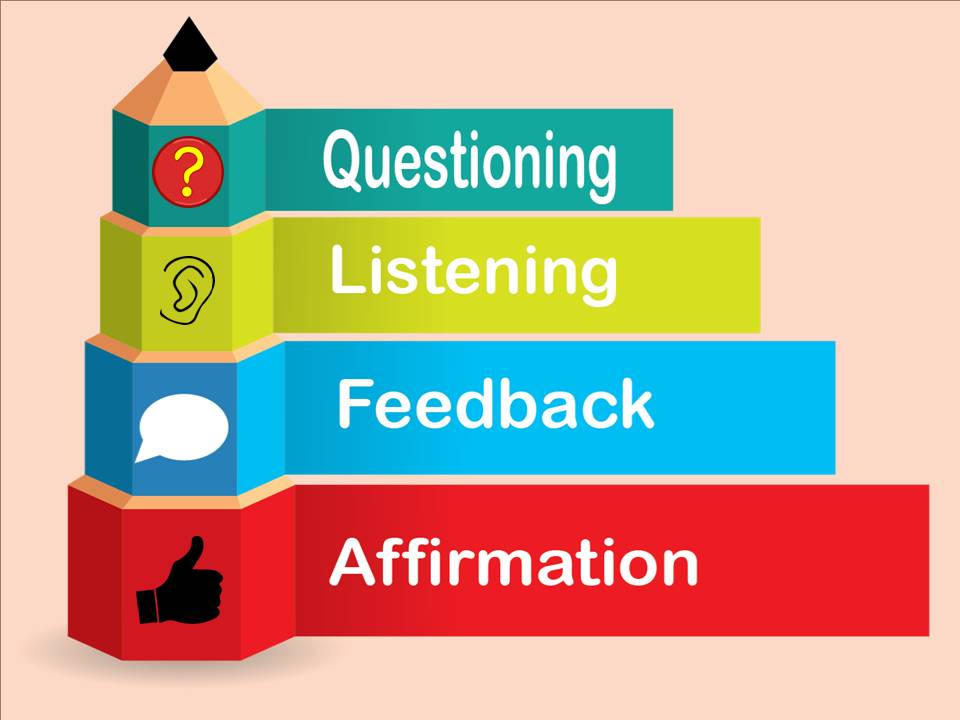
A PBL teacher ideally encourages debates, cross-questioning, and discussions to allow students to arrive at a driving question on their own. Handing out driving questions excludes students from the process and it is discouraged. The diagram below lays down some attitudinal changes for teachers to adopt to fulfill their roles effectively.
The Solution: High Quality PBL Framework
Various models and guidelines exist currently to mentor teachers in PBL. Consequently, there is a lack of agreement about learning outcomes of PBL. The solution lies in standardized core models. To ensure that institutions can provide high quality PBL experiences to learners, a standardized framework has been put together. According to the HQPBL Framework, the six criteria for standard PBL are:
- INTELLECTUAL CHALLENGE AND ACCOMPLISHMENT – to enable students to learn deeply, critically, and to strive for excellence.
- AUTHENTICITY – to enable students to work on projects relevant to their culture, lives, and future.
- PUBLIC PRODUCT – to arrange for public display and critique of students’ works.
- COLLABORATION – students collaborate with classmates and adults to receive mentoring and guidance.
- PROJECT MANAGEMENT – to engage students in a project management process.
- REFLECTION – to encourage students to reflect on their learning throughout the project.
Why Do Teachers’ Role in Project-Based Learning Need to Evolve?
The digitization of print media has brought on newer techniques of teaching, such as Blended Learning, Flipped Classrooms, and Gamified Learning. A plethora of teaching aids and tools have made the learning process experiential and interactive. Therefore, with constant innovation around, teaching cannot remain hinged on a 19th century model.
The teacher’s role as a sage, handing out wisdom, needs revision and transformation into lifelong learners who participate in project designing, execution, and evaluation processes of PBL.
The benefits of PBL far outweigh its drawbacks. As a futuristic teaching methodology, it reserves great prospects both within and beyond the classroom. The change in the teachers’ role and attitude will not arrive overnight, and the creative demands of PBL can hardly be overemphasized. However, if done well, it can ensure lifelong learning and deep interest in core concepts.
Teachers may avail themselves of vital resources, grading rubrics, and standards to follow while designing intellectually stimulating projects at pblworks.org.
Image resources: Shutterstock and Clker
For more information, visit Evelyn Learning blog.
Create. Engage. Inspire
The post Teachers’ Role in Project-based Learning appeared first on Test.Evelyn.
]]>The post Project-Based Learning as a New Tool for Learning appeared first on Test.Evelyn.
]]>Project-Based Learning as a New Methodology
With increasing innovations in the field of education, Project-Based Learning becomes an implicit feature of the teaching-learning system. Mapping the future of learning is a key aspect of understanding the massive change that the world is undergoing due to the Fourth Industrial Revolution.
- The foremost Industrial Revolution mechanized production by using water and steam.
- The second introduced mass-production of goods by using electricity.
- The third revolution automated the production process by using electronics and information technology (IT).
- Finally, the fourth wave is creating an increasingly automated reality, featuring an amalgamation of technologies that brings together digital, physical, and biological areas of living.
Data is the new social currency. Modern learners are exposed to knowledge that is arising at a startling pace. Therefore, a reconsideration of learning outcomes is mandatory. To clarify, Project-Based Learning appears to be a potent solution for the same.
A Pearson report titled Future of Skills looks at the employment landscape of 2030, a near-future for present learners. It provides refreshing insight on how megatrends (urbanization, environmental sustainability, demographics, and so on) will affect future job requirements, and it also predicts the top 10 skills that will be most in demand. Decision-making, Critical Thinking, Active Learning, Originality, and Fluency of Ideas were the skills topping the chart.
The Altered Face of Education
The near future realm of education will have the following features:
- There will be a shift of emphasis from traditional teaching methods to newer approaches, where the teacher is no longer just an instructor, but also a coach and mentor who participates in the learning process with students rather than just leading it.
- The use of blended learning will become commonplace, which features an optimal balance between teaching and technological aid. Additionally, lifelong learning would likely replace specialization.
- Personalized and project-based learning to encourage equitable learning and active participation at a pace that benefits each student uniquely will become ubiquitous.
Project-Based Learning: What and Why
PBL is a student-oriented teaching methodology in which students gain knowledge and experience by working for a prolonged period on real-world challenges and problems. PBL is part of the solution for educators looking for dynamic teaching methods. It fosters 21st-century skills such as Active Learning, Collaboration and Cooperation, Critical thinking, and Problem-solving. Ultimately, all these skills enhance employability in the future.
 Benefits of Project-Based Learning
With the advent of the Gig Economy, learners should be equipped with vital skills and relevant knowledge. The benefits of PBL as a tool for teaching are many and widespread.
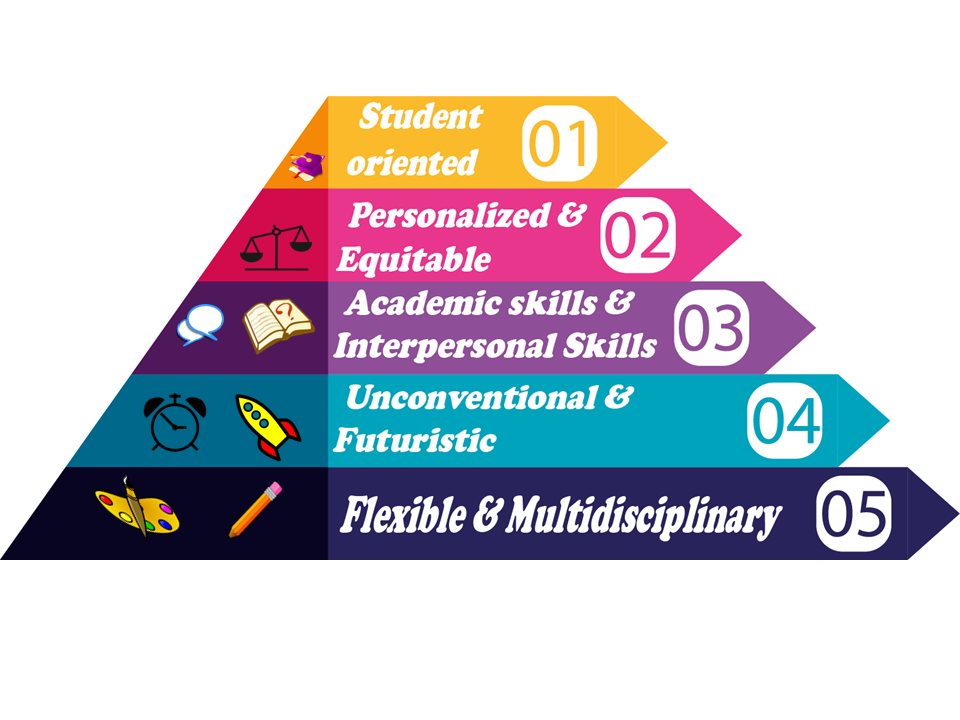
The manifold benefits of Project-based Learning are:
- Project-Based Learning is a highly personalized approach and it caters to diverse interests. Students welcome the learning experience as they get to work at their chosen pace. This eliminates the run-of-the-mill curricula of traditional classroom teaching and fosters deep interest. It accommodates varying learning patterns and difficulties, ensuring that knowledge dissemination is equitable and inclusive.
- Using the help of the PBL framework, learners can make the crucial connection between academic concepts and real-world situations. PBL also inculcates in learners valuable interpersonal skills such as conflict-resolution, resource allocation, teamwork, and cooperation.
- The PBL curriculum deals with the future of education; therefore, it involves visionary learning techniques. As an unconventional approach, it allows for maximum experimentation. This, in turn, encourages learners to invent new solutions and develop alternative approaches to the project at hand.
- Finally, PBL engages students across different academic disciplines and learning styles with its flexibility. Knowledge of a variety of disciplines typically ensures the successful completion of each project. As a result, this methodology is multidisciplinary.
Teachers’ Role in Implementing PBL
Teachers have a unique role to play in PBL. They must transition from being mere instructors to coaches or collaborators who help their students approach complex projects and problems. In the subsequent articles on PBL, we shall be discussing essential teaching resources and objectives to conduct PBL successfully and where to find them. Subsequently, PBL holds considerable promise to facilitate holistic learning of complex topics. However, it is the teachers who reserve the capability to design intellectually challenging projects and ensure deep learning by the way of probing questions.
In conclusion, teachers as coaches should give effective and specific feedback on projects designed by learners. Consequently, this helps them reach their goals and promotes competition. In addition, teachers are responsible for the assessment of projects by encouraging debates, discussions, and questioning. As a teaching methodology of a new, more technologically advanced society, PBL helps learners acquire essential skills for employability. It is through effective guidance and participation that teachers can fulfill their teaching objectives and shape capable and creative lifelong learners.
For ideas on other teaching methodologies, visit our blog.
Create. Engage. Inspire
The post Project-Based Learning as a New Tool for Learning appeared first on Test.Evelyn.
]]>