The post Animation in Education: Advantages appeared first on Test.Evelyn.
]]>Moreover, eLearning animation is an interactive learning approach that works well for any chosen subject. It offers numerous benefits to educators and learners. This article brings to light the many advantages of animation in education.
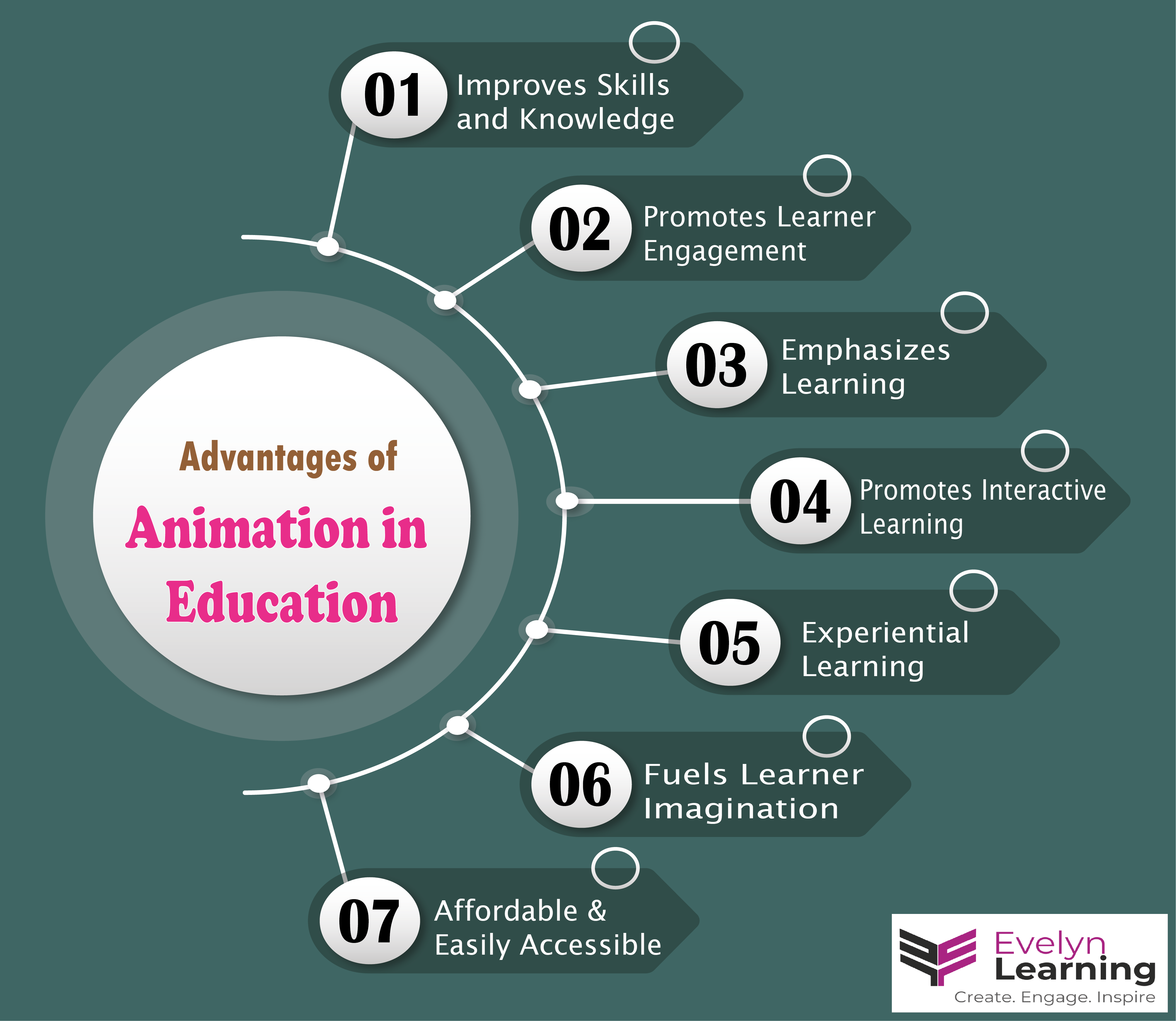
7 Advantages of Animation in Education
1. Improves Skills and Knowledge
Animation in education makes use of visuals for learning. It presents abstract concepts through visuals to provide learners a clear picture of the lesson. For instance, educators can create animated videos to teach cell biology in science class. Learners can get a fair idea of the structure of a cell through an animated video. Furthermore, the learners can also learn the functions of various organs in the body through such videos.
A noteworthy feature of animation in education is its visual impact on the learners. Owing to their short attention span, contemporary learners often digress from the lesson and fail to learn effectively. However, animated videos are short and cover only relevant content while grabbing learners’ attention. Consequently, learners develop their skills and knowledge through short visual representations.
2. Promotes Learner Engagement
Animation in education is all about interactive learning. It incorporates various learning styles in one. As the learners indulge in the enriching visuals, they participate in the learning process. Educators can use animation to create lessons as well as assessments that engage learners. Different teaching methodologies can serve their purpose with the help of animation. For instance, gamification a useful technique to design assessments where animation is used in the form of games. Game-like situations ignite a sense of thrill in the learners who look forward to moving ahead and win. Also, it is a rejuvenating exercise that diverts the mind from a monotonous learning schedule.
3. Emphasizes Learning
Animation in education is a combination of entertainment and learning. Animated eLearning videos cover complex topics with easy-to-understand visuals. The contemporary tech-savvy learners like to spend most of their time watching short, entertaining videos. As a result, learners would likely prefer a short informative video for learning rather than attending a lecture. Also, there are chances that they might replay an animated video if they find it interesting.
Additionally, with powerful visuals operating on-screen, the learners’ attention is engaged. They immerse in the learning experience and can easily retain the lessons.
4. Interactive Learning
Video-based learning is known to be an effective method of learning, owing to its numerous benefits. Different learners follow varied video learning styles, depending on the patterns of learning that they follow. The use of graphics and audio makes learning interactive and participatory. Learners interact with the course content and comprehend the lesson quickly. Also, the retention rate is higher when the concepts are in the form of videos. Gamifying a lesson is one of the strategies of interactive learning.
5. Experiential Learning
Animation in education presents abstract concepts through virtual reality. AI and VR together bring flexibility in learning intricate concepts. For instance, certain science experiments are often too hazardous to be performed in real-life. Although they form a crucial part of learning, such experiments are difficult to execute in real-time. Animation in education allows learners to experience such experiments that are otherwise not safe to perform. Virtual reality videos show the actual experiments with complete accuracy of results. It gives the learners an experience that they could only get by performing them in real life.
Another instance of the use of 3D animation in education is its use to demonstrate geometrical shapes in maths. Educators can use 3D animation to teach geometrical principles and their real-life application. It can also be used to showcase many historical events to make history interesting to learn.
Moreover, the learners cannot learn each concept practically while attending an eLearning class. Here, animation provides an alternative through experiential learning.
6. Fuels Learner Imagination
Videos can teleport the learners to an entirely different world with virtual reality. Learners get a glimpse of otherwise unimaginable concepts through animated videos. The use of different colors, shapes, and pictures appeals to the learner’s imagination. Consequently, they learn to create abstract images in their minds. Also, learners develop vivid imaginative abilities as they come across possibilities through visual animation. Not only do they gain knowledge about the subject but also learn about technology. They discover how technology can make learning easier by converting anything imaginable into virtual reality. As a result, learners get an understanding of scenario-based learning and develop social and practical skills.
7. Easily Accessible and Affordable
Employing animation in education is extremely affordable. Contrary to popular myths, animated videos are budget-friendly. Educators can use any form of animated videos without having to compromise on quality. Additionally, another benefit of using animation in education is that it is readily available. Educators can use one animated video to teach a large number of learners for a long time. Also, learners can revisit a video for recapitulation and revision. This means that they can access these videos anytime and anywhere. The only requirement is a smartphone or computer with an Internet connection.
Final Note
Teaching methodologies are no more confined to classroom activities. Learning now involves more technology than it ever did. The dynamic and sturdy rise in edutech is contributing to the development of new teaching methodologies. These methodologies focus on the holistic development of the learners with innovative teaching-learning methods. The use of animation in education facilitates educators and learners in a variety of ways. Not only it assists learning but also gives educators freedom to use a combination of teaching methodologies. They can quickly pick-up an animated video about a topic and show it to the learners for better understanding. Various teaching methodologies focus on the holistic development of the learners with innovative teaching-learning methods. The use of animation in education is another such development in tech that is continuously evolving. Its various advantages mentioned in this article make it an attractive learning solution for all levels.
Furthermore, innovations in virtual reality and artificial intelligence constantly work to enhance learners’ experience. The introduction of these innovations in education opens new opportunities and immense learning possibilities.
Research websites: Medium and Mom and More
Images: Shutterstock and Freepik
For more information on Interactive Learning, visit our blog.
Create. Engage. Inspire.
The post Animation in Education: Advantages appeared first on Test.Evelyn.
]]>The post Animation in eLearning: An Introduction appeared first on Test.Evelyn.
]]>This article explores the various uses of animation in eLearning and measures its effectiveness.
What is eLearning Animation?
In simple terms, sequential capturing of images, including drawings and pictures of inanimate objects, is considered to be animation. Animation occurs when the images are played in rapid succession to mimic real-world motions.
In education, the term ‘Animation’ may refer to any image used for teaching and learning. However, educational animation can either be simple or complex. The complexity entirely depends upon the type of educational material. For instance, moving an arrow on the screen is simpler than producing a cartoon.
Educators produce different types of study material with the help of animation. This study material is available on the Internet for learners all around the world. It is easily accessible and does not require learners to travel to a specific classroom to learn. Different eLearning courses offer the knowledge of various concepts with the help of animation. It entails that educators can deliver lessons on complex topics more effectively through visual animation. Also, such interactive courses work better at engaging learners. Consequently, it creates an impact on the learners and promotes learning and retention.
Types of Animation in eLearning
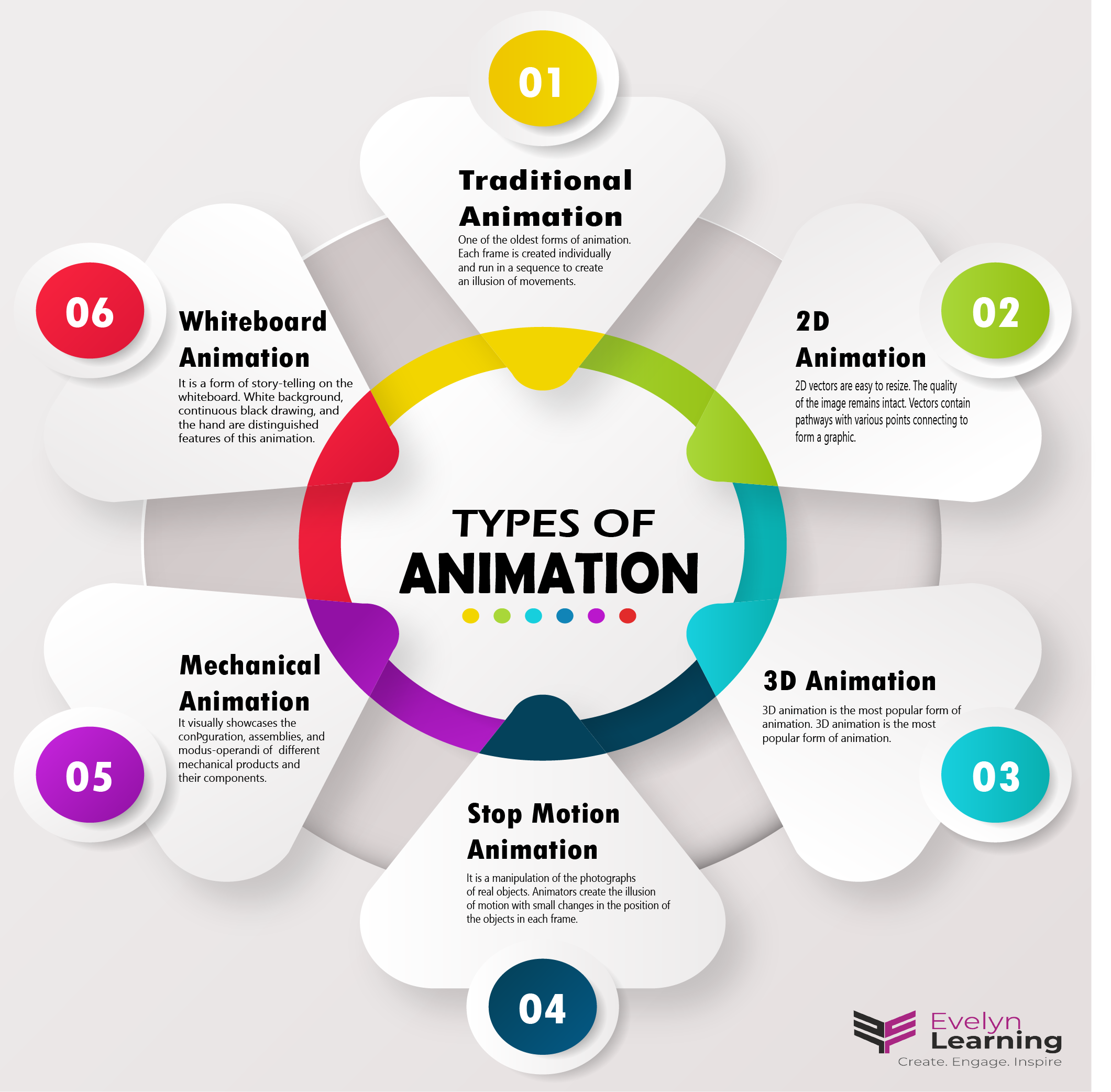
Although animation is an umbrella term for adding movement to images, it has many different types.
- Traditional Animation: This is one of the oldest forms of animation. Each frame is created individually and runs in a sequence to create an illusion of movements. Animators used to draw on an illuminated table with the previous animation kept below it. Although this method was precise, it was costly and time-consuming.
- 2D Vector Animation: This type of animation is a modification to traditional animation. Unlike the JPEG, GIF, BMP formats in traditional animation, 2D vectors are easy to resize. As a result, the quality of the image remains intact. Vectors contain pathways with various points connecting to form a graphic. Ergo, different convertible shapes form a character or another image. Moreover, there is no need for manual drawing as this type of animation uses software to create animation.
- 3D Animation: Currently, 3D animation is the most popular form of animation. Its creation entirely depends on the knowledge and use of computers. Although it completely depends on technology, the process is still complex. This type of animation uses digital frames to put characters in the right position. The animators adjust and tweak the curvatures to set the movements of the characters. However, the creation of 3D animation also requires a storyboard.
- Stop Motion: Stop motion graphics, also known as claymation, is a manipulation of the photographs of real objects. It is somewhat similar to the traditional animation and the flipbook style. However, it has physical objects in place of photographs. Animators create the illusion of motion with small changes in the position of the objects in each frame. Similar to traditional animation, creating stop motion graphics is a time-consuming and costly method.
Why Choose Animation?
Animation adds a spark of creativity to learning. It is a valuable tool that helps to ignite learners’ interest. A simple PowerPoint presentation is also animation. There are numerous reasons for choosing animation as a method to deliver e-lessons. The first and the most important function of animation is that it grabs the attention of the learners. With the Internet serving the entire world at the click of a button, gathering information has become easier than ever before. However, on the downside, the attention span of learners has downgraded. The use of animation in eLearning provides information in chunks while using the audio-visual method. This helps grab learners’ attention for a considerable period of time to promote learning.
Secondly, the use of animation in eLearning encourages better retention. Learners follow unique eLearning styles. Some learn through visuals, while others learn through listening or other methods. Animation in eLearning is the culmination of different learning styles, so it is an all-in-one teaching-learning method.
Moreover, animation in eLearning helps break complex information into consumable chunks. It also enlivens the uninteresting topics and engages the learners. It is a creative story-telling method that is useful for introducing new concepts. Another benefit of animation in eLearning is that is useful for learners of all age groups. All these benefits make it a good teaching methodology for the learners present in the post-Internet environment.
Resources: eLearning Industry and Mindflash
Images: Shutterstock and Freepik
For more information, visit our blog.
Create. Engage. Inspire.
The post Animation in eLearning: An Introduction appeared first on Test.Evelyn.
]]>The post Interactive Courses: Tips to Create E-Learning Courses appeared first on Test.Evelyn.
]]>Instructional design is evolving with the availability of a variety of methods and tools to develop instructions. As a result, we have an abundance of teaching-learning methods to choose from. Also termed teaching methodologies, these methods can be used to develop interactive courses. This article discusses the significance of interactive eLearning courses and provides some important tips to create an interactive eLearning course.
Tips to Create Interactive E-Learning Courses
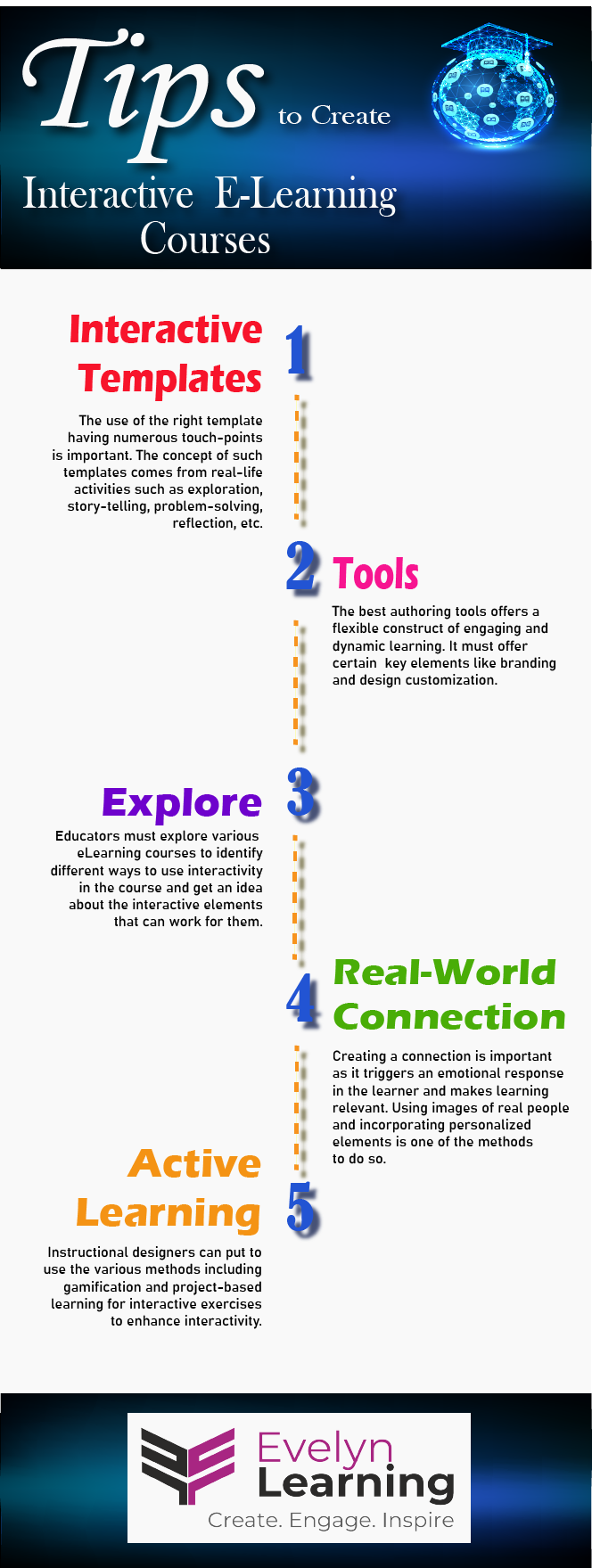
1. Use Interactive Templates
The use of the right template with numerous touch-points is important. It effectively allows learners to interact with the content without the need for specific programming. The concept of such templates comes from real-life activities, such as exploration, story-telling, problem-solving, reflection, and so on. Different activities spanning across different categories can be designed. These include games, presentations, simulations, assessments, and more. The biggest advantage of using such templates is that it makes it easier to design eLearning courses and bring learning to life.
2. Use the Right Tools
Creating interactive courses does not always require a hefty spend. Instructional designers can easily create interactive courses with the help of various authoring tools available on the Internet. The best authoring tools offer a flexible construct of engaging and dynamic learning. It must offer certain key elements like branding and design customization, powerful learner data analytics, and dynamic video capabilities. Also, the tools must be able to make a compatible course to meet the needs of different learners. SCORM compatibility is also a necessary addition to the LMS.
3. Exploration is the Key
Before working to develop interactive courses, educators must explore various eLearning courses. This helps identify different ways to use interactivity in the course. Additionally, instructional designers can get an idea about the interactive elements that can work for them. Another benefit of such exploration is that it can help drive engagement to a course. This is thanks to the visual elements that attract more visitors and enhance retention. Moreover, these visual elements help connect to other pages through hyperlinks, enhancing overall learners’ engagement with the course content.
4. Connect to the Real World
Interactivity is all about bringing learning to life with the help of virtual reality. Although eLearning has comparatively fewer chances of interactivity, it can serve this purpose through a connection with the real world. Using images of real people and incorporating personalized elements is one of the methods to do so. Creating a connection is important as it triggers an emotional response in the learner and makes learning relevant. Consequently, their engagement and retention of the content increase.
5. Use Active Learning Techniques
Building interactive courses requires the use of active learning techniques. These techniques transform passive training into an active learning program. Instructional designers can put to use the various methods, including gamification and project-based learning for interactive exercises, to enhance interactivity. Another way of doing so is by introducing a character or avatar to bring a human touch to the course. Role-play is also an active learning technique for eLearning courses.
Importance of Designing Courses with Interactivity

Designing an eLearning course can be challenging at times. This is why instructional designers must be aware of the different ways that can be used to engage learners. The most crucial aspect of an eLearning course is its content. Course content must be relevant and valid in every eLearning course/training. It ensures that learners are on the right track in learning, but it is not the only aspect to be assessed. The level of interactivity of an eLearning course also determines its effectiveness. The more interactive the course is, the more engagement it drives from learners.
Moreover, with traditional learning methods becoming ubiquitous, eLearning courses are surfacing with new trends. The physical presence of an educator is no more a requirement for learning. However, this calls for an equal compensation of in-class interaction with the help of technology. This is why interactive courses become important. Interactive courses allow more engagement and better learning opportunities at the same time, thus favoring the educators and learners equally.
Read our article on e-learning to grasp a better understanding of the dynamics of e-learning.
Research Articles: E-Learning Industry and Lambda Solutions
Images: Shutterstock and pxhere
For more information on Interactive Learning, visit our blog.
Create. Engage. Inspire.
The post Interactive Courses: Tips to Create E-Learning Courses appeared first on Test.Evelyn.
]]>The post Enhancing E-Learning with Interactivity appeared first on Test.Evelyn.
]]>The quality of engaging the viewer or listener in the content is called interactivity. The instructional designers must develop the lesson in a manner that actively involves the learners and pushes them in the right direction. Learners who actively participate in the learning process perform better and retain more. It also defines the learning patterns the learners follow. This article explores the meaning and various levels of interactivity in eLearning. Further, it also inspects its roles and benefits.
What is Interactivity in eLearning?
The term eLearning refers to a form of learning that takes place online using electronic gadgets and technology. Interactivity in eLearning is a form of a dialogue between the technology and the learners. This interaction is somewhat similar to the teacher-student interaction during a classroom lesson.
In a traditional classroom, an educator instructs learners who learn through physical material. This material includes whiteboards, books, research journals, and so on. On the other hand, eLearning involves the use of technology and electronic gadgets that often replace the teacher. Learners have access to a wider range of study material available on the Internet, which contrasts with the limited resource availability of in-class learning.
A stark difference between both is the physical presence of an educator to monitor the learning process. An educator can easily deliver an interactive lesson in the classroom, which is not possible in an eLearning environment. An eLearning environment is where neither the educators nor the learners are physically present. Although learning happens online, interactivity in eLearning acts as a bridge between concepts and their understanding. The interactive elements of the e-lessons engage learners in experiential learning. As a result, learners gain a better understanding of the concepts as they get involved in learning.
Levels of Interactivity
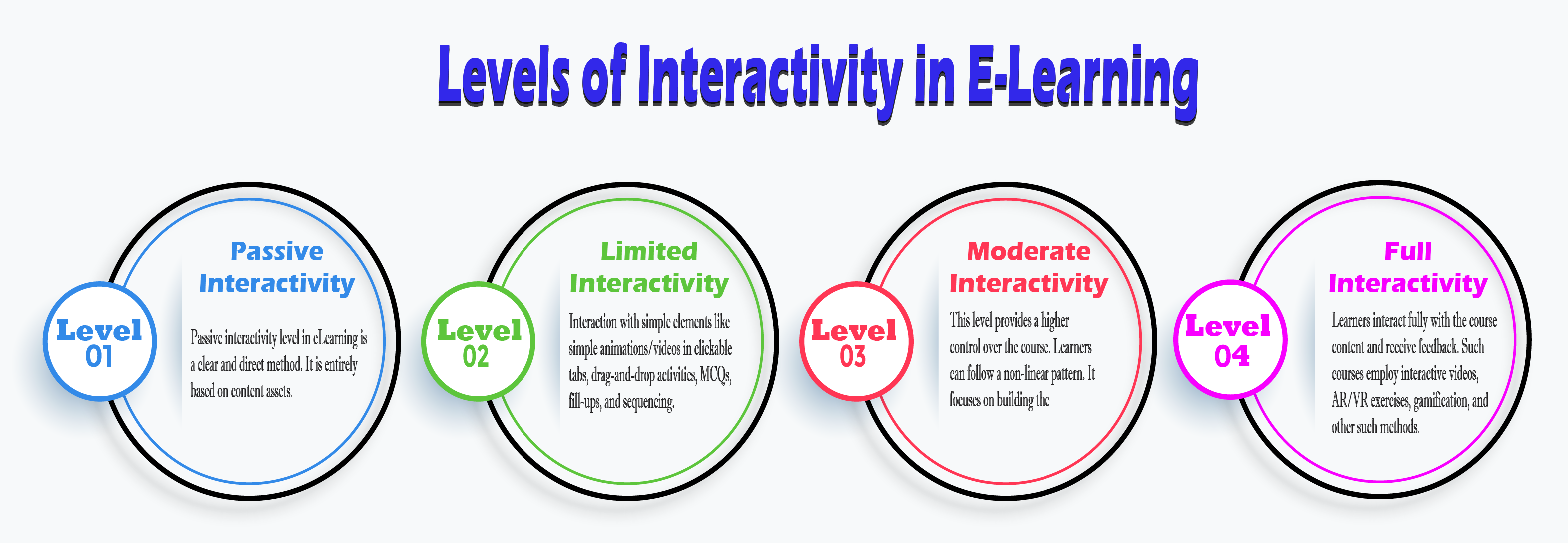
Interactivity in eLearning that happens in stages. There are four stages/levels of interactivity in eLearning.
-
Passive eLearning Interactivity
Passive interactivity level in eLearning is a clear and direct method. It is entirely based on content assets. For instance, web journals, research papers, podcasts, recordings, illustrations, and more. To elaborate, such courses are relatively passive in nature. Consequently, learners are restricted to on-screen reading and navigation or listening to podcasts and audio. However, this level is only an initial stage in eLearning. It implies that there is no interaction at all between the learners and the study material. Courses with this level of interactivity are less likely to engage learners, thus producing average learning outcomes.
-
Limited eLearning Interactivity
The second level has limited interactivity in eLearning. This level is again basic yet slightly different from the first one. At this level, learners interact with simple elements in the course, including simple animations or videos. These elements are in the form of clickable tabs, drag-and-drop activities, MCQs, fill-ups, and sequencing. Courses with a limited level of interactivity involve a low level of learner engagement. However, there is a considerable amount of interaction in comparison to the first level of passive interactivity. This means that learners do not deal with text-only information; they can also have a personalized learning experience.
Additionally, this level is good for assessments. The reason is that textual overload is less, which allows more information retention.
-
Moderate eLearning Interactivity
This level provides a higher control over the course. Learners can follow a non-linear pattern as they navigate through the course. This level particularly focuses on developing the problem-solving and decision-making abilities of learners. The course content majorly promotes knowledge application and transfer. In essence, the moderate eLearning interactivity level addresses real-world problems that require actual representation and practice.
Moreover, this level includes informative feedback along with a practical application of knowledge. Some salient features of eLearning courses with moderate levels of interactivity include the use of complex and narrative animation. It also includes case–studies, multiple-choice questions, drag-and-drop actions, and other such forms of interactive elements.
-
Full eLearning Interactivity
At this level of interactivity in eLearning, learners interact with the course content fully and also receive feedback. They exercise complete control over learning while they learn and practice their skills. There is a continuous interaction taking place between the learners and the learning material on their screens. Additionally, full interactivity in eLearning helps learners understand complex issues and develops their behavior and attitude. Moreover, it puts various elements of learner’s cognition into use by offering complex learning situations. To do this, fully interactive courses employ interactive videos, AR/VR exercises, gamification, and other such methods. Learners interact with the course by decoding the symbols, listening to audio and stories, as well analyzing various scenarios.
Furthermore, the feedback mechanism of such courses helps learners identify the areas of improvement. Eventually, learners perform better and gain high levels of knowledge.
Roles & Benefits of Interactivity in eLearning
Interactivity plays an important role in all forms of learning. The degree of interactivity in eLearning defines the quality of the course content. It also works to engage learners and motivate them to employ critical abilities for meaningful learning. Additionally, interactive elements induce alertness and activate long-term memory. The following points briefly describe the role and benefits of interactivity in eLearning.
- Causes Reaction: Interactive eLearning involves real-life scenarios that help learners experience learning through virtual reality. It also encourages learners to explore immense possibilities in a stress-free learning environment.
- Encourages Reflection: Interactive eLearning requires that learners reflect upon their learning before they answer. It encourages their involvement and promotes reflective learning.
- Boosts Engagements: Experiential learning induces various responses in the learners. The interactive elements of a course develop different skills along with motivating and engaging the learners.
- Promotes Better Retention: Learners retain more of what they experience in comparison to reading. It engages learners to provide experiential learning, which promotes better retention of information.
- Enhances Motivation: The fun elements of an interactive lesson/course make learning interesting. This works as a motivating factor for the learners who engage in learning.
With continuous developments in education, interactivity has become a must-have element for any course. Instructional designers across the world are experimenting with various forms of interactive elements to design eLearning courses. These elements are designed carefully with the help of technology to target specific areas of learning. Interactive eLearning is not only an essential feature of eLearning but also extends to the business world. Various training programs in the workplace also involve interactivity. In conclusion, interactivity is a crucial requirement at all levels of learning.
Resources: TalentLMS and eLearning Industry
Images: Shutterstock and Freepik
For more information on Interactive Learning, visit our blog.
Create. Engage. Inspire.
The post Enhancing E-Learning with Interactivity appeared first on Test.Evelyn.
]]>The post Video Hosting Platforms for Online Courses appeared first on Test.Evelyn.
]]>Why Use Video Hosting Platforms?
Videos take up a lot of storage space. This hinders the speed of servers and has an impact on the video quality. Also, not all platforms can provide an appropriate audience for a video-based course. Consequently, it is important to choose a video hosting platform with a relevant audience.
Moreover, the demand for high-definition videos is on a constant rise. These high-quality videos take up more hardware storage. As a result, they require a dedicated server capable of handling a significant amount of traffic. Uploading videos on a website can be taxing for a server, which affects the entire functionality of a platform. Hence, using a video hosting platform is more convenient.
Top 7 Video Hosting Platforms
There are many video hosting platforms offering a plethora of hosting options. Many of these are free to use with a paid upgrade option to avail advanced features.
The top 7 video hosting platforms have been described below.
1. YouTube
YouTube is the largest video-sharing platform with over 2 billion users worldwide. Also, it is the second-largest search engine after Google. It contains numerous video lessons uploaded by its various users. This platform provides several convenient features, including automatic transcription for more accessibility. Most YouTube videos are easily downloadable, which means a course can easily be copied and distributed. Consequently, there are more privacy breaches. However, the paid version of YouTube offers security options with ad-free services and other premium features.
Another feature is the search engine visibility of YouTube videos. This signifies that users can discover videos simply with a Google search. It makes YouTube one of the best video hosting platforms for online courses.
2. Vimeo
Vimeo is a professional interface for video sharing. Although it offers comparatively less upload space and customization, more privacy controls are available to the users. It provides powerful video analytics and high-quality videos without ads. Also, the video download option is only available if the creator enables it. This protects the videos and content from unwanted distribution. This platform is beneficial for creative professionals, including educators who wish to share their work with a large audience.
Although there are fewer customizations available in the free version, Vimeo offers four types of upgrade plans based on a user’s requirements. Upgrading to a paid version offers more customization and comes with more cloud storage space.
3. Wistia
Wistia is a professional digital marketing platform. It offers a wide range of marketing tools, including a built-in call to action button. Users can upload videos and embed links to their website in between. It offers a completely customizable embedded player that highlights videos from the same user. However, there are no video recommendations from other channels. It is also useful for CRM integration and custom branding because it helps create a custom audience for different social media platforms.
4. Facebook
Facebook is a ubiquitous social media platform and one of the most prominently used platforms for video hosting. It offers the biggest audience with a large number of visitors each day. Users can showcase their creativity by creating and uploading videos on Facebook. Moreover, it supports different aspect ratios and provides unlimited file storage. Although there are fewer options available to embed videos, Facebook is still useful for creating brand awareness.
5. WordPress Video Hosting
WordPress offers video hosting options in its premium and professional plans. Users must install the Jetpack plugin to access unlimited video hosting options. WordPress accepts videos in different formats, namely, .MOV, .MPEG4, MP4, .AVI, and others. Also, it offers a customizable embedded video player with video stats available on the WordPress dashboard.
A drawback of WordPress video hosting is that it does not have the premium features that other video hosting platforms offer. Also, it does not have an established audience. As a result, WordPress video hosting might not seem a good idea for someone targeting a large audience in less time.
6. Brightcove
Brightcove is a paid video hosting platform that has a fast server and powerful live-streaming options. It is a scalable solution used by many Fortune 500 companies because it does not have any resolution limit and supports all aspect ratios. It also supports all upload sizes without any issues. However, the storage depends on the plan selected.
In conclusion, Brightcove is a complete enterprise solution that supports advanced integrations for large-scale marketing and communications.
7. Dailymotion
Dailymotion is somewhat similar to YouTube. It is a platform with over 300 million unique users. This platform provides free unlimited video hosting with advanced security options. The host can protect their videos with passwords or make them private. Also, users enjoy unlimited file storage and can upload videos in the desired formats.
However, the maximum upload limit is restricted to 2GB with a maximum video length of one hour. There is less competition so building an audience becomes easy. However, there are frequent ads and issues with embedding videos on the websites.
Final Note
There are a variety of video-hosting platforms available for various unique users for free or at a low cost. Choosing the right platform requires a thorough analysis of the needs and requirements of the user. They can then compare and choose a suitable platform that serves their purpose.
Read more about Video Learning here.
Research articles: Wondershare Filmora and Kinsta
Images:
For more information on Video-Based Learning, visit our blog.
Create. Engage. Inspire.
The post Video Hosting Platforms for Online Courses appeared first on Test.Evelyn.
]]>The post Video Learning Styles: An Introduction appeared first on Test.Evelyn.
]]>The reason video-based learning outshines any other method of teaching-learning is that it allows better learner engagement. It also stimulates faster and better understanding. To achieve these outcomes, educators must possess a sound knowledge of the various video learning styles. Here are some video learning styles that satisfy the learning needs of discrete learners.
Different Video Learning Styles
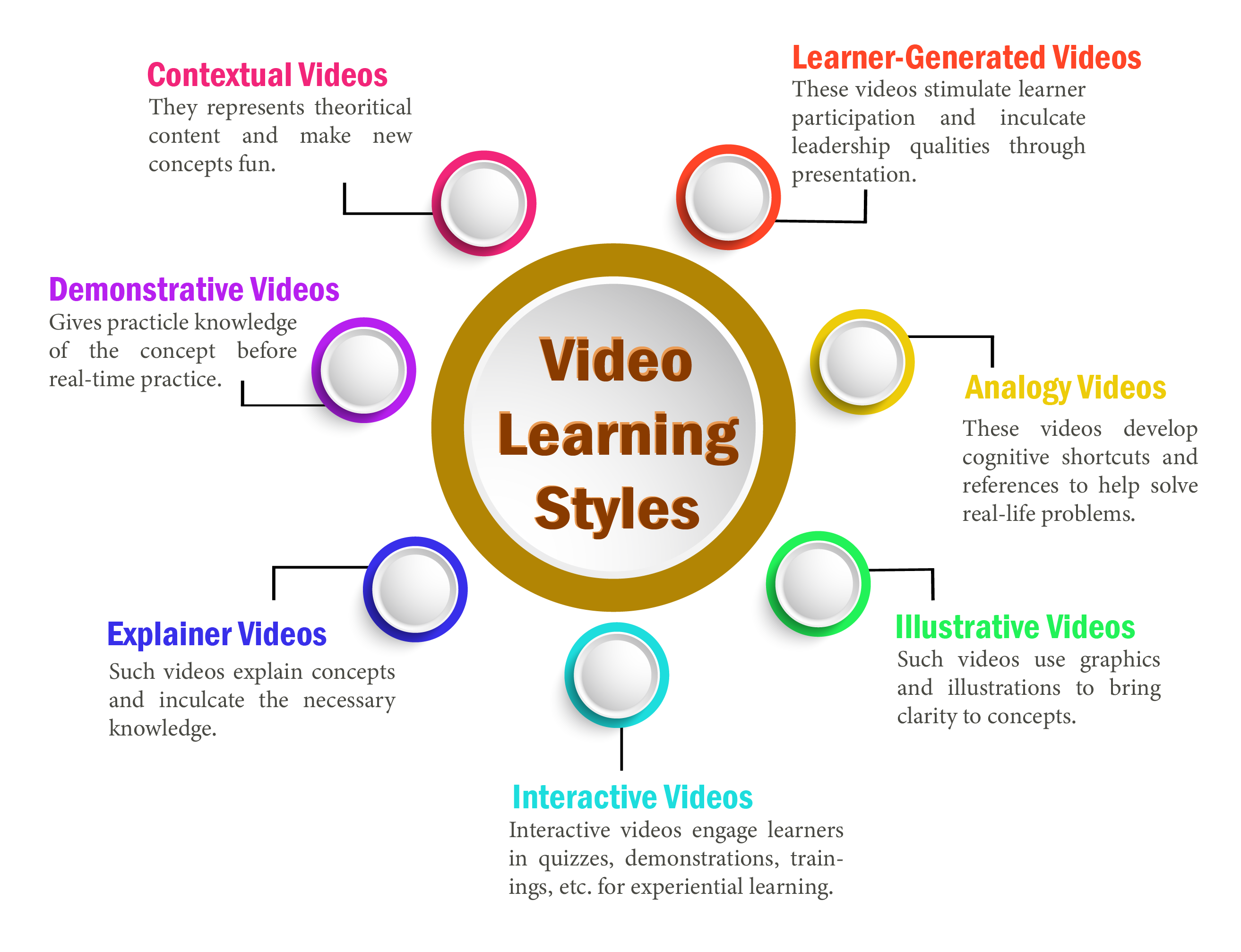
i) Contextual Videos
Contextual video learning style is a powerful way of introducing e-learning. It helps create a tech-friendly environment for learning that promotes learner participation. Also, learners gain autonomy to proceed further in learning at will with the help of videos.
Moreover, such videos are perfect for theoretical content. They help students learn faster and better by reducing text rigidity and making the information easier to consume. They make the introduction of new concepts easy and fun.
ii) Demonstrative Videos
Demonstrative video learning style follows the learning by doing approach. Such videos are useful for providing practical knowledge of a subject before learners try it on their own. This signifies that demonstrative videos help share a skill before learners acquire the relevant experience. The virtual environment brings forth the steps and risks of the activity. Consequently, learners get a virtual experience of performing an exercise in real-time.
Moreover, it prepares learners to practice precaution measures while performing the actual practical experiment.
iii) Explainer Videos
Explainer video learning style uses animation, slides, live videos, and other ways to explain concepts. Such videos explain complex concepts and inculcate in learners the necessary knowledge regarding those concepts. Moreover, this video learning style influences learning to a great extent with its usability and effectiveness in teaching and learning.
iv) Interactive Videos
The concept of interactive videos is comparatively new in video-based learning. Interactive videos are not only useful for learning but also for corporate training. They help address the multiple learning needs of various learners. Additionally, as the name suggests, interactive videos interact with learners in different ways to engage them. This interaction can be in the form of quizzes, demonstrations, or skill training.
Furthermore, the most fundamental benefit of this video learning style is that it enhances learner participation and promotes longer retention. In turn, it helps produce better learning results.
v) Illustrative Videos
Illustrative videos employ illustrations and graphics to bring clarity to concepts. In addition to this, illustrative examples help define topics and concepts, leading to a better understanding so that learners retain more. Educators can create such videos with simple illustrations, images, and graphics. As a result, they are extremely cost-effective. Additionally, illustrative videos are compatible with different devices and are lightweight. Their function is not limited by restricted internet bandwidth on a multitude of devices.
vi) Analogy Videos
Analogy video learning style helps develop cognitive shortcuts and references to solve real-life problems. Learners get to learn multiple concepts within the course without switching between topics. This makes it easier to relate one concept with another in a multidisciplinary environment. Also, learners can conclude learning with a cumulative analysis of the concepts. This learning style promotes holistic learning and longer retention.
vii) Learner-Generated Videos
Learner-Generated videos provide a stimulus for learner participation. Learners share videos through the Internet to showcase their knowledge. These videos work as a medium to transfer knowledge to other learners as well. Moreover, it promotes social learning and helps inculcate leadership qualities in learners.
Furthermore, such videos also ignite the interest of peer learners, cutting down the monotony of learning.
Video-based learning is a fun way to promote learning and enhance retention. It reduces cognitive stress and engages learners. There are a variety of areas where video learning proves to be the go-to method. And these areas extend to the workplace as well. However, educators must be familiar with various video learning styles to create effective video lessons/courses.
Research article: EdTechReview
Images: Shuterstock and Freepik
To explore more e-learning options, visit our blog.
Create. Engage. Inspire.
The post Video Learning Styles: An Introduction appeared first on Test.Evelyn.
]]>The post Creating Video-Based Educational Courses appeared first on Test.Evelyn.
]]>Steps to Create a Video-Based Education Course
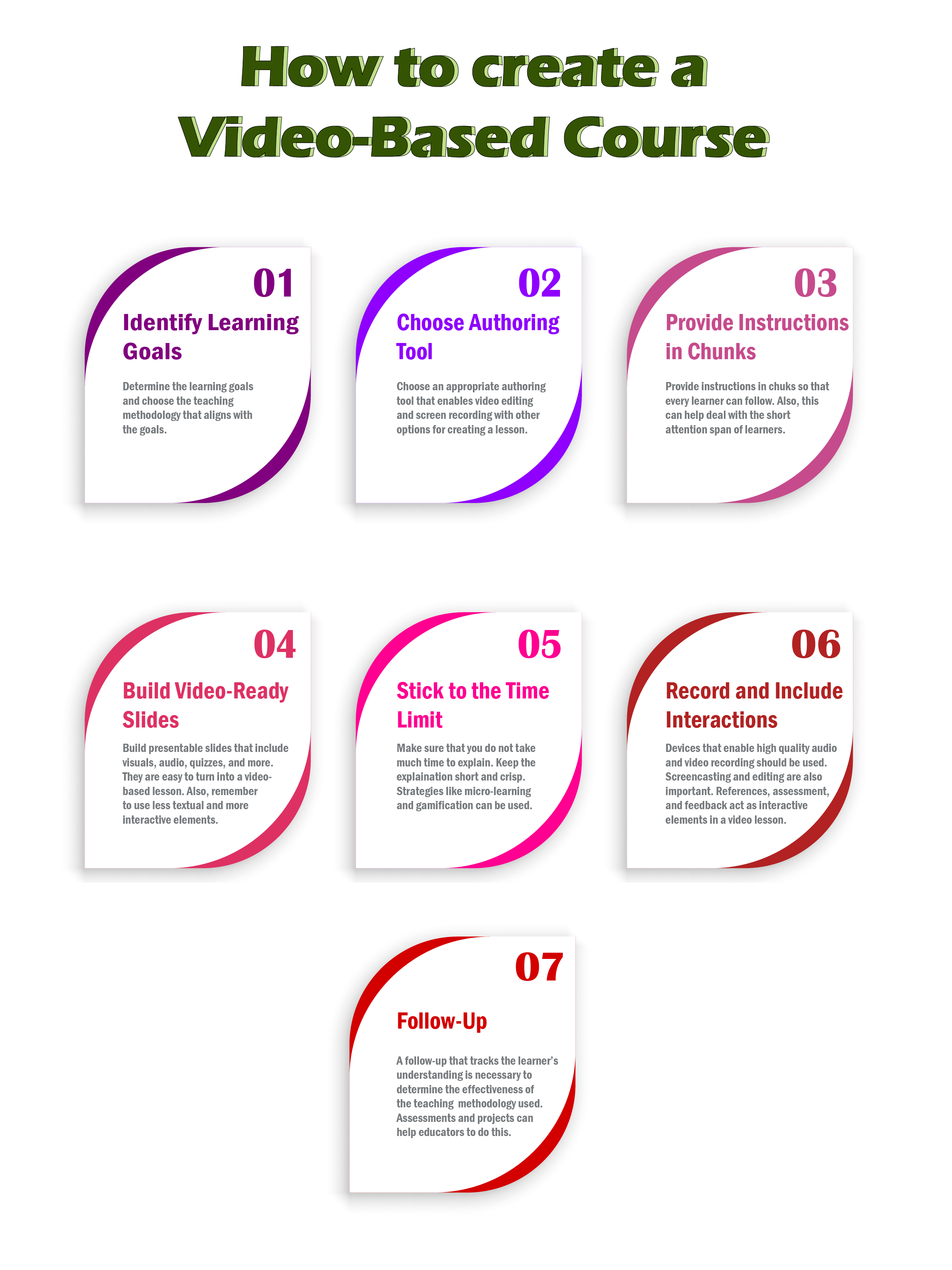
Step-1: Identify the Learning Goals
Identification of the learning goals is the first step for creating a video-based course or lesson. Educators must first determine what the learners wish to achieve through a lesson/course. This helps identify the appropriate teaching methodology that aligns with the teaching and learning goals.
Educators can also consult a subject-matter expert or a graphic designer for professional advice on creating a video-based course.
Step-2: Choose the Correct Authoring Tools
To use the video-based education method, educators must be familiar with different authoring tools and their use. These authoring tools assist in creating digital content for various purposes. They also allow educators to develop various forms of digital content with ease. This digital content covers everything from a simple MS Word document to video lessons on complex STEM concepts. Thus, choosing the correct authoring tool that enables video editing along with screen recording becomes essential.
Several authoring tools on the Internet offer these features for free or with a minimum fee to access certain features. For instance, Camtasia Recorder allows educators to create different types of videos with pre-built templates. It also provides video recording and editing. Khan Academy uses Camtasia Recorder to create and edit educational videos.
Other options include SmoothDraw3, Articulate 360, Adobe Captivate, Lectora, and so on.
Step-3: Provide Instructions in Chunks
An average learner’s attention span is about 8 seconds, which is a short period. Expecting young learners to sit for a 90-minute video lesson is out of the question. Also, learners find it difficult to follow a large set of instructions in one go. A well-organized class with crisp and meaningful chunks of information works better to engage learners.
Moreover, learners prefer several small videos instead of a single long video. Some platforms that offer video-based learning include Khan Academy, Lynda, Udemy, Coursera, TED-Ed, and more.
Step-4: Build Video-Ready Slides
Presentation is the key to engaging learners. It provides better learning outcomes as learners immerse themselves in the learning process. Educators often use digital means to supplement in-class learning. However, presentations are not sufficient for video-based education because the supplementary material contains more textual information, which the teacher explains. However, in video-based education, educators do not involve themselves directly in the class. The entire process of learning takes place through on-screen videos. Thus, it becomes difficult to capture learner attention with text-only slides. Therefore, educators must include more visuals and other interactive elements like quizzes and puzzles instead of text.
For instance, a science lesson on Resonance Structures of Benzene containing visuals that include chemical compound structure is easier to understand than just plain text. Text-only information on such complex topics can confuse the learners. Also, learners are likely to be uninterested in learning such complicated concepts through text. As a result, video-based courses also affect learning outcomes.
Step-5: Stick to the Time Limit
As mentioned earlier, a typical learners’ attention span is small. This signifies that they cannot sit and watch educational videos for long. Consequently, it is crucial to stick to the time limit while creating video-based lessons. Educators can use different strategies like micro-learning and gamification to improve learner engagement. Additionally, eLearning localization is an excellent strategy to cater to the learning needs of diverse learners.
Moreover, several small videos with digestible chunks of information are better than longer ones. Khan Academy presents the most significant example of this form of learning. They offer lessons in the form of short videos with relevant information about the topic.
Step-6: Record and Include Interactions
Recording a lesson is an essential part of creating a video-based course. Various tools available on the Internet allow educators to perform different functions of video-based education. These functions range from recording and screencasting to video editing.
Additionally, including interactions in the form of references, assessments, and feedback is essential. Such forms of interaction help create a link between learners and the concepts they are learning. It eventually renders better learning outcomes.
Step-7: Follow Up
The final step is to follow up with learners about what they have learned. This step includes tracking the results based on their performance in the assessment tests. Also, follow-up helps educators decide whether the teaching methodology applied is fruitful or not. Moreover, it provides a clear picture of the learner’s performance throughout the course.
The steps and guidelines mentioned for creating video-based education courses can help educators establish useful video-based lessons/courses. Above all, a crucial step to follow is to be genuine while delivering the lesson. The impact of the educator’s personality leaves a significant mark on learners and their learning.
Moreover, educators must know the essentials of delivering an e-lesson before they work with video-based education. This can help provide the initial experience required to teach a lesson/course effectively.
Reference Websites: Edutopia and ELearning Industry
Images: Shutterstock and Freepik
To explore more e-learning options, visit our blog.
Create. Engage. Inspire.
The post Creating Video-Based Educational Courses appeared first on Test.Evelyn.
]]>The post Benefits of Video Based Learning appeared first on Test.Evelyn.
]]>What are the Benefits of Video-Based Learning?
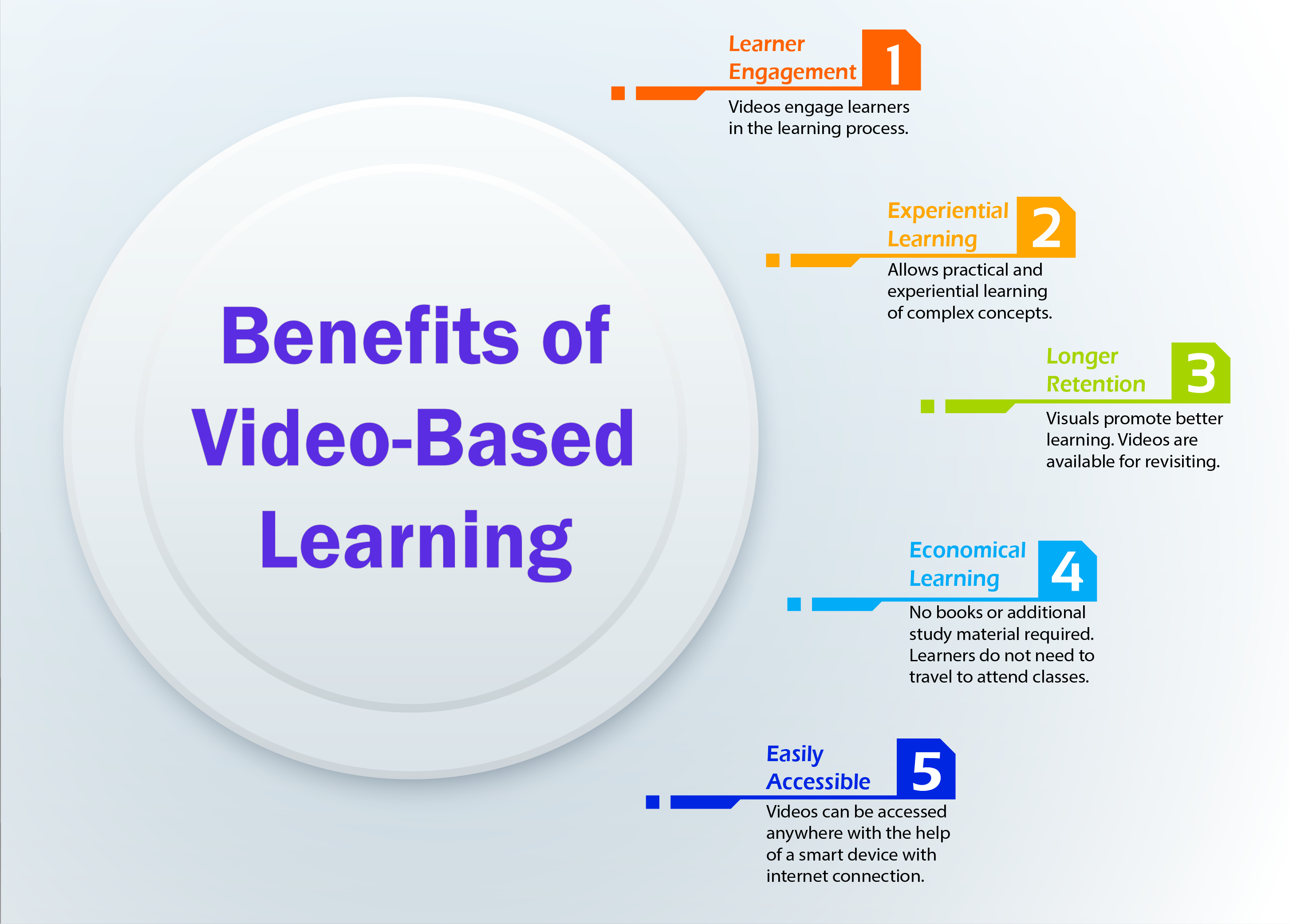
a) Learner Engagement
Videos are an interactive way of learning. Learners are likely to engage more with videos in contrast to text-only content. This is because videos include visuals that paint a clear picture of concepts. Also, educators can use non-verbal cues to their benefit in such type of courses. Non-verbal communication such as intonation when combined with questioning skills promotes engagement. This strategy is not only effective for in-class teaching but also works for video-based learning.
Moreover, videos grasp learner attention with the help of colorful and interactive visuals. As a result, learners remain constantly engaged with the visuals while learning.
b) Experiential Learning
Learning by doing is the key to achieve the best learning outcomes. The practical knowledge of a concept is necessary along with theoretical knowledge, but this practical knowledge is limited to certain subjects. For instance, learners cannot dissect a human body by themselves to study human anatomy. However, videos provide a solution for such situations that limit learning. Learners can learn about anatomy through videos that show the human body through virtual reality. In this way, the actual practical learning takes place with the help of videos.
c) Longer Retention
Videos are an amalgamation of text, visuals, and sounds. All these form the basis of learning. Studies suggest that the average adult retains 10% of what they hear, 20% of what they read, and 80% of what they see. This is because the human brain processes visual information better than verbal or written information. Consequently, when the brain receives information in a combination of text, visuals, and sounds, it becomes easier to retain.
Furthermore, videos are much more engaging than mundane classroom lectures. Learners interact with the content on the screen and are free to revisit the lessons/courses at their will. This means that they are free to practice the concepts based on their convenience. This eventually leads to better learning and retention.
d) Economical Learning
Video-based learning is an economical learning solution. Learners have access to various educational videos available on the Internet. Most of these videos are available for free or at minimum charges. Also, video-based learning does not require traveling or attending classes physically. This helps learners save time and money that would otherwise be utilized.
Moreover, there is no requirement for books and other study material. Only a good Internet connection and a smart device can serve as the tools for receiving knowledge.
e) Easily Accessible
Videos are one of the most easily accessible resources in the current era. This is thanks to technology and the Internet, which provide easy access to all online services. Learners can access any videos on the concepts they wish to learn without having to spend much time finding a teacher. Moreover, videos are always available for reviewing to recapitulate a lesson/concept.
Additionally, technology enables educators to create learning videos on their own. There are various tools available on the Internet that help create an e-learning course.
(Read our blog on Creating a Video-Based Learning Course for more information.)
Future of Video-Based Learning
Auditory learning is gradually becoming a thing of the past. The Internet presents various new learning possibilities. Consequently, eLearning is gradually becoming a go-to learning method. It serves learners with different e-learning styles with an amalgamation of various teaching/learning methods. Video-Based Learning is a great way of administering knowledge. This is because videos immediately grasp the learners’ attention.
Although videos are a part of eLearning, they also supplement in-class learning. Various forms of blended learning (including the flipped classroom) use eLearning to supplement in-class learning. This yields better learning outcomes and also promotes better retention.
Video-based learning will have more consumers in the future, which is due to its ease of usability and application in a wide gamut of industries. It is not only useful for learning but also serves various corporate training and learning needs. Additionally, with technology and resources gradually becoming available to all, creating educational videos will be much easier in the future. As a result, it has great potential to play a prominent part in the future of eLearning.
Research Website: ELearning Industry
Images: Shutterstock and Freepik
To explore more e-learning options, visit our blog.
Create. Engage. Inspire.
The post Benefits of Video Based Learning appeared first on Test.Evelyn.
]]>The post Video-Based Learning: Definition, Emerging Trends, and Usage appeared first on Test.Evelyn.
]]>A study has proven that the human mind retains more information when imparted via visual means. Therefore, video-based learning is becoming an effective tool for learning and is yielding better results than traditional learning. Through this article, we will explore video-based learning and its various dimensions in detail.
What is Video-Based Learning?
Video-based learning, put simply, refers to the learning that takes place with the help of videos. Nowadays, the physical presence of a teacher and students is not necessary for learning. Video-based learning is one such means of learning that supports this newly found global dimension of learning.
Since these video lessons are easily available over the internet, creators need to put together easily comprehensible lessons with more retention rates and the least possibility of deviation. They should include eye-catching graphics, clear audio with great intonation, and error-free content in their videos to yield the best results.
Emerging Trends in Video-Based Learning
Although technology eases learning, it becomes a distraction as well. The internet brings everything to a screen with a click, but it has many disadvantages as well. The biggest of these is the decreasing attention span of learners, especially that of the millennials. Millennial learners need quick bites of information and cannot stand long hours of lectures. Therefore, video-based learning proves to be one of the most effective ways to learn.
Various innovations in this type of learning make it a game-changing learning method. Some of these trends are as follows:
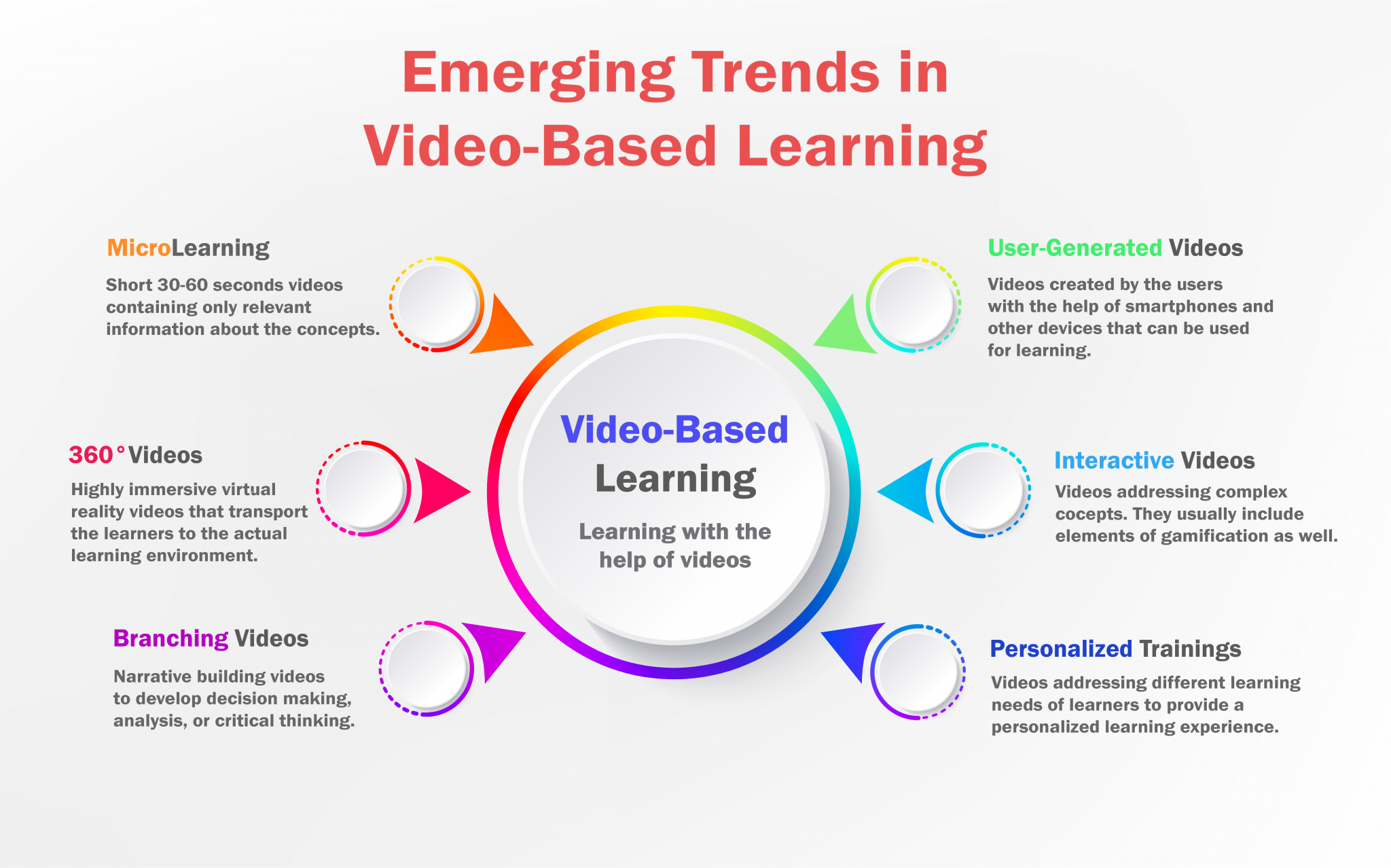
a) Microlearning Videos
Microlearning videos include short videos addressing the main concept. Such videos are shorter, approximately 30-60 seconds, and give brief information about a concept. Therefore, learners do not have to sit for long hours and cram unnecessary information in the name of learning.
Moreover, microlearning videos are target-specific and prove to be an effective training method.
(Refer to our blog on Micro-Learning for more information.)
b) Interactive Learner Experience
Interactive learning is a way of engaging learners in the lesson/course. This promotes better learning and retention. This trend emerges with the acknowledgment of the fact that learners cannot remember everything included in a lesson/course. Also, long hours of learning are usually boring. Thus, making a lesson/course interactive is necessary.
Some methods to make an interactive lesson/course include gamification, inserting annotations, quizzes, and more.
c) Video-Based Branching Narratives
Video-based branching narratives focus on building a story. Learners decide how the story unfolds by perceiving its negative and positive consequences. As a result, this video-based learning trend provides a multitude of choices and interactive points for better learning.
Why Use It?
Videos are the most influential consumer engagement method. There are endless possibilities that only videos can achieve. They help create comparatively more engaging, interactive, and fun lessons/courses. Additionally, learners prefer videos over lengthy articles. This alludes to the fact that we retain visual information for a longer time. Also, concepts sound more appealing in the visual form. Thus, learners develop stronger mental connections with the engagement of multiple senses.
Furthermore, this innovative method is useful for both education and corporate training purposes. This feature makes it an even more dynamic way of learning.
Research websites: Next Day Animations and CommLab India
Images: Shutterstock and Freepik
To explore more e-learning options, visit our blog.
Create. Engage. Inspire.
The post Video-Based Learning: Definition, Emerging Trends, and Usage appeared first on Test.Evelyn.
]]>The post E-Learning Resources for College Students appeared first on Test.Evelyn.
]]>In the contemporary world, continuous learning is the only key to success. College students are often swamped with a lot of learning and responsibilities. Consequently, managing time to travel and to physically attend a class becomes tiresome, so e-learning through different resources serves as the best alternative. Also, these resources allow learning to continue at all costs, with minimum requirements of time, space, and money.
The top free e-learning resources for college students have been listed below.
1. TED-Ed
TED-Ed is a youth and education initiative of TED. It is an international platform that aids teaching and learning. With a growing animated video library, TED-Ed allows educators to create interactive lessons to teach students around the globe. The TED-Ed animated videos, or TED-Ed Lessons, are short videos about the ideas that spark the curiosity of learners. These videos are a result of the collaboration between experts, including TED speakers, TED fellows, educators, writers, and many others.
Moreover, the advisors of TED-Ed include prominent personalities from different fields relating to education. Aaron Sams, Jackie Bezos, Melinda French Gates, and Salman Khan (from Khan Academy) are a few to name.
2. ResearchGate
ResearchGate is a global professional network for researchers and scientists. The platform aims to connect the world of science and ease research. Presently, ResesarchGate has millions of members collaborating on specific topics in science and research.
An additional feature of this platform is that it allows the members to publish their data and see who’s reading or citing it. Moreover, this data is accessible from any corner of the world, making it a handy tool for college students to learn.
3. Coursera
Coursera is an online education platform providing free academic references and modules for learning. It provides knowledge about various subjects with on-demand video lectures, discussion forums, and homework exercises. The courses are available for free, with some requiring payment. Moreover, learners receive a sharable certificate at the end of the course.
An additional advantage of learning with Coursera is that it partners with more than 200 top universities in the world. Also, industry educators partner with Coursera to offer specializations. Certificates, courses, and various degree programs. Overall, the platform provides universal access to the best education with top universities and organizations.
4. Khan Academy
Khan Academy provides numerous educational videos and test exercises that help learners study at their own pace. It eliminates the need to attend a physical classroom for learning with an open learning platform. Also, it is one of the biggest learning platforms with courses that cater to the learning needs of all age groups. All these courses are free and accessible anytime, anywhere. Moreover, the courses are available in more than 36 languages, promoting learning without the barriers of language.
5. Duolingo
Duolingo is a mobile application for language learning. The application is available for free with more than 90 different language courses. It gives a personalized learning experience with gamified lessons. Also, the lessons review learner’s vocabulary effectively and show grades instantly.
Moreover, Duolingo uses gamification as the basis of learning in all the courses. As a result, the gaming and reward system better learning and engagement, eventually producing better learning outcomes.
6. Udemy
Udemy is a skill development platform for learners who wish to earn a technical certificate or acquire skills for a job. The Udemy mobile application provides access to a variety of videos, podcasts, presentations, and lectures for free. Moreover, it allows learners to connect with the best instructors from around the world and work towards realizing their dreams.
Udemy offers courses on a wide variety of subjects. These include finance, accounting, business, economics, real estate, and much more. Moreover, these courses are available in more than 65 languages and are delivered by highly skilled instructors.
Bottom Line
The Internet is an ocean of opportunities and a lifelong learning resource, particularly for college students. The various free e-learning resources available on the Internet make it possible to learn anything and everything from the comfort of one’s home. College students often engage in numerous activities apart from their studies. As a consequence of this, they find it difficult to learn something new and often fail to turn their dreams into reality. This can happen due to the limitations of time, space, money, and other such factors. But the various free learning resources act as a lifeline for such students and help them fulfill their learning requirements to succeed in life.
Research Website: Collegecliffs
Featured image: Shutterstock
For more information e-learning, visit our blog.

Create. Engage. Inspire.
The post E-Learning Resources for College Students appeared first on Test.Evelyn.
]]>