The post What is SEL (Social Emotional Learning) and How Does it Help Students? appeared first on Test.Evelyn.
]]>Social emotional learning provides a foundation for good, long-term benefits on kids, adults, and communities by teaching effective problem-solving, self-discipline, impulse control, emotion regulation, and more. This is significant since people do not come into this world knowing how to regulate their emotions, solve problems, or interact with others. Pupils must acquire these talents, and schools can assist them in doing so. It is also worth noting that some pupils may require individualized support in order to properly benefit from social emotional learning.
What is Social Emotional Learning?
Social emotional learning (SEL) is a teaching strategy that teaches students of all ages how to better understand their emotions, feel them fully, and show empathy for others. These taught behaviors are then used to assist students in making positive, responsible decisions, establishing frameworks for achieving their objectives, and forming positive relationships with others.
Creating learning environments that create healthy interactions between students and teachers leads to enhanced communication skills, motivation, and exam results. SEL, on the other hand, is not just vital in the classroom. It is a lifelong practice that extends into adulthood. Effective collaboration and communication need the development of SEL skills and abilities.
Components of Social Emotional Learning
Social emotional learning involves five core components that can be applied in the classroom, at home, and in students’ communities, according to the Collaborative for Academic, Social, and Emotional Learning (CASEL). It is an organization dedicated to students and educators to help achieve positive outcomes for PreK-12 students. These are the five core competencies:
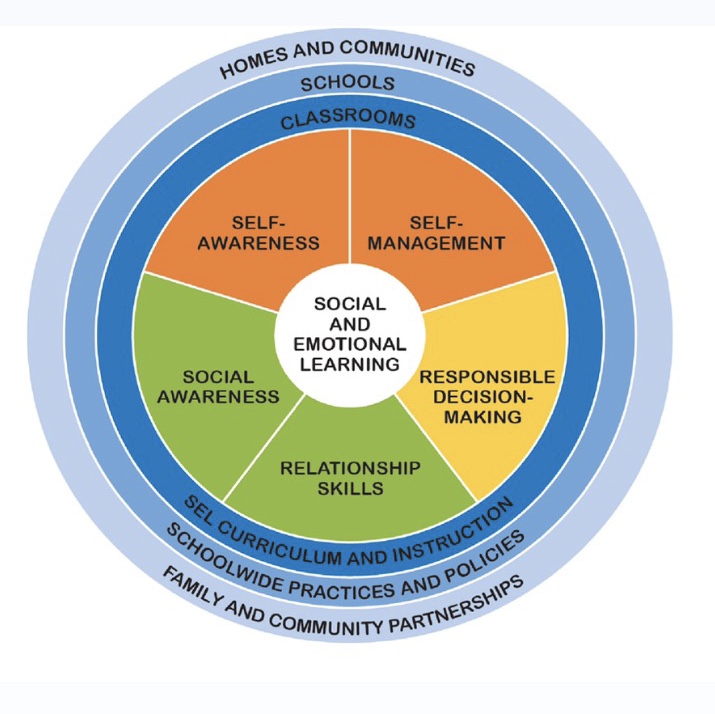
- Self-Awareness
Students learn to recognize their own strengths and limitations, as well as the impact of their actions on others. Coaching and simulation sessions are an example of this in practice, where students notice how various acts influence others so that they can learn how to perceive their own feelings as well as what other people are feeling. - Self-Management
Students learn to control their emotions and actions, which includes stress and time management, motivation, and academic/personal goal setting, all of which are critical skills for youngsters as they grow and need to manage their own schedules and businesses. Older, more experienced students can teach kids about these types of actions.By pairing students in a mentor-mentee relationship, the mentee will learn about vital academic skills as well as how to improve self-esteem and confidence, while the mentor will offer skills learned from experience. This will help the mentee navigate common challenges like imposter syndrome and insecurity. - Social Awareness
Students learn to detect other people’s emotions, grasp social behavioral norms, and empathize with people from various origins and cultures. Introduction and inclusion exercises, in which participants share their favorite interests, fascinating facts about themselves, and so on, are an example of an activity that strengthens this skill. - Relationship Skills
Students learn how to build healthy relationships and communicate clearly with one another and in groups. Participating in a range of activities, such as team sports, games, and group projects, can help them practice this. Active listening, team building, and conflict resolution are all abilities that are useful both inside and beyond the classroom. - Responsible Decision-Making
When it comes to behavior and speech, students learn how to make their own autonomous decisions, whether personal or academic. Students will be able to make polite and well-thought-out judgments by considering societal norms and differences, potential consequences, and safety issues. Students can solve qualitative problems in a number of ways to learn diverse strategies and ways of thinking. This is one way to actively practice responsible decision-making.
Social Emotional Learning Activities
Many schools have begun to teach students how to deal with emotions, make objectives, and get along with others. Parents can also assist their youngster practice these abilities at home.
Here are a few socio-emotional learning activities to assist children regulate emotions and improve social skills while also having fun. These low-tech social-emotional learning activities are really effective. And they are all made to fit into one’s regular routine.
-
Starfish and Tornadoes
The idea is to teach kids how to recognize how much energy they have inside. When they realize they have too much energy, they can either apply self-calming techniques or seek help from a trustworthy adult.
Playing Instructions: Draw a thermometer on a piece of paper. At the bottom, draw a starfish, and at the top, draw a tornado. Inquire whether the youngster is quiet and tranquil, like a starfish, or frantic and agitated, like a tornado. When a youngster is very energetic, mentors can discuss with him or her ways to make him or her feel more like a starfish. For instance, bouncing a ball can assist in the release of some of that energy.Mentors can help the mentee define their energy levels by playing this game at different times of the day.
Points to remember: Self-awareness can aid in the development of a skill called self-regulation in children. It is all about managing one’s own energy when it comes to self-regulation. It aids children in controlling their emotions and body movements in stressful situations. Moreover, it aids their ability to pay attention and learn.
-
Turtle Time
The idea is to assist children in developing their ability to see what is happening around them. Picking up on social signs allows children to get their needs satisfied while also understanding the viewpoints of others.
Playing Instructions: When the mentor and mentee arrive at the playground or other location, they must look around slowly and exaggeratedly like a turtle. They should take turns describing what they see: “All the swings have been taken.” “For the slide, there is a short line.”
The mentor must assist the child in making the connection between his or her observations and the behavior choices he or she makes.Points to remember: Mentors are not required to dress up as turtles. To aid their vision, they may use their pretend binoculars or a special pair of spectacles. A mentor could also participate in a game of “I spy with my little eye.” The mentor and the youngster can take turns observing and reporting social encounters until the other participant finds what they are looking for.
-
“Who am I right now?”
The idea is to help the child develop self-awareness and identify his or her strengths. These abilities can also aid in decision-making and understanding others’ viewpoints.
Playing instructions: The mentor can get some index cards and start playing. Draw drawings of the child doing something positive, such as being a good helper or a good teacher, with them. Consider what additional cards the youngster could create.
Mentors can comment on their child’s positive behaviors to encourage them to come up with ideas: “You just offered to teach your sister a nursery rhyme.” Let us talk about what kind of person you are right now for a second.”
Points to remember: Mentors must remember that many families attempt to teach social-emotional skills by criticizing undesirable behavior. But they must not forget to praise the youngster when he or she does something good. Praise for good behavior frequently leads to more of the same.
Mentors can also purchase these cards or they can find templates online. Children, on the other hand, could enjoy crafting their own cards.
-
Let us Make a Deal
The idea is to assist children in learning to compromise. Practicing how to perceive things from someone else’s point of view will assist the youngster consider the needs of others.
Playing instructions: When the mentor and the youngster cannot agree, the mentor can sing these words to the tune of ‘This Old Man.’ “You want this. That is something I would want. How can we both get what we want?” Then come up with a few ideas and pick the best one for now.
Points to remember: The child may have problems letting go of a notion. Mentors can combine their efforts to select the best of the runner-up ideas and place them in a unique container.
-
Take turns Taking Charge
The idea is to aid in the development of self-awareness, decision-making, and seeing things from other people’s perspectives.
Playing instructions: Mentors can start a custom where they and the child take turns preparing a fun night once a week. They might choose a topic, such as what meal to eat, what movie to watch, or what game to play. Alternatively, they can leave everything open and let the person in control choose.
Points to remember: Making a chart with categories like “Waiting my turn” and “Staying cool when doing something I do not like” might be helpful. The mentor can have everyone rate themselves after the exercise. Then they discuss what has been working well and what they would like to improve.
The Importance of SEL
In today’s ever-diversifying world, the classroom is frequently the first location where children are exposed to people from a variety of backgrounds, hold differing ideas, and possess unique abilities.
Social emotional learning aims to help students — both children and adults — better understand their thoughts and emotions, become more self-aware, and develop more empathy for others in their community and the world around them. Mentors must do this in order to account for these differences and help put all students on an equal footing to succeed.
Students can become better, more productive, self-conscious, and socially aware citizens outside the classroom if these attributes are developed in the classroom.
Image Sources: Daycare vector created by vectorjuice at Freepik
For more information on social emotional learning, visit our blog.
Create. Engage. Inspire.
The post What is SEL (Social Emotional Learning) and How Does it Help Students? appeared first on Test.Evelyn.
]]>