The post What is SEL (Social Emotional Learning) and How Does it Help Students? appeared first on Test.Evelyn.
]]>Social emotional learning provides a foundation for good, long-term benefits on kids, adults, and communities by teaching effective problem-solving, self-discipline, impulse control, emotion regulation, and more. This is significant since people do not come into this world knowing how to regulate their emotions, solve problems, or interact with others. Pupils must acquire these talents, and schools can assist them in doing so. It is also worth noting that some pupils may require individualized support in order to properly benefit from social emotional learning.
What is Social Emotional Learning?
Social emotional learning (SEL) is a teaching strategy that teaches students of all ages how to better understand their emotions, feel them fully, and show empathy for others. These taught behaviors are then used to assist students in making positive, responsible decisions, establishing frameworks for achieving their objectives, and forming positive relationships with others.
Creating learning environments that create healthy interactions between students and teachers leads to enhanced communication skills, motivation, and exam results. SEL, on the other hand, is not just vital in the classroom. It is a lifelong practice that extends into adulthood. Effective collaboration and communication need the development of SEL skills and abilities.
Components of Social Emotional Learning
Social emotional learning involves five core components that can be applied in the classroom, at home, and in students’ communities, according to the Collaborative for Academic, Social, and Emotional Learning (CASEL). It is an organization dedicated to students and educators to help achieve positive outcomes for PreK-12 students. These are the five core competencies:
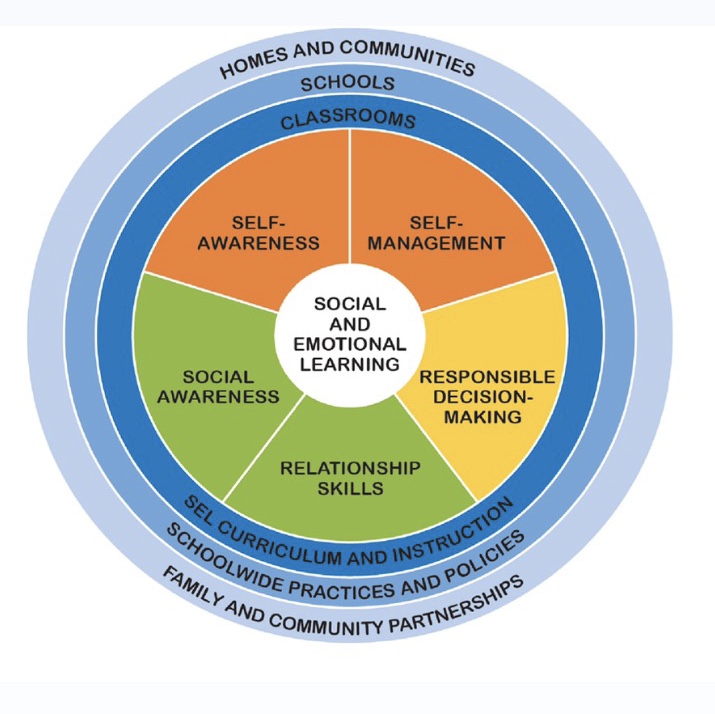
- Self-Awareness
Students learn to recognize their own strengths and limitations, as well as the impact of their actions on others. Coaching and simulation sessions are an example of this in practice, where students notice how various acts influence others so that they can learn how to perceive their own feelings as well as what other people are feeling. - Self-Management
Students learn to control their emotions and actions, which includes stress and time management, motivation, and academic/personal goal setting, all of which are critical skills for youngsters as they grow and need to manage their own schedules and businesses. Older, more experienced students can teach kids about these types of actions.By pairing students in a mentor-mentee relationship, the mentee will learn about vital academic skills as well as how to improve self-esteem and confidence, while the mentor will offer skills learned from experience. This will help the mentee navigate common challenges like imposter syndrome and insecurity. - Social Awareness
Students learn to detect other people’s emotions, grasp social behavioral norms, and empathize with people from various origins and cultures. Introduction and inclusion exercises, in which participants share their favorite interests, fascinating facts about themselves, and so on, are an example of an activity that strengthens this skill. - Relationship Skills
Students learn how to build healthy relationships and communicate clearly with one another and in groups. Participating in a range of activities, such as team sports, games, and group projects, can help them practice this. Active listening, team building, and conflict resolution are all abilities that are useful both inside and beyond the classroom. - Responsible Decision-Making
When it comes to behavior and speech, students learn how to make their own autonomous decisions, whether personal or academic. Students will be able to make polite and well-thought-out judgments by considering societal norms and differences, potential consequences, and safety issues. Students can solve qualitative problems in a number of ways to learn diverse strategies and ways of thinking. This is one way to actively practice responsible decision-making.
Social Emotional Learning Activities
Many schools have begun to teach students how to deal with emotions, make objectives, and get along with others. Parents can also assist their youngster practice these abilities at home.
Here are a few socio-emotional learning activities to assist children regulate emotions and improve social skills while also having fun. These low-tech social-emotional learning activities are really effective. And they are all made to fit into one’s regular routine.
-
Starfish and Tornadoes
The idea is to teach kids how to recognize how much energy they have inside. When they realize they have too much energy, they can either apply self-calming techniques or seek help from a trustworthy adult.
Playing Instructions: Draw a thermometer on a piece of paper. At the bottom, draw a starfish, and at the top, draw a tornado. Inquire whether the youngster is quiet and tranquil, like a starfish, or frantic and agitated, like a tornado. When a youngster is very energetic, mentors can discuss with him or her ways to make him or her feel more like a starfish. For instance, bouncing a ball can assist in the release of some of that energy.Mentors can help the mentee define their energy levels by playing this game at different times of the day.
Points to remember: Self-awareness can aid in the development of a skill called self-regulation in children. It is all about managing one’s own energy when it comes to self-regulation. It aids children in controlling their emotions and body movements in stressful situations. Moreover, it aids their ability to pay attention and learn.
-
Turtle Time
The idea is to assist children in developing their ability to see what is happening around them. Picking up on social signs allows children to get their needs satisfied while also understanding the viewpoints of others.
Playing Instructions: When the mentor and mentee arrive at the playground or other location, they must look around slowly and exaggeratedly like a turtle. They should take turns describing what they see: “All the swings have been taken.” “For the slide, there is a short line.”
The mentor must assist the child in making the connection between his or her observations and the behavior choices he or she makes.Points to remember: Mentors are not required to dress up as turtles. To aid their vision, they may use their pretend binoculars or a special pair of spectacles. A mentor could also participate in a game of “I spy with my little eye.” The mentor and the youngster can take turns observing and reporting social encounters until the other participant finds what they are looking for.
-
“Who am I right now?”
The idea is to help the child develop self-awareness and identify his or her strengths. These abilities can also aid in decision-making and understanding others’ viewpoints.
Playing instructions: The mentor can get some index cards and start playing. Draw drawings of the child doing something positive, such as being a good helper or a good teacher, with them. Consider what additional cards the youngster could create.
Mentors can comment on their child’s positive behaviors to encourage them to come up with ideas: “You just offered to teach your sister a nursery rhyme.” Let us talk about what kind of person you are right now for a second.”
Points to remember: Mentors must remember that many families attempt to teach social-emotional skills by criticizing undesirable behavior. But they must not forget to praise the youngster when he or she does something good. Praise for good behavior frequently leads to more of the same.
Mentors can also purchase these cards or they can find templates online. Children, on the other hand, could enjoy crafting their own cards.
-
Let us Make a Deal
The idea is to assist children in learning to compromise. Practicing how to perceive things from someone else’s point of view will assist the youngster consider the needs of others.
Playing instructions: When the mentor and the youngster cannot agree, the mentor can sing these words to the tune of ‘This Old Man.’ “You want this. That is something I would want. How can we both get what we want?” Then come up with a few ideas and pick the best one for now.
Points to remember: The child may have problems letting go of a notion. Mentors can combine their efforts to select the best of the runner-up ideas and place them in a unique container.
-
Take turns Taking Charge
The idea is to aid in the development of self-awareness, decision-making, and seeing things from other people’s perspectives.
Playing instructions: Mentors can start a custom where they and the child take turns preparing a fun night once a week. They might choose a topic, such as what meal to eat, what movie to watch, or what game to play. Alternatively, they can leave everything open and let the person in control choose.
Points to remember: Making a chart with categories like “Waiting my turn” and “Staying cool when doing something I do not like” might be helpful. The mentor can have everyone rate themselves after the exercise. Then they discuss what has been working well and what they would like to improve.
The Importance of SEL
In today’s ever-diversifying world, the classroom is frequently the first location where children are exposed to people from a variety of backgrounds, hold differing ideas, and possess unique abilities.
Social emotional learning aims to help students — both children and adults — better understand their thoughts and emotions, become more self-aware, and develop more empathy for others in their community and the world around them. Mentors must do this in order to account for these differences and help put all students on an equal footing to succeed.
Students can become better, more productive, self-conscious, and socially aware citizens outside the classroom if these attributes are developed in the classroom.
Image Sources: Daycare vector created by vectorjuice at Freepik
For more information on social emotional learning, visit our blog.
Create. Engage. Inspire.
The post What is SEL (Social Emotional Learning) and How Does it Help Students? appeared first on Test.Evelyn.
]]>The post Strategies for Self-Directed Learning: Teaching Methodologies appeared first on Test.Evelyn.
]]>In our previous Self-Directed Learning article, we familiarized our readers with the basics of self-directed learning, as well as provided an insight into what the approach of self-learning offers its disciples. Through this article, we offer some effective strategies for self-directed learning to gain or enhance a new skill.
Self-Directed Learning Strategies for Teachers
1. Open Questioning
Preparing lesson plans that include high-order, open-ended questions is a powerful medium to engage students and stimulate their curiosity. This eventually leads them down the path of self-directed learning.
Develop questions that compel students to think critically, analyze, and research. Using open-ended questions to introduce different elements of the lessons, instead of direct objectives, opens the door for discussions and debates. This method allows immediate feedback on students’ understanding and knowledge. It also enforces independent thinking.

2. Hybrid or Blended Style
This method of learning primarily focuses on combining the teacher’s interest and curriculum with the needs and interests of the students. This is done to develop a student-centered learning environment.
Engage students in determining learning goals and forming lesson plans. This stirs a sense of responsibility in them toward learning.
3. Encouraging /Introducing Technology in Classroom
Technology surrounds us at all times. Incorporating it as a tool for education is an effective approach toward creating a dynamic learning environment. Technology widens the horizons of learning beyond the classroom and gives students a chance to engage themselves in the process of learning in a creative manner. Learning comes to them internally when it targets their interest. In this way, it supports active learning. Internet, then, becomes their substitute teacher.
Create assignments that encourage them to use technology in order to find answers. This prompts them to delve further into the subject. Also, using media in the classroom helps make learning fun.
Self-Directed Learning Strategies for Learners
1. Smart Goals
Identifying the final goals is the first step toward starting self-directed learning, but this is not where it ends. It is crucial to create goals for each step. Losing focus is quite easy; short-term realistic goals help in staying focused and also boost the learning process. Using the SMART framework is one of the most efficient techniques, to begin with.
SMART is abbreviated for:
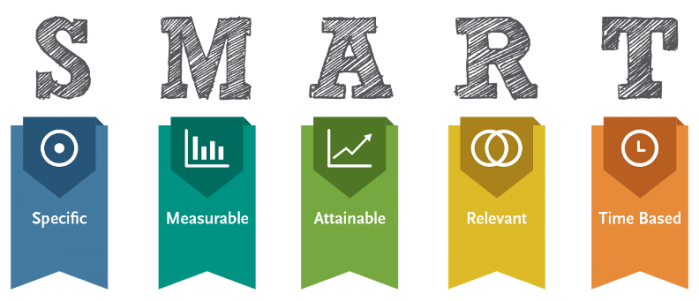
Specific: Be specific about what you want to gain. Do not settle for general goals.
Measurable: Create goals in a manner where you can track your progress.
Attainable: Create realistic goals, challenge yourself, but do not make it impossible for you to accomplish them.
Relevant: Ensure that the goals are relevant to you and are aligned to what you want to achieve. Create reasonable goals that will motivate you.
Time-bound: Set deadlines. Time limits help you remain focused and determined.
2. Mix and Match
Self-directed learning provides the flexibility of choosing a method of learning that is suited to individual needs.
Therefore, it is critical to analyze the learning process employed and choose the methods that align with the learner’s interests. Different subjects require different approaches. Hence, select the most suitable one. Additionally, these can be modified along the way.
3. Productive Learning Mindset
Developing an optimistic and never-give-up attitude is essential for self-directed learning, which is tested frequently at every curve of the learning journey. Learners will have to come to terms with the fact that failure is a part of growth.
Keeping faith in one’s abilities and believing that one can accomplish their goals is a requisite for a fruitful self-directed learning experience. What’s more, learners will have to overcome one of the biggest bane of learning – procrastination- and move ahead with determination and a strong, dedicated mind that stays focused.
4. Sandbox Method
Step 1: Build Your Sandbox
It is advised to create a place where one can experiment and build on their skills. It will motivate them to work more diligently. Share any completed work with peers, teachers, and family from the very beginning. This will help in overcoming public fear and provide valuable feedback at the same time.
Step 2: Research
To master a skill, regular research must be diligently performed. The boundaries of the sandbox will expand upon trying new things and mastering them. The immediate resources of research are books, online courses, blogs, forums, etc.
Step 3: Implement and Practice
Practice as much as possible in a progressive manner. Self-directed learning negates “naïve practice”, where repeating the same things incessantly is often encouraged. Instead, it promotes the learning of fundamentals and then applying them in a variety of scenarios. Furthermore, this will open cracks in learning and provide a chance to fill those gaps.
Step 4: Get Feedback
Constructive criticism offers opportunities for growth. Finding someone who can provide effective feedback about learning goals, progress, and the work done goes a long way in making any self-learning project successful. It will also help identify any potential shortcomings in the learning strategies employed. Thus, mentors, teachers, or experts of the targeted subject serve as excellent guides for self-directed learning.
Step 5: Continue and repeat
Any obstacle in learning should not stop one from the pursuit of learning. Receiving constructive feedback and working in the areas of development help the learner to master the concept. The shortcomings and failures should not deter the learner from continuing, even if it means starting all over again and making the same mistakes. Self-Directed learning encourages students and teachers to gain experience and work out ways to improve to acquire an in-depth understanding and thorough mastery of the subject.
Step 6: Have fun learning!
Learning should not be considered a solely academic affair with an objective to achieve. It should also be seen as a course of development as an individual. Enhancing skills and gaining knowledge is one aspect of learning, whereas developing individuality and gaining experience while doing so is another. The course of learning should be immensely enjoyed to support development.
Self-Directed Learning encourages the students to actively participate in the learning process and take responsibility for their own learning. It is a constructive approach to learning as it involves critical analysis of growth and development in the parameters of learning. This is even more essential as the analysis is undertaken by the learner themselves. Despite being reined by the student, the self-directed learning process lets the teacher play an important role in the process. Therefore, it is essential for them to guide the students to use effective strategies to achieve better results.
Image Credits: Research Vectors by Vecteezy
Research Credits: Discoverpraxis
Visit out blog for further reading about learning techniques and teaching methodologies.
Create.Engage.Inspire
The post Strategies for Self-Directed Learning: Teaching Methodologies appeared first on Test.Evelyn.
]]>The post Self-Directed Learning And Its Significance appeared first on Test.Evelyn.
]]>Self-Directed Learning refers to the learning strategy that fosters independent learning. The learners take the onus of their learning and learn at their own pace. Incorporating self-directed learning is an effective and convenient method that works as a supplement to instructional learning for developing a well-rounded learning process. This is a form of constructive learning where education does not depend on teachers or instructors. It does not encourage spoon-feeding; it empowers the learners and involves them in their learning process.
Learners drive and direct their learning, which makes them responsible for their cognitive development as it prompts them to know what they really want to learn and how they want to advance with their learning. With the easy availability of relevant resources, it has become easier to make learning much more fun, interesting, and creative.
Self-learning aims at involving learners in their learning process. With the advancement in technology and teaching methodologies, self-directed learning has become a handy tool for various educational institutions that aim to enhance the learner’s experience. This method liberates learning from the restricted space of a classroom.
Importance of Self-Learning
Self-learning does not confine itself to chosen subjects or goals or academics. It provides flexibility to students in their learning experience by allowing them to research and learn without any restrictions of resources. Self-directed learning offers an opportunity to learn about a subject in depth. This kind of learning is not restricted by age. It provides liberty to students in the sphere of education and minimizes the instructional approaches.
The solutions are not provided beforehand. Students have to find answers on their own. This develops problem-solving capability and provides new opportunities for learning and growing, emphasizing the process of learning and not the final outcome. Moreover, it introduces students to the vastness of the world as the research that they undertake stirs curiosity, which internalizes learning. This disables external factors, such as peer pressure, the importance placed on scores, and other distractions that inhibit learning.
This method makes learning more meaningful and ignites an inner desire to learn and grow. Besides achieving the learning goals, it also helps develop other skills, such as discipline, problem-solving ability, focus, zeal to learn and grow, and many more. These skills become an indispensable part of successful living.
The Role of Teacher and Student in Self-Directed Learning

- This method holds both the teacher and the student equally responsible for a successful and holistic learning environment. A teacher must have an innate desire to help students. They should be open to suggestions and work as the facilitators of learning. The traditional authoritarian figure associated with teachers is something that should be discarded.
- A teacher must aim to build a cooperative and friendly environment. They should motivate and encourage students and provide them with timely guidance. They should provide feedback frequently, keeping the learners in the loop and helping them improve.
- Students must be optimistic and enthusiastic about learning and should always take an initiative to enhance their learning level to facilitate personal growth and development. Active participation in learning, further evaluating, and improving upon your methods are the fundamentals of holistic learning.
Stages of Self-Directed Learning
Self-directed learning involves the following four stages:
- Assessing the motivation and preparations for learning and analyzing the current environment, conditions, and learning space
- Identifying and formulating learning goals and creating a well-structured and organized plan with the help of instructors
- Engaging in the learning process. Immersing oneself in the pool of learning is ideal, but staying focused and analyzing the employed learning process is also crucial.
- Understanding and evaluating the employed methods, and whether they prove useful or not. If not, adapt a different approach if possible. The whole process of self-learning allows learning, unlearning, and relearning, thereby providing a better understanding of one’s psyche at the same time. Engaging in self-reflection is a great source of self-growth.
Resources Used: University of Waterloo blog and Faculty Focus Blog Page
Visit our blog for further reading about learning techniques and teaching methodologies.
Create.Engage.Inspire
The post Self-Directed Learning And Its Significance appeared first on Test.Evelyn.
]]>