The post Adult Learning Theory: Its Need and Impact appeared first on Test.Evelyn.
]]>Adult learners are students who are over the age of 18 and do not begin postsecondary education the same year they graduate from high school. One may adapt business training programs to take advantage of attributes adult learners possess. This could include their eagerness to learn relevant material, their desire to connect with experience, and their urge to develop themselves, all by understanding how adults learn.
Adult education is very popular in the United States. Various colleges and institutions frequently refer to these students as “non-traditional students”. Most adults pursue education for a variety of reasons, including self-improvement, the necessity to learn specific skills, and the desire to better career prospects.
If an adult is ready to continue their education, they must first comprehend how they learn differently. Adult Education Theories and practices assist millions of adult students in achieving success as they continue their growth and education. In this article, readers will learn about the ideas underpinning Adult Learning Theory and how it can help one achieve their higher education goals.
What is Adult Learning Theory?
Corporate training circles frequently use the term “Adult Learning Theory”.
First, let us debunk a myth: There is no SINGLE Adult Learning Theory. There are several popular hypotheses that describe how adults learn from various perspectives. It is a concept or study of how adults learn and how it differs from how children learn. Additionally, its main goal is to discover the learning styles that are most appropriate for adults.
Andragogy, action learning, experiential learning, self-directed learning, and transformational learning are only a few examples of adult learning theories. All of these theories aim at assisting one in creating effective learning experiences for adult learners.
Components of Adult Learning Theories
Adult Learning Theory is a branch of study that focuses on figuring out how to make ‘training’ something adults desire to undertake and how to make it effective. To put it simply, if you want the finest outcomes, you must integrate four vital components in your training and development for adults.
Motivation
When creating training content, the first constituent educators must know about is motivation. Adult learners will not learn if they do not have a strong desire to do so. That’s all there is to it. There are a variety of approaches that can be used to elicit a sense of motivation. Here are a few examples:
- Firstly, educators must clearly define how the learning curriculum will have a concrete and immediate impact on the learner’s job. When creating learning content, one should not leave it up to the student to figure out why the information is being offered; instead, one must explain to them why they are supposed to study the material up front.
- It is necessary to establish learning chances that will allow the learner to improve personally. In a corporate setting, for instance, learners are more interested in the process if they believe it will help them get a promotion or progress their career in some way.
- Extrinsic competitiveness can encourage learners. This is why learning that incorporates gamification and social aspects is becoming increasingly popular right now.
Essentially, it boils down to a simple principle: Adults will desire to learn when they believe it would benefit or add value to their life. That is what motivates people.
Reinforcement
Reinforcement can either be positive or negative. Positive reinforcement in Adult Learning Theory refers to providing something that fosters excellent conduct. For instance, one can predicate development-based learning on the premise that learning a new skill could lead to a pay raise.
Negative reinforcement, on the other hand, entails taking actions to correct negative behavior, such as safety training to reduce workplace errors.
Retention
When creating corporate learning material, one must consider not just if the learner will absorb the material at first, but also if he or she will retain it. One should create courses that are tailored to the target audience’s needs. Educators can deploy these courses utilizing the most effective approaches that encourage participation.
Interactivity, quizzes throughout the learning modules, and the opportunity to instantly put what has been learned into practice are all fantastic strategies to enhance the retention of material.
For instance, after each piece of information is provided, educators can invite participants to take a quick quiz to see how much they have retained. In many cases, simply informing learners that the instructor will be assessing them on the content is a good retention tool in and of itself. Case studies and scenarios are also quite helpful. These are all simple things to incorporate into learning, thanks to the tools available with a learning management system.
Transference
This stage of Adult Learning Theory is when the learners can put what they have learned into practice in a real-world setting.
When the learners reach this stage, the educator will know if the information was effective and how well they can interpret and apply it. Moreover, transference is frequently monitored in a corporate environment against a set of preset standards in order to coincide with overall performance and organizational objectives.
Educators can consider incorporating social elements into the process to increase transference inside the corporate learning environment.
Different Types of Learning Theories
When it comes to adult learners, there are numerous learning theories, each with its own set of applications and methodologies. Depending on their primary learning style, different ideas and practices will resonate better with adult learners. The following are some of the most popular Adult Learning Theories:
Andragogy
Andragogy, coined by Malcolm Knowles in 1968, is defined as “the art and science of assisting adults in learning”. It is opposed to pedagogy, which is defined as the “art and science of assisting children in learning”. Adult learners vary from children in numerous respects, according to Knowles and the andragogy theory.
The andragogical approach is based on four principles:
- Adults learn more effectively through experience (even if they make mistakes).
- They prefer a practical approach to learning and must be able to apply what they have learned to address a specific problem.
- Adults are most interested in learning things that are immediately applicable to their lives.
- They must participate in the design and evaluation of their own education.
Case Study: Farm Bureau, a rural service organization, employs an andragogic strategy to train volunteer leaders and Board of Director candidates. Through mutual agreement with each student, the training programme diagnoses learning needs and establishes goals. Participants must actively participate in activities, debate the practical worth of their learning. Moreover, they must apply what they have learned to their leadership roles.
Transformational Learning
Transformative learning theory, developed by Jack Mezirow in 1978, asserts that all learners make meaning of the world around them by employing a variety of assumptions, predictions, and perceptions.
- Through a process of problem-solving, procedural tasks, and self-reflection, transformational learning seeks to help learners modify — or transform — their existing frames of reference.
- Secondly, individuals experience learning transformations when educators confront them with a “disorienting predicament”. This causes them to question their previous beliefs and critically reflect on what has happened.
- It can change an individual’s viewpoint on how to behave, interact, or solve problems. Hence, educators often regard it as one of the “stickiest” types of learning.
Case Study: Workforce Council financed a group of 12 worker-learners to attend an Australian university’s Graduate Certificate in Executive Leadership program. Three teams were formed from the group. To impact improvements in their organizational processes and systems, each team engaged in transformational learning.
Learning materials were available on the university’s website. Face-to-face consultations on the job site and regular emails were also part of the training program. All the learning lessons were designed to foster a critical and reflective thinking culture. This would help shift existing viewpoints and habits. Additionally, it allowed the students to break free from their “habits of thinking.”
Action Learning
Action learning, coined by Reg Revans in 1982, is a problem-solving strategy. It entails taking action and then reflecting on the outcomes.
- It aims to improve problem-solving processes while also simplifying the solutions that follow.
- This method approaches challenges by first asking questions to define the issue. Following this, they reflect and identify potential solutions, and finally take action.
- Questions boost learning outcomes by fostering group dialogue and cohesion, as well as developing inventive and systematic thinking.
- The ability to take action on the problem the group is working on is a necessity for action learning. The group loses its vitality, inventiveness, and passion if learners merely give recommendations.
- Lastly, a coach should be there to assist the group in learning and working more efficiently.

Case Study: In 1990, Florida Power and Light (FPL), a power utility company, was the first company in the United States to receive the Deming Prize for Quality. But before that, it had faced problems with its power producing systems and could not effectively convert energy to electricity. This issue had been present for quite some time.
Eventually, they gathered a team of people from various FPL departments to rectify the problem. The team members improved their problem-solving and teamwork skills by working together. As a result, they were able to identify and resolve the cause of the problem.
Experiential Learning
Experiential learning was developed in the 1970s by David Kolb. It is based on the work of John Dewey, Kurt Lewin, and Jean Piaget. This Adult Learning Theory involves a hands-on approach that places the learner at the center of the learning process.
- Active involvement is very important. However, learning occurs only when the individual reflects on what they are doing, according to the theory.
- Secondly, continued participation, reflection on practice, interpretation of the experience, and application of knowledge obtained from experience are the four pillars of experiential learning.
Case Study: Capital One teamed up with the College of St. Bernard/St. John’s University to mentor students enrolled in an advanced global strategy course. Students faced real-world business difficulties and worked to address them by actively participating in the research and hands-on work processes. Mentors solely offered expert assistance and counsel.
Self-Directed Learning (SDL)
Self-Directed Learning is based on Malcolm Knowles’ Adult Learning Theory, with self-management elements added by D.R. Garrison in 1997.
- Individuals evaluate learning requirements, develop learning goals, find resources, implement a learning plan, and analyze their own results using Self-Directed Learning.
- Professors, mentors, resources, and peers frequently aid SDL.
- It is necessary for the learner to have access to and pick relevant learning.
- All learning decisions are under the control of the learner.
Case Study: Tahiya Alam, a University of Manchester Junior e-learning Support Specialist, needed to publish the findings of a scientific research study online. Ms. Alam met with e-learning colleagues and investigated her choices once she discovered her learning requirements. She upskilled herself using Self-Directed Learning principles and was able to create interesting and robust e-learning modules.
For a more effective training program, combine Science with Adult Learning Theory
When knowledge is relevant and beneficial to adults, they remember it better. As a result, it is critical to understand why one is studying about a particular theme. Adults are frequently better at generating answers to real-life problems than they are at memorizing knowledge because they have a mature attitude. Adult learning is built on the foundations of problem-solving, rapid application, and performance-based activities.
Understanding diverse adult learning theories and practices might help an adult learner be even more successful as he or she prepares to seek higher education. Recognizing one’s learning style, knowing adult learners’ strengths and limitations, and preparing for their specific strengths can all assist an adult learner succeed.
Image Sources: Shutterstock and Unsplash
For more information on Adult Learning Theory, visit our blog.
Create. Engage. Inspire.
The post Adult Learning Theory: Its Need and Impact appeared first on Test.Evelyn.
]]>The post Pedagogical Practices To Suit Various Learning Styles appeared first on Test.Evelyn.
]]>To Begin, what exactly are Learning Styles?
Almost all educators would be familiar with the concept that everyone has a preferred method of absorbing knowledge. Students will learn more easily if an educator teaches them in their chosen style. This concept has been around since the 1970s and well-intentioned teachers and dedicated students who want to learn effectively still carry it forward. It is no wonder that everyone wants to learn faster and more efficiently.
Unfortunately, there is no convincing proof that there are different learning styles.
In truth, the best evidence points in the opposite direction. The notion that people perform best when trained in a way that corresponds to their unique “learning style” — Auditory, Kinesthetic, Visual, or a combination of the three — is generally dismissed. According to multiple studies, learners do not profit from their own learning style. Teachers and students have different ideas about what learning styles work best for them, and we have no insight into how much we learn from various approaches.
The Myth of Learning Styles
Every student will differ in terms of skill, interest, and prior experience, but not in terms of learning styles. According to research, when people have a favorite style of presentation, it is typically for a task or topic in which they have a high level of talent and already feel good.
One may think they are an Auditory learner if they are good at music, or a Visual learner if they are creative. While one can prefer a certain method of learning, there is no proof that it can help them learn more effectively.
The myth of learning styles appears to be as widespread as ever. The learning styles paradigm can also be harmful to education in a variety of ways, according to various previous studies. Even though all students will profit from learning by multiple methods, educators expend time and money tailoring lessons to specific learning styles for different students. Even if it will not help them excel, students study in ways that correspond to their perceived learning style.
However, it is not obvious why educators want to believe in them. It is possible that the theory is heavily reinforced during teacher training; it is also possible that teachers are dealing with their students in the same way that their teachers interacted with them. Alternatively, it is possible that efforts to dispel the theory have become close to zero, struggling to reach educators.
Best Teaching Practices to Suit Various Learning Styles
Educators are well aware that no two students are alike, and that there is a wide range of learning styles. As a result, an educator’s teaching style may have a significant effect on a student’s ability to understand and comprehend. This is why teachers must be familiar with a variety of learning styles.
Is Shawn’s preferred method of learning pictures and graphics? It is possible that he is a Visual learner.
Is it true that Kevin learns best by attending seminars, asking questions, and engaging in group discussions? He may be an Auditory learner.
Is it more convenient for Jack and Katie to collect knowledge by reading, taking notes, and writing reports or essays? They may be Reading/Writing learners.
What about Joel, for instance? She is very hands-on and seems to love disassembling and reassembling items in order to learn by doing. It is possible she is a Kinesthetic learner.
That is one common breakdown of the learning styles continuum, but it is by no means the only one. Most teaching types fall into one of two categories: Teacher-Centered or Student-Centered. Here is a breakdown of the differences between teacher-centered and student-centered instruction:
• Teacher-Centered Approach:
The Teacher-Centered approach to education is a teaching style that views the teacher as the authority in charge of imparting information to students through lectures or direct instruction. Students are passive actors or “empty vessels” in this approach (also known as “sage on the stage”). They listen and absorb information.
This Teacher-Centered approach to teaching is the most common, but it is not always the strongest. And, as educators learn more about how to involve students of all learning styles, the teacher-centered approach is becoming less common.

• Student-Centered Approach:
The Student-Centered approach is a teaching style that fosters greater harmony between the instructor and the student by allowing both to participate in the learning process. The instructor is often referred to as the “guide on the side” in this strategy.
While the teacher retains authority, he or she is more likely to serve as a facilitator, coaching and assisting students in their studies. This method promotes student autonomy while also allowing students to engage with one another. Under the student-centered approach to teaching, there are a few styles to consider:
• Approach Based on Inquisitiveness
Students lead the way and receive instruction from their teachers in this Student-Centered learning style. Moreover, this approach promotes flexibility, autonomy, and hands-on learning.
• Approach Based on Co-operation
Cooperative learning is a Student-Centered method of instruction that emphasizes group work and social development. The cooperative model, like the inquiry-based style, promotes individuality and hands-on learning, but places a premium on peer-to-peer collaboration and culture.
Many teaching resources categorize the best teaching styles into the five key categories mentioned below:
1) Authoritative or Lecturer Style
The Authoritative teaching style is based on the conventional Teacher-Centered approach. This includes lecture sessions and one-way presentations. Students are expected to pay attention, process information, take down notes, and ask questions in this approach (also known as the “chalk and chat” style).
2) Coach or Demonstrator Style
The Demonstrator style, which is common in math, science, and music, emphasizes “showing” rather than “telling,” with teachers more likely to back up their points with examples, tests, demos, or multimedia presentations.
3) Activity Style or Facilitator
The facilitator/teacher is focused on encouraging students to learn for themselves and assisting them in developing critical thinking and learning skills. It is a Student-Centered approach that entails designing learning plans. It includes classes that enable students to explore and discover course material in unique and innovative ways.
4) Group or Delegator Style
The Delegator style of teaching is well-suited for curricula that include or emphasize group activities, as it places much of the responsibility for learning on the students, who are motivated to collaborate on projects related to the lesson themes (think science labs, debates, etc.). The instructor is an involved spectator in this style, guiding students in the right direction.
5) Blended or Hybrid Style
The Hybrid approach combines elements of the above-mentioned models, often blending the teacher’s personality and interests with the students’. While this method is considered inclusive because it allows teachers to adapt their teaching styles to the needs of their students within the subject matter, some educators claim it risks diluting the learning process by putting less emphasis on in-depth research than a single, concentrated approach.
Final Thoughts
The aim of the discourse above is not to categorize the organic practice of classroom teaching into tidy categories. We do not wish to label educators as one “type” of teacher or another, but rather to investigate various methodologies in order to improve our collective understanding of the teaching experience.
It all comes down to getting to know the students and using the respective skills and intuition to figure out the best ways to involve individual students and whole classes with the curriculum. What works for one student or community may or may not work for another.
That is why, in order to be the most successful instructor possible, educators must have a clear understanding of the various student learning styles. They must have a solid grasp of the various teaching styles and strategies available.
Image Sources: Shutterstock and Unsplash
For more information on different teaching practices, visit our blog.
Create. Engage. Inspire.
The post Pedagogical Practices To Suit Various Learning Styles appeared first on Test.Evelyn.
]]>The post Avoiding Plagiarism In Academic Content appeared first on Test.Evelyn.
]]>Many copywriters are forced to write about subjects that have previously been explored on other websites. And, no matter how hard they try, coming up with a completely new story angle isn’t always easy. Generating plagiarism-free content becomes much more challenging in sectors where reputable sources are limited to a single hand.
Plagiarism is defined as the use of another person’s words or ideas without properly attributing the creator. Plagiarism can be intentional, such as when someone steals another’s work, but it is more commonly unintentional, such as when someone forgets something. When writing an academic paper, writers build on the work of others and gather information and evidence from a variety of sources. They must properly include these sources into their text to avoid plagiarism.
We’ll give you some content writing ideas as well as plagiarism tools in this article to assist you avoid plagiarism in academic content. They’ll help you write remarkable, plagiarism-free content that attracts high-quality traffic.
The Importance of Academic Integrity
Integrity entails believing in the community’s beliefs and standards and acting in accordance with them. A person with integrity is somebody who is genuine and sincere. An individual’s personal principles and ideals reflect their character and trustworthiness as a student. Maintaining academic integrity indicators when pursuing a degree at university indicates a student’s actual academic achievements.
Students with dignity will study and complete tasks diligently in order to acquire their degrees in a fair and honest manner. When a student purposefully cheats his or her way through university, the integrity of the degree and the individual’s morals are jeopardized. This lack of trustworthiness follows a student into the workplace and might have a negative impact on their career.

Key Reasons why Academic Integrity is Important
Academic integrity is essential for a variety of reasons.
- To begin with, academic integrity implies that others can put their faith in the writer. People who do business with such a person know they can count on them to be professional. Additionally, trust is one of the most critical characteristics of a great leader. Successful people are fully aware of the benefits of acting with integrity. Our ability to trust each other is the foundation of our entire environment. As a result, it’s critical to develop strong ethical practices.
- Second, academic integrity is essential since it adds worth to one’s diploma. Employers seek graduates with a high level of personal integrity. They would rather focus on developing the human capital of someone who will have a good impact on the firm and whom they can entrust with carrying out the company’s objective.
- Finally, academic integrity is crucial because it can provide an individual with peace of mind knowing that they believe in doing the right thing and that they constantly attempt to act in accordance with those convictions. Integrity can help one live a happier, healthier, and more productive life by reducing unnecessary stress.
Key Tips to Avoid Plagiarism in Academic Content
It might be difficult to preserve the uniqueness of information when writing, especially when the topic is unfamiliar to the writer. Maintaining uniqueness in their writing is a problem for every content writer. One thing a writer should know about Google is that it despises plagiarism. So, aside from everything else, if a writer wants their work of art to stand out and trend on Google, they must first focus on keeping it original.
To avoid plagiarism in academic content and develop good plagiarism-free material that attracts high-quality visitors, we’ll list out some content writing tactics as well as plagiarism tools below.
1. Start from Scratch
That is, after all, the way to go. A writer must always begin their piece of writing with their own unique ideas. That is when they’re no longer at risk of being accused of plagiarism. You are probably thinking how to come up with something unique on a topic you’ve never heard of before.
To avoid plagiarism in academic content, a writer should always begin by researching the issue thoroughly, gathering all necessary material, studying it thoroughly, and comprehending it completely. Following this, they will be able to compose it on their own. And, if the subject is relevant to a writer’s field of competence, they can rapidly lose their reputation as a profound and brilliant writer.

2. Evaluate the Context Properly
A writer must take the time to comprehend the concepts they will be discussing in their essay while conducting the study. Also, if they’re drawing inspiration from precise published resources, they must read them numerous times to grasp the primary ideas and concepts. They’ll gain a better understanding of the context and be able to come up with a fresh structure for the article or blog post this way. When a writer has clear concepts, their piece of content will be clear as well.
Even if a writer highlights and copies passages from other articles into their draft, none of these should appear in the final product. They must try to demonstrate the concepts, try to describe everything in their own words, using synonyms and even case studies and instances.
Instead of repeating facts and data from other articles, a simple approach to avoid plagiarism in academic content and add more value to the work is to hunt for current facts and data. Academic content should always be written from the writer’s own perspective. This way, they will still have an original article even if the material reflects the same thoughts as another website.
3. Make use of Synonyms
Although Google dislikes plagiarism, one must regard it as their best friend while writing original content. It aids a writer in a variety of ways. It is also one of the finest places to look for synonyms when writing. As a result, writers should make the most of Google to identify synonyms and incorporate them into their writing in order to avoid plagiarism in academic content. In the event that another choice is required, Microsoft Word can be used.
4. Learn when to quote and how to quote effectively.
When a writer can’t paraphrase, they must use quotation marks to reproduce the exact words from the respective source. It comes in handy when they need to rewrite someone else’s precise words to give their essay more weight. Copywriters should also acknowledge the source of any data, assertions, or facts used to support their work.
Using quotes and references to shield themselves and their webpage from plagiarism charges can be very successful. Filling the content with quotation marks, on the other hand, isn’t going to improve the SEO. So, to keep both the readers and the search engines interested, a writer must strike a balance between original content and quotes. As a general rule, a writer should resist using cited information that doesn’t add value to the issue or doesn’t provide enough context for readers to comprehend what they’ve just read.
5. Employ Plagiarism Checking Software
Only a writer understands the benefits of drawing inspiration from other articles. Many people even suffer as a result of doing so. They end up writing content that is plagiarized heavily.
So, what’s the best method to deal with this issue and avoid plagiarism in academic content? Plagiarism Detection Tools and Software. When a writer has taken ideas from other papers, using a plagiarism checker is the simplest way to ensure that their material is unique. Such a tool scans the material for duplicate content using powerful algorithms that compare it to search engine results, books, journal articles, and other online sources.
When a writer examines the content for plagiarism before publishing it on the internet, they are able to post fully original content. They escape search engine penalties, as well as litigation for copyright infringement and public shame, by doing so. The ability to examine the constructs and phrases that match what the other author wrote is one of the benefits of employing a plagiarism checker. It’s useful when a writer wants to create unique material because they don’t have to rewrite the complete post and can concentrate solely on the parts.
Best Plagiarism Checking Tools to Avoid Plagiarism in Academic Content
An allegation of plagiarism can do a huge amount of damage to a writer’s reputation and academic record. Even the implication of a charge can have a negative impact on one’s grades or career, so it’s critical to provide plagiarism-free content and assignments. While the majority of problems are inadvertent, inaccurate citations and quotes might be considered plagiarism.
A Plagiarism Checker is an internet program that can detect plagiarized or identical content in a document or a section of it. These programs look for duplicates of content or documents on the internet. Many of these programs let you check the URL of a website or add material from documents.

The top three Plagiarism Checkers are listed below, along with their most popular characteristics.
1. CopyScape
CopyScape is a cloud-based tool that allows you to look for plagiarism and other forms of content theft, making it very easy to avoid plagiarism in academic content. It is straightforward to use by simply typing the URL of the original material. It is one of the finest free plagiarism checkers that enables you to scan for web page copies indefinitely.
Characteristics:
- Batch search the content.
- It lets everyone compare two pieces of content side by side.
- This plagiarism checker has a private index that allows you to check for duplicates in the text.
- Allows for case administration and tracking.
- This plagiarism checker website allows one to filter out results from sites they’re already familiar with.
- It has a user-friendly interface.
2. Grammarly
Grammarly offers both premium and free plagiarism detection, in addition to the site’s well-known proofreading features. Anyone can use Grammarly to avoid plagiarism in academic content and to proofread their paper, docx Word file, or web page for free. This program can detect plagiarism on a variety of online pages. It allows one to determine whether or not their text contains duplicate content.
Characteristics:
- This program allows everyone to search the material in batches.
- When text aligns with online content or in the database, Grammarly generates plagiarism alerts.
- It detects plagiarism by comparing the text to more than eight billion web pages.
- It includes a variety of writing styles as well as grammar, vocabulary, and syntax tips.
- The Grammarly instant report will tell a writer how many content duplication concerns there are.
- The program also calculates a document’s total originality score.
3. ProWritingAid
ProWritingAid is a multipurpose tool comes with a couple extra functions that make it ideal for any type of writing and make it very easy to avoid plagiarism in academic content. While working in popular programs, writers can use this copyright checker to scan their work. Alternatively, they can just upload a file containing their writing. However, in order to conduct a plagiarism report on a piece of writing, writers will need to purchase credits.
Characteristics:
- It assists in self-editing.
- More than 20 in-depth writing reports are available from ProWritingAid.
- It works with Word, Chrome, Google Docs, Gmail, and other programs.
- The tool is simple to operate.
- Supports a large number of file types.
- It assists in locating facts, questions, ideas, phrasing, and other aspects of the work.
- ProWritingAid allows the writers to preserve control over their words.
Parting Note
Unintended plagiarism can happen to anybody, especially if they copy words and ideas from other authors without properly citing them, or when citing them incorrectly. A writer may not notice they’re duplicating someone else’s work since they read so much before writing.
That’s why, while gathering information, it’s best to jot down the sources so the writer can recall where they received their ideas. Any uncomfortable situations can be avoided by using a plagiarism checker. It can also help one modify the draft more quickly and make it more creative by highlighting the exact structures that need to be rephrased.
This may increase the editing time, but it’s worth it in the end if writers want to provide more value to their readers and increase their search engine ranking.
Image Sources: Shutterstock and Unsplash
For more information on avoiding plagiarism in academic content, visit our blog.
Create. Engage. Inspire.
The post Avoiding Plagiarism In Academic Content appeared first on Test.Evelyn.
]]>The post Blended Learning Explained: Definition, Models, & More appeared first on Test.Evelyn.
]]>(Refer to our blog on Online Learning vs Traditional Learning: An Introduction for more information on traditional learning.)
What Is Blended Learning?

Blended Learning, as the name suggests, is an integrated form of learning in which traditional classroom learning is clubbed with eLearning to enhance learners’ experience and to engage them better. In other words, it brings technology-based learning into the brick-mortar classroom setting, where learning occurs under the supervision of an expert teacher. It is also known as Hybrid Learning.
Technology has become an inseparable part of life. Hybrid learning makes use of this technology to supplement and eventually transform the learning process. Moreover, the use of technology renders an improved learning process, promoting better learning and retention. Also, the rise of digital learning and mobile learning acts as a contributing factor in blended learning.
Taking an online course while simultaneously attending classes for the same is an instance of the blended learning process. Similarly, a student participating in a classroom discussion and preparing it in the form of a video as a home assignment is another example of hybrid learning.
Blended Learning Models
eLearning has gained a broader perspective with time. It is the culmination of various learning practices that aim to achieve different learning objectives. Blended learning is one such form. However, blended learning is an independent form of eLearning. It is categorized into various types depending upon the content, scale, technology used, and other relevant factors.
1. Station Rotation Learning
The Station Rotation Learning model allows students to rotate through stations that are a blend of traditional and online learning. The rotation occurs based on a fixed schedule. This model particularly applies to elementary schools.
2. Lab Rotation Learning
The Lab Rotation model and the Station Rotation model are alike. This model uses computer labs in schools on a rotation basis as per a fixed schedule. This model works by considering both the learning needs and the resources available.
3. Individual Rotation Learning
This is another type of rotation model where students rotate through stations at regular intervals following a schedule. But unlike other rotation models, the Individual Rotation model allows students to rotate through stations according to an individual schedule of the software algorithm or the teacher.
4. The Flipped Classroom
In a Flipped Classroom, the traditional roles of the school and home are flipped. The concept of learning occurs at home and the students practice it in the school in a supportive environment with peers and teachers.
5. Enriched Virtual Blended Learning
Enriched Virtual Blended Learning provides an enriched virtual learning experience where the students focus more on online coursework rather than attending lectures. The scheduling of lectures is occasional and depends on learners’ requirements.
6. Self-Directed Learning
The Self-Directed Learning model is a personalized learning model where the students direct their learning by switching between face-to-face learning and online learning simultaneously as per the demand of the course. Thus, the role of the teacher and online courses keep changing as per the learners’ requirements.
7. Project-Based Learning
In the Project-Based Learning model, the students make use of classroom learning as well as online learning while collaborating to design, iterate, and publish project-based learning assignments, products, and others. This type of learning is supported by various online resources that the students can use to create projects.
8. Supplemental Learning
The Supplemental Learning model provides a supplementing learning experience to the learners. The lessons achieve critical learning objectives in one place, while another platform acts as a supplement to the learning. For instance, students either attend a face-to-face learning class while online learning works as a supplement to it or vice-versa.
Advantages and Disadvantages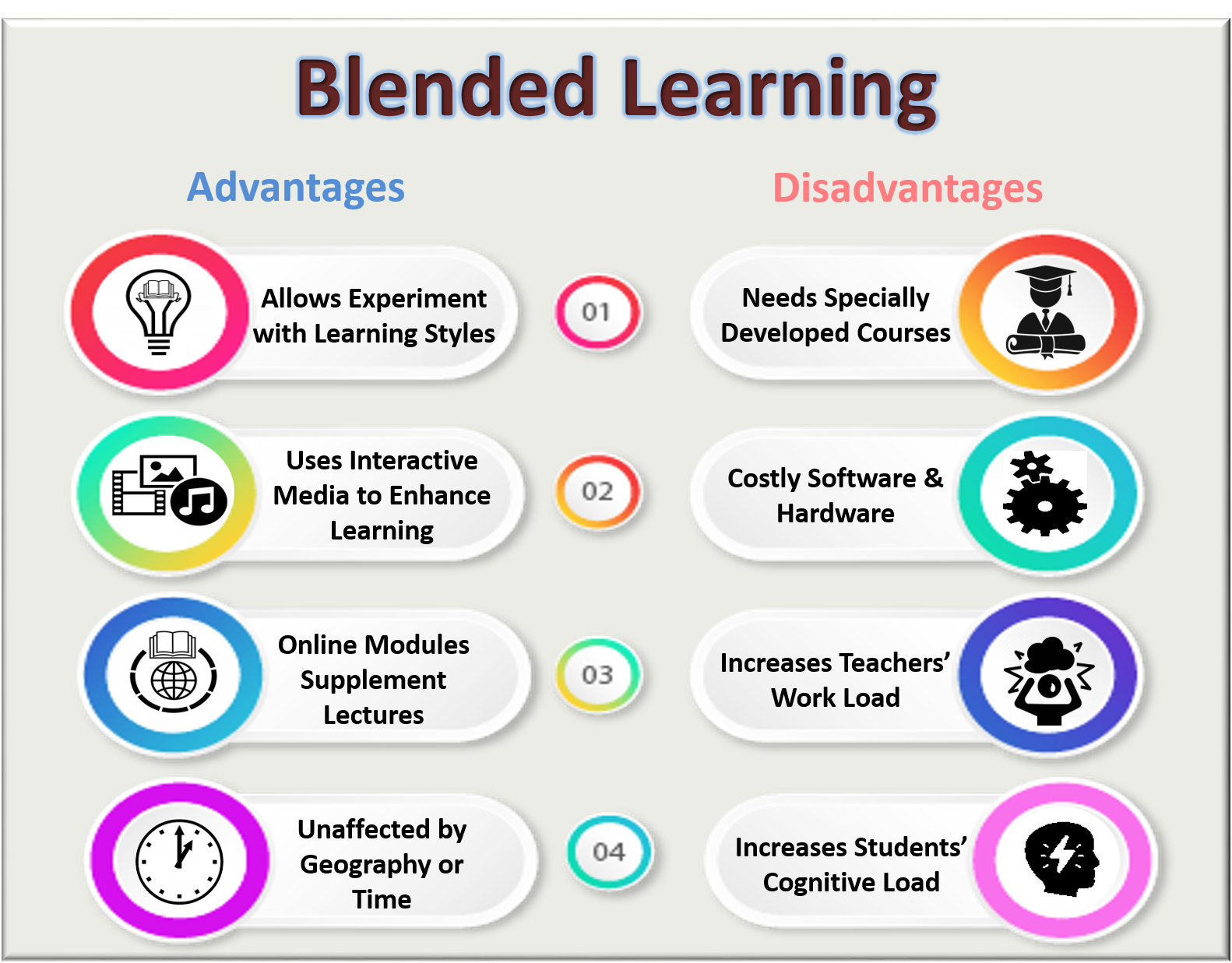
Effectiveness of Blended Learning
Blended learning is a method that engages learners by building their interests as they participate in traditional as well as online learning. Learners get a wider field of action that promotes learning and application of the knowledge gained. As a result, learners get a chance to experiment with different learning styles and produce better test scores.
Moreover, learners form stronger mental connections as they participate in two types of learning, that is, independent learning and mentored learning. Learning through a blend of traditional and online learning helps learners associate concepts with real-life situations. It also allows them to experience what they have learned, ultimately increasing the retention rate. Therefore, different pedagogical researchers have concluded that blended learning is an effective method of learning.
Read our next blog to find out about the strategies and best practices in Blended Learning.
Articles used for research: Teachthought and Lambda Solutions
Images from Shutterstock
Visit Evelyn Learning blog for more information on Blended Learning.

Create. Engage. Inspire
The post Blended Learning Explained: Definition, Models, & More appeared first on Test.Evelyn.
]]>The post Strategies for Self-Directed Learning: Teaching Methodologies appeared first on Test.Evelyn.
]]>In our previous Self-Directed Learning article, we familiarized our readers with the basics of self-directed learning, as well as provided an insight into what the approach of self-learning offers its disciples. Through this article, we offer some effective strategies for self-directed learning to gain or enhance a new skill.
Self-Directed Learning Strategies for Teachers
1. Open Questioning
Preparing lesson plans that include high-order, open-ended questions is a powerful medium to engage students and stimulate their curiosity. This eventually leads them down the path of self-directed learning.
Develop questions that compel students to think critically, analyze, and research. Using open-ended questions to introduce different elements of the lessons, instead of direct objectives, opens the door for discussions and debates. This method allows immediate feedback on students’ understanding and knowledge. It also enforces independent thinking.

2. Hybrid or Blended Style
This method of learning primarily focuses on combining the teacher’s interest and curriculum with the needs and interests of the students. This is done to develop a student-centered learning environment.
Engage students in determining learning goals and forming lesson plans. This stirs a sense of responsibility in them toward learning.
3. Encouraging /Introducing Technology in Classroom
Technology surrounds us at all times. Incorporating it as a tool for education is an effective approach toward creating a dynamic learning environment. Technology widens the horizons of learning beyond the classroom and gives students a chance to engage themselves in the process of learning in a creative manner. Learning comes to them internally when it targets their interest. In this way, it supports active learning. Internet, then, becomes their substitute teacher.
Create assignments that encourage them to use technology in order to find answers. This prompts them to delve further into the subject. Also, using media in the classroom helps make learning fun.
Self-Directed Learning Strategies for Learners
1. Smart Goals
Identifying the final goals is the first step toward starting self-directed learning, but this is not where it ends. It is crucial to create goals for each step. Losing focus is quite easy; short-term realistic goals help in staying focused and also boost the learning process. Using the SMART framework is one of the most efficient techniques, to begin with.
SMART is abbreviated for:
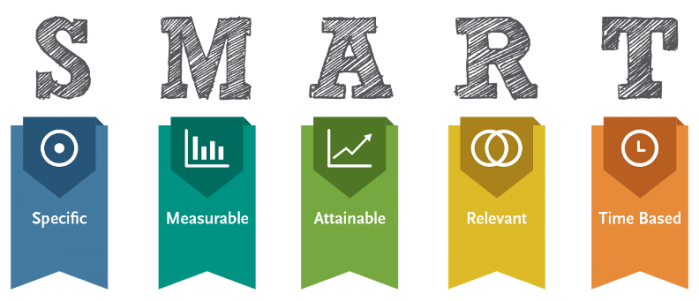
Specific: Be specific about what you want to gain. Do not settle for general goals.
Measurable: Create goals in a manner where you can track your progress.
Attainable: Create realistic goals, challenge yourself, but do not make it impossible for you to accomplish them.
Relevant: Ensure that the goals are relevant to you and are aligned to what you want to achieve. Create reasonable goals that will motivate you.
Time-bound: Set deadlines. Time limits help you remain focused and determined.
2. Mix and Match
Self-directed learning provides the flexibility of choosing a method of learning that is suited to individual needs.
Therefore, it is critical to analyze the learning process employed and choose the methods that align with the learner’s interests. Different subjects require different approaches. Hence, select the most suitable one. Additionally, these can be modified along the way.
3. Productive Learning Mindset
Developing an optimistic and never-give-up attitude is essential for self-directed learning, which is tested frequently at every curve of the learning journey. Learners will have to come to terms with the fact that failure is a part of growth.
Keeping faith in one’s abilities and believing that one can accomplish their goals is a requisite for a fruitful self-directed learning experience. What’s more, learners will have to overcome one of the biggest bane of learning – procrastination- and move ahead with determination and a strong, dedicated mind that stays focused.
4. Sandbox Method
Step 1: Build Your Sandbox
It is advised to create a place where one can experiment and build on their skills. It will motivate them to work more diligently. Share any completed work with peers, teachers, and family from the very beginning. This will help in overcoming public fear and provide valuable feedback at the same time.
Step 2: Research
To master a skill, regular research must be diligently performed. The boundaries of the sandbox will expand upon trying new things and mastering them. The immediate resources of research are books, online courses, blogs, forums, etc.
Step 3: Implement and Practice
Practice as much as possible in a progressive manner. Self-directed learning negates “naïve practice”, where repeating the same things incessantly is often encouraged. Instead, it promotes the learning of fundamentals and then applying them in a variety of scenarios. Furthermore, this will open cracks in learning and provide a chance to fill those gaps.
Step 4: Get Feedback
Constructive criticism offers opportunities for growth. Finding someone who can provide effective feedback about learning goals, progress, and the work done goes a long way in making any self-learning project successful. It will also help identify any potential shortcomings in the learning strategies employed. Thus, mentors, teachers, or experts of the targeted subject serve as excellent guides for self-directed learning.
Step 5: Continue and repeat
Any obstacle in learning should not stop one from the pursuit of learning. Receiving constructive feedback and working in the areas of development help the learner to master the concept. The shortcomings and failures should not deter the learner from continuing, even if it means starting all over again and making the same mistakes. Self-Directed learning encourages students and teachers to gain experience and work out ways to improve to acquire an in-depth understanding and thorough mastery of the subject.
Step 6: Have fun learning!
Learning should not be considered a solely academic affair with an objective to achieve. It should also be seen as a course of development as an individual. Enhancing skills and gaining knowledge is one aspect of learning, whereas developing individuality and gaining experience while doing so is another. The course of learning should be immensely enjoyed to support development.
Self-Directed Learning encourages the students to actively participate in the learning process and take responsibility for their own learning. It is a constructive approach to learning as it involves critical analysis of growth and development in the parameters of learning. This is even more essential as the analysis is undertaken by the learner themselves. Despite being reined by the student, the self-directed learning process lets the teacher play an important role in the process. Therefore, it is essential for them to guide the students to use effective strategies to achieve better results.
Image Credits: Research Vectors by Vecteezy
Research Credits: Discoverpraxis
Visit out blog for further reading about learning techniques and teaching methodologies.
Create.Engage.Inspire
The post Strategies for Self-Directed Learning: Teaching Methodologies appeared first on Test.Evelyn.
]]>The post Self-Directed Learning And Its Significance appeared first on Test.Evelyn.
]]>Self-Directed Learning refers to the learning strategy that fosters independent learning. The learners take the onus of their learning and learn at their own pace. Incorporating self-directed learning is an effective and convenient method that works as a supplement to instructional learning for developing a well-rounded learning process. This is a form of constructive learning where education does not depend on teachers or instructors. It does not encourage spoon-feeding; it empowers the learners and involves them in their learning process.
Learners drive and direct their learning, which makes them responsible for their cognitive development as it prompts them to know what they really want to learn and how they want to advance with their learning. With the easy availability of relevant resources, it has become easier to make learning much more fun, interesting, and creative.
Self-learning aims at involving learners in their learning process. With the advancement in technology and teaching methodologies, self-directed learning has become a handy tool for various educational institutions that aim to enhance the learner’s experience. This method liberates learning from the restricted space of a classroom.
Importance of Self-Learning
Self-learning does not confine itself to chosen subjects or goals or academics. It provides flexibility to students in their learning experience by allowing them to research and learn without any restrictions of resources. Self-directed learning offers an opportunity to learn about a subject in depth. This kind of learning is not restricted by age. It provides liberty to students in the sphere of education and minimizes the instructional approaches.
The solutions are not provided beforehand. Students have to find answers on their own. This develops problem-solving capability and provides new opportunities for learning and growing, emphasizing the process of learning and not the final outcome. Moreover, it introduces students to the vastness of the world as the research that they undertake stirs curiosity, which internalizes learning. This disables external factors, such as peer pressure, the importance placed on scores, and other distractions that inhibit learning.
This method makes learning more meaningful and ignites an inner desire to learn and grow. Besides achieving the learning goals, it also helps develop other skills, such as discipline, problem-solving ability, focus, zeal to learn and grow, and many more. These skills become an indispensable part of successful living.
The Role of Teacher and Student in Self-Directed Learning

- This method holds both the teacher and the student equally responsible for a successful and holistic learning environment. A teacher must have an innate desire to help students. They should be open to suggestions and work as the facilitators of learning. The traditional authoritarian figure associated with teachers is something that should be discarded.
- A teacher must aim to build a cooperative and friendly environment. They should motivate and encourage students and provide them with timely guidance. They should provide feedback frequently, keeping the learners in the loop and helping them improve.
- Students must be optimistic and enthusiastic about learning and should always take an initiative to enhance their learning level to facilitate personal growth and development. Active participation in learning, further evaluating, and improving upon your methods are the fundamentals of holistic learning.
Stages of Self-Directed Learning
Self-directed learning involves the following four stages:
- Assessing the motivation and preparations for learning and analyzing the current environment, conditions, and learning space
- Identifying and formulating learning goals and creating a well-structured and organized plan with the help of instructors
- Engaging in the learning process. Immersing oneself in the pool of learning is ideal, but staying focused and analyzing the employed learning process is also crucial.
- Understanding and evaluating the employed methods, and whether they prove useful or not. If not, adapt a different approach if possible. The whole process of self-learning allows learning, unlearning, and relearning, thereby providing a better understanding of one’s psyche at the same time. Engaging in self-reflection is a great source of self-growth.
Resources Used: University of Waterloo blog and Faculty Focus Blog Page
Visit our blog for further reading about learning techniques and teaching methodologies.
Create.Engage.Inspire
The post Self-Directed Learning And Its Significance appeared first on Test.Evelyn.
]]>