The post Avoiding Plagiarism In Academic Content appeared first on Test.Evelyn.
]]>Many copywriters are forced to write about subjects that have previously been explored on other websites. And, no matter how hard they try, coming up with a completely new story angle isn’t always easy. Generating plagiarism-free content becomes much more challenging in sectors where reputable sources are limited to a single hand.
Plagiarism is defined as the use of another person’s words or ideas without properly attributing the creator. Plagiarism can be intentional, such as when someone steals another’s work, but it is more commonly unintentional, such as when someone forgets something. When writing an academic paper, writers build on the work of others and gather information and evidence from a variety of sources. They must properly include these sources into their text to avoid plagiarism.
We’ll give you some content writing ideas as well as plagiarism tools in this article to assist you avoid plagiarism in academic content. They’ll help you write remarkable, plagiarism-free content that attracts high-quality traffic.
The Importance of Academic Integrity
Integrity entails believing in the community’s beliefs and standards and acting in accordance with them. A person with integrity is somebody who is genuine and sincere. An individual’s personal principles and ideals reflect their character and trustworthiness as a student. Maintaining academic integrity indicators when pursuing a degree at university indicates a student’s actual academic achievements.
Students with dignity will study and complete tasks diligently in order to acquire their degrees in a fair and honest manner. When a student purposefully cheats his or her way through university, the integrity of the degree and the individual’s morals are jeopardized. This lack of trustworthiness follows a student into the workplace and might have a negative impact on their career.

Key Reasons why Academic Integrity is Important
Academic integrity is essential for a variety of reasons.
- To begin with, academic integrity implies that others can put their faith in the writer. People who do business with such a person know they can count on them to be professional. Additionally, trust is one of the most critical characteristics of a great leader. Successful people are fully aware of the benefits of acting with integrity. Our ability to trust each other is the foundation of our entire environment. As a result, it’s critical to develop strong ethical practices.
- Second, academic integrity is essential since it adds worth to one’s diploma. Employers seek graduates with a high level of personal integrity. They would rather focus on developing the human capital of someone who will have a good impact on the firm and whom they can entrust with carrying out the company’s objective.
- Finally, academic integrity is crucial because it can provide an individual with peace of mind knowing that they believe in doing the right thing and that they constantly attempt to act in accordance with those convictions. Integrity can help one live a happier, healthier, and more productive life by reducing unnecessary stress.
Key Tips to Avoid Plagiarism in Academic Content
It might be difficult to preserve the uniqueness of information when writing, especially when the topic is unfamiliar to the writer. Maintaining uniqueness in their writing is a problem for every content writer. One thing a writer should know about Google is that it despises plagiarism. So, aside from everything else, if a writer wants their work of art to stand out and trend on Google, they must first focus on keeping it original.
To avoid plagiarism in academic content and develop good plagiarism-free material that attracts high-quality visitors, we’ll list out some content writing tactics as well as plagiarism tools below.
1. Start from Scratch
That is, after all, the way to go. A writer must always begin their piece of writing with their own unique ideas. That is when they’re no longer at risk of being accused of plagiarism. You are probably thinking how to come up with something unique on a topic you’ve never heard of before.
To avoid plagiarism in academic content, a writer should always begin by researching the issue thoroughly, gathering all necessary material, studying it thoroughly, and comprehending it completely. Following this, they will be able to compose it on their own. And, if the subject is relevant to a writer’s field of competence, they can rapidly lose their reputation as a profound and brilliant writer.

2. Evaluate the Context Properly
A writer must take the time to comprehend the concepts they will be discussing in their essay while conducting the study. Also, if they’re drawing inspiration from precise published resources, they must read them numerous times to grasp the primary ideas and concepts. They’ll gain a better understanding of the context and be able to come up with a fresh structure for the article or blog post this way. When a writer has clear concepts, their piece of content will be clear as well.
Even if a writer highlights and copies passages from other articles into their draft, none of these should appear in the final product. They must try to demonstrate the concepts, try to describe everything in their own words, using synonyms and even case studies and instances.
Instead of repeating facts and data from other articles, a simple approach to avoid plagiarism in academic content and add more value to the work is to hunt for current facts and data. Academic content should always be written from the writer’s own perspective. This way, they will still have an original article even if the material reflects the same thoughts as another website.
3. Make use of Synonyms
Although Google dislikes plagiarism, one must regard it as their best friend while writing original content. It aids a writer in a variety of ways. It is also one of the finest places to look for synonyms when writing. As a result, writers should make the most of Google to identify synonyms and incorporate them into their writing in order to avoid plagiarism in academic content. In the event that another choice is required, Microsoft Word can be used.
4. Learn when to quote and how to quote effectively.
When a writer can’t paraphrase, they must use quotation marks to reproduce the exact words from the respective source. It comes in handy when they need to rewrite someone else’s precise words to give their essay more weight. Copywriters should also acknowledge the source of any data, assertions, or facts used to support their work.
Using quotes and references to shield themselves and their webpage from plagiarism charges can be very successful. Filling the content with quotation marks, on the other hand, isn’t going to improve the SEO. So, to keep both the readers and the search engines interested, a writer must strike a balance between original content and quotes. As a general rule, a writer should resist using cited information that doesn’t add value to the issue or doesn’t provide enough context for readers to comprehend what they’ve just read.
5. Employ Plagiarism Checking Software
Only a writer understands the benefits of drawing inspiration from other articles. Many people even suffer as a result of doing so. They end up writing content that is plagiarized heavily.
So, what’s the best method to deal with this issue and avoid plagiarism in academic content? Plagiarism Detection Tools and Software. When a writer has taken ideas from other papers, using a plagiarism checker is the simplest way to ensure that their material is unique. Such a tool scans the material for duplicate content using powerful algorithms that compare it to search engine results, books, journal articles, and other online sources.
When a writer examines the content for plagiarism before publishing it on the internet, they are able to post fully original content. They escape search engine penalties, as well as litigation for copyright infringement and public shame, by doing so. The ability to examine the constructs and phrases that match what the other author wrote is one of the benefits of employing a plagiarism checker. It’s useful when a writer wants to create unique material because they don’t have to rewrite the complete post and can concentrate solely on the parts.
Best Plagiarism Checking Tools to Avoid Plagiarism in Academic Content
An allegation of plagiarism can do a huge amount of damage to a writer’s reputation and academic record. Even the implication of a charge can have a negative impact on one’s grades or career, so it’s critical to provide plagiarism-free content and assignments. While the majority of problems are inadvertent, inaccurate citations and quotes might be considered plagiarism.
A Plagiarism Checker is an internet program that can detect plagiarized or identical content in a document or a section of it. These programs look for duplicates of content or documents on the internet. Many of these programs let you check the URL of a website or add material from documents.

The top three Plagiarism Checkers are listed below, along with their most popular characteristics.
1. CopyScape
CopyScape is a cloud-based tool that allows you to look for plagiarism and other forms of content theft, making it very easy to avoid plagiarism in academic content. It is straightforward to use by simply typing the URL of the original material. It is one of the finest free plagiarism checkers that enables you to scan for web page copies indefinitely.
Characteristics:
- Batch search the content.
- It lets everyone compare two pieces of content side by side.
- This plagiarism checker has a private index that allows you to check for duplicates in the text.
- Allows for case administration and tracking.
- This plagiarism checker website allows one to filter out results from sites they’re already familiar with.
- It has a user-friendly interface.
2. Grammarly
Grammarly offers both premium and free plagiarism detection, in addition to the site’s well-known proofreading features. Anyone can use Grammarly to avoid plagiarism in academic content and to proofread their paper, docx Word file, or web page for free. This program can detect plagiarism on a variety of online pages. It allows one to determine whether or not their text contains duplicate content.
Characteristics:
- This program allows everyone to search the material in batches.
- When text aligns with online content or in the database, Grammarly generates plagiarism alerts.
- It detects plagiarism by comparing the text to more than eight billion web pages.
- It includes a variety of writing styles as well as grammar, vocabulary, and syntax tips.
- The Grammarly instant report will tell a writer how many content duplication concerns there are.
- The program also calculates a document’s total originality score.
3. ProWritingAid
ProWritingAid is a multipurpose tool comes with a couple extra functions that make it ideal for any type of writing and make it very easy to avoid plagiarism in academic content. While working in popular programs, writers can use this copyright checker to scan their work. Alternatively, they can just upload a file containing their writing. However, in order to conduct a plagiarism report on a piece of writing, writers will need to purchase credits.
Characteristics:
- It assists in self-editing.
- More than 20 in-depth writing reports are available from ProWritingAid.
- It works with Word, Chrome, Google Docs, Gmail, and other programs.
- The tool is simple to operate.
- Supports a large number of file types.
- It assists in locating facts, questions, ideas, phrasing, and other aspects of the work.
- ProWritingAid allows the writers to preserve control over their words.
Parting Note
Unintended plagiarism can happen to anybody, especially if they copy words and ideas from other authors without properly citing them, or when citing them incorrectly. A writer may not notice they’re duplicating someone else’s work since they read so much before writing.
That’s why, while gathering information, it’s best to jot down the sources so the writer can recall where they received their ideas. Any uncomfortable situations can be avoided by using a plagiarism checker. It can also help one modify the draft more quickly and make it more creative by highlighting the exact structures that need to be rephrased.
This may increase the editing time, but it’s worth it in the end if writers want to provide more value to their readers and increase their search engine ranking.
Image Sources: Shutterstock and Unsplash
For more information on avoiding plagiarism in academic content, visit our blog.
Create. Engage. Inspire.
The post Avoiding Plagiarism In Academic Content appeared first on Test.Evelyn.
]]>The post Avoiding Plagiarism Related Issues appeared first on Test.Evelyn.
]]>The content available online is termed as Intellectual Property and is legally protected under copyright, trademark, franchise, etc. It demonstrates the scholarly and academic integrity of the respective owner. Copying or stealing content is thus deemed an unlawful and punishable offense.
The field of education has also witnessed a paradigm shift in teaching-learning methodologies that make use of technology. Teachers can devise interactive lessons that help the learners to understand the concepts better. And learners get access to numerous courses on an open learning platform. However, the information available on the Internet cannot always be used as it is, without duly acknowledging the creator. Therefore, writing and publishing something on the Internet requires a special emphasis on the practices that help avoid plagiarism.
Plagiarism can be of several types. Even using the same content repeatedly is termed as Self-Plagiarism, which falls under the umbrella term of Plagiarism. In this article, we recommend certain practices for avoiding plagiarism in various kinds of content.
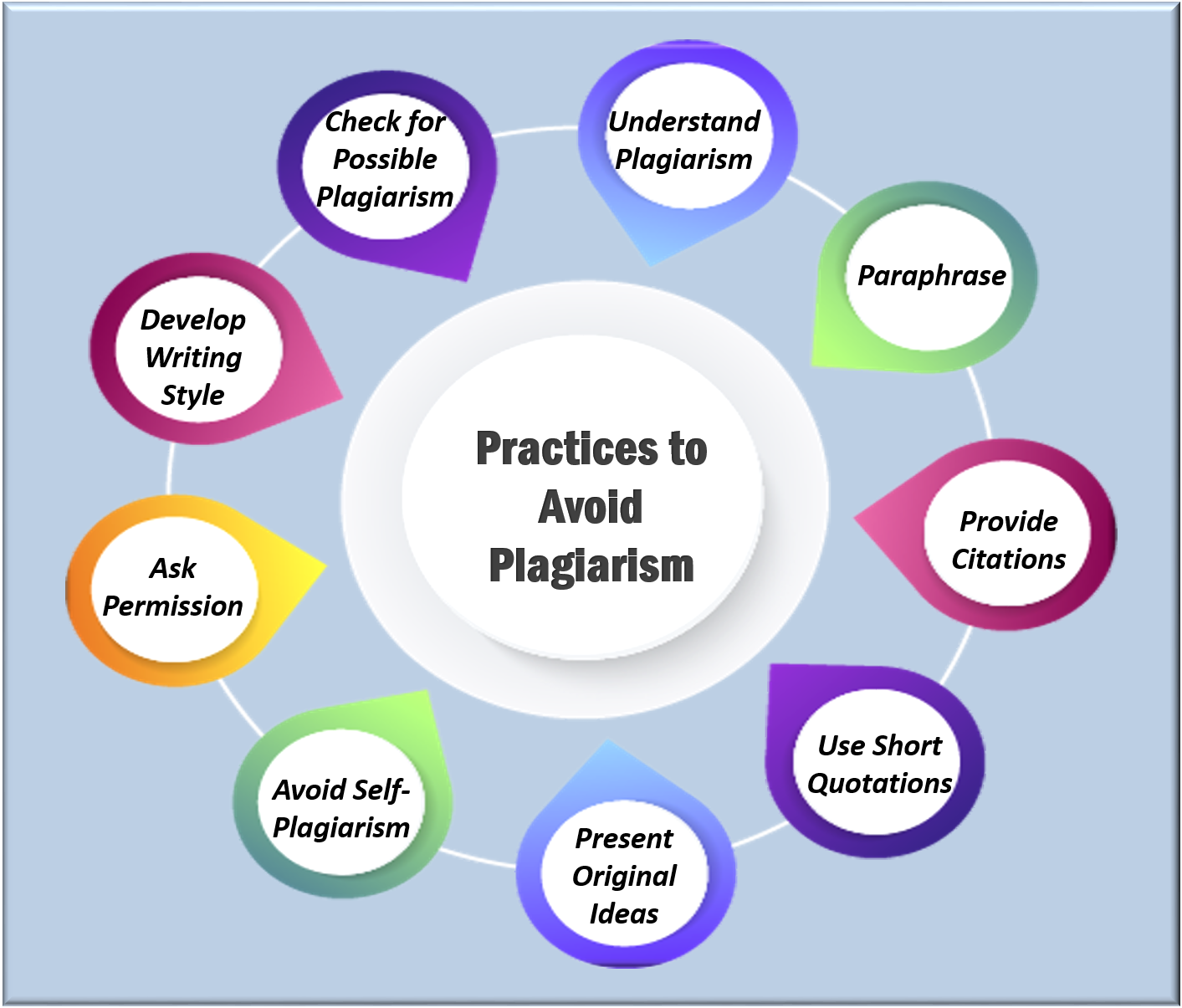
Practices for Avoiding Plagiarism
Producing plagiarism-free content can be challenging at times. Regardless of how difficult it seems, prioritize producing only original content, keeping in mind the serious legal repercussions of plagiarizing content.
I. Understanding Plagiarism
A little knowledge is a dangerous thing. To produce great, plagiarism-free content, it is extremely important to understand the meaning of plagiarism, its types, and its consequences. (Refer to our Plagiarism article for these.)
II. Paraphrasing
Paraphrasing refers to presenting the information in your own words without altering its actual meaning. This includes the use of synonyms or other forms of words that express the same meaning as the source. While it may seem easy, paraphrasing sometimes may slip into plagiarism if not practiced appropriately.
III. Providing Citations
Providing citations is a way of giving due credit to the owner of the original content. It is a good practice to include citations in your content as it is useful for avoiding plagiarism.
IV. Quoting
Using short quotations is preferable for avoiding plagiarism. It should be noted here that quotations should be used sparingly as excessive quotations make the text difficult to read. Additionally, they should not be too long.
V.Presenting Original Ideas
Instead of copy-pasting exact words from the source content, come up with creative ways of describing an idea originally, adding a new perspective to it.
VI. Avoiding Self-Plagiarism
Presenting original ideas may sometimes turn into self-plagiarism. This happens when the same words and phrases are used for specific content on multiple platforms. This has the same repercussions as plagiarism and must be avoided at all costs.
VII. Asking Permission
While using small parts of original content for transformative use, make sure that the source author identifies their content in the category of ‘Fair Use’. In case this is not clear, ask for permission from the copyright holder before using the content to avoid plagiarism-related issues.
VIII. Developing Unique Writing Style
The best way of avoiding plagiarism is to develop a unique writing style. Put your imagination to work by producing content with varied vocabulary. Eventually, a unique writing style will develop over time.
IX. Checking for Possible Plagiarism
It is always a good idea to check the content for possible and unintended plagiarism. Many software available on the Internet can be used to detect plagiarized content for free. These provide a detailed report of the content, containing the plagiarized parts and the information about the source content. Grammarly Premium, Plagiarism Checker X, Copyspace, and PlagTracker are a few software that can be utilized for this.
Conclusion
Creating any sort of content is an art not all can master. Quality of the content reflects the knowledge, understanding, and skills of the creator gained and developed with repeated practice. If viewed from a wider perspective, writing can be seen as a form of expression that ultimately impacts all the aspects of human personality. Every person has an exclusive way of expressing opinions, thoughts, and feelings. Thus, plagiarizing is never a good idea in any situation. It is an unethical act that equals stealing and must be avoided at all costs. One must have a sound understanding of plagiarism and should adhere to the guidelines mentioned in this article to produce original content that is free of plagiarism.
Sources referred to for research: Ediqo
Image: Freepik
For more information, visit our blog.

Create. Engage. Inspire.
The post Avoiding Plagiarism Related Issues appeared first on Test.Evelyn.
]]>The post An Introduction to Plagiarism appeared first on Test.Evelyn.
]]>Readers may go through the web articles at the Caltech, University of Cambridge, University of California, and University of Oxford websites to develop an idea about the holistic definition of plagiarism.
Types of Plagiarism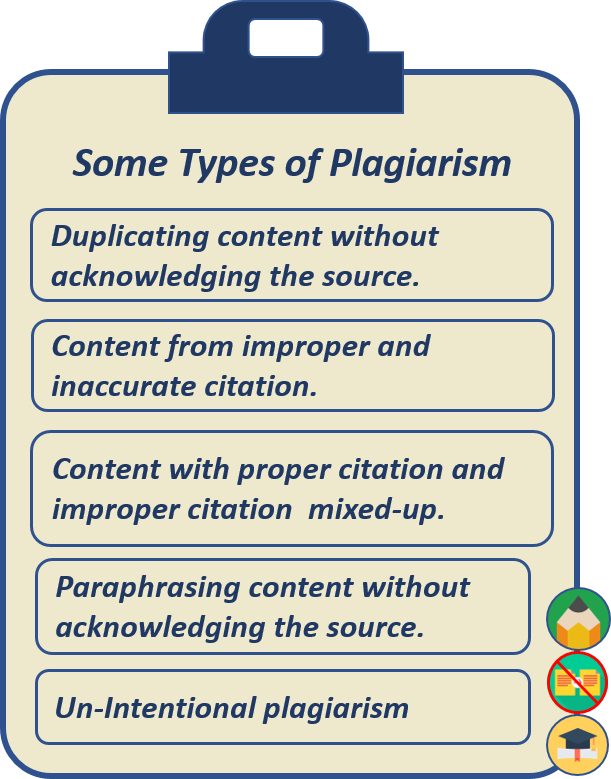
Listed below are some of the most common ways in which people plagiarize.
- Taking content “as-it-is” from a source without acknowledging and crediting the source. Commonly, the copied content is in the form of a “single large block” from one source. Otherwise, the content may be also copied in several “chunks” from one or multiple sources.
- Paraphrasing the content without acknowledging the source(s). Such a practice involves changing a few words in the content taken from single or multiple sources. The structure and flow of content remain the same.
- Besides the above two major ways, there are several cases of plagiarism. For example, the final content is a mix of content with proper citation and content with improper citation, content with improper or inaccurate citation of sources, and content borrowed from a previous work of self, thereby rendering the new work ‘unoriginal’.
- Plagiarism may be unintentional or accidental as well. This happens when one does not have the understanding of how to quote and cite sources. However, the content may seem to be the outcome of a conscious attempt at plagiarizing.
Readers may access web write-ups on plagiarism at the Bowdoin College and Turnitin websites. Additionally, an infographic at the iThenticate website offers a detailed study with case-specific examples. The content available at the suggested sites would help consolidate the readers’ understanding of the topic at hand.
Consequences of Plagiarism
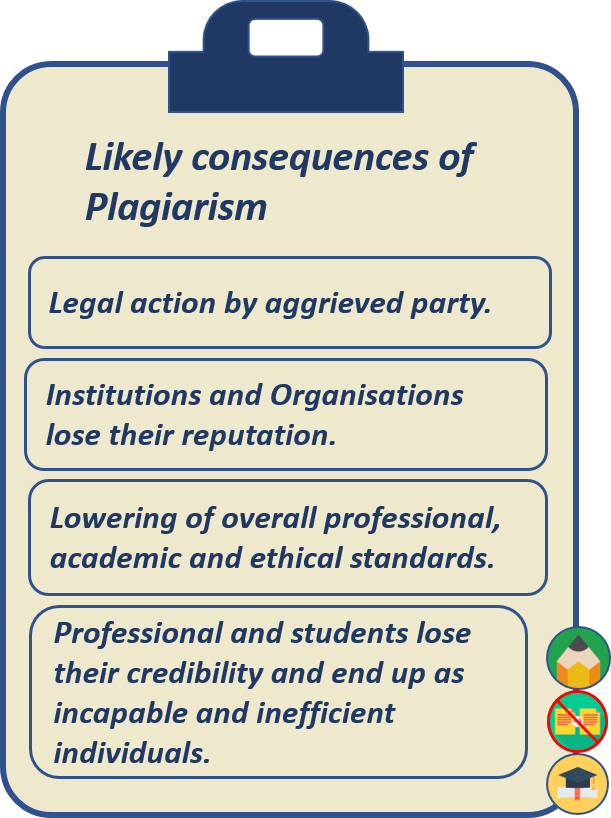
People who plagiarize are under the false impression that they stand to benefit from such a practice. From a short-term perspective, they do. They are not only able to develop “their work” quickly and conveniently but also grab credit and recognition for “their contribution”. The original creator of the work (the aggrieved party) thus loses the immediate benefits and credits that are rightfully theirs. From a long-term perspective, however, plagiarists end up as ineffective and incapable professionals. Their professional reputation is irreversibly destroyed to the point that their social image is severely dented as well. The world of academia and the knowledge industry is replete with such examples.
Academic institutions, the knowledge industry, and publishing companies (print/electronic) have now begun to take cognizance of the fact that plagiarism is a malady infecting academic integrity. Conscious efforts are hence being undertaken to avoid and curb this malady. Academic institutions and forums, for instance, have a distinct and clear set of guidelines to penalize plagiarism. Also, the degree or percentage of plagiarism is an important metric in deciding the quantum of penalty.
A dedicated FAQ page at the IEEE website gives an idea about the kind of guidelines that describe the extent of appropriate penalty for any plagiarism found.
Ways and Means to Detect and Identify Plagiarism
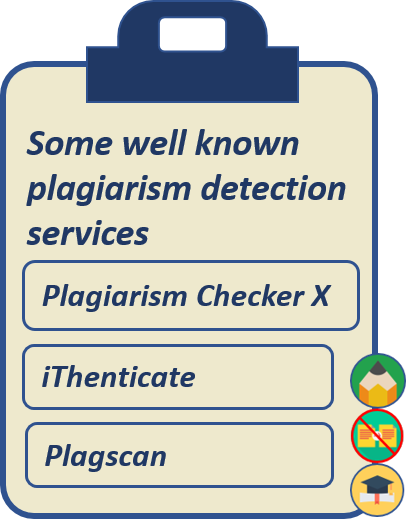
It is important to understand that to award penalties, it has to be proven that plagiarism has been committed intentionally. However, proving a case requires the identification of instances of plagiarism. This is where the ubiquitous internet and digital tools which make it easy to plagiarize make it equally easy to identify plagiarized content. A plethora of digital services, both paid and free, help identify plagiarism. Such services conduct a close and thorough examination of content and provide a detailed analysis of any plagiarism found. It is not necessary, however, to carry out the analysis of content through digital/electronic means only. A case discovered through human observation is equally well established to call for action.
The evidence of plagiarism found is duly put before a panel or board (designated to handle such cases) of the relevant organization/institution/body for formal examination and subsequent action. Penalties may range from zero credits for plagiarized scripts to outright cancellation of a candidate’s registration in a study program, depending upon the extent of plagiarism. Knowledge and learning-based organizations remove such content from their portals and sever their professional relations with knowledgeable professionals who indulge in plagiarism.
As a measure, penalizing plagiarism definitely deters people from practicing it. It is equally important that professionals adopt ethical practices during the course of their work. Therefore, institutions and organizations are advising students and professionals on ways and means to avoid plagiarism. This requires creating awareness about the issue amongst students and professionals. A dedicated “FAQ” on the website of an institution would help achieve the objective. Readers may access such FAQs through the links provided earlier in this article.
Citation and Its Purpose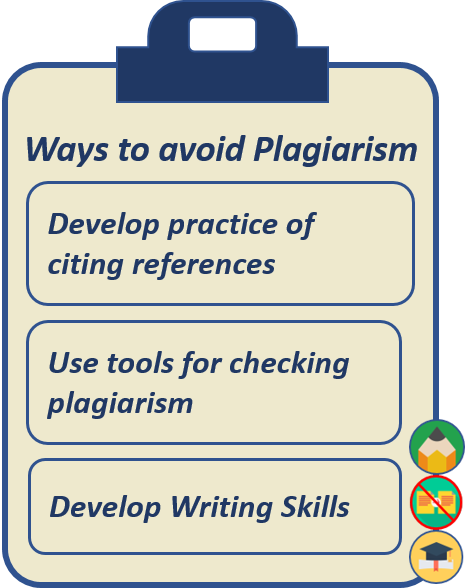
A sure approach to avoiding plagiarism is the practice of developing good writing skills. Good writing calls for the honest and effective articulation of thoughts, ideas, and facts. Honest writing calls for crediting the resources which have had an influence on the developed content. This is where the practice of including citation assumes significance.
A citation is a reference to a source referred to during the development of a work. It may also be a link/credit to a resource from where content is suitably adapted for inclusion in a work. Citation ensures that credits are rightfully given to the original creators of the cited work. It also helps the audience refer to additional sources on the subject. Readers may note that facts/thoughts that are a matter of “common knowledge” do not need a citation. However, if a thought/fact/idea is beyond the purview of common knowledge and is a unique and distinct work of a creator, a citation is necessary.
The publishing industry adopts specific formats for making citations. An improper citation, at times, is equivalent to plagiarized work. The web articles When to Cite and Referencing conventions at the University of Cambridge website offer a sound idea about the need for citations and the practiced conventions for making citations. Readers may go through similar articles on the Caltech and University of Oxford websites.
This article is part of a series of articles on Plagiarism.
Additional References:
- Promotion of Academic Integrity and Prevention of Plagiarism at the University Grants Commission, India.
- Draft Document on Plagiarism Policy at IIT Kanpur, India.
Image Credits:
Icons made by Icon Monk, Vectors Market, Smashicons from www.flaticon.com
For further reading related to pedagogy and education standards, please visit the blog at Evelyn learning.

Create.Engage.Inspire
The post An Introduction to Plagiarism appeared first on Test.Evelyn.
]]>