The post Mobile Learning – What All You Need To Know? appeared first on Test.Evelyn.
]]>The idea of mobile learning is nothing new. Many schools and educational institutions are attempting to implement this technology in order to better teach students using computers and mobile phones. This method is not only useful and practical but also enjoyable, which is how it encourages individuals of all ages to learn. That is why, on a daily basis, numerous educational technologies are introduced and made available to educators and trainers.
This article will discuss the definition of mobile learning, as well as its benefits and drawbacks. It will also cover a variety of mobile learning tools and creating content for mobile learning.
What is Mobile Learning?
Mobile learning (m-learning) is the process of obtaining learning materials via mobile apps, social interactions, and online educational hubs over the Internet or a network utilizing personal mobile devices such as tablets and smartphones. It is adaptable, allowing students to receive education from anywhere and at any time.
Mobile learning allows educational institutions to transmit information and educational content to students on any platform, at any time, and from anywhere. Students use mobile apps and technologies to complete and submit projects to teachers, download course materials, and collaborate on activities in online social groups.
Course creators most commonly use the term “mobile learning” to describe the technology of mobile devices and apps that educators utilize in the classroom. However, it can also refer to the use of mobile technology to facilitate always-on learning.
Creating Content For Mobile Learning
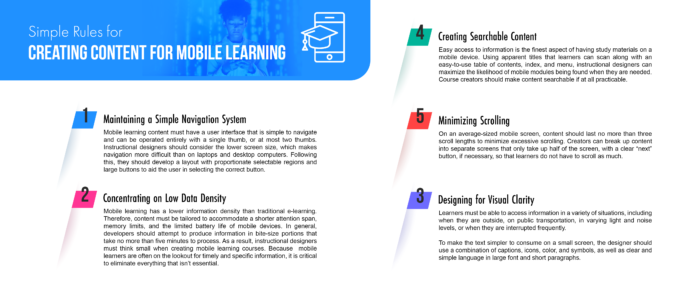
It is a prevalent misperception that educators can easily convert eLearning resources to mobile learning courses. During the transition, however, they must rethink the entire instructional design. To create a gratifying and a visually and cognitively rewarding user experience, mobile learning necessitates minimalism, an emphasis on granular design, and instructionally sound design.
Following these simple but important rules will allow course makers to make learning easier for students and provide them with an intuitive and engaging learning experience that matches their needs wherever they are.
To avoid both distracting learners and wasting space in the initial scrolling zone, all secondary content, such as optional navigational controls, links that are not relevant to the information being displayed, copyright notices, and other legal information, should be kept to the bottom of the screen. Every screen should direct the student to further content so he or she can catch up or dig deeper into a topic.
Advantages And Disadvantages
Following are a few key advantages and disadvantages of mobile learning that all course creators should be aware of.
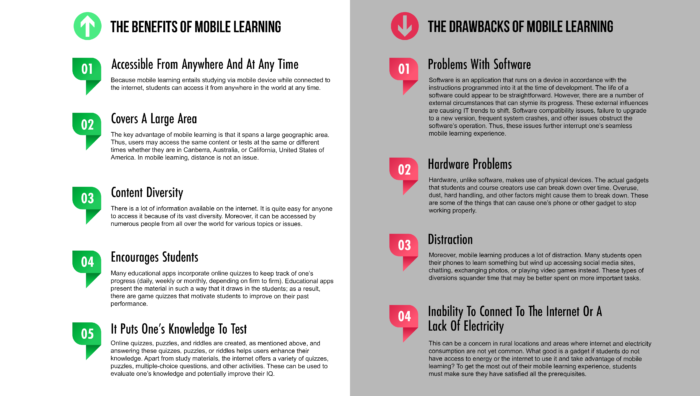
The Applicability of Mobile Learning
Mobile learning is formal but informal, which is exactly what most students want. Mobile learning allows students to learn in the comfort of their own home without having to abandon their daily activities and plans.
Those who do not participate in online classes can still access learning resources. These include educational articles, videos, audios, pictures, and even text. This on-demand accessibility has further added to the success and renown of this learning method.
These and other advantages of mobile learning, such as eco-friendliness, cost-effectiveness, ease, and the amount of enjoyment obtained from learning, have prompted corporate behemoths and developing firms to migrate from physical to virtual training sets.
Mobile Devices Prices
The prices of mobile devices have reduced dramatically over the years. This is a result of the ongoing release of new gadgets and the variety that is now available. For those considering mobile learning, this is the icing on the cake. This means that everyone, from the young to the elderly, may easily make a one-time investment that will provide years of learning and enjoyment.
Image Sources: Shutterstock and Unsplash
For more information on mobile learning, visit our blog.
Create. Engage. Inspire.
The post Mobile Learning – What All You Need To Know? appeared first on Test.Evelyn.
]]>The post E-Learning Resources for College Students appeared first on Test.Evelyn.
]]>In the contemporary world, continuous learning is the only key to success. College students are often swamped with a lot of learning and responsibilities. Consequently, managing time to travel and to physically attend a class becomes tiresome, so e-learning through different resources serves as the best alternative. Also, these resources allow learning to continue at all costs, with minimum requirements of time, space, and money.
The top free e-learning resources for college students have been listed below.
1. TED-Ed
TED-Ed is a youth and education initiative of TED. It is an international platform that aids teaching and learning. With a growing animated video library, TED-Ed allows educators to create interactive lessons to teach students around the globe. The TED-Ed animated videos, or TED-Ed Lessons, are short videos about the ideas that spark the curiosity of learners. These videos are a result of the collaboration between experts, including TED speakers, TED fellows, educators, writers, and many others.
Moreover, the advisors of TED-Ed include prominent personalities from different fields relating to education. Aaron Sams, Jackie Bezos, Melinda French Gates, and Salman Khan (from Khan Academy) are a few to name.
2. ResearchGate
ResearchGate is a global professional network for researchers and scientists. The platform aims to connect the world of science and ease research. Presently, ResesarchGate has millions of members collaborating on specific topics in science and research.
An additional feature of this platform is that it allows the members to publish their data and see who’s reading or citing it. Moreover, this data is accessible from any corner of the world, making it a handy tool for college students to learn.
3. Coursera
Coursera is an online education platform providing free academic references and modules for learning. It provides knowledge about various subjects with on-demand video lectures, discussion forums, and homework exercises. The courses are available for free, with some requiring payment. Moreover, learners receive a sharable certificate at the end of the course.
An additional advantage of learning with Coursera is that it partners with more than 200 top universities in the world. Also, industry educators partner with Coursera to offer specializations. Certificates, courses, and various degree programs. Overall, the platform provides universal access to the best education with top universities and organizations.
4. Khan Academy
Khan Academy provides numerous educational videos and test exercises that help learners study at their own pace. It eliminates the need to attend a physical classroom for learning with an open learning platform. Also, it is one of the biggest learning platforms with courses that cater to the learning needs of all age groups. All these courses are free and accessible anytime, anywhere. Moreover, the courses are available in more than 36 languages, promoting learning without the barriers of language.
5. Duolingo
Duolingo is a mobile application for language learning. The application is available for free with more than 90 different language courses. It gives a personalized learning experience with gamified lessons. Also, the lessons review learner’s vocabulary effectively and show grades instantly.
Moreover, Duolingo uses gamification as the basis of learning in all the courses. As a result, the gaming and reward system better learning and engagement, eventually producing better learning outcomes.
6. Udemy
Udemy is a skill development platform for learners who wish to earn a technical certificate or acquire skills for a job. The Udemy mobile application provides access to a variety of videos, podcasts, presentations, and lectures for free. Moreover, it allows learners to connect with the best instructors from around the world and work towards realizing their dreams.
Udemy offers courses on a wide variety of subjects. These include finance, accounting, business, economics, real estate, and much more. Moreover, these courses are available in more than 65 languages and are delivered by highly skilled instructors.
Bottom Line
The Internet is an ocean of opportunities and a lifelong learning resource, particularly for college students. The various free e-learning resources available on the Internet make it possible to learn anything and everything from the comfort of one’s home. College students often engage in numerous activities apart from their studies. As a consequence of this, they find it difficult to learn something new and often fail to turn their dreams into reality. This can happen due to the limitations of time, space, money, and other such factors. But the various free learning resources act as a lifeline for such students and help them fulfill their learning requirements to succeed in life.
Research Website: Collegecliffs
Featured image: Shutterstock
For more information e-learning, visit our blog.

Create. Engage. Inspire.
The post E-Learning Resources for College Students appeared first on Test.Evelyn.
]]>The post Blended Learning Explained: Definition, Models, & More appeared first on Test.Evelyn.
]]>(Refer to our blog on Online Learning vs Traditional Learning: An Introduction for more information on traditional learning.)
What Is Blended Learning?
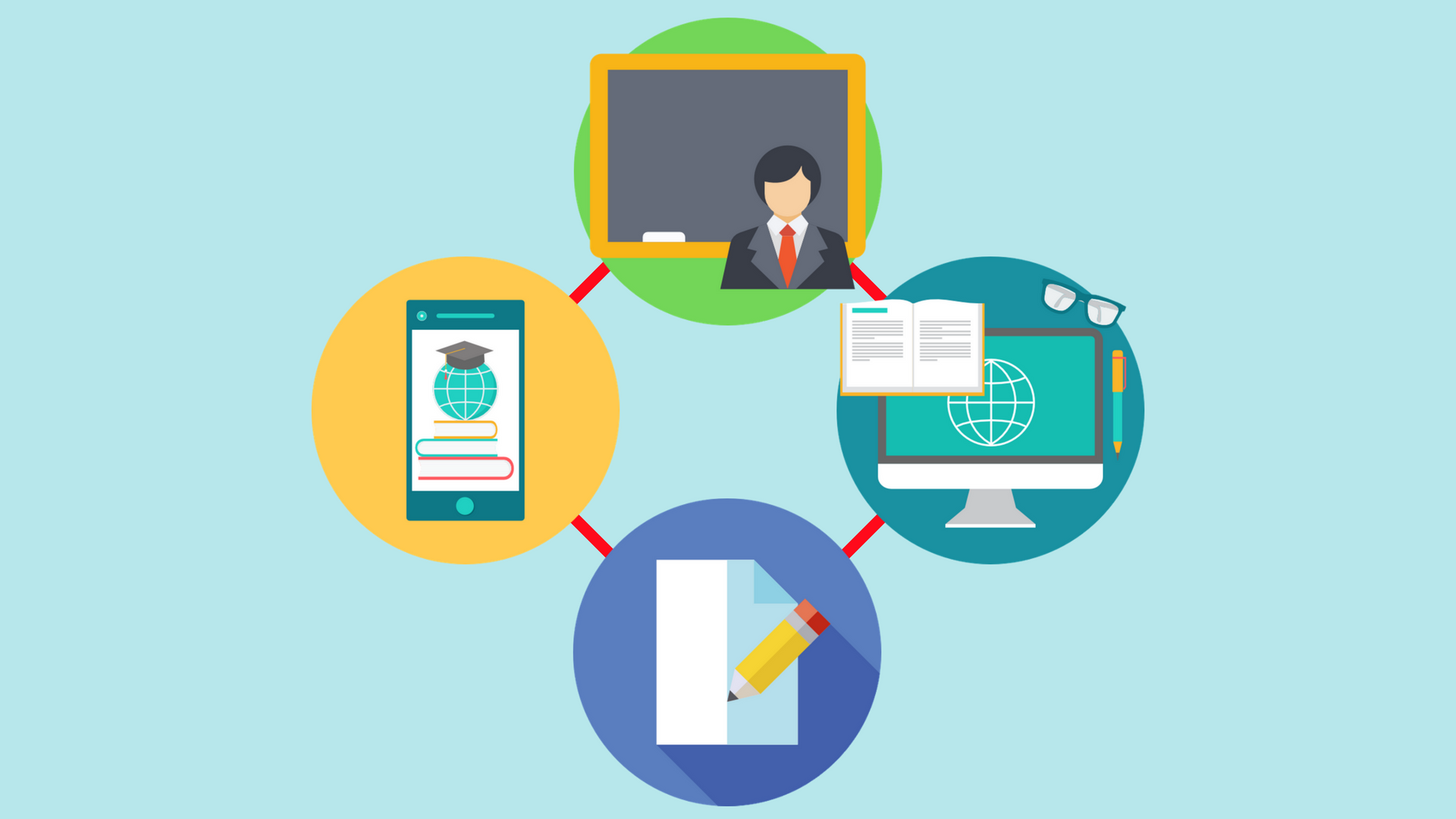
Blended Learning, as the name suggests, is an integrated form of learning in which traditional classroom learning is clubbed with eLearning to enhance learners’ experience and to engage them better. In other words, it brings technology-based learning into the brick-mortar classroom setting, where learning occurs under the supervision of an expert teacher. It is also known as Hybrid Learning.
Technology has become an inseparable part of life. Hybrid learning makes use of this technology to supplement and eventually transform the learning process. Moreover, the use of technology renders an improved learning process, promoting better learning and retention. Also, the rise of digital learning and mobile learning acts as a contributing factor in blended learning.
Taking an online course while simultaneously attending classes for the same is an instance of the blended learning process. Similarly, a student participating in a classroom discussion and preparing it in the form of a video as a home assignment is another example of hybrid learning.
Blended Learning Models
eLearning has gained a broader perspective with time. It is the culmination of various learning practices that aim to achieve different learning objectives. Blended learning is one such form. However, blended learning is an independent form of eLearning. It is categorized into various types depending upon the content, scale, technology used, and other relevant factors.
1. Station Rotation Learning
The Station Rotation Learning model allows students to rotate through stations that are a blend of traditional and online learning. The rotation occurs based on a fixed schedule. This model particularly applies to elementary schools.
2. Lab Rotation Learning
The Lab Rotation model and the Station Rotation model are alike. This model uses computer labs in schools on a rotation basis as per a fixed schedule. This model works by considering both the learning needs and the resources available.
3. Individual Rotation Learning
This is another type of rotation model where students rotate through stations at regular intervals following a schedule. But unlike other rotation models, the Individual Rotation model allows students to rotate through stations according to an individual schedule of the software algorithm or the teacher.
4. The Flipped Classroom
In a Flipped Classroom, the traditional roles of the school and home are flipped. The concept of learning occurs at home and the students practice it in the school in a supportive environment with peers and teachers.
5. Enriched Virtual Blended Learning
Enriched Virtual Blended Learning provides an enriched virtual learning experience where the students focus more on online coursework rather than attending lectures. The scheduling of lectures is occasional and depends on learners’ requirements.
6. Self-Directed Learning
The Self-Directed Learning model is a personalized learning model where the students direct their learning by switching between face-to-face learning and online learning simultaneously as per the demand of the course. Thus, the role of the teacher and online courses keep changing as per the learners’ requirements.
7. Project-Based Learning
In the Project-Based Learning model, the students make use of classroom learning as well as online learning while collaborating to design, iterate, and publish project-based learning assignments, products, and others. This type of learning is supported by various online resources that the students can use to create projects.
8. Supplemental Learning
The Supplemental Learning model provides a supplementing learning experience to the learners. The lessons achieve critical learning objectives in one place, while another platform acts as a supplement to the learning. For instance, students either attend a face-to-face learning class while online learning works as a supplement to it or vice-versa.
Advantages and Disadvantages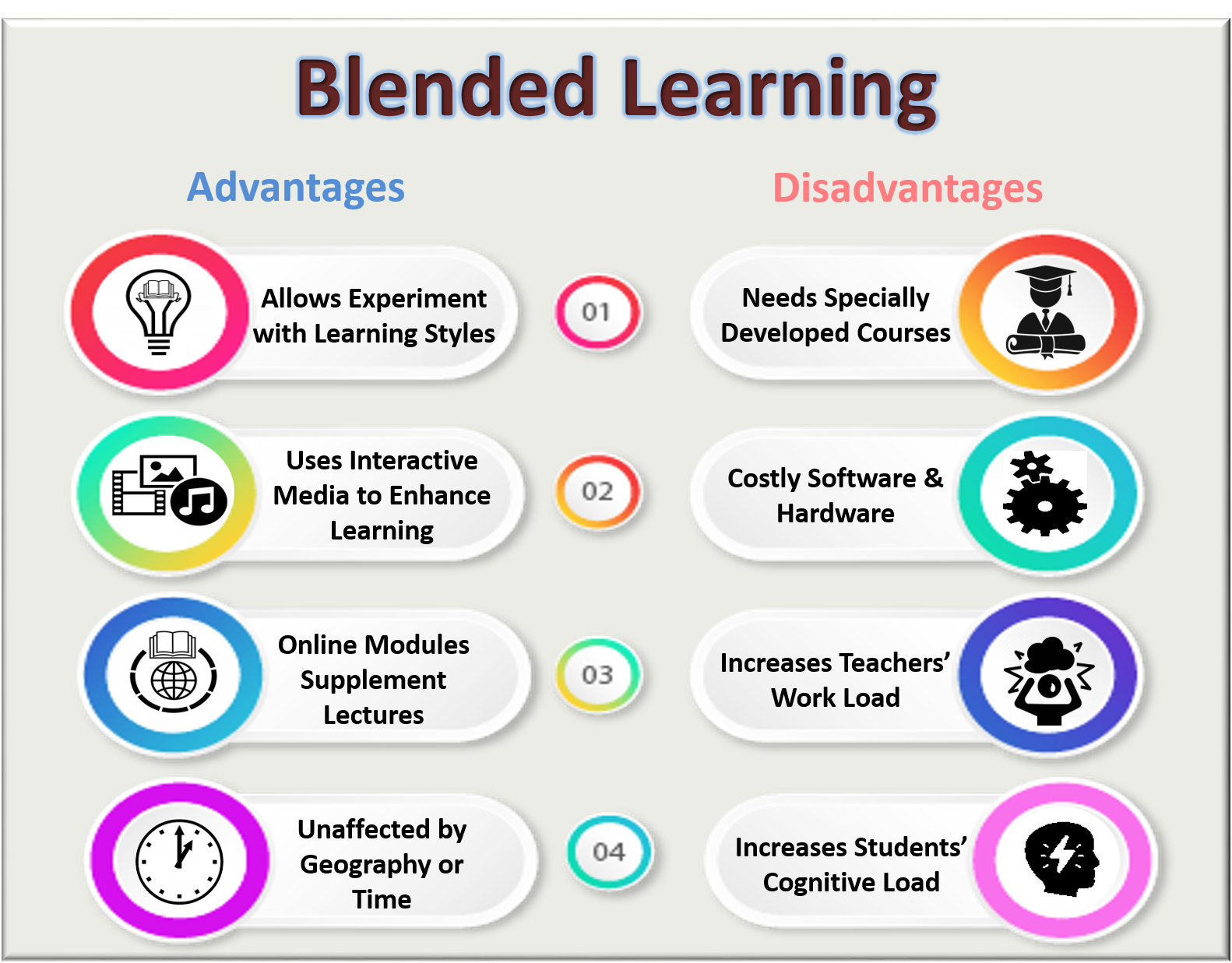
Effectiveness of Blended Learning
Blended learning is a method that engages learners by building their interests as they participate in traditional as well as online learning. Learners get a wider field of action that promotes learning and application of the knowledge gained. As a result, learners get a chance to experiment with different learning styles and produce better test scores.
Moreover, learners form stronger mental connections as they participate in two types of learning, that is, independent learning and mentored learning. Learning through a blend of traditional and online learning helps learners associate concepts with real-life situations. It also allows them to experience what they have learned, ultimately increasing the retention rate. Therefore, different pedagogical researchers have concluded that blended learning is an effective method of learning.
Read our next blog to find out about the strategies and best practices in Blended Learning.
Articles used for research: Teachthought and Lambda Solutions
Images from Shutterstock
Visit Evelyn Learning blog for more information on Blended Learning.

Create. Engage. Inspire
The post Blended Learning Explained: Definition, Models, & More appeared first on Test.Evelyn.
]]>