The post Best Practices for E-Learning Localization appeared first on Test.Evelyn.
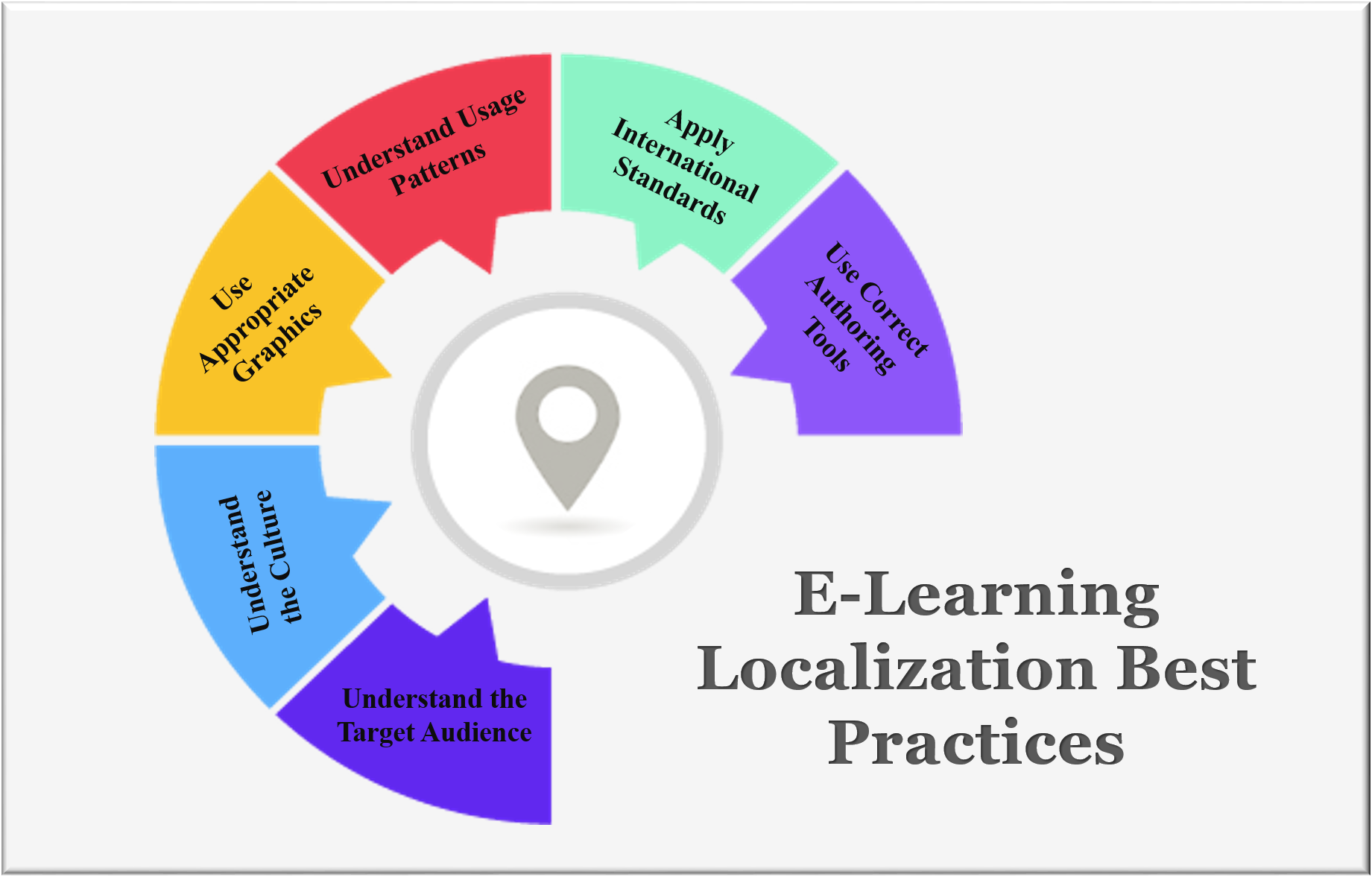
]]>a) Understanding the Target Audience
Understanding the target audience is the first and most important step in localization. An analysis of the audience based on their language, country, and culture helps identify the preferences of the learners around the world. This would give an e-learning course a wider scope in the international market. Moreover, it boosts the usability and growth of the course.
b) Understanding the Culture
Culture is the culmination of thoughts and beliefs of a community. It helps understand what shapes the people. Moreover, it is a way of identifying the needs and requirements of the community. Therefore, culture is important because it helps enhance the content of the course to promote better understanding and retention. Thus, localization provides a better learning experience with culturally enhanced content.
c) Use of Graphics
Graphics play a pivotal role when it comes to e-learning content. Graphic representations in the form of images and videos work to promote better understanding, as they allow the learners to relate the concepts with real-life situations. Learners associate the visuals with certain thoughts and beliefs. Also, images signify different meanings in different cultures. Thus, graphics must be carefully embedded in an e-learning course while localizing it.
d) Content Usage Pattern
Content usage pattern implies the format in which the learners are accustomed to learning. It includes layouts, fonts, visuals, etc. For instance, many countries follow a right-to-left text orientation. So, the learners belonging to those regions would prefer reading text in the same format. Similarly, the color preferences of people also differ in different regions. For instance, black color signifies mourning in some parts of the world, unlike other places. Similarly, yellow represents envy in Germany and happiness and good fortune in Egypt.
e) Apply Internationalization Standards
E-learning content designers should be well-informed about the international standards and adhere to them while designing a course. These standards mainly include the UI, the date format, and the currency display format. Poorly designed content may confuse the learners. Therefore, instructional designers must use the correct formats and user-friendly design to make an e-learning course easily accessible to the learners, thus promoting its use worldwide.
f) Using Correct Authoring Tools
Authoring tools determine the ease of usage of a document. They also make the content localization-friendly by providing options to change it into the desired format. For instance, Adobe Captivate allows instructional designers to create mobile-friendly e-learning courses in various formats.
Benefits of E-Learning Localization
The localization of e-learning content prepares it for global use. It provides both, the developers and the users, with many benefits. A localized e-learning course is cost-effective. The cost of setting up online training is comparatively less. Moreover, it eliminates the need to create separate content for different users as the core design of the course remains the same while localized elements are added to it.
Furthermore, a localized e-learning course gives consistent information to the global audience. Another benefit of e-learning localization is that it provides relatable content to the users, which increases understanding. Additionally, learning through a localized e-learning course promotes better retention.
Conclusion
With the ever-growing use of the Internet, e-learning has become a significant term. E-learning courses are being employed globally to learn various things. Thus, e-learning providers must focus on developing user-friendly courses that work for the users worldwide, irrespective of the language and culture they belong to.
As a result, e-Learning localization is an excellent way of promoting an e-learning course in the global market. Moreover, it has numerous benefits that work in favor of the developer as well as the user. Following the best practices mentioned above would render an excellent e-learning course that benefits one and all.
Websites used for research EI Design
Images from Shutterstock and Freepik
Visit our blog to learn more about e-learning localization.

Create. Engage. Inspire
The post Best Practices for E-Learning Localization appeared first on Test.Evelyn.
]]>The post E-Learning Localization appeared first on Test.Evelyn.
]]>What is E-Learning Localization?
E-Learning localization incorporates the process of converting an e-learning course into a different language so that it can cater to the learning needs of the masses. This implies that an e-learning course produced in any language can be translated into various target languages for global use. Therefore, translation is an essential part of e-learning localization.
Translation refers to the process of converting a text from its source language into a new language. For instance, a course available in English requires translation into French and Spanish, so, English is the source language of the text, and French and Spanish are the target languages.
Moreover, e-learning localization does not apply only to written text. Rather, it focuses on localizing all the elements. These elements include images, fonts, colors, audios, videos, case studies, etc. Additionally, localizing these elements of an e-learning course incorporates the cultural nuances of that specific region into the text. However, these elements do not require changes in every case and can be kept in their original form.
Localization vs Translation
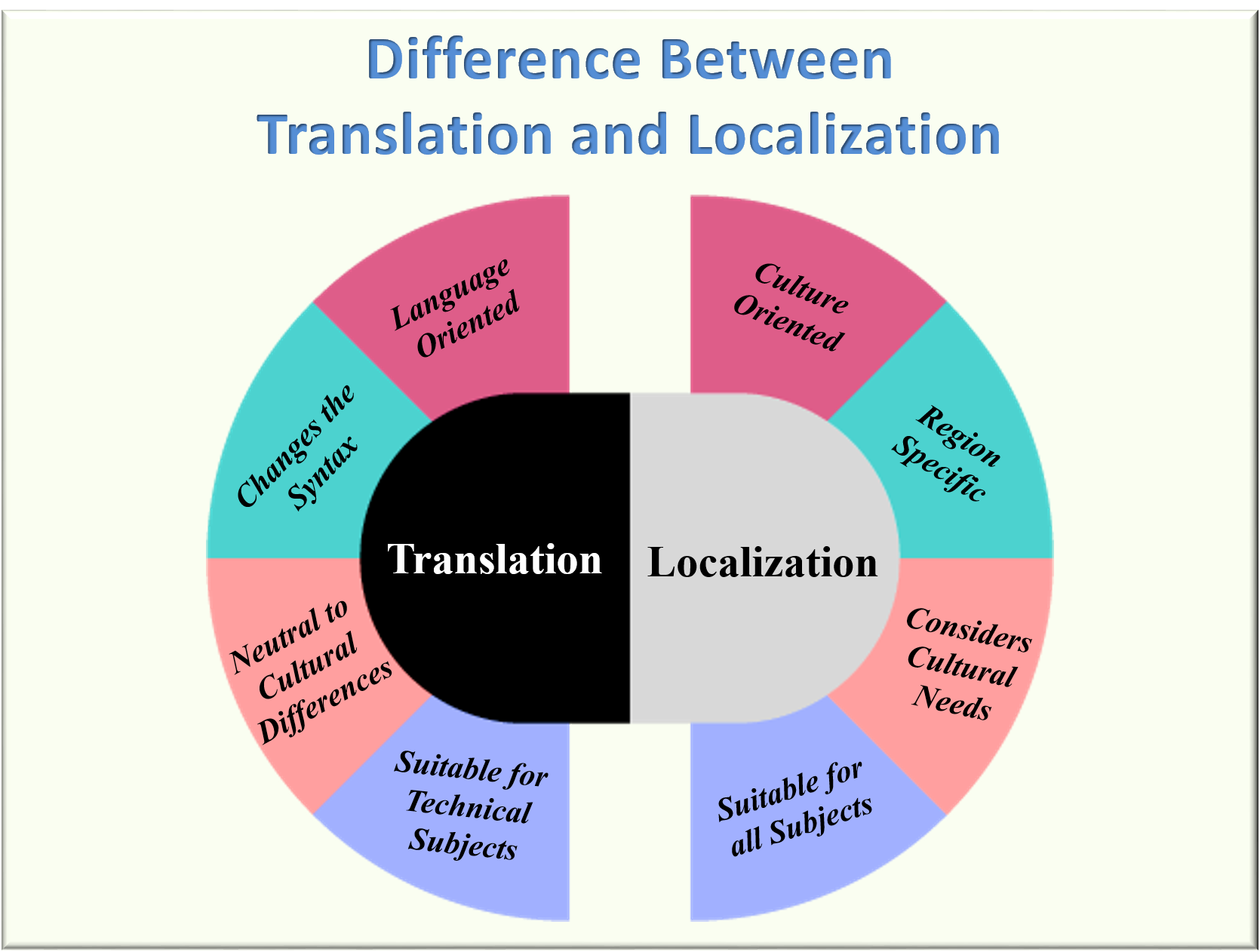
Language and culture are intertwined. Every language has a unique cultural identity associated with it. This cultural identity finds roots in the hearts of the people. Therefore, to sell a product, say an e-learning course, the content marketing strategy must include the use of local language and culture to establish a connection with the consumers. Incorporating the local language within the product through translation lays the foundation of localization.
Moreover, once an e-learning course steps into the global market, it is available to a larger audience belonging to various linguistic and cultural backgrounds. Merely translating the course cannot provide for the learning needs of a large proportion of learners. A course requires the addition of cultural elements as well to promote effective learning. Thus, a localized e-learning course gives learners the freedom to learn and understand the concepts by placing them in their own language and cultural contexts.
Additionally, localization encompasses translation and at the same time, addresses other aspects such as local idioms, local connotations of words and their cultural contexts, measurement units, date formats, page sizes, etc. Thus, localization is more than just translation.
Need for E-Learning Localization

As it is clear by now that localization is a long process that includes translation as a small step, an important question that requires attention here is, ‘What needs to be localized in an e-learning course?’.
While localizing an e-learning course, the slightest details of the culture and language need recognition. Grammar and syntax are important, but so are the details that help break the barriers of language and culture to improve the usability of the e-learning course. Thus, cultural aspects play an equally important role in the complex process of localization along with the translation.
Besides translation, the elements that need to be localized include colors, layouts, visuals, measurement units, currency, contracts, and agreements, etc. Different colors signify a distinct meaning as we switch between places and cultures. Similarly, various languages require different layouts as they might have a different orientation. Also, the units of measurement and currency vary across borders and cannot be kept uniform for the global audience. The local laws of every region need to be considered while writing contracts and agreements.
Final Note
E-learning localization is a complex process that prepares an e-learning course for the global market. A localized e-learning course not only involves translation, buts also addresses the cultural aspects of the region it is localized for.
Moreover, a localized e-learning course works differently for different learners and is more effective than a non-localized one. This is because it creates familiarity between what the learner knows and what the course teaches by placing the concepts in their cultural contexts, promoting better understanding.
To know more about localization and its best practices, refer to the next blog in this series.
Further reading: Clear Words Translation
Images: Shutterstock and Freepik
Visit our blog for more information on Content localization.

Create. Engage. Inspire.
The post E-Learning Localization appeared first on Test.Evelyn.
]]>The post Localization: An Introduction appeared first on Test.Evelyn.
]]>A product or content that is globally available must connect with consumers to meet their demands. The best way to establish a relationship with consumers is to incorporate the use of their language and cultural aspects into the marketing strategy. This is what localization means. In other words,
‘Localization is a way of making a product or content available in different markets in their respective languages and cultural contexts.’
It is also referred to as L10N.
Localization is a part of the larger processes called Internationalization and Globalization. All these processes together aim at spreading the business across the world. Different languages are spoken in different parts of the world and thus having a uniform language would not work. Therefore, it is important to adopt a local language for every intended market. Translation plays an important role here. It is necessary to localize a product or service for each country to get more consumers, resulting in more profits. At the same time, it is also important to have a unique voice for the product/service. Altogether, localization is a cultural approach that not only involves translating but also reshaping a product/service so that it appeals to the local public.
Although translation seems to be an easy task, certain aspects call for special attention. While translating, it is necessary to address the cultural diversity of the region. Possibly, certain words/phrases with positive connotations in one culture might be derogatory for the other. Thus, a translator must be familiar with the local culture along with the language.
Translation as a part of the localization strategy boosts the growth of a business. Have a look at some instances of localization in practice.
Case Study
Coca-Cola
Coca-Cola, one of the oldest brands in the world maintains its brand’s voice with its signature colors. To expand its business, the company had to change its name in China as a part of the localization strategy. Thus, ‘Coca-Cola’ became ‘Kekou Kele’, literally, ‘delicious happiness’ as a part of the local marketing strategy to adopt local culture.
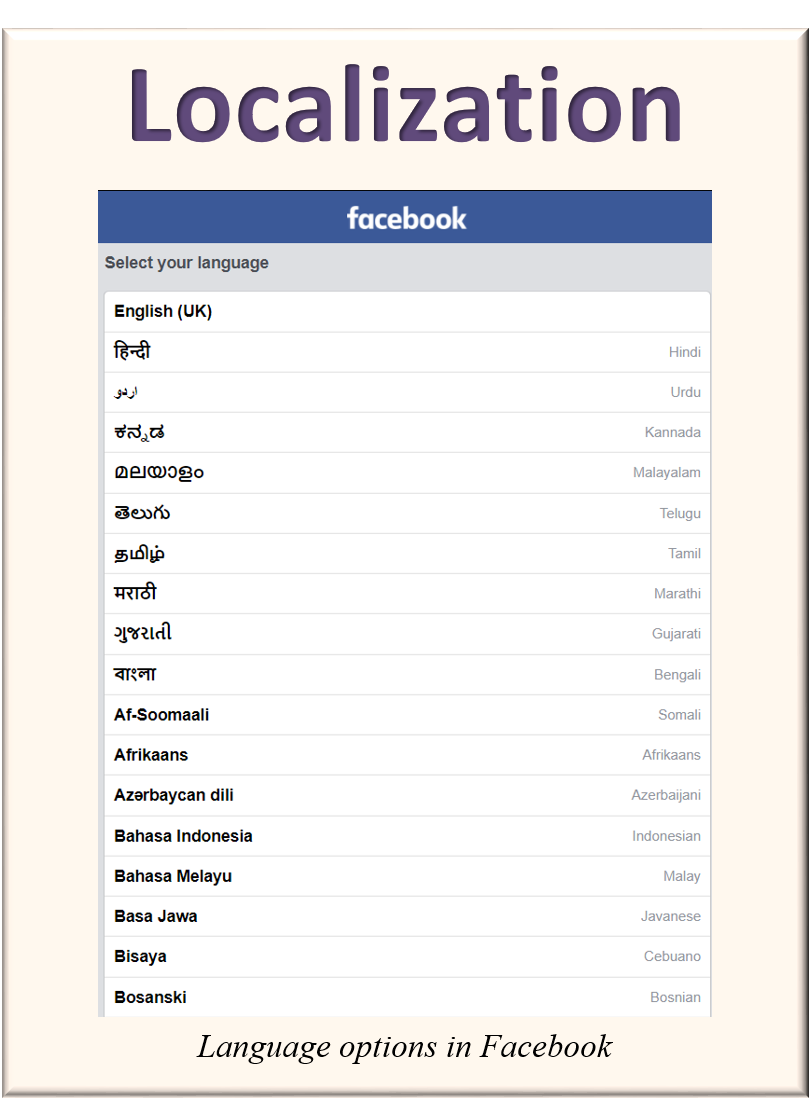
Facebook is the best example of website localization. Since 2008, it has come up with different language versions with the help of crowdsourcing. Despite being available in various languages, the overall user experience and brand remain uniform across cultures. Moreover, localization is not only visible in the text, but also in the date & time format on Facebook.
What is Internationalization?
To understand localization, there is a need to understand the concept of Internationalization as well because both these terms are often used interchangeably. Internationalization is a process of preparing a digital product/service for localization. It involves separating the content codes so that localization can be performed without hampering the inner workings of the product/service each time while translating. This takes place after a localized set of content is loaded in the software which translates and displays the content to the user in a local language.
Case Study
Coca-Cola
Let’s look at the internationalization of Coca-Cola to understand it.
Coca-Cola adopted a strategy of gradually investing in foreign markets and forming franchises in nations across the world. To begin with, it established trade with local brands and either acquired them completely through a partnership or merged with them later. As a result, Coca-Cola could peek into the local markets worldwide and figure out the taste and preferences of the local customers.
What is Globalization?
Another term often interchangeably used with localization is Globalization. Globalization refers to the process of integrating the culture and policies of a country to the rest of the world. It works to bring various people, economies, and cultures together. Moreover, it is an important factor that generates the need for localization.
Globalization is somewhat similar to Internationalization. Altogether, it is a strategy of expanding business across the national borders.
Case Study
Netflix
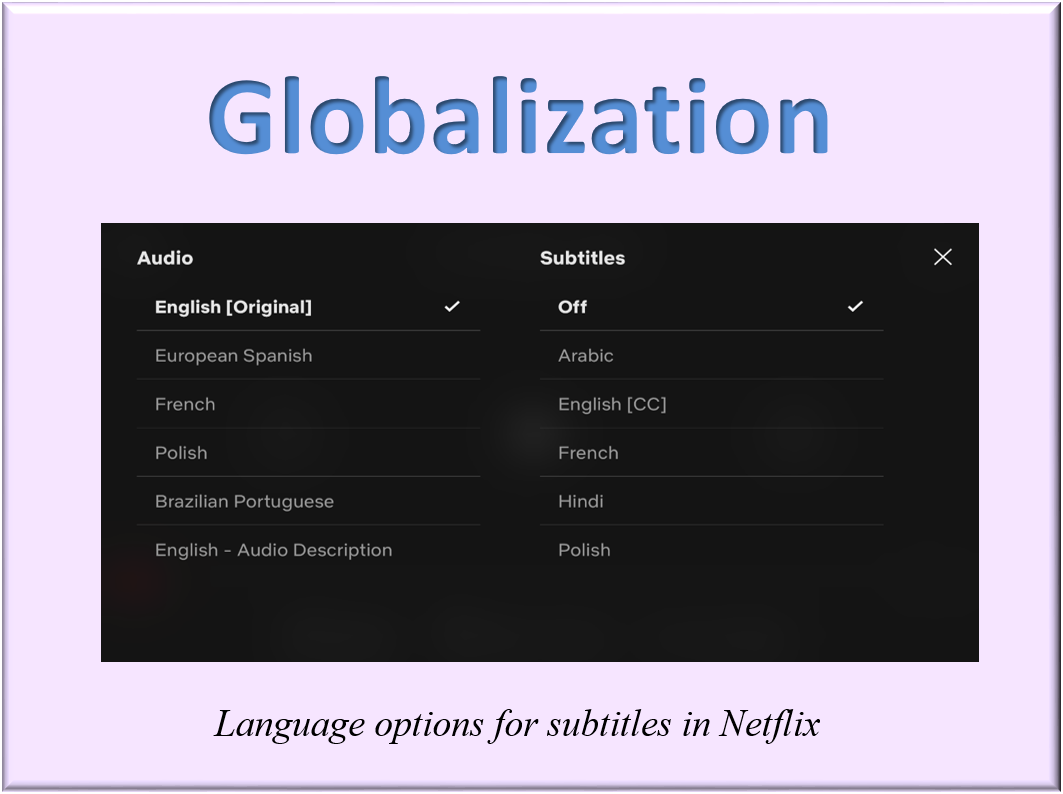
Netflix, the widely used video streaming app, has captured the global audience through a well-planned globalization strategy. It allows the users to view subtitles in the desired language or watch the dubbed versions of shows from all over the globe. At present, Netflix functions in over 190 countries with customized content offerings as per local languages and cultures.
Nike
Nike follows a globalization policy where it partners with various athletes who play a variety of sports and belong to different countries. Further, it uses these endorsements for expanding the business worldwide. A note-worthy factor here is that the logo of the brand, that is a ‘swoosh’, remains the same for every country. Consequently, the brand enjoys a global market and at the same time, maintains a unique identity.
Conclusion
Localization, Internationalization, and Globalization are three interchangeable yet slightly different terms. Moreover, all three concepts are inter-dependent and cannot exist individually in the global market. Any form of content/product that is to be internationalized or globalized needs a localization policy to meet the required marketing standards.
Moreover, localization plays a very role in creating value for the brand being promoted. It acts as an umbrella term that incorporates translation as one of the key elements. In conclusion, adopting the local language and cultural aspects increases the demand for a product/service in the market.
Follow our next blog in the series to know more about localization.
Websites used for research: Lionbridge and Technitrad
Images from Shutterstock
For more information, visit our blog.

Create. Engage. Inspire
The post Localization: An Introduction appeared first on Test.Evelyn.
]]>