The post Learning Styles: Definition, Types, & Other Insights appeared first on Test.Evelyn.
]]>However, the likelihood of acquiring knowledge or skill may vary with time or place. For instance, humans learn elementary social skills during their childhood years at their homes. Professional skills, though, develop during their adulthood at an institution. Similarly, how different individuals prefer to learn or are likely to learn is also not predetermined. For instance, an individual may prefer learning by seeing. Yet another might prefer learning by writing. Learning Styles are thus the different approaches through which individuals learn.
Representation of the Learning Process
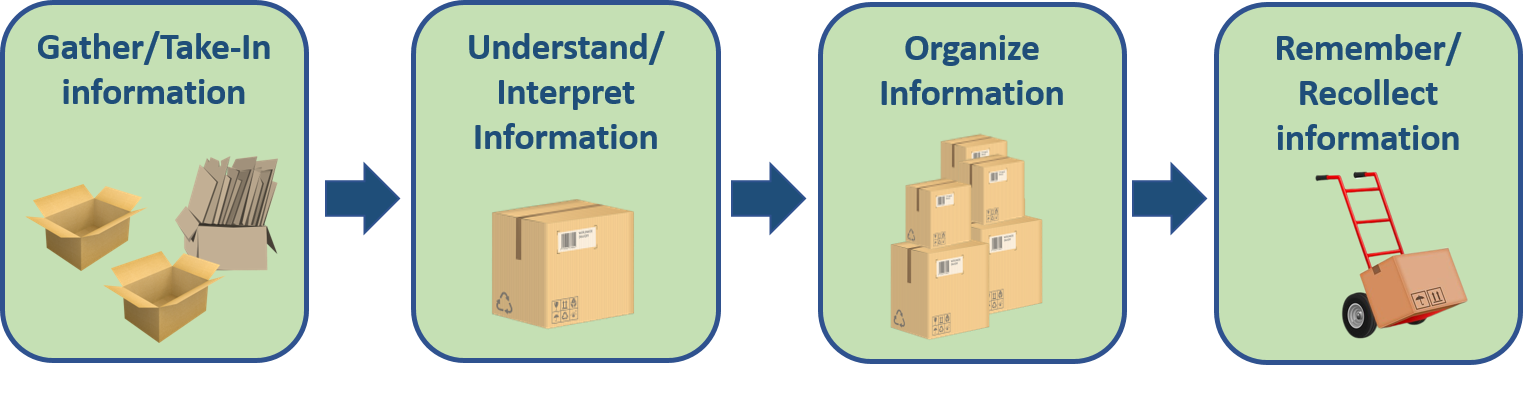
Every individual has a unique learning style. This is because how an individual gathers, understands, organizes, and remembers information is unique. However, the learning style of an individual does not stay the same throughout. It changes and evolves. Factors such as age, subject area, learning environment, social environment, cognitive skills, and education influence the learning style. An individual’s unique learning style does not in any way limit their learning abilities. It is just their preferred way of learning, not their only way of learning. An individual may prefer to learn differently under different situations.
The articles What is learning? at Queen’s University and Learning Styles at the Vanderbilt University websites offer more information on learning and learning styles to the reader.
Types of Fundamental Learning Styles
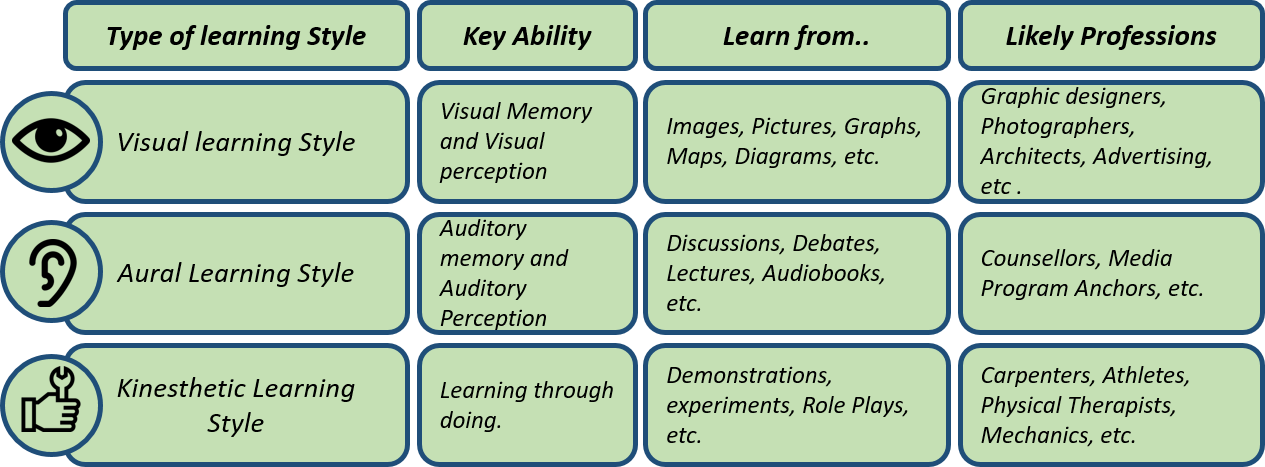
Researchers have conducted detailed studies to classify and describe the different learning preferences. A model, known as the VARK, by Neil Fleming and another one by David Kolb are widely discussed and cited on the internet. This article discusses the seven most commonly identified and discussed learning styles. The three fundamental types are visual, aural, and kinesthetic. The other four styles are verbal, logical, social, and solitary. Each of these styles is also known by alternate names in different print and online texts.
- Visual Learning Style: Visual learners prefer to use images, pictures, or other visual media for learning. They are more likely to retain information that is rich in visual content (graphs, maps, diagrams). Graphic designers, architects, photographers, etc. are likely to belong to this category of learners.
- Aural Learning Style: Aural learners prefer to learn through listening. They tend to retain information that is rich in aural content, such as discussions, debates, and lectures. Such learners may face difficulty in learning from visual content such as graphs or diagrams. Professionals, such as counselors and media program anchors, are likely to belong to this category of learners.
- Kinesthetic Learning Style, also known as the Physical or Tactual Learning Style: Physical learners learn well if they can involve hand or body movement in the learning process. Examples of kinesthetic style exercises are making drawings or role-playing. Physical therapists and mechanics are professionals who belong to this category of learners.
The article The Four Different Types Of Learners, And What They Mean To Your Presentations [Infographic] on the Prezi Blog provides a short introduction to fundamental types of learners. It also advises on the design of suitable infographics for such learners. Another article, The Importance of Understanding Employee learning Styles for working professionals, is available on the BGW-CPA webpage.
Other Types of Learning Styles
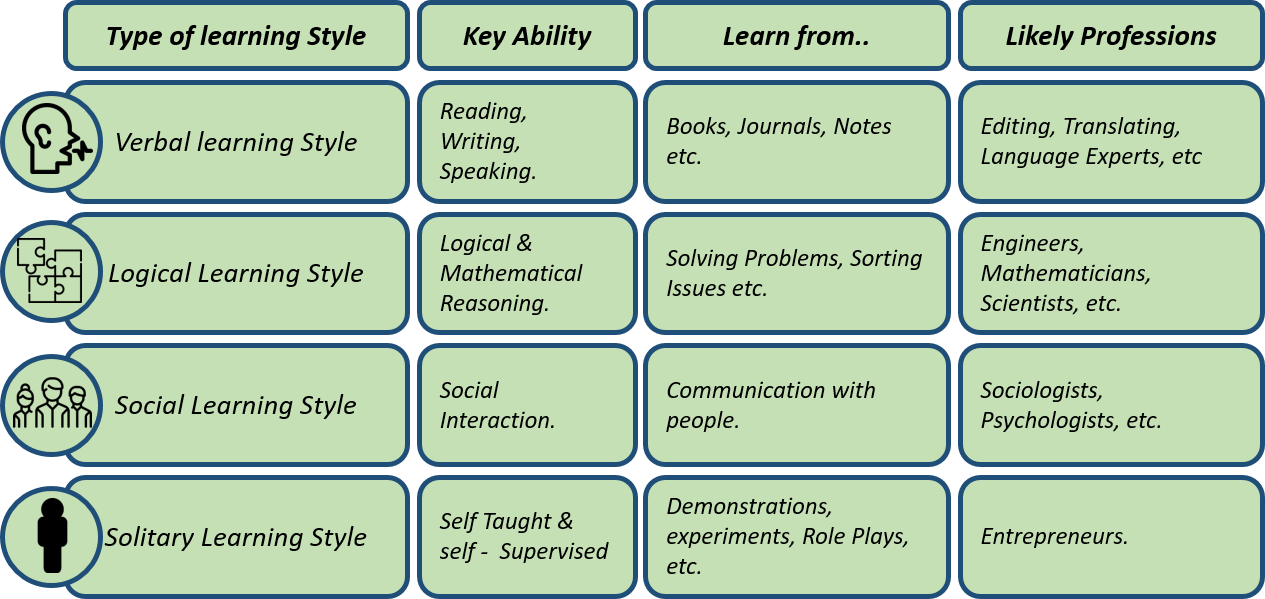
- Verbal Learning Style, alternately known as the Auditory-Verbal or Verbal (Linguistic) Style: Learners in this category prefer to learn through the use of language in different forms, viz. reading, writing, listening, and speaking. Verbal style learners can learn different languages.
- Logical Learning Style, alternately known as the Mathematical Style: Learners in this category employ logical and mathematical reasoning to further their knowledge and learning. Engineers, scientists, mathematicians, etc. belong to this category of learners.
- Social Learning Style, alternately known as the Interpersonal Style: Learners in this category have a strong ability to communicate with people. They employ this ability to develop their knowledge. Sociologists and psychologists belong to this category of learners.
- Solitary learning Style, alternately known as the Intrapersonal Style: Learners in this category prefer to be on their own without any supervision. Such learners are self-motivated, self-managed, and may be introverts. Entrepreneurs belong to this category of learners.
Importance and Identification of Learning Styles
Developing and employing effective pedagogy has always been an area of concern for educators. Employment of ineffective pedagogies may, ultimately, result in poor learning outcomes. The concept of learning styles helps mitigate this problem. Knowledge of learning styles helps an instructor decide the type of exercises, activities, and method of instruction for a class. The method of instruction for visual learners may include charts, graphs, posters, or pictures. The method of instruction for auditory learners may include recorded speeches, podcasts, or audiobooks.
A balanced combination of different methods of instruction is suitable for a class of students with different styles of learning. In turn, the adoption of appropriate pedagogy aids the learning process and intended learning outcomes are achieved. This also ensures that the learning sessions become more fulfilling. Therefore, it is essential to identify the learning style of individuals before picking suitable strategies for teaching and learning. VARK is one of the most popular among the many online tools, and it helps in identifying the learning preferences of an individual. It is available free of cost for use by academia. Businesses and other users may have to pay a fee to use the tool.
The Counterview
A popular counterview states that adopting teaching strategies following learning styles yields no distinct benefits in terms of learning outcomes. The video resource Learning styles & the importance of critical self-reflection | Tesia Marshik | TEDxUWLaCrosse on YouTube, offers an insight into the counterview.
This article is part of a series of articles on Learning tyles.
References:
- Your Guide To Understanding And Adapting To Different Learning Styles on the Cornerstone University website.
- The VARK guide to Learning Preferences at Vark-learn
Image Credits:
Pexels, Pixabay, Icons made by Freepik from www.flaticon.com.
 For further reading related to pedagogy and education standards, please visit the blog pages at Evelyn learning.

Create.Engage.Inspire
The post Learning Styles: Definition, Types, & Other Insights appeared first on Test.Evelyn.
]]>