The post Interactive Courses: Tips to Create E-Learning Courses appeared first on Test.Evelyn.
]]>Instructional design is evolving with the availability of a variety of methods and tools to develop instructions. As a result, we have an abundance of teaching-learning methods to choose from. Also termed teaching methodologies, these methods can be used to develop interactive courses. This article discusses the significance of interactive eLearning courses and provides some important tips to create an interactive eLearning course.
Tips to Create Interactive E-Learning Courses
1. Use Interactive Templates
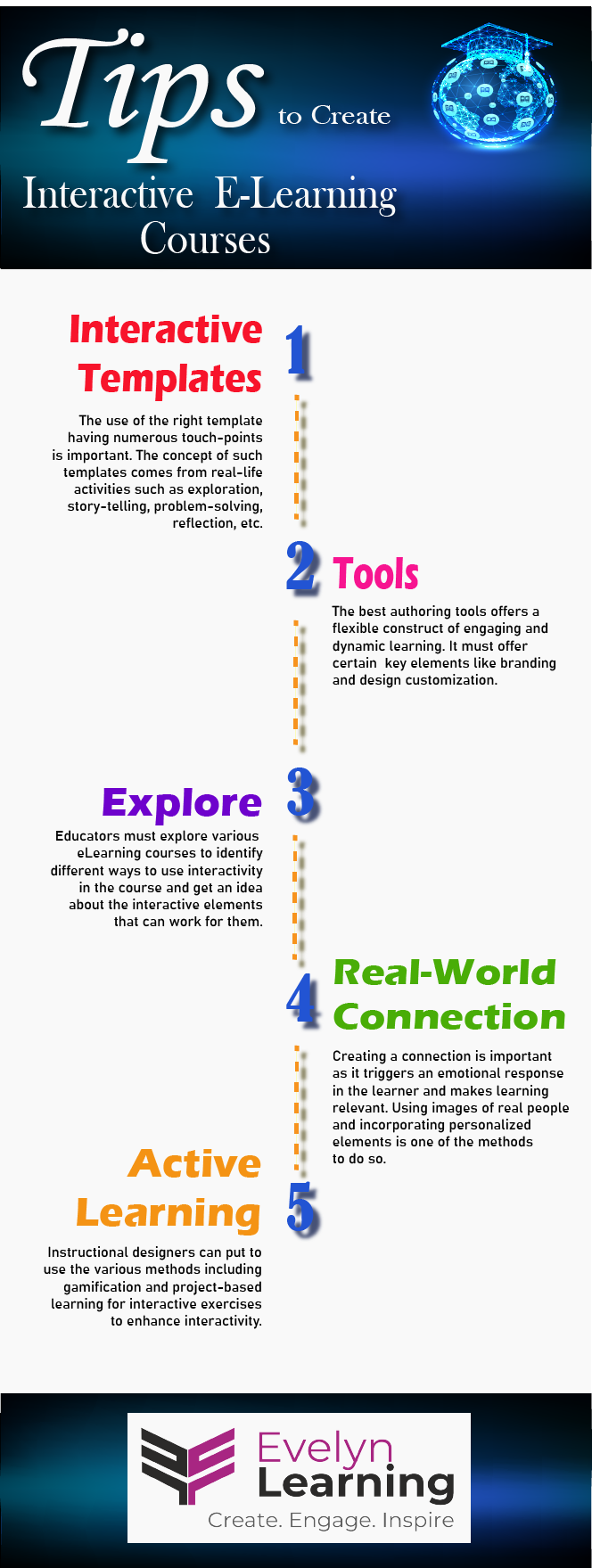
The use of the right template with numerous touch-points is important. It effectively allows learners to interact with the content without the need for specific programming. The concept of such templates comes from real-life activities, such as exploration, story-telling, problem-solving, reflection, and so on. Different activities spanning across different categories can be designed. These include games, presentations, simulations, assessments, and more. The biggest advantage of using such templates is that it makes it easier to design eLearning courses and bring learning to life.
2. Use the Right Tools
Creating interactive courses does not always require a hefty spend. Instructional designers can easily create interactive courses with the help of various authoring tools available on the Internet. The best authoring tools offer a flexible construct of engaging and dynamic learning. It must offer certain key elements like branding and design customization, powerful learner data analytics, and dynamic video capabilities. Also, the tools must be able to make a compatible course to meet the needs of different learners. SCORM compatibility is also a necessary addition to the LMS.
3. Exploration is the Key
Before working to develop interactive courses, educators must explore various eLearning courses. This helps identify different ways to use interactivity in the course. Additionally, instructional designers can get an idea about the interactive elements that can work for them. Another benefit of such exploration is that it can help drive engagement to a course. This is thanks to the visual elements that attract more visitors and enhance retention. Moreover, these visual elements help connect to other pages through hyperlinks, enhancing overall learners’ engagement with the course content.
4. Connect to the Real World
Interactivity is all about bringing learning to life with the help of virtual reality. Although eLearning has comparatively fewer chances of interactivity, it can serve this purpose through a connection with the real world. Using images of real people and incorporating personalized elements is one of the methods to do so. Creating a connection is important as it triggers an emotional response in the learner and makes learning relevant. Consequently, their engagement and retention of the content increase.
5. Use Active Learning Techniques
Building interactive courses requires the use of active learning techniques. These techniques transform passive training into an active learning program. Instructional designers can put to use the various methods, including gamification and project-based learning for interactive exercises, to enhance interactivity. Another way of doing so is by introducing a character or avatar to bring a human touch to the course. Role-play is also an active learning technique for eLearning courses.
Importance of Designing Courses with Interactivity

Designing an eLearning course can be challenging at times. This is why instructional designers must be aware of the different ways that can be used to engage learners. The most crucial aspect of an eLearning course is its content. Course content must be relevant and valid in every eLearning course/training. It ensures that learners are on the right track in learning, but it is not the only aspect to be assessed. The level of interactivity of an eLearning course also determines its effectiveness. The more interactive the course is, the more engagement it drives from learners.
Moreover, with traditional learning methods becoming ubiquitous, eLearning courses are surfacing with new trends. The physical presence of an educator is no more a requirement for learning. However, this calls for an equal compensation of in-class interaction with the help of technology. This is why interactive courses become important. Interactive courses allow more engagement and better learning opportunities at the same time, thus favoring the educators and learners equally.
Read our article on e-learning to grasp a better understanding of the dynamics of e-learning.
Research Articles: E-Learning Industry and Lambda Solutions
Images: Shutterstock and pxhere
For more information on Interactive Learning, visit our blog.
Create. Engage. Inspire.
The post Interactive Courses: Tips to Create E-Learning Courses appeared first on Test.Evelyn.
]]>The post Enhancing E-Learning with Interactivity appeared first on Test.Evelyn.
]]>The quality of engaging the viewer or listener in the content is called interactivity. The instructional designers must develop the lesson in a manner that actively involves the learners and pushes them in the right direction. Learners who actively participate in the learning process perform better and retain more. It also defines the learning patterns the learners follow. This article explores the meaning and various levels of interactivity in eLearning. Further, it also inspects its roles and benefits.
What is Interactivity in eLearning?
The term eLearning refers to a form of learning that takes place online using electronic gadgets and technology. Interactivity in eLearning is a form of a dialogue between the technology and the learners. This interaction is somewhat similar to the teacher-student interaction during a classroom lesson.
In a traditional classroom, an educator instructs learners who learn through physical material. This material includes whiteboards, books, research journals, and so on. On the other hand, eLearning involves the use of technology and electronic gadgets that often replace the teacher. Learners have access to a wider range of study material available on the Internet, which contrasts with the limited resource availability of in-class learning.
A stark difference between both is the physical presence of an educator to monitor the learning process. An educator can easily deliver an interactive lesson in the classroom, which is not possible in an eLearning environment. An eLearning environment is where neither the educators nor the learners are physically present. Although learning happens online, interactivity in eLearning acts as a bridge between concepts and their understanding. The interactive elements of the e-lessons engage learners in experiential learning. As a result, learners gain a better understanding of the concepts as they get involved in learning.
Levels of Interactivity
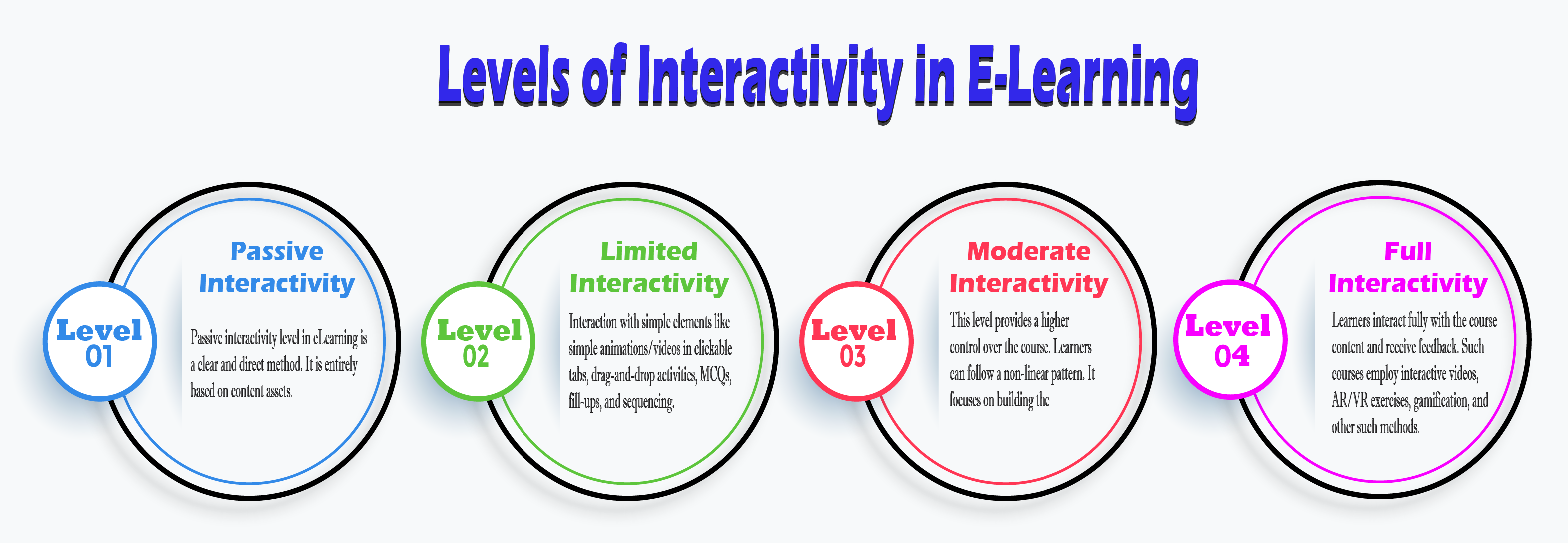
Interactivity in eLearning that happens in stages. There are four stages/levels of interactivity in eLearning.
-
Passive eLearning Interactivity
Passive interactivity level in eLearning is a clear and direct method. It is entirely based on content assets. For instance, web journals, research papers, podcasts, recordings, illustrations, and more. To elaborate, such courses are relatively passive in nature. Consequently, learners are restricted to on-screen reading and navigation or listening to podcasts and audio. However, this level is only an initial stage in eLearning. It implies that there is no interaction at all between the learners and the study material. Courses with this level of interactivity are less likely to engage learners, thus producing average learning outcomes.
-
Limited eLearning Interactivity
The second level has limited interactivity in eLearning. This level is again basic yet slightly different from the first one. At this level, learners interact with simple elements in the course, including simple animations or videos. These elements are in the form of clickable tabs, drag-and-drop activities, MCQs, fill-ups, and sequencing. Courses with a limited level of interactivity involve a low level of learner engagement. However, there is a considerable amount of interaction in comparison to the first level of passive interactivity. This means that learners do not deal with text-only information; they can also have a personalized learning experience.
Additionally, this level is good for assessments. The reason is that textual overload is less, which allows more information retention.
-
Moderate eLearning Interactivity
This level provides a higher control over the course. Learners can follow a non-linear pattern as they navigate through the course. This level particularly focuses on developing the problem-solving and decision-making abilities of learners. The course content majorly promotes knowledge application and transfer. In essence, the moderate eLearning interactivity level addresses real-world problems that require actual representation and practice.
Moreover, this level includes informative feedback along with a practical application of knowledge. Some salient features of eLearning courses with moderate levels of interactivity include the use of complex and narrative animation. It also includes case–studies, multiple-choice questions, drag-and-drop actions, and other such forms of interactive elements.
-
Full eLearning Interactivity
At this level of interactivity in eLearning, learners interact with the course content fully and also receive feedback. They exercise complete control over learning while they learn and practice their skills. There is a continuous interaction taking place between the learners and the learning material on their screens. Additionally, full interactivity in eLearning helps learners understand complex issues and develops their behavior and attitude. Moreover, it puts various elements of learner’s cognition into use by offering complex learning situations. To do this, fully interactive courses employ interactive videos, AR/VR exercises, gamification, and other such methods. Learners interact with the course by decoding the symbols, listening to audio and stories, as well analyzing various scenarios.
Furthermore, the feedback mechanism of such courses helps learners identify the areas of improvement. Eventually, learners perform better and gain high levels of knowledge.
Roles & Benefits of Interactivity in eLearning
Interactivity plays an important role in all forms of learning. The degree of interactivity in eLearning defines the quality of the course content. It also works to engage learners and motivate them to employ critical abilities for meaningful learning. Additionally, interactive elements induce alertness and activate long-term memory. The following points briefly describe the role and benefits of interactivity in eLearning.
- Causes Reaction: Interactive eLearning involves real-life scenarios that help learners experience learning through virtual reality. It also encourages learners to explore immense possibilities in a stress-free learning environment.
- Encourages Reflection: Interactive eLearning requires that learners reflect upon their learning before they answer. It encourages their involvement and promotes reflective learning.
- Boosts Engagements: Experiential learning induces various responses in the learners. The interactive elements of a course develop different skills along with motivating and engaging the learners.
- Promotes Better Retention: Learners retain more of what they experience in comparison to reading. It engages learners to provide experiential learning, which promotes better retention of information.
- Enhances Motivation: The fun elements of an interactive lesson/course make learning interesting. This works as a motivating factor for the learners who engage in learning.
With continuous developments in education, interactivity has become a must-have element for any course. Instructional designers across the world are experimenting with various forms of interactive elements to design eLearning courses. These elements are designed carefully with the help of technology to target specific areas of learning. Interactive eLearning is not only an essential feature of eLearning but also extends to the business world. Various training programs in the workplace also involve interactivity. In conclusion, interactivity is a crucial requirement at all levels of learning.
Resources: TalentLMS and eLearning Industry
Images: Shutterstock and Freepik
For more information on Interactive Learning, visit our blog.
Create. Engage. Inspire.
The post Enhancing E-Learning with Interactivity appeared first on Test.Evelyn.
]]>