The post Doodling: An Innovative and Effective Way of Teaching appeared first on Test.Evelyn.
]]>It turns out that both pupils and teachers are unaware of the educational benefits that doodling can provide. It does not have to be a hindrance to learning.
Teachers and parents always view doodling as a frivolous activity that diverts attention from the learning process. Doodling, however, stimulates creativity, intellectual engagement, and attention retention in pupils. Continue reading to learn the role of doodling as an effective learning tool and how it can help you study more effectively.
Advantages of Doodling as an Effective Learning Tool
To begin with, doodling can keep the brain engaged when there is not enough stimulation to keep it interested. Consider doodling as a way to fill in the blanks in your stimulation. Yes, it could be a student’s approach of dealing with uninteresting material. However, it does not imply that the learner is tuning out. In fact, studies demonstrate that doodlers remember material better than non-doodlers.
However, there is another approach to use doodling as an effective learning tool to encourage children to become more active learners.
Educators can encourage pupils to doodle or sketch what they are learning
We already know that the more senses we use, the more we learn. For instance, if students are studying photosynthesis, they may take notes to keep the material verbal. They could, however, make diagrams of the procedure. This would aid their verbal and visual learning of the knowledge by allowing them to listen to what the teacher is saying and create drawings of the process. The drawing process would also aid in their assimilation of the knowledge, resulting in effective learning.
• Encourages the Use of Imagination
The very first benefit of using doodling as an effective learning tool is that it can help students who struggle with verbal reasoning and text-based classes come up with new ideas and kick-start the creative process. It is a low-risk practice that allows pupils to experiment with new material without having to worry about being judged or failing.
Doodling avoids the mistake of critiquing as you go, which every poet or writer knows is the easiest way to stifle the creative process. Students who doodle recruit deeper brain connections than those who only use words, resulting in a stronger bond with the content.
• Maintains Brain Activity
Even the best teachers will not be able to keep all of their students’ attention at all times. Individualized education has recently attracted a lot of attention since varied presentations appeal to various students. Doodling can keep the mind active and on task for kids who are not engaged by a lesson. It also allows doodlers to customize the session’s meaning.
When the student does not stimulate the brain enough, it creates its own content, diverting thoughts into fantasy. Doodling helps to keep the mind focused on the present moment and the activity at hand.
• Additional Senses are Recruited
Doodling counts as a visual learning tool, and educators have long recognized the benefits of multimodal learning. For instance, it can aid in the rapid and concise capture of extremely complex and subtle information. Drawing an animation of mitosis, for example, might be more beneficial to a biology student than reading about it for hours.
Similarly, studies demonstrate that the more senses used in learning, the better the concept is remembered. Doodling helps to engage the brain by activating the senses of sight and sound. Although doodling still has a negative reputation in schools, attitudes are changing. The scientific evidence in favor of doodling in the classroom is substantial. It has numerous benefits ranging from improved memory to increased attention span.
• Improves the Recollection of Memories
Numerous studies show that doodling boosts the memory of the subject a student is learning while drawing. This is an additional advantage of using doodling as an effective learning tool. The University of Plymouth, for instance, had participants listen to a long, tedious voicemail message detailing the names of those attending a party. On an unanticipated memory quiz, the group told to doodle while listening remembered 29 percent more than the group that merely listened.

Academic Benefits of Doodling
The investigation is not through yet. As per a Huffington Post article, Jackie Andrade, a psychology professor at Plymouth University who researched doodlers, “Doodling uses the brain’s executive resources – processes that help us strategize, multi-task, and focus.”
While we are listening to a lecture or are on the phone, using drawings to engage our executive resources ensures that they do not wander off to ponder about the shopping list or our plans for the weekend. Encouraging pupils to doodle while taking notes may really help them remember more.
Jesse Prinz, a philosophy professor at City University of New York Graduate Center who examined doodling in the context of art study, discovered that the technique is best suited for oral learning, according to the same article. Doodling, he claims, allows people to be in a condition of “pure listening.” That appears to be knowledge that teachers should be aware of and employ.
Concluding Remarks
You will discover a flood of diaries and sketch pads in your neighborhood gift or bookshop that promise to help stressed-out individuals reconnect with their creative side. People are more overwhelmed than ever before in the modern world. There is a wealth of information and opportunities available. This abundance, on the other hand, might contribute to tension and a lack of focus.
Doodling, according to research, can help us relax, process information, and solve problems creatively. Serious doodling affects your physical and neurological states in measurable ways.
This brings to mind a phrase from Pablo Picasso: “All children are artists. The issue is how to stay that way as we get older.” Doodling is one technique for everyone, whether or not they are artistically inclined, to stay visual thinkers. A blank sheet can act as an extension of the brain’s playing field. It allows people to rewrite and develop their creative ideas and thoughts.
Image Sources: Shutterstock and Unsplash
For more information on doodling as an effective learning tool, visit our blog.
Create. Engage. Inspire.
The post Doodling: An Innovative and Effective Way of Teaching appeared first on Test.Evelyn.
]]>The post Ways To Boost Your E-Learning Course appeared first on Test.Evelyn.
]]>Technology used to be flat and one-sided, and it could not efficiently communicate subjects. New innovations now make it possible to reach and engage learners. However, these latest developments have also revealed new challenges.
Courseware is frequently overly complicated, with confusing text, pictures, links, and graphics, a lack of continuity and clarity in the learning message, and navigation that is much more complicated than appropriate. All of this makes it difficult for students to concentrate, understand, and learn what they want. Students become disengaged, unmotivated, and uninterested in their online learning as a result.
When careful attention is paid to the seemingly minor details that are too easy to overlook, the standard of online learning courses has boundless potential for development and evolution. Educators can follow these basic and effective rules to quickly boost their e-Learning courses and build the best e-Learning courseware.
1) One idea, one screen
Since the course designer incorrectly assumes that fancy design contributes to more successful e-Learning, some e-Learning course screens seem to be a jumble of ideas and concepts. In reality, it is the polar opposite. A course’s screens can only express one concept at a time. This Rule of One keeps the student centered on the most critical concepts one at a time and helps boost the e-Learning Course.
2) Keep it simple (visually)
One must remove any unnecessary graphics, photographs, and text from their online learning materials, restricting them to just a few pieces that are well-structured, appropriate, high-quality, and neatly organized. When classes become difficult, visual aids such as graphs and charts provide the opportunity to choose more over less. Otherwise, choosing white space over needless and distracting clutter is a reasonable rule of thumb to boost ab e-Learning course. One may use headings, bullet points, and short paragraphs for a clean visual structure that allows online learners to easily locate important things within the document.
3) Make it easy to navigate
Learners should be able to work through a course independently. Arrows, icons, and buttons are examples of navigational aids that must be thoughtful, practical, and easily recognizable. Navigating a course should be similar to navigating a road: it should be straightforward and easy to follow so that one can concentrate on the task at hand.
4) E-Learning video teasers
Consider how much a trailer for a film excites us. A teaser attracts the viewer by showing clips from the film’s most entertaining or noteworthy scenes. This straightforward approach can also be used to promote e-Learning and boost one’s e-Learning course. Educators can create a video teaser that focuses on what the e-Learning course will be like and how it will help learners boost their results.
5) Include self-assessment.
Teachers must enable students to self-assess their learning by providing opportunities for them to do so. Allowing students to score their own discussion posts or contribute to their own grade for course participation can be rewarding since it encourages students to take ownership of their learning and hence helps educators boost their e-Learning course.
6) Providing incentives and rewards
Who does not want to be rewarded? Here is an example of how one can use incentives to boost their e-Learning course: instructors can build a fast learning game or prepare a quiz based on the e-Learning course. They can inform the workers that the first fifteen employees who sign up and play the game will earn prizes, discounts, or vouchers. This method of rewarding students also promotes word-of-mouth publicity.
7) Setting time constraints rather than slide constraints.
Or, to put it another way, quality over quantity. The total number of slides in a course does not imply usefulness if the content on those slides is poor. Instead of a slide quota, one can build a course with a time limit. Learners can become disengaged if educators use slides that have no meaning. Setting a time limit will help one to boost their e-Learning course as it allows people to get down to the point and stay on task.

8) Importance of social interaction
E-Learning allows students to communicate on a variety of social media channels. To involve the students and boost their e-Learning Course, educators can use social media. To help create a sense of classroom community, one can add a Twitter badge to their course homepage. They can also use a hashtag to push tweets with course-relevant content to their students.
In order to socially engage users, educators can consider using embedded audio and video, chat rooms, instant messaging, broadcast text messaging, and homepage announcements. Furthermore, creating explanatory screencast videos has become increasingly simple and inexpensive, providing yet another communication platform.
9) Rather than text, use visuals
Teachers can transform a long, complicated text into a visual representation of the data. Could one, for instance, use a flow chart, video, or infographic to illustrate a process that is described in the text? Visuals promote thought and assist in the solidification of ideas that might be lost in vast blocks of text.
10) Corporate Newsletters
A newsletter is a good way to boost an e-Learning course and raise awareness about the training one is providing. The good news is that no matter what, every employee has access to the weekly/monthly/bi-monthly/quarterly/annual newsletter, which makes it a good place to advertize. One may provide information on the upcoming training in a given location in the newsletter. The promotional material for the e-Learning course in the newsletter, including posters and infographics, should walk a fine line between text and visuals so that workers can scan it easily.
Concluding Remarks
We have designed these online learning tips to increase online learners’ participation and inspire them to get the most out of their courses. Although some of them can seem obvious, they are often the overlooked—but crucial—’small’ or ‘simple’ specifics that make or break a course’s performance. Focusing on increasing interaction rather than only providing content transactionally would improve the consistency of a course’s message. This will ensure engagement and, eventually, retention.
We cannot overstate the importance of marketing and spreading the word about the advantages of online learning to students. Well-designed promotional campaigns attract more students to enroll in the course, ensuring long-term sustainability and profitability for the company. So, one must keep these ten simple e-Learning promotion strategies in mind in order to boost their e-Learning course. Educators can tell learners what they are getting into and how online learning will help them perform better, and their e-Learning enrollment rates will skyrocket.
Image Sources: Shutterstock and Unsplash
For more information on boosting and marketing an e-Learning course, visit our blog.
Create. Engage. Inspire.
The post Ways To Boost Your E-Learning Course appeared first on Test.Evelyn.
]]>The post Tips To Use Animation In E-Learning Courses appeared first on Test.Evelyn.
]]>E-Learning is extremely beneficial because it is more immersive and allows for the presentation of knowledge in motion. It may also assist learners in easily comprehending and remembering challenging subject matters.
Animation has the ability to inspire one’s imagination and take them to fantastical realms, from favorite Disney characters to breathtaking Anime works of art. It does, however, have a much more practical use. In reality, animations can be a useful e-learning tool for creating an emotional bond with online learners and getting them excited about the e-learning process. The use of animation in e-learning is becoming increasingly common. Using a random animated video, on the other hand, does not work and will harm an online course. Spend a few minutes here before taking some action to learn how to properly use animation in e-learning.
-

Benefits of Using Animation in E-Learning
The variety of ways in which we can use animation in various situations will astound you. Let’s look at some of the advantages of using animation in an e-learning module:
1. Animation is Fun to Watch.
Engaging the learner is one of the most important objectives of any training material, module, or course. Without commitment, it’s unlikely that the learner can grasp the material or acquire the necessary new skills. As a result, it’s critical to include such content in e-learning courses that boosts interaction. This is something that animations can help one with. Rather than reading a page or two of text, most people would rather watch a cartoon.
2. Students are Often Familiar with Seeing Animations.
Animations would be familiar to the students who complete an e-learning course. They come across them on social media, the internet, when shopping, and in the content they consume, among other places. This familiarity eradicates barriers between the learner and the course material, allowing them to become more engaged in the course.
3. Encourages a Constructive Outlook on Future Preparation.
The students would be more interested and able to learn new ideas in the future if they know their training is engaging. The use of animation enhances the overall learning experience.
4. The Best Way to simplify Complicated Information
This is one of the most important advantages of animation in general, and it definitely extends to e-learning. Sounds, speech, on-screen text, static pictures, graphs, moving images, and calls to action are all easily includible in a single animation. This enables one to concisely and clearly describe even the most complex of subjects to learners.
5. It’s Useful for Quickly Explaining Information and Ideas.
Following up on the previous point, the various elements present in an animation help learners grasp details more quickly than many other types of content presentation.
6. Highly Effective at Establishing a Tone
When compared to other types of material, adding animation to your e-learning course makes it much easier to set the right tone. It is difficult, for example, to encourage learners to adopt a new idea, motivate them to improve their performance, or persuade them to change their behavior using text or an image. This is much easier with animation, especially when it comes to sounds and voice overs.
In e-learning animations can bring complicated or boring topics to life, enriching the learning experience. Most importantly, they aid in improving training course outcomes. To put it another way, animations will assist one in achieving their goals and thereby have a positive return on investment. They are a strong teaching tool, even though they aren’t appropriate for all e-learning modules.
- Tips for Including Animation in E-Learning
Tips for Using Animation in E-Learning
While animation is one of the best practices in e-learning, one must use it correctly in order for training to be successful. So, here are few pointers to keep in mind in order to have a better learning experience.
1. Select Elements that Elicit the Appropriate Emotion.
In e-learning, animations are only successful if they express the appropriate emotion or sound. A lighthearted e-learning animation won’t convey the seriousness of the situation if a writer is dealing with serious subject matter, such as bio-hazards or hazardous equipment. Instead, they should use a more intense and convincing cartoon, such as an animated e-learning character that demonstrates the cleaning process and instructs them on how to put on the proper safety equipment. It’s crucial to remember that every aspect of an e-learning animation will affect its mood, from the background music and sound effects to the e-learning script. As a result, all of these elements must be in sync with the objectives and relate to the emotional environment.
2. Use Animation in a Consistent Manner.
It’s important to use animation consistently in order to maximize training effectiveness. This aids in the creation of an easy-to-understand course while also preventing learners from becoming distracted from their learning objectives. Besides that, one should pay the same attention to their animation as they do to their online training’s complementary color scheme and fonts. This will aid in the promotion of continuity, resulting in a stronger learning experience.
3. At a Time, Concentrate on just One E-Learning Character or Subject.
Since educators don’t have any restrictions for e-learning animations, they can quickly become messy or confusing. With the right animation method, one can construct virtually any e-learning character, scenario, or environment; however, they should concentrate on one e-learning character or subject at a time. Don’t include facts or e-learning characters that aren’t important to the situation, such as giving your protagonist’s backstory or referring to secondary e-learning characters who aren’t involved. Additionally, one must limit the number of moving images or graphics in their e-learning animation. Busy screens can only confuse online students and divert their attention away from the main point.
4. Give the Students the Ability to Monitor the Animation Video.
Giving the learners the ability to monitor or pause and play an animation video at any time will help improve training effectiveness. Without a doubt, not all students will be able to sit through the animation video presentation in order to achieve the learning objectives. Some of them may be busy with their jobs and have only a small amount of time to devote to the course. As a result, allowing them to monitor the animation if a distraction occurs will help them achieve the learning objectives. Also, at the start of the online training, make sure you give them specific instructions on how to control the animation video.
5. Try to use Audio and Visuals Together.
If educators don’t use audio, such as background music or narration, even the most entrancing and convincing visuals would fall short. Audio has the ability to immerse online learners in an emotional ambiance. It also clarifies any misunderstandings regarding the e-learning animation. An audio narration, for instance, may explain why an e-learning character is responding the way they are or describe their inner thought process. Also keep in mind that some of the online students can speak English as a second language or have hearing difficulties. As a result, they’ll need text, such as captions or subtitles, to help them remember what they’ve learned.
6. Allow Students to Take a Breather.
Many of the online students would not have the time to watch the entire animated online presentation or e-learning operation. This is particularly true for on-the-job e-learning learners. As a result, educators make it simple for them to pause, rewind, or quick forward the e-learning animation at any time. If they get distracted, they may easily press the pause button and resume when they have more time. Also, at the start of the e-learning animation, they can include specific instructions about how to use the playback control buttons so that there is no misunderstanding.
Final Thoughts
There are no specific guidelines for how to use animation in e-learning. These guidelines include an overview of the benefits of video styles and how to incorporate them into your course. Furthermore, you could mix and match multiple styles to get the best of each. Animations will improve the interactivity, engagement, and emotional focus of your eLearning course. Animation in e-learning will assist you in creating an entertaining and immersive online training that matters. To maximise the efficacy of your learning, follow the tips mentioned above!
Image Sources: Shutterstock and Freepik
For more information on Animation in e-learning, visit our blog.
Create. Engage. Inspire.
The post Tips To Use Animation In E-Learning Courses appeared first on Test.Evelyn.
]]>The post Animation in Education: Advantages appeared first on Test.Evelyn.
]]>Moreover, eLearning animation is an interactive learning approach that works well for any chosen subject. It offers numerous benefits to educators and learners. This article brings to light the many advantages of animation in education.
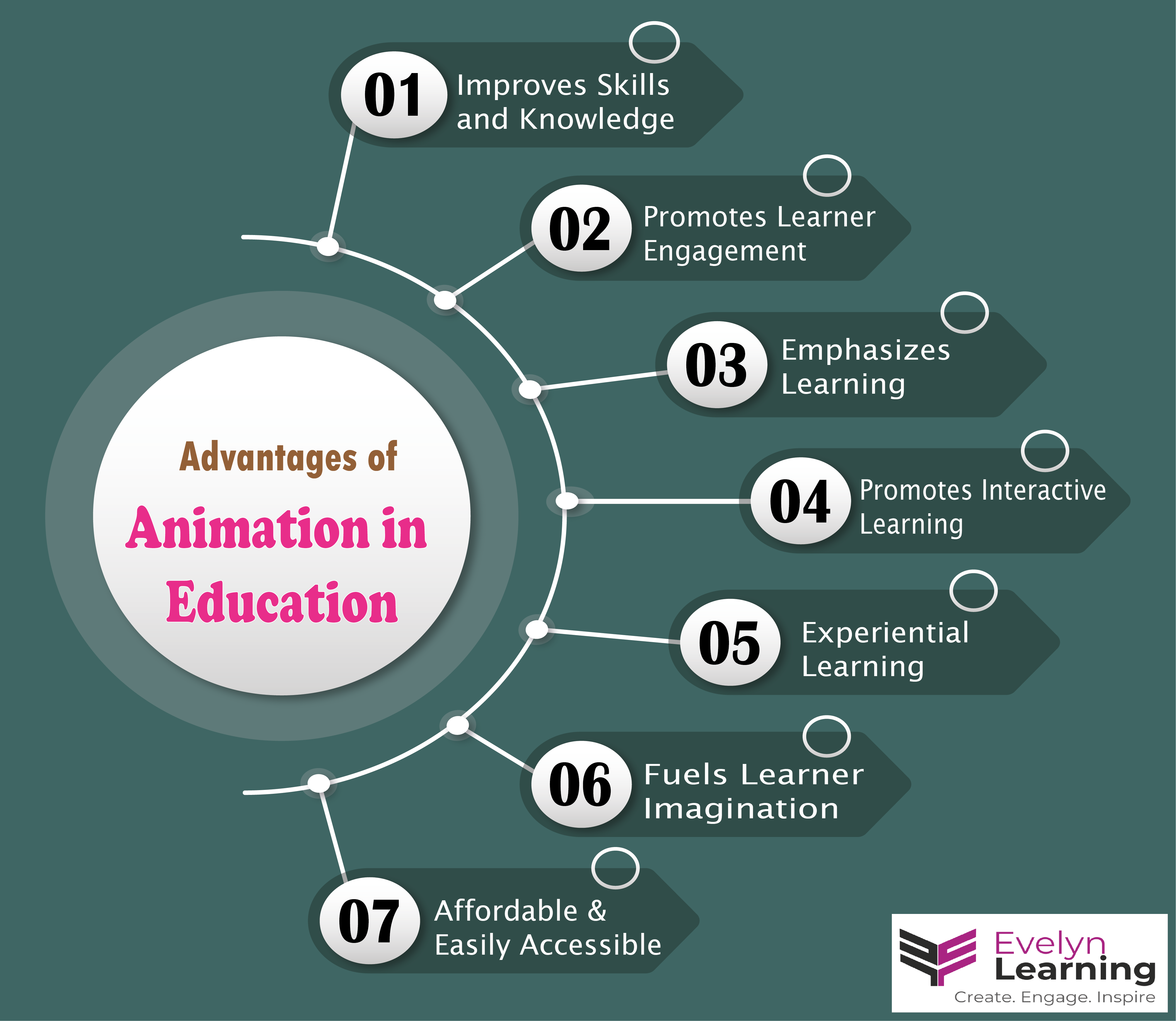
7 Advantages of Animation in Education
1. Improves Skills and Knowledge
Animation in education makes use of visuals for learning. It presents abstract concepts through visuals to provide learners a clear picture of the lesson. For instance, educators can create animated videos to teach cell biology in science class. Learners can get a fair idea of the structure of a cell through an animated video. Furthermore, the learners can also learn the functions of various organs in the body through such videos.
A noteworthy feature of animation in education is its visual impact on the learners. Owing to their short attention span, contemporary learners often digress from the lesson and fail to learn effectively. However, animated videos are short and cover only relevant content while grabbing learners’ attention. Consequently, learners develop their skills and knowledge through short visual representations.
2. Promotes Learner Engagement
Animation in education is all about interactive learning. It incorporates various learning styles in one. As the learners indulge in the enriching visuals, they participate in the learning process. Educators can use animation to create lessons as well as assessments that engage learners. Different teaching methodologies can serve their purpose with the help of animation. For instance, gamification a useful technique to design assessments where animation is used in the form of games. Game-like situations ignite a sense of thrill in the learners who look forward to moving ahead and win. Also, it is a rejuvenating exercise that diverts the mind from a monotonous learning schedule.
3. Emphasizes Learning
Animation in education is a combination of entertainment and learning. Animated eLearning videos cover complex topics with easy-to-understand visuals. The contemporary tech-savvy learners like to spend most of their time watching short, entertaining videos. As a result, learners would likely prefer a short informative video for learning rather than attending a lecture. Also, there are chances that they might replay an animated video if they find it interesting.
Additionally, with powerful visuals operating on-screen, the learners’ attention is engaged. They immerse in the learning experience and can easily retain the lessons.
4. Interactive Learning
Video-based learning is known to be an effective method of learning, owing to its numerous benefits. Different learners follow varied video learning styles, depending on the patterns of learning that they follow. The use of graphics and audio makes learning interactive and participatory. Learners interact with the course content and comprehend the lesson quickly. Also, the retention rate is higher when the concepts are in the form of videos. Gamifying a lesson is one of the strategies of interactive learning.
5. Experiential Learning
Animation in education presents abstract concepts through virtual reality. AI and VR together bring flexibility in learning intricate concepts. For instance, certain science experiments are often too hazardous to be performed in real-life. Although they form a crucial part of learning, such experiments are difficult to execute in real-time. Animation in education allows learners to experience such experiments that are otherwise not safe to perform. Virtual reality videos show the actual experiments with complete accuracy of results. It gives the learners an experience that they could only get by performing them in real life.
Another instance of the use of 3D animation in education is its use to demonstrate geometrical shapes in maths. Educators can use 3D animation to teach geometrical principles and their real-life application. It can also be used to showcase many historical events to make history interesting to learn.
Moreover, the learners cannot learn each concept practically while attending an eLearning class. Here, animation provides an alternative through experiential learning.
6. Fuels Learner Imagination
Videos can teleport the learners to an entirely different world with virtual reality. Learners get a glimpse of otherwise unimaginable concepts through animated videos. The use of different colors, shapes, and pictures appeals to the learner’s imagination. Consequently, they learn to create abstract images in their minds. Also, learners develop vivid imaginative abilities as they come across possibilities through visual animation. Not only do they gain knowledge about the subject but also learn about technology. They discover how technology can make learning easier by converting anything imaginable into virtual reality. As a result, learners get an understanding of scenario-based learning and develop social and practical skills.
7. Easily Accessible and Affordable
Employing animation in education is extremely affordable. Contrary to popular myths, animated videos are budget-friendly. Educators can use any form of animated videos without having to compromise on quality. Additionally, another benefit of using animation in education is that it is readily available. Educators can use one animated video to teach a large number of learners for a long time. Also, learners can revisit a video for recapitulation and revision. This means that they can access these videos anytime and anywhere. The only requirement is a smartphone or computer with an Internet connection.
Final Note
Teaching methodologies are no more confined to classroom activities. Learning now involves more technology than it ever did. The dynamic and sturdy rise in edutech is contributing to the development of new teaching methodologies. These methodologies focus on the holistic development of the learners with innovative teaching-learning methods. The use of animation in education facilitates educators and learners in a variety of ways. Not only it assists learning but also gives educators freedom to use a combination of teaching methodologies. They can quickly pick-up an animated video about a topic and show it to the learners for better understanding. Various teaching methodologies focus on the holistic development of the learners with innovative teaching-learning methods. The use of animation in education is another such development in tech that is continuously evolving. Its various advantages mentioned in this article make it an attractive learning solution for all levels.
Furthermore, innovations in virtual reality and artificial intelligence constantly work to enhance learners’ experience. The introduction of these innovations in education opens new opportunities and immense learning possibilities.
Research websites: Medium and Mom and More
Images: Shutterstock and Freepik
For more information on Interactive Learning, visit our blog.
Create. Engage. Inspire.
The post Animation in Education: Advantages appeared first on Test.Evelyn.
]]>The post Interactive Courses: Tips to Create E-Learning Courses appeared first on Test.Evelyn.
]]>Instructional design is evolving with the availability of a variety of methods and tools to develop instructions. As a result, we have an abundance of teaching-learning methods to choose from. Also termed teaching methodologies, these methods can be used to develop interactive courses. This article discusses the significance of interactive eLearning courses and provides some important tips to create an interactive eLearning course.
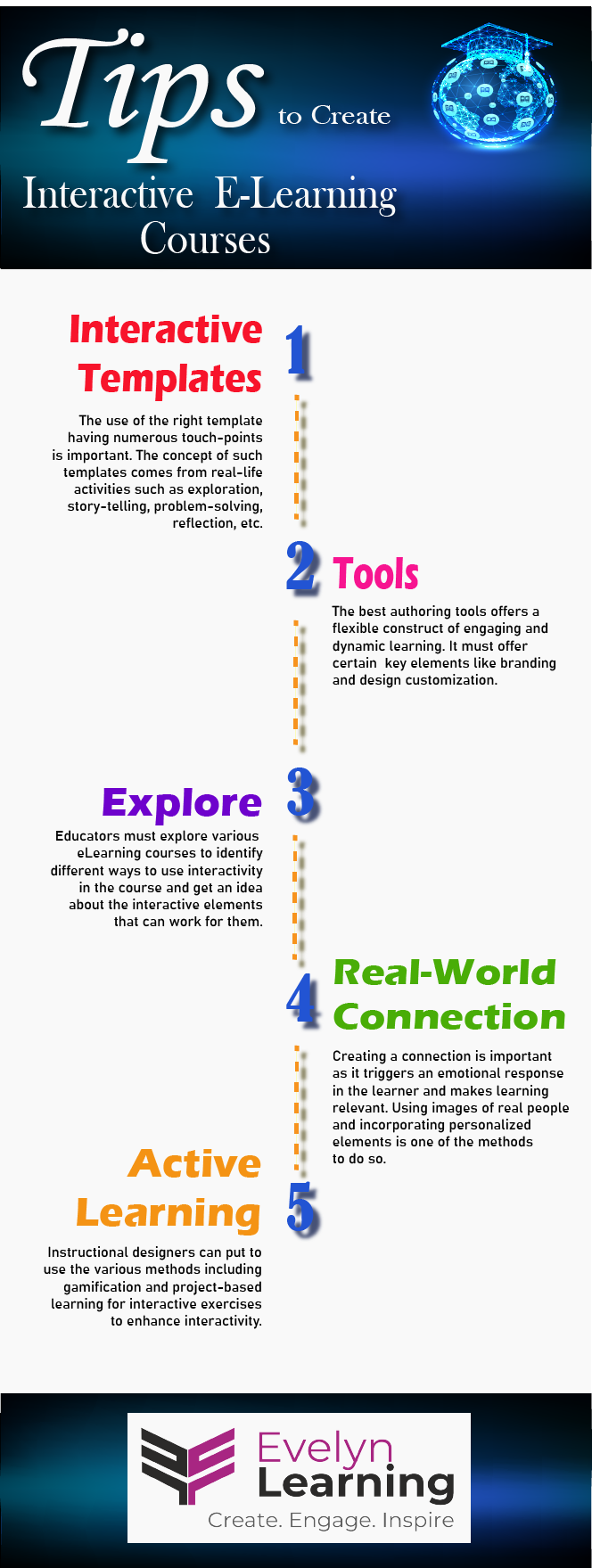
Tips to Create Interactive E-Learning Courses
1. Use Interactive Templates
The use of the right template with numerous touch-points is important. It effectively allows learners to interact with the content without the need for specific programming. The concept of such templates comes from real-life activities, such as exploration, story-telling, problem-solving, reflection, and so on. Different activities spanning across different categories can be designed. These include games, presentations, simulations, assessments, and more. The biggest advantage of using such templates is that it makes it easier to design eLearning courses and bring learning to life.
2. Use the Right Tools
Creating interactive courses does not always require a hefty spend. Instructional designers can easily create interactive courses with the help of various authoring tools available on the Internet. The best authoring tools offer a flexible construct of engaging and dynamic learning. It must offer certain key elements like branding and design customization, powerful learner data analytics, and dynamic video capabilities. Also, the tools must be able to make a compatible course to meet the needs of different learners. SCORM compatibility is also a necessary addition to the LMS.
3. Exploration is the Key
Before working to develop interactive courses, educators must explore various eLearning courses. This helps identify different ways to use interactivity in the course. Additionally, instructional designers can get an idea about the interactive elements that can work for them. Another benefit of such exploration is that it can help drive engagement to a course. This is thanks to the visual elements that attract more visitors and enhance retention. Moreover, these visual elements help connect to other pages through hyperlinks, enhancing overall learners’ engagement with the course content.
4. Connect to the Real World
Interactivity is all about bringing learning to life with the help of virtual reality. Although eLearning has comparatively fewer chances of interactivity, it can serve this purpose through a connection with the real world. Using images of real people and incorporating personalized elements is one of the methods to do so. Creating a connection is important as it triggers an emotional response in the learner and makes learning relevant. Consequently, their engagement and retention of the content increase.
5. Use Active Learning Techniques
Building interactive courses requires the use of active learning techniques. These techniques transform passive training into an active learning program. Instructional designers can put to use the various methods, including gamification and project-based learning for interactive exercises, to enhance interactivity. Another way of doing so is by introducing a character or avatar to bring a human touch to the course. Role-play is also an active learning technique for eLearning courses.
Importance of Designing Courses with Interactivity

Designing an eLearning course can be challenging at times. This is why instructional designers must be aware of the different ways that can be used to engage learners. The most crucial aspect of an eLearning course is its content. Course content must be relevant and valid in every eLearning course/training. It ensures that learners are on the right track in learning, but it is not the only aspect to be assessed. The level of interactivity of an eLearning course also determines its effectiveness. The more interactive the course is, the more engagement it drives from learners.
Moreover, with traditional learning methods becoming ubiquitous, eLearning courses are surfacing with new trends. The physical presence of an educator is no more a requirement for learning. However, this calls for an equal compensation of in-class interaction with the help of technology. This is why interactive courses become important. Interactive courses allow more engagement and better learning opportunities at the same time, thus favoring the educators and learners equally.
Read our article on e-learning to grasp a better understanding of the dynamics of e-learning.
Research Articles: E-Learning Industry and Lambda Solutions
Images: Shutterstock and pxhere
For more information on Interactive Learning, visit our blog.
Create. Engage. Inspire.
The post Interactive Courses: Tips to Create E-Learning Courses appeared first on Test.Evelyn.
]]>The post Enhancing E-Learning with Interactivity appeared first on Test.Evelyn.
]]>The quality of engaging the viewer or listener in the content is called interactivity. The instructional designers must develop the lesson in a manner that actively involves the learners and pushes them in the right direction. Learners who actively participate in the learning process perform better and retain more. It also defines the learning patterns the learners follow. This article explores the meaning and various levels of interactivity in eLearning. Further, it also inspects its roles and benefits.
What is Interactivity in eLearning?
The term eLearning refers to a form of learning that takes place online using electronic gadgets and technology. Interactivity in eLearning is a form of a dialogue between the technology and the learners. This interaction is somewhat similar to the teacher-student interaction during a classroom lesson.
In a traditional classroom, an educator instructs learners who learn through physical material. This material includes whiteboards, books, research journals, and so on. On the other hand, eLearning involves the use of technology and electronic gadgets that often replace the teacher. Learners have access to a wider range of study material available on the Internet, which contrasts with the limited resource availability of in-class learning.
A stark difference between both is the physical presence of an educator to monitor the learning process. An educator can easily deliver an interactive lesson in the classroom, which is not possible in an eLearning environment. An eLearning environment is where neither the educators nor the learners are physically present. Although learning happens online, interactivity in eLearning acts as a bridge between concepts and their understanding. The interactive elements of the e-lessons engage learners in experiential learning. As a result, learners gain a better understanding of the concepts as they get involved in learning.
Levels of Interactivity
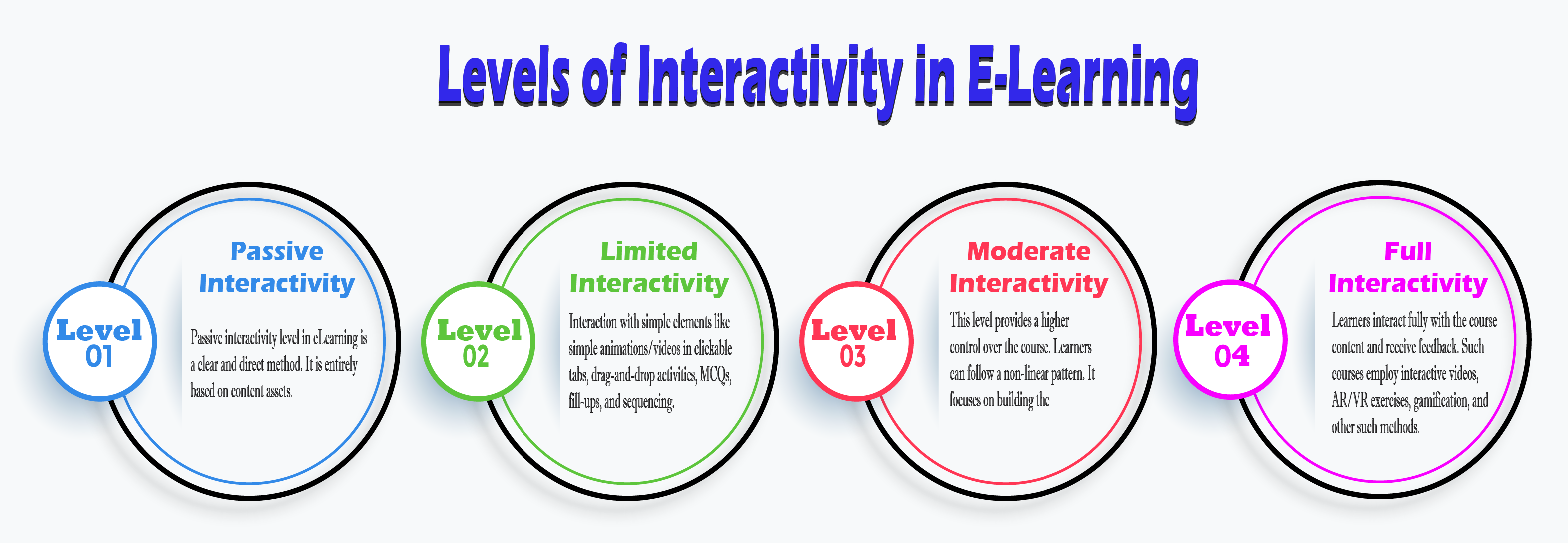
Interactivity in eLearning that happens in stages. There are four stages/levels of interactivity in eLearning.
-
Passive eLearning Interactivity
Passive interactivity level in eLearning is a clear and direct method. It is entirely based on content assets. For instance, web journals, research papers, podcasts, recordings, illustrations, and more. To elaborate, such courses are relatively passive in nature. Consequently, learners are restricted to on-screen reading and navigation or listening to podcasts and audio. However, this level is only an initial stage in eLearning. It implies that there is no interaction at all between the learners and the study material. Courses with this level of interactivity are less likely to engage learners, thus producing average learning outcomes.
-
Limited eLearning Interactivity
The second level has limited interactivity in eLearning. This level is again basic yet slightly different from the first one. At this level, learners interact with simple elements in the course, including simple animations or videos. These elements are in the form of clickable tabs, drag-and-drop activities, MCQs, fill-ups, and sequencing. Courses with a limited level of interactivity involve a low level of learner engagement. However, there is a considerable amount of interaction in comparison to the first level of passive interactivity. This means that learners do not deal with text-only information; they can also have a personalized learning experience.
Additionally, this level is good for assessments. The reason is that textual overload is less, which allows more information retention.
-
Moderate eLearning Interactivity
This level provides a higher control over the course. Learners can follow a non-linear pattern as they navigate through the course. This level particularly focuses on developing the problem-solving and decision-making abilities of learners. The course content majorly promotes knowledge application and transfer. In essence, the moderate eLearning interactivity level addresses real-world problems that require actual representation and practice.
Moreover, this level includes informative feedback along with a practical application of knowledge. Some salient features of eLearning courses with moderate levels of interactivity include the use of complex and narrative animation. It also includes case–studies, multiple-choice questions, drag-and-drop actions, and other such forms of interactive elements.
-
Full eLearning Interactivity
At this level of interactivity in eLearning, learners interact with the course content fully and also receive feedback. They exercise complete control over learning while they learn and practice their skills. There is a continuous interaction taking place between the learners and the learning material on their screens. Additionally, full interactivity in eLearning helps learners understand complex issues and develops their behavior and attitude. Moreover, it puts various elements of learner’s cognition into use by offering complex learning situations. To do this, fully interactive courses employ interactive videos, AR/VR exercises, gamification, and other such methods. Learners interact with the course by decoding the symbols, listening to audio and stories, as well analyzing various scenarios.
Furthermore, the feedback mechanism of such courses helps learners identify the areas of improvement. Eventually, learners perform better and gain high levels of knowledge.
Roles & Benefits of Interactivity in eLearning
Interactivity plays an important role in all forms of learning. The degree of interactivity in eLearning defines the quality of the course content. It also works to engage learners and motivate them to employ critical abilities for meaningful learning. Additionally, interactive elements induce alertness and activate long-term memory. The following points briefly describe the role and benefits of interactivity in eLearning.
- Causes Reaction: Interactive eLearning involves real-life scenarios that help learners experience learning through virtual reality. It also encourages learners to explore immense possibilities in a stress-free learning environment.
- Encourages Reflection: Interactive eLearning requires that learners reflect upon their learning before they answer. It encourages their involvement and promotes reflective learning.
- Boosts Engagements: Experiential learning induces various responses in the learners. The interactive elements of a course develop different skills along with motivating and engaging the learners.
- Promotes Better Retention: Learners retain more of what they experience in comparison to reading. It engages learners to provide experiential learning, which promotes better retention of information.
- Enhances Motivation: The fun elements of an interactive lesson/course make learning interesting. This works as a motivating factor for the learners who engage in learning.
With continuous developments in education, interactivity has become a must-have element for any course. Instructional designers across the world are experimenting with various forms of interactive elements to design eLearning courses. These elements are designed carefully with the help of technology to target specific areas of learning. Interactive eLearning is not only an essential feature of eLearning but also extends to the business world. Various training programs in the workplace also involve interactivity. In conclusion, interactivity is a crucial requirement at all levels of learning.
Resources: TalentLMS and eLearning Industry
Images: Shutterstock and Freepik
For more information on Interactive Learning, visit our blog.
Create. Engage. Inspire.
The post Enhancing E-Learning with Interactivity appeared first on Test.Evelyn.
]]>