The post Understanding Models of Instructional Design appeared first on Test.Evelyn.
]]>Now that there was a concept to improve instructions, a need to devise measures to employ it emerged. This gave way to the development of Instructional Design models. Educationists have developed innumerable models of instructional design over the years, but only a few have been widely accepted as resourcefully effective. This article takes a deeper look into these instructional design models.
Widely Used Instructional Design Models
I. ADDIE (Analyze, Design, Develop, Implement, and Evaluate)
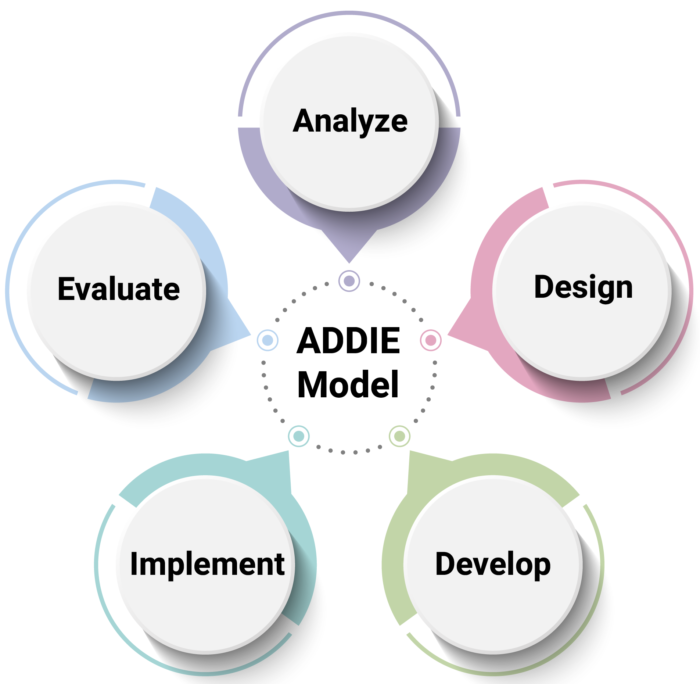
This model consists of five phases, which are:
Analyze:
Examine the need for training by defining the needs of the learners. This determines the need for training, instructional environment, skills, opportunities available, constraints, and the abilities of the learners and trainers.
Design:
Determine the objectives of learning and instructional strategies. Additionally, choose the look, feel, and operation and delivery methods of the instructional material.
Develop:
Assemble the content into a final design to produce instructional material. Instructional Designers review and revise the content multiple times for quality analysis.
Implement:
Deliver the finished course to the intended audience/learners and register the impact of the product.
Evaluate:
Assess the impact of the instructional material using a variety of evaluation tools.
II. The Assure Model of Instructional Design
Teachers use this model to design and develop the most suitable classroom learning environment. It is an amalgamation of Robert Gagne’s events of instructions, which tries to ensure the effective use of media in lesson delivery.
A – Analyze learners
S – State standards and objectives
S – Select strategies, media, technology, and objectives
U – Employ technology, media, and materials
R – Require the learner to participate
E – Evaluate and revise
Further reading on the Assure Model
III. Gagne’s 9 Events of Instruction Model
This is based on the behaviorist approach to learning. According to Gagne, adults require certain mental conditions for learning. For this reason, the following nine events of instructions were developed using these conditions.
1. Gain the student’s attention
Activities such as storytelling or asking thought-provoking questions set the foundation for learning and retention of knowledge.
2. Inform students about the objectives
This step is for the establishment of certain expectations from the course and to set a criterion for the measurement of success or failure.
3. Stimulate recall of prior learning
Learners acquire new knowledge using their existing knowledge.
4. Present the content
This is the most important step for teachers. They must employ their skills and knowledge to come up with new forms of presentation. This is done for the maximum utilization of resources and for achieving the desired learning outcome.
5. Provide learner guidance
Supplement the learning material with case studies, classroom activities, discussion papers, and other forms of instructional support materials. This provides a better understanding of concepts.
6. Elicit performance
Challenge the learners to recollect, employ, and evaluate their learning.
7. Provide feedback
Use immediate feedback for reinforcement of knowledge.
8. Assess performance
Test the learner’s knowledge as per established criteria.
9. Enhance retention and transfer to the job
Use content retention procedures for appropriate job aids and to retain the knowledge gained.
IV. Merrill’s Principles of Instruction Model (2002)
It is a consolidation of five learning principles, which are:
A. Task-centered principle:
Learning must begin with a real-world task that the learners can relate to.
B. Activation principle:
Activate the previous knowledge of learners so that they can link it with new knowledge.
C. Demonstration principle:
The course must illustrate knowledge in multiple ways. This may include visual storytelling so that it caters to the varied learning requirements of learners and helps in knowledge retention.
D. Application principle:
Learners must be taught to apply their new knowledge.
E. Integration principle:
The learner’s world must be integrated with new knowledge. This can be done through the process of discussions, reflections, and/or presentations of the new knowledge.
V. The Kemp Model of Instructional Design
Also known as the Morrison, Ross, and Kemp Model, it incorporates the following 9 steps:
Step 1
Identify the problems and specifications of the goals of instructional program design.
Step 2
Examine the aspects that must receive planned attention.
Step 3
Identify the subject content and analyze the task components according to the stated goals and objectives.
Step 4
State instructional objectives for the learners.
Step 5
Arrange the content as per the instructional unit of logical learning.
Step 6
Design instructional strategies to help each learner master the skills.
Step 7
Plan appropriate instructional activities.
Step 8
Develop instruments of evaluation for assessment.
Step 9
Select appropriate instruction and learning sources.
VI. Kirkpatrick Model of Instructional Design
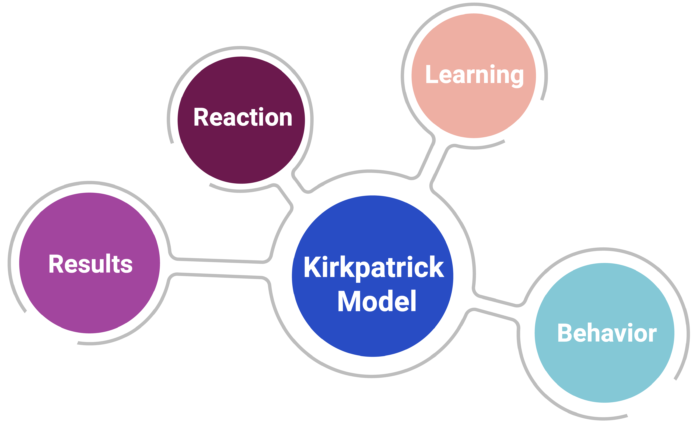
The Kirkpatrick Model determines a learner’s aptitude by analyzing and evaluating the results of the educational program. It is a four-level process carried out as follows:
-
Level 1 (Reaction)
- Measure the reaction of the learners to the provided training.
-
Level 2 (Learning)
- Analyze the level of understanding.
-
Level 3 (Behavior)
- Record the application of the concepts learned.
-
Level 4 (Results)
- Determine the impact of the material delivered through instructional design.
This model of evaluation is applicable at all stages of training because of its systematic evaluation process. For this reason, it is the most widely used model in business training assessment.
There are dozens of other instructional design models that teachers/trainers use to create different types of instructions for the various needs of training. Training designed with the help of Instructional Design models proves to be effective in inculcating knowledge about a topic. Trained professionals carry out this task, and they ensure that the lesson is delivered effectively.
Read about more Instructional Models here.
Featured Image Designed by Freepik.
Visit our blog for further reading on Instructional Design.

Create. Engage. Inspire.
The post Understanding Models of Instructional Design appeared first on Test.Evelyn.
]]>