The post Gamification in eLearning- Scope & Development (Part-2) appeared first on Test.Evelyn.
]]>In Part-I of our article on the application of Gamification in eLearning, we discussed how gamification is applied in the field of eLearning as per the demands of the field. In this article, we will take a look at the challenges associated with gamifying eLearning and how these issues can be eliminated with a structured approach.
Overcoming Challenges with Gamification in eLearning
eLearning is an emerging concept that is entirely different from the traditional classroom learning experience. It poses several challenges for teachers as well as learners who become a part of this process. Gamification helps overcome these challenges in a smooth and effective manner. Some of the important challenges can be found below:
I. Intriguing environment
Continuously cramming theory or textbook information is tiresome and can make imparting knowledge seem monotonous. Gamification helps in eliminating this boring experience by providing means to engage learners in an active gaming environment. This environment is full of excitement and interesting experiential learning.
II. Learning impulse
Motivation is a crucial factor to push learners to achieve the desired levels of learning. Motivating students to complete a course becomes the biggest obstacle in the eLearning context. Unlike a traditional classroom, neither the teacher nor the students are physically present in a virtual classroom. Therefore, the job of the teacher as a motivator is restricted. In this case, gamification works in favor of the instructor and provides the required amount of motivation, which the gaming situations induce.
III. Level playing field
Learners proceed further when they are pushed to compete in a healthy environment. However, unfair competition kills the learning impulse and may result in some students dropping out of the course. Gamified lessons ensure that the learners’ efforts are recognized in the form of awards, badges, leaderboard rankings, and so on, which provides a level playing field for the learners to compete and learn in.
IV. Positive outlook toward failure
A learner might fear failure and lose motivation to proceed with a lesson in a traditional classroom learning scenario. Gamification in eLearning provides a stimulus for learning by positioning failure in a positive manner. This impels the learner to move further and to produce better results rather than completely opting out of the course.
Playing it safe with Gamification
Although gamification is arguably a better alternative to traditional classroom teaching, its effective conduct requires a well-structured approach. A gamified lesson requires several professionals to develop such lessons and to deliver them to learners in a virtual classroom. Some of the focal points that impact the learning outcomes are:
i) Neglecting learners’ efforts
Awarding the learners that take part in gamification activities motivates them to proceed in the course. Conversely, not giving learners due recognition has an adverse effect on their learning and motivation levels. For this reason, there is a requisite need to recognize learners’ efforts.
ii) Transient approach
A game becomes boring over time if it does not involve evolving challenges that excite learners at various levels. As a result, gamified lessons require a long-term learning outlook.
iii) Entirely competition-oriented
Not all learners thrive in a highly competitive environment. This emphasizes the need for creating accommodating lessons, where all learners get equal opportunity to compete and master lessons.
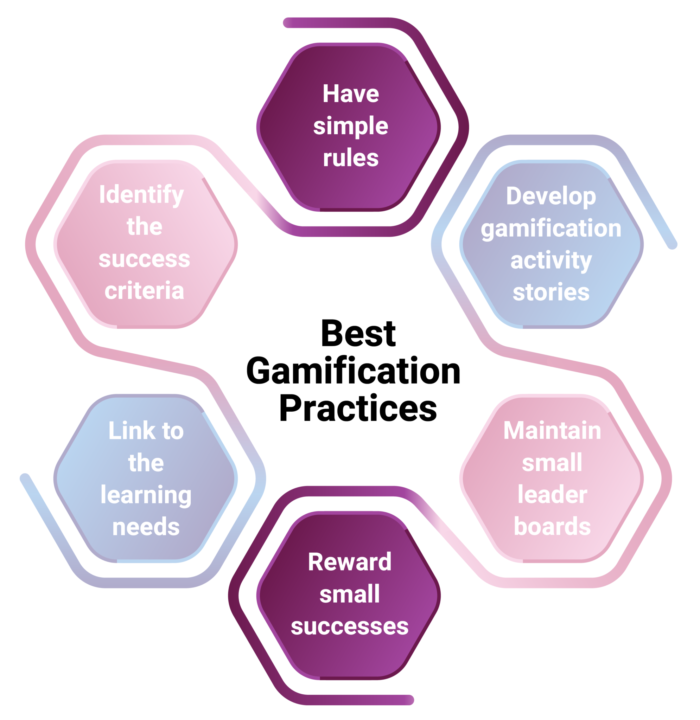
Effective Professional Strategies for Gamification
Gamification in eLearning requires certain strategies so that lessons for achieving the specified objectives of learning can be developed. These strategies improve over time with practice and experience. The effective professional strategies for gamification in eLearning include:
1. Content
The content is the heart and soul of a lesson. If the content lacks a crucial element and is not presentable, the application of gamification will not be fruitful. Gamification enhances the learner experience only when the content is exciting and new. Therefore, an impartial review of the content is important.
2. Time
Some learners are good at game-related activities and might complete their tasks earlier than others. Thus, gamification requires a long-term strategy to engage varied learners in interactive activities to obtain the desired results of learning.
3. Marketing
Similar to any other technology, gamification requires time before implementation. The need for gamifying an activity/field requires recognition at the right time. The application of gamification takes place only after a thorough analysis of the field it is being applied to.
4. Outcome
It is necessary to determine the expected outcomes of a gamified eLearning course. The designers accordingly plan the development strategies for an eLearning course.
Benefits of Gamification in eLearning
Gamification in eLearning creatively engages the students and the teachers in the teaching-learning process. While the teachers toil to provide a creative and exciting side to mundane lessons, students feel encouraged to learn by themselves by performing engaging activities. Following are some of the benefits of gamification in eLearning:
1. Encourages self-directed learning
By actively engaging in achieving the goal of the games being played, the students are not just fulfilling the game’s objective; they are also subconsciously absorbing the lesson working as the foundation of the game. As they proceed with the levels of the game, they receive continuous feedback, which makes them think of strategies to build on the areas of improvement. As the teacher is not directly involved in the learning process, the students actively take responsibility for their performance, thereby engaging in self-directed learning.
2. Supports uninterrupted learning
With each level of the game, the students receive regular feedback for their performance. A good eLearning game allows students to compete with themselves and create high-score milestones. It encourages students to beat their own records and enhance their understanding of the concept. Every time a student re-attempts a level to increase the score, they reflect on the mistakes made in the earlier attempts. With this characteristic of gamification, the students engage in uninterrupted learning, which is progressive and not repetitive.
3. Binds fun with learning
Learning can yield no good results if taken in isolation from the element of fun. Students have shown more interest in lessons involving exciting activities than in conventional one-way lessons. Binding fun with learning piques the students’ curiosity and attracts their interest. When they enjoy every aspect of it, they are more involved in the learning process compared to when they do not.
Concluding Note
Just like other forms of learning, gamified learning depends on certain strategies and carries its own shortcomings and challenges. In-depth knowledge and mindful application of gamification in eLearning can facilitate conducting lessons effectively and render the desired results to its users.
Blog referenced for research: Medium.com
Gamification Practices image designed using Vecteezy
Visit our blog for further reading on Gamification.

Create. Engage. Inspire.
The post Gamification in eLearning- Scope & Development (Part-2) appeared first on Test.Evelyn.
]]>The post Gamification in eLearning appeared first on Test.Evelyn.
]]>What is Gamification?

Gamification in eLearning refers to applying gaming mechanics to teaching methodologies to create an engaging learning experience. The term gamification was advanced by Nick Pelling in 2002. Though gamification can be employed in traditional classroom teaching through various activities, it has a wider application in eLearning as well.
Learners engage in competitions where the rewards can be points, levels, badges, gift cards, vouchers, and so on. Some of these are a part of typical video game mechanics. The learners engage in learning activities, and they become a part of the game dynamics where every participant is connected.
Moreover, this connection fosters positive motivation, and the participants advance by collaborating. Gamification stokes the innate interest and curiosity of learners as they participate in learning activities, and it encourages them to be consistent in their learning and knowledge application.
How to use Gamification in eLearning?
Education has come a long way from traditional classrooms. As a result, with the ubiquity and evolution of technology, online learning platforms are becoming increasingly popular.
A major deterrent to eLearning is that it does not allow learners to directly interact with the trainer/teacher during lesson delivery.
Typically, a teacher aims to inculcate knowledge, motivates learners, and tries to ensure that the gained knowledge is retained. This may prove to be particularly difficult when lessons are provided over the internet. As a result, the very fundamental requirement of learner participation in the teaching-learning process may go unfulfilled.
This is where gamification steps in.
Gamification in eLearning fills this gap by creating a competitive environment promoted by incentives that motivate the learners to succeed. But then how is a game different from gamified learning?
The answer lies in the fact that gamified lessons employ game mechanics that induce game-like reactions toward learning. Similar to a video game, factors such as time constraints/countdowns and/or rewards are added to learning. These features provide learners a game-like experience, which employs game mechanics for engaging knowledge delivery.
The gamification of a lesson accounts for a better understanding and retention of knowledge. The reason is that it is a learner-centered outlook and an emerging new aspect of teaching and learning.
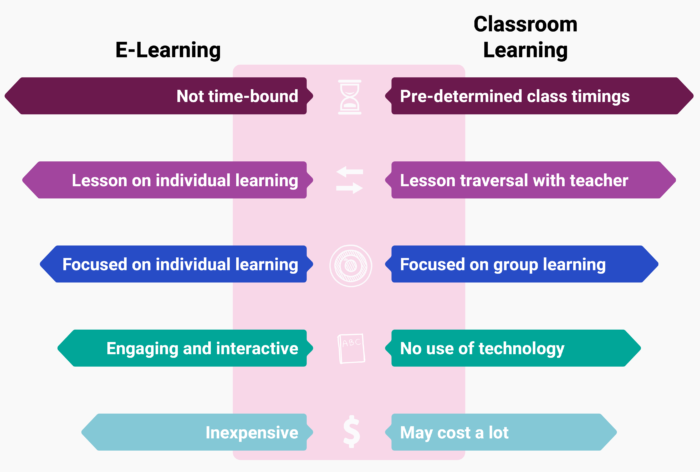
Demand for Gamification in eLearning
Teaching in a virtual classroom is markedly more demanding than teaching in a traditional classroom. Delivering a credible lesson in a virtual classroom requires comparatively more effort and preparation on the part of teachers.
Gamification in eLearning eases this additional pressure on teachers.
Gamification allows and serves to fulfill the fundamental requirements of classroom learning. The pointers that lead to a demand for gamification in eLearning are:
1. Foster interest
A gamified lesson develops the interest of learners, thus ensuring effective lesson delivery in a virtual classroom.
2. Hook the learners
A lesson designed through gamification techniques grabs the attention of learners faster than traditional lessons. This ensures that learners are hooked to what is being taught in the class and participate actively.
3. Stimulate better retention
An interesting lesson induces certain emotions in the learners that stimulate reactions. These reactions lead to better retention of concepts.
4. Practical application
In the gamified virtual learning approach, students learn through experience. This creates a stimulus for an effective practical application of the knowledge gained.
5. Assurance of progress
Gamification keeps track of a learner’s progress. This eventually motivates students to work harder and to discover and apply new knowledge.
Gamification in eLearning has become a major avenue for learning in the current world. It has opened doors for the development of highly effective teaching-learning processes, where learners gain knowledge through experiential learning. Gamification can thus be considered a futuristic approach to learning.
Read Part II of this series to learn more about the applications of gamification in eLearning.
Read more about gamification here.
Image source: Shutterstock
eLearning/Classroom Learning image designed using Freepik
Visit our blog for further reading on Gamification.

Create. Engage. Inspire.
The post Gamification in eLearning appeared first on Test.Evelyn.
]]>