The post Interactive Courses: Tips to Create E-Learning Courses appeared first on Test.Evelyn.
]]>Instructional design is evolving with the availability of a variety of methods and tools to develop instructions. As a result, we have an abundance of teaching-learning methods to choose from. Also termed teaching methodologies, these methods can be used to develop interactive courses. This article discusses the significance of interactive eLearning courses and provides some important tips to create an interactive eLearning course.
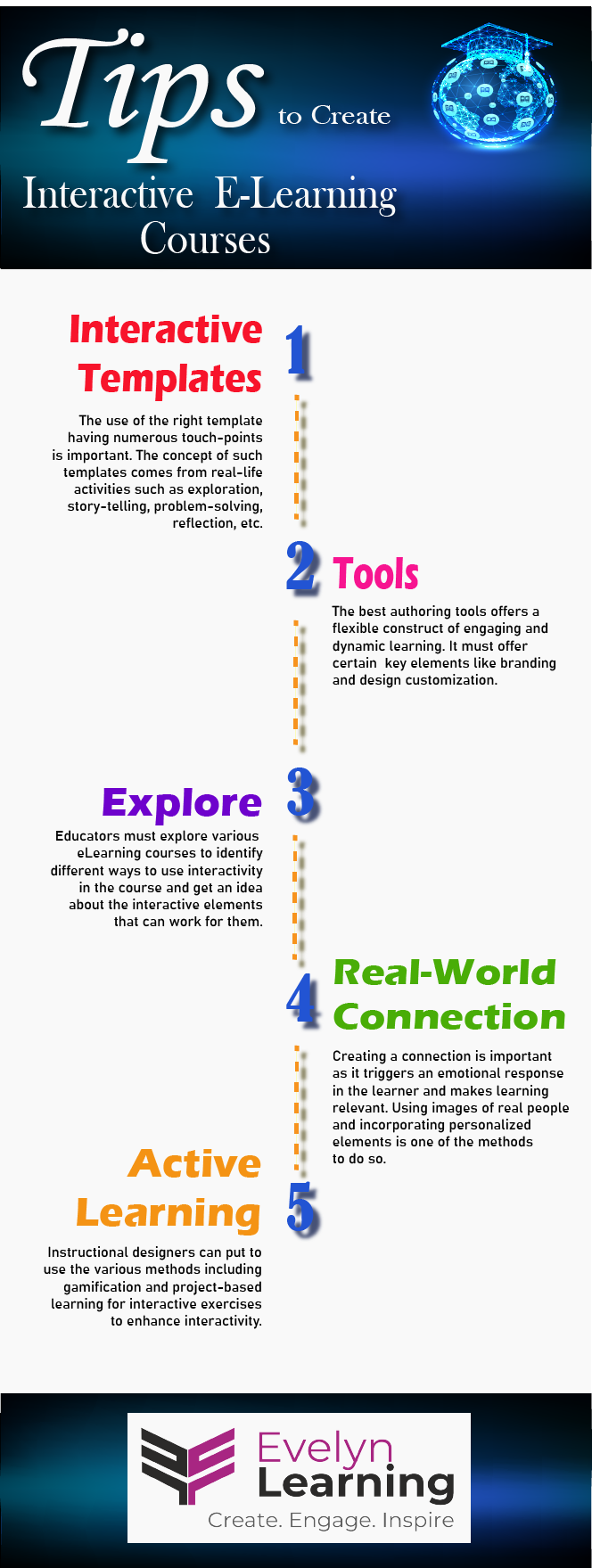
Tips to Create Interactive E-Learning Courses
1. Use Interactive Templates
The use of the right template with numerous touch-points is important. It effectively allows learners to interact with the content without the need for specific programming. The concept of such templates comes from real-life activities, such as exploration, story-telling, problem-solving, reflection, and so on. Different activities spanning across different categories can be designed. These include games, presentations, simulations, assessments, and more. The biggest advantage of using such templates is that it makes it easier to design eLearning courses and bring learning to life.
2. Use the Right Tools
Creating interactive courses does not always require a hefty spend. Instructional designers can easily create interactive courses with the help of various authoring tools available on the Internet. The best authoring tools offer a flexible construct of engaging and dynamic learning. It must offer certain key elements like branding and design customization, powerful learner data analytics, and dynamic video capabilities. Also, the tools must be able to make a compatible course to meet the needs of different learners. SCORM compatibility is also a necessary addition to the LMS.
3. Exploration is the Key
Before working to develop interactive courses, educators must explore various eLearning courses. This helps identify different ways to use interactivity in the course. Additionally, instructional designers can get an idea about the interactive elements that can work for them. Another benefit of such exploration is that it can help drive engagement to a course. This is thanks to the visual elements that attract more visitors and enhance retention. Moreover, these visual elements help connect to other pages through hyperlinks, enhancing overall learners’ engagement with the course content.
4. Connect to the Real World
Interactivity is all about bringing learning to life with the help of virtual reality. Although eLearning has comparatively fewer chances of interactivity, it can serve this purpose through a connection with the real world. Using images of real people and incorporating personalized elements is one of the methods to do so. Creating a connection is important as it triggers an emotional response in the learner and makes learning relevant. Consequently, their engagement and retention of the content increase.
5. Use Active Learning Techniques
Building interactive courses requires the use of active learning techniques. These techniques transform passive training into an active learning program. Instructional designers can put to use the various methods, including gamification and project-based learning for interactive exercises, to enhance interactivity. Another way of doing so is by introducing a character or avatar to bring a human touch to the course. Role-play is also an active learning technique for eLearning courses.
Importance of Designing Courses with Interactivity

Designing an eLearning course can be challenging at times. This is why instructional designers must be aware of the different ways that can be used to engage learners. The most crucial aspect of an eLearning course is its content. Course content must be relevant and valid in every eLearning course/training. It ensures that learners are on the right track in learning, but it is not the only aspect to be assessed. The level of interactivity of an eLearning course also determines its effectiveness. The more interactive the course is, the more engagement it drives from learners.
Moreover, with traditional learning methods becoming ubiquitous, eLearning courses are surfacing with new trends. The physical presence of an educator is no more a requirement for learning. However, this calls for an equal compensation of in-class interaction with the help of technology. This is why interactive courses become important. Interactive courses allow more engagement and better learning opportunities at the same time, thus favoring the educators and learners equally.
Read our article on e-learning to grasp a better understanding of the dynamics of e-learning.
Research Articles: E-Learning Industry and Lambda Solutions
Images: Shutterstock and pxhere
For more information on Interactive Learning, visit our blog.
Create. Engage. Inspire.
The post Interactive Courses: Tips to Create E-Learning Courses appeared first on Test.Evelyn.
]]>The post E-Learning Resources for College Students appeared first on Test.Evelyn.
]]>In the contemporary world, continuous learning is the only key to success. College students are often swamped with a lot of learning and responsibilities. Consequently, managing time to travel and to physically attend a class becomes tiresome, so e-learning through different resources serves as the best alternative. Also, these resources allow learning to continue at all costs, with minimum requirements of time, space, and money.
The top free e-learning resources for college students have been listed below.
1. TED-Ed
TED-Ed is a youth and education initiative of TED. It is an international platform that aids teaching and learning. With a growing animated video library, TED-Ed allows educators to create interactive lessons to teach students around the globe. The TED-Ed animated videos, or TED-Ed Lessons, are short videos about the ideas that spark the curiosity of learners. These videos are a result of the collaboration between experts, including TED speakers, TED fellows, educators, writers, and many others.
Moreover, the advisors of TED-Ed include prominent personalities from different fields relating to education. Aaron Sams, Jackie Bezos, Melinda French Gates, and Salman Khan (from Khan Academy) are a few to name.
2. ResearchGate
ResearchGate is a global professional network for researchers and scientists. The platform aims to connect the world of science and ease research. Presently, ResesarchGate has millions of members collaborating on specific topics in science and research.
An additional feature of this platform is that it allows the members to publish their data and see who’s reading or citing it. Moreover, this data is accessible from any corner of the world, making it a handy tool for college students to learn.
3. Coursera
Coursera is an online education platform providing free academic references and modules for learning. It provides knowledge about various subjects with on-demand video lectures, discussion forums, and homework exercises. The courses are available for free, with some requiring payment. Moreover, learners receive a sharable certificate at the end of the course.
An additional advantage of learning with Coursera is that it partners with more than 200 top universities in the world. Also, industry educators partner with Coursera to offer specializations. Certificates, courses, and various degree programs. Overall, the platform provides universal access to the best education with top universities and organizations.
4. Khan Academy
Khan Academy provides numerous educational videos and test exercises that help learners study at their own pace. It eliminates the need to attend a physical classroom for learning with an open learning platform. Also, it is one of the biggest learning platforms with courses that cater to the learning needs of all age groups. All these courses are free and accessible anytime, anywhere. Moreover, the courses are available in more than 36 languages, promoting learning without the barriers of language.
5. Duolingo
Duolingo is a mobile application for language learning. The application is available for free with more than 90 different language courses. It gives a personalized learning experience with gamified lessons. Also, the lessons review learner’s vocabulary effectively and show grades instantly.
Moreover, Duolingo uses gamification as the basis of learning in all the courses. As a result, the gaming and reward system better learning and engagement, eventually producing better learning outcomes.
6. Udemy
Udemy is a skill development platform for learners who wish to earn a technical certificate or acquire skills for a job. The Udemy mobile application provides access to a variety of videos, podcasts, presentations, and lectures for free. Moreover, it allows learners to connect with the best instructors from around the world and work towards realizing their dreams.
Udemy offers courses on a wide variety of subjects. These include finance, accounting, business, economics, real estate, and much more. Moreover, these courses are available in more than 65 languages and are delivered by highly skilled instructors.
Bottom Line
The Internet is an ocean of opportunities and a lifelong learning resource, particularly for college students. The various free e-learning resources available on the Internet make it possible to learn anything and everything from the comfort of one’s home. College students often engage in numerous activities apart from their studies. As a consequence of this, they find it difficult to learn something new and often fail to turn their dreams into reality. This can happen due to the limitations of time, space, money, and other such factors. But the various free learning resources act as a lifeline for such students and help them fulfill their learning requirements to succeed in life.
Research Website: Collegecliffs
Featured image: Shutterstock
For more information e-learning, visit our blog.

Create. Engage. Inspire.
The post E-Learning Resources for College Students appeared first on Test.Evelyn.
]]>The post eLearning Styles: An Introduction appeared first on Test.Evelyn.
]]>Our brains combine several methods to process information for faster and easier knowledge acquisition. The many ways in which the brain registers information include visual, aural, verbal, physical, logical, social, and solitary learning.
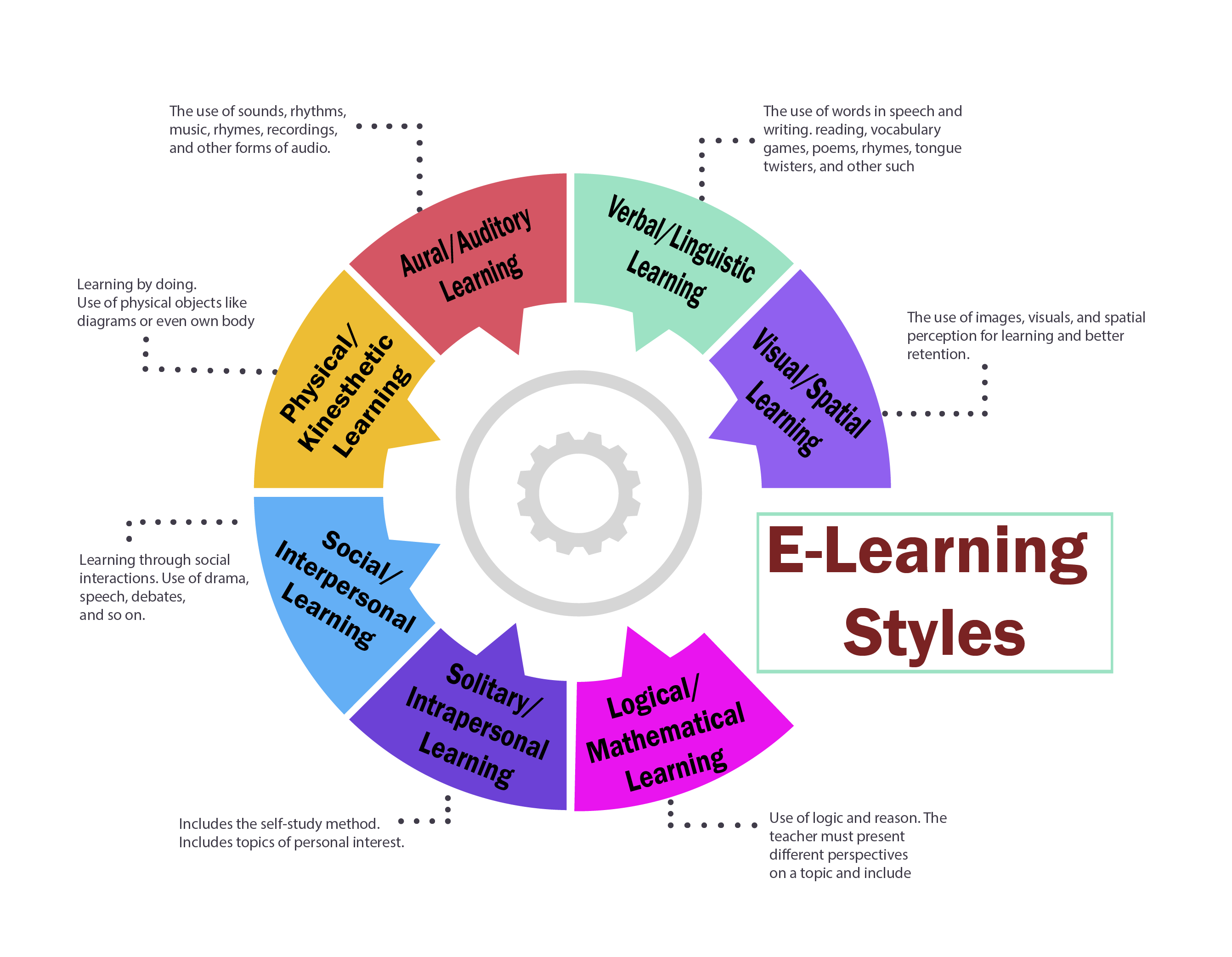
Traditional learning typically uses the linguistic and logical teaching styles, and the range of techniques is limited. However, e-learning offers a wider range of techniques depending on the eLearning styles the learners follow. Educators must know different eLearning styles before beginning to design or teach a lesson/course. The various eLearning styles are as follows:
1. Visual/Spatial Learning
Visual learning entirely constitutes the use of images, visuals, and spatial perception. These traits are native to modern classrooms. Also, the use of images, diagrams, and visual representations promotes learning and better retention. The use of such multimedia in the form of animated videos, images, and illustrations in an e-lesson is an example of visual/spatial learning.
Moreover, visual learners comprise more than 50% of the class. Thus, educators must pay special attention to include visual cues in instruction. This will help maximize learning outcomes.
2. Verbal/Linguistic Learning
Verbal/Linguistic Learning involves the use of words in speech and writing. Linguistic learners express themselves through words and have an extensive vocabulary. This means communication and interpersonal connections are important for such learners. Therefore, interactive learning or group learning is the best method of learning.
Moreover, language learning is the priority of linguistic learners. Consequently, reading, vocabulary games, poems, rhymes, tongue twisters, and other such activities are useful for assisting learning.
3. Aural/Auditory Learning
Aural/Auditory learning involves the use of sounds, rhythms, music, rhymes, recordings, and other forms of audio. Auditory learners make use of sounds to learn and remember things. The tone, pitch, and volume of the voice are the means of expression for such learners. Although they are good listeners, aural learners often initiate discussions as they love to talk.
Furthermore, sound is also a distraction for such learners. Thus, the lessons and activities must contain content that completely engages learners. Some of the best practices for teaching such types of learners include discussion and initiating conversations. Also, using beats, songs, and rhymes helps in the reinforcement of information.
4. Physical/Kinesthetic Learning
Kinesthetic learners are physical learners that usually learn by doing. This means that they use physical objects like diagrams or even their own body to learn. Such learners possess excellent motor memory and usually perform well in art and drama. Also, they are quick to react with their high energy levels and great eye-hand coordination.
Furthermore, the physical eLearning style is an amalgamation of different eLearning styles. Learners gather information in various ways as they touch, feel, and manipulate objects around them. In this way, the learners involve directly in the process of learning.
5. Social/Interpersonal Learning
Social/Interpersonal learning is a style that involves learning through social interactions. This eLearning style entirely depends on communication. Learners communicate with the people around them verbally and non-verbally. Also, social learners tend to be good mentors and counselors.
The educators using the social eLearning style to teach must use activities that involve all learners. Also, frequent breaks and feedback allow informal discussions to reinforce learning. So, activities like drama, speech, debates, and so on are excellent ways to impart education to such students.
6. Solitary/Intrapersonal Learning
Solitary or Intrapersonal learning includes the self-study method. Solitary learners are usually introverts that enjoy quiet and peaceful moments with their thoughts. They are good at focusing and are aware of their feelings and thoughts.
Moreover, learners who prefer solitary eLearning styles assess their goals and accomplishments and experience high levels of motivation. Therefore, the eLearning lesson/course should include topics of personal interest and connect to familiar subjects. Assigning tasks individually can also yield better learning outcomes.
7. Logical/Mathematical Learning
Logical/Mathematical eLearning styles use logic and reason as the basis for learning. Logical learners possess phenomenal logical and reasoning skills. They are known for their inclination towards math, science, and reasoning. Moreover, learners with this style of learning possess great analytical and problem-solving abilities.
While teaching such students, educators must present different perspectives on a topic and include strategic games that emphasize organizational skills.
To sum up, there are several eLearning styles that different learners follow. A teacher must possess good knowledge of these styles to design and deliver effective eLearning lessons/courses. Teachers should also focus on creating effective assessments that employ gamification. Such strategies help achieve the maximum learning outcomes with effective teacher instructions.
Research website: Time 4 Learning
Images: Shutterstock and Freepik
For more information on teaching and learning, visit our blog.

Create. Engage. Inspire.
The post eLearning Styles: An Introduction appeared first on Test.Evelyn.
]]>The post Gamification in eLearning- Scope & Development (Part-2) appeared first on Test.Evelyn.
]]>In Part-I of our article on the application of Gamification in eLearning, we discussed how gamification is applied in the field of eLearning as per the demands of the field. In this article, we will take a look at the challenges associated with gamifying eLearning and how these issues can be eliminated with a structured approach.
Overcoming Challenges with Gamification in eLearning
eLearning is an emerging concept that is entirely different from the traditional classroom learning experience. It poses several challenges for teachers as well as learners who become a part of this process. Gamification helps overcome these challenges in a smooth and effective manner. Some of the important challenges can be found below:
I. Intriguing environment
Continuously cramming theory or textbook information is tiresome and can make imparting knowledge seem monotonous. Gamification helps in eliminating this boring experience by providing means to engage learners in an active gaming environment. This environment is full of excitement and interesting experiential learning.
II. Learning impulse
Motivation is a crucial factor to push learners to achieve the desired levels of learning. Motivating students to complete a course becomes the biggest obstacle in the eLearning context. Unlike a traditional classroom, neither the teacher nor the students are physically present in a virtual classroom. Therefore, the job of the teacher as a motivator is restricted. In this case, gamification works in favor of the instructor and provides the required amount of motivation, which the gaming situations induce.
III. Level playing field
Learners proceed further when they are pushed to compete in a healthy environment. However, unfair competition kills the learning impulse and may result in some students dropping out of the course. Gamified lessons ensure that the learners’ efforts are recognized in the form of awards, badges, leaderboard rankings, and so on, which provides a level playing field for the learners to compete and learn in.
IV. Positive outlook toward failure
A learner might fear failure and lose motivation to proceed with a lesson in a traditional classroom learning scenario. Gamification in eLearning provides a stimulus for learning by positioning failure in a positive manner. This impels the learner to move further and to produce better results rather than completely opting out of the course.
Playing it safe with Gamification
Although gamification is arguably a better alternative to traditional classroom teaching, its effective conduct requires a well-structured approach. A gamified lesson requires several professionals to develop such lessons and to deliver them to learners in a virtual classroom. Some of the focal points that impact the learning outcomes are:
i) Neglecting learners’ efforts
Awarding the learners that take part in gamification activities motivates them to proceed in the course. Conversely, not giving learners due recognition has an adverse effect on their learning and motivation levels. For this reason, there is a requisite need to recognize learners’ efforts.
ii) Transient approach
A game becomes boring over time if it does not involve evolving challenges that excite learners at various levels. As a result, gamified lessons require a long-term learning outlook.
iii) Entirely competition-oriented
Not all learners thrive in a highly competitive environment. This emphasizes the need for creating accommodating lessons, where all learners get equal opportunity to compete and master lessons.
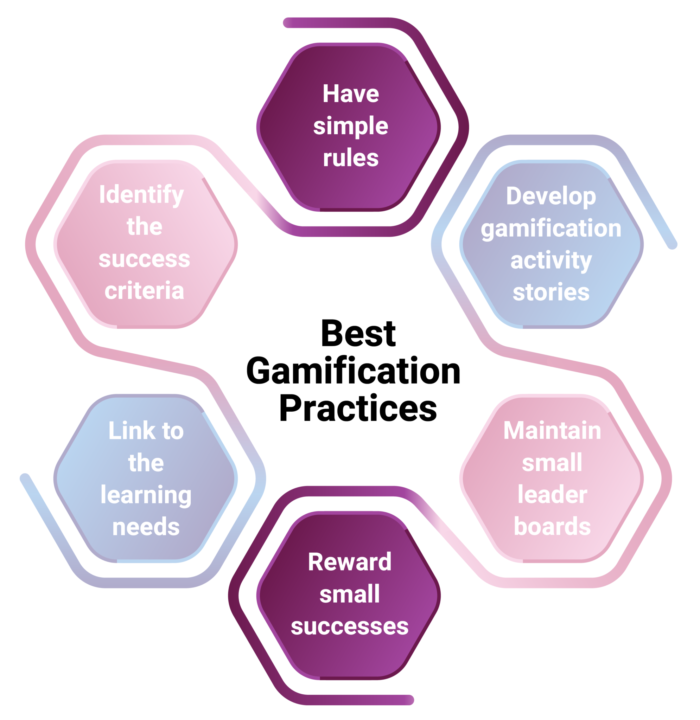
Effective Professional Strategies for Gamification
Gamification in eLearning requires certain strategies so that lessons for achieving the specified objectives of learning can be developed. These strategies improve over time with practice and experience. The effective professional strategies for gamification in eLearning include:
1. Content
The content is the heart and soul of a lesson. If the content lacks a crucial element and is not presentable, the application of gamification will not be fruitful. Gamification enhances the learner experience only when the content is exciting and new. Therefore, an impartial review of the content is important.
2. Time
Some learners are good at game-related activities and might complete their tasks earlier than others. Thus, gamification requires a long-term strategy to engage varied learners in interactive activities to obtain the desired results of learning.
3. Marketing
Similar to any other technology, gamification requires time before implementation. The need for gamifying an activity/field requires recognition at the right time. The application of gamification takes place only after a thorough analysis of the field it is being applied to.
4. Outcome
It is necessary to determine the expected outcomes of a gamified eLearning course. The designers accordingly plan the development strategies for an eLearning course.
Benefits of Gamification in eLearning
Gamification in eLearning creatively engages the students and the teachers in the teaching-learning process. While the teachers toil to provide a creative and exciting side to mundane lessons, students feel encouraged to learn by themselves by performing engaging activities. Following are some of the benefits of gamification in eLearning:
1. Encourages self-directed learning
By actively engaging in achieving the goal of the games being played, the students are not just fulfilling the game’s objective; they are also subconsciously absorbing the lesson working as the foundation of the game. As they proceed with the levels of the game, they receive continuous feedback, which makes them think of strategies to build on the areas of improvement. As the teacher is not directly involved in the learning process, the students actively take responsibility for their performance, thereby engaging in self-directed learning.
2. Supports uninterrupted learning
With each level of the game, the students receive regular feedback for their performance. A good eLearning game allows students to compete with themselves and create high-score milestones. It encourages students to beat their own records and enhance their understanding of the concept. Every time a student re-attempts a level to increase the score, they reflect on the mistakes made in the earlier attempts. With this characteristic of gamification, the students engage in uninterrupted learning, which is progressive and not repetitive.
3. Binds fun with learning
Learning can yield no good results if taken in isolation from the element of fun. Students have shown more interest in lessons involving exciting activities than in conventional one-way lessons. Binding fun with learning piques the students’ curiosity and attracts their interest. When they enjoy every aspect of it, they are more involved in the learning process compared to when they do not.
Concluding Note
Just like other forms of learning, gamified learning depends on certain strategies and carries its own shortcomings and challenges. In-depth knowledge and mindful application of gamification in eLearning can facilitate conducting lessons effectively and render the desired results to its users.
Blog referenced for research: Medium.com
Gamification Practices image designed using Vecteezy
Visit our blog for further reading on Gamification.

Create. Engage. Inspire.
The post Gamification in eLearning- Scope & Development (Part-2) appeared first on Test.Evelyn.
]]>The post Gamification in eLearning appeared first on Test.Evelyn.
]]>What is Gamification?
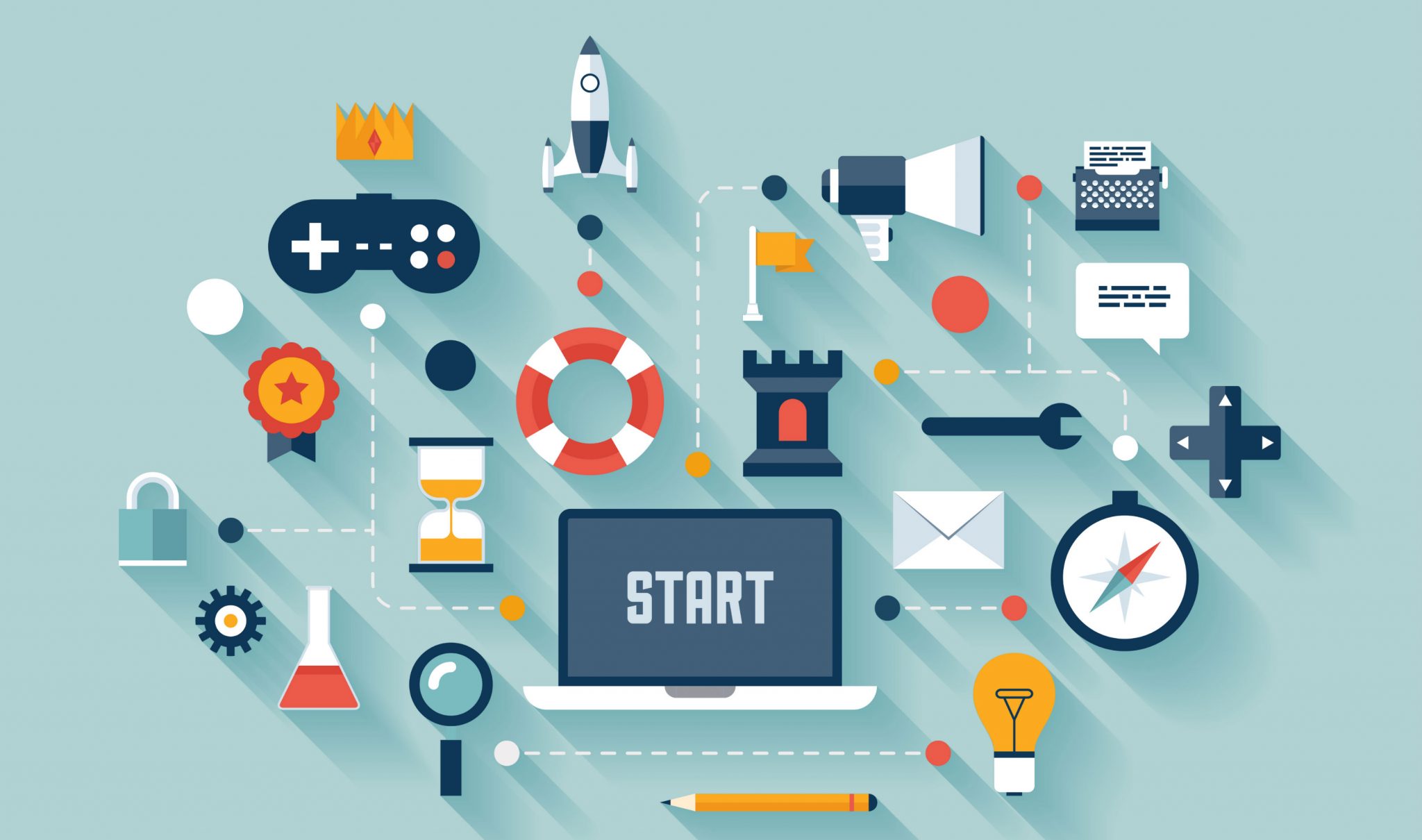
Gamification in eLearning refers to applying gaming mechanics to teaching methodologies to create an engaging learning experience. The term gamification was advanced by Nick Pelling in 2002. Though gamification can be employed in traditional classroom teaching through various activities, it has a wider application in eLearning as well.
Learners engage in competitions where the rewards can be points, levels, badges, gift cards, vouchers, and so on. Some of these are a part of typical video game mechanics. The learners engage in learning activities, and they become a part of the game dynamics where every participant is connected.
Moreover, this connection fosters positive motivation, and the participants advance by collaborating. Gamification stokes the innate interest and curiosity of learners as they participate in learning activities, and it encourages them to be consistent in their learning and knowledge application.
How to use Gamification in eLearning?
Education has come a long way from traditional classrooms. As a result, with the ubiquity and evolution of technology, online learning platforms are becoming increasingly popular.
A major deterrent to eLearning is that it does not allow learners to directly interact with the trainer/teacher during lesson delivery.
Typically, a teacher aims to inculcate knowledge, motivates learners, and tries to ensure that the gained knowledge is retained. This may prove to be particularly difficult when lessons are provided over the internet. As a result, the very fundamental requirement of learner participation in the teaching-learning process may go unfulfilled.
This is where gamification steps in.
Gamification in eLearning fills this gap by creating a competitive environment promoted by incentives that motivate the learners to succeed. But then how is a game different from gamified learning?
The answer lies in the fact that gamified lessons employ game mechanics that induce game-like reactions toward learning. Similar to a video game, factors such as time constraints/countdowns and/or rewards are added to learning. These features provide learners a game-like experience, which employs game mechanics for engaging knowledge delivery.
The gamification of a lesson accounts for a better understanding and retention of knowledge. The reason is that it is a learner-centered outlook and an emerging new aspect of teaching and learning.
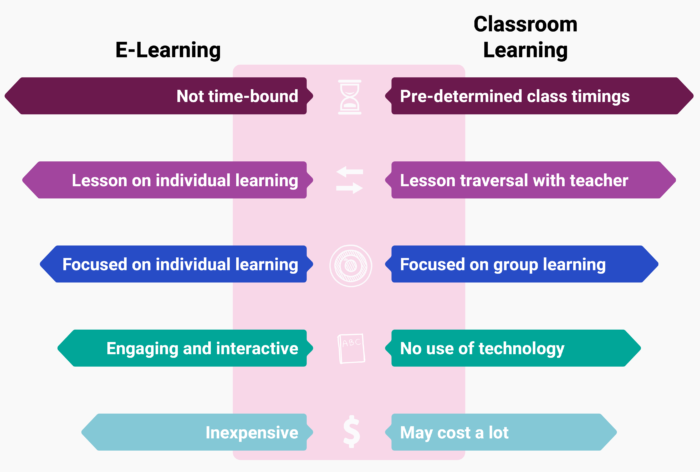
Demand for Gamification in eLearning
Teaching in a virtual classroom is markedly more demanding than teaching in a traditional classroom. Delivering a credible lesson in a virtual classroom requires comparatively more effort and preparation on the part of teachers.
Gamification in eLearning eases this additional pressure on teachers.
Gamification allows and serves to fulfill the fundamental requirements of classroom learning. The pointers that lead to a demand for gamification in eLearning are:
1. Foster interest
A gamified lesson develops the interest of learners, thus ensuring effective lesson delivery in a virtual classroom.
2. Hook the learners
A lesson designed through gamification techniques grabs the attention of learners faster than traditional lessons. This ensures that learners are hooked to what is being taught in the class and participate actively.
3. Stimulate better retention
An interesting lesson induces certain emotions in the learners that stimulate reactions. These reactions lead to better retention of concepts.
4. Practical application
In the gamified virtual learning approach, students learn through experience. This creates a stimulus for an effective practical application of the knowledge gained.
5. Assurance of progress
Gamification keeps track of a learner’s progress. This eventually motivates students to work harder and to discover and apply new knowledge.
Gamification in eLearning has become a major avenue for learning in the current world. It has opened doors for the development of highly effective teaching-learning processes, where learners gain knowledge through experiential learning. Gamification can thus be considered a futuristic approach to learning.
Read Part II of this series to learn more about the applications of gamification in eLearning.
Read more about gamification here.
Image source: Shutterstock
eLearning/Classroom Learning image designed using Freepik
Visit our blog for further reading on Gamification.

Create. Engage. Inspire.
The post Gamification in eLearning appeared first on Test.Evelyn.
]]>