The post Flipped Classrooms Model: A New Gateway To Learning appeared first on Test.Evelyn.
]]>As goes the saying, education is never a one-way process. Unless the learner is made to relate to the information they are loaded with, one cannot produce thinking individuals. In the light of making learning a more interactive experience for the learners, a relatively modern approach to education is now becoming ubiquitous in the education ecosystem. This method entails the use of electronic and online tools in conjunction with traditional classroom learning as part of imparting knowledge and is called Blended Learning. There are many successful teaching practices that employ blended learning, and one of them, which has caught the attention of most educationists everywhere, is the Flipped Classrooms concept.
What Is A Flipped Classroom Model?
Suggestive enough by the name, a flipped classroom upturns the traditional classroom methodology wherein the teacher simply imparts information related to the topic being taught while the students just follow her moderation with no or very little scope of interaction beyond bounds. Simply put, in a flipped classroom setting, the teacher and the students engage in discussing the subject and explore the intricacies together as scholars rather than just playing roles of teacher and student as in a traditional classroom.
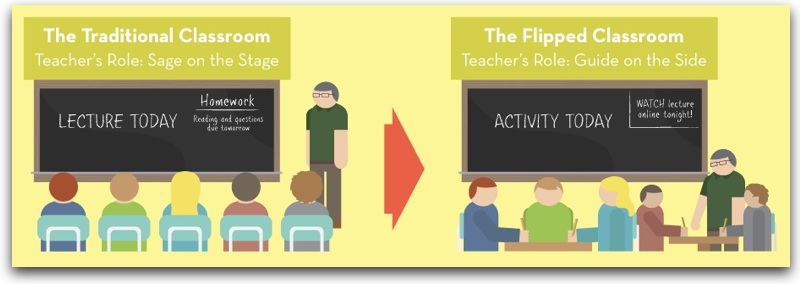
The coursework or the learning content is provided to the students even before they enter the classroom, usually via online mediums, in the Flipped Classrooms approach to teaching. The students are expected to familiarize themselves with the coursework outside the classroom. What goes on inside the classroom in the presence of a teacher is an interactive session for exchanging the ideas of the students, clarifying problems, if any, and practicing relevant concepts.
Flipped Classroom As A Tool of Blended Learning
Since the Flipped Classroom approach is a type of blended learning, online learning is a core part of this concept. The students watch online lectures, synchronously or asynchronously, and engage in online discussions. Moreover, they may carry out research related to the curriculum at home. Additionally, the students delve deeper into the topic during the class. Activities such as reviewing, which have been traditionally associated with homework, are performed during the class as well.
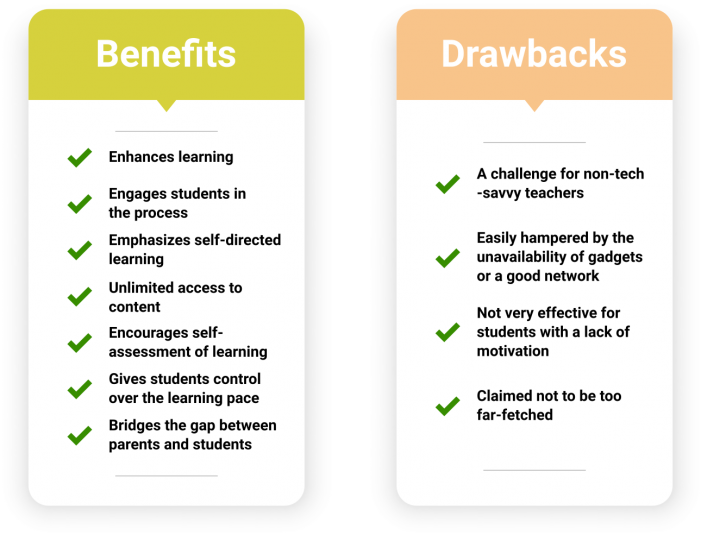
Drawbacks and Benefits of Flipped Classroom Model
Promoters of the Flipped Classroom Model
The concept of Flipped Classrooms has perhaps been the most widely recognized due to the popularity of a book published by chemistry teachers Jonathan Bergmann and Aaron Sams in 2012. They implemented the Flipped Classroom approach in their class and published their findings through the book.
Another propagator of the Flipped Classroom style of teaching was Sal Khan, the founder of Khan Academy, a free online education platform. It provides thousands of instructional lectures on Math and Science. These lectures are free to access for one and all.
Is the Flipped Classroom Approach Really Effective?
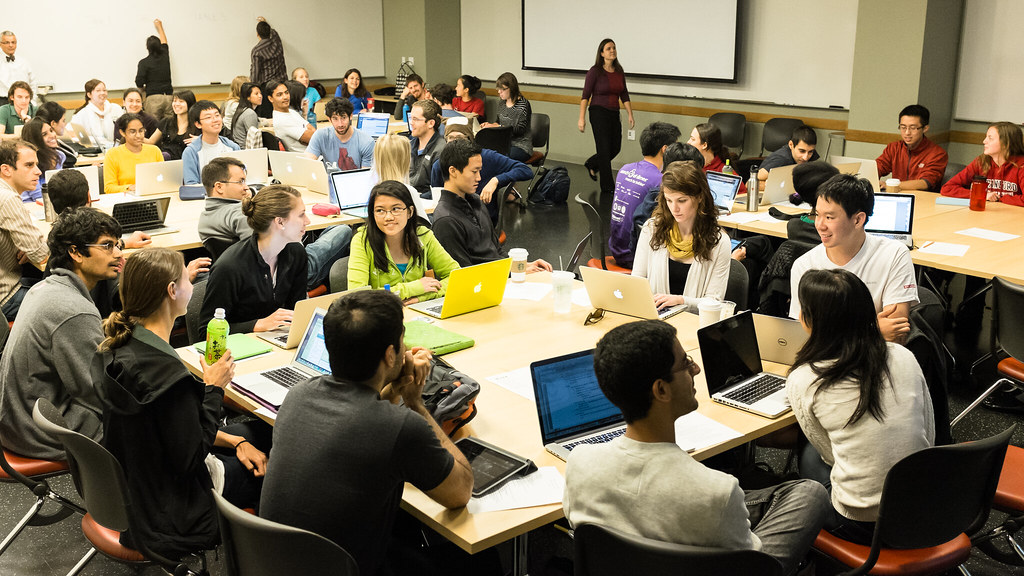
With the advent of technology, this teaching practice can be practically applied to teach certain groups of students. For example, at the university level.
So, the question isn’t “can it be done?”. The question is “whether it should be done?”.
The general consensus reached by the education community is that, under the right conditions, the Flipped Classrooms approach is one of the most ideal methods to dive deeper into the course curriculum and teach students efficiently.
Removing lesson delivery from the list of things done in the classroom frees up precious time. It is best to use this time judiciously, further understand the topic, collaborate, and employ activities that promote long-term retention, and develop problem-solving skills.
You can get more information about Jonathan Bergmann and Aaron Sams’s book here.
Read about the practical implementations of the Flipped Classrooms approach on this slideshare post by Michelle Pacansky-Brock and NC State Uni blog post by Jimmy Ryals.
Images: Wikimedia, Pixabay and Flickr.
For further reading related to pedagogy and education standards, visit our site.
Create. Engage. Inspire
The post Flipped Classrooms Model: A New Gateway To Learning appeared first on Test.Evelyn.
]]>