The post Creating Video-Based Educational Courses appeared first on Test.Evelyn.
]]>Steps to Create a Video-Based Education Course
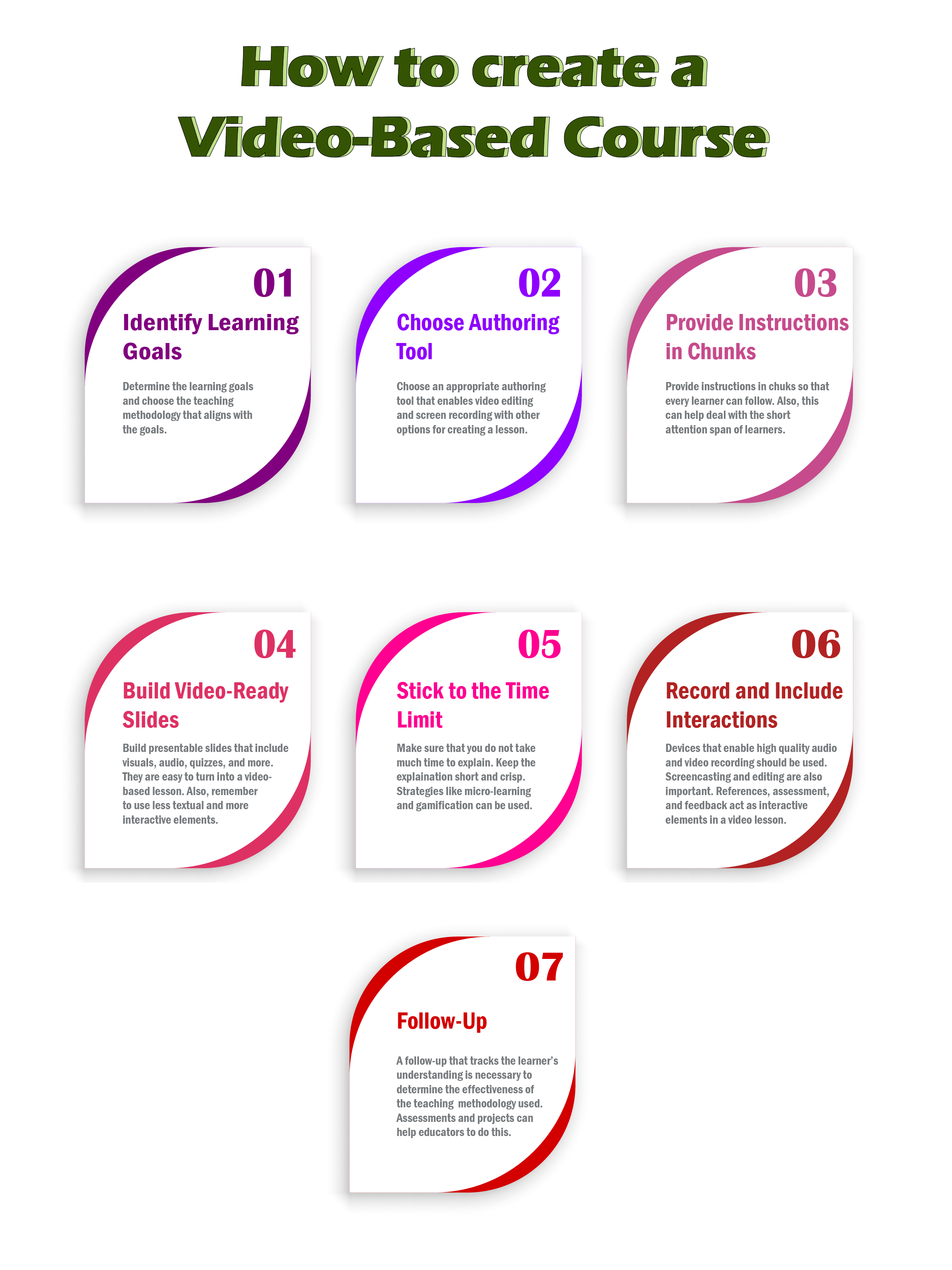
Step-1: Identify the Learning Goals
Identification of the learning goals is the first step for creating a video-based course or lesson. Educators must first determine what the learners wish to achieve through a lesson/course. This helps identify the appropriate teaching methodology that aligns with the teaching and learning goals.
Educators can also consult a subject-matter expert or a graphic designer for professional advice on creating a video-based course.
Step-2: Choose the Correct Authoring Tools
To use the video-based education method, educators must be familiar with different authoring tools and their use. These authoring tools assist in creating digital content for various purposes. They also allow educators to develop various forms of digital content with ease. This digital content covers everything from a simple MS Word document to video lessons on complex STEM concepts. Thus, choosing the correct authoring tool that enables video editing along with screen recording becomes essential.
Several authoring tools on the Internet offer these features for free or with a minimum fee to access certain features. For instance, Camtasia Recorder allows educators to create different types of videos with pre-built templates. It also provides video recording and editing. Khan Academy uses Camtasia Recorder to create and edit educational videos.
Other options include SmoothDraw3, Articulate 360, Adobe Captivate, Lectora, and so on.
Step-3: Provide Instructions in Chunks
An average learner’s attention span is about 8 seconds, which is a short period. Expecting young learners to sit for a 90-minute video lesson is out of the question. Also, learners find it difficult to follow a large set of instructions in one go. A well-organized class with crisp and meaningful chunks of information works better to engage learners.
Moreover, learners prefer several small videos instead of a single long video. Some platforms that offer video-based learning include Khan Academy, Lynda, Udemy, Coursera, TED-Ed, and more.
Step-4: Build Video-Ready Slides
Presentation is the key to engaging learners. It provides better learning outcomes as learners immerse themselves in the learning process. Educators often use digital means to supplement in-class learning. However, presentations are not sufficient for video-based education because the supplementary material contains more textual information, which the teacher explains. However, in video-based education, educators do not involve themselves directly in the class. The entire process of learning takes place through on-screen videos. Thus, it becomes difficult to capture learner attention with text-only slides. Therefore, educators must include more visuals and other interactive elements like quizzes and puzzles instead of text.
For instance, a science lesson on Resonance Structures of Benzene containing visuals that include chemical compound structure is easier to understand than just plain text. Text-only information on such complex topics can confuse the learners. Also, learners are likely to be uninterested in learning such complicated concepts through text. As a result, video-based courses also affect learning outcomes.
Step-5: Stick to the Time Limit
As mentioned earlier, a typical learners’ attention span is small. This signifies that they cannot sit and watch educational videos for long. Consequently, it is crucial to stick to the time limit while creating video-based lessons. Educators can use different strategies like micro-learning and gamification to improve learner engagement. Additionally, eLearning localization is an excellent strategy to cater to the learning needs of diverse learners.
Moreover, several small videos with digestible chunks of information are better than longer ones. Khan Academy presents the most significant example of this form of learning. They offer lessons in the form of short videos with relevant information about the topic.
Step-6: Record and Include Interactions
Recording a lesson is an essential part of creating a video-based course. Various tools available on the Internet allow educators to perform different functions of video-based education. These functions range from recording and screencasting to video editing.
Additionally, including interactions in the form of references, assessments, and feedback is essential. Such forms of interaction help create a link between learners and the concepts they are learning. It eventually renders better learning outcomes.
Step-7: Follow Up
The final step is to follow up with learners about what they have learned. This step includes tracking the results based on their performance in the assessment tests. Also, follow-up helps educators decide whether the teaching methodology applied is fruitful or not. Moreover, it provides a clear picture of the learner’s performance throughout the course.
The steps and guidelines mentioned for creating video-based education courses can help educators establish useful video-based lessons/courses. Above all, a crucial step to follow is to be genuine while delivering the lesson. The impact of the educator’s personality leaves a significant mark on learners and their learning.
Moreover, educators must know the essentials of delivering an e-lesson before they work with video-based education. This can help provide the initial experience required to teach a lesson/course effectively.
Reference Websites: Edutopia and ELearning Industry
Images: Shutterstock and Freepik
To explore more e-learning options, visit our blog.
Create. Engage. Inspire.
The post Creating Video-Based Educational Courses appeared first on Test.Evelyn.
]]>The post Benefits of Video Based Learning appeared first on Test.Evelyn.
]]>What are the Benefits of Video-Based Learning?
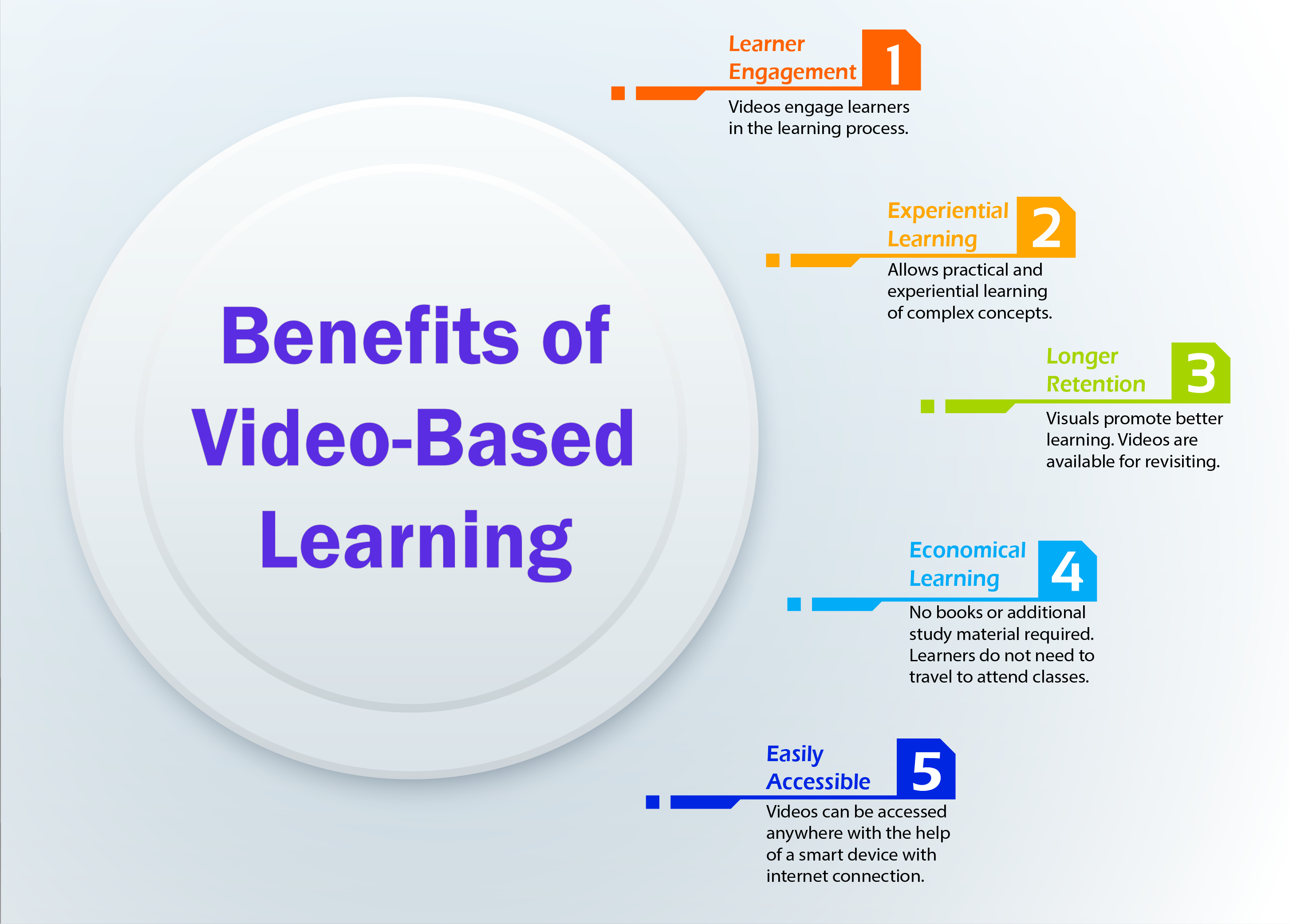
a) Learner Engagement
Videos are an interactive way of learning. Learners are likely to engage more with videos in contrast to text-only content. This is because videos include visuals that paint a clear picture of concepts. Also, educators can use non-verbal cues to their benefit in such type of courses. Non-verbal communication such as intonation when combined with questioning skills promotes engagement. This strategy is not only effective for in-class teaching but also works for video-based learning.
Moreover, videos grasp learner attention with the help of colorful and interactive visuals. As a result, learners remain constantly engaged with the visuals while learning.
b) Experiential Learning
Learning by doing is the key to achieve the best learning outcomes. The practical knowledge of a concept is necessary along with theoretical knowledge, but this practical knowledge is limited to certain subjects. For instance, learners cannot dissect a human body by themselves to study human anatomy. However, videos provide a solution for such situations that limit learning. Learners can learn about anatomy through videos that show the human body through virtual reality. In this way, the actual practical learning takes place with the help of videos.
c) Longer Retention
Videos are an amalgamation of text, visuals, and sounds. All these form the basis of learning. Studies suggest that the average adult retains 10% of what they hear, 20% of what they read, and 80% of what they see. This is because the human brain processes visual information better than verbal or written information. Consequently, when the brain receives information in a combination of text, visuals, and sounds, it becomes easier to retain.
Furthermore, videos are much more engaging than mundane classroom lectures. Learners interact with the content on the screen and are free to revisit the lessons/courses at their will. This means that they are free to practice the concepts based on their convenience. This eventually leads to better learning and retention.
d) Economical Learning
Video-based learning is an economical learning solution. Learners have access to various educational videos available on the Internet. Most of these videos are available for free or at minimum charges. Also, video-based learning does not require traveling or attending classes physically. This helps learners save time and money that would otherwise be utilized.
Moreover, there is no requirement for books and other study material. Only a good Internet connection and a smart device can serve as the tools for receiving knowledge.
e) Easily Accessible
Videos are one of the most easily accessible resources in the current era. This is thanks to technology and the Internet, which provide easy access to all online services. Learners can access any videos on the concepts they wish to learn without having to spend much time finding a teacher. Moreover, videos are always available for reviewing to recapitulate a lesson/concept.
Additionally, technology enables educators to create learning videos on their own. There are various tools available on the Internet that help create an e-learning course.
(Read our blog on Creating a Video-Based Learning Course for more information.)
Future of Video-Based Learning
Auditory learning is gradually becoming a thing of the past. The Internet presents various new learning possibilities. Consequently, eLearning is gradually becoming a go-to learning method. It serves learners with different e-learning styles with an amalgamation of various teaching/learning methods. Video-Based Learning is a great way of administering knowledge. This is because videos immediately grasp the learners’ attention.
Although videos are a part of eLearning, they also supplement in-class learning. Various forms of blended learning (including the flipped classroom) use eLearning to supplement in-class learning. This yields better learning outcomes and also promotes better retention.
Video-based learning will have more consumers in the future, which is due to its ease of usability and application in a wide gamut of industries. It is not only useful for learning but also serves various corporate training and learning needs. Additionally, with technology and resources gradually becoming available to all, creating educational videos will be much easier in the future. As a result, it has great potential to play a prominent part in the future of eLearning.
Research Website: ELearning Industry
Images: Shutterstock and Freepik
To explore more e-learning options, visit our blog.
Create. Engage. Inspire.
The post Benefits of Video Based Learning appeared first on Test.Evelyn.
]]>