The post Formative Assessment Tools For Classroom Learning appeared first on Test.Evelyn.
]]>Features Of Good Formative Assessment Tools
The following features should be present in a good formative assessment tool:
- It should be goal-oriented and based on what we do daily. A good formative assessment is precise, tangible, and measurable since it is intended to assist students in performing well.
- Formative assessment tools need to concentrate on higher-order thinking abilities. We are not just concerned about the nuts and bolts but also need to know if the students are using the higher levels of resources to submit, analyze, evaluate, and develop.
- It should keep students responsible for their results. In and of itself, group evaluation is beneficial. Furthermore, pinpointing the specific needs of the person will provide you with direction in which to guide your teaching, ensuring that the students are successful.
- Good formative assessment tools should be smooth, and you should not have to alter your daily routine to accommodate the exam. Some formative assessment tools have a steep learning curve, while others are simple to understand even though you have no prior experience. You may need to incorporate formative evaluation into your lesson. Some of it can be done on the fly, but others will need planning.
Top Formative Assessment Tools For Classroom

Students can be motivated to pursue learning goals as a regular and continuous part of their everyday routine using digital formative assessment tools. Here are five free formative assessment tools to assist you in integrating technology into your classroom. The list includes a wide range of features and alternatives to aid in the development of your formative assessment strategy.
1) Socrative:
Socrative offers real-time scoring on quizzes and questions. According to various online reviews from teachers and qualified reviewers alike, Socrative is one of the top-rated formative assessment tools for teachers. It is an immersive digital platform that allows you to quiz, score, and test on the fly; “learning at the speed of light.” Fast queries for immediate input, class counts to see who is logging in, and complete quizzes for deeper comprehension are all available to teachers.
Build surveys, activities, and shuffle questions with or without student names using this powerful method. Quizzes are graded in real-time and can be saved for later use for different classes. It operates on MS Windows, Android and iOS phones, tablets, laptops, and other computers. It is completely free for students, apart from being straightforward, adaptable, and aligned with Common Core.
2) Padlet:
Padlet is a virtual wall where students can share their thoughts on a given subject. You may embed audio and video in addition to written speech and have students answer in the form of a structured discussion. It is also possible to create separate Padlet for different classes or groups of students using password protection. For instance, using Padlet, you might have students identify keywords and address areas of agreement and disagreement with what their classmates have written.
3) Google Forms:
Google Forms is an easy-to-use, COPPA/FERPA-compliant tool. What is the best reason to use Google Forms as an educational formative assessment tool? The ease with which it can be used. Even if it is your first time using Google Forms, it is a favorite among teachers because it is fast and easy to build and automatically grade quizzes.
Make multiple-choice or short-answer quizzes with a simple answer key that includes point assignments for each problem. Students can quickly respond to questions by selecting an option from a drop-down menu, typing a quick text response, or uploading a short YouTube video to Google. For a fast bird’s-eye view of the class as a whole, teachers can view graphs and summaries of often missed responses.
4) Mentimeter:
Among evaluation instruments used in the classroom, professional reviewers and teachers give Mentimeter a high rating. It includes a listening skills assessment, icebreakers, formative tests, post-lecture surveys, and polls, as well as other educational models for the classroom. Create quizzes and assessments, monitor academic standards, engage students, and even lead a teacher training session.
Mentimeter not only gives everyone a voice but also has a handy feature that allows you to silence extra-loud students. It is completely free to use and allows you to build and host live quizzes using templates or from scratch. For a few dollars a month, schools and universities can get a Pro edition that includes unlimited question slides per presentation, exports, unlimited quizzes, and help. The user interface is easy on a 101 basis, with tech support available to smooth out the kinks.
5) Kahoot:
Kahoot‘s game-based approach to learning and evaluation is a hit with students. Teachers can select from over 40 million ready-to-use learning games or quickly build their own. Organize games in real-time or as tasks.
Students may also make their own “kahoots” to share with their peers, making the activity more social. In minutes, you can create a quiz game, import questions from spreadsheets, and check their 500-million question bank. Want to incorporate sketches from your iOS device or merge multiple mini-kahoots into a single assessment? That is something Kahoot can do, besides incorporating YouTube videos into your questions.
Teachers can apply multiple choice or true/false questions to the evaluation games, which students can schedule individually or in groups. The games are paced and graded, with the instructor establishing point scales. You can also download basic spreadsheet reports.
Concluding Remarks
In the physical classroom, it is simple to measure student success. We take for granted that paper assessments, quizzes, and spot questions are among the instruments used in the evaluation. For personalized virtual learning, the best online evaluation tools for teachers provide the same degree of input.
Formative assessment has the advantage of being completed when students are still learning. Formative evaluation methods that are fast and enjoyable are ideal for checking in on certain learning journeys. One final piece of advice is to choose one formative appraisal and personalize it. Do not attempt too many at once. Use one before the students have figured out how to do it and you have figured out how to interpret the data.
Read more about assessments on other blogs.
Image Sources: Shutterstock and Unsplash
For more information on formative assessment tools, visit our blog.

Create. Engage. Inspire.
The post Formative Assessment Tools For Classroom Learning appeared first on Test.Evelyn.
]]>The post Assessments: Different Types, Importance, & More appeared first on Test.Evelyn.
]]>Assessment is a comprehensive term. It is the assimilation of a plethora of activities that assist with learning. This article demonstrates the concept of assessment, its types, and its importance.
What are Assessments?
Assessments are often mistaken with standardized tests that determine grades and ranks. In reality, assessment is an umbrella term that incorporates standardized tests and many other forms of evaluation. It refers to a wide range of methods that educators use to assess learners at different levels of learning.
In other words, assessment refers to the systematic gathering of information that evaluates, measures, and documents the performance of learners to give a clear picture of their academic readiness, learning progress, and acquisition of skills. Moreover, assessments help identify the strengths and weaknesses of the students. This helps teachers modify their teaching techniques according to the students’ learning requirements.
Other than providing diagnostic feedback, assessments motivate students as well as teachers in different ways. Students get a chance to demonstrate their skills and improve through self-assessment, and teachers get directions to help the students perform better in learning through improved instructions.
Types of Assessments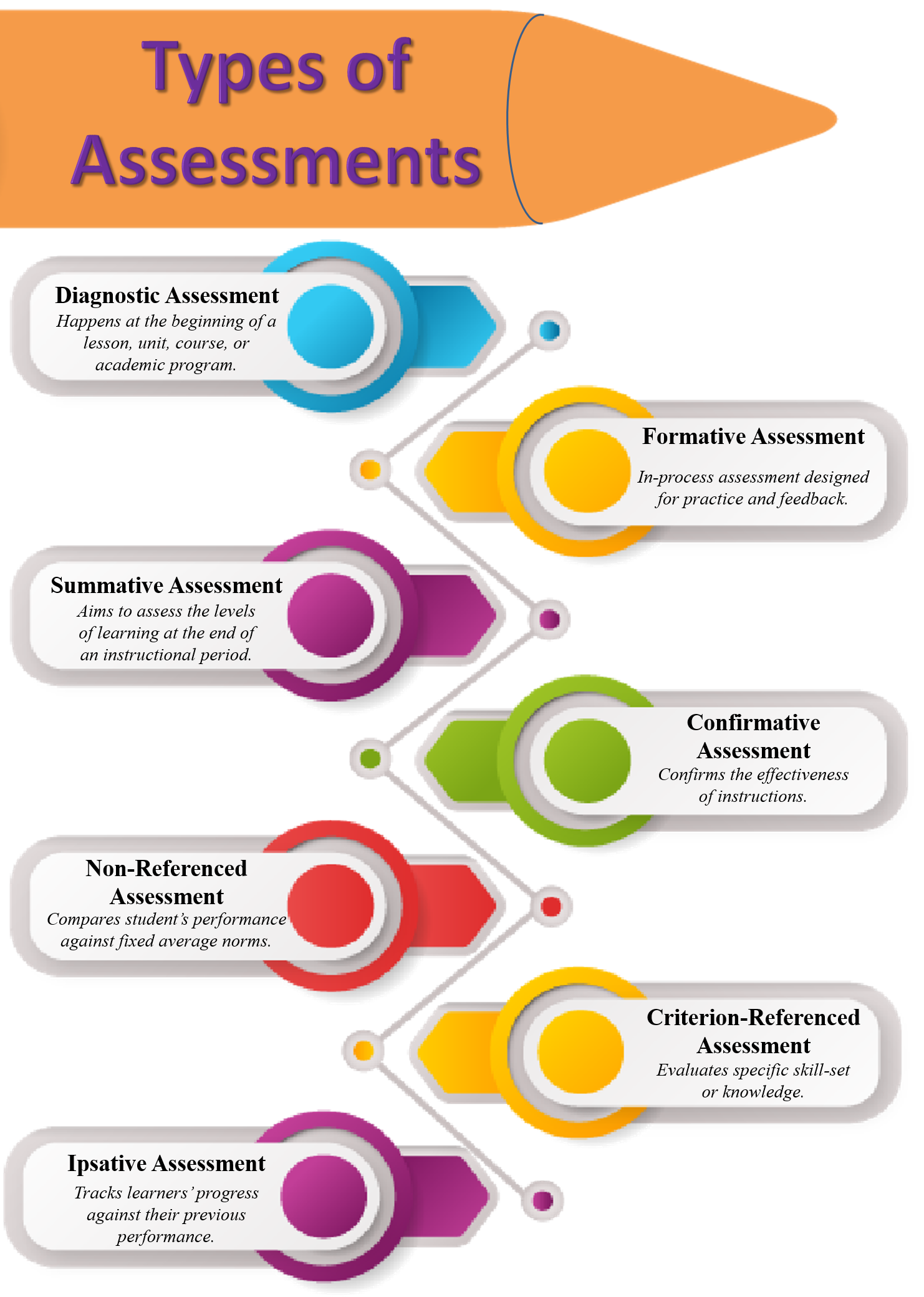
Assessment is vital not only for grading and determining the learners’ knowledge base but also for assessing their abilities to organize and structure the knowledge to apply it to complex situations. Thus, it serves a wide variety of purposes in education.
Some of the most important types of assessments are:
1. Diagnostic Assessment or Pre-Assessment
Diagnostic or pre-assessments happen before the beginning of a lesson, unit, course, or any academic program. They are useful for collecting information about the strengths, weaknesses, skills, and knowledge the learners possess. Instructions are designed thereafter as per the learners’ requirements.
2. Formative Assessment
These are the in-process assessments that support learning. A teacher administers formative assessment multiple times during a unit, lesson, or course. They are particularly designed for practice. Additionally, the most important function of formative assessment is to monitor learning and provide feedback to modify instructions.
It acts as a form of continuous learning, covering small content areas while also monitoring the learning process. However, such types of evaluations do not assign ranks and grades.
3. Summative Assessment
This type of assessment aims to assess the learning levels at the end of an instructional period. It attempts to measure the effectiveness of learning, the student’s proficiency, and their success. For this, this method uses tests, assignments, and projects for specific grading and ranking of students.
Moreover, it measures the knowledge, skills, and attitude of the learners in the long run. Hence, it gives an insight into the students’ performance as well as the effectiveness of a teacher’s instructions.
(For more information and detailed comparison, read Formative vs Summative Assessment.)
4. Confirmative Assessment
As the name suggests, confirmative assessment is a way to confirm the effectiveness of instructions a year after the end of an instructional period. The ultimate goal here is to check whether the employed instructional strategies are still successful and that the teaching is accurate. Therefore, they are, most importantly, an extensive form of summative assessment.
5. Norm-Referenced Assessment
In this assessment, teachers compare a student’s performance against certain fixed average national norms. For instance, the average grade in English state-wise.
Moreover, it compares the students’ performance with their peers in a competitive environment. Here, the average grade comparison is with the entire school. Hence, this assessment is also referred to as Group/Demographic Assessment.
6. Criterion-Referenced Assessment
Criterion-referenced tests evaluate specific skill-set or knowledge against pre-determined criteria of learning. It checks the learning requirements and abilities of the students at a particular learning stage. These tests evaluate the students on specific goals, objectives, or standards. In other words, it evaluates the entire course curriculum.
7. Ipsative Assessment
Ipsative assessment tests track the learners’ progress against their previous performance. The learners attempt to improve through comparison with previous results.
This type of assessment considers the fact that comparison with peers is not always a good idea as it might affect their self-confidence. However, comparing with personal previous results helps improve the overall knowledge and personality of the learners.
Articles Referred: Toppr and EasyLMS
Images: Shutterstock and Freepik
For more information, visit Evelyn Learning blog.

Create. Engage. Inspire.
The post Assessments: Different Types, Importance, & More appeared first on Test.Evelyn.
]]>The post Assessments: Formative v/s Summative Assessments appeared first on Test.Evelyn.
]]>What is Formative Assessment?
A formative assessment serves as a practice of the concepts learned. Moreover, it is specifically designed to monitor student learning and provide feedback to improve teaching. This means that formative assessment helps the students to identify their strengths, weaknesses, and improvement areas. Also, it helps the teachers to identify the learning issues that the students face and devise methods to resolve them.
However, formative assessments are not always about grading. The primary objective of formative assessments is to enhance the understanding and competencies of the students. Also, it gives a fair idea about the student’s needs and progress while they engage in activities like quizzes, conversations, and more.
What is Summative Assessment?
In contrast to formative assessments, summative assessment is a graded assessment that generally occurs at the end of a course. It is a periodical process that evaluates the overall learning, knowledge, proficiency, and success of the students along with the effectiveness of a course/program.
Moreover, unlike the practice-oriented formative assessment, summative assessment evaluates the students on their performance in standardized tests. The test scores, percentages, and grades determine the student ranks and indicate the quality of the curriculum. Thus, this type of assessment is result-oriented.
Formative vs Summative Assessments
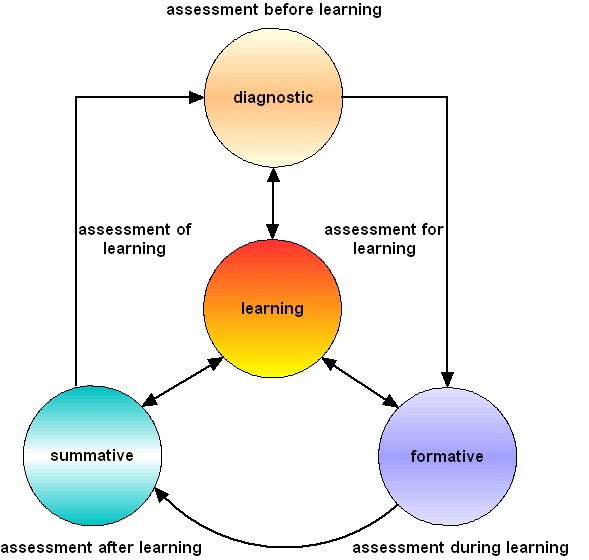
Both formative and summative assessments are related yet different. As modes of evaluation, both tend to evaluate the areas of learning. A side-by-side comparison of both makes the differences obvious.
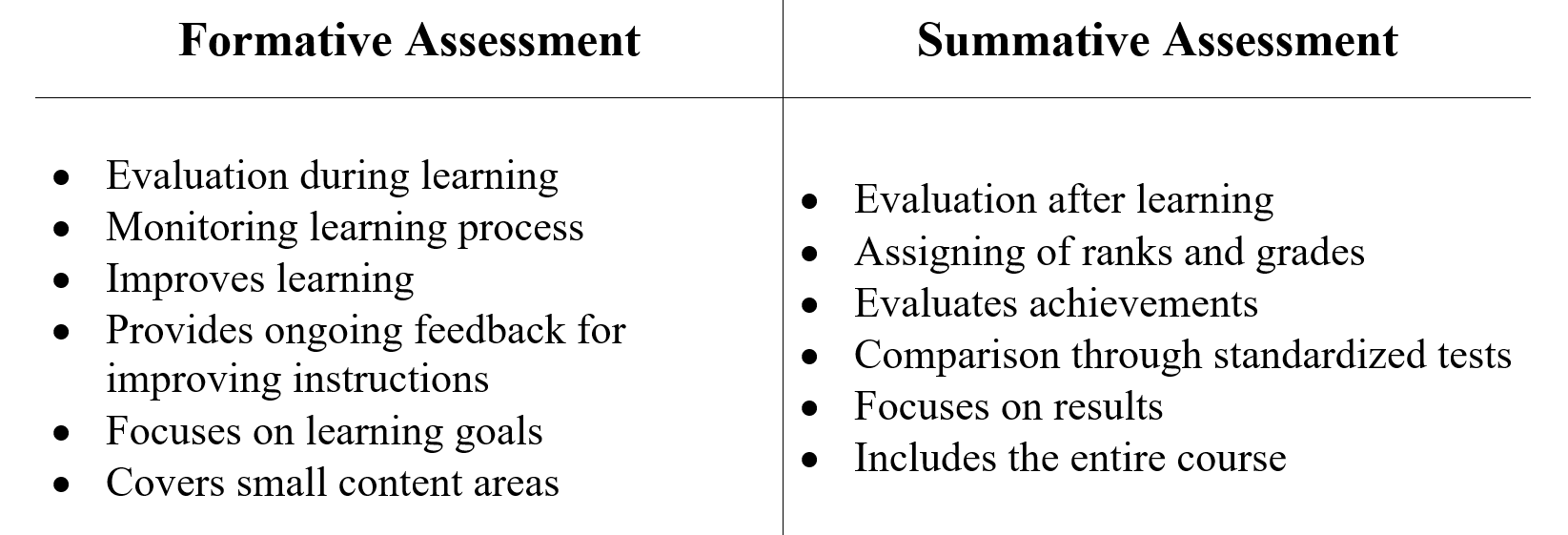
Examples of Formative and Summative Assessments
Formative Assessment
A formative assessment is often conducted in the form of various fun and interactive activities. Such activities engage students and induce learning. For instance:
- Classroom Discussions
- Group Activities
- Homework Assignments
- Polls, Surveys, and Quizzes
- Reflection Writing Assignment
- Class Presentations
- Educational Games
Summative Assessment
A summative assessment takes place at the end of a unit/course. It measures the students’ learning and determines their rank, grades, and percentages. Thus, it can be conducted in the following forms:
- Standardized Tests
- Final Reports and Projects
- End of Unit Tests
- Achievement Tests
- Final Presentations
- Mid-Term Examinations
- End-Term Examinations
Therefore, Formative and Summative assessments play an important role in the assessment of learning. While formative assessments encourage communication and cooperation among peers, summative assessments serve the purpose of evaluation. This implies that formative assessment is qualitative, whereas summative assessment may be considered quantitative in nature.
Moreover, summative assessment primarily takes into account the percentages, marks, and grades that often overshadow the qualitative aspects of learning and the skills acquired by the student. Therefore, the right balance of assessment methods must be employed for effective conduct and evaluation of learning.
Read more about assessments in our previous blog.
Research article: AES Education
Images: Shutterstock
For more information, visit Evelyn Learning blog.

Create. Engage. Inspire
The post Assessments: Formative v/s Summative Assessments appeared first on Test.Evelyn.
]]>