The post Benefits of Video Based Learning appeared first on Test.Evelyn.
]]>What are the Benefits of Video-Based Learning?
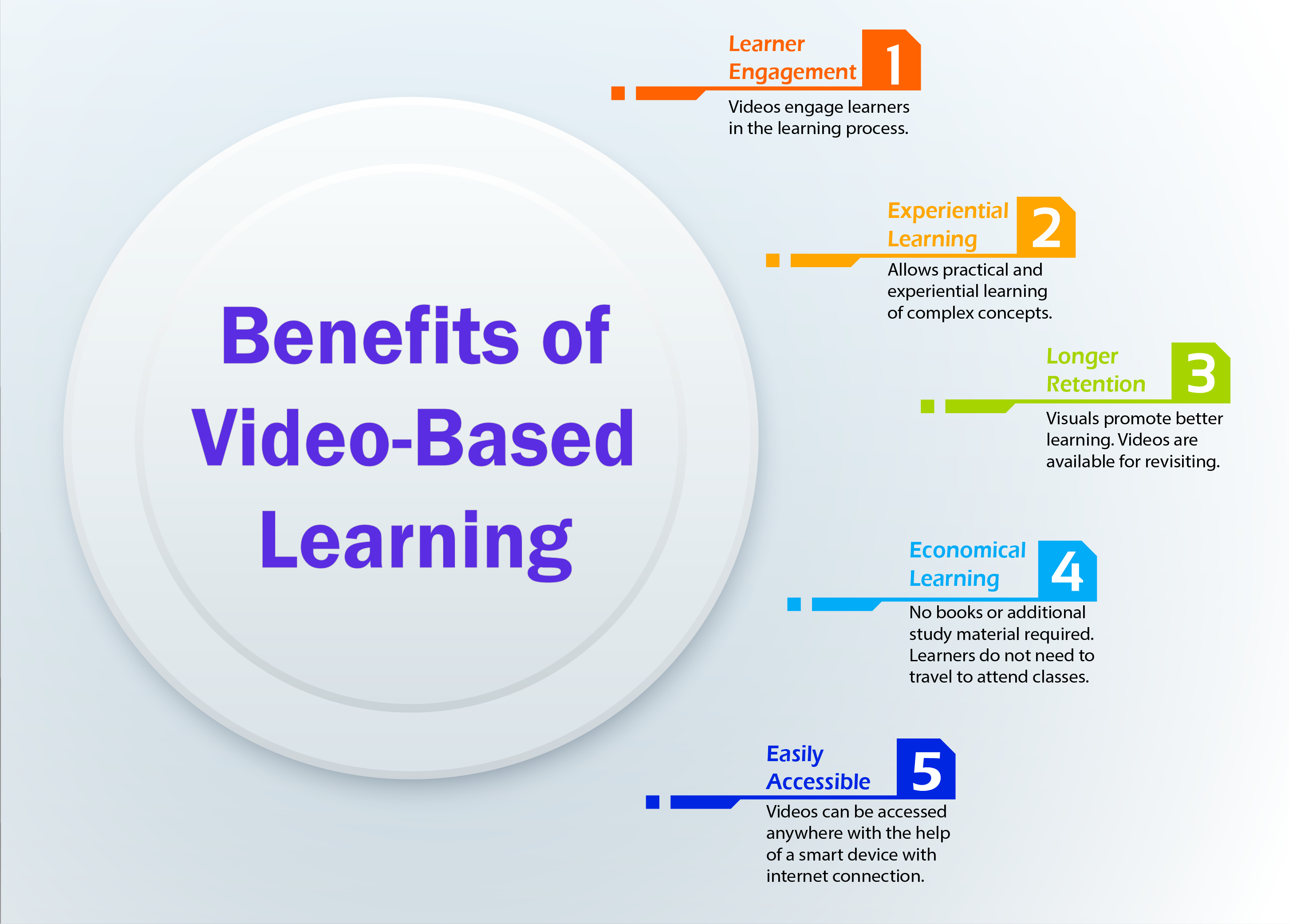
a) Learner Engagement
Videos are an interactive way of learning. Learners are likely to engage more with videos in contrast to text-only content. This is because videos include visuals that paint a clear picture of concepts. Also, educators can use non-verbal cues to their benefit in such type of courses. Non-verbal communication such as intonation when combined with questioning skills promotes engagement. This strategy is not only effective for in-class teaching but also works for video-based learning.
Moreover, videos grasp learner attention with the help of colorful and interactive visuals. As a result, learners remain constantly engaged with the visuals while learning.
b) Experiential Learning
Learning by doing is the key to achieve the best learning outcomes. The practical knowledge of a concept is necessary along with theoretical knowledge, but this practical knowledge is limited to certain subjects. For instance, learners cannot dissect a human body by themselves to study human anatomy. However, videos provide a solution for such situations that limit learning. Learners can learn about anatomy through videos that show the human body through virtual reality. In this way, the actual practical learning takes place with the help of videos.
c) Longer Retention
Videos are an amalgamation of text, visuals, and sounds. All these form the basis of learning. Studies suggest that the average adult retains 10% of what they hear, 20% of what they read, and 80% of what they see. This is because the human brain processes visual information better than verbal or written information. Consequently, when the brain receives information in a combination of text, visuals, and sounds, it becomes easier to retain.
Furthermore, videos are much more engaging than mundane classroom lectures. Learners interact with the content on the screen and are free to revisit the lessons/courses at their will. This means that they are free to practice the concepts based on their convenience. This eventually leads to better learning and retention.
d) Economical Learning
Video-based learning is an economical learning solution. Learners have access to various educational videos available on the Internet. Most of these videos are available for free or at minimum charges. Also, video-based learning does not require traveling or attending classes physically. This helps learners save time and money that would otherwise be utilized.
Moreover, there is no requirement for books and other study material. Only a good Internet connection and a smart device can serve as the tools for receiving knowledge.
e) Easily Accessible
Videos are one of the most easily accessible resources in the current era. This is thanks to technology and the Internet, which provide easy access to all online services. Learners can access any videos on the concepts they wish to learn without having to spend much time finding a teacher. Moreover, videos are always available for reviewing to recapitulate a lesson/concept.
Additionally, technology enables educators to create learning videos on their own. There are various tools available on the Internet that help create an e-learning course.
(Read our blog on Creating a Video-Based Learning Course for more information.)
Future of Video-Based Learning
Auditory learning is gradually becoming a thing of the past. The Internet presents various new learning possibilities. Consequently, eLearning is gradually becoming a go-to learning method. It serves learners with different e-learning styles with an amalgamation of various teaching/learning methods. Video-Based Learning is a great way of administering knowledge. This is because videos immediately grasp the learners’ attention.
Although videos are a part of eLearning, they also supplement in-class learning. Various forms of blended learning (including the flipped classroom) use eLearning to supplement in-class learning. This yields better learning outcomes and also promotes better retention.
Video-based learning will have more consumers in the future, which is due to its ease of usability and application in a wide gamut of industries. It is not only useful for learning but also serves various corporate training and learning needs. Additionally, with technology and resources gradually becoming available to all, creating educational videos will be much easier in the future. As a result, it has great potential to play a prominent part in the future of eLearning.
Research Website: ELearning Industry
Images: Shutterstock and Freepik
To explore more e-learning options, visit our blog.
Create. Engage. Inspire.
The post Benefits of Video Based Learning appeared first on Test.Evelyn.
]]>The post eLearning Styles: An Introduction appeared first on Test.Evelyn.
]]>Our brains combine several methods to process information for faster and easier knowledge acquisition. The many ways in which the brain registers information include visual, aural, verbal, physical, logical, social, and solitary learning.
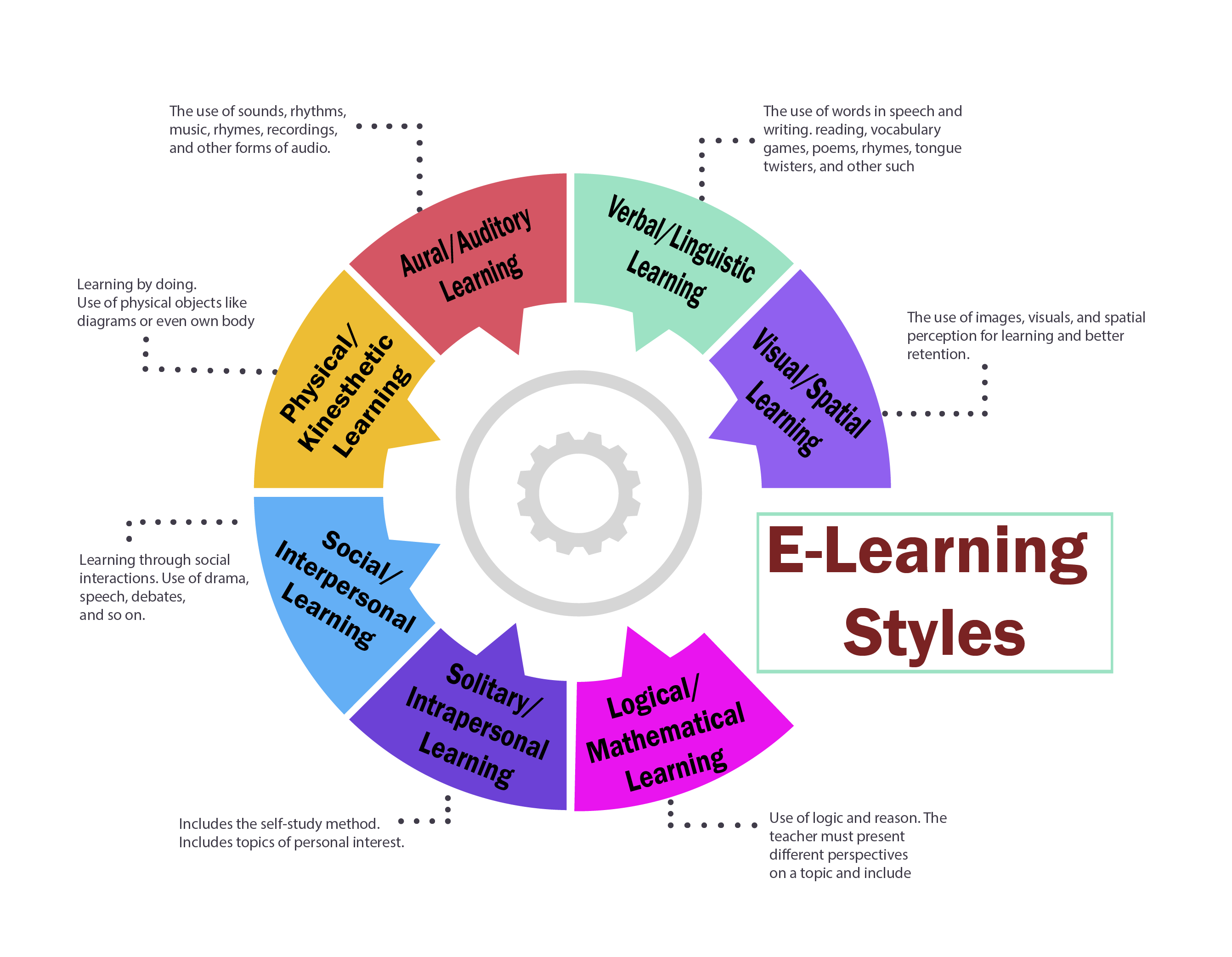
Traditional learning typically uses the linguistic and logical teaching styles, and the range of techniques is limited. However, e-learning offers a wider range of techniques depending on the eLearning styles the learners follow. Educators must know different eLearning styles before beginning to design or teach a lesson/course. The various eLearning styles are as follows:
1. Visual/Spatial Learning
Visual learning entirely constitutes the use of images, visuals, and spatial perception. These traits are native to modern classrooms. Also, the use of images, diagrams, and visual representations promotes learning and better retention. The use of such multimedia in the form of animated videos, images, and illustrations in an e-lesson is an example of visual/spatial learning.
Moreover, visual learners comprise more than 50% of the class. Thus, educators must pay special attention to include visual cues in instruction. This will help maximize learning outcomes.
2. Verbal/Linguistic Learning
Verbal/Linguistic Learning involves the use of words in speech and writing. Linguistic learners express themselves through words and have an extensive vocabulary. This means communication and interpersonal connections are important for such learners. Therefore, interactive learning or group learning is the best method of learning.
Moreover, language learning is the priority of linguistic learners. Consequently, reading, vocabulary games, poems, rhymes, tongue twisters, and other such activities are useful for assisting learning.
3. Aural/Auditory Learning
Aural/Auditory learning involves the use of sounds, rhythms, music, rhymes, recordings, and other forms of audio. Auditory learners make use of sounds to learn and remember things. The tone, pitch, and volume of the voice are the means of expression for such learners. Although they are good listeners, aural learners often initiate discussions as they love to talk.
Furthermore, sound is also a distraction for such learners. Thus, the lessons and activities must contain content that completely engages learners. Some of the best practices for teaching such types of learners include discussion and initiating conversations. Also, using beats, songs, and rhymes helps in the reinforcement of information.
4. Physical/Kinesthetic Learning
Kinesthetic learners are physical learners that usually learn by doing. This means that they use physical objects like diagrams or even their own body to learn. Such learners possess excellent motor memory and usually perform well in art and drama. Also, they are quick to react with their high energy levels and great eye-hand coordination.
Furthermore, the physical eLearning style is an amalgamation of different eLearning styles. Learners gather information in various ways as they touch, feel, and manipulate objects around them. In this way, the learners involve directly in the process of learning.
5. Social/Interpersonal Learning
Social/Interpersonal learning is a style that involves learning through social interactions. This eLearning style entirely depends on communication. Learners communicate with the people around them verbally and non-verbally. Also, social learners tend to be good mentors and counselors.
The educators using the social eLearning style to teach must use activities that involve all learners. Also, frequent breaks and feedback allow informal discussions to reinforce learning. So, activities like drama, speech, debates, and so on are excellent ways to impart education to such students.
6. Solitary/Intrapersonal Learning
Solitary or Intrapersonal learning includes the self-study method. Solitary learners are usually introverts that enjoy quiet and peaceful moments with their thoughts. They are good at focusing and are aware of their feelings and thoughts.
Moreover, learners who prefer solitary eLearning styles assess their goals and accomplishments and experience high levels of motivation. Therefore, the eLearning lesson/course should include topics of personal interest and connect to familiar subjects. Assigning tasks individually can also yield better learning outcomes.
7. Logical/Mathematical Learning
Logical/Mathematical eLearning styles use logic and reason as the basis for learning. Logical learners possess phenomenal logical and reasoning skills. They are known for their inclination towards math, science, and reasoning. Moreover, learners with this style of learning possess great analytical and problem-solving abilities.
While teaching such students, educators must present different perspectives on a topic and include strategic games that emphasize organizational skills.
To sum up, there are several eLearning styles that different learners follow. A teacher must possess good knowledge of these styles to design and deliver effective eLearning lessons/courses. Teachers should also focus on creating effective assessments that employ gamification. Such strategies help achieve the maximum learning outcomes with effective teacher instructions.
Research website: Time 4 Learning
Images: Shutterstock and Freepik
For more information on teaching and learning, visit our blog.

Create. Engage. Inspire.
The post eLearning Styles: An Introduction appeared first on Test.Evelyn.
]]>