The post Animation in Education: Advantages appeared first on Test.Evelyn.
]]>Moreover, eLearning animation is an interactive learning approach that works well for any chosen subject. It offers numerous benefits to educators and learners. This article brings to light the many advantages of animation in education.
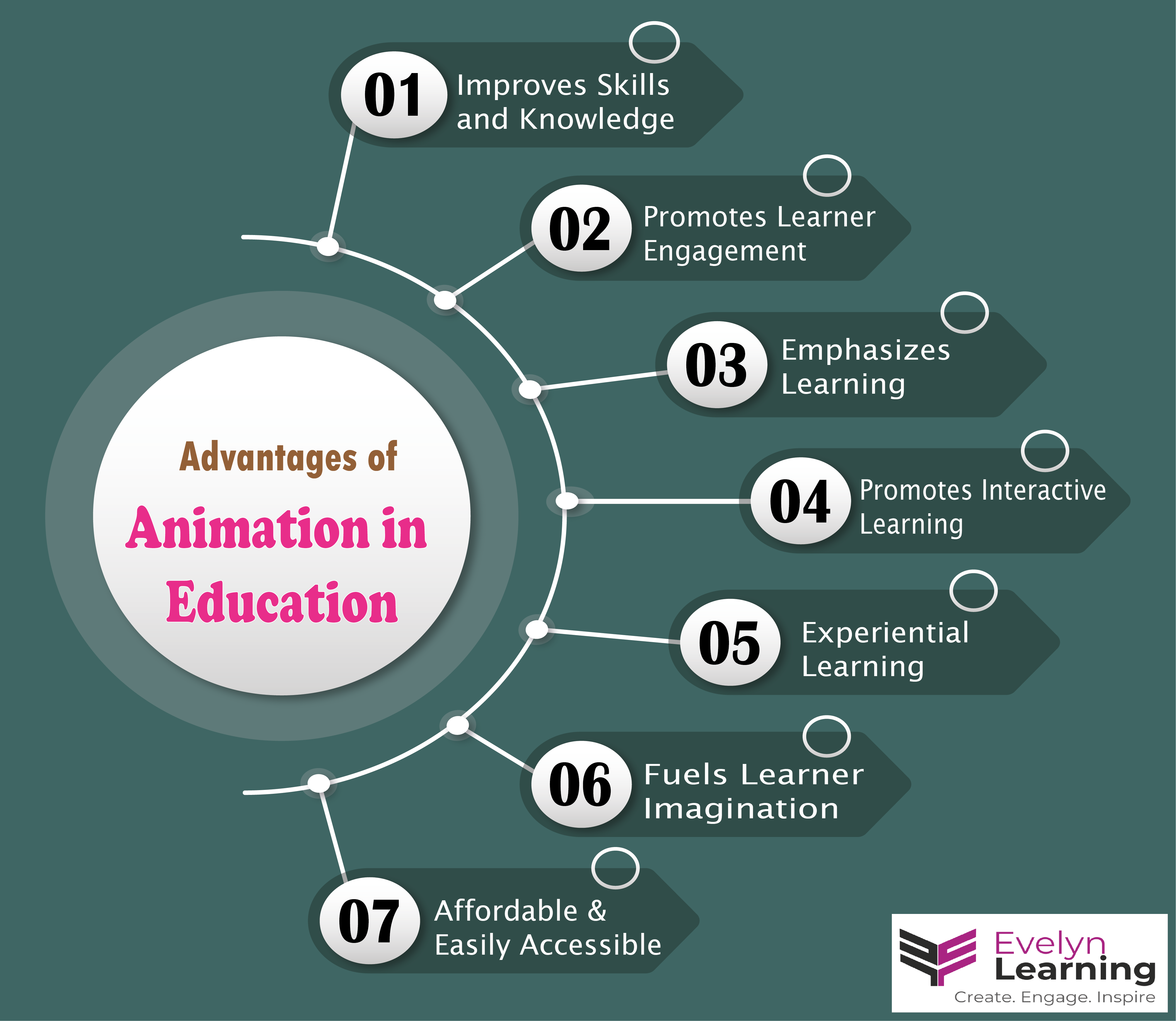
7 Advantages of Animation in Education
1. Improves Skills and Knowledge
Animation in education makes use of visuals for learning. It presents abstract concepts through visuals to provide learners a clear picture of the lesson. For instance, educators can create animated videos to teach cell biology in science class. Learners can get a fair idea of the structure of a cell through an animated video. Furthermore, the learners can also learn the functions of various organs in the body through such videos.
A noteworthy feature of animation in education is its visual impact on the learners. Owing to their short attention span, contemporary learners often digress from the lesson and fail to learn effectively. However, animated videos are short and cover only relevant content while grabbing learners’ attention. Consequently, learners develop their skills and knowledge through short visual representations.
2. Promotes Learner Engagement
Animation in education is all about interactive learning. It incorporates various learning styles in one. As the learners indulge in the enriching visuals, they participate in the learning process. Educators can use animation to create lessons as well as assessments that engage learners. Different teaching methodologies can serve their purpose with the help of animation. For instance, gamification a useful technique to design assessments where animation is used in the form of games. Game-like situations ignite a sense of thrill in the learners who look forward to moving ahead and win. Also, it is a rejuvenating exercise that diverts the mind from a monotonous learning schedule.
3. Emphasizes Learning
Animation in education is a combination of entertainment and learning. Animated eLearning videos cover complex topics with easy-to-understand visuals. The contemporary tech-savvy learners like to spend most of their time watching short, entertaining videos. As a result, learners would likely prefer a short informative video for learning rather than attending a lecture. Also, there are chances that they might replay an animated video if they find it interesting.
Additionally, with powerful visuals operating on-screen, the learners’ attention is engaged. They immerse in the learning experience and can easily retain the lessons.
4. Interactive Learning
Video-based learning is known to be an effective method of learning, owing to its numerous benefits. Different learners follow varied video learning styles, depending on the patterns of learning that they follow. The use of graphics and audio makes learning interactive and participatory. Learners interact with the course content and comprehend the lesson quickly. Also, the retention rate is higher when the concepts are in the form of videos. Gamifying a lesson is one of the strategies of interactive learning.
5. Experiential Learning
Animation in education presents abstract concepts through virtual reality. AI and VR together bring flexibility in learning intricate concepts. For instance, certain science experiments are often too hazardous to be performed in real-life. Although they form a crucial part of learning, such experiments are difficult to execute in real-time. Animation in education allows learners to experience such experiments that are otherwise not safe to perform. Virtual reality videos show the actual experiments with complete accuracy of results. It gives the learners an experience that they could only get by performing them in real life.
Another instance of the use of 3D animation in education is its use to demonstrate geometrical shapes in maths. Educators can use 3D animation to teach geometrical principles and their real-life application. It can also be used to showcase many historical events to make history interesting to learn.
Moreover, the learners cannot learn each concept practically while attending an eLearning class. Here, animation provides an alternative through experiential learning.
6. Fuels Learner Imagination
Videos can teleport the learners to an entirely different world with virtual reality. Learners get a glimpse of otherwise unimaginable concepts through animated videos. The use of different colors, shapes, and pictures appeals to the learner’s imagination. Consequently, they learn to create abstract images in their minds. Also, learners develop vivid imaginative abilities as they come across possibilities through visual animation. Not only do they gain knowledge about the subject but also learn about technology. They discover how technology can make learning easier by converting anything imaginable into virtual reality. As a result, learners get an understanding of scenario-based learning and develop social and practical skills.
7. Easily Accessible and Affordable
Employing animation in education is extremely affordable. Contrary to popular myths, animated videos are budget-friendly. Educators can use any form of animated videos without having to compromise on quality. Additionally, another benefit of using animation in education is that it is readily available. Educators can use one animated video to teach a large number of learners for a long time. Also, learners can revisit a video for recapitulation and revision. This means that they can access these videos anytime and anywhere. The only requirement is a smartphone or computer with an Internet connection.
Final Note
Teaching methodologies are no more confined to classroom activities. Learning now involves more technology than it ever did. The dynamic and sturdy rise in edutech is contributing to the development of new teaching methodologies. These methodologies focus on the holistic development of the learners with innovative teaching-learning methods. The use of animation in education facilitates educators and learners in a variety of ways. Not only it assists learning but also gives educators freedom to use a combination of teaching methodologies. They can quickly pick-up an animated video about a topic and show it to the learners for better understanding. Various teaching methodologies focus on the holistic development of the learners with innovative teaching-learning methods. The use of animation in education is another such development in tech that is continuously evolving. Its various advantages mentioned in this article make it an attractive learning solution for all levels.
Furthermore, innovations in virtual reality and artificial intelligence constantly work to enhance learners’ experience. The introduction of these innovations in education opens new opportunities and immense learning possibilities.
Research websites: Medium and Mom and More
Images: Shutterstock and Freepik
For more information on Interactive Learning, visit our blog.
Create. Engage. Inspire.
The post Animation in Education: Advantages appeared first on Test.Evelyn.
]]>The post Animation in eLearning: An Introduction appeared first on Test.Evelyn.
]]>This article explores the various uses of animation in eLearning and measures its effectiveness.
What is eLearning Animation?
In simple terms, sequential capturing of images, including drawings and pictures of inanimate objects, is considered to be animation. Animation occurs when the images are played in rapid succession to mimic real-world motions.
In education, the term ‘Animation’ may refer to any image used for teaching and learning. However, educational animation can either be simple or complex. The complexity entirely depends upon the type of educational material. For instance, moving an arrow on the screen is simpler than producing a cartoon.
Educators produce different types of study material with the help of animation. This study material is available on the Internet for learners all around the world. It is easily accessible and does not require learners to travel to a specific classroom to learn. Different eLearning courses offer the knowledge of various concepts with the help of animation. It entails that educators can deliver lessons on complex topics more effectively through visual animation. Also, such interactive courses work better at engaging learners. Consequently, it creates an impact on the learners and promotes learning and retention.
Types of Animation in eLearning
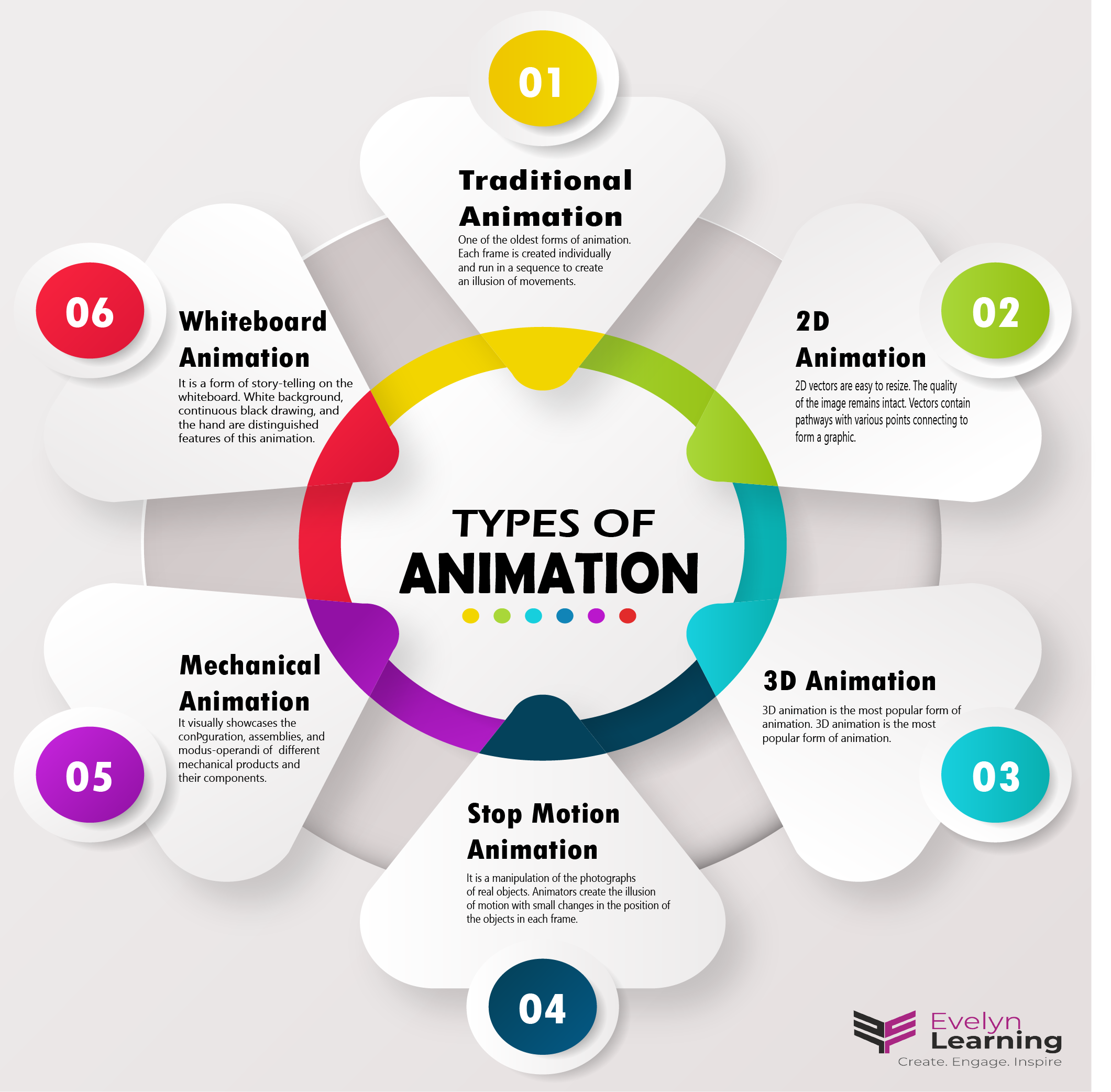
Although animation is an umbrella term for adding movement to images, it has many different types.
- Traditional Animation: This is one of the oldest forms of animation. Each frame is created individually and runs in a sequence to create an illusion of movements. Animators used to draw on an illuminated table with the previous animation kept below it. Although this method was precise, it was costly and time-consuming.
- 2D Vector Animation: This type of animation is a modification to traditional animation. Unlike the JPEG, GIF, BMP formats in traditional animation, 2D vectors are easy to resize. As a result, the quality of the image remains intact. Vectors contain pathways with various points connecting to form a graphic. Ergo, different convertible shapes form a character or another image. Moreover, there is no need for manual drawing as this type of animation uses software to create animation.
- 3D Animation: Currently, 3D animation is the most popular form of animation. Its creation entirely depends on the knowledge and use of computers. Although it completely depends on technology, the process is still complex. This type of animation uses digital frames to put characters in the right position. The animators adjust and tweak the curvatures to set the movements of the characters. However, the creation of 3D animation also requires a storyboard.
- Stop Motion: Stop motion graphics, also known as claymation, is a manipulation of the photographs of real objects. It is somewhat similar to the traditional animation and the flipbook style. However, it has physical objects in place of photographs. Animators create the illusion of motion with small changes in the position of the objects in each frame. Similar to traditional animation, creating stop motion graphics is a time-consuming and costly method.
Why Choose Animation?
Animation adds a spark of creativity to learning. It is a valuable tool that helps to ignite learners’ interest. A simple PowerPoint presentation is also animation. There are numerous reasons for choosing animation as a method to deliver e-lessons. The first and the most important function of animation is that it grabs the attention of the learners. With the Internet serving the entire world at the click of a button, gathering information has become easier than ever before. However, on the downside, the attention span of learners has downgraded. The use of animation in eLearning provides information in chunks while using the audio-visual method. This helps grab learners’ attention for a considerable period of time to promote learning.
Secondly, the use of animation in eLearning encourages better retention. Learners follow unique eLearning styles. Some learn through visuals, while others learn through listening or other methods. Animation in eLearning is the culmination of different learning styles, so it is an all-in-one teaching-learning method.
Moreover, animation in eLearning helps break complex information into consumable chunks. It also enlivens the uninteresting topics and engages the learners. It is a creative story-telling method that is useful for introducing new concepts. Another benefit of animation in eLearning is that is useful for learners of all age groups. All these benefits make it a good teaching methodology for the learners present in the post-Internet environment.
Resources: eLearning Industry and Mindflash
Images: Shutterstock and Freepik
For more information, visit our blog.
Create. Engage. Inspire.
The post Animation in eLearning: An Introduction appeared first on Test.Evelyn.
]]>