The post Localization: An Introduction appeared first on Test.Evelyn.
]]>A product or content that is globally available must connect with consumers to meet their demands. The best way to establish a relationship with consumers is to incorporate the use of their language and cultural aspects into the marketing strategy. This is what localization means. In other words,
‘Localization is a way of making a product or content available in different markets in their respective languages and cultural contexts.’
It is also referred to as L10N.
Localization is a part of the larger processes called Internationalization and Globalization. All these processes together aim at spreading the business across the world. Different languages are spoken in different parts of the world and thus having a uniform language would not work. Therefore, it is important to adopt a local language for every intended market. Translation plays an important role here. It is necessary to localize a product or service for each country to get more consumers, resulting in more profits. At the same time, it is also important to have a unique voice for the product/service. Altogether, localization is a cultural approach that not only involves translating but also reshaping a product/service so that it appeals to the local public.
Although translation seems to be an easy task, certain aspects call for special attention. While translating, it is necessary to address the cultural diversity of the region. Possibly, certain words/phrases with positive connotations in one culture might be derogatory for the other. Thus, a translator must be familiar with the local culture along with the language.
Translation as a part of the localization strategy boosts the growth of a business. Have a look at some instances of localization in practice.
Case Study
Coca-Cola
Coca-Cola, one of the oldest brands in the world maintains its brand’s voice with its signature colors. To expand its business, the company had to change its name in China as a part of the localization strategy. Thus, ‘Coca-Cola’ became ‘Kekou Kele’, literally, ‘delicious happiness’ as a part of the local marketing strategy to adopt local culture.
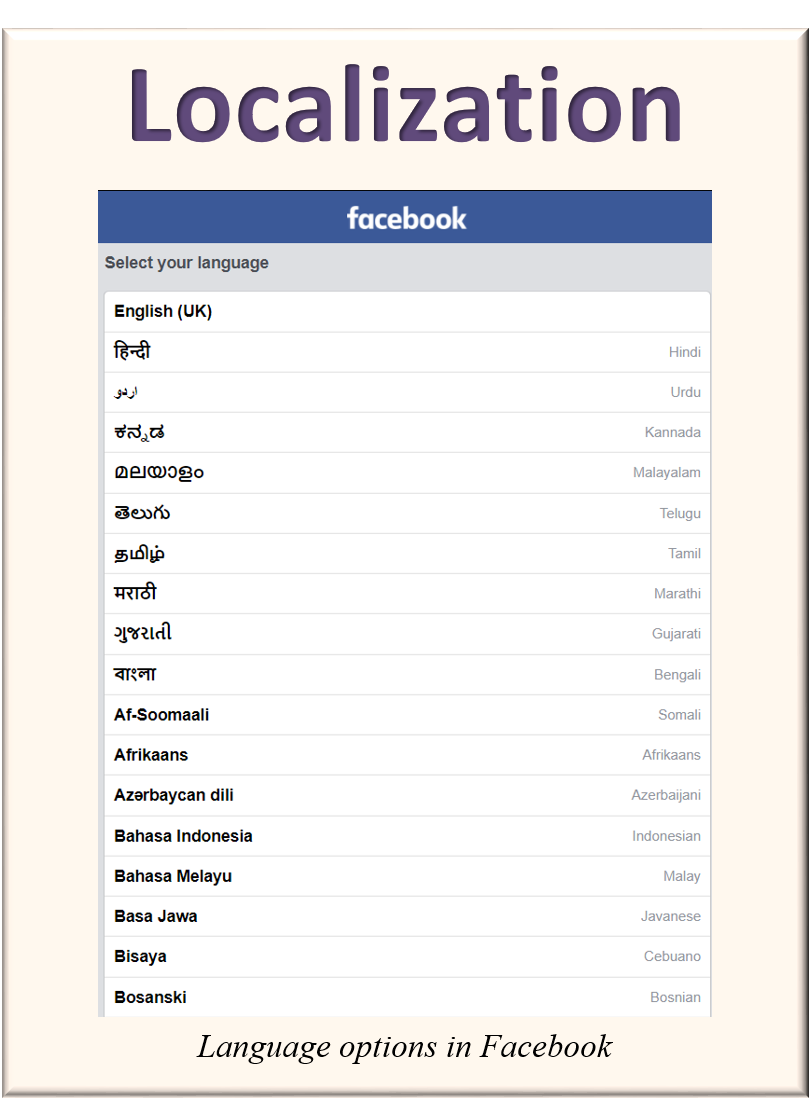
Facebook is the best example of website localization. Since 2008, it has come up with different language versions with the help of crowdsourcing. Despite being available in various languages, the overall user experience and brand remain uniform across cultures. Moreover, localization is not only visible in the text, but also in the date & time format on Facebook.
What is Internationalization?
To understand localization, there is a need to understand the concept of Internationalization as well because both these terms are often used interchangeably. Internationalization is a process of preparing a digital product/service for localization. It involves separating the content codes so that localization can be performed without hampering the inner workings of the product/service each time while translating. This takes place after a localized set of content is loaded in the software which translates and displays the content to the user in a local language.
Case Study
Coca-Cola
Let’s look at the internationalization of Coca-Cola to understand it.
Coca-Cola adopted a strategy of gradually investing in foreign markets and forming franchises in nations across the world. To begin with, it established trade with local brands and either acquired them completely through a partnership or merged with them later. As a result, Coca-Cola could peek into the local markets worldwide and figure out the taste and preferences of the local customers.
What is Globalization?
Another term often interchangeably used with localization is Globalization. Globalization refers to the process of integrating the culture and policies of a country to the rest of the world. It works to bring various people, economies, and cultures together. Moreover, it is an important factor that generates the need for localization.
Globalization is somewhat similar to Internationalization. Altogether, it is a strategy of expanding business across the national borders.
Case Study
Netflix
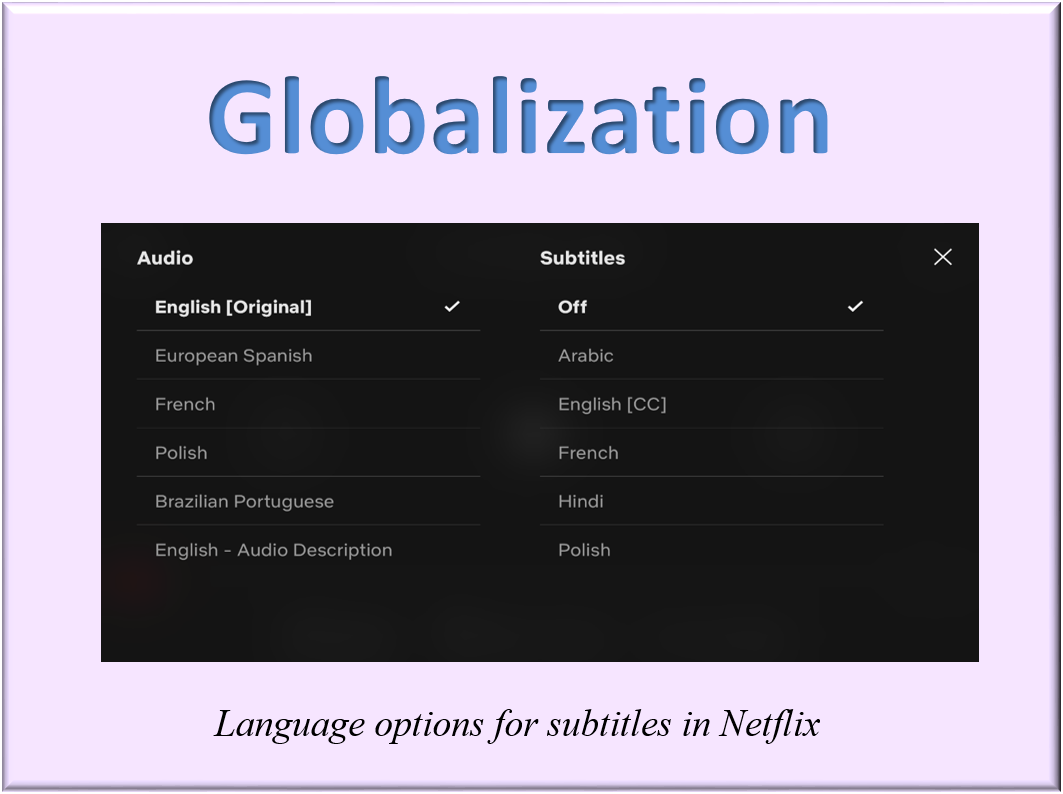
Netflix, the widely used video streaming app, has captured the global audience through a well-planned globalization strategy. It allows the users to view subtitles in the desired language or watch the dubbed versions of shows from all over the globe. At present, Netflix functions in over 190 countries with customized content offerings as per local languages and cultures.
Nike
Nike follows a globalization policy where it partners with various athletes who play a variety of sports and belong to different countries. Further, it uses these endorsements for expanding the business worldwide. A note-worthy factor here is that the logo of the brand, that is a ‘swoosh’, remains the same for every country. Consequently, the brand enjoys a global market and at the same time, maintains a unique identity.
Conclusion
Localization, Internationalization, and Globalization are three interchangeable yet slightly different terms. Moreover, all three concepts are inter-dependent and cannot exist individually in the global market. Any form of content/product that is to be internationalized or globalized needs a localization policy to meet the required marketing standards.
Moreover, localization plays a very role in creating value for the brand being promoted. It acts as an umbrella term that incorporates translation as one of the key elements. In conclusion, adopting the local language and cultural aspects increases the demand for a product/service in the market.
Follow our next blog in the series to know more about localization.
Websites used for research: Lionbridge and Technitrad
Images from Shutterstock
For more information, visit our blog.

Create. Engage. Inspire
The post Localization: An Introduction appeared first on Test.Evelyn.
]]>