The post Adaptive Learning in The Classroom appeared first on Test.Evelyn.
]]>As mentioned in our previous article, Adaptive Learning systems provide personalized learning experience for students by first adjusting to their learning styles and paces. Following this, instructional designers perform unique course sequencing and evaluation methods. In this way, educators can secure equitable learning on a scale of 100-200 pupils per class. This article explains how to start implementing Adaptive Learning in the course curriculum.
-
Designed Adaptivity
Using this method a teacher designs the course, sequences its components, and includes assessments to guide learners through the learning process. The system operates based on the instructor’s design and accordingly offers feedback to students based on a variety of parameters called the Adaptivity Factors. To clarify, these factors have been described in-detail here.
This method tells the technology what alternative course content to offer in unique situations following the “if-this-then-that” approach. For instance, if a student is facing difficulty grasping the concept of Bubble sorting technique in Java, then the system directs them to more quizzes on coding bubble sort rather than pushing them towards the next content (i.e., selection sort).
Consequently, this method rejects linear course sequencing, provides remediation to struggling students, and brings up advanced materials for educating learners. It gives the teacher much needed agency and control over the learning process so as to ensure equity in teaching.
-
Algorithmic Adaptivity
A method in which one or more algorithms answer the following two questions:
- What previous knowledge does the learner have?
- What should they learn next?
Based on these answers, the algorithm can adjust the path and pace so that students learn the right thing at the right time. One benefit reaped from adaptive learning as emphasized on our previous blog is that it respects and utilizes learners’ prior knowledge.
One such algorithm, for instance, is Bayesian Knowledge Tracing (BKT) which measures such parameters as the probability of students demonstrating a skill correctly or incorrectly, and other such parameters.
Adaptivity Factors
In order to personalize the syllabi, adaptive learning systems take a variety of inputs about the learners. These factors help the system/educator adapt to learners’ styles and needs and these are called Adaptivity factors. Some common adaptivity factors are:
-
Performance
Measuring a learner’s accuracy over a series of tasks, sequenced in an increasing order of difficulty.
-
Content preferences
Discerning whether the student learns better with audio-visual content or prefers printed material.
-
Demographics
Collecting a learner’s background information: where the learner has grown up, their cultural background, and other such data points contribute to their prior knowledge. For instance, a learner based in the US is expected to excel in a module on US polity while a student hailing from another country might need added course material.
-
Level of knowledge
Checking the level of mastery/skill demonstrated by learners in various topics.
-
Misconceptions
Evaluating the learning prejudices or misconceptions that might be embedded in learners.
-
Behaviour
Discerning how long learners take to complete a test or what their feedback was of the same.
Education technology uses a combination of any of these adaptivity factors to readjust course sequences. For instance, a combination of Misconceptions and Demographics is chosen, and the system then tests a learner’s gaps in learning due to misconceptions, and aims to fill them by offering alternative reading lists and/or tutorials.
Since Adaptivity factors generate unique responses from each learner, they enable educators to re-route the learning experience by taking into account the learners’ experiences, instead of blindly moving forward with a set course structure.
Overall Method in which Adaptive Learning Works
The overall learning algorithm involved in Adaptive Learning has been shown below:
Adaptive Content
[Students answer questions along with feedback as to why they chose that option]
Course Sequencing
[Continuous analysis of student feedback and skills to reorder what the student learns next]
Adaptive Assessment
[Changing questions based on the student’s responses to the previous ones. The difficulty will increase if the students have been answering with ease. If they have been struggling, the questions will get easier]
Research Report
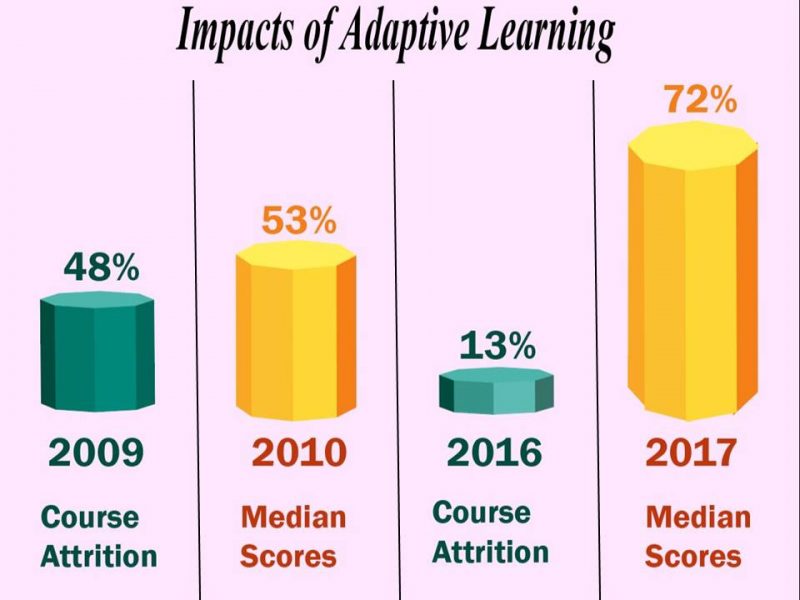
A five-year study conducted at the University of California, Los Angeles revealed the real-life benefits of Adaptive Learning. Scholars incorporated an interactive interface called Courselets as a resource where instructors collaborated to design courses. The algorithm measured Misconceptions and Course attrition when compared between traditional lectures and Adaptive Learning. To clarify, course attrition refers to the pressure experienced by learners that compels them to lose potential and interest in learning.
The results of the study were:
- Median score measured at 53% increased to 72% over a 5-year stretch
- The course attrition decreased four-fold, from 48% to a staggering 13%.
The following chart illustrates how Adaptive Learning systems dramatically improve academic performances:
Final Thoughts
Just as the said statistics suggest, numerous advantages are attached to the adoption of an adaptive learning technique in an institution. Implementing Adaptive learning opens up opportunities for individualized learning experiences, where students stay on focused pathways and work at their chosen pace.
The post Adaptive Learning in The Classroom appeared first on Test.Evelyn.
]]>The post Adaptive Learning as a New-Age Teaching Methodology appeared first on Test.Evelyn.
]]>Traditional teaching presents a rigid course material to fit all the students. Adaptive Learning makes use of frequent assessments, exchanges feedback with learners, and opens alternative learning paths that help students gain content mastery before moving onto other steps of learning.
Case Study
Let us say a group of 5 students are undertaking a module which includes sections such as Logical Reasoning, Quantitative Aptitude, Statistics and Language skills. If the teacher applies conventional methodology, he will hand out course material and then evaluate the students through tests. The learning outcomes are understandably poor. The teacher finds that among the 5, one is especially conversant in language skills while being weak in statistics. He may find still others who are well versed in all the sections of the module.
Yet the common evaluation generates an average result for all five, which is as good as false data. Going by this data, some students fail in select sections, some excel in all, while others move on with insufficient depth of knowledge in a section where they had begun to show promise.
Problems with the Case Study
The concerns regarding with the aforementioned case study are evident.
- Sample Size: While monitoring a small group of 5 students, the teacher is able to alter the course depending on the areas which each student seems to struggle with. This option however limits itself to a small sample size. The teacher cannot single-handedly design unique learning pathways for say, a batch of 100 students.
- Inequitable teaching outcome: This method only pools the knowledge shared in the classroom to a handful of average students, while the high-performing students and those who fall behind get left out of the equation.
- False data: A “one-fits-all” evaluation technique for learners with differing abilities generates false data, leading to failing the term or causing drop-outs.
Adaptive Learning as a Ready Solution
Adaptive Learning addresses all these problems. It offers interactive systems that measure performances of each student. Additionally, based on similarity of demographic or ability, they offer customized learning paths and course materials.
Students communicate with programs, provide feedback, and complete quizzes – all of which helps the system learn or adapt to their unique learning style. This also presents content in a set sequence, adjusting to the students’ learning path and pace. Adaptive learning systems take on the task of restructuring the course sequence from the teacher. Consequently, we can apply it to a greater sample size with ease.
Traditional classroom teaching does not rule out certain drawbacks such as failure to clear assignments and drop-outs, which Adaptive Learning does help with.
School systems have been infamous for “teaching to the middle”, where there are no provisions to encourage excellent performers with more challenging material, or support lagging students with customized content. This leads to failing the classes or dropping out of the system.
This methodology ensures that students gain mastery over individual topics before moving on to the next. It also generates assessments based on the performance of the learners, caters to the under-performers, and bolsters the excellent students, with more complex tasks.
Benefits of Adaptive Learning
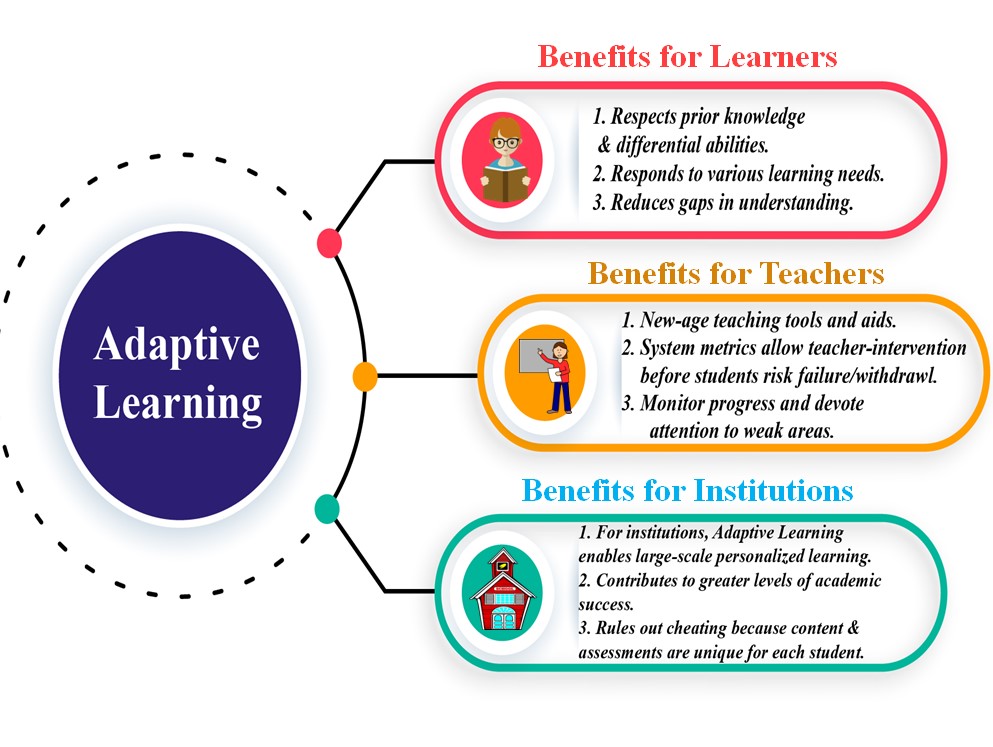
Adaptive Learning has three-fold advantages for students, teachers, and institutions as illustrated by the chart:
Challenges of Adaptive Learning
- Costly and Time-consuming: Adaptive Learning systems come at a steep cost to institutions. However, in most cases, it is a one-time investment. It also requires content-mapping and objective designing to support diverse learning styles and stages of mastery. This is a strenuous and time-consuming task.
- Not suited for some courses: Adaptive Learning is typically unsuited for courses that demand high-level critical thinking and evaluation.
- Not immediately effective: System algorithms need time to adapt to students’ learning needs by way of prolonged feedback and interaction. Systems also collect course materials over time before suggesting learning paths, so Adaptive Learning cannot be effective immediately.
Adaptive Course Samples
The great thing about Adaptive Learning system is that it can be applied to all levels of learning. Let’s look at some popular adaptive platforms and find out about sample course-ware.
- Quizalize is an adaptive platform which breaks down difficult concepts into fun, interactive quizzes. It promotes gamification in learning, and even allows for tracking students’ progress.
- Fulcrum Labs incorporates A.I to model a personal instructor for every learner who signs up. This platform takes the help of Artificial Intelligence, not only to track progress but also to make predictions about weak points and errors. It extends beyond academic subjects and helps students to cultivate real-world skills as well
- Elevate supports adult learning while entertaining learners at the same time. The platform includes a host of games, quizzes and alternate learning arcs to help adults improve upon math, reading, writing and speaking abilities. An added advantage of Elevate is that it is backed by significant research.
Taking a tour through these websites and looking at their course descriptions reveals how Adaptive Learning encourages students to choose their own path in online learning. In all these platforms we see how systems depend heavily on feedback, interaction and adaptation to learners and instructors as is the essential feature of this model.
In conclusion, Adaptive Learning though uniquely tailored for all learning needs, has its own limitations as well. By implementing it correctly, teachers hold the capability to maximize its benefits. We shall explain the different kinds of Adaptive Learning in this (placeholder) article.
For more information, visit Evelyn Learning blog.

Create. Engage. Inspire.
The post Adaptive Learning as a New-Age Teaching Methodology appeared first on Test.Evelyn.
]]>