The post Content Editing: An Itemized Breakdown Of Its Meaning And Levels appeared first on Test.Evelyn.
]]>Editors oversee the final stage of the content creation process before it goes live. So, content editing transforms a piece of academic content writing into a compelling presentation, but where does one begin? Here is a step-by-step guide to content editing, encompassing its meaning and different levels.

What Is Content Editing?
Content editing is a component of the editing process that looks for persuasive, cohesive, and intelligible arguments in written content. The step examines misspellings, comma splices, and poor word choice, apart from other grammar faults. Poor material quality with typos and grammatical errors can erode any faith customers have in your brand. Hence, content editing is essential to the online publication process.
Keyword research and optimization employing structural features such as H2 and H3 headings are all part of high-quality content creation. So are internal links, and a variety of long-tail keywords. However, optimizing content is only the beginning. One should also ensure that the material is easy to read and understand, which is where content editing comes in.
Content Editing vs. Copy Editing
Here is a quick rundown of the distinctions between content and copy editing. Content editing ensures that writing is clear, concise, and effective. This entails examining the argument’s strength and logic, the quality of the sources or examples, the piece’s fit with your brand language, and the piece’s scope.
Copy editing, on the other hand, seeks for and corrects more minor errors. This includes double-checking spelling, grammar, punctuation, syntax, and compliance with style guides. Double-checking graphs, charts, and image placement, as well as proofreading the title, meta descriptions, and captions, are all examples.
Dos And Don’ts Of Content Editing
To become a successful content editor, one must first learn the rules of the game. In light of this, here are a few content editing dos and don’ts for modern creatives.
Dos Of Content Editing
Here are four effective editing tactics for content editing that editors can use to turn their drafts into memorable content.
• Understanding What They Are Up Against
Editors must first assess what they are editing before they begin. Is it a quick SEO post aimed at ranking for a specific keyword? Is it an infographic-enhanced long-form guide? Are they displaying confidential survey results? This will prepare them for what to expect and what to look out for. The word count must also be considered by editors. Content editing is more productive when the editor has a rough notion of what they are altering before they start.
• Making A Style Check
Moving on, editors must identify the client for whom they are editing. As a content editor, you may work with a variety of clients, ranging from lifestyle and wedding magazines to finance and insurance firms, each with their own distinct voice, branding, and style rules.
Some clients prefer the traditional approach, while others supply editors with their own set of rules. Editors must always set aside time to get into the zone for that particular client. If a client is new to the agency or to the editor, the editor will need to spend more time learning about their guidelines.
• Avoiding Cliches, Slang Or Clunky Prose
There will always be a statement that sounds cliched or does not resonate with the audience. This is where a content editor comes in helpful. They might see something that the writer missed since he or she is so close to the work. Editors choose what works and what does not at the first read.
• SEO Retouching
Search engine optimization is one of the last tasks in the proofreading and editing process. When editors develop material for their target audience that is useful, instructive, or entertaining, they want readers to be able to locate it on Google, Bing, or another search engine.
Editors must ensure that they have suitable header tags and that they are employing phrases that their target audience would use – keywords — in step. This is also a good moment to compose the title, URL slug, and metadata, which should include the terms and phrases that your target audience is likely to look for.
Don’ts Of Content Editing
Understanding what not to do is almost as important as learning what to do with online content. With that in mind, here are a few things to avoid in content editing at all costs.
• Using Software For Editing
Editing software, such as the built-in spell-check on an editor’s word processor, are all excellent tools for catching faults in a writer’s work. They should not, however, rely on them to correct all of their errors.
That is not to suggest editors should not utilize them; they are wonderful for saving time and catching errors as they happen so they do not have to correct them later. However, editors should be cautious about how much they rely on them.
• Inconsistency
Readers may not care how a writer refers to someone or something, but they will notice if the writer cannot decide whether to refer to someone or something one way or the other. An editor must always ensure that a piece of writing has one point of view and sticks to it throughout all of the information.
• Excessive Usage Of Pronouns
When writers start mixing and matching pronouns, the meanings are not always obvious, at least in print. Editors must be very careful to identify who or what a pronoun refers to, and to clarify if necessary. Better to have a name repeated twice in the same line than a reader puzzled about who is who.
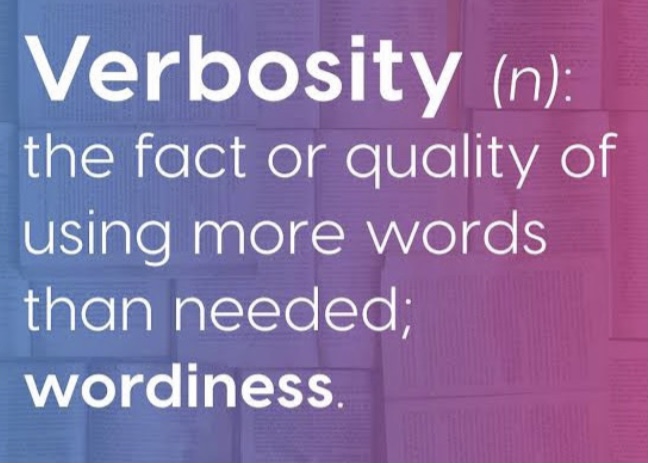
• Sentences That Are Extremely Long And Wordy
It is possible that sentences with a lot of commas, semicolons, dashes, and conjunctions are excessively long. There is no key word count for what constitutes a run-on sentence, but editors must divide it up if they feel they have been in the same sentence for a long time or have just become lost. In order to connect the new sentences and guide readers from one notion to the next, they must utilize transitional words like hence, nevertheless, or furthermore.
• Assuming The Writer Is Correct At All Times
If copy editors see facts that do not seem quite right while copy editing other writers, they should investigate more. The information is usually correct, but even the most conscientious writers can lose attention for a moment and type something they did not plan to say. Rather than allowing a severe error to appear on the website, editors must send a quick email or leave a note in the copy for review, asking for clarification.
• Common Grammatical Errors
It is likely that a complete post could be written regarding typical use errors that editors can easily spot when modifying. Compliment or complement, effect or affect, and ensure or insure are only a few examples.
Levels of Content Editing
While no single “ideal” version of any piece of writing exists, there are numerous tactics and possibilities for refining a text. Knowing all the ways an editor can respond to a draft is beneficial, since a skilled editor will recognize all the possibilities of content editing–even if the author does not.

So, here is how an editor should determine what a piece of academic content writing requires:
Grammatical Edits (Level 1)
The author is comfortable with the material at this point and simply wants small and obvious faults in spelling, grammar, and punctuation corrected.
Fact Checking (Level 2)
This level of content editing encompasses Level 1 as well as difficulties of consistency and accuracy for some finer aspects. Is the use of numbers and abbreviations coherent, the wording acceptable for the audience, and the structural layout (headings, etc.) consistent and practical?
Stylistic Editing (Level 3)
The editor begins identifying the writer’s style at Level 3 of content editing. Wordiness, overuse of certain words or phrases, shortage of transitional phrases (which highlight the piece’s organizational structure), tone appropriateness, and even sentence rhythm (are all the sentences the same length?) are all examples of this.
If the article is to be published, the publisher may have its own “style manual” or intended style, which can influence sentence length, tone formality, and even grammar formality.
Structural Editing (Level 4)
At Level 4, the editor begins to think about the piece beyond the sentence level, which is a significant change. Internal paragraph structures (are ideas thoroughly and rationally explained?), paragraph organization (too many, too few, are transitions appropriately marked?), sequence of material, and type and structure of headings may all be addressed at this level. This includes how things look in the table of contents, if there is one. Nevertheless, the editor is still working with what is already on the page and does not address broader issues that require rewriting at this level.
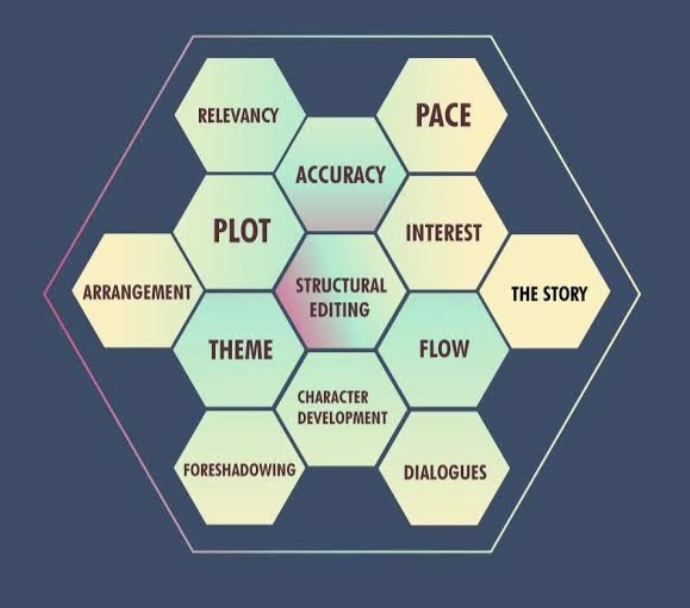
Substantive Editing (Level 5)
Level 5 talks about the context for a piece of academic content writing, rather than just dealing with what the author has provided on the page:
- Who is the intended audience?
- What is the piece’s point of view?
- When and where will the writer publish it?
- What does the author hope to achieve with the article (which may or may not be the obvious goal)?
At level 5, an editor can remark things regarding additional specifics, illustrations, examples or even incorrect writing approaches. The editor or author may need to undertake some minor rewriting. They could even add a bit of additional substance to what is currently there at this level.
Revision Editing (Level 6)
Since it makes no sense to edit or proofread until a new version is complete, other types of editing come to a halt when a piece requires revision. As an editor, one can prepare a list of questions to ask in response to a piece that needs to be revised, as well as a critique of what works and what does not in the piece as a whole.
The word “re-vision” means “re-seeing,” which implies the author must go back and evaluate decisions made in the first draft. It may necessitate redefining one’s audience or goal, altering the piece’s structure, or substantively rewriting the piece’s content.
Rewriting (Level 7)
An editor’s work at this stage moves from modifying what the author wrote to rewriting it for them. This could entail altering the writing style, tone, structure, or even a significant section of the content. It may be necessary to go back to the original source materials and perform new research. In any case, this is not an attempt to fix the author’s work, but rather a fresh start on it (or a section of it).
Final Proofreading (Level 8)
Proofreading is the process of checking the final draft of a piece of writing for grammar, spelling, punctuation, and formatting consistency and accuracy. Proofreading is the process of identifying little and big errors that were either overlooked or made during the editing process. At this point, editors must guarantee that the document’s final draft is free of grammatical, formatting, and typographical faults (e.g., subject–verb agreement issues, inappropriate word selections, improper punctuation, and erroneous spelling). They must also ensure that the article follows the style guide that has been chosen.
All in all, content editing is the process of going over a piece of online writing to make sure it is clear, succinct, and targeted to the reader’s needs. While this is all there is to it for now, Part-2 of this article will go over the steps of content editing. It will also introduce readers to some of the most effective content editing tools. This will help them turn their drafts into memorable and quality content.
Image Sources: Shutterstock and Unsplash
Also Read: Recent Trends In Educational Publishing
For more information on content editing, visit our blog.
Create. Engage. Inspire.
The post Content Editing: An Itemized Breakdown Of Its Meaning And Levels appeared first on Test.Evelyn.
]]>The post Academic Content Writing appeared first on Test.Evelyn.
]]>
Academic Writing vs. Content Writing
Content writing is very diverse. It does not have any distinct style, language or structure. Individual writers have their own styles, language and manner of writing. Readability is important since the content is for consumption by general readership, which is wide and varied. Most of the content that is available online (website, blogs, etc.) comes within the ambit of general content writing. The topics of the content may be daily news, sports, ecommerce, business, etc.
The goal of academic writing, on other hand, is to improve the technical knowledge of a reader. Developed by people from academia, academic writing is for consumption by an academic audience. The topics of discussion are from disciplines of academic study and research. There are several styles of academic writing, each of which is unique and used for a specific academic objective. This article focuses on academic content writing, its characteristics and its types.
The article: “Academic Writing” on the Massey University, New Zealand website offers more idea about Academic Writing in general.
Characteristics of Academic Content Writing
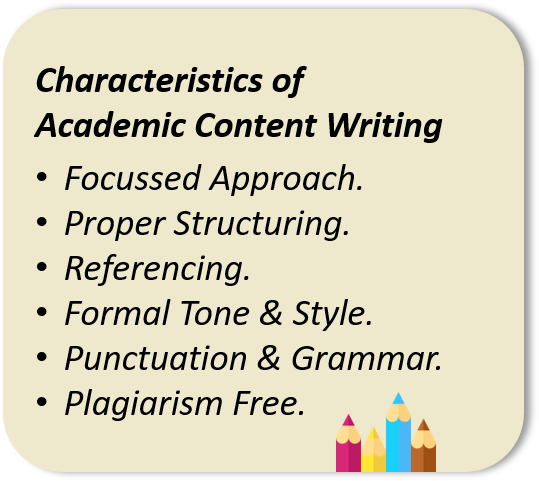
The usual goal of academic writing is to present the outcome of a research study. It is an attempt at apprising the academia about the subject of research, the study conducted to understand it and the research contribution made to it, if any. A piece of academic writing engages readers and draws them in, as participants in the process of discussion. Well written academic content does not culminate the process of thinking. It rather takes the process of thinking forward and further. Academic writing has a few characteristics which also serve as guidelines for an academic content writer. Described below are some of these characteristics.
Focused approach
The approach of the content is clear- persuasive, analytical, informative, etc. For Instance, a persuasive approach tries to convince the reader to develop a certain perspective. A combination of facts, reasoning and logic may help achieve the purpose. An informative approach attempts to educate the reader about a perspective. It does not persuade the reader to adopt a perspective.
Proper Structuring
The content is well structured. It follows a logical order- introduction, body paragraphs and concluding paragraph. A piece of academic writing presents ideas, thoughts, references, discussions, etc. in a manner that engages the reader. The content introduces the topics, discusses/analyzes it and then takes it to a meaningful conclusion. A piece of academic writing does not end abruptly or vaguely.
Referencing
Academic writing is rich in references drawn from subject literature. References and citations support facts. Inclusion of references in academic writing means that the writer is well informed of the existing research in the subject. Thus, referencing and citation lend credibility to academic writing.
Formal Tone, Style, Punctuation & Grammar
Academic writing has a distinct tone. It is simple but formal. Use of subjective language is avoided. The vocabulary is precise and spelled correctly. Abbreviations are usually avoided. Punctuation and grammar rules are strictly followed to ensure that the words and statements convey their intended meanings. All kinds of academic writing call for following a standard style guide.
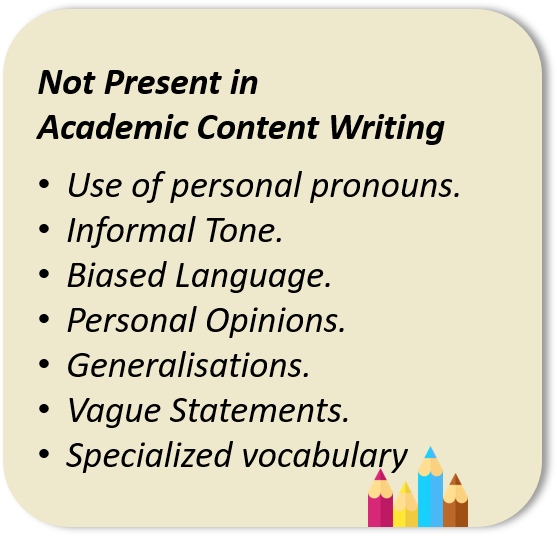
Additionally, the use of personal nouns, informal tone, biased language, opinions, generalizations, verbosity, vague statements, specialized terminology and difficult vocabulary is not advisable. Academic writing is plagiarism free. Quality academic writing reflects academic integrity.
The articles: “Academic Writing” on the University of Leeds, UK website; “Organizing Your Social Sciences Research Paper: Academic Writing Style” on University of Southern California website; “Academic Writing Guide” by Annie Whitaker of the City University of Seattle at Bratislava, Slovakia offer more insight into the topic.
Types of Academic Writing
Academic writing is quite diverse in terms of the approach it reflects. The approach of a piece of academic writing can be descriptive, analytical, persuasive or critical. Depending on the purpose, the overall approach can be a combination of these individual approaches also.
The following discussion provides a brief description of each of these approaches.
Descriptive Writing
The objective of such writing is to introduce facts and information to the reader. It is one of the most simple forms of academic writing. A lab report that informs the reader about the results of an experiment is an example of descriptive writing. Descriptive writing is also used for describing people, places, situations, events, etc.
Analytical Writing
A piece of analytical writing generally includes- problem description, probable solutions to the problem, assessment of the different methods of solution and their comparison. The views expressed in the analysis are impartial. The writer cogitates over the facts and the ideas that relate to the problem and its solution. A piece of analytical writing may include graphs, flow-charts, diagrams to improve clarity of understanding. Different Styles of Academic Content Writing
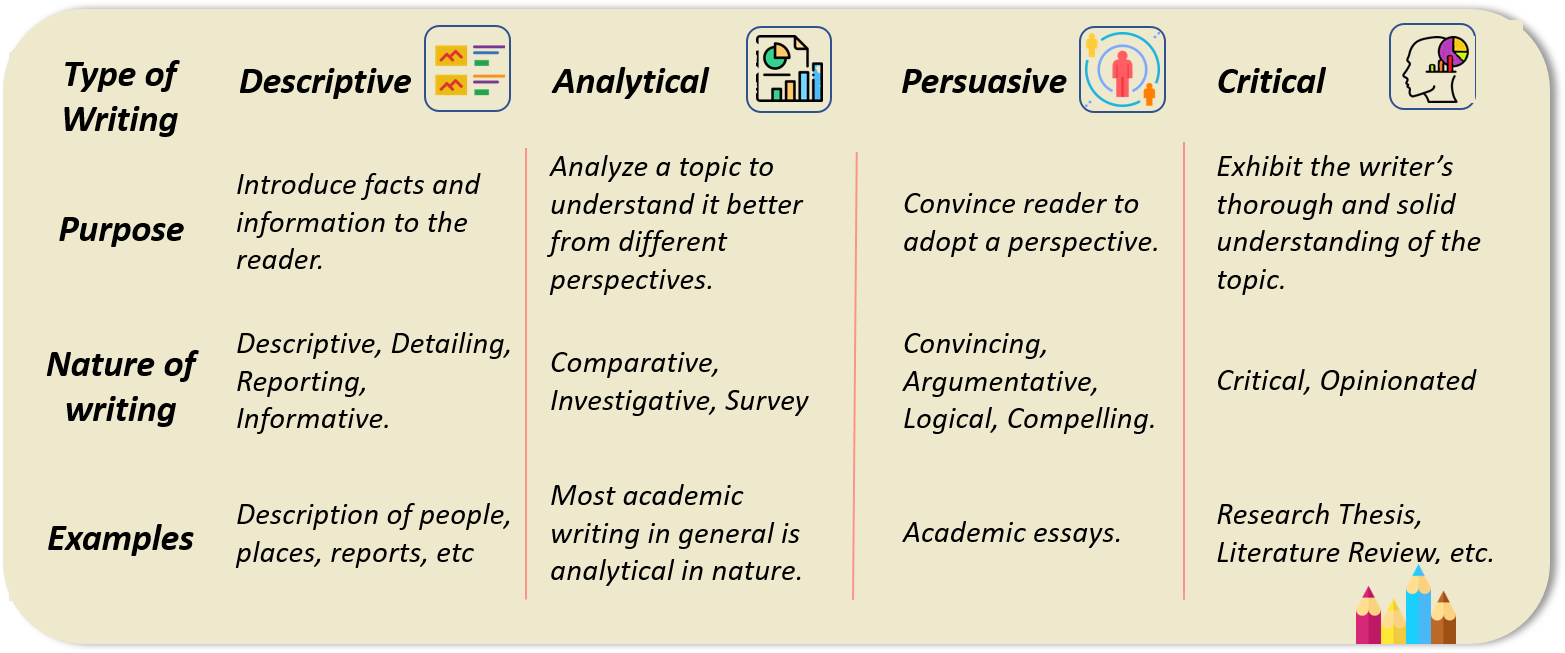
Persuasive Writing
This writing style goes one step beyond analytical writing. A persuasive writing piece carries the view/perspective of the writer also. In fact, the writer attempts to convince the reader to adopt a perspective. To help achieve this objective, the writer uses arguments supported by reason and evidence. Academic essays are persuasive in nature. News editorials, advertisements, reviews of electronic gadgets, etc. have a persuasive writing style.
Critical Writing
This is the preferred writing style for research-oriented writing work. Critical writing takes more than one source of information to develop an argument. A piece of critical writing summarizes all/part of work on a topic, including interpretations, assumptions and methodology. The piece also carries an opinion of the work taken into account and the writer’s point of view on the topic. The content is rich in analysis and strongly evidenced. The writer has a thorough understanding of the topic and strong writing skills.
The “Writing” page on The University of Sydney website offers a detailed insight into academic content writing. The website: eapfoundation, offers more details on critical writing.
Another Classification of Academic Writing
Academic writing is also classified on the basis of the kind of writing that scholars do. Lab reports, case studies, literature reviews, research papers, book reports, bibliographies, research theses are just a few examples of documents found in an academic setting. Such documents follow a well-defined writing style in many institutions. Institutions provide clear guidelines to the academia regarding the kind of academic writing applicable for different documents. Besides academic writing, there are many diverse forms of content writing. Information pertaining to content writing and different ways of classifying it is available on the internet. A few websites that offer idea on the subject of content writing are: Owlcation, constantcontent and AdEspresso.
The documents: “How to Write a Thesis: A Working Guide” at the University of Western Australia and “Guidelines For Writing A Thesis Or Dissertation” at the College of Journalism and Communications, University of Florida website offer idea of the kind of guidelines advised for writing a thesis document.
Writing is an important skill. It helps improve an individual’s understanding of a topic. Writing also helps develop vocabulary and articulation skills. This article is part of a series of articles on Writing.
Image Credits:
Icons by prettycons, Freepik, geotatah, Smashicons at www.flaticon.com
For further reading related to pedagogy and education standards, please visit the blog pages at Evelyn Learning.

Create.Engage.Inspire
The post Academic Content Writing appeared first on Test.Evelyn.
]]>