The post Why the Education Expenses are Rising and How to Deal with it? appeared first on Test.Evelyn.
]]>Providing college education to their children is still a utopia for many American families. College affordability is the most important yet scariest factor faced by these families when their child completes their high school graduation.
When making a decision about which college to attend, there are numerous factors to take into account, such as tuition fee, available courses, extracurricular activities, and more. However, many students find themselves stuck on the cost and perceive it as the primary determinant of their access to education.
Now, what can be done to eliminate the financial barrier to the path of acquiring an education? It appears that there may be a shortage of available resources to obtain accurate information regarding the diversity of universities, their tuition fee, and the process of applying for scholarships and grants at these universities.
Reasons for Hike in Education Expenses
According to the 2017 research report of College Board, tuition fee in colleges at four-year private and public colleges have increased by 36%.
Here are a few factors responsible for this problem of rising education costs, which are taking away the rights of students and making education a luxury.
- Rising Demand
The cost of education and students enrolling into universities are two sides of the same coin.
According to the Education Data Initiative, enrollment peaked in the year 2010 at 21.02 million students. Since then, education has gotten more expensive, with tuition fee increasing every year.
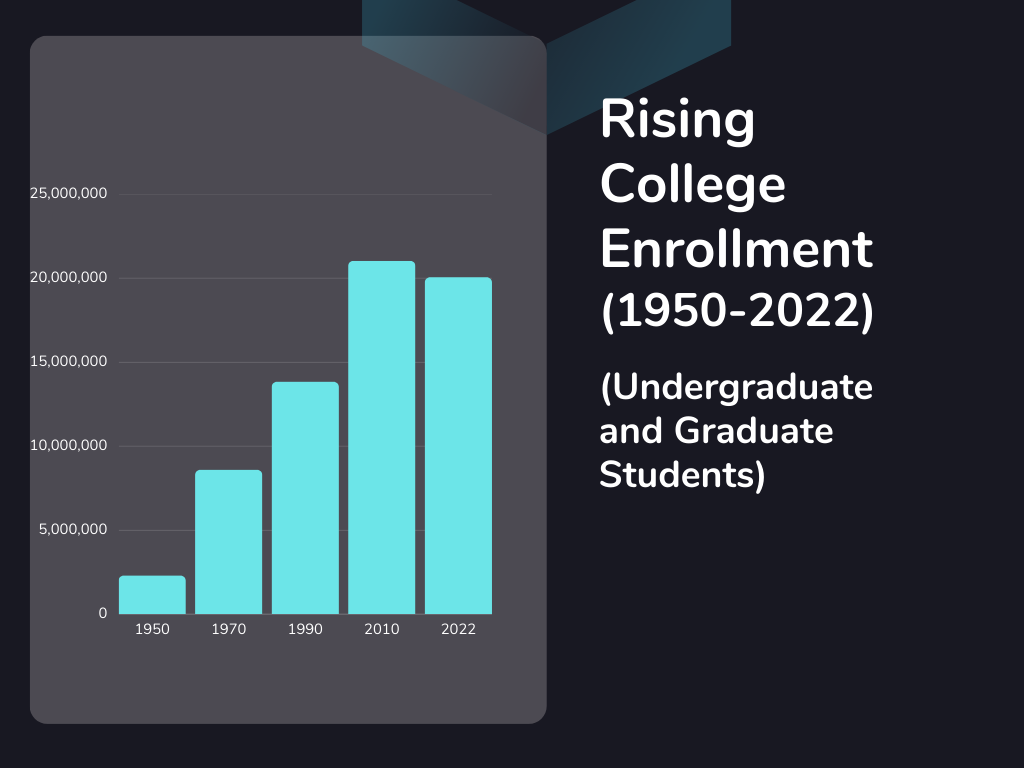
Rise in Education Expenses are Associated with the Cycle of Demand and Supply
In the above graph, we can see a slight decrease in enrollment numbers in the year 2022. This is because of the shift in thinking of students, who are losing trust in college education.
Is a College Degree Worth It?
Our society is divided into two parts. One believes in the education system, and the other believes that it is a waste of money and effort. We have some really great examples of billionaires and geniuses who do not have a college degree.
Bill Gates dropped out of college at the age of 20 and made a revolutionizing company, “Microsoft”. Walt Disney ended his schooling in the 8th grade and moved on to open the world’s eyes to see animation at its best.
Today’s generation is inclining more toward becoming social media influencers, stock market traders, etc. They are finding it fun and a way to make money with minimal effort.
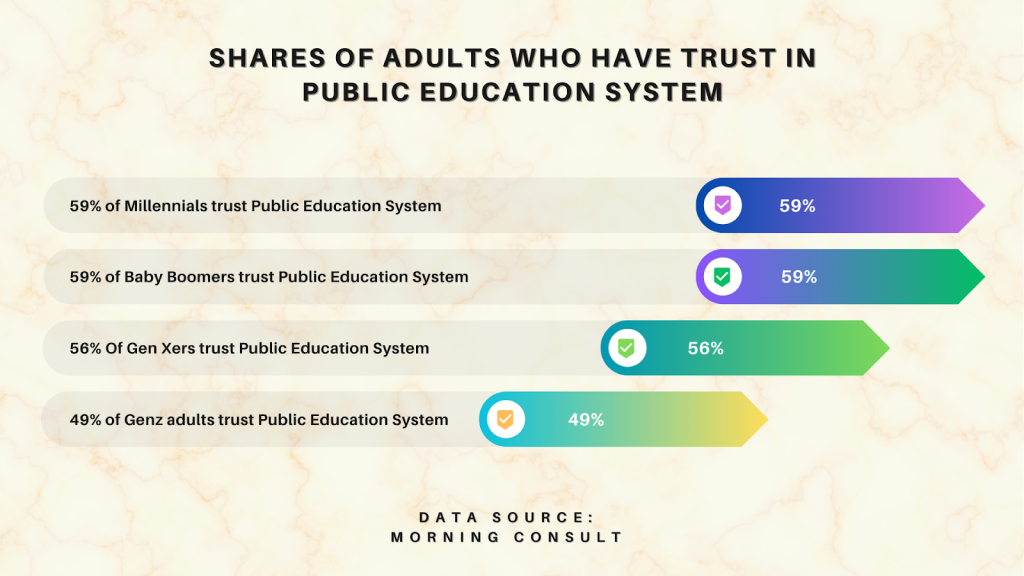
People Losing Trust in College Degrees
According to the data collected by Morning Consult, Gen Z has the lowest trust in the education system of public colleges or universities. They also revealed that in October 2020, 62% of adults supported the public education system, and now, as of May 2023, the numbers have decreased to 52.5%.
- Lower State Funding
Another reason for increased tuition fee is the decreasing financial support from the states. According to the data from the College Board, there is a correlation between the state’s funding and education costs. In the academic year 2015-16, the state’s funding was reduced by 11% as compared to the last 10 years, which is the result of a hike in education expenses.

Lack of State Funding Means the Burden of High Education Expenses Is Shifted to Students and Their Parents
At the same time, state funding is only related to public universities, as these colleges and universities are affiliated with the government. So, a reduction in state funding would have little impact on private universities but more on public universities and scholarships for college students.
- Operational Cost
Gone are the days when the things required to impart education were just different subject books, a professor, a blackboard, chalk, desks, and students. Now, the time has changed. Universities and colleges are no longer just institutions of learning and teaching. A classroom has become an e-classroom, with tablets on each and every desk.
Online learning is now the primary focus, with learning resources readily accessible on the internet, surpassing the significance of traditional learning methods.
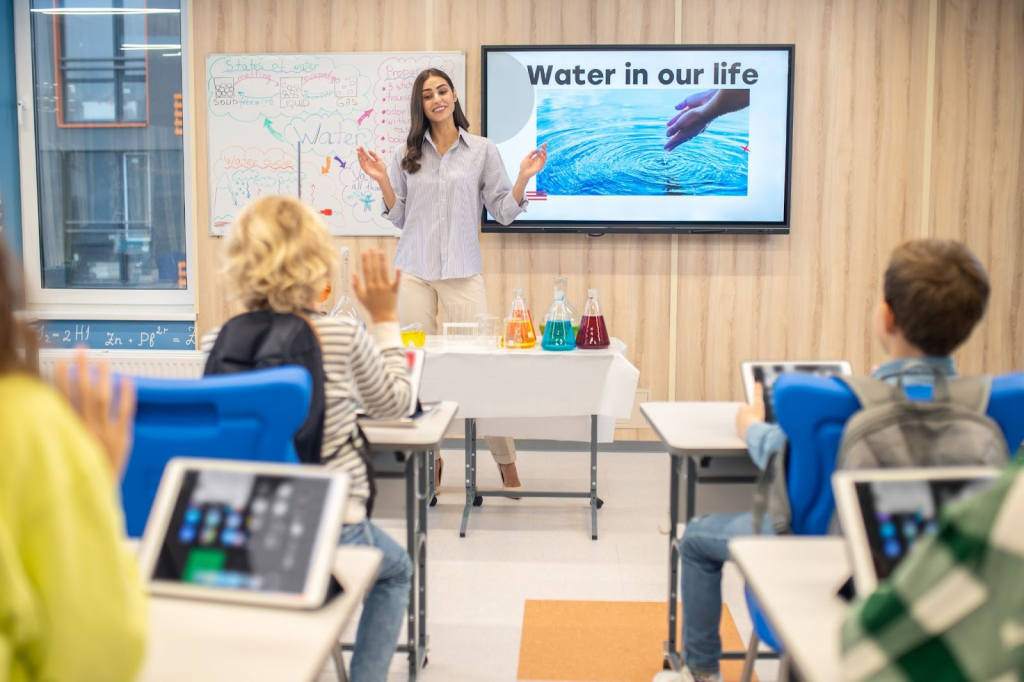
High-Quality Education Comes With High Education Costs
Many institutions now have full facilities and services like healthcare, technological devices, counseling, research, dormitories, and institutional support. These facilities and services take a major chunk of money from the university’s budget, which in turn leads to skyrocketing tuition fee. Moreover, universities provide quality education, so they have to hire highly educated people, which means high salaries.
You may also like to read: Challenges in the Current US Education System
Student Loan Statistics 2023
The ballooning education costs and student loans go hand in hand. According to Forbes Advisor, there is around $1.75 trillion student loan debt as of now, including federal and private loans. On average, one borrower owes $28,950. Moreover, 55% of public university students have educational debt, whereas 57% of private non-profit institution students take loans.
If we look at the statistics, student loan borrowers aged between 24 and 35 years owe around $500 billion to federal banks. Unfortunately, for some people, these loans do not leave the borrower’s side even after middle age. Not only this, people feel the pressure of repaying loans even after retirement.
Taking out a student loan is inevitable unless you have a scholarship or come from a financially strong family.
“Borrowing to pay for college used to be an exception; now it’s the rule.” – Arne Duncan, Formal United States Secretary of Education.
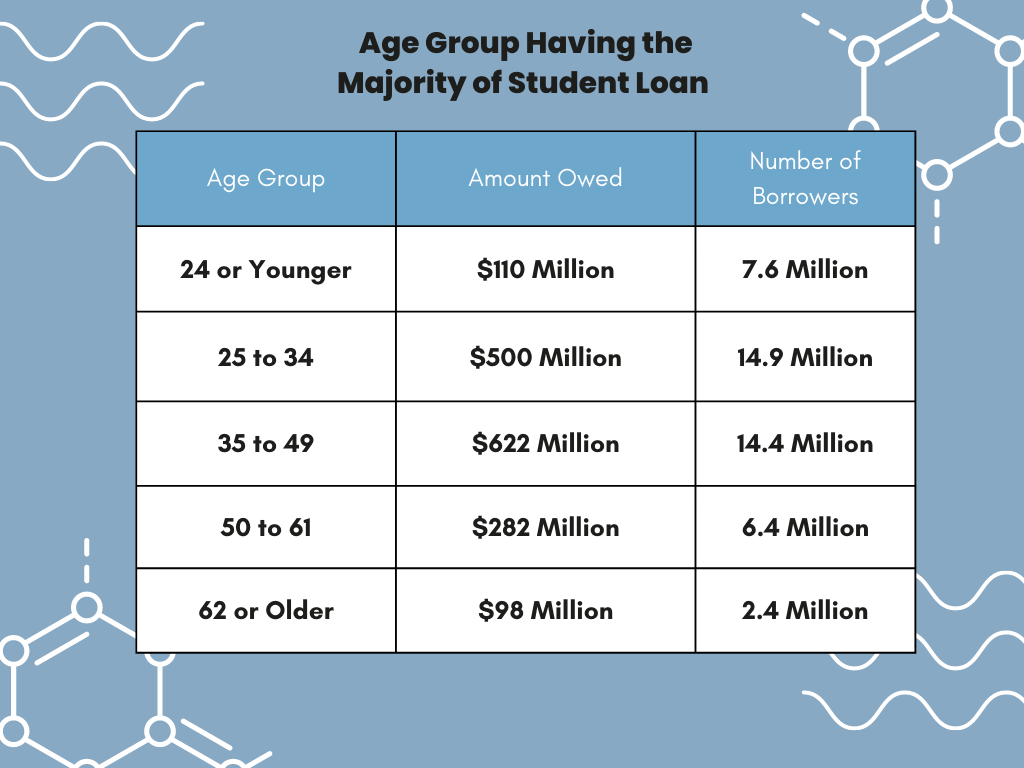
The Burden of Student Loan Remains With Individuals Even Beyond Their Retirement.
Federal Aid for Student Loan
In the year 2007, the Federal Government introduced the Public Service Loan Forgiveness Program (PSLF) under the act of College Cost and Reduction. Under the PSLF program, people who make 120 loan repayments while working for a non-profit organization or public service institution can get a portion of their student loans excused or forgiven.
According to the U.S. Department of Education, as of May 2023, more than 6,15,000 borrowers had successfully had their loans forgiven. PSLF has approved a total of $42 billion since October 2021.
The Public Service Loan Forgiveness Program is one of the most brilliant programs established by the government. It supports public employees, including professors, doctors, and policemen, as well as members of nonprofit organizations, by giving them relief from the headache of the installments of student loans.
How to Make Education Affordable?
In our January’s Industry Discussion, “How to Make Education Equitable and Affordable”, we got an amazing opportunity to invite and interact with brilliant speakers, Dr. Danny Barnes, Dr. Audrey Peek, and Lucas Kavlie.
Dr. Danny Barnes is a renowned Data Scientist and Cybersecurity Professor from Augusta University. Dr. Audrey Peek is a Senior Government Policy and Data Analyst from ACE University. Last but not least, Lucas Kavlie is a Vice President of Western Governors University.
All of these speakers made some really interesting points about how to make education affordable.
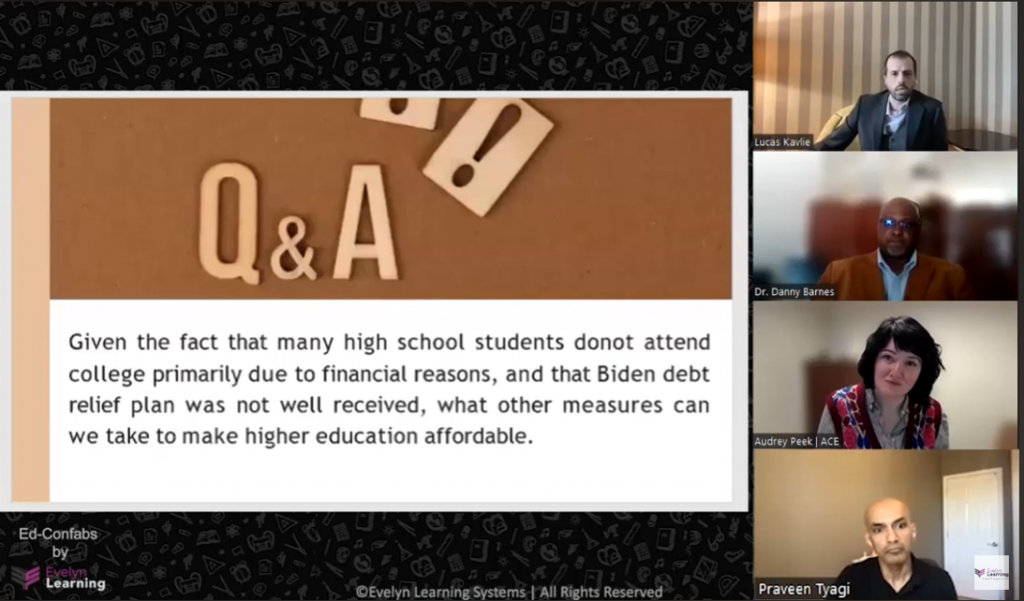
Dr. Danny Barnes. Dr. Audrey Peek, and Mr. Lucas Kavlie during an industry discussion co-hosted by Evelyn Learning’s CEO and Founder Praveen Tyagi and Content Analyst Tavleen Kour
Dr. Danny Barnes gave a great idea about opening a corporate education construct in a college where students can go to work as well as to classes. So, when they graduate, they’ll have a degree as well as work experience.
“A lot of problems are going around related to social-economic aspects, historical aspects, digital divide, etc. These problems are impacting the cost of education. There are two ways to overcome this situation. Schools should focus on e-books more which will help to cut down the cost of books from the cost of tuition. We can also guide students to take their early courses or generic courses at community colleges”.
On the other hand, Dr. Audrey Peek pointed out that there is an affordable college that’s right for every student. There are colleges that put students first and make sure they have minimal debt.
She advised everyone to use The Federal Government College Scorecard, which helps students to make their choice among the many options that fit their budget best.
“We have to help future students to avoid taking debt and struggling to repay it and that’s where we have to be innovative as well. The Federal Student Loan Program is broken and we need to fix it. There are some areas where a lot of improvement is needed like lowering student rate and improving student loan services. On the other hand, we want our states to increase funding to colleges or universities so that the education expense is reduced”.
Lucas Kavlie addressed that the problem of public relations is more than the problem with people being able to go to college, and there is always an ability to pursue tertiary or post-secondary education.
“When it comes to financial reasons, it should never be finance that eliminates somebody’s access to post secondary education. Individuals, who want money to attend colleges, there is money available but we’ve not done a good job of helping to guide them. We’ve figured out a way to reduce the tuition fee many decades ago in the United States by subsidizing primary and secondary education. But, tertiary and post secondary education are subsidized to a certain extent”.

Can We Afford Universities With Skyrocketing Education Costs?
How to Deal With the Problem of Cost of Education?
The increasing tuition costs and fees cannot be attributed to a single reason. There are a lot of factors that are responsible for this spiraling problem. Technological advancements, increasing inflation, reducing state funds, and certain economical challenges are causing this inevitable problem of the rising cost of education.
Now that we have somewhat understood the problem, it is important to find some backup plans and other options.
As said by Audrey Peek, students have to make their research game strong and find some colleges or universities providing scholarships, grants, or cheaper tuition fee. There is always an affordable college available for every student that fits right into their budget. Try finding resources online and gain as much information as you can.
According to Lucas Kavlie, there is always the ability to pursue education in a way that is either minimal or at no cost.
Also, if someone is ready enough to take a student loan, there are many schemes and programs started by the U.S. government to reduce the burden of repayment of loans. The information is out there, and you just have to grab it and seize the opportunity.
Lastly, a college degree is not the only criterion for judging whether a person will be successful in their career or not. If you’re interested in acting, singing, painting, designing, etc., you can make a career out of these fields too. You just need to be passionate about the career path that you’re choosing.
The post Why the Education Expenses are Rising and How to Deal with it? appeared first on Test.Evelyn.
]]>The post Top Trends And Challenges That Define EdTech Industry’s Health In 2023 appeared first on Test.Evelyn.
]]>At the end of 2022, we got a sneak peek of upcoming technologies, such as artificial intelligence, AR/VR, etc. At one point, we saw tremendous growth in the edtech industry, while at another, rising tuition fees and excessive screen time of students got us in a dilemma.
Now that we are into the first quarter of 2023, we are here to talk about the educational trends that are having a positive as well as negative impact on the edtech industry.
We will also take help from Evelyn’s industry report, “Trends and Forecasts on Learning Effectiveness in 2023”. In this report, many educational pundits, who have a rich experience of more than 15 years in the education industry, answered some questions regarding concerns affecting the e-learning industry and opportunities coming in 2023 to look forward to.
Edtech Industry Trends in 2023
During and after the pandemic, e-learning and blended learning started catching the limelight. They became more of a necessity rather than a luxury, as the pandemic refused physical contact completely.
In 2023, both these learning styles proved to have the biggest impact on the ed-tech industry.
Apart from this, AI has been in the news for the last few years. Just last November, OpenAI surprised us with ChatGPT and DALL-E 2. Let’s have a deeper look at all of these trends.
Artificial Intelligence
ChatGPT and DALL-E 2 have been in the news a lot since last year. OpenAI announced that more than a million people signed up for experimenting with this sensational chatbot. This chatbot has the potential to generate long-form content, extend longer conversations and compose, write song lyrics and educational content too.
According to Grandview Research, the real boost in the AI market was experienced after the year 2021. At that time, the size of the AI market was around $93.5 billion (USD).
During the last quarter of 2022, the AI market reached $136.65 billion, which is around a 50% increase from the previous year.
It is also estimated that by the year 2030, the market size of AI would reach $1,810 billion. A few decades ago, artificial intelligence was just a thought in progress. Now, we have robotics, machine learning, natural language processing, artificial neural networks, and whatnot.

Are robots going to replace humans as teachers?
In the next few years, it is believed that robots might have a certain level of self-awareness.
Some robots are humanized to some extent, like Sophia, the human-robot. Self-awareness means that there is no difference between a robot and human, which can also be concerning.
Sophia is a human-robot created by Hanson Robotics. Sophia uses some very advanced technologies, such as Natural Language Processing to understand human speech and Machine Learning to respond to human speech and gestures. This invention is the future of AI and one of the most advanced till date.
University and Startup Collaboration
Talking about industry-academia partnerships, in recent news, Jolly Good, a Japan-based startup has collaborated with Brigham and Women’s Hospital, which is affiliated with Harvard University. Together, they developed emergency care virtual reality content (VR).
Jolly Good medical VR solution will provide a more realistic experience than computer graphics. It will enable medical professionals to create their own live-action VR images.
Blended Learning
Coming to blended learning, this type of learning trend has not gained popularity only because of its sensationalism, but essentialism. Blended learning has become the most loved teaching method because it increases efficiency as well as student achievement by making them learn at their own pace. Apart from this, blended learning is also economical as well as time saving.
On the other hand, many people believe that hybrid learning leads to demotivation and procrastination. Also, it increases the screen time of students, making them feel lethargic all the time.
According to a report by NPR, 53% of children have their own smartphone at the age of 11.
In the year 2019, Common Sense Media found out that children aged 8-12 years spend almost 5 hours a day looking at the screen of their smartphones, tablets, and laptops. Moreover, teens aged 13-17 years spend around 7 hours a day doing the same.

Addressing the Challenges of the Education Industry in 2023
After talking about the useful trends in 2023, let’s move on to the concerns that we could be facing in the near future. The education industry has seen both bright and dull days.
“It cannot be denied that virtual technology is the future of education, but we also cannot agree that it would replace a physical presence”.
Are More Teachers Switching Professions?
During the pandemic, we saw teachers struggling with online teaching. They were feeling dejected, disrespected, and drained. The covid outbreak took a toll on most people’s mental health and online teaching did nothing, but added more mental fatigue to the already stressful life of teachers.
In the session 2022-23, many teachers stopped working. They either moved into non-teaching positions or switched schools.
School districts are unable to retain their teachers. Almost 50% of teachers transfer to new schools or worse, leave the teaching profession altogether. High school students as well as college freshmen have lost interest in teaching as a profession.

Image Credit: National Education Association
The above graph is a question from a research by Langer Research Associates asking parents if they want their children to pursue teaching as a profession. This question was first asked in 1969.
According to the U.S. Department of Education, 50 states in the United States reported a scarcity of teachers in the session 2022-23. There is a widespread shortage of special education teachers in 48 states, science teachers in 46 states, and math teachers in 44 states.
However, many education experts have also stated that the pandemic is just an excuse, and the problem of teacher shortage has been going on for more than a decade.

Teachers switching professions: The real reason
Cost of Education
Education is mandatory, but unaffordable. Many students who are willing to study opt not to continue their education because of the skyrocketing cost involved.
This concern was also highlighted in Evelyn’s industry report. Many experts highlighted this problem and agreed that the cost of education would continue to increase in the coming years too. As online learning is becoming more popular, the cost of education is also increasing.
“While we cannot deny the fact that technology has become an integral part of education, rising tuition fee is also a concern that the average American family is facing a lot”.

Cost of Education skyscraping higher than the previous sessions
The report of the College Board shows an immense increase in the average tuition fee of the private schools in the United States, such as Princeton University, Stanford University, etc.
The above graph shows the education cost, from the session 1992-93 to 2022-23. Although the tuition fee of public schools has declined slightly, keeping in mind the inflation, it is still expensive for lower-middle class families.
Reasons of Hike in Education Cost
In 2022, the cost of education was touching the sky. There are some reasons for this high cost of education . The important one is reduced state funding. In the academic year 2015-16, state funding declined by 11% compared to the last 10 years, which led to increased tuition fees.
This year, the trend has unfortunately continued and is now a big concern for students with poor pecuniary support. Students as well as parents are having second thoughts about pursuing a college degree.
According to the latest Forbes report, the number of students registering for college after high school has declined a lot. This year, college enrollment has decreased by 7% in comparison to the year 2017.
The reason is the sky touching tuition fee. Parents are thinking if taking a high debt for college education is worth it or not.
They are being skeptical regarding the value of a college degree. Students are starting to believe that colleges are overpriced and overrated.
Also Read: Should I go to college? We let our experts answer
Parental Involvement
Parental involvement is the participation of parents or guardians in a child’s education at home as well as in school.
Recently, we saw a lot of people inclining toward the idea of parental involvement in influencing school curriculums. They believed that this involvement leads to the growth and advancement of student.

Parental involvement in education is still a questionable thought.
In Evelyn’s 2023 ed-tech trends report, more than 50% of experts were in favor of the idea that parents should get involved in the decision making process regarding school curriculums.
However, other experts think that parents’ involvement leads to biased decision making. They consider that parents make decisions emotionally and not practically.
It is also believed by some pundits that educators make decisions by taking each and every student into consideration. On the other hand, a parent’s opinion might only be restricted to their child only.
Education Experts’ Opinions
In our recent Industry Discussion: Assessing New Age Curriculum Requirements with Jessica Aurilio and Alex Lochoff, we enquired if the involvement of parents in curriculum designing is valid or not. Their response to the question had some interesting points.
Jessica Aurilio is an edtech specialist at PowerSchool whereas Alex Lochoff is the director of curriculum at Edpuzzle.
Jessica said that curriculum development is not the area of parents to have a voice on. According to her, the idea should come from educators and people who are in the classroom.
On the other hand, Alex Lochoff was of the opinion that it might be okay to take suggestions from parents, but the parents should not have the decision-making power.
Watch the Full Webinar:
Conclusion
While we cherish the boost of artificial intelligence, AR/VR, and e-learning, we are also confused if this elevation is harmful for children. Students are having second thoughts about attending college, which is believed to be a foundational step towards career building. Increased screen time is not only harmful for physical health, but mental health too.
Parents must take measures to limit their children’s usage of technology. State should look into the matter of rising tuition fees. Awareness regarding scholarships and grants is required to provide education to every deserving student.
We have come a long way with technology. Many people are in support of e-learning. However, some think that traditional learning is still the most impactful way of learning. Both are correct in their own ways.
Everything has its pros and cons. Technology, if used correctly can turn out to be the best thing that ever happened to mankind. We should always look at the bright side of things.
The post Top Trends And Challenges That Define EdTech Industry’s Health In 2023 appeared first on Test.Evelyn.
]]>The post Emerging Technology is an Intersection of Humanity and Technology: Brad Waid on AR/VR appeared first on Test.Evelyn.
]]>This is how Brad Waid is encouraging everyone to utilize digital technology to its best advantage.
In recent years, virtual and augmented reality have gained popularity in education. Students have shown interest in learning because of AR/VR.
A report conducted by ResearchGate and drafted by E. Demirtas, “Reality Technologies and Use in Education” mentioned some exciting facts about virtual reality.
According to this report, the market for VR reached $5.5 billion in the year 2019. However, it is expected that, by the end of 2026, the VR market will reach approximately $18.6 billion.
Students and teachers are inclining more towards online learning than traditional ones, as tech-based learning provides students with an opportunity to understand difficult concepts in a fun and interactive way.
Since the pandemic, there has been an immense increase in the usage of technology in education. This fact has been highlighted by another research report published by Research Gate in the year 2022.
The report features a graph representing the AR/VR users in the United States. There were nearly 60 million users of AR and 35 million users of VR in the year 2018. But, during and after the pandemic hit the entire world, there was a drastic increase in the number of AR/VR users. By the end of the year 2022, AR users had crossed the mark of 95 million, while virtual reality users were more than 60 million.

Graph Representation of AR/VR Users in the United States 2018-2022
We had the pleasure of speaking with Brad Waid in our series “Ed-Insights by Evelyn.” He discussed the changes in student learning that have occurred in recent years due to the inclusion of technology in education.
Brad is an award-winning emerging technology leader, international keynote speaker, educator, and author. He is a visionary who specializes in AR/VR/XR, machine learning, and artificial intelligence.
Brad is recognized as one of the top 20 global futurists and keynote speakers by TAFFD. Furthermore, he is also recognized as the #14 influencer in augmented reality (AR) by Onalytica worldwide.

Brad Waid appeared on our 4th episode of Ed-Insights By Evelyn. Watch the Full Interview here.
The blend of technology and education has increased in recent years. Can you give us some examples of the fundamental changes in student learning due to the inclusion of AR/VR in education?
I’ve seen two radical changes in student learning. One of the changes came around 2011-12 when the iPad was introduced. The introduction of the iPad threw a wrinkle in education. We got access to tools, which have now completely changed what we are doing. The second and most important change is the expectation that students will use technology in education. They are using online learning platforms such as phones, tablets, and laptops as part of their online learning sessions. Nowadays, students don’t know a world without devices. They don’t know a world without technology.
The inclusion of AR and VR in education has made students more engaged in their learning. Traditionally, teachers used to lecture to share all the information about a particular topic. Eventually, students had to memorize that information and respond.
You may like to read about: Influencing the Future of Education with AR/VR
Now, we have a lot more integration of technology in education. The method of teaching has also changed. Teachers share an idea and then students have to research and investigate it. The change that we are seeing is a jump from simple memorization to an active approach to research and coming up with unique ideas.
Do you think it is a concern that we might replace actual books sometime in the future?
I don’t believe that AR/VR is going to replace all books because nothing can replace a classic book. But at the same time, what an ordinary book is used for might change. Reading something motivational, informative, fiction, etc., would still be done with a traditional book.
What augmented reality in education can do is add a digital representation. Imagine you’re reading about a museum in a textbook. Now, with the help of AR, instead of just reading about that museum, you can look at the artifacts in the museum, check its size for scale, and also read a little history about it. augmented reality is not going to replace a book, but it can enhance the classic books we use in education.
What is your idea about what lies beyond 2022? Are we looking forward to some exciting newer trends or better technology in 2023?
AR/VR is starting to take a foothold and it’s being used all over the world. The two big things that are coming shortly are artificial intelligence and metaverse. Both AI and metaverse will come under a blanket of Industry 4.0.
Industry 4.0 will defeat the traditional way of learning and teaching. This change would inculcate curiosity among students by shifting the responsibility of learning from teachers to them.

Inclusion of Technology in Education is Inevitable and the Key to Moving Forward
AI and metaverse are starting to cause some more wrinkles in modern education, but I’m always going to look at their benefits. Students would use AI as a tutorial that will help and assist them. Moreover, metaverse is going to have an impact on students’ learning. However, it’s not going to give them an environment where they can explore. Still, it’s also going to be a new place for students where they can meet people from all over the world.
AI and metaverse are the two big things that we will see in the future. They are already here but will be further developed for better use in education.
Would you like to give a message to our audience?
I want to encourage everyone to use technology in a way that will benefit humanity. Automobiles, airplanes, computers, etc. are built for the welfare of humankind. Teachers should be open to new technology and try to understand it more with the help of their students.
“Embrace the technology and use it. Whether you’re a teacher or a student, or you’re in the industry, try to use technologies like virtual and augmented reality in a way that will benefit humanity”.
Students can play a big role in helping us understand emerging technology and also assist us in moving forward. They are the ones who took us into this new world. We are living in a great time where modern technologies like AR/VR can help all humankind.
The post Emerging Technology is an Intersection of Humanity and Technology: Brad Waid on AR/VR appeared first on Test.Evelyn.
]]>The post Challenges in Education System: PJ Caposey interview appeared first on Test.Evelyn.
]]>An accomplished educator and motivational speaker, PJ has written around eight books, and his work has been featured in several notable spaces, including Washington Post, NPR, CBS This Morning, ASCD, Edutopia, the Huffington Post, etc.
It was enlightening and an honor speaking with PJ Caposey about the challenges in education. PJ gave us a glimpse of the ways how we can change the education system for the good of the students.
You have often talked about teachers reaching out to children for effective learning; how do recent teaching restrictions and salary concerns affect teacher morale?
The issue with teacher morale is both overstated and understated. We are in a time with a dramatic teacher shortage, particularly in the United States.
You may like to read: Things That We Should Know About the Teacher Shortage in America
Many people point to teacher morale as both a result of that and a precursor to that, and both can be true. The issue is that this is not a new or pandemic-related issue.

The teacher shortage is a decades-old problem and not a new concern
Multiple studies show that a cliff like that happened in 2008 when teacher responses to questions like, ‘Hey, I like my job’, or ‘I’m very likely to recommend’; all of that kind of fell off a cliff in 2008. So, it’s been on this downward spiral for a while. When I say this is not a new problem, I mean, this is literally a decades-old problem.
Morale, to me, is almost always like a climate issue that’s dictated by culture. So, when someone says hey, the morale is low, my question is, so let’s define the culture. Are we recognizing, appreciating, honoring, Valuing, or collaborating with?
If you’re doing those things, even if morale is low, it’s most likely to bounce back, if you’re not doing those things, and the morale is low, then we’ve got a serious problem that we need to address.
Your book ‘Students Voice-from Invisible to Invaluable.’ discusses the importance of students’ voices in learning. Do you think post-covid, the student approach to learning has changed?
I think that people are changing. Students are reflective of society. And I think, in some ways, they are demanding a greater voice in their learning, and there are positives and negatives to that.
I believe, every school wants to create community contributors that can communicate and able to think critically. I think that’s pretty universal, whether in Country A, Country B, or whatever.
If we want to create people that will make society better and be able to think critically, there is such a thing as experts, and I believe most of our teachers and leaders have expertise.

Students’ voices in learning is important for effective learning
So, for lack of a better term, even though I don’t know if one exists like a democratic model of education, it might not be what’s best.
That doesn’t mean that students shouldn’t have some choice in how they demonstrate their knowledge or the things they may study to practice the skills we say they need to master.
One of my all-time best examples of this is- we had a foreign exchange student early in my career that came from Bosnia.
And we were discussing the antecedents and causes of war, and the teacher wanted the class to focus on the United States Civil War. This person, a foreign exchange student, came from a war-torn country that had just experienced war and wanted to practice and master all the same skills but with a different prompt.
In my view, if we don’t listen to student voices in a case like that, that’s almost educational malpractice. But, that said, those types of examples are only sometimes there, which means that if we want students to research a classic novel and they want to do it on our recent publication in a magazine, those are two different things.
So, there’s this ray spectrum between trying to maximize and emphasize students’ voices. And then also saying there’s a right and wrong way to do things.
What do you think is the biggest gap in classroom teaching today: access technology, teacher shortage, classroom environment, or any other?
The most significant gap still exists between what is being measured in terms of how schools are reported. Some countries are considered successful in terms of education and what is likely to put kids in the best position to succeed tomorrow. So, for instance, in our district, we are very fortunate to have a lot of students that go to Ivy League schools and go to the most prestigious schools.
We also have many students in our area that enter directly into the workforce, the military, or whatever. Our desire to remediate any possible gap so that our test scores would look great sometimes run counterintuitive to what we could best provide for kids.
The second gap for me is geography. To explain, we are a small rural school, which means that my students live 60 miles to the East. They would have a much, much larger variety of offerings to take both on this-the advanced academic side and the excellent education side, simply because the schools are bigger and the volume of money that flows through, and the number of classes that can be offered are dramatically different.
Correspondingly, if you go 20 miles north, we have an urban center where education is much further because the school environment is different, where, you know, we might have a fight or two a year, they might have a fight or two an hour.
These students are having these vastly different experiences, So, when I look at education holistically, the biggest concern is that there’s just inequity by geography.
Would you like to give a message to our readers?
It’s to make sure that we’re doing meaningful work. If you ever find yourself in the throes of the day, the week, or the month and you’re wondering ‘why’, don’t ever lose that question of’ why’. If we lose that question, then the status quo is just going to be pervasive.
If we keep asking ‘why’, finding better solutions, and trying to make meaningful use of every hour of every day. We can do really good work on behalf of kids and our communities.
Watch the Full Interview:
The post Challenges in Education System: PJ Caposey interview appeared first on Test.Evelyn.
]]>The post Should I go to College? We Let Our Experts Answer appeared first on Test.Evelyn.
]]>Sonya, who hails from a family of highly educated (with postgrad degrees and PhDs) individuals, says, ‘I can’t accept this; she should at least get a graduate degree!’
So the teenager is now in a dichotomy and wonders, ‘ Should I go to college? Why is a college degree important? Is a college degree necessary to be successful?’
We got a similar audience question during our October webinar, “Learning Beyond College Studies,” and our speakers gave their expert opinions. You can watch the webinar here.
People Are Losing Trust In College Degrees
Society is divided into people who trust the education system and those who do not. But it does not mean that those who attend college necessarily believe in education or a degree system. They merely see it as a means to a promising job/career. But, unfortunately, this is what has been projected on us since our childhood.
School>College>Job>Money
This is a more conventional way our society has worked since the industrial revolution.
Then we had billionaires who were college drop-outs running the world’s biggest companies. This had people questioning, Is a college education worth it?
A global decision intelligence company named Morning Consult regularly researches how people think and behave, which helps leaders to make appropriate decisions. For example, in one of its recent surveys, Morning Consult found a trend in people’s trust in the public education system.

According to its data, Gen Z has the lowest trust in the public education system; the trend has been falling with every generation since Baby Boomers.
The survey also revealed that in Oct 2020, 62% of US adults parked their trust in the public education system, and today that number stands at 57%.
With time and technological advancement, people, such as social media influencers, stock market traders, or software developers, figured out ways to make money at home. These people needed education and some learning but not necessarily a college degree to pursue their passion.
You may like to read Why students should learn beyond college subjects and three ways to do that
Is College Education Worth it?
Our real-life experience starts once we are out of school life. Then, we enter the adulthood phase. We have to manage not only our expenses but also ourselves.

In our recent webinar, ‘Looking Beyond College Studies’, the experts spoke about the importance of college education.
Alok Jain, co-founder and CEO of an EdTech startup Moonpreneur.com has the following opinion on college education:
A college education is indispensable in specific streams; for instance, an individual has to study college to become a doctor.
There are other streams, like a software developer who might not need to attend the entire four years to get a good job and might only need a high school education and some training to get into the work industry. However, our schools need to prepare more to give industry-ready knowledge to their students to make them directly employable.
Here is an excerpt from Annette Ethcuit, a Coach and Mentor based in the UK and adept at understanding personalities and skill requirements at every level.
I think one should go for a college education. I am glad that I got a college degree even though my job was not based on my degree. But am I glad that I went to college? Yes.
I got to learn so much during that time. I learned several life skills living away from my family. Although a person never stops learning throughout their lives, studying in college lends you an environment to build confidence and a strong personality that helps you when you get into the workforce.
Here is another excerpt from Praveen Tyagi, former educator and the founder and CEO of Evelyn Learning Systems.
The question of a college education has many faces. It’s interesting how, recently, tech companies like Tesla and Facebook have been telling people that they do not need an actual degree to get a job in their companies.
But we see that when people apply to these companies and give interviews, there is a bias towards people who hold degrees. So those interviewers will look at what college you went to and what your CGPA is.
In my opinion, it is critical that we attend college. I agree when Annette says that college is an experience in itself. I had one of my best days when I was studying engineering.
But coming to another aspect of this question, do we have to have a degree to succeed? No. But college prepares us for our future endeavors and is a good investment.
Gen Z: Lack of Motivation for College Degree
Gen Z comprises young adults who want to ditch the traditional education path and follow their dreams.

Caption: Majority of Gen Zs do not find college education relevant
In a new Multiverse Survey, we learned that 72% of Gen Z believed college education did not give them the required skills needed to start their careers.
They mentioned the skills gap between college education and the industry, which is a demotivating factor in studying college.
Nearly 75% of Gen Z adults believe that it would be their first choice if they could get a chance to pursue their dreams without having to attend college.
They (60%) want to work (internships, apprenticeships, etc.) and gain experience rather than study in a 4-year program and start from the base.
The Fault in the Education System
There is a lot to be done with a college education. The cost of Education is escalating, which is cited as one of the top reasons for students not wanting to go to college.
For most of them, it is a cycle of working to study and studying to get work!
The modern adult says, ‘Ditch that college education and let me find jobs without the degree’.
If this is a reason, then in that case, the education system should be fixed in a way that can make college education more accessible and feasible. For example, we know that only some qualify for a grants program or a scholarship.
Making the Right Choice
The students must evaluate, and they need guidance. Proper counseling from parents and educators at the right time (probably high school) can help students understand what they want to do in life.
Randomly applying for courses can be a waste of time and money if the student wishes to pursue something other than a career in the subjects studied in college. Instead, parents, educators, or counselors can counsel students to understand what they want to do and their preferred career choice and then choose the career path accordingly.
A college education is an experience in itself. It gives us a brief glimpse into the real world of work and self-management.
A doctor might want to study medicine in college and cannot do without it. Another example can be a child who wants to be a musician and may or may not like to learn music through college.
Not only this, but as a society, we need to reduce the biases based on formal degrees and become open to skill-based hiring, which can give equal opportunities to individuals who are skilled and have experience.
The post Should I go to College? We Let Our Experts Answer appeared first on Test.Evelyn.
]]>The post Administrators need to have a vision and understand its value in learning: Jaime Donally on AR/VR appeared first on Test.Evelyn.
]]>Jaime is an educational consultant and technology enthusiast. She started her professional journey as a Math teacher and soon moved to instructional consulting.
Jaime is the founder of ARVRinEdu and Global Maker Day. She is also a persuasive author who has written extensively about immersive technologies in her books: ‘The Immersive Classroom: Create Customized Learning Experiences with AR/VR’ and ‘Learning Transported’.
I had the honor of speaking with Jaime Donally in our series of ‘Ed-Insights by Evelyn’.
In this series, we have a brief interaction with leaders and experts from the Education industry to help us get a wide and assorted perspective on various themes.
Jaime Donally joined us to talk about AR/VR in Education.
Also read about Influencing the Future of Education with AR/VR
She enlightened us on how AR/VR can be evolutionary for education and how important and easy it is to incorporate immersive learning into our learning methods. Here is the brief of what she had to say:
How can we include AR/VR technology in education given the resourcefulness of the schools?
It depends on how you’re using it. I am an advocate of using the technology we already have in schools first and then identifying if there’s a need later to expand that. I think oftentimes people think they have to go out and have a big budget and buy these high-end devices when that’s not the best place to start. It would typically not give you the biggest bang for your buck.
In addition to that, I do agree with its equitable access. Many of our students struggle to have the latest and greatest device on a personal side, and certainly, our classrooms are even behind that.
A lot of the tools that I share are available on older devices, and on devices that are mobile. The problem that we run into in education is the school district having an access to those devices, their owning them, and protecting them.

But we can maximize the idea by using the tools that our students are already bringing into the classroom, and tools they are already familiar with. We can leverage the tools that students (some of them if not all of them) do have access to, like Chrome books, computers, or iPads. So there’s a way to be resourceful about it.
Who, according to you (teachers, parents, or students) are more inclined or reluctant to include AR/VR in learning styles and why?
Well, the older you are, the higher probability that you’re not going to be as gung-ho ready to jump in. I am in my forties and I can understand how it feels to learn something new.
I think some of the problems that our teachers or administrators face is understanding what they are accountable for. So, are they accountable for bringing AR/VR into their district? Unlikely! They need to really have a vision for bringing that and understand the value of it. They can analyze how it meets students’ needs, and what students are building or capable of building with technology tools and then have some win over it, believe in it and buy into it, and that is only where the conflict mostly arises.
You may also like Technology in Education: An overview
On the other hand, students are really drawn to immersive experiences. That’s just naturally part of what they’re experiencing right now, including their social media and how they’re using technology. We have to give students an opportunity to deeply engage with technology and keep their enthusiasm spot-on with the learning outcomes.
The parents’ reactions are mixed. Some are excited about how technology affects every aspect of our lifestyles. Others express concerns related to privacy and data usage and I completely agree with that. Parents and students should be mindful of what information we are giving, who owns that information, and how it would be used. But we are slowly heading in that direction, which protects our data and privacy for students.

Students are excited for technology but some parents carry concern for privacy as well
How do you evaluate if the use of technology (AR/VR) has actually helped in achieving learning outcomes for students?
When it comes to what tool is valuable and what isn’t, I really think it depends on what our goal is. So for example, my husband who is a science teacher told me about a student with autism. The student comes with a person to support him in the classroom.
One day, that person could not accompany the child, so the child was all over the place that day. My husband gave him the incentive to use merge cubes if he finished writing and then let him understand the science concepts through the use of merge experience on iPad and the student was blown away. He was completely involved.
What we can learn from this is that we need to have sustainable technology around that can transform how students are learning.
Watch the Full Interview
The post Administrators need to have a vision and understand its value in learning: Jaime Donally on AR/VR appeared first on Test.Evelyn.
]]>The post Censorship in Schools: Will They Hurt the Core Purpose of Learning? appeared first on Test.Evelyn.
]]>Similar situations may crop up soon if certain proposed bills become laws in multiple states in the USA. Recent stories talk about how the State governments want to ban certain words, topics, and books from being taught in schools. Some people in America are also terming this exercise to be anti-public education.
But is it an act of prudence to dictate what the children will learn in schools, or should the education department become an independent body without bias?
Censorship in Schools
Many state governments have seen a rise in the number of proposed bills restricting what can be taught in classrooms to children. Political interference is causing discomfort to many teachers. It is becoming one of the main reasons why teachers want to exit the profession.
PEN America, a non-profit organization, observed that in 2022, 36 States introduced around 137 bills that put restrictions on teaching themes, like sexuality, race, gender, or the history of the United States. Additionally, many books face bans and are out-shelved by the school and other libraries.
Texas, for instance, has banned more than 700 books from the libraries of public schools. Teachers and superintendents have been tasked with reviewing all the books to check if their content is censorship-worthy.
According to the report, many of these bills have the potential to become laws before the end of this year. In all, such statements, termed ‘censorship in education,’ have increased to 250% in the last year.
39% of the bills introduced in 2022, the report mentions, are focused on higher education and many of them also include punishments for violations. The similarity between these laws is that they come from Republican legislators.

Data: PEN America, Chart: K-12 Dive
Understanding the intent on the other end of the stick
In a diverse society like America, some people support moves like book bans and curriculum restrictions. In their view, discussing ideas like sexuality, and slavery in American history, can unpleasantly influence students.
This partially comes from parents’ concerns about school lessons as a part of SEL. It is one of the reasons why many parents are also switching to homeschooling.
Parents are concerned that teachers might be trying to influence their children and teaching them to follow the so-called ‘Un-American’ culture. In addition, parents worry when their children are encouraged to come out of the closet and accept their natural sexual orientations at a young age.
So, what can be done to counter this?
This negative perception can be avoided if parents are invited to understand what the curriculum is all about. Parents can be encouraged become active in learning their child’s syllabus and then choose if this is right for them or not. Schools should communicate healthily with parents and explain the curriculum’s intent and content. If something is found outrageous by a majority, it should be excluded.
Reactions from Americans
Since these censorship in education have come into the picture in the last year, surveys have been conducted to understand the citizen perspective.
A majority of parents supported the following topics to be taught in schools. For instance, 87 percent of parents support teaching the Civil Rights movement, 74 percent of parents support teaching the history of Slavery, and 59 percent of parents agree to teaching the concept of Systemic Racism in American institutions and society.
Student Mental Health
The students have suffered due to the Covid-19 pandemic, which has disrupted regular school life. Following this, the narrative around the teaching shortage emerged, which spoke of this phenomenon affecting the quality of education in schools. And now, we see public schools coming under the radar for teaching specific topics while omitting others. These educational hiccups can affect students’ learning interests and make them emotionally vulnerable.
Students need stability and discipline to learn. If teachers are constantly in fear that them saying something might turn into legal action against them, no actual teaching would be taking place.
Partial or Uneven Learning
Learning can be partial if students learn about one part of history and not the other part of it.

CAP Data: PEN America
It would be a rather peculiar scenario if parents have learned certain things about history and their children have learned completely different things about the past. Learning should be even and truthful. Suppose the government opposes the idea of teaching concepts like critical race theory to younger children. In that case, they should be allowed to learn this in higher classes when they start understanding the credos of a prosperous society.
Conclusion
It is never really possible to ban information, because even though books can be banned and teachers’ behavior can be controlled, there is a technology where only some things are filtered. Students can still learn from the internet, which by large, contains only some authentic and accurate information. Legitimate books can portray ideas in a more sophisticated and acceptable manner.
The post Censorship in Schools: Will They Hurt the Core Purpose of Learning? appeared first on Test.Evelyn.
]]>The post Are Good Colleges Only for the Rich? appeared first on Test.Evelyn.
]]>Well, I think every nerd dreams of the world’s best colleges!!
Unfortunately, it is not easy to crack admission to the world’s top colleges. They demand excellent grades, curricular activities, and community participation. But is it all? What about the lofty fee structure?
As per the recent US News and World Report rankings, at least 19 colleges (of the top 20 universities) in the US charge more than $55,000 as their yearly tuition. To some, it can be shocking, but for others, this tuition money is worth and justifiable.
So, we have two points of view on this theme, to help you see the good of both sides. Once again, there is no one right answer, its all about perception.
POV: Expensive Higher Education is a bad idea
An expensive college education is definitely bad news in times of inflation, pandemic recoveries, and a predicted recession.
A Cengage study revealed that nearly two third of college students fully pay for their education. They are determined to get a degree, but the financial burden is quite demotivating.
It is figured that nearly 68% of high school graduates go ahead and enroll in college. However, this figure is not very satisfying. One of the significant reasons students do not enroll in colleges is that they find it difficult to afford college fees.
So is higher education only for the rich?

This also points to a notion about the education status of Americans. A study by Pew Research Center tells that 4 out of 10 Americans aged 25 years or above are high school graduates. This is a concerningly large percentage in a country that boasts of having the world’s best higher education institutions.
You may also want to read about E-Learning Resources for College Students
If this is concerning, then what is the role of the government?
We know about student loans and their long repayment burden. Loans are a liability. The exorbitant cost of education makes colleges less desirable, let alone unattainable. Moreover, the burden of the loan has been exacerbated, courtesy, of the pandemic. As a result, waiving student debt was one of the new government’s priorities last year.

The Student loan debt is around $1.75 trillion among about 48 million Americans.
Does student loan forgiveness solve the problem?
Although student loan forgiveness intends to help poorer families, the views are divided. Some critics believe that this loan forgiveness will only add to inflation since the burden of payment will only come to the taxpayers. This makes a vicious cycle where middle-class/poor people see themselves suffering.
Nevertheless, the idea of loan forgiveness does not bring a solution to the root cause, which is the high cost of education. Making loans cheaper is different from making the product affordable!
There is another critical side to this. These critics believe that the Biden administration’s decision to forgive loans will add to the increasing cost of college tuition. It is so because expensive colleges are aware that students can get higher grants of financial aid, making them more insensitive to tuition fees.
The inflation and recession scare add to the fears of the ordinary American citizen.
POV: Quality Education is Expensive
Why do people want to go to an excellent college with high reputation. Because it extraordinary features like:
● Good quality teachers who are well-paid for not just teaching but also conducting research work for students and the university
● A clean and sufficient campus to accommodate the students and a cafeteria and provide them with a conducive learning environment
● Latest technology that enables students to learn effectively
● Educational visits or guest lectures from accomplished industry professionals
Quality education comes with a price. Interaction with great minds, proficient teachers, and having high-quality amenities cannot come for free.
No wonder many world leaders are alumni of the country’s top universities like Princeton, Harvard, MIT, etc.
Businessman and one of the world’s richest, Jeff Bezos, is an alumnus of Princeton University.
Notable personalities like Sal Khan, Buzz Aldrin, and Kofi Annan are an alumnus of MIT.

24 alumni of Princeton University were Nobel Prize winners.
So, these colleges justify their worth since they have produced some of the tallest leaders in the world.
Expensive colleges can afford qualified teachers. This is the kind of worth that the lot of highly skilled experts expects in return for their dedication to learning. High value should not be just for the corporates but also for the educators who work hard to impart valuable knowledge to students.
You may be interested to read: Things That We Should Know About the Teacher Shortage in America
There are numerous other colleges and state universities that are not unaffordable.
For admission in these top universities there are financial aids and options. Students can apply for grants and scholarships, which help them pay for their college education.
Nowadays, there are options for virtual education, and they are less expensive than offline education. Same university, same value, but virtual education for a lesser fee.
The purpose of scholarships, student loans and distance education is that no hurdle should elude an intelligent mind from getting the best of knowledge from some of the best educators.
Rewarding Brilliance
Students who work hard should be rewarded with a high-quality education. Top colleges that harbor top minds from the world become world leaders or change makers. Seeing these colleges as a gift to students who deserve the best work environment is essential. When it comes to questioning the reasonability of their fee structure, one can argue that students from poor or weaker economic backgrounds get the option to avail scholarships and Pell grants (which do not have to be repaid).
It’s like saying that these colleges raise the bar. Expensive but high-quality colleges inspire other colleges to compete and provide better education to students to make them their product alma mater.
Expensive colleges allow students to network with high-worth and accomplished individuals, which is very important in a prosperous professional career.
High-cost colleges are like an investment that pays off well in the future.
The post Are Good Colleges Only for the Rich? appeared first on Test.Evelyn.
]]>The post Things That We Should Know About the Teacher Shortage in America appeared first on Test.Evelyn.
]]>The concern is less about how this teacher shortage will be met and how we want to deal with it and more about- does it even exist, or is it an inflated matter?
There are two stories. On the one hand, teacher shortage is seeing soaring attention, and on the other hand, there are talks about throwing off these claims. Whom do we believe? The data or the teachers?
Long story short, the teachers feel dejected, drained, and disrespected.
Data tells that pandemic has given them a hard time to teachers and they feel burned out. This feeling is exacerbated by lesser salaries. And to top it all, these came with the politicization of the profession. Teachers feel powerless over what and how they can teach. They cannot exercise self-discretion on teaching topics around sex education or SEL.
What is Happening?
A survey tells us that the job satisfaction of teachers in 2022 is 16 percentage points less than what it was in 2021. It also speaks about how more than 70 percent of educators are unhappy with their current working conditions.

Source:2022, Educator Shortage Research, by Emma White Research for MEA
Many educators are not willing to continue to work in the same job since schools have reopened. The pandemic has given big jolts to many of them, such as having to work harder through online classes, lesser pay, sickness, mental health concerns, and so on.
Governments in different states are taking measures to manage this shortage. For example, in Florida, the Education Department allowed military veterans and their spouses to teach in schools even if they lack a degree.
The Arizona Government has asked college students to fill in as teachers in schools in response to dealing with teacher shortages in their schools.
Is There a Real Shortage?
Although there is a large hue and cry about teacher shortage, there is no definite national data that says so. There are reports by independent research organizations or state data but nothing in national entirety.
RAND Corporation’s report tells a different story. They say that there is no shortage. In fact, more than half of the districts have expanded their teaching and non-teaching positions to numbers that are higher than the pre-pandemic ones. The demand for substitute teachers is high, and on average, districts have increased the daily pay of a substitute teacher by 6 percent. All this comes in light of the federal stimulus to the schools.

Source: 2022, Educator Shortage Research, by Emma White Research for MEA
The US Education Department discovered national data from 800 schools and concluded that on average, one school had 3 unfilled teachers’ positions. They believe that the shortage is not because of teachers leaving or planning to leave. It seems exacerbated because hiring is a little slow. Some researchers say that the word ‘shortage’ is also a misnomer as the quitting rate is not higher than what it was in previous years.
Addressing Teachers’ Issues

The shortage is not uniform in its sense. There is a shortage but it is in specific areas, such as teachers of special education. Teachers are burned-out and it is real. It is true that doctors were encouraged and applauded during the pandemic for their long hours and dog-tiring service at the hospitals, but we certainly cannot say that our teachers haven’t done enough.
The research results by Gallup Panel Workforce Study, 2022 tell that workers in K-12 feel more burned-out compared to workers in other professions. In the K-12 workforce, the teachers were found to be the most fatigued.

Tell that workers in K-12 feel more burned-out compared to workers in other professions
There are mental health challenges for teachers in schools as well. They have to finish the curriculum in time, cannot teach certain subjects, and lack the power to introduce changes to curriculums.
The above illustration shows that 44% of K-12 workers feel burned out, in far contrast to 30% of workers in other jobs.
All this burnout and then the profession is also low paid. It is affecting their lifestyles. Educators who teach for the love of education and because they have a passion for teaching are leaving or at least planning to leave because of the disrespectful conditions around their work environment and less pay which does not correspond to their hard work and living expenses.
Parents are taking their kids out of school and planning to homeschool them. This came into the picture due to the concerns raised over the school curriculum. Parents see the curriculum as political and going against their cultural basics and history.
The White House
Recently, the US government held a meeting to discuss the challenges faced by the K-12 workers. The first lady is an educator and was a part of the panel that was discussing the issues around teachers. Well, it is a good start.
The Biden administration has encouraged schools to use funds from the American Rescue Plan to give higher compensation to the teachers and welcomed platforms that can help in hiring school staff, including nurses and social workers. The government has given more stimulus to hiring and increasing the pay of the teachers.
The government is seeking support from private recruiting platforms like Handshake and Indeed to fill these positions for the schools’ staff.
We hope this works and brings some positivity to the school education system and the teachers. The education system is still dealing with the challenges thrown by the pandemic, and just like all times, this too shall pass. The government, the schools, and district leaders can work in tandem to mend what is broken in the best interests of the children and society as a whole.
The post Things That We Should Know About the Teacher Shortage in America appeared first on Test.Evelyn.
]]>The post Why students should learn beyond college subjects and three ways to do that appeared first on Test.Evelyn.
]]>Since regular classes have started post-pandemic, there has been a lot of pressure on students and teachers. Students have reported that sometimes the sessions run fast, making it difficult to keep up with the assignments, projects, or exams.
There has been a lot of discussion on the industry-institution partnership to enable a realistic and relevant education system. Students in college learn the skills needed to complete their tasks.
However, some skills help employees complete the tasks effectively, on time, and efficiently. These general skills that improve the employability of an individual include:
- Communication
- Collaboration
- Leadership
- Creative thinking
- Problem-solving
- Time management
- Feedback analysis
Let’s face it! Management students read about them and probably also get some practical sense of how important these skills are, but what about the non-management students?
Skills like time management, feedback analysis, collaboration, and communication are universally needed by individuals working in all types of organizations. But do our colleges focus on such skills?
Today, we talk about lean structures, with self-managed groups requiring little or no management. These teams may or may not be physically working together. So, for every team member, having specific general skills is extremely significant.
A team with one member in LA, one in NY, and another in Chicago would not give effective results until they know how to communicate in time, take responsibility, give feedback, and coordinate. These skills are not what just a management student should be taught; students with technical backgrounds would also require them.
Institutions have a responsibility to hold on to
Universities and colleges need to ensure that their students blend in the work environment and are least shocked when exposed to corporate work culture. We are in the era of Gen X and Z, who are multi-taskers. These generations question every status quo, are technology-savvy, and can learn independently.

Multitasking young generation
But how do they know what the corporate world needs? They would not understand until they either get into jobs or the institutions enlighten them.
Students should be taught skills that are required in the current work environment, which is dynamic.
The talk around skill gaps is not new, but it is still relevant. And it seems that since the pandemic struck, it has influenced almost every aspect of business and education.
According to the latest Mercer and Mettl research report on L&D, a quarter of employees feel that the skills needed for the work environment have changed, and a quarter of them believe that soft skills take priority over other skills.
These skills include communication and empathy in the top order soft skills that require employees to work in the current environment (remote/hybrid). As much as 38% of companies have decided to increase their learning and development budget by 20-50%.
Just like companies update their L&D programs as per the current industry needs, so can the universities.
Perhaps we can save them some money. Students can easily learn these skills while in college. All we need is some industry collaboration with institutions.
Focus on Financial skills
It is not just about general skills. There are other skills that make an individual ready for real life. We believe essential domains of knowledge, such as financial education, should be taught in colleges.

Recently, a study by Bankrate tells that nearly 22% of Americans have higher credit card debt than savings. Among them, the Millennials comprise the largest number. The study delineated that a majority of Americans struggle to understand what the focus of their finance management-paying debts or savings should be.
These trends show concern because they ultimately impact the economy. Poor finance management can increase the social liability of the government.
People worldwide understood the value of savings during the pandemic that caused income depletion, triggered by unemployment and expensive utilities. Instilling some pecuniary sense into students can help them float through rough times, clear their basic investment doubts, and improve their financial future.
How can colleges make students industry-ready?
The idea of a college education is to make it more holistic. Instead of only equipping them with core subject knowledge, let them also be aware of necessary soft skills that can make a difference in their lives once they graduate.
The following three ideas can steer a college and the student toward industry readiness.
Include more Coop programs in their college
There are college programs that allow students to gain work experience along with their college degrees. Many colleges offer such programs, also known as co-op programs. These programs tend to deliver the best of both, theory and practical knowledge.
The idea is to teach real-life skills to the students in such a way that they are exposed to the industry needs and still have time to acquire those skills. These programs have been there for a while, but skill gaps remain.
Perhaps the students can also act as agents of knowledge and give the institutions feedback about the curriculum’s learning gaps, bringing them in sync with the current industry requirements.
Conduct yearly review programs with the companies
Institutions can conduct yearly or two-yearly review meetings with companies that have previously hired students from colleges or with companies that are willing to make campus recruitments in the coming year. This can help the institutions understand which skills are preferable so that they can align their curriculum or projects to instill those skills in the students.
Use the Alumni
Alumni are one of the biggest assets of institutions. And alumni who are in big companies or entrepreneurs are treasures for the institutions. The institutions can request the alumni to not only enlighten the students and institutions about what topics are obsolete and what skills are much needed but also about how those skills can be achieved.
The post Why students should learn beyond college subjects and three ways to do that appeared first on Test.Evelyn.
]]>