The post Should I go to College? We Let Our Experts Answer appeared first on Test.Evelyn.
]]>Sonya, who hails from a family of highly educated (with postgrad degrees and PhDs) individuals, says, ‘I can’t accept this; she should at least get a graduate degree!’
So the teenager is now in a dichotomy and wonders, ‘ Should I go to college? Why is a college degree important? Is a college degree necessary to be successful?’
We got a similar audience question during our October webinar, “Learning Beyond College Studies,” and our speakers gave their expert opinions. You can watch the webinar here.
People Are Losing Trust In College Degrees
Society is divided into people who trust the education system and those who do not. But it does not mean that those who attend college necessarily believe in education or a degree system. They merely see it as a means to a promising job/career. But, unfortunately, this is what has been projected on us since our childhood.
School>College>Job>Money
This is a more conventional way our society has worked since the industrial revolution.
Then we had billionaires who were college drop-outs running the world’s biggest companies. This had people questioning, Is a college education worth it?
A global decision intelligence company named Morning Consult regularly researches how people think and behave, which helps leaders to make appropriate decisions. For example, in one of its recent surveys, Morning Consult found a trend in people’s trust in the public education system.

According to its data, Gen Z has the lowest trust in the public education system; the trend has been falling with every generation since Baby Boomers.
The survey also revealed that in Oct 2020, 62% of US adults parked their trust in the public education system, and today that number stands at 57%.
With time and technological advancement, people, such as social media influencers, stock market traders, or software developers, figured out ways to make money at home. These people needed education and some learning but not necessarily a college degree to pursue their passion.
You may like to read Why students should learn beyond college subjects and three ways to do that
Is College Education Worth it?
Our real-life experience starts once we are out of school life. Then, we enter the adulthood phase. We have to manage not only our expenses but also ourselves.

In our recent webinar, ‘Looking Beyond College Studies’, the experts spoke about the importance of college education.
Alok Jain, co-founder and CEO of an EdTech startup Moonpreneur.com has the following opinion on college education:
A college education is indispensable in specific streams; for instance, an individual has to study college to become a doctor.
There are other streams, like a software developer who might not need to attend the entire four years to get a good job and might only need a high school education and some training to get into the work industry. However, our schools need to prepare more to give industry-ready knowledge to their students to make them directly employable.
Here is an excerpt from Annette Ethcuit, a Coach and Mentor based in the UK and adept at understanding personalities and skill requirements at every level.
I think one should go for a college education. I am glad that I got a college degree even though my job was not based on my degree. But am I glad that I went to college? Yes.
I got to learn so much during that time. I learned several life skills living away from my family. Although a person never stops learning throughout their lives, studying in college lends you an environment to build confidence and a strong personality that helps you when you get into the workforce.
Here is another excerpt from Praveen Tyagi, former educator and the founder and CEO of Evelyn Learning Systems.
The question of a college education has many faces. It’s interesting how, recently, tech companies like Tesla and Facebook have been telling people that they do not need an actual degree to get a job in their companies.
But we see that when people apply to these companies and give interviews, there is a bias towards people who hold degrees. So those interviewers will look at what college you went to and what your CGPA is.
In my opinion, it is critical that we attend college. I agree when Annette says that college is an experience in itself. I had one of my best days when I was studying engineering.
But coming to another aspect of this question, do we have to have a degree to succeed? No. But college prepares us for our future endeavors and is a good investment.
Gen Z: Lack of Motivation for College Degree
Gen Z comprises young adults who want to ditch the traditional education path and follow their dreams.

Caption: Majority of Gen Zs do not find college education relevant
In a new Multiverse Survey, we learned that 72% of Gen Z believed college education did not give them the required skills needed to start their careers.
They mentioned the skills gap between college education and the industry, which is a demotivating factor in studying college.
Nearly 75% of Gen Z adults believe that it would be their first choice if they could get a chance to pursue their dreams without having to attend college.
They (60%) want to work (internships, apprenticeships, etc.) and gain experience rather than study in a 4-year program and start from the base.
The Fault in the Education System
There is a lot to be done with a college education. The cost of Education is escalating, which is cited as one of the top reasons for students not wanting to go to college.
For most of them, it is a cycle of working to study and studying to get work!
The modern adult says, ‘Ditch that college education and let me find jobs without the degree’.
If this is a reason, then in that case, the education system should be fixed in a way that can make college education more accessible and feasible. For example, we know that only some qualify for a grants program or a scholarship.
Making the Right Choice
The students must evaluate, and they need guidance. Proper counseling from parents and educators at the right time (probably high school) can help students understand what they want to do in life.
Randomly applying for courses can be a waste of time and money if the student wishes to pursue something other than a career in the subjects studied in college. Instead, parents, educators, or counselors can counsel students to understand what they want to do and their preferred career choice and then choose the career path accordingly.
A college education is an experience in itself. It gives us a brief glimpse into the real world of work and self-management.
A doctor might want to study medicine in college and cannot do without it. Another example can be a child who wants to be a musician and may or may not like to learn music through college.
Not only this, but as a society, we need to reduce the biases based on formal degrees and become open to skill-based hiring, which can give equal opportunities to individuals who are skilled and have experience.
The post Should I go to College? We Let Our Experts Answer appeared first on Test.Evelyn.
]]>The post Career Counseling for High School Students and Role of EdTech Companies appeared first on Test.Evelyn.
]]>High school is a rollercoaster ride. Teenagers are at their peak of hormonal changes and on the cusp of career transformation.
The students may admit it or not, but they do need help.
It can be a real task for students to understand their interests and go through the college selection and admission process. There will be rejections and application errors, so students should receive proper guidance for subject selection and admissions.
Most students plan on going to college, but sometimes they either drop the idea or drop out before graduation because of high tuition fee or other reasons. In a study by the Pew Research Center, about 44% of women gave unaffordability as their reason for not attending college, while only 39% of men said the same. But the second most common reason for men and women was to work to help their families.
Some students also ditch a regular college education because they want to pursue their passion.

Importance of Higher Education
There are two schools of thought. One says that a college degree is important if you seek financial betterment. To corroborate, a 2021 study said that in 2021, a bachelor’s degree holder earned a median wage of $52,000 annually. On the other hand, a student with only a high school diploma earned a median wage of $30,000 annually.
The other school of thought mentions that a college degree does not define an individual’s career. Of course, there are exceptions, but it is also true that everyone has their own journeys.
You may Also Want To Read About Why students should learn beyond college subjects and three ways to do that
Unfortunately, COVID has widened the college employment gaps among graduates and undergraduates. A study conducted in December 2021 tells us that the unemployment rate for college graduates is 1.9% ( aged 25 years or older), and for high school graduates is 3.7%.
Why is Counseling Necessary in High School?
We all know that students are often confused about selecting their majors in college. We have all been there.
Counseling is a guidance program that helps students to channel their energies in the right direction. For example, in high school, counselors help students to:
- Unveil their interests and follow the right career path.
- Assist students in determining which courses will benefit them in a specific career field.
- Educate them about colleges as per their tuition fees.
- Help them through the college admissions process.
But this is just what is in the job description. Many good counselors go to lengths to help students get into college. And this is where our answer lies.
Students often feel they are not well guided to help them decide on their career path. They are mostly confused about what subjects to study and how that would help them achieve a desirable career path.
They can often make mistakes. As a result, they may either change their majors or drop out of college altogether. However, both these options are a significant waste of time and money.
Effective and timely counseling can help students discover their interests, understand their career paths, and choose relevant courses and colleges as per their feasibility.
Why Counseling When the Internet is There?
No doubt the internet holds immense information, but we cannot speak to it about our doubts. It just delivers and does not help us discover. Counselors are trained professionals who know about careers and how to deal with confused students.
We spoke to some college students through social media, and they feel that career counseling in high school would have helped them select their majors in college. However, some also said they decided to study in college because they had nothing else to do.
We found it to be concerning. Students choosing to study college just because they have nothing else to do can lead them to choose the wrong subjects, which might increase the dropout rates. This can cost them their time and money too.
Sessions with a career counselor can start by telling students about the importance of attending a college and what process can be followed for applications to different colleges.
Role of EdTech Companies in Counseling Students
Career choice and subject selection are big tasks for high school students. This is where EdTech companies can play a part. EdTech companies can act as a one-stop shop with a combined cluster of resources to help students guide their careers.
You May also be E-Learning Resources for College Students
EdTech companies can be helpful in this area since the school counselors are overwhelmed with almost 400 students per counselor. Unfortunately, this can prevent students from receiving personalized guidance sessions.
Some of the many companies that offer college counseling services include:
- College Essay Guy provides a wide range of services for students, parents, and counselors. Writing a college essay is one of the significant challenges to admissions, and this website helps students with the entire process.

- College Vine was founded in 2013 and has offices in the United States and the United Kingdom.It boasts a 70% acceptance rate of students into the Ivy League and top schools.

- Empowerly was founded in 2018 and boasts of a 94% success rate of college admissions for students in the top 50 schools.

- Niche is a US-based online platform that helps students find the right school and colleges for them. It gives school/college rankings, reviews of parents and students that can help others to take decisions.

- Common App as an online counseling platform is old and is a non-profit initiative. It bridges the gap between college applicants and institutions to help students simplify the college admission process.

The post Career Counseling for High School Students and Role of EdTech Companies appeared first on Test.Evelyn.
]]>The post SMEs v/s Learning Experts: Exploring the Differences appeared first on Test.Evelyn.
]]>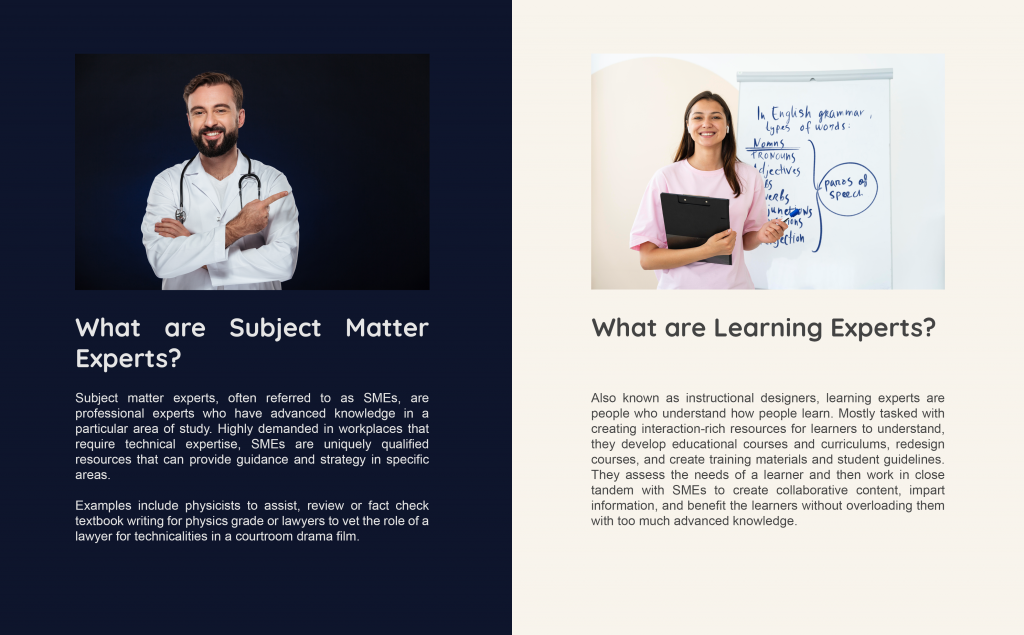
Striking the Right Balance: SMEs v/s Learning Experts
Point 1:
Subject matter experts have a high talent and affinity for their subjects. However, learners may or may not be able to follow the guidelines or the syllabi listed by the SMEs.
To straighten out these creases, a Learning Expert who helps bridge the gap between SMEs and learners is considered.
How Does a Learning Expert Work:
- They take complex and comprehensive subject matter from subject matter experts and break it down into a series of steps of easier ‘building blocks’ that learners can comprehend, understand, and learn from.
- Find out case studies and real world examples to illustrate a theoretical concept better.
- In some cases, they also highlight the practical benefits and personal gains for the learners, which help the learners look at the topic objectively.
Point 2:
Subject matter experts hold a far more nuanced knowledge of a subject than a regular instructor, but sometimes, there is not a requirement of in-depth explanation of topics. Other times, internal factors like time restrictions and deadlines do not permit over investing in detailed information.
This issue is also resolved with the help of instructional designers who are hired to explain the topic at hand (mostly relevant in case of school students) in an easy and quick manner. Learning experts may not have advanced mastery over a subject but they definitely know the nuances and have the skillset to illustrate key concepts.
How Does a Learning Expert Work:
- Focus on the key topics and concepts while illustrating or explaining a topic.
- Focus on leveraging the maximum time that is allocated, keeping in mind the organization’s goals and the learner’s interest.
Point 3:
Subject matter experts often consider their job to transmit information. However, learning experts balance the knowledge between pure information and real application. For example, a subject matter expert may explain a simple concept of physics like refraction through complex equations, theorems, and formula derivations, but a learning expert is most likely to demonstrate the same concept through real life examples and demonstrations.
After listing the above points, it is only clear that subject matter experts and learning experts work well in coherence. While SMEs provide the reasoning and information behind technical concepts, instructional designers (or learning experts) help learners relate those difficult theorems from real life, thus making it easier for them to understand hard concepts and topics.
The post SMEs v/s Learning Experts: Exploring the Differences appeared first on Test.Evelyn.
]]>The post Adaptive Learning as a New-Age Teaching Methodology appeared first on Test.Evelyn.
]]>Traditional teaching presents a rigid course material to fit all the students. Adaptive Learning makes use of frequent assessments, exchanges feedback with learners, and opens alternative learning paths that help students gain content mastery before moving onto other steps of learning.
Case Study
Let us say a group of 5 students are undertaking a module which includes sections such as Logical Reasoning, Quantitative Aptitude, Statistics and Language skills. If the teacher applies conventional methodology, he will hand out course material and then evaluate the students through tests. The learning outcomes are understandably poor. The teacher finds that among the 5, one is especially conversant in language skills while being weak in statistics. He may find still others who are well versed in all the sections of the module.
Yet the common evaluation generates an average result for all five, which is as good as false data. Going by this data, some students fail in select sections, some excel in all, while others move on with insufficient depth of knowledge in a section where they had begun to show promise.
Problems with the Case Study
The concerns regarding with the aforementioned case study are evident.
- Sample Size: While monitoring a small group of 5 students, the teacher is able to alter the course depending on the areas which each student seems to struggle with. This option however limits itself to a small sample size. The teacher cannot single-handedly design unique learning pathways for say, a batch of 100 students.
- Inequitable teaching outcome: This method only pools the knowledge shared in the classroom to a handful of average students, while the high-performing students and those who fall behind get left out of the equation.
- False data: A “one-fits-all” evaluation technique for learners with differing abilities generates false data, leading to failing the term or causing drop-outs.
Adaptive Learning as a Ready Solution
Adaptive Learning addresses all these problems. It offers interactive systems that measure performances of each student. Additionally, based on similarity of demographic or ability, they offer customized learning paths and course materials.
Students communicate with programs, provide feedback, and complete quizzes – all of which helps the system learn or adapt to their unique learning style. This also presents content in a set sequence, adjusting to the students’ learning path and pace. Adaptive learning systems take on the task of restructuring the course sequence from the teacher. Consequently, we can apply it to a greater sample size with ease.
Traditional classroom teaching does not rule out certain drawbacks such as failure to clear assignments and drop-outs, which Adaptive Learning does help with.
School systems have been infamous for “teaching to the middle”, where there are no provisions to encourage excellent performers with more challenging material, or support lagging students with customized content. This leads to failing the classes or dropping out of the system.
This methodology ensures that students gain mastery over individual topics before moving on to the next. It also generates assessments based on the performance of the learners, caters to the under-performers, and bolsters the excellent students, with more complex tasks.
Benefits of Adaptive Learning
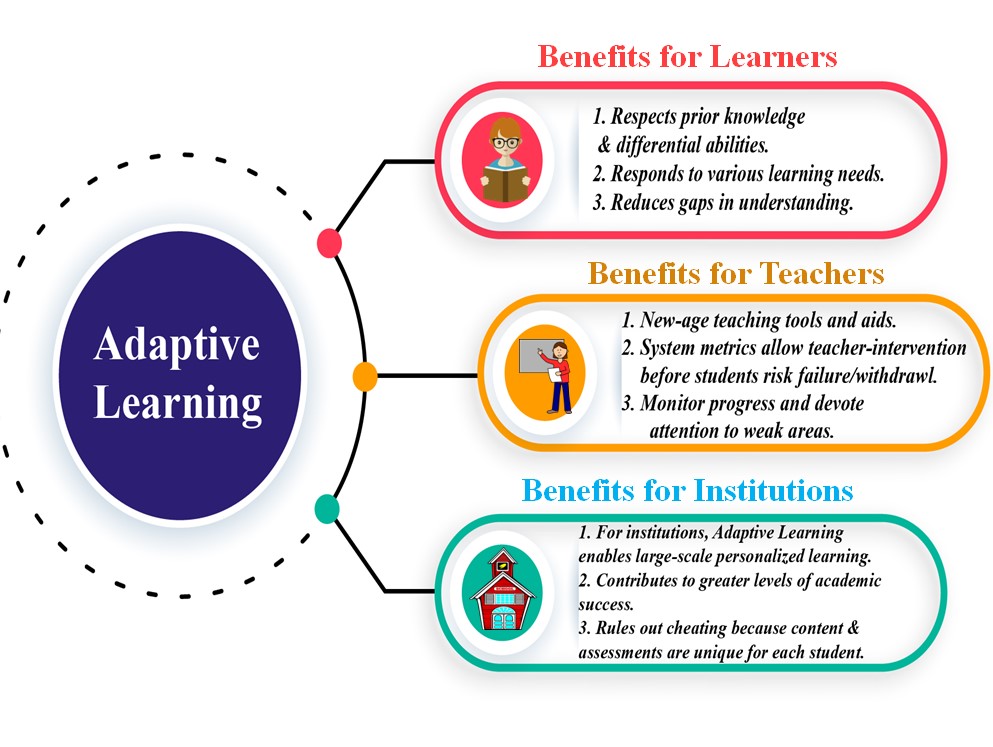
Adaptive Learning has three-fold advantages for students, teachers, and institutions as illustrated by the chart:
Challenges of Adaptive Learning
- Costly and Time-consuming: Adaptive Learning systems come at a steep cost to institutions. However, in most cases, it is a one-time investment. It also requires content-mapping and objective designing to support diverse learning styles and stages of mastery. This is a strenuous and time-consuming task.
- Not suited for some courses: Adaptive Learning is typically unsuited for courses that demand high-level critical thinking and evaluation.
- Not immediately effective: System algorithms need time to adapt to students’ learning needs by way of prolonged feedback and interaction. Systems also collect course materials over time before suggesting learning paths, so Adaptive Learning cannot be effective immediately.
Adaptive Course Samples
The great thing about Adaptive Learning system is that it can be applied to all levels of learning. Let’s look at some popular adaptive platforms and find out about sample course-ware.
- Quizalize is an adaptive platform which breaks down difficult concepts into fun, interactive quizzes. It promotes gamification in learning, and even allows for tracking students’ progress.
- Fulcrum Labs incorporates A.I to model a personal instructor for every learner who signs up. This platform takes the help of Artificial Intelligence, not only to track progress but also to make predictions about weak points and errors. It extends beyond academic subjects and helps students to cultivate real-world skills as well
- Elevate supports adult learning while entertaining learners at the same time. The platform includes a host of games, quizzes and alternate learning arcs to help adults improve upon math, reading, writing and speaking abilities. An added advantage of Elevate is that it is backed by significant research.
Taking a tour through these websites and looking at their course descriptions reveals how Adaptive Learning encourages students to choose their own path in online learning. In all these platforms we see how systems depend heavily on feedback, interaction and adaptation to learners and instructors as is the essential feature of this model.
In conclusion, Adaptive Learning though uniquely tailored for all learning needs, has its own limitations as well. By implementing it correctly, teachers hold the capability to maximize its benefits. We shall explain the different kinds of Adaptive Learning in this (placeholder) article.
For more information, visit Evelyn Learning blog.

Create. Engage. Inspire.
The post Adaptive Learning as a New-Age Teaching Methodology appeared first on Test.Evelyn.
]]>The post Why Children Hate School and How You Can Help Them? appeared first on Test.Evelyn.
]]>Through this blog, we attempt to look at the question ‘what do children hate about school?’ critically and suggest some ways to deal with it.
Why Children Hate School? Or, What Do Children Hate About School?
There can be several reasons for hating school, some of which include:
1. Lack of Freedom
It is claimed that every child is born curious. This curiosity fosters the desire to communicate. Thus, children tend to be talkative and restless. So, the lack of freedom becomes the most common reason for hating school.
In a school, students are confined to a classroom and must ask for permission for almost all actions. Moreover, they are restricted to behave according to the rules of the school. This suppresses their desire to communicate and curbs their freedom, turning it into a reason for many students to hate school.
2. Monotonous Schedule
Schools function on the principles of discipline and proper utilization of time. There is a fixed schedule for classes and activities conducted in a school. Therefore, the students have to adhere to the fixed timings and follow the code of conduct of the school. Children are usually not accustomed to following such a schedule. Also, attending lectures sitting in the same classroom for hours is tiresome. Such a monotonous schedule and fixed timings create an aversion to school.
3. Loneliness and Bullying
Communication is the most primordial and innate human requirement. The inability to express and connect can affect the various aspects of an individual’s personality. Moreover, it has an impact on the psychological makeup and can affect mental health as well.
In a school, the lack of freedom often leads to a feeling of loneliness. Additionally, the inability to communicate makes it difficult for students to make friends. Thus, they end up feeling lonely and are unwilling to go to school.
On the other hand, some students try to exert their influence on their peers who seem to be weak and submissive. They often bully them, which instills a sense of fear in that child. This is another reason for students finding school abhorrent.
4. Lack of Interest in the Subjects Offered
Schools typically have certain mandatory subjects and a few or no optional subjects. This means that students are restricted to learning a limited number of subjects. Consequently, they often end up studying the subjects they do not like. Few subject choices lead to a lack of interest in learning.
Additionally, some students might come to fear certain subjects, such as mathematics. This can be the result of their inability to understand complex concepts or failure to secure good marks in that subject.
5. Inability to Learn
The dislike toward school may arise due to certain mental conditions that disrupt the learning patterns. A child may be suffering from a learning disability such as Dyslexia, Dysgraphia, Dyscalculia, and others, which makes learning difficult.
Moreover, certain learning disorders, such as ADHD, Dyspraxia, and Executive Functioning, make it difficult for students to learn. Eventually, students find reasons to avoid school and end up hating it.
6. Loads of Homework and Fear of Exams
Homework is something almost every student despises. Spending long hours at school and then putting additional efforts to do homework seems like a burden to growing children. Moreover, homework tasks are often boring and submission dates seem like a threat. Therefore, students tend to escape the responsibility of completion and submission of homework.
Additionally, another potential fear of the students in school is testing. Assessments are a crucial part of education. They are a way of measuring the students’ performance. Typically, examinations are reduced to scoring marks. As a result, students who get good marks get a reward, whereas the ones who do not are often neglected rather than focusing on the reasons behind their poor grades.
Additionally, score-based biases are common in schools. This demotivates the students and they begin to find ways to avoid school.
How to Deal with it?
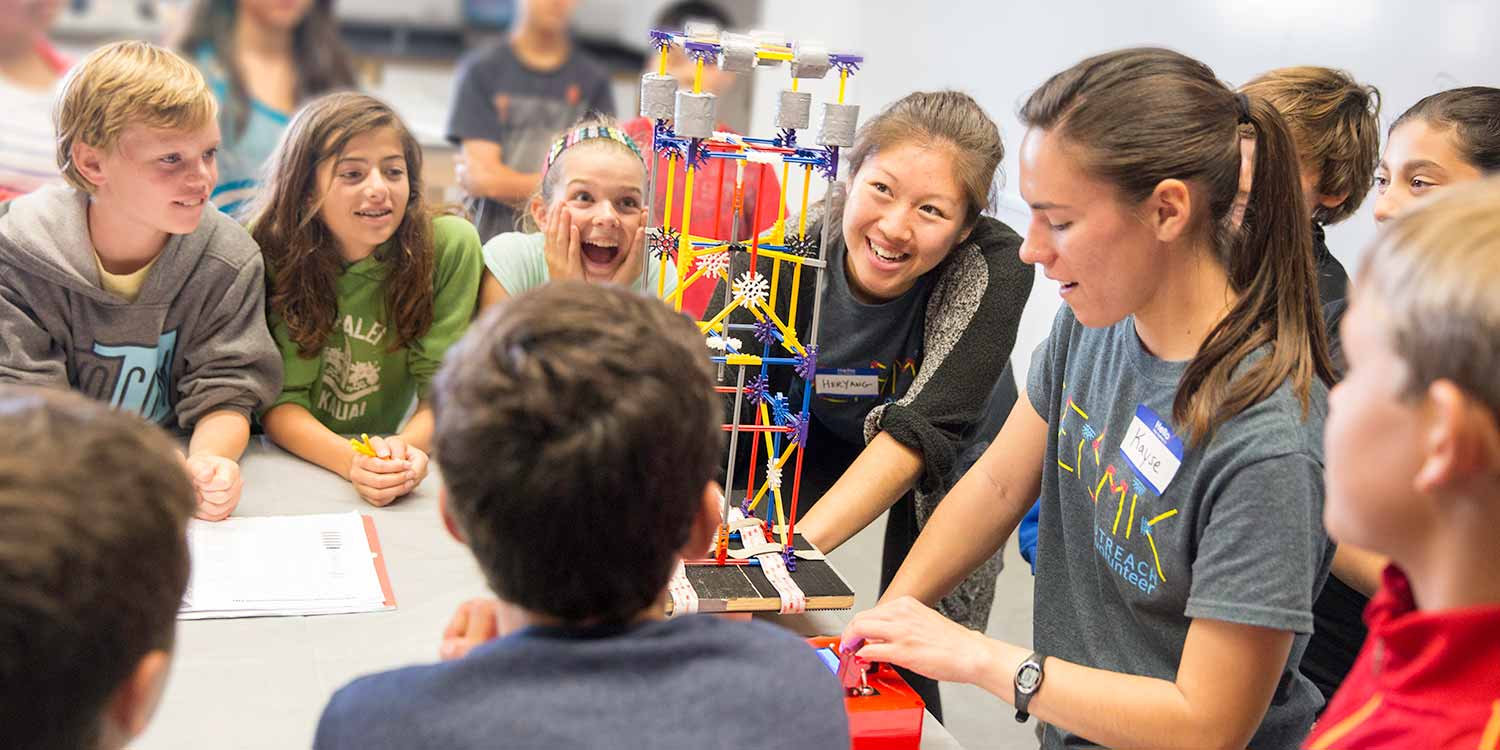
Learning is a requisite for human existence. Schools play a vital role in imparting education. Additionally, parents play an important part in the learning process. Thus, parents must participate equally with their children to assist them at various levels of learning. A collaboration between schools and teachers is the key to promoting better learning and development of a child. Learning is an interactive process where students are free to participate and express themselves. Teachers and parents contribute toward making a child confident enough to express their opinions and feelings. The classroom environment and the environment at home play a significant role here. Here are some ways to support learning both at school and home:
- A teacher must create a positive environment in the class that encourages the students to do their best.
- The parents must initiate a healthy conversation with their child and listen to the issues he/she needs to discuss.
- Instead of nagging, parents must practice friendly gestures and talk to their children to find a solution to the issues plaguing them.
- Both teachers and parents should be quick in identifying an unusual behavior of a child and try to find out the cause for the same.
- Parents should ensure that they work hand-in-hand with the teachers for the development of the child.
- Receiving and providing regular feedback on the child’s performance is necessary for both the teacher and the parents.
It must be understood that education is not merely getting good grades and maintaining a good status in society. It goes beyond the boundaries of school. Collaboration and understanding can together contribute to providing a good learning experience. However, if any of the reasons included do not fit, parents and teachers both should not hesitate to meet a counselor to figure out the reasons for a child hating school.
Visit our blog for more education-related articles.
Further Reading: The Learning Apps
Image: Shutterstock and USCD
For more such content on teaching methodologies, visit our blog.

Create. Engage. Inspire.
The post Why Children Hate School and How You Can Help Them? appeared first on Test.Evelyn.
]]>