The post SAT vs ACT: Differences appeared first on Test.Evelyn.
]]>It is important to note that no institution would favor SAT over ACT, or vice versa.
These exams are meant to evaluate the student’s general knowledge in several areas. The goal for both the exams is the same: to determine college readiness.
First, this article breaks down the differences between the SAT and the ACT. Further, it puts light on the factors to consider while choosing an exam.

SAT vs ACT: Key Differences
Vocabulary
As far as the critical reading section of SAT goes, vocab is the first requisite to excel. Generally, SAT questions are believed to be trickier and less direct compared to the ACT.
In contrast, the ACT eases out on vocab and contains a separate section for science instead. It can be said that the ACT is more curriculum based while the SAT is focused on problem solving.
Therefore, learners who struggle with vocabulary may often perform better with the ACT. However, students cannot judge a test on this single aspect.
Time per Section
Another biggest difference is the time allocation between these two tests. The SAT offers more time for each question, whereas the ACT requires pacing quickly through the questions.
On top of that, the ACT has additional questions, but the SAT questions are quite tricky and lengthy (so they might take longer to complete).
Given below is the section-wise distribution of time:
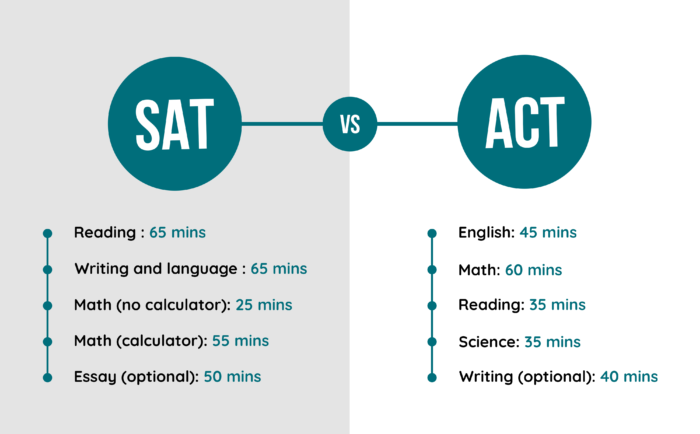
Therefore, students who can stay focused and work under pressure will be better off with taking the ACT test.
Scoring
The scoring is also vastly different between these tests. The ACT is scored on a scale of 1-36, whereas the SAT ranges between 400-1600.
Mainly, the overall score on the ACT is an average of the four sections (that is, English, Math, Reading, Science). On the other hand, the SAT tends to weigh the score on the basis of each section individually.
Most importantly, there is no penalty for wrong answers (no minus points) on both the tests. So, test-takers have the freedom to turn to guessing when their time is running out.
Essay
The essay section is optional on both the tests, but many colleges still require the SAT or ACT essay scores to judge the student’s potential.
The SAT asks students to read a full written essay and analyze the author’s argument. Further, the student’s essay should dissect the argument using evidence and reasoning. In short, the students cannot present their own opinion.
Similarly, on the ACT, the student is supposed to analyze the different perspectives in the passage and mainly present their own opinion, unlike the SAT essay.
Science Section
The ACT has a separate science section unlike the SAT. The ACT science section provides 35 minutes to answer 40 questions. In this case, a science wizard who loves to analyze scientific data, graphs, and charts the ACT might be a better fit.
That being said, the SAT does test scientific knowledge, though not with the use of a separate science section. With the complexity in questions, the students have to interpret graphs and charts in a way similar to the ACT.
For more information on preparing for the LSAT, visit our blog.
Create. Engage. Inspire.
The post SAT vs ACT: Differences appeared first on Test.Evelyn.
]]>The post Talent Assessment: Methodologies and Tools appeared first on Test.Evelyn.
]]>What are Talent Assessments?

If we were to describe what talent assessments are, indeed it helps companies cut through thousands of applicants and choose the right candidate for the job. Companies should implement talent assessment when they need to hire the right candidate.
Talent assessment is now a part of companies of all sizes. Companies design a pre-employment talent assessment test that candidates must specifically go through. Based on several parameters, candidates are selected for the interview process and then go through the talent assessment screening. These are the deciding factors for a company when they conduct recruitment drives.
To illustrate, some of the famous examples of companies that use talent assessment are Walmart, Sears, PetSmart, Express, Neiman Marcus, and Macy’s.
The common perception here is to test the experience and work capability of the candidate. It is as simple as it can get. Candidates who go through the tests and ace them are more likely to be the right fit.
Moving on to the criteria based on which the tests are designed, it is specifically hiring and retention case studies. Companies analyze all types of employee data to make the right kind of assessment test. How the candidates perform shows their compatibility with the job role. Alternative names for talent assessment are pre-employment tests, employment screening tests, and employment assessment tests.
How do Talent Assessments Work?
Through online assessment platforms, companies use their HR managers to conduct talent assessments. Such screening procedures truly help the recruiting managers or the HR personnel separate the unfit candidates and shortlist the fit ones.
They are conducted online on a cloud-based platform and must be secured with advanced proctoring tech. The process is automated, inclusive of interviews consequently conducted on a talent assessment platform.
Check out the step-by-step process to this test:
- Creating the tests
- Sending out the test invites to the candidates
- Proctoring intervention
- Identity verification of candidates
- Conducting tests
- Result report generated instantly
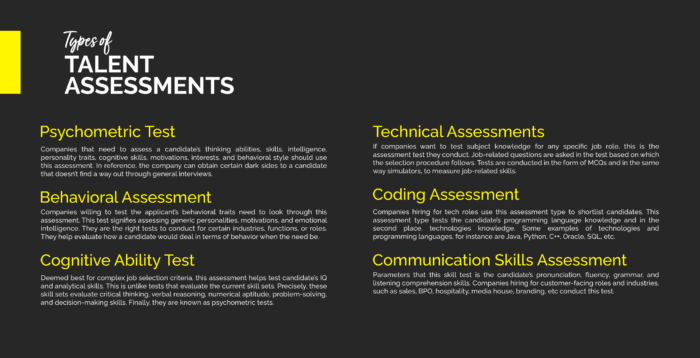
Types of Talent Assessments
Since we already know what talent assessment signifies, let’s go through its multiple forms.
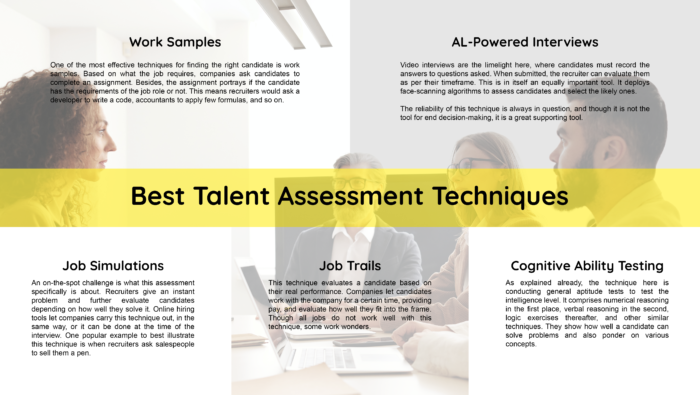
Best Talent Assessment Techniques
We have a bunch of talent assessment techniques that companies could use. They would come in handy at the time of hiring.
Top Talent Assessment Tools
If you are pleased with this form of hiring candidates, it is probably time you use this methodology for your company. Look out for these 12 tools which you can consider at the time of assessing the applicants.
- Applied
- Codility
- eSkill
- HackerRank
- HireSelect
- Interview Mocha
- Koru
- Mettl
- Plum
- Predictive Index
- Pymetrics
- Self Management Group
Talent assessment puts the shortcomings of the traditional recruitment process on hold. Talent assessment amplifies the experience for both the candidate and the recruiter. It makes bringing the best talent on board easy and reliable.
For more information on preparing for the LSAT, visit our blog.
Create. Engage. Inspire.
The post Talent Assessment: Methodologies and Tools appeared first on Test.Evelyn.
]]>The post Learning Experience Design or LXD appeared first on Test.Evelyn.
]]>What is Learning Experience Design (LXD)?

LXD is the acronym for learning experience design and best refers to the process of creating learning experiences. The focus of creating such designs is to make the approach human-specific and goals inclined so the best outcome ventures from it.
Specifying LXD, it has several design disciplines at its core with the prime objective of the field of learning. Some key design principles used in LXD are interaction design, user experience design, experience design, graphic design, and game design. Let us get a clear picture of LXD by breaking the concept into 3 parts.
Experience
Knowledge comes to us from experience and might be in multiple forms, not limited to education. Knowledge gathered from home, any outdoor areas, or work and experience obtained from any place is worthy of a shot. These experiences are what matter. Hence, LX designers need to integrate such experiences.
Design
LX design is all about the creative design discipline, the applied form of art. Research, experimentation, ideation, conceptualization, prototyping, iteration, and testing goes toward the process of LX design. Designs of the process have one objective – provide value or provide elegant solutions. Here, the design discipline denotes a design detail that teaches.
Learning
Defining LX design is about how the candidates learn, not the teaching pattern or the training schedule. The catch is to know the designs and efficient approaches of using the design that endorses learning. The end game is to curate a learning experience that works and lets the learner absorb much.
Other facets to this concept as we already know are human-centered and goal-oriented.
Elements of Learning Experience Design
The success of the eLearning courses of LXD depends on four key elements as described. Before we go through the elements, let us brush up on the basics, that is, the difference between UXD and LXD.
UXD or user experience design is used to enhance user experience and is used in the product development field. On the other end, LXD leverages the UXD principle to provide an enhanced learning experience in eLearning courses. LXD makes technology in favor of the learners.
Now, let us get started with discussing the elements.
Understanding Learners
Learners do not necessarily begin from the same origins as others do. Some learners are newbies, while others have already built up the base level and wish to go advance. The experience curve that LX designs create does not have the same origin for everyone.
LX designers, with the help of multiple tools, learn about the experience level of the candidates. Then, they get started with creating the design and add facilitation of skipping a few sections. This allows learners with some knowledge to skip past the sections they already know about.
Experiential Learning
One of the primary reasons why traditional corporate training fails is because they are inclined toward tasks and not experience. Though mainstream training seems reliable, it may not essentially be of value and fun.
LX designs leverage the traditional aspects such as functionality, usability, and convenience and add the missing parts. LX designs let learners move past the traditional offerings and engage them in a great way. The learning has the end course of action where learners find the solutions themselves.
Engagement and Motivation
Content competence apart, LX designs must indeed design a course for humans. The idea should be to create a design that learners would find entertaining, engaging, and valuable. Learners must feel they are getting a lot more in return for taking up the course and there is no compromise.
Sensory Layer
While crafting the learning course, another aspect that LX designs consider is the sensory experience of learners. Each and every aspect of the learning program must be in line with the sensory experience of learners. Designers should ensure they collect from the learner’s senses and amplify the materials and instructions accordingly.
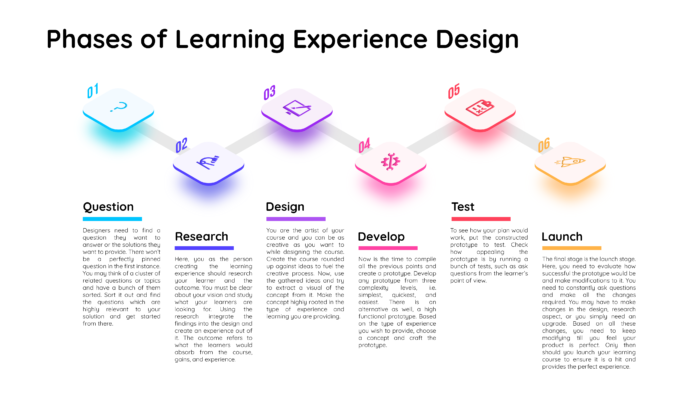
Phases of Learning Experience Design
When you want to create a learning experience design, you need to set for a journey of uncertainty and adventure. The approaches that LX designers use often reciprocate that journey and there is a streamlined process to it. There are 6 collective steps or a rough draft of how the design phases go:
Learning Design v/s Instructional Design
Confusion between LX design and instructional design is an obvious phenomenon. The look of it might be the same, but they are entirely different concepts when you dive deep into them both. Precisely, instructional design is teacher and teaching-oriented, while learning design is learning and learning outcome-oriented.
For more information on preparing for the LSAT, visit our blog.
Create. Engage. Inspire.
The post Learning Experience Design or LXD appeared first on Test.Evelyn.
]]>The post Project-based Learning: Its Meaning, Benefits And Impediments appeared first on Test.Evelyn.
]]>What Is Project-based Learning?
Talking about what is project-based learning, it is a teaching and learning approach and framework in which students acquire content knowledge and abilities in order to respond to a driving question based on a real-world issue, need, problem, or concern. Project-based learning is done in groups and cooperatively, with the use of a variety of employability skills, such as critical thinking, communication, and creativity. It encourages student participation and choice as well as inquiry. Authentic PBL requires a community partner and a publicly displayed product. A continuous process of reflection is also a part of it.
Designing an app, geocaching, student farming and bridge building are just a few great project-based learning examples. If educators are looking for more engaging project-based learning ideas, they can have students design a garden that meets specific design objectives, then plant and care for the garden, start a recycling program that addresses a problem with existing recycling programs, or assist a local business in improving environmental sustainability.
Characteristics Of Project-based Learning
The three most important characteristics of project-based learning activities that lead to deeper student comprehension are outlined below:
a) Student-centered
Here, the teacher’s role is more of a co-learner who engages in the growth and development of the student by providing them the freedom to experiment. Hence, this allows the student to demonstrate their capabilities while working independently.
b) Multi-disciplinary
Real world challenges can be difficult to solve when looked at from a single perspective. In PBL, projects require students to gather knowledge from multiple academic domains, which helps in understanding the root problem.
c) Collaborative Environment
The last characteristic of project-based learning is a collaborative atmosphere. PBL is an ideal approach to foster teamwork and collaboration. Undoubtedly, at first, students may often find it difficult to reach a common ground with cross functional teams, but eliminating these differences is one of the great outcomes that PBL can provide.
Benefits Of Project-Based Learning
The advantages of using PBL as a teaching method are numerous and varied. The following are a few of the project-based learning benefits.
1. Continuous Learning Benefits
Students can face endless problems while working on a project, but only constant practice and learning can help them solve these problems. Similar to real-life situations where uncertainty is inevitable, PBL helps in shaping the students to face reality with much more confidence.
A student can learn all the knowledge from a subject, but eventually what matters is how he or she implements this knowledge. PBL allows the students to take control of the situation, which advances them on the path to become a lifelong learner.
2. Supports Different Learning Styles
Each and every student has different skills and competences. As mentioned earlier, project-based learning gives the freedom to experiment and requires a lot of application. In addition, it allows students the flexibility to use their individual learning styles to solve a problem.

3. Student Assessment
While the traditional way of checking performance is through exams, it is not always the best way. Exams can help judge the knowledge of students, but they may not alone be effective in retaining it. PBL requires students to not only retain information but also apply it and see how relevant it is in a real-life setting.
PBL allows educators to perform assessments by helping in the growth of the student. This leads to solid feedback which helps them to improve skills and, most of all, remain engaged in the classroom.
4. Develop Real Life Skills
Another significant feature of project-based learning is that it requires good communication skills. It allows a student to solve an open-ended problem in many different ways. This approach helps in building various skills, such as critical skills, communication skills, and problem solving skills. Therefore, the four walls of a classroom do not limit these abilities. In fact, learners can apply them in various school subjects and even in real-life situations to solve problems.
5. Encourage Intrinsic Rewards
Last on the list of project-based learning benefits is encouragement of intrinsic rewards. The rewards attached to project-based learning are much greater than just getting an A on the test. Students achieve self-respect and satisfaction by performing a real-world problem, such as solving a riddle, presenting a business idea, and creating innovative solutions.

Problem-based Learning v/s Project-based Learning
Problem-based learning is a student-centered teaching pedagogy that dates back to the 1960s. Students learn about a topic through solving questions, and they usually collaborate in groups to solve problems when there isn’t always a single perfect answer. In a nutshell, it gives students the ability to conduct research, combine theory and practice, and use knowledge and abilities to create a feasible solution to a problem. Problem-based learning differs from project-based learning in that students who complete problem-based learning often share their results with the teacher and work together to set learning goals and outcomes.
Project-based learning, on the other hand, is a method in which the objectives are predetermined. It is also quite regimented in terms of how the lessons are delivered. Problem-based learning is more likely to be a single subject and shorter, whereas project-based learning is more likely to be multidisciplinary and longer. Problem-based learning follows particular processes while project-based learning follows generic steps. Project-based learning frequently contains realistic assignments that solve real-world problems, whereas problem-based learning employs scenarios and situations that are possibly less relevant to real life.
Challenges Of Project-based Learning
Student unpreparedness can act as a barrier in the success of PBL. Thus, it is one among the many challenges of project-based learning. Some students may struggle to grasp the concepts and identify the problem on their own, which can make them feel disengaged. However, continuous monitoring and providing additional resources can help eliminate these challenges of project-based learning.
While PBL has the ability to transform the education sector, one must keep certain limitations in mind. The amount of time consumed to plan and deliver is often a problem in PBL. Only schools and teachers with the ability to understand the deep waters of this system can do full justice to this teaching pedagogy. Therefore, in order to make PBL successful, some points need to be noted, such as monitoring tasks, the quality of those tasks, collaboration, teamwork, and benchmarks. Although this can be a time-consuming task, the outcome is sure to be fruitful in the long run.
Image Sources: Shutterstock and Unsplash
Also Read: Adult Learning Theory: Its Need And Impact
For more information on project-based learning, visit our blog.
Create. Engage. Inspire.
The post Project-based Learning: Its Meaning, Benefits And Impediments appeared first on Test.Evelyn.
]]>The post Technology in Education: An overview appeared first on Test.Evelyn.
]]>With the evolution of technology, new technologies for teaching started developing. From abacus to handheld calculators, from slide projectors to virtual reality tools, artificial intelligence, from books to kindle. Most of all, the effective use of these digital learning tools in eLearning has helped to facilitate personalized learning experiences which couldn’t have been possible in the past in a traditional classroom setting. This has extended learning beyond the classroom and a person can virtually reach anywhere just with the click of a button.
There are various aspects to incorporating technology in the education sector .This article will further evaluate the role and benefits of using the right technology in classrooms.
Role of technology in education
Just a couple of decades ago, finding technology in classrooms was not a very common sight. Today, technology is a fundamental part of the learning process.
According to a recent study, evidence has shown about 70% of all primary and secondary schools in the UK use tablet computers to deliver learning content.
Although technology is essential, it may not be enough to integrate technology alone in online classrooms. Undoubtedly, with lack of good teaching practices, individual tools are destined to fail in providing effective learning experiences.

Why is the use of technology in education essential?
1. Automating everyday tasks
If technology is incorporated effectively into the learning process, it can become a teacher’s best friend and a trusted teaching assistant.
For instance, a number of apps are designed to help teachers take attendance so their time is utilized in other important tasks. Students can mark their attendance through a tablet, even if the teacher is busy preparing for class. And voice assistant tools such as Alexa, Siri, Cortana can help teachers to multitask, find information to share with students, set up appointments, make phone calls, etc.
Meanwhile, as students browse information and access everything online, it eliminates the need to perform basic everyday tasks such as making notes, photocopying or stapling.
2. Greater accessibility
In the past, students and teachers had to be physically present to conduct lectures or exams. Similarly with the use of technology in eLearning, this process can be shifted online avoiding any distance barriers.
Educational technology opened doors to exciting possibilities such as distance learning, virtual field trips, gamification and many more. Established traditional schools now provide online courses, while other schools have shifted their operations online completely. This proves incredibly useful for students who like being flexible and learn at their own pace.
3. Increased collaboration
Educational technology provides endless possibilities for immersive learning practices. Not only are teachers involved with students during lectures, but, students also communicate with each other. Through online lessons and activities, students can interact among themselves to share ideas and work in a team. For example, teachers could hold extra doubt solving classes, by being available via instant messaging or video calls to help students as they go about with the day’s homework.
4. Real time feedback
Using technology for providing real-time feedback can take a great many forms. But, overall, technology can enhance assessment by providing the means to gauge a wide range of student competencies. For instance, schools may opt for an LMS software to assess the leaner’s progress and provide immediate feedback. This can help in healthy engagement of the students. In short, providing real time feedback can foster communication within the classroom.
5. Personalized learning
Technology provides 24/7 access to learning tools and resources. This, in turn, helps the learners utilize their time in a much better way. Through online videos, learners can easily comprehend difficult concepts as it is laid out in bite-sized chunks . Adopting methods such as blended learning in eLearning can also be a great tool to personalize lessons for students with different learning needs. An added benefit is students can complete a course at their own pace and time. Similarly, teachers offer their support by monitoring and assessing the students at every stage.
Technology is here to stay
It is impossible to deny that technology has become an inseparable part of our lives. Today, digital technologies make it easy to find and share information. As well as, people can reach any part of the world through just a screen. Similarly, most classrooms depend on technology to provide personalized learning experiences that results in collaboration. Tech tools give the ability to make teaching easier and eliminate challenges otherwise faced in a non-tech traditional classroom setting.
Above all, it helps to eliminate any geographical barriers, making learning more accessible. Whether you’re a student or an educator, it’s crucial to integrate the right technology by assessing the benefits it will bring in the classroom.
Image credits: Freepik
For more such content on technology and e-learning, visit our blog.
Create. Engage. Inspire
The post Technology in Education: An overview appeared first on Test.Evelyn.
]]>The post What is a Learning Management System (LMS) appeared first on Test.Evelyn.
]]>- Admin app- A trainer or instructor can construct, manage, and integrate all training programs through the admin app. The admin app typically involves adjustments and features which allow them to fully customize the training programs.
- An user interface- In the user interface, participants can take an active part and experience what the admin has compiled for them. Participants learn and access the training programs created for them through a mobile screen or a web browser.
Today, more learners are turning flexible and need their learning on-the-go. Therefore, LMSs need to adapt to the learner’s preferences and create a system where they can access courses according to their pace. Most importantly, accessibility plays a huge role in influencing the purchasing decision. The sign-on process should be simple and user-friendly. Also. the learner should be able to get all the information he needs through the homepage. Therefore, a robust LMS system should have various elements such as user access, calendars, communication, assessments, etc.
Features of Learning Management System
The definition of good LMS varies from individual to individual, but every LMS needs to have a certain set of features.
- Mobile accessibility – Any good LMS system should be compatible with mobile (tablets, smartphones). This is especially helpful for courses that require learning outside work hours or for distributed teams where learning can occur between meetings or calls.
- Advanced Security – Generally, corporate LMS solutions include advanced encryption protocols and backup options to guarantee data security
- Gamification – According to a 2018 study, almost 70 percent of students felt “gamified courses” were better than a traditional course. Additional features such as leaderboards, points, badges can be an extra motivating factor for students. Similarly, most LMS platforms are adopting this trend and including gamification elements in their software to stand out from the market.
- Calendar Catalog – Assigning dates for course-related project deadlines or upcoming tests and publishing it online.
- Collaborative Learning – A great system will help to bring everyone together to share their learning experiences. Also, engaging in group discussions, working together, sharing pictures, and so on, are just a few examples of inducing collaboration in eLearning.
- Coursework Grading – Tracking performance over time and assigning grades to students for continuous improvement.
- Ecommerce – LMS with an Ecommerce functionality will be useful for those organizations looking to sell courses. Here, it allows users to set prices for course material, as well as track revenue and manage expenses without feeling the need to integrate an e-commerce back-end.
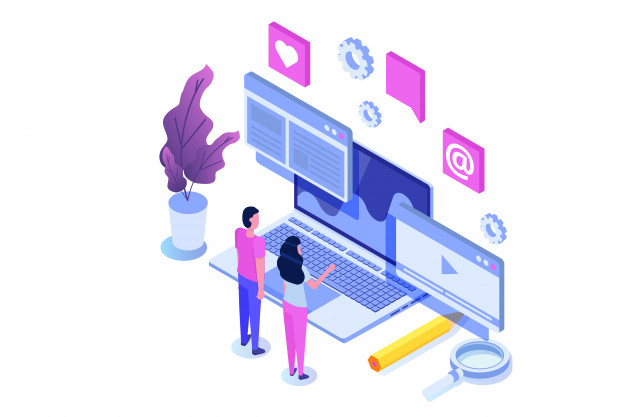
Role and functionalities in LMS
a. Schools, universities, eLearning providers
Traditional education institutions and schools selling eLearning will be beneficiaries of an online Learning management system. Also, the system is a crucial tool to design and manage online schools and classrooms by adopting effective teaching styles in an ever-connected world.
b. Administrators
The administrator’s role is at the top of the hierarchy with the most power in relation to the entire platform. But this type of admin is different from the administrator who focuses on handling the technical issues of the server instead. On the contrary, this role is an important one which has a vision of the whole LMS.
c. Instructors
Instructors and teachers’ carries out the whole training process, from the creation of the training course, to strategy building and content delivery. In addition, the teacher will have access to everyone student’s progress and reports to provide assessment and keep track of the activities.
d. Students
It proves to be a highly effective approach for students who prefer a flexible environment of learning, unlike the traditional method. Also, it is suitable for professionals with tight work schedules that cannot choose a traditional or face-to-face program.
Types of Learning Management System
1. Open Source vs Commercial
Free, open source software is all about combining user control with affordability. This can turn out to be quite customizable for any organization. However, organizations must have a technical team and necessary infrastructure in place to support an open-source LMS.
Unlike the open source, free LMS, the commercial version comes with easy execution, promising customer service and extra features. The difference is that it is not free. Ultimately, the necessary features and capabilities required decide the cost you incur.
2. SaaS vs Licensed
This is known as one of the user-friendly models, the SaaS LMS comes with a subscription model. Here, the vendor looks after all the operations and necessary upgrades. And the cost is charged on a monthly or annual basis.
The Licensed model is considered a much safer alternative because it provides customization, customer support and reliability.
3. On-premise or Cloud-based
On-premise offers users the ability to customize and take control. This is useful when the organization has a reliable IT team in place to handle and administer the system. Whereas one disadvantage is that it tends to be more difficult to scale than a cloud-based LMS and may be more expensive.
On the other hand, a cloud-based LMS is hosted on the vendor’s server and users can access it through a web server. As a result, this requires much less maintenance because the cloud service provider carries out all the necessary upgrades or changes.
4. Integration
As the need for LMS solutions keeps increasing, one of the most exciting developments is the ability to integrate with other softwares like HRM, Talent Management System, Payroll, etc. Depending on your organization’s need, you can look for an LMS software which offers this sort of app integration.
Final Thoughts
To sum up, evaluating an LMS requires an extensive analysis of all the functions and advantages that each one offers.
There is an increase in the demand for LMS every year as more companies are adopting eLearning. LMSs are confidently, a modern generation of training systems that outperform conventional classroom training in terms of outcome. Evaluating an LMS becomes a necessity in such factors, requiring a thorough analysis of the features each one offers.
Reference: Learn Upon
Image credits: Freepik
For more such content on technology and e-learning, visit our blog.
Create. Engage. Inspire
The post What is a Learning Management System (LMS) appeared first on Test.Evelyn.
]]>The post Virtual Reality Widening the Scope of Education appeared first on Test.Evelyn.
]]>VR as a Game-changer in Education
A study conducted by National Survey showed that 90% of teachers believed that VR in education was an effective tool to provide immersive learning for students.
Tablets and lightweight computers emerged first in classrooms, but as you might guess, there was still a lack of room for interaction. This is how virtual reality is differentiated from every learning practice.
By combining advanced technology with knowledge, it has been possible to create a learning environment by projecting different versions of reality.
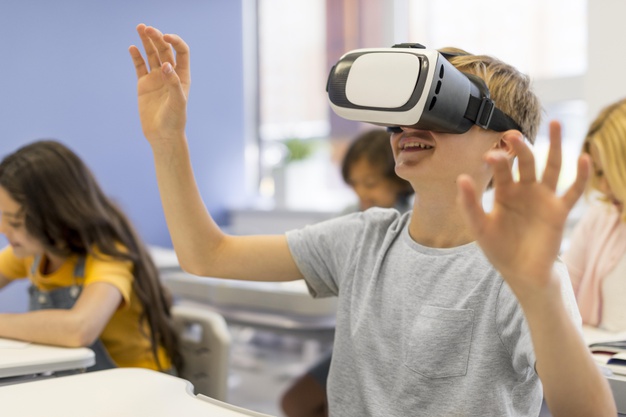
Application of VR in Education
-
Distance Learning
One of the best things is that virtual reality in school education helps students and teachers overcome geographical boundaries and produces natural interactions in classrooms. Similarly, one can attend any interesting event on Earth with just a press of a button. For instance, the London School of Business and Finance is a great example of combining VR with distance learning in the courses they offer to postgraduate students.
-
Virtual Field trips
The capability of VR to offer deeply immersive experiences can be useful for teaching subjects such as history, geography, and art with the help of a virtual field trip. This technology promotes students with the freedom to explore and learn at their own pace. Some of the biggest universities are already offering these trips to students, and the best part about virtual field trips is that they can be distributed on a massive scale.
What Makes VR in Education Beneficial?
1. Engaging
A great deal of time and resources are spent by teachers to engage students through interactive projects, public speaking, and a variety of other ways. Oftentimes, their efforts go in vain.
On the other hand, virtual reality makes it easier to create immersive experiences which bring lessons to life. By gaining hands-on skills, students also become prepared for the future.
2. Technology
It’s incredible how digital technology has changed the way classrooms are taught. The move from passive learners to active learners has changed the game. Especially today in the 21st century, students need to be proficient in technological skills to adapt to the world.
3. Language Roadblock
International education can be a problem for the learner, considering the differences in culture and languages. With virtual reality, every possible language can be included within the software. Therefore, language will no longer be a barrier.
4. Safe Learning Environment
Sometimes, making mistakes during learning can make the students scared of the possible outcome. Gaining skills without the fear of failure makes virtual reality a preferable tool for training to build the student’s confidence. Therefore, students can try different approaches and choose what’s best for them.
5. Practicality
Regarding the practicality of education, students often need special tools and the application of theory in real-life scenarios for learning. Difficult concepts in subjects can be hard to comprehend due to the lack of practical application. And that is how just by using VR in education, students get a chance to learn by doing rather than simply reading. By visualizing complex topics or mechanisms, the cognitive load to process the information is highly reduced.
Final Thoughts
Undoubtedly, we can say that VR is the best fit for modern education. It creates an immersive learning experience and offers a favorable environment for every student out there. Therefore, VR keeps reshaping the way we view the world. It can be said that the young learners of tomorrow are truly in good hands with technology. They will employ it to its full potential.
Reference: Immersion VR
Image credits: Freepik
For more such content on technology and e-learning, visit our blog.
Create. Engage. Inspire
The post Virtual Reality Widening the Scope of Education appeared first on Test.Evelyn.
]]>