The post Descriptive Writing: Introduction and Examples appeared first on Test.Evelyn.
]]>Characteristics of Descriptive Writing
A piece of descriptive writing has certain unique attributes. Some are presented below. Readers may go through them to better understand the examples that follow.
- Descriptive writing is clear, unambiguous, and focused. The central idea of the writing piece is reflected in the content.
- Descriptive text is powerful enough to bring the imagination of a reader into play. The reader is able to visualize an impression of what is vividly described in the writing piece. A descriptive piece carries information for a reader and conveys it imaginatively.
- A piece of descriptive writing is well-structured. A logical flow of expression makes the content appealing to the reader.
- The level of language and vocabulary is fairly simple. Descriptive writing also includes examples and analogies. This helps cut down verbosity, improve clarity, and make the content more engaging.
Sample Descriptive Writings
Presented below are a few samples of descriptive writing. Their attributes as a descriptive writing piece are also discussed and highlighted.
Example 1
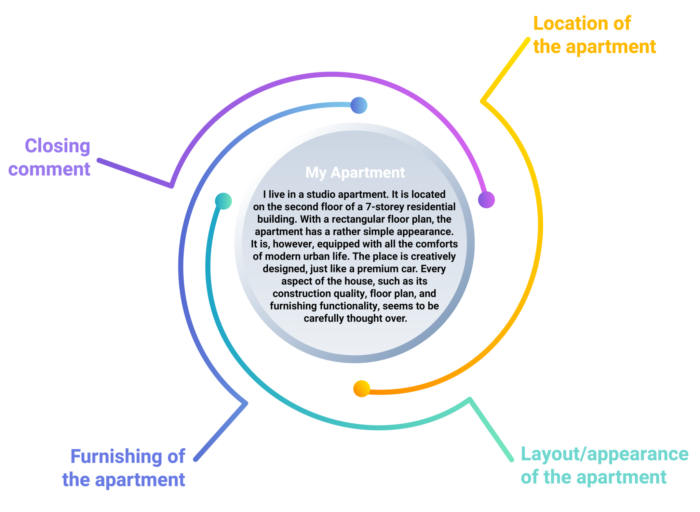
Writing Sample 1 presents the first-person description of an apartment. Readers may go through the sample and observe how the attributes of descriptive writing reflect the content in the writing piece.
Observations
- The sample has a clear focus: the apartment.
- The phrases “simple appearance”, “comforts of the modern urban life”, and “just like a premium car” help build the imagination of the reader.
- No difficult words are used in the sample text.
- The flow of the content is quite logical: location of the apartment→ layout/appearance of the apartment→ furnishing of the apartment→ closing comment.
Example 2
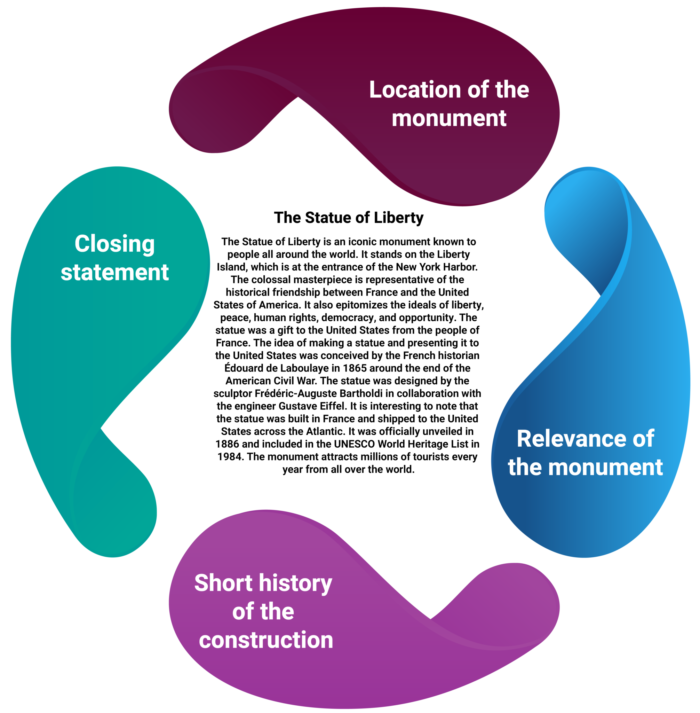
Writing Sample 2 presents a short piece of descriptive text on the Statue of Liberty. Readers may observe how the essential attributes of descriptive writing apply to the sample piece.
Observations
- The piece focuses on providing general information about the Statue of Liberty.
- The phrases ”iconic monument” and “colossal masterpiece” help the reader get an idea about the kind of monument the Statue of Liberty is.
- The vocabulary in the writing piece is simple and easily understandable.
- The flow of content is rational: location of the monument→ relevance of the monument→ short history of the construction→ closing statement.
Example 3
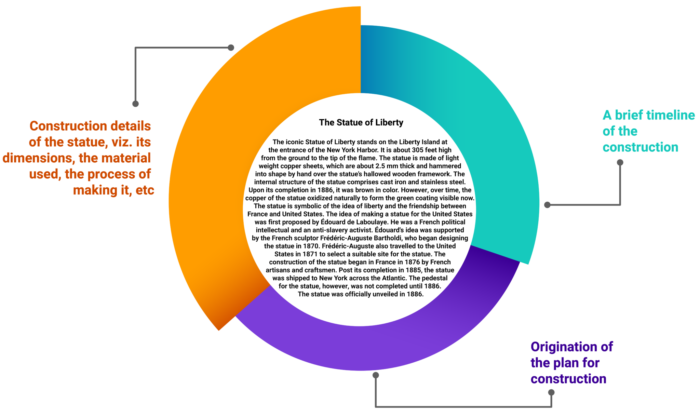
Writing Sample 3 presents another short description of the Statue of Liberty. Readers may observe that though the subject of writing samples 2 and 3 is the same, the focus is completely different. The attributes of descriptive writing, however, still hold true.
Observations
- The focus of the text is on the different aspects related to the construction of The Statue of Liberty.
- The description is informative and highlights several important aspects, such as the materials used for making the statue, the process of making it, the timeline of construction, etc.
- The vocabulary is fairly simple and straightforward.
- Though the sample does not have a clear closing statement, the flow of content is logical: construction details of the statue→ origination of the plan for construction → a brief timeline of the construction.
Example 4
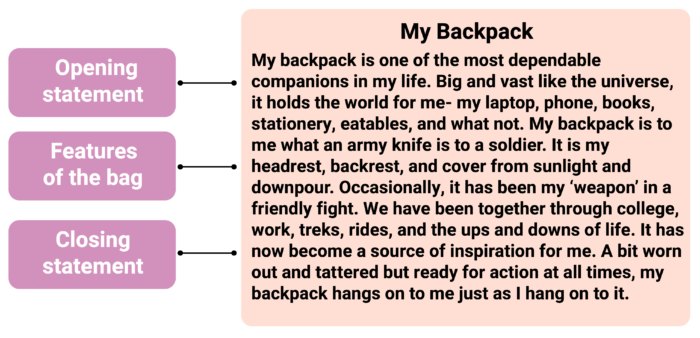
Writing Sample 4 presents a short first-person description of a backpack. Readers may observe how the attributes of descriptive writing apply to the write-up.
Observations
- The focus of the text: the backpack.
- The phrases “Big and vast like the universe”, “what an army knife is to a soldier”, and “ups and downs” point to different qualities of the bag, namely spaciousness, versatility, and toughness.
- The vocabulary is fairly simple and can be understood effortlessly.
- The flow of content: opening statement→ features of the bag (spacious, versatile, tough)→ closing statement.
- The writing piece is lively; it seems that there is a conscious attempt made by the writer to ‘personify’ the backpack.
- The closing statement of the writing piece is impactful and condenses the entire description into itself.
Discussion
Each sample presented here has a few distinct features that make it a piece of descriptive writing. Readers may attempt writing similar short pieces on topics of general interest. Writing is an important skill. It helps improve an individual’s understanding of a topic and develops vocabulary and articulation skills.
As suggested by the name itself, descriptive writing involves describing the subject of writing. When it comes to describing, the content may not be restricted to the physical aspect of the subject of writing. However, it should also involve opinions regarding the subject matter. Including both the physical facts and the writer’s opinion in the writing makes the piece engaging and useful to read. A writer should try to involve as many sensory details as possible to visualize the subject matter in the readers’ heads. If kept concise, informative, and strongly opinionated, a simple piece of writing can be transformed into good descriptive writing.
References:
- Kathleen Jones White Writing Center at Indiana University of Pennsylvania.
- The Writing page at The University of Sydney website.
- 5 Examples of How to Write a Good Descriptive Paragraph at ThoughtCo.
Image Credits:
Icon made by Smashicons from www.flaticon.com
This article is part of a series of articles on Writing.
For further reading related to pedagogy and education standards,
please visit the blog pages at Evelyn Learning.

Create.Engage.Inspire
The post Descriptive Writing: Introduction and Examples appeared first on Test.Evelyn.
]]>The post Academic Content Writing appeared first on Test.Evelyn.
]]>
Academic Writing vs. Content Writing
Content writing is very diverse. It does not have any distinct style, language or structure. Individual writers have their own styles, language and manner of writing. Readability is important since the content is for consumption by general readership, which is wide and varied. Most of the content that is available online (website, blogs, etc.) comes within the ambit of general content writing. The topics of the content may be daily news, sports, ecommerce, business, etc.
The goal of academic writing, on other hand, is to improve the technical knowledge of a reader. Developed by people from academia, academic writing is for consumption by an academic audience. The topics of discussion are from disciplines of academic study and research. There are several styles of academic writing, each of which is unique and used for a specific academic objective. This article focuses on academic content writing, its characteristics and its types.
The article: “Academic Writing” on the Massey University, New Zealand website offers more idea about Academic Writing in general.
Characteristics of Academic Content Writing
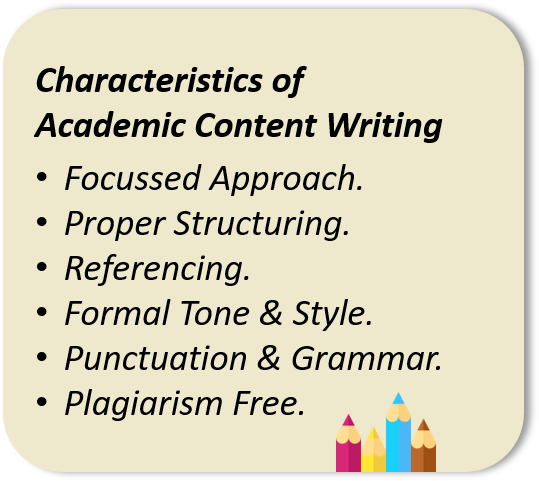
The usual goal of academic writing is to present the outcome of a research study. It is an attempt at apprising the academia about the subject of research, the study conducted to understand it and the research contribution made to it, if any. A piece of academic writing engages readers and draws them in, as participants in the process of discussion. Well written academic content does not culminate the process of thinking. It rather takes the process of thinking forward and further. Academic writing has a few characteristics which also serve as guidelines for an academic content writer. Described below are some of these characteristics.
Focused approach
The approach of the content is clear- persuasive, analytical, informative, etc. For Instance, a persuasive approach tries to convince the reader to develop a certain perspective. A combination of facts, reasoning and logic may help achieve the purpose. An informative approach attempts to educate the reader about a perspective. It does not persuade the reader to adopt a perspective.
Proper Structuring
The content is well structured. It follows a logical order- introduction, body paragraphs and concluding paragraph. A piece of academic writing presents ideas, thoughts, references, discussions, etc. in a manner that engages the reader. The content introduces the topics, discusses/analyzes it and then takes it to a meaningful conclusion. A piece of academic writing does not end abruptly or vaguely.
Referencing
Academic writing is rich in references drawn from subject literature. References and citations support facts. Inclusion of references in academic writing means that the writer is well informed of the existing research in the subject. Thus, referencing and citation lend credibility to academic writing.
Formal Tone, Style, Punctuation & Grammar
Academic writing has a distinct tone. It is simple but formal. Use of subjective language is avoided. The vocabulary is precise and spelled correctly. Abbreviations are usually avoided. Punctuation and grammar rules are strictly followed to ensure that the words and statements convey their intended meanings. All kinds of academic writing call for following a standard style guide.
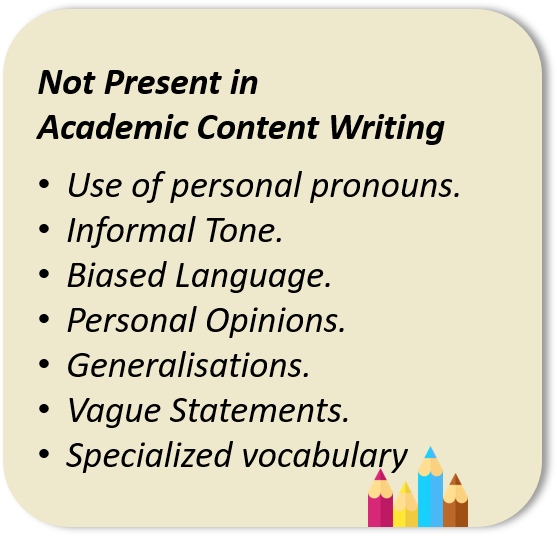
Additionally, the use of personal nouns, informal tone, biased language, opinions, generalizations, verbosity, vague statements, specialized terminology and difficult vocabulary is not advisable. Academic writing is plagiarism free. Quality academic writing reflects academic integrity.
The articles: “Academic Writing” on the University of Leeds, UK website; “Organizing Your Social Sciences Research Paper: Academic Writing Style” on University of Southern California website; “Academic Writing Guide” by Annie Whitaker of the City University of Seattle at Bratislava, Slovakia offer more insight into the topic.
Types of Academic Writing
Academic writing is quite diverse in terms of the approach it reflects. The approach of a piece of academic writing can be descriptive, analytical, persuasive or critical. Depending on the purpose, the overall approach can be a combination of these individual approaches also.
The following discussion provides a brief description of each of these approaches.
Descriptive Writing
The objective of such writing is to introduce facts and information to the reader. It is one of the most simple forms of academic writing. A lab report that informs the reader about the results of an experiment is an example of descriptive writing. Descriptive writing is also used for describing people, places, situations, events, etc.
Analytical Writing
A piece of analytical writing generally includes- problem description, probable solutions to the problem, assessment of the different methods of solution and their comparison. The views expressed in the analysis are impartial. The writer cogitates over the facts and the ideas that relate to the problem and its solution. A piece of analytical writing may include graphs, flow-charts, diagrams to improve clarity of understanding. Different Styles of Academic Content Writing
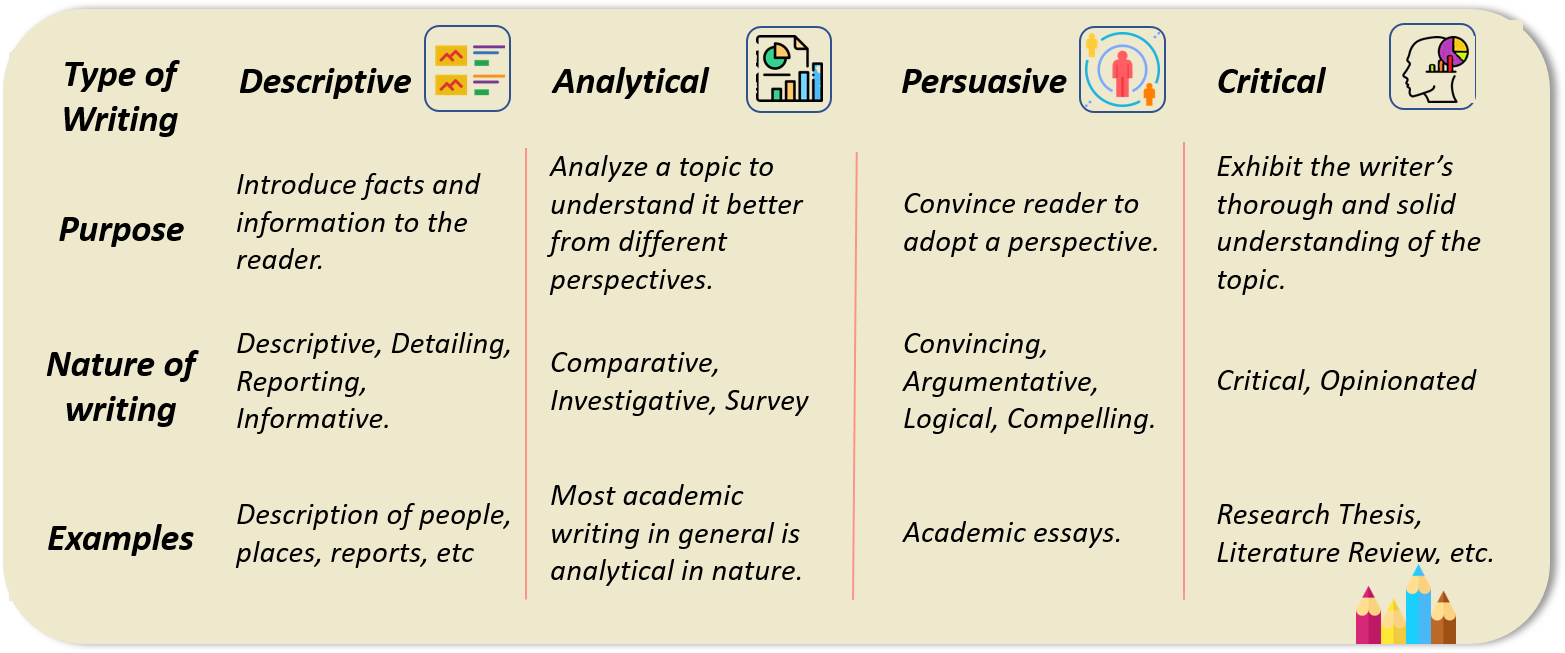
Persuasive Writing
This writing style goes one step beyond analytical writing. A persuasive writing piece carries the view/perspective of the writer also. In fact, the writer attempts to convince the reader to adopt a perspective. To help achieve this objective, the writer uses arguments supported by reason and evidence. Academic essays are persuasive in nature. News editorials, advertisements, reviews of electronic gadgets, etc. have a persuasive writing style.
Critical Writing
This is the preferred writing style for research-oriented writing work. Critical writing takes more than one source of information to develop an argument. A piece of critical writing summarizes all/part of work on a topic, including interpretations, assumptions and methodology. The piece also carries an opinion of the work taken into account and the writer’s point of view on the topic. The content is rich in analysis and strongly evidenced. The writer has a thorough understanding of the topic and strong writing skills.
The “Writing” page on The University of Sydney website offers a detailed insight into academic content writing. The website: eapfoundation, offers more details on critical writing.
Another Classification of Academic Writing
Academic writing is also classified on the basis of the kind of writing that scholars do. Lab reports, case studies, literature reviews, research papers, book reports, bibliographies, research theses are just a few examples of documents found in an academic setting. Such documents follow a well-defined writing style in many institutions. Institutions provide clear guidelines to the academia regarding the kind of academic writing applicable for different documents. Besides academic writing, there are many diverse forms of content writing. Information pertaining to content writing and different ways of classifying it is available on the internet. A few websites that offer idea on the subject of content writing are: Owlcation, constantcontent and AdEspresso.
The documents: “How to Write a Thesis: A Working Guide” at the University of Western Australia and “Guidelines For Writing A Thesis Or Dissertation” at the College of Journalism and Communications, University of Florida website offer idea of the kind of guidelines advised for writing a thesis document.
Writing is an important skill. It helps improve an individual’s understanding of a topic. Writing also helps develop vocabulary and articulation skills. This article is part of a series of articles on Writing.
Image Credits:
Icons by prettycons, Freepik, geotatah, Smashicons at www.flaticon.com
For further reading related to pedagogy and education standards, please visit the blog pages at Evelyn Learning.

Create.Engage.Inspire
The post Academic Content Writing appeared first on Test.Evelyn.
]]>The post Delving Deep into the Visual Learning Style and Its Applications appeared first on Test.Evelyn.
]]>Visual Learning Style Strategies
The quality of a learning process is often measured through the achievement of learning outcomes. The achievement of learning outcomes calls for the adoption of effective strategies for teaching and learning. For visual learners, the strategy should be around the idea of developing learning content in visual form. As individuals, visual learners may adopt certain practices to accelerate their learning. They may add visual attributes such as color highlighting, memory maps, or process-flow diagrams to the content they are learning. Educators may go the extra mile by developing exercises, lectures, and notes with visual features. Exercises on theoretical concepts may involve drawing concept maps for the illustration of concepts. Such exercises would be distinctly helpful in understanding concepts with clarity.
Visual Learning Style Examples and Application in Academic Content
Content with visual pedagogical features stimulates a visual learner. Features such as diagrams, flowcharts, process flow diagrams, etc. comprise visual pedagogy. The examples presented below depict the use of visual pedagogy in learning content.
Example 1
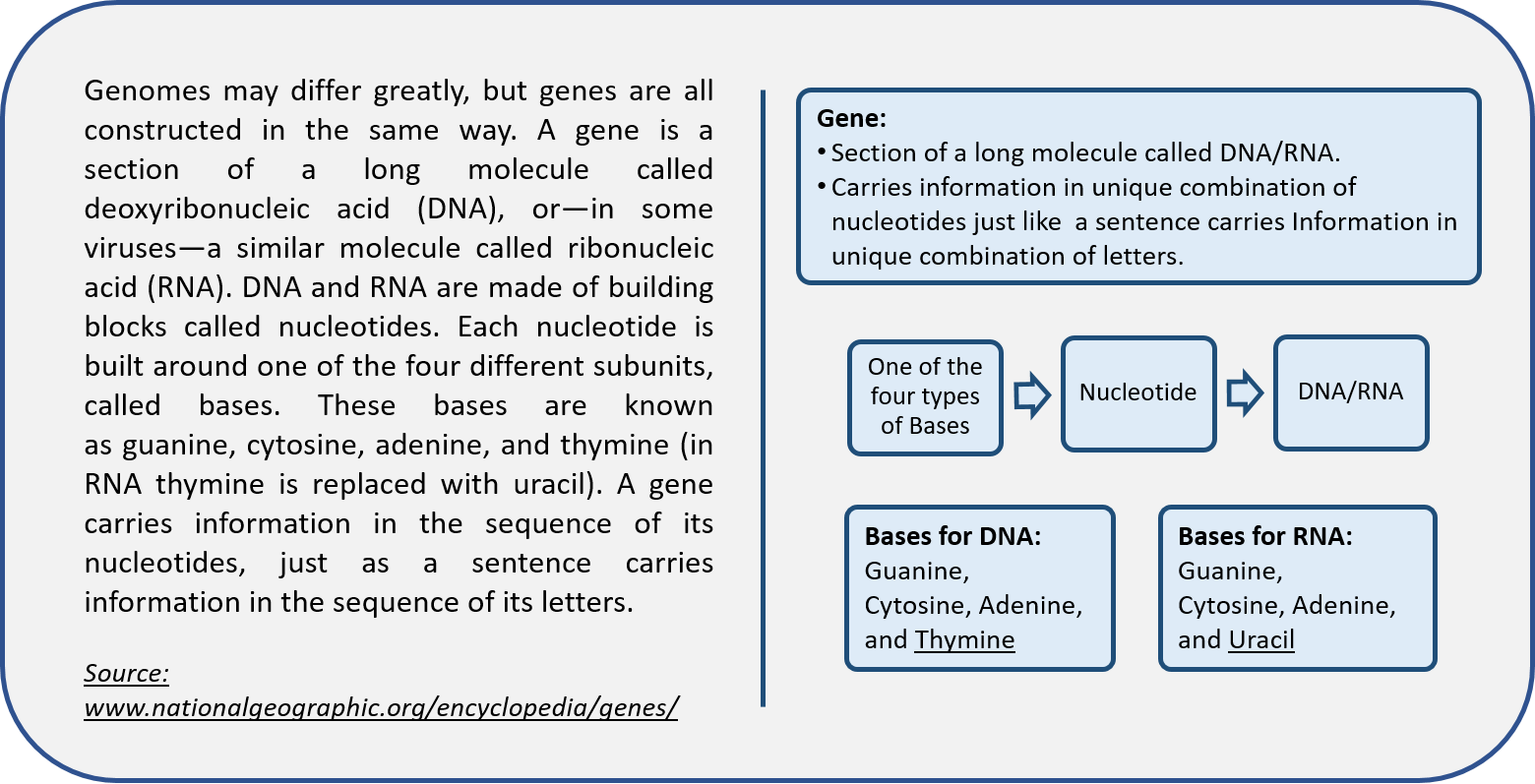
Figure 1 presented below shows an excerpt on genomes presented in two different ways. The write-up on the left is a descriptive discussion on Genomes. The same content is present on the right in a piecemeal form. The approach employs “blocks” to present information: the first block carries the basic definition and role of a gene; the next set of blocks explain the hierarchy of DNA/RNA, nucleotide, and bases; the last two blocks provide the names of the bases that make up the DNA/RNA. Though the manner of presentation is different, there is no loss of information. In addition, the content is engaging for a visual learner and easier to grasp.
Example 2
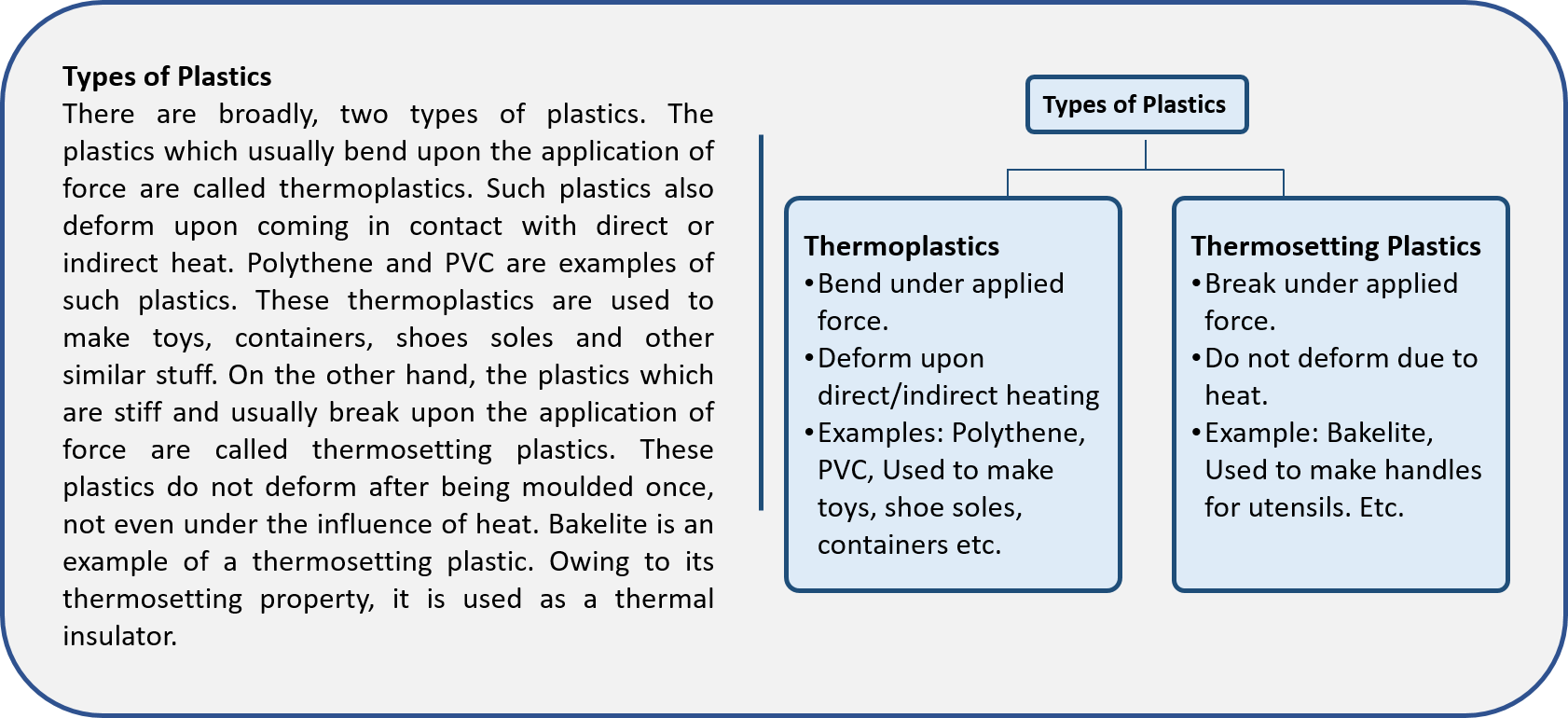
Figure 2 presented below shows sample content on the topic of “Types of Plastics”. It presents the discussion about the two types of plastics in a general descriptive form. The same content is presented on the right in a visually enhanced form which includes a hierarchical diagram, with content arranged point-wise. The presentation on the right is more appealing for a visual learner. In addition, the information presented therein is easier to recall, analyze, and re-present, if required.
Example 3
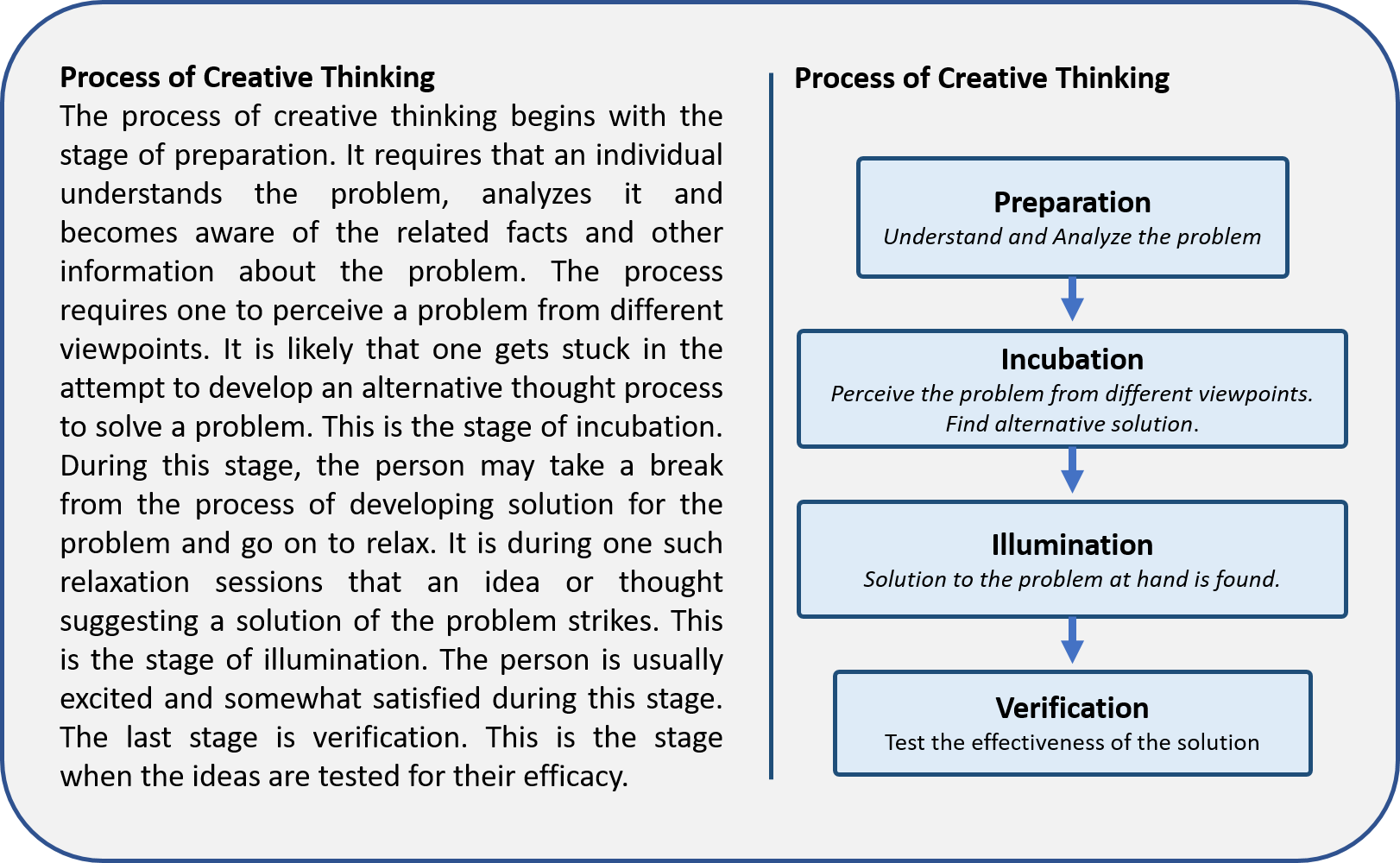
Figure 3 shown below depicts the general process flow for creative thinking. The descriptive content on the left is expressed in the process flow diagram on the right. The diagram is more suited to the learning style of a visual learner. It outlines the complete process on the left into four distinct stages represented by a process flow diagram. The description of each step of the process is described within the respective block in the flow diagram. Such simplified presentation of complex and detailed information accelerates the process of learning for visual learners. It improves and consolidates their comprehension and grasp of what is taught.
Example 4
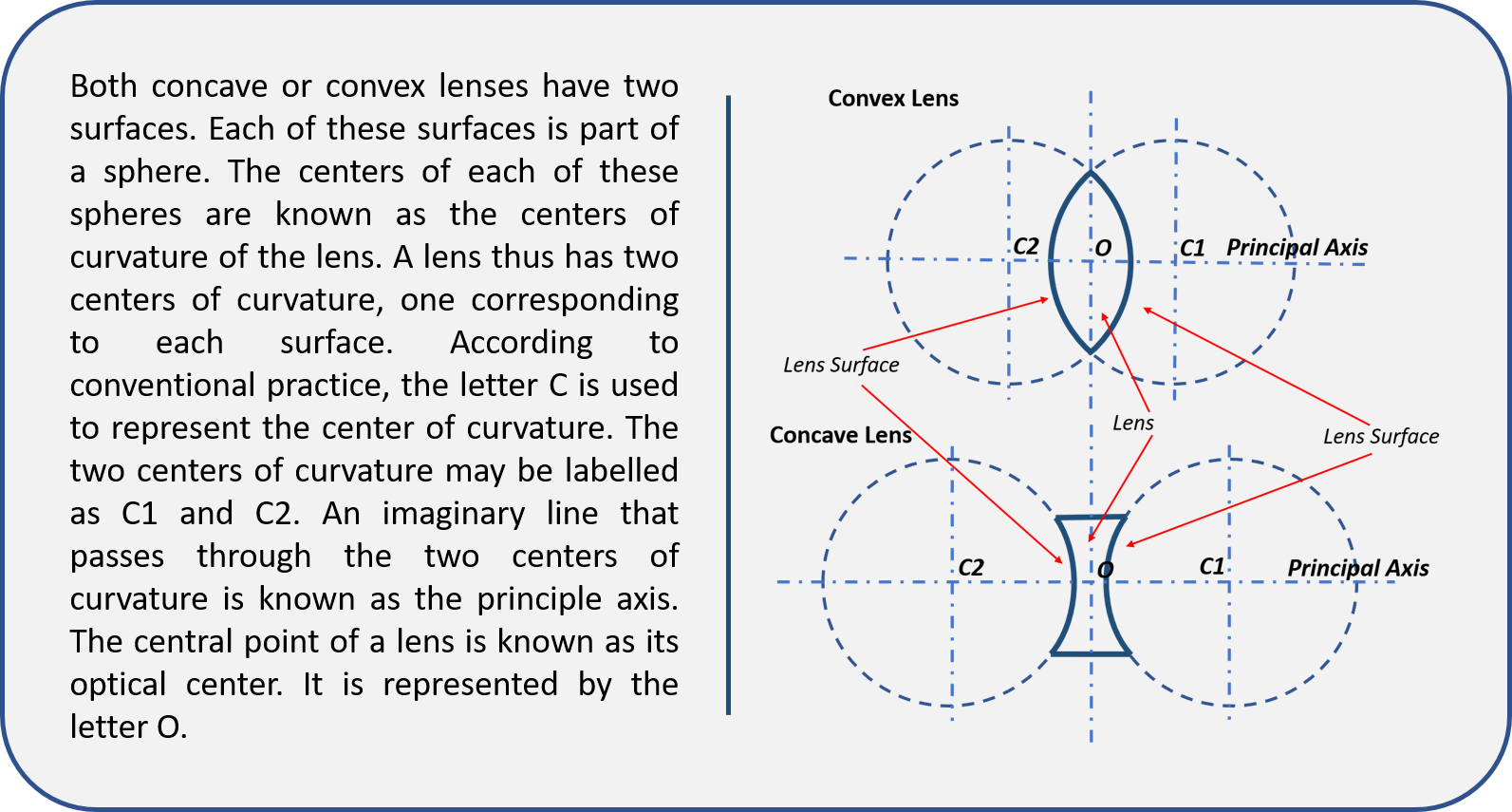
Figure 4 presented below depicts a short discussion about lenses in a general descriptive form. Though the description is quite clear, it might seem overwhelming and difficult to recall for a visual learner. The figure shown alongside the description on the right presents the same discussion about the two types of lenses, in a visual form. It summarizes all the details present in the description on the left. In addition, the diagram is more suitable for a visual learner to learn and recall.
Example 5
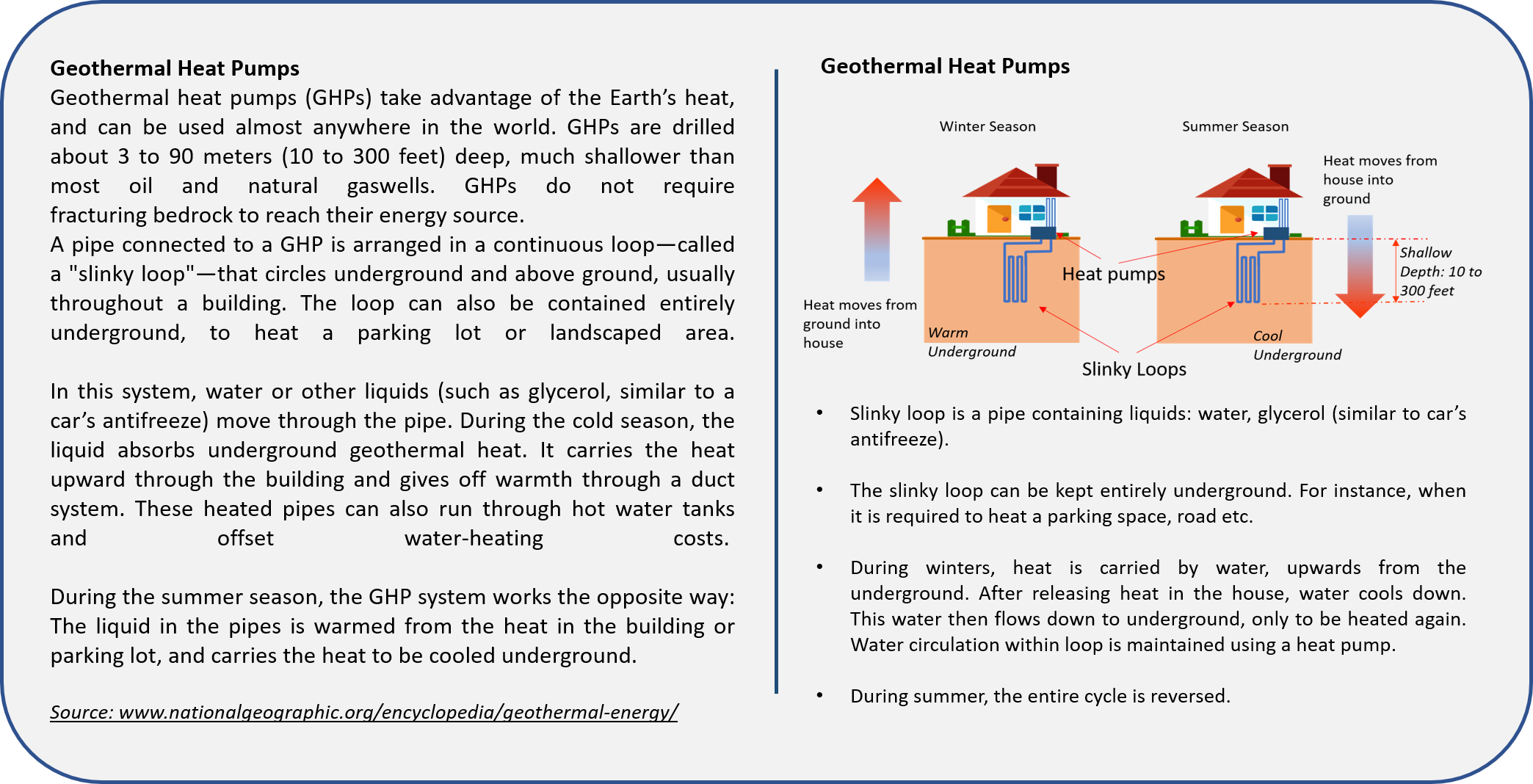
Figure 5 presented below shows yet another content sample presented in two different forms- general descriptive and visually enhanced. The write-up on the left is a description of geothermal heat pumps. The same content is present on the right with a diagram. The diagram is informative and communicates the topic with clarity. It depicts all the details that are present in the description on the left. A visual learner would be more receptive to the visually enhanced content presented on the right.
It is thus quite evident that the addition of features such as diagrams, tables, and flowcharts to otherwise descriptive text makes it suitable for visual learners. It makes the learning process lively and draws more attention from the reader. Educators may attempt to develop similar visually engaging content for their pupils. This would help achieve learning outcomes effectively.
This article is part of a series of articles on Learning Styles.
References:
- The Visual Learning Style at ThoughtCo.
Image Credits:
Icons made by Roundicons from www.flaticon.com.
  For further reading related to pedagogy and education standards,
please visit the blog pages at Evelyn learning.

Create.Engage.Inspire
The post Delving Deep into the Visual Learning Style and Its Applications appeared first on Test.Evelyn.
]]>The post Technology-Enhanced Questions Explained and Its Importance appeared first on Test.Evelyn.
]]>This article, however, discusses one of the most distinct impacts technology has had on the assessment process- designing questions for assessments. Such questions, called technology-enhanced questions, make learning impactful and fulfilling.
The Need for Electronic Assessments
Ever since the education system started evolving, it began catering to a very wide spectrum of learners. The education system in schools and universities offered a plethora of courses. Such courses could be both full and part-time, academic and professional. These courses attracted a large number of student enrolments.
The academia had to ensure the achievement of learning outcomes in each of these programs. Assessments have always been the tool of preference to serve this purpose. Different kinds of programs called for different kinds of assessments. The developing education systems called for a continuous assessment and evaluation of learners enrolled in a program. Thus, assessments happen not only at the culmination of a program but also during the course of the program. Formative assessments (during the course of a program) ensure that the learners get an idea of how well they follow a course. Summative assessments conducted at the culmination of a program helped in grading students as per their acquired knowledge level.
You may also like reading about: Best 07 Assessment Tools for Teachers
Thus, considering the kinds of assessments, the number of learners, and the plethora of courses, it was quite obvious that assessments could not remain a manual process entirely. In addition, assessments had to be uniform and standardized in all aspects for all the students enrolled in a program. There was a need for some kind of automation. Electronic assessments have been successful in fulfilling the requirements of the modern education system. They have developed and evolved in terms of their form, design, and pedagogy in teaching. From the classical “multiple-choice questions” to the “technology-enhanced questions” in use today, electronic assessments integrate more closely with the learning content.
What is a Technology Enhanced Question?
The modern education system calls for a continuous assessment and evaluation-based approach for imparting education and learning. This requires the integration and blending of the processes of teaching and evaluation. Assessments embedded into learning content in a manner that is engaging for learners help achieve this objective.
A majority of the learners today are active users of interactive technology devices such as computers, tablets, or smartphones. Such devices offer an intuitive experience to users, thus keeping them engaged. A Technology-Enhanced Question (TEQ) or Technology-Enhanced Item (TEI) has its origins in this very observation.
A TEQ is so designed that it takes the learner beyond the usual approach of using memory recall to answer a question. A TEQ interacts with learners through electronic interfaces like keyboard, mouse clicks, or touch-screen. This interaction keeps the learners engaged, which ultimately leads to a fulfilling learning experience.
Further reading: Online Learning Challenges & Solutions: For Students
MCQ format is one of the most elementary and classical forms of TEQ. MCQs are the outcome of the very first attempt to standardize the assessment process. The design of MCQs has now evolved and developed to a point where it can also assess the level and extent of learning acquired by a student.
If you want to know What are Technology-Enhanced Items?, you can check here, and if you want to know What Are Technology Enhanced Questions and What Do They Look Like, you can check here to develop a further idea of the concept of TEQs.
Additionally, readers may visit the article Multiple Choice Questions as Effective Assessment Tools at the Evelyn Learning blog to know in detail how MCQs have developed from simple memory-based questions to tools meant for effective assessment.
Types of Technology Enhanced Questions
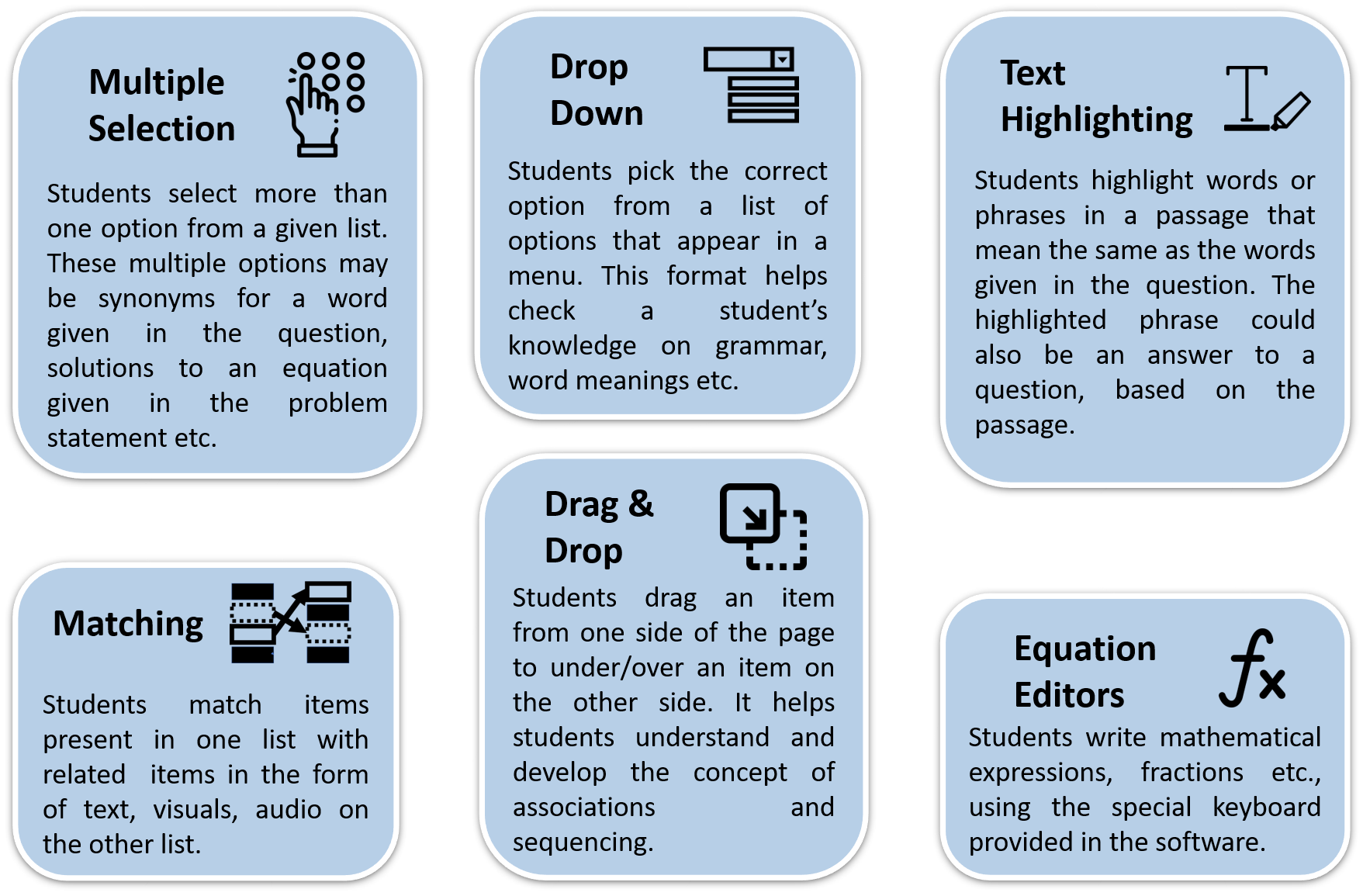
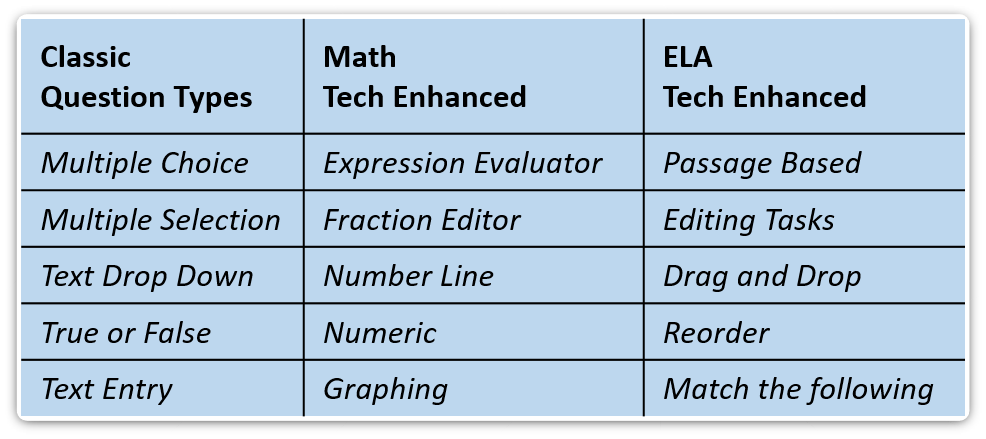
In addition to MCQs, there are a wide variety of TEQ formats that are available for developing assessments. They range from the fairly simple type (MCQs, true/false, etc.) to TEQs for mathematics (expression evaluator, fraction editor, graphing, etc.) and TEQs for English language Arts (editing, passage-based, etc.). Discussed here are some of the most common types of TEQs formats.
Importance of Technology Enhanced Questions
TEQs based assessments offer a number of benefits. Discussed below are some of those distinct benefits.
- TEQs stimulate higher-order thinking among learners.
- TEQs, or electronic assessments, do not take much time for evaluation. In fact, evaluation can be real-time also.
- TEQs are customizable and can meet a variety of learning objectives. Aptly designed TEQs are embedded into a lesson or put together as a standalone assessment.
- TEQs prove to be useful for modeling real-world scenarios. Since TEQs can capture a student’s response in real-time, it makes them useful in the analysis and study of learner behavior and response.
Some Examples of TEQs Employed in Different Subject Areas
The table presented above mentions a few examples of different types of TEQs commonly found in the assessments designed for learners. The reader may visit the web pages What are Technology-Enhanced Items? at Learnosity.com and Assessment, Section 4: Measuring For Learning at the
Office of Educational Technology, USA website to read about the importance of TEQs.
Given the vast spread of technology, blending technology with educational practices is the best way to make the most of the resources. Technology-Enhanced Questions are one of the many ways to blend technology with learning. The use of TEQs in assessments is not just proven to be effective in analyzing students’ performance but is also an effective tool for minimizing human effort and maximizing output. With a variety of TEQs available, students have been able to develop critical thinking and problem-solving abilities along with learning various disciplines thoroughly. In the technology-oriented world of the 21st century, TEQs are working wonders in enhancing the teaching-learning experience. Therefore, adapting to the changing techniques and medium is the best way to pave way for a resourceful and brighter future ahead.
Additional References
- Five ways technology has changed teaching and learning at Education Technology, UK.
- 5 Ways Technology Has Transformed Learning at Apperson, USA
Image Credits:

Feature image by Salinger at Pixabay; Icons made by Freepik from www.flaticon.com
For further reading related to pedagogy and education standards, please visit the blog pages at Evelyn learning.
The post Technology-Enhanced Questions Explained and Its Importance appeared first on Test.Evelyn.
]]>The post Designing Effective Multiple-Choice Questions appeared first on Test.Evelyn.
]]>A good MCQ-based assessment comprises questions that force the student to apply the concept and decipher the answer. The choices in a good MCQ question are never straightforward but tricky enough to distract the student from the correct answer, which further pushes the students to apply the learned concepts to deduce answers.
What Are Assessments?
Multiple Choice Questions (MCQs) are one of the most widely adopted formats for developing assessments. Composed of MCQs in part or full, assessment is an exercise that measures the academic performance of a learner in absolute and relative terms. This article examines the origins of the first MCQs, a comparison of MCQs with essay-type questions, and what entails designing effective multiple-choice questions.
The First MCQs
Multiple-Choice Questions were not an integral element of the academic assessment systems from the beginning of the formal education system. An educator, however, realized that a student’s performance in a test or class was a matter of subjective evaluation by different teachers. The educator could make one more important observation- the assessment process was time-taking for teachers.
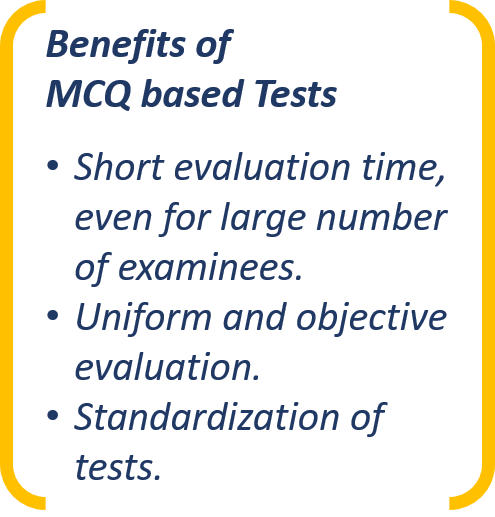
The first-ever design of MCQs was instrumental in getting around and over these two hurdles. Some additional benefits of the MCQ-based tests were obvious. The tests could be conducted for a very large number of examinees and the process of evaluation and assessment still did not take much time. In addition, the answers could also be graded by someone who was not necessarily a teacher. The students’ performance was no more a matter of subjective evaluation by different teachers. The MCQs thus standardized the tests.
Readers may visit the webpages: Multiple Choice and Testing Machines: A History at HackEducation and Where Did Standardized Testing Come From Anyway? at hastac for an in-detail reading about MCQs developed.
MCQs vs Essay Type Questions
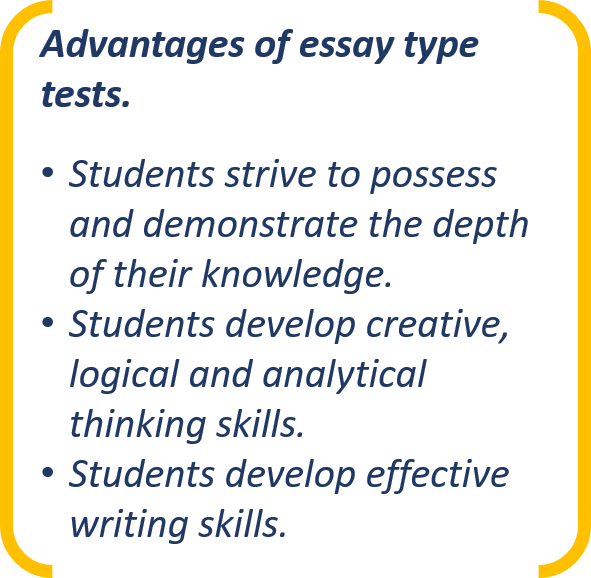
The new MCQ-based tests offered an edge over the traditional essay-type tests and were hence widely accepted into the education system. However, there was always a counterview. It was believed that MCQs had a lower educational value and that answering essay-type tests required examinees to not only possess but also demonstrate their depth of knowledge. Essay questions also made it incumbent upon the examinees to develop creative thinking and effective writing skills. MCQs seemingly, helped students score, merely on their ability to memorize, and not help a student develop logical and analytical thinking.
However, the public education system was expanding, thereby pushing the need to have a measure that could help meet the assessment requirements for an increasing number of students. The new education system also required a versatile mechanism to not only evaluate an individual’s progress in absolute terms but also compare it with that of other students across schools and geographies. An effective design of MCQs was thus the need of the hour.
The webpages Where Did Standardized Testing Come From Anyway? at hastac and Improving Your Test Questions at CITL, University of Illinois offer more information on how MCQs compare with essay-type questions.
The Need to Evolve
The true utility of an assessment not only lies in grading examinees but also in helping them identify their weaknesses. An assessment also provides teachers an idea about the weaknesses of their students. These valuable insights obtained from an assessment help teachers develop effective teaching strategies for specific topics. Traditional MCQ-based assessments offered a faster, standardized, scalable alternative for grading students’ performance. However, the possibility of employing traditional MCQ-based assessments as a tool to identify the students’ level or extent of learning was yet to be explored.

The Structure of an MCQ
In general, the structure of a multiple-choice statement comprises a problem statement (called the stem) and four/five options listed under it. Usually, only one of the options from amongst the given list of four/five options is correct. It is the key. The rest of the incorrect options from the list are distractors.
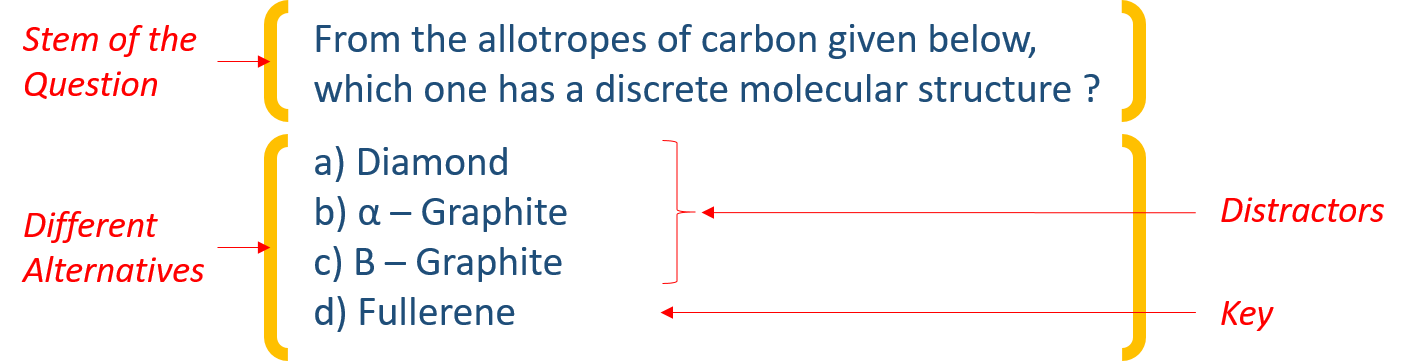
While attempting an MCQ, an examinee who has not studied well is likely to choose one of the distractors (incorrect options) as the answer. The distractors seem to be the right answer, but they are not. They are, in fact, erroneously drawn from the correct answer (the key) and hence seem to be the right answer. The choice of a particular distractor depends on the level of understanding and learning of the examinee. A well-read and prepared examinee chooses the key as the answer. An examinee who has not learned the topic about a question properly chooses one of the distractors as the answer.
Readers may refer the web pages Writing Good Multiple Choice Test Questions at Vanderbilt University and Designing Multiple-Choice Questions at the University of Waterloo to get an idea about the structure of an MCQ.
The Role of Distractors
An MCQ may have three/four distractors, each of which corresponds to a different level of knowledge/understanding about a topic. The key corresponds to the complete level of knowledge/understanding of a topic. Thus, a particular chosen distractor would reflect the level of knowledge/understanding of an examinee/student about the topic of the question. Distractors can thus play a very important role in helping an instructor understand the level of knowledge/understanding student(s) have developed across one or multiple topics. A teacher employs this feedback in developing an effective teaching/instruction strategy.
A detailed taxonomy of rationale (with examples) is available in the document The Distractor Rationale Taxonomy: Enhancing Multiple-Choice Items in Reading and Mathematics at Pearson Assessments.
Guidelines for Designing Stem and Distractors
An MCQ must assess the knowledge level of the learner effectively. This calls for a thoughtful approach while designing it. A poorly designed MCQ might give away a hint for the answer. A well-structured MCQ would compel the learner to employ the knowledge and skill required to find the answer. A careful balance between different aspects of the question, such as language quality and presentation style, is thus necessary.
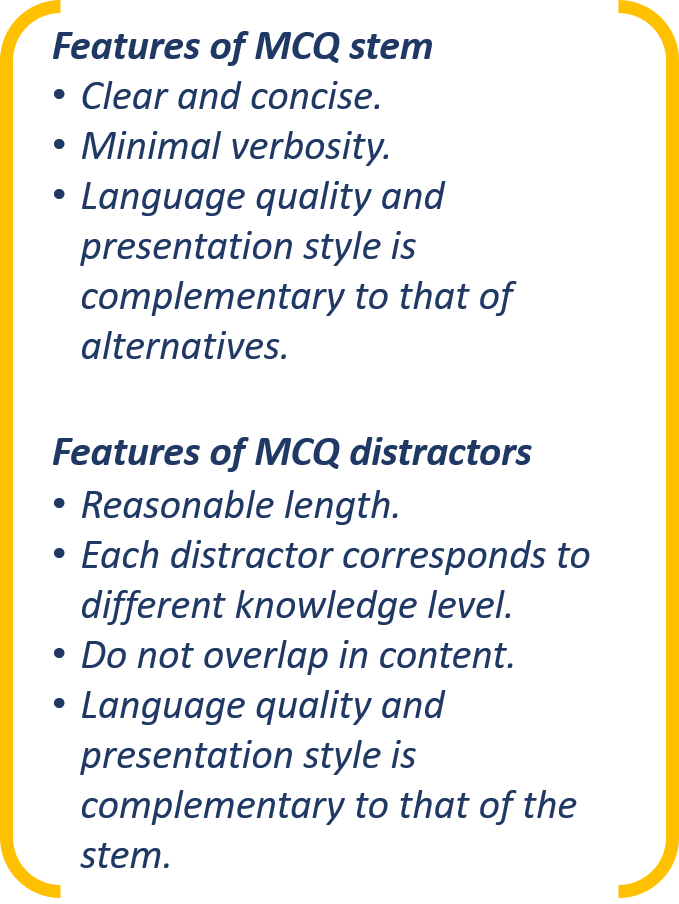
An MCQ structure comprises the stem and alternatives. The stem defines the problem statement. It should be clear, precise, and without vagueness. Verbose and irrelevant problem statements require more time to read and understand. Such questions also cause unnecessary confusion to learners. These criteria assume more relevance for time-bound tests.
The alternatives in an MCQ comprise the key and distractors. The designer should make a choice of distractors for an MCQ thoughtfully. To begin with, the distractors should correspond to different levels of knowledge/understanding of a particular topic. They all may seem to be the correct answer. Additionally, all the distractors should be clear, have the same language as the stem, and be of the same length. Distractors should not overlap in content or carry a hint in their language, structure or otherwise. Due emphasis on the criteria which have been discussed while designing an MCQ is thus necessary.
The reader may refer the web pages Writing Good Multiple-Choice Test Questions at Vanderbilt University and Designing Multiple-Choice Questions at the University of Waterloo websites to get more ideas about designing effective multiple-choice questions.
Assessments are instrumental not only in assessing knowledge but also in developing it further. Assessments can serve as a vital tool to help identify the areas of improvement. This article is part of a series of articles on Assessments.
Additional References
- Advantages and Disadvantages of Different Types of Test Questions at Faculty Focus.
- The Role of Assessment by Fisseha Mikre.
- Writing Good Multiple-Choice Exams by Dawn M. Zimmaro, Ph.D., The University of Texas at Austin.
- The Test by Anya Kamenetz.
For further reading related to pedagogy and education standards, please visit the blog at Evelyn learning.

Create.Engage.Inspire
The post Designing Effective Multiple-Choice Questions appeared first on Test.Evelyn.
]]>The post What is Bloom’s Taxonomy? Definition, Details and Application appeared first on Test.Evelyn.
]]>Domains of Human Learning
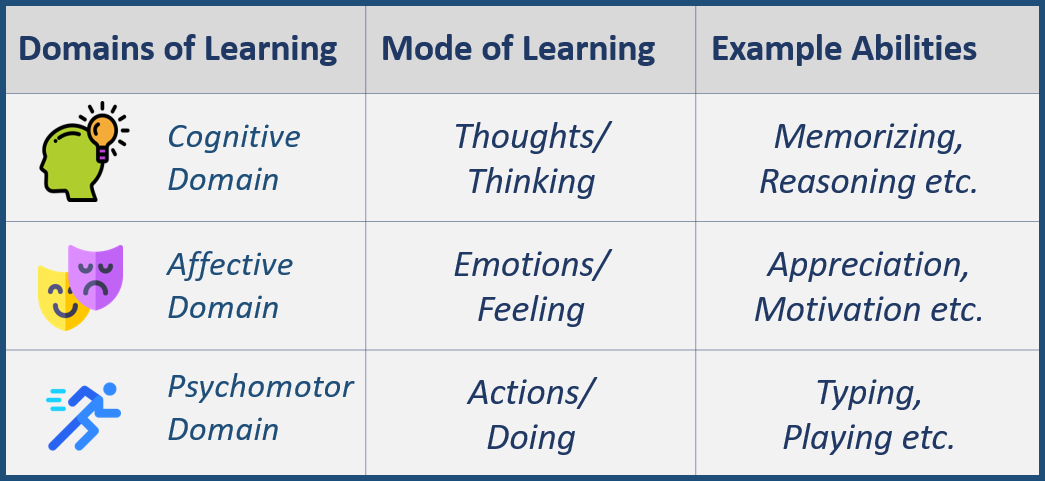
Learning is a continuous process through which humans acquire knowledge and develop skills or behavior. It begins from a simple, elementary level, and grows in terms of complexity. Learning does not have an abrupt beginning or end. Bloom’s Taxonomy is an attempt to arrange the knowledge and skills acquired through continuous learning in a hierarchical order, ranging from simpler to complex skills.
Humans learn through three distinct modes – thoughts, emotions, and actions. Each of these modes enables a human being to acquire/develop a certain kind of ability. Thoughts help humans develop abilities such as memorizing, reasoning, etc. Emotions help develop abilities such as motivation, appreciation, enthusiasm, etc. Actions help develop abilities such as hand-eye coordination, typing, playing an instrument, etc. In simple words, humans learn through thinking, feeling, or doing, or through a combination of these. The set of skills acquired through a particular mode constitutes a “domain”. Thus, there are three domains of learning, one domain corresponding to each mode of learning. These are the cognitive domain (thoughts/thinking), affective domain (feeling/emotions), and psychomotor domain (actions). The table in figure 1 summarizes the different domains, their corresponding modes, and examples of abilities acquired through each of these modes.
Readers may access a more detailed definition of learning at the webpage What is learning at the Queen’s University, Canada website. More information on domains of learning and instruction is available in Unit -1 titled Differentiating Between Psychomotor, Cognitive, and Affective Domains of Instruction at the KNILT website.
What is Bloom’s Taxonomy?

The skills that constitute a domain may range from simple to complex in nature. A scheme of classification (taxonomy) helps arrange the skills in a hierarchical manner. Each domain of human learning has its own hierarchy of skills. Simple skills are at a lower level and complex skills are at a higher level of the hierarchy. The skills at the lower level of the hierarchy are a prerequisite to developing skills at a higher level. The figure 2 presented here depicts the hierarchy of skills in the cognitive domain. This taxonomy (a hierarchical classification) of human skills was developed in 1956 by Prof. Benjamin S. Bloom, who was the Associate Director of the Board of Examinations at the University of Chicago. The taxonomy is a result of his work at understanding how educators evaluate a student’s performance at examinations.
Readers may go through the article Bloom’s Taxonomy on the Open Colleges, Australia website.
The Development of Bloom’s Taxonomy

Prof. Bloom discovered that the objective of an academic exercise (lesson, examination, etc) was a matter of subjective inference amongst educators and teachers. This led to a variation in the outcomes that learners achieved by the end of an academic exercise. Thus, Prof. Bloom along with his graduate students set upon the task of developing a framework that could standardize the objectives of academic exercises. This framework also established uniformity and standardization in terms of learning outcomes that are expected to be achieved by the end of an academic exercise. In addition, it helped academics avoid making redundant efforts which lead to the same academic outcomes ultimately.
Formal education today, however, has developed more around the process of thinking rather than the processes of emotions or actions. It is thus the cognitive domain in Bloom’s taxonomy that has been very widely adopted in formal education. The taxonomy of cognitive skills was detailed in 1956, that of affective skills in 1964, and that of psychomotor skills in the 1970s.
Figure 3 depicts each level in the hierarchy of cognitive skills along with some unique action verbs associated with each level. These action verbs outline the different kinds of academic exercises and activities recommended for developing skills of different levels in Bloom’s taxonomy.
Application of Bloom’s Taxonomy

Bloom’s taxonomy intends to promote higher-order thinking rather than rote learning amongst learners. Unique action verbs are associated with each level in this taxonomy. These verbs are useful for developing observable and measurable objectives for an academic exercise. The table in figure 4 presents a few objectives employing the appropriate action verbs for different levels of Bloom’s Taxonomy.
More examples of writing learning outcomes using Bloom’s Taxonomy are available on the webpage Writing Learning Outcomes Using Bloom’s Revised Taxonomy at the University of Toronto website. A similar effort with action verbs can be undertaken to develop questions for an assessment. The webpage A Guide to Bloom’s Taxonomy at The Innovative Instructor Blog, Johns Hopkins University offers guidance on writing test questions and course learning objectives using Blooms Taxonomy.
Bloom’s taxonomy proves useful as a guide to design foundation and advanced courses as well. A foundation course may have academic content developed around lower-order cognitive levels. An advanced course on the other hand may focus on higher-order cognitive skills. Thus, Blooms taxonomy is useful in defining and developing academic exercises to focus on a particular cognitive skill level. This, in turn, ensures that the learning outcomes are uniform and standardized across a spectrum of learners.
Advanced Bloom’s Taxonomy

The taxonomy presented in this article is the revised Bloom’s Taxonomy, published in the year 2001. Figure 5 shows the original taxonomy, published in the year 1956. A careful comparison between the two taxonomies given in figure 2 (revised) and figure 5 (original) shows that there is a change in the order of the top two cognitive skills. The taxonomy changed following the flow of the human learning process: humans conduct an evaluation before creating something. In addition, the new taxonomy has a separate and distinct taxonomy of the types of knowledge used in cognition. This separate knowledge taxonomy is presented below in brief.
- Factual Knowledge
- Conceptual Knowledge
- Procedural Knowledge
- Metacognitive Knowledge
The articles Bloom’s Taxonomy at the Vanderbilt University website and Three Domains of Learning-Cognitive, Affective, Psychomotor at the The Second Principle webpage provide a detailed comparison of the Original and Revised Blooms Taxonomy.
Additional Reference:
- The discussion: What is the importance of Bloom’s Taxonomy for the assessment and the strategies of Cognitive Learning? at reserachgate.net.
Image Credits:
Icon made by Freepik, geotatah from www.flaticon.com, and Vectorstock.
For further reading related to pedagogy and education standards, please visit the blog pages at Evelyn Learning.

Create.Engage.Inspire
The post What is Bloom’s Taxonomy? Definition, Details and Application appeared first on Test.Evelyn.
]]>The post Pedagogy as a Tool of Effective Teaching and Learning appeared first on Test.Evelyn.
]]>To enhance the interaction between the teacher and students, educationists deem pedagogy as a tool of effective teaching and learning and have developed various effective pedagogical practices for the same. Read on to find out more about Pedagogy and its importance.
What is Pedagogy?
Pedagogy defines the methods adopted for conducting teaching-learning sessions using various strategies and approaches adopted by teachers to ensure the fulfillment of the objective. What is pedagogy in education? Pedagogy is highly influenced by educational psychology and child psychology. It is not just concerned with enhancing the methods of imparting education but also analyzing learners’ responses. All in all, its primary objective is to develop effective learning experiences.
Education has gone through a lot of transformation over the past many decades. It is within the reach of more learners than before. Also, today, formal education is available in many disciplines of learning for various categories of learners and is deliverable through technology-enabled channels. This has been possible because the pedagogical practices have also evolved with the changing world around. The demand for quality education is at an all-time high today. So, effective pedagogical approaches are of critical importance in providing quality education.
For a more detailed idea of pedagogy, readers may refer the article Pedagogy: What Educators Need to Know at TOPHAT.
Importance of Pedagogy in Teaching
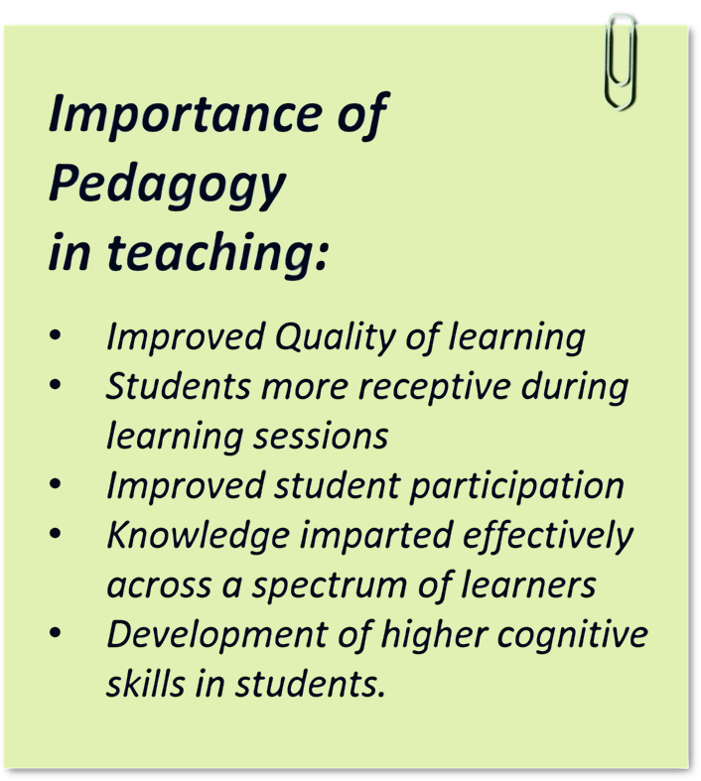
Employing effective pedagogical approaches helps students achieve learning outcomes and realize their full educational potential. Quality teaching pedagogy provides strong foundations for learning. It aids students in developing advanced concepts and abilities. Also, the right pedagogy enables instructors to observe the academic progress of their students. The points listed below highlight the importance of pedagogy.
- A thoughtfully developed pedagogy improves the quality of teaching. It makes the student more receptive during learning sessions. Consequently, this improves the student’s level of participation in the teaching-learning process.
- An appropriate pedagogy helps impart education to students with different learning styles/abilities. Students develop a deeper understanding of the subject matter. Subsequently, this ensures the achievement of the learning outcomes of a program.
- A correct pedagogical approach is required for students with special needs and students from disadvantaged groups, viz. females or minorities. Also, it encourages them to be a part of the mainstream learning community.
- A thoughtfully developed teaching pedagogy example makes students develop higher-level cognitive skills, viz. analysis, synthesis, and evaluation. On the other hand, knowledge, comprehension, and application are lower-order cognitive skills in Bloom’s Taxonomy.
- Assessing student performance appropriately is an essential part of the learning experience. Effectively grading papers while being fair to all students is most critical. For a more detailed idea of grading papers, readers may go to Study Crumb and refer the article How to Grade Papers: A Quick Guide.
Factors Affecting Pedagogy
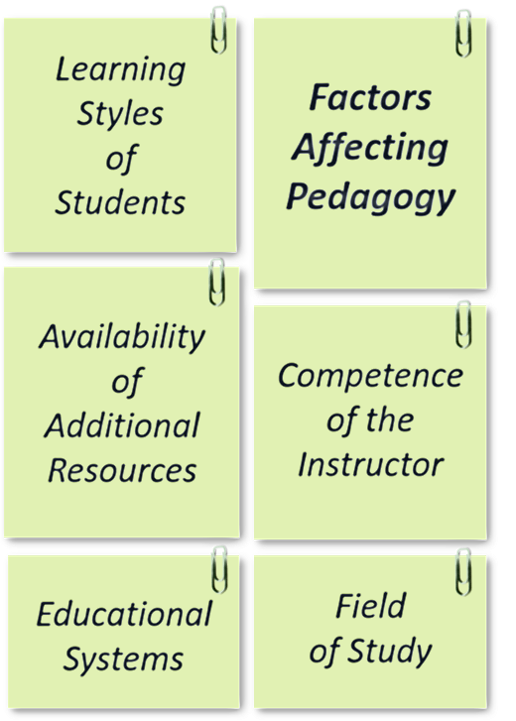
Various factors and pedagogy teaching methods influence the pedagogy adopted in the teaching-learning process. Some obvious factors are subject, curriculum, motivation to learn, and competence of the instructor. Additionally, the learning styles of students and the availability of infrastructure also influence the pedagogy. The following points elaborate on some of these factors.
1. Competence of the Instructor:
A competent teacher keeps the students motivated, interested, and eager to learn. Also, such an instructor employs a judicious blend of skills, abilities, and knowledge.
2. Learning Styles of the Students:
An idea about the students’ learning styles helps instructors adopt the appropriate pedagogical approach. Also, a pedagogical approach that complements students’ learning styles helps accelerate the learning process. It keeps students motivated and interested in learning.
3. Field of Study:
The field of study also influences the choice of pedagogy. For instance, physics requires a balance of theory and laboratory sessions. Political science, on the other hand, does not need laboratory sessions. Architecture requires field visits, besides theory and laboratory sessions.
4. Availability of Additional Resources:
Projectors, virtual laboratories, etc. help widen the scope of the teaching-learning process. Such educational resources keep the learning sessions alive and students engaged.
5. Education System:
The policies of an education system, curriculum standards, etc. also influence the pedagogical approach. For instance, an exam that tests the ability of a student to memorize and recall facts discourages the instructor from employing a learning pedagogy that develops higher-order thinking.
Types of Pedagogical Approaches
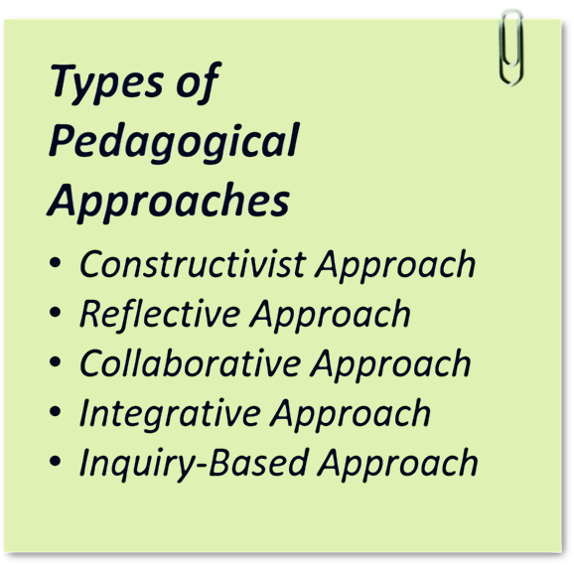
Effective pedagogical approaches are crucial in the effective delivery of knowledge to learners. The choice of a particular pedagogy depends on many factors, some of which have been discussed above. Also, pedagogy relates teachers, students, and learning with each other. It helps achieve academic outcomes. So, teachers are often advised by educationists to develop their own, unique pedagogical approach. Some pedagogical approaches described below are more general and ubiquitously adopted.
| Constructive Approach | Reflective Approach | Collaborative Approach | Integrative Approach | Inquiry-Based Approach |
Facilitator
|
|
|
|
|
Additional Pedagogical Approaches
There are several ways of classifying pedagogical methods and approaches. Effective and appropriate pedagogy at Learning Portal, UNESCO – IIEP classifies pedagogical approaches into three main types: teacher-centered pedagogy, learner-centered pedagogy, and learning-centered pedagogy. Regular classroom lectures and chorus answering are included in the teacher-centered pedagogical approach. In contrast, presentations, experiments, and case studies done by students are parts of the learner-centered pedagogy.
The development of human civilization brings transformations in education. These transformations lead to new challenges in the teaching-learning process. Eventually, these challenges lead to the evolution of more effective pedagogical approaches. This article is part of a series of articles on Pedagogy. For more, visit the blog pages at Evelyn Learning.
Additional References:
- Role of Pedagogy in Effective Teaching by Bhowmick1, Roy2, Banerjee3 at Basic Research Journals.
- Factors that Influence Academic Teacher’s Acceptance of E-Learning Technology in Blended Learning Environment at Intech Open.
- Integrative Pedagogy by Jouni Enqvist at Hame University of Applied Sciences, Finland.
Photo Credits: Unsplash
For further reading related to pedagogy and education standards, please visit the blog pages at Evelyn Learning.
Create Engage Inspire
The post Pedagogy as a Tool of Effective Teaching and Learning appeared first on Test.Evelyn.
]]>The post An Introduction to Plagiarism appeared first on Test.Evelyn.
]]>Readers may go through the web articles at the Caltech, University of Cambridge, University of California, and University of Oxford websites to develop an idea about the holistic definition of plagiarism.
Types of Plagiarism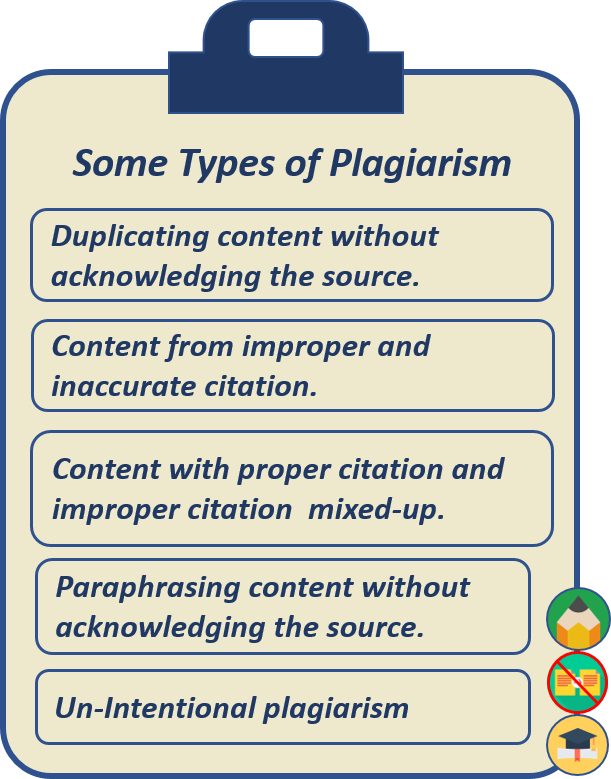
Listed below are some of the most common ways in which people plagiarize.
- Taking content “as-it-is” from a source without acknowledging and crediting the source. Commonly, the copied content is in the form of a “single large block” from one source. Otherwise, the content may be also copied in several “chunks” from one or multiple sources.
- Paraphrasing the content without acknowledging the source(s). Such a practice involves changing a few words in the content taken from single or multiple sources. The structure and flow of content remain the same.
- Besides the above two major ways, there are several cases of plagiarism. For example, the final content is a mix of content with proper citation and content with improper citation, content with improper or inaccurate citation of sources, and content borrowed from a previous work of self, thereby rendering the new work ‘unoriginal’.
- Plagiarism may be unintentional or accidental as well. This happens when one does not have the understanding of how to quote and cite sources. However, the content may seem to be the outcome of a conscious attempt at plagiarizing.
Readers may access web write-ups on plagiarism at the Bowdoin College and Turnitin websites. Additionally, an infographic at the iThenticate website offers a detailed study with case-specific examples. The content available at the suggested sites would help consolidate the readers’ understanding of the topic at hand.
Consequences of Plagiarism
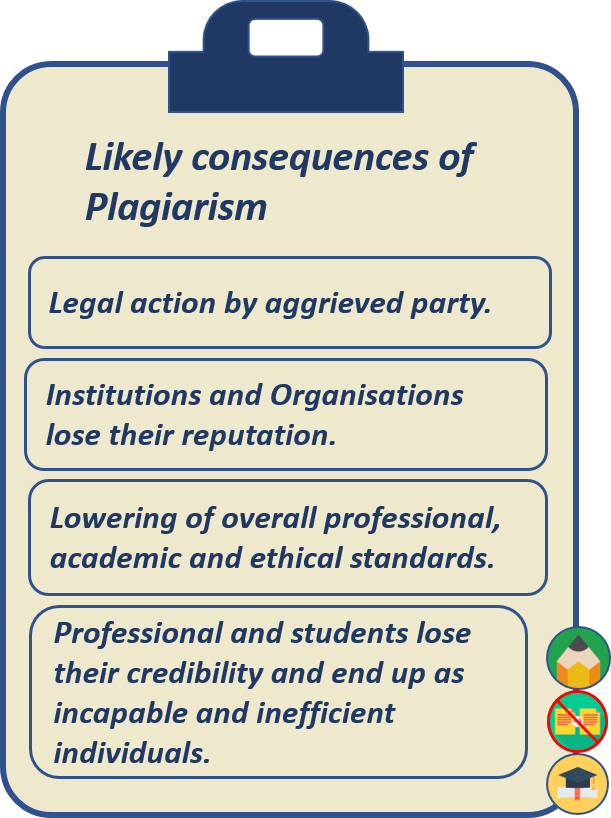
People who plagiarize are under the false impression that they stand to benefit from such a practice. From a short-term perspective, they do. They are not only able to develop “their work” quickly and conveniently but also grab credit and recognition for “their contribution”. The original creator of the work (the aggrieved party) thus loses the immediate benefits and credits that are rightfully theirs. From a long-term perspective, however, plagiarists end up as ineffective and incapable professionals. Their professional reputation is irreversibly destroyed to the point that their social image is severely dented as well. The world of academia and the knowledge industry is replete with such examples.
Academic institutions, the knowledge industry, and publishing companies (print/electronic) have now begun to take cognizance of the fact that plagiarism is a malady infecting academic integrity. Conscious efforts are hence being undertaken to avoid and curb this malady. Academic institutions and forums, for instance, have a distinct and clear set of guidelines to penalize plagiarism. Also, the degree or percentage of plagiarism is an important metric in deciding the quantum of penalty.
A dedicated FAQ page at the IEEE website gives an idea about the kind of guidelines that describe the extent of appropriate penalty for any plagiarism found.
Ways and Means to Detect and Identify Plagiarism
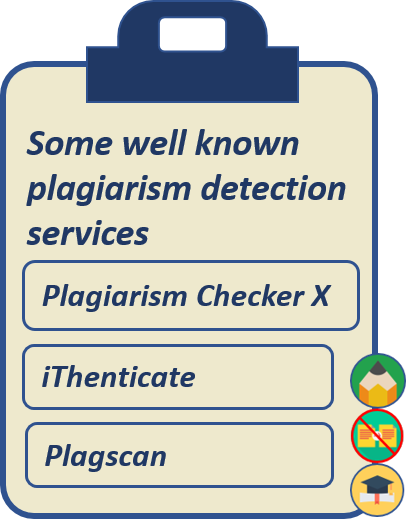
It is important to understand that to award penalties, it has to be proven that plagiarism has been committed intentionally. However, proving a case requires the identification of instances of plagiarism. This is where the ubiquitous internet and digital tools which make it easy to plagiarize make it equally easy to identify plagiarized content. A plethora of digital services, both paid and free, help identify plagiarism. Such services conduct a close and thorough examination of content and provide a detailed analysis of any plagiarism found. It is not necessary, however, to carry out the analysis of content through digital/electronic means only. A case discovered through human observation is equally well established to call for action.
The evidence of plagiarism found is duly put before a panel or board (designated to handle such cases) of the relevant organization/institution/body for formal examination and subsequent action. Penalties may range from zero credits for plagiarized scripts to outright cancellation of a candidate’s registration in a study program, depending upon the extent of plagiarism. Knowledge and learning-based organizations remove such content from their portals and sever their professional relations with knowledgeable professionals who indulge in plagiarism.
As a measure, penalizing plagiarism definitely deters people from practicing it. It is equally important that professionals adopt ethical practices during the course of their work. Therefore, institutions and organizations are advising students and professionals on ways and means to avoid plagiarism. This requires creating awareness about the issue amongst students and professionals. A dedicated “FAQ” on the website of an institution would help achieve the objective. Readers may access such FAQs through the links provided earlier in this article.
Citation and Its Purpose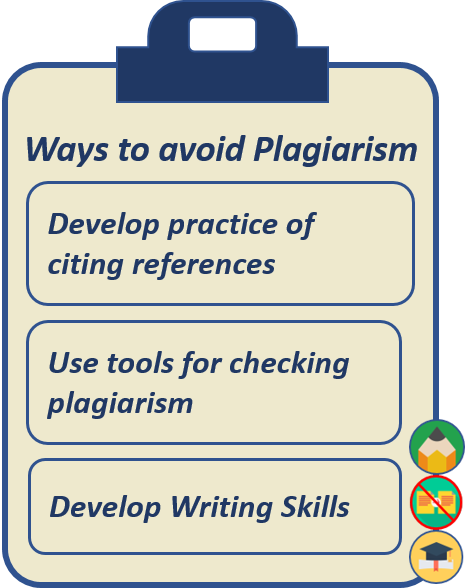
A sure approach to avoiding plagiarism is the practice of developing good writing skills. Good writing calls for the honest and effective articulation of thoughts, ideas, and facts. Honest writing calls for crediting the resources which have had an influence on the developed content. This is where the practice of including citation assumes significance.
A citation is a reference to a source referred to during the development of a work. It may also be a link/credit to a resource from where content is suitably adapted for inclusion in a work. Citation ensures that credits are rightfully given to the original creators of the cited work. It also helps the audience refer to additional sources on the subject. Readers may note that facts/thoughts that are a matter of “common knowledge” do not need a citation. However, if a thought/fact/idea is beyond the purview of common knowledge and is a unique and distinct work of a creator, a citation is necessary.
The publishing industry adopts specific formats for making citations. An improper citation, at times, is equivalent to plagiarized work. The web articles When to Cite and Referencing conventions at the University of Cambridge website offer a sound idea about the need for citations and the practiced conventions for making citations. Readers may go through similar articles on the Caltech and University of Oxford websites.
This article is part of a series of articles on Plagiarism.
Additional References:
- Promotion of Academic Integrity and Prevention of Plagiarism at the University Grants Commission, India.
- Draft Document on Plagiarism Policy at IIT Kanpur, India.
Image Credits:
Icons made by Icon Monk, Vectors Market, Smashicons from www.flaticon.com
For further reading related to pedagogy and education standards, please visit the blog at Evelyn learning.

Create.Engage.Inspire
The post An Introduction to Plagiarism appeared first on Test.Evelyn.
]]>The post Learning Styles: Definition, Types, & Other Insights appeared first on Test.Evelyn.
]]>However, the likelihood of acquiring knowledge or skill may vary with time or place. For instance, humans learn elementary social skills during their childhood years at their homes. Professional skills, though, develop during their adulthood at an institution. Similarly, how different individuals prefer to learn or are likely to learn is also not predetermined. For instance, an individual may prefer learning by seeing. Yet another might prefer learning by writing. Learning Styles are thus the different approaches through which individuals learn.
Representation of the Learning Process
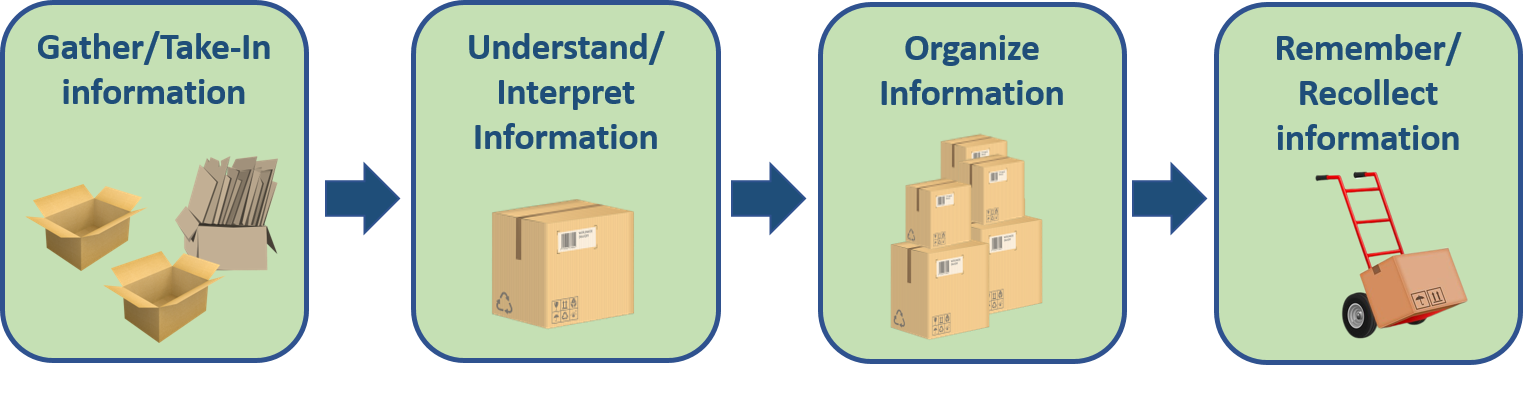
Every individual has a unique learning style. This is because how an individual gathers, understands, organizes, and remembers information is unique. However, the learning style of an individual does not stay the same throughout. It changes and evolves. Factors such as age, subject area, learning environment, social environment, cognitive skills, and education influence the learning style. An individual’s unique learning style does not in any way limit their learning abilities. It is just their preferred way of learning, not their only way of learning. An individual may prefer to learn differently under different situations.
The articles What is learning? at Queen’s University and Learning Styles at the Vanderbilt University websites offer more information on learning and learning styles to the reader.
Types of Fundamental Learning Styles
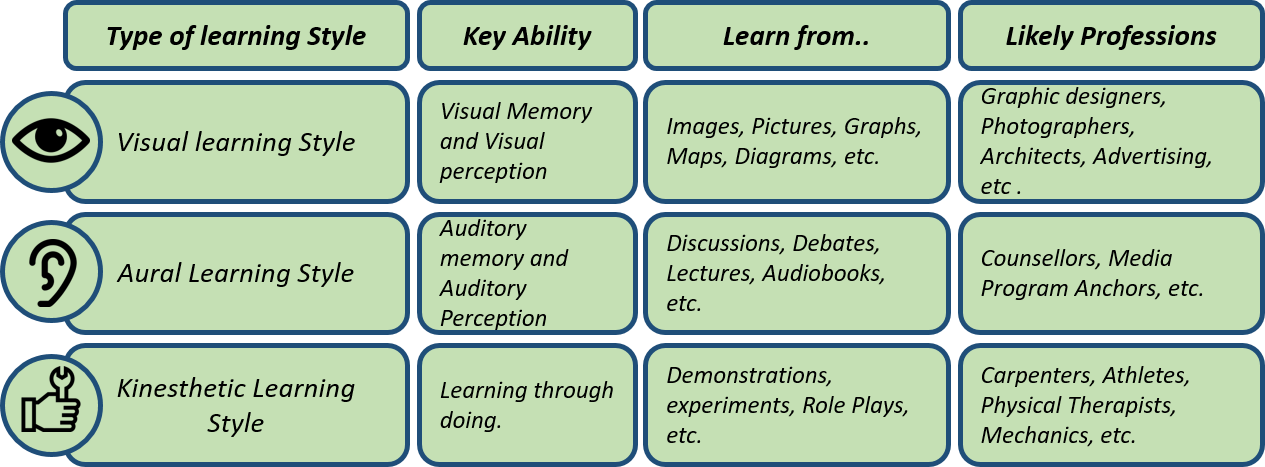
Researchers have conducted detailed studies to classify and describe the different learning preferences. A model, known as the VARK, by Neil Fleming and another one by David Kolb are widely discussed and cited on the internet. This article discusses the seven most commonly identified and discussed learning styles. The three fundamental types are visual, aural, and kinesthetic. The other four styles are verbal, logical, social, and solitary. Each of these styles is also known by alternate names in different print and online texts.
- Visual Learning Style: Visual learners prefer to use images, pictures, or other visual media for learning. They are more likely to retain information that is rich in visual content (graphs, maps, diagrams). Graphic designers, architects, photographers, etc. are likely to belong to this category of learners.
- Aural Learning Style: Aural learners prefer to learn through listening. They tend to retain information that is rich in aural content, such as discussions, debates, and lectures. Such learners may face difficulty in learning from visual content such as graphs or diagrams. Professionals, such as counselors and media program anchors, are likely to belong to this category of learners.
- Kinesthetic Learning Style, also known as the Physical or Tactual Learning Style: Physical learners learn well if they can involve hand or body movement in the learning process. Examples of kinesthetic style exercises are making drawings or role-playing. Physical therapists and mechanics are professionals who belong to this category of learners.
The article The Four Different Types Of Learners, And What They Mean To Your Presentations [Infographic] on the Prezi Blog provides a short introduction to fundamental types of learners. It also advises on the design of suitable infographics for such learners. Another article, The Importance of Understanding Employee learning Styles for working professionals, is available on the BGW-CPA webpage.
Other Types of Learning Styles
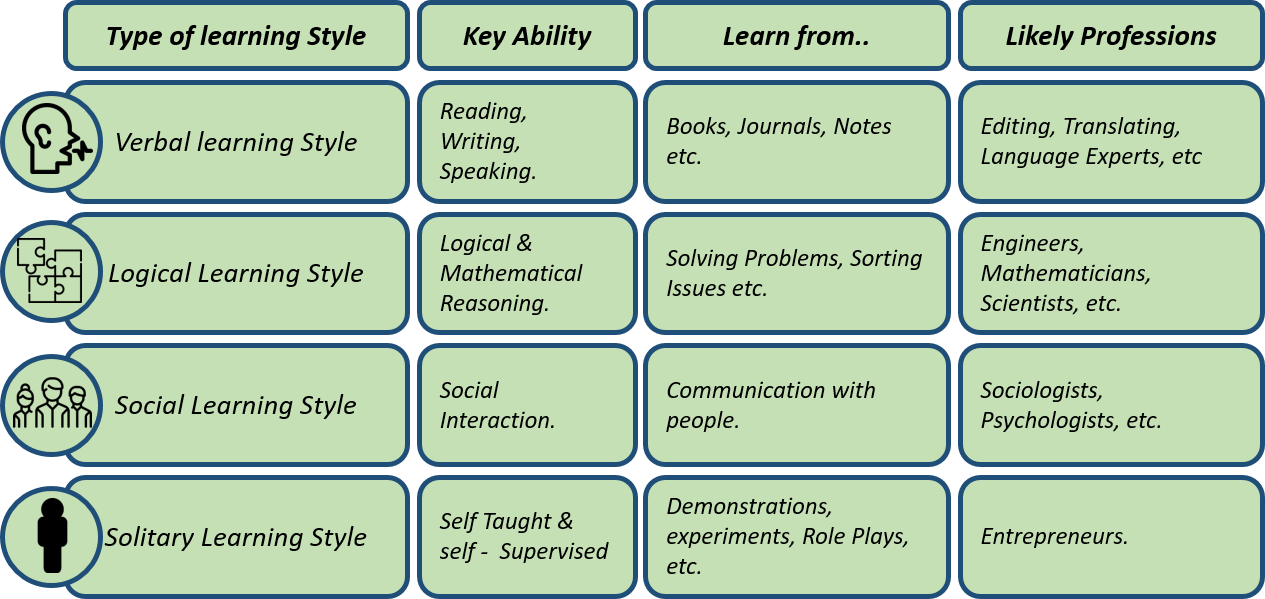
- Verbal Learning Style, alternately known as the Auditory-Verbal or Verbal (Linguistic) Style: Learners in this category prefer to learn through the use of language in different forms, viz. reading, writing, listening, and speaking. Verbal style learners can learn different languages.
- Logical Learning Style, alternately known as the Mathematical Style: Learners in this category employ logical and mathematical reasoning to further their knowledge and learning. Engineers, scientists, mathematicians, etc. belong to this category of learners.
- Social Learning Style, alternately known as the Interpersonal Style: Learners in this category have a strong ability to communicate with people. They employ this ability to develop their knowledge. Sociologists and psychologists belong to this category of learners.
- Solitary learning Style, alternately known as the Intrapersonal Style: Learners in this category prefer to be on their own without any supervision. Such learners are self-motivated, self-managed, and may be introverts. Entrepreneurs belong to this category of learners.
Importance and Identification of Learning Styles
Developing and employing effective pedagogy has always been an area of concern for educators. Employment of ineffective pedagogies may, ultimately, result in poor learning outcomes. The concept of learning styles helps mitigate this problem. Knowledge of learning styles helps an instructor decide the type of exercises, activities, and method of instruction for a class. The method of instruction for visual learners may include charts, graphs, posters, or pictures. The method of instruction for auditory learners may include recorded speeches, podcasts, or audiobooks.
A balanced combination of different methods of instruction is suitable for a class of students with different styles of learning. In turn, the adoption of appropriate pedagogy aids the learning process and intended learning outcomes are achieved. This also ensures that the learning sessions become more fulfilling. Therefore, it is essential to identify the learning style of individuals before picking suitable strategies for teaching and learning. VARK is one of the most popular among the many online tools, and it helps in identifying the learning preferences of an individual. It is available free of cost for use by academia. Businesses and other users may have to pay a fee to use the tool.
The Counterview
A popular counterview states that adopting teaching strategies following learning styles yields no distinct benefits in terms of learning outcomes. The video resource Learning styles & the importance of critical self-reflection | Tesia Marshik | TEDxUWLaCrosse on YouTube, offers an insight into the counterview.
This article is part of a series of articles on Learning tyles.
References:
- Your Guide To Understanding And Adapting To Different Learning Styles on the Cornerstone University website.
- The VARK guide to Learning Preferences at Vark-learn
Image Credits:
Pexels, Pixabay, Icons made by Freepik from www.flaticon.com.
 For further reading related to pedagogy and education standards, please visit the blog pages at Evelyn learning.

Create.Engage.Inspire
The post Learning Styles: Definition, Types, & Other Insights appeared first on Test.Evelyn.
]]>