The post Curriculum Development Models appeared first on Test.Evelyn.
]]>This article will describe what curriculum development is and how educators can employ the main models of curriculum design to ensure the success of any course. The importance of a well-thought-out course plan in any classroom—and for any group of students—will be clear to readers.
What is Curriculum Development?
The way one thinks about and theorizes education has evolved dramatically over time. The most basic definition of the term “curriculum” nowadays is the disciplines that comprise a course of study at a school, university, or college. Course planning and development are both terms teachers often use to describe curriculum development.
It is critical to note that course design varies. A math course at one university may cover the same content as another. However, the instructor may present it differently. The basics of curriculum development, on the other hand, do not change.
Walker’s Model of Curriculum Development
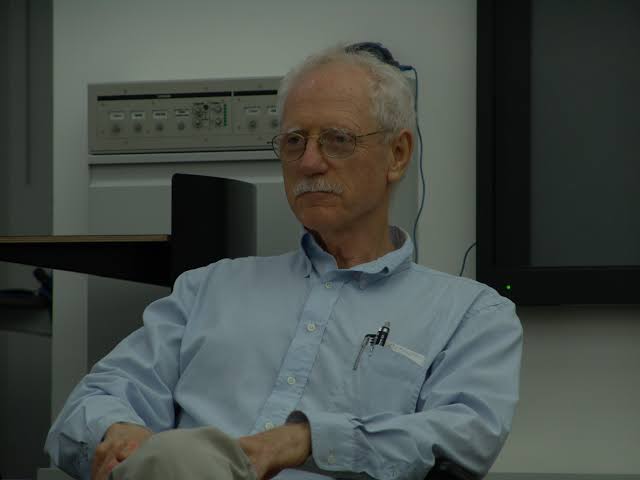
Decker Walker earned his Ph.D. in 1971 as an assistant professor of education at Stanford University. His area of expertise was curriculum, and the process of curriculum development and the formulation of curriculum policy particularly sparked his interest.
What is the Naturalistic Model, and How Does it Work?
In contrast to Tyler’s classical prescriptive model, Walker’s model is a descriptive one. Communicative approach is another name for it. The communicative approach begins with the designers’, target group’s, and other stakeholders’ more subjective impressions and perspectives.
Instead of recommending how curriculum planning should be done, the word naturalistic explains how it is done. Walker believes that if people were involved in the process and came to an agreement on the end output, better curriculum planning and development would occur.
Platform, deliberation, and design are the three steps of curriculum preparation in this methodology.
Platform: At this point, the curriculum workers bring their own beliefs, knowledge, and values to the table. This is akin to the concept of pre-printing a syllabus.
Deliberation: This phase specifies which facts are required for the means and purposes, as well as the generation of alternatives and consideration of the alternatives’ effects. The analysis of different costs and repercussions and selection of the optimal option for the upcoming curriculum work also employs this.
Design: Finally, this step entails curriculum preparation, decision-making, and implementation.
The level at which the development is taking place has an impact on this curriculum development model. Educators utilize it for curriculum development at a macro level. It also emphasizes the designers’, target group’s, and other stakeholders’ subjective perceptions and perspectives.
Taba’s Model of Curriculum Development

Hilda Taba contributed to the theoretical and pedagogical foundations of concept development and critical thinking in the social studies curriculum, as well as helped to lay the groundwork for education. She also developed a multipurpose teaching paradigm that incorporates a variety of processes, such as listing, grouping, re-grouping, labeling, and synthesizing. Taba’s “Grassroots method” is a modified version of Tyler’s model.
Steps of Hilda Taba’s Curriculum Development Model
This learning paradigm was created by Hilda Taba. Taba thought that constructing a curriculum follows a logical and linear order. She advocates for the “Down-Top model”, also known as the “Grassroots method.” She advocates for teachers to play a prominent role. Following are the seven steps of Taba’s Grassroots model.
-
Learners’ Needs Diagnosis:
The teachers who are also the curriculum designers begin the process by determining the requirements of the pupils for whom they need to design the curriculum. For example, the majority of students are incapable of critical thinking.
-
Establishing Objectives:
After the instructors recognizes the learners’ needs that require attention, they determine the goals that they will use to meet those requirements.
-
Choosing the Content:
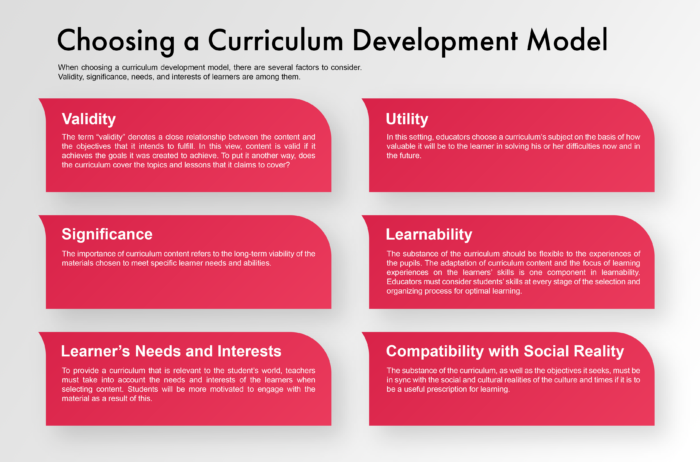
The objectives chosen or produced suggest the curriculum’s subject or substance. It is necessary to determine the validity and significance of the chosen content in addition to the aims and substance, that is, the content’s relevance and significance.
-
Organization of the Content:
A teacher must not only select content but also organize it in a particular sequence that takes into account the learners’ maturity, academic achievement, and interests.
-
Choosing Learning Experiences:
Students must be presented with content and be actively interested in it. At this point, the teacher should choose an educational style that will engage pupils in the material.
-
Organizing Learning Activities:
Learning activities should be ordered in a sequence based on both the content sequence and the characteristics of the learners. The teacher must consider the kids he or she will be instructing.
-
Evaluation:
The curriculum planner, that is, the educator, must determine whether the objectives were met. To assess the achievement of learning objectives, evaluation processes need to be created.
Tyler’s Model of Curriculum Development

The Tyler Model is the definitive prototype of curriculum development in the scientific approach, developed by Ralph Tyler in the 1940s. One might virtually argue that every licensed teacher in America, and possibly abroad, has designed a curriculum using this paradigm or one of its numerous versions, either directly or indirectly.
Tyler did not aim for his contribution to the curriculum to serve as a development model. Initially, he put his thoughts down in a book called Basic Principles of Curriculum and Instruction for his students to give them an understanding of how to make curriculum. Tyler’s model is brilliant since it was one of the earliest, and it was (and still is) a very simple model consisting of four steps.
Curriculum and Instructional Fundamentals
-
Determining the Goals of the School (AKA Objectives)
The first step is to figure out what the school’s goals are. To put it another way, what must students do in order to be successful? Each subject has its own set of natural goals that serve as signs of mastery. All objectives must be congruent with the school’s philosophy, which teachers frequently overlook in curriculum development. For instance, a school designing an English curriculum would set a goal for pupils to produce essays. This would be just one of the curriculum’s numerous goals.
-
Identifying Educational Experiences that are Relevant to the Goal
Step two is to create learning experiences that will assist students in completing step one. For instance, suppose educators require students to complete an essay. They may demonstrate how to write an essay as part of the learning experience. The pupils may then get the opportunity to practice writing essays. The experience (essay writing and demonstration) is in line with the goal (students will write an essay).
-
Organizing the Experiential Learning
The third step is to classify the experiences. Is it better for the teacher to demonstrate initially, or for the pupils to learn by writing right away? Either technique could work, and the preference is determined by the teacher’s mindset and the students’ needs. The point is that the teacher must decide on a logical order for the students’ experiences.
-
Assessing the Objectives
The fourth and last phase is to evaluate the objectives. The teacher is now evaluating the students’ abilities to compose an essay. This can be accomplished in a variety of ways. For example, the teacher could assign pupils to write an essay on their own. If they are able to do so, it indicates that the students have met the lesson’s goal.
This model has a few variations. Educators, on the other hand, still widely regard the Tyler model as the most effective paradigm for curriculum development.
Wheeler’s Model of Curriculum Development
Wheeler created a five-phased cyclical model of curriculum development, which appeared to address Tyler’s criticisms. His cyclical model resembles both linear and Taba’s interactive models in many ways. The following are the essential components of Wheeler’s model:
- Aims, goals, and objectives must be chosen.
- Educators must select learning experiences.
- Content selection which delivers specific types of experiences
- The organization and integration of learning experiences and content in relation to the teaching-learning process in the classroom and school
- Evaluation of all aspects of all other phases’ effectiveness in achieving the goals
This model depicts a cyclic and continuous process, implying that curriculum development should always be moving from one step to the next; it should never stop. The curriculum planner and the teacher are involved in a series of continual decision-making processes about a wide range of elements in Wheeler’s approach, which is considered dynamic rather than static. Because of its broad application, Wheeler advises that educators must employ this technique in all curriculum development at any level.
This model has a number of advantages. The cyclic model responds to changing needs, which necessitates continuous updating of the curricular process.
They are adaptable and relevant to students in specific scenarios. Adoptions and adaptations are conceivable due to the dynamic nature of the system, as long as there is a good objective that the activities fulfill.
The aspects of the curriculum are seen as interconnected and interdependent in this model. It allows for some interaction between the various aspects of the program.
To Sum Up
It is not easy to create, construct, and implement an education program, especially when it comes to online learning. Instructors have their work cut out for them, with educational technology playing an increasingly important part in higher education and today’s diverse student body.
Educators, on the other hand, will be setting themselves—and their students—up for long-term success if they follow the core standards and framework of curriculum development.
Image Sources: Shutterstock and Unsplash
For more information on curriculum development models, visit our blog.
Create. Engage. Inspire.
The post Curriculum Development Models appeared first on Test.Evelyn.
]]>The post Mobile Learning – What All You Need To Know? appeared first on Test.Evelyn.
]]>The idea of mobile learning is nothing new. Many schools and educational institutions are attempting to implement this technology in order to better teach students using computers and mobile phones. This method is not only useful and practical but also enjoyable, which is how it encourages individuals of all ages to learn. That is why, on a daily basis, numerous educational technologies are introduced and made available to educators and trainers.
This article will discuss the definition of mobile learning, as well as its benefits and drawbacks. It will also cover a variety of mobile learning tools and creating content for mobile learning.
What is Mobile Learning?
Mobile learning (m-learning) is the process of obtaining learning materials via mobile apps, social interactions, and online educational hubs over the Internet or a network utilizing personal mobile devices such as tablets and smartphones. It is adaptable, allowing students to receive education from anywhere and at any time.
Mobile learning allows educational institutions to transmit information and educational content to students on any platform, at any time, and from anywhere. Students use mobile apps and technologies to complete and submit projects to teachers, download course materials, and collaborate on activities in online social groups.
Course creators most commonly use the term “mobile learning” to describe the technology of mobile devices and apps that educators utilize in the classroom. However, it can also refer to the use of mobile technology to facilitate always-on learning.
Creating Content For Mobile Learning
It is a prevalent misperception that educators can easily convert eLearning resources to mobile learning courses. During the transition, however, they must rethink the entire instructional design. To create a gratifying and a visually and cognitively rewarding user experience, mobile learning necessitates minimalism, an emphasis on granular design, and instructionally sound design.
Following these simple but important rules will allow course makers to make learning easier for students and provide them with an intuitive and engaging learning experience that matches their needs wherever they are.
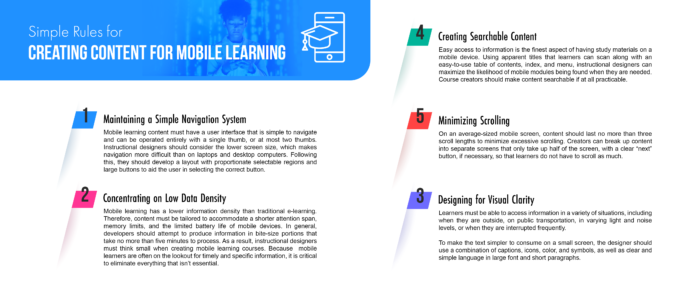
To avoid both distracting learners and wasting space in the initial scrolling zone, all secondary content, such as optional navigational controls, links that are not relevant to the information being displayed, copyright notices, and other legal information, should be kept to the bottom of the screen. Every screen should direct the student to further content so he or she can catch up or dig deeper into a topic.
Advantages And Disadvantages
Following are a few key advantages and disadvantages of mobile learning that all course creators should be aware of.
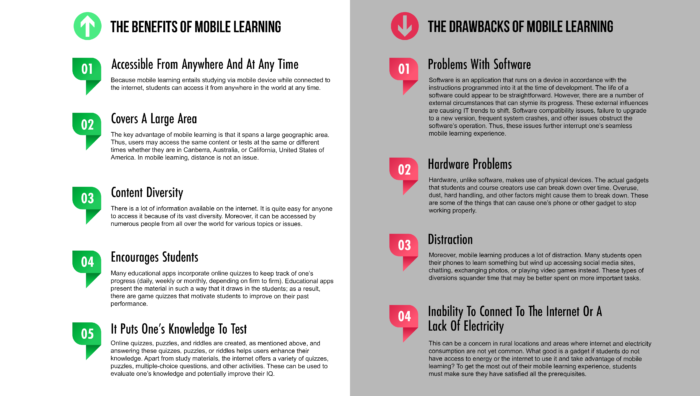
The Applicability of Mobile Learning
Mobile learning is formal but informal, which is exactly what most students want. Mobile learning allows students to learn in the comfort of their own home without having to abandon their daily activities and plans.
Those who do not participate in online classes can still access learning resources. These include educational articles, videos, audios, pictures, and even text. This on-demand accessibility has further added to the success and renown of this learning method.
These and other advantages of mobile learning, such as eco-friendliness, cost-effectiveness, ease, and the amount of enjoyment obtained from learning, have prompted corporate behemoths and developing firms to migrate from physical to virtual training sets.
Mobile Devices Prices
The prices of mobile devices have reduced dramatically over the years. This is a result of the ongoing release of new gadgets and the variety that is now available. For those considering mobile learning, this is the icing on the cake. This means that everyone, from the young to the elderly, may easily make a one-time investment that will provide years of learning and enjoyment.
Image Sources: Shutterstock and Unsplash
For more information on mobile learning, visit our blog.
Create. Engage. Inspire.
The post Mobile Learning – What All You Need To Know? appeared first on Test.Evelyn.
]]>The post Animation Techniques For Effective Content appeared first on Test.Evelyn.
]]>A thousand words can be written to convey a message, but a short animation film is significantly more powerful. Perhaps this is why they are preferred for educational, business, and presentation purposes, among other things. However, before animators begin creating their own, it is necessary to have a fundamental awareness of the numerous animation techniques used in multimedia. After all, it is likely that a 3D approach will appeal to their audience more than a 2D approach or stop motion, or vice versa.
The goal of this article is to guide readers through the complexities of various animation styles and approaches. It also covers the fundamentals of color coding, as well as the ideal quantity of text to include in an animation.
What To Choose: 2D v/s 3D
There are several aspects animators must consider when determining whether to create a 2D video animation or a 3D animation. Although both are fantastic in their own right, there are several differences that may lead animators to prefer one over the other.
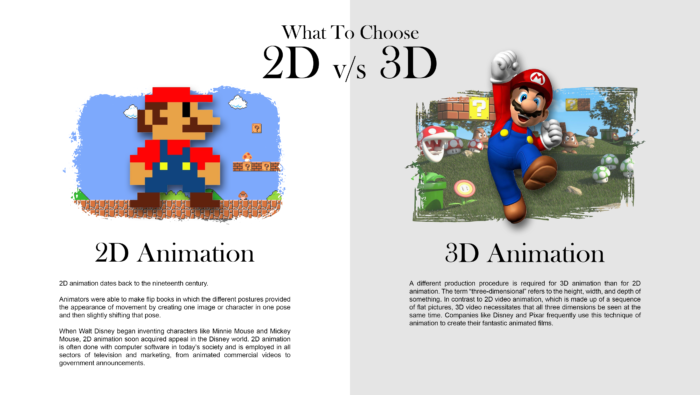
So, what should animators think about when determining whether to make a 2D or 3D animated video?
-
Target Audience
The target audience should be the first thing to think about. If animators have a topic they need to convey, a 2D explainer movie is the most digestible and enjoyable way to do so.
3D videos, on the other hand, are considerably more realistic. So, if animators want to showcase a new product, such as a smartphone, a 3D video would be an excellent choice.
-
Pricing
Pricing is another element animators should think about when deciding on the proper video animation path for them.
2D video animation is typically far more cost-effective than 3D animation. This is due to the fact that 3D animation is far more sophisticated than 2D, requiring an animator to devote significantly more time to the process. When it comes to creating video animations, time truly is money.
-
Turnaround Time
Following up on the previous point, animators can create 2D videos far more quickly than 3D animations. The average turnaround time for a 2D video is roughly six weeks.
Due to the more difficult animation process, creating a 3D video might take months or even years, depending on the length and complexity of the animation.
Color Coding
Animators must think carefully about the colors they employ in their animations and why they do so. When animators do not handle color correctly or in the right context, it might become a distraction for users, lowering their performance.
It is crucial to think about the associations people have with particular hues (e.g. red and green). On the website, animators may be able to use red to color code a subject, but it will likely have to be a darker shade that does not feel alarming.
The color red, for instance, in a US safety handbook implies “warning” or “danger.” Users with an American background will notice the red signaling cue right away and will most likely read the material.
Differentiating Information Sections Using Color
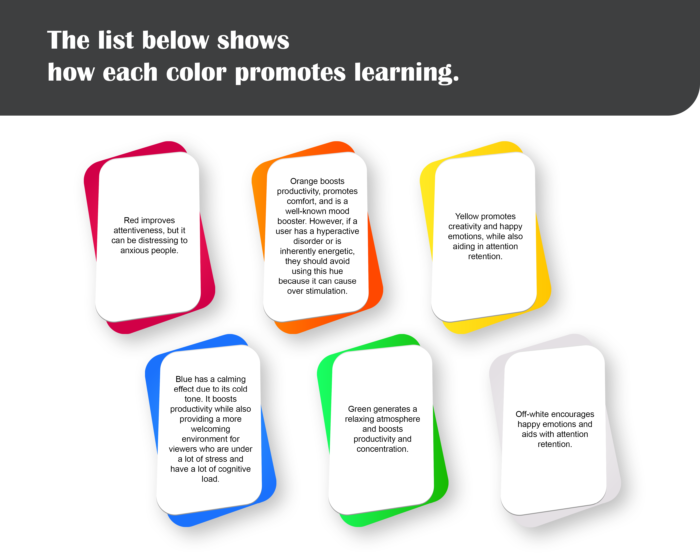
With so much information to digest, colors are able to provide the ideal environment for learning to take place.
Each hue has its own wavelength, which is thought to have various effects on our brain. This means that when it comes to learning, the colors animators choose will have an impact on the user’s feelings, behaviors, and attention.

Humans are sensitive to visual cues, and color has been demonstrated to boost the likelihood of information being encoded, retained, and retrieved when compared to black and white. As a result, viewers can process information faster with color because it visually organizes information in ways that are relevant to them.
Color should be utilized to distinguish between distinct pieces of information in a program or on a website. Color should be utilized to give each area of the website a distinct look if there are numerous pages of content that might be arranged into certain sections (subjects, chapters, sub-sections, etc.). Each part may have its own distinct look and feel.
Color-coding sections makes it easier for users to figure out where they are in the app’s navigation. As they become more familiar with the colors, they will construct a mental map of where different pieces of content are located.
Optimum Amount Of Text In Animation
When it comes to adding text to animations, animators must keep two things in mind:
a. Aesthetics
Yes, the goal is not to overpower the animation with too many words. It can be counter-intuitive to include too much text in an animation. Instead of aiding audience retention, it detracts from the aesthetics and elegance of the animated content.
The words animators add must blend in with the animation’s theme and contribute to its artistic appeal.
b. Legibility
While it is necessary to maintain the animation’s aesthetics, the primary reason for having text on it is to improve the audience’s capacity to retain the information.
Bearing this in mind, it is vital to arrange the text in a readable manner. For this purpose, animators can use proper text qualities, such as color, font, and size. The number of words on the screen at any given time has a significant impact on one’s ability to read. Some people can only read a few paragraphs at a time. Animators can employ split text online tools to easily divide big volumes of text into bite size bits, as well as other tools to make readable chunks of video text.
The animator ultimately decides how much text the video needs. It is no longer difficult to strike a nice balance between aesthetics and legibility when adding text to animations. However, animators should avoid making obvious errors when doing so. A handful of the most typical mistakes individuals make while adding text to animations are listed below.
-
Color
The text animators add to a video should have a color that contrasts nicely with the video’s subject. It is critical that the reader be able to grasp it without difficulty.
The aim is to put the text on top of something that contrasts effectively with the text color. It is also crucial to make the backdrop object slightly transparent (opacity 0.7 to 0.8) so that the animated content behind it is not obscured.
-
Size
This is a simple task. Animators must determine the significance of the text. If it is a subtitle, they may put it toward the bottom and keep the font size tiny. Animators can increase the font size of a title by 3-4 times. Unlike a subtext, the audience should never overlook it.
Many people believe that keeping text tiny will impair the animation’s output. If animators believe the message is significant, they should prominently display it in the animation.
-
Position
One can never overstate the importance of text placement. Animators should always place crucial text, such as titles, in the middle of their frame. They should have no reservations about doing so. If it is an assistance annotation, they can place it at the bottom 2/3 of the animation on the left or right side, toward the top.
-
Duration
When animating text, animators should always ensure that their audience has enough time to read and grasp the text they have added to the video. If they fail to do so, the whole point of putting text to video is moot.
It is a good idea to keep the text open for 2 seconds longer than the typical reading time. There are certain exceptions to this rule, such as when the text must appear in sync with specific sequences. Animators can ignore this regulation in certain instances.
To conclude, design is more than just a matter of aesthetics. Interaction is at the heart of design. Communication necessitates the use of animation. Animators must embrace the interactive nature of the web from the start and consider it a natural element of their work.
Image Sources: Shutterstock and Unsplash
For more information on animation techniques for effective content, visit our blog.
Create. Engage. Inspire.
The post Animation Techniques For Effective Content appeared first on Test.Evelyn.
]]>The post Preparing For The LSAT – Law School Admission appeared first on Test.Evelyn.
]]>The Law School Admission Test (LSAT) is unlike any other exam a candidate has ever taken in their life. The LSAT is a skills-based exam. It assesses critical reading and analytical thinking abilities that are essential for law school success. Before they start preparing for the LSAT, aspirants should familiarize themselves with the exam’s ins and outs. This will help them prepare for what will be on the exam.
Let us start with a definition of the LSAT, as well as its eligibility and prerequisites. Following that, we will move on to how to study for the LSAT, the exam format, and the cost of taking it.
What is LSAT?
In the United States, Canada, and a rising number of other countries, the Law School Admission Test (LSAT) is a requirement for admission to law school. The LSAT is designed to assess the skills needed to succeed in the first year of law school. These skills include reading comprehension, thinking, and writing. The exam results provide vital insight into law school readiness for both admissions decision makers and candidates.
The LSAT is the single strongest predictor of first-year law school achievement, even better than undergraduate grade-point average, according to studies. The LSAT, according to LSAC, should be simply one component of a comprehensive admissions process that takes into account each candidate’s skills and life experience.
Eligibility and Prerequisites of LSAT
Most law schools require applicants to take the Law School Admission Test, which is a form of standardized test. Candidates must take the LSAT before applying to a law school in the same manner in which they would take the ACT or SAT before applying to college.
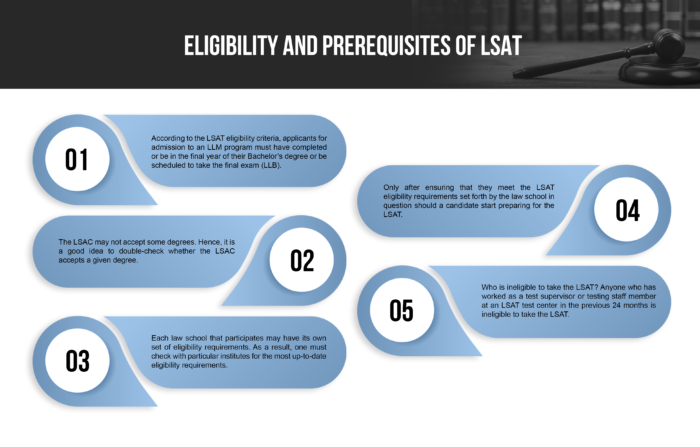
Candidates preparing for the LSAT can take the exam three times in a single LSAC year (June to May), five times in five years, or seven times in a lifetime. Tests taken prior to September 2019 are not a part of these totals. All of one’s results from the previous five years are submitted. Moreover, depending on the concerned law school’s policy, either their greatest score or an average of their scores is used.
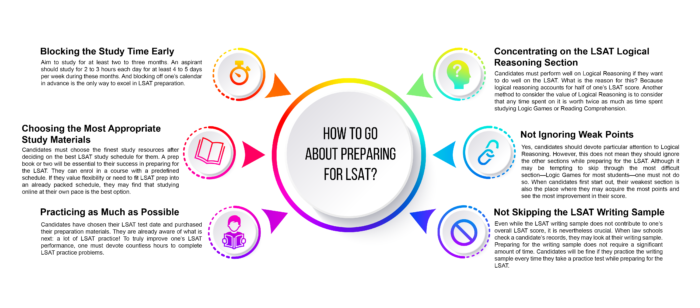
How to go about preparing for LSAT?
If a candidate is considering taking the exam or has already begun preparing for the LSAT, they may be feeling overwhelmed. That is fine; everyone studying for the LSAT experiences this at some point. All an aspirant needs to do is stick to a few LSAT study tips, and they will be fine on the test day.
LSAT Exam Pattern
The LSAT is divided into six sections: one unscored essay section and five 35-minute digital multiple-choice sections administered at the testing center on a tablet. Four of these sections will be graded, while the fifth (or variable) section will be left ungraded. Test takers have no idea which sections are unscored until the day of the test. As a result, mentors advise that the candidate responds to all the questions on the LSAT question paper. To prevent cheating, sections are given in a varied sequence to various test takers.
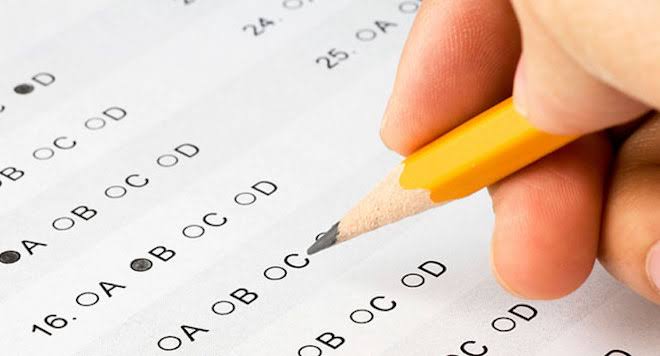
Sections of the LSAT include:
- Two 25-question logical thinking sections entail dissecting and analyzing a short argument or set of data to find the main assumption, other conclusions, errors and omissions, comparable arguments, and components that strengthen or weaken the argument.
- One reading comprehension section with 26–28 questions is divided into four 400–500-word passages with five to eight related questions each. Test takers must identify the primary idea, particular information, inferences, and/or writing structure for topics such as law, arts and humanities, physical sciences, and social sciences.
- One analytical reasoning section of 22 to 24 questions consists of four logic games that require grouping, matching, and ordering elements based on a premise and a set of conditions and relationships between subjects that serve as the foundation for conclusions based on the statements. Although there is no single correct answer, the LSAC assesses test takers on their analytical abilities. Aspirants widely regard this as the most challenging section of the LSAT. It is where many test takers devote the most of their preparation time.
- Administrators test new questions for future tests in the variable section, and the results do not factor toward the final score. However, candidates must keep in mind that they will not be able to discern which section is the variable while taking the test.
- Finally, utilizing secure proctoring software, the written exam is done separately on the test taker’s own computer. Test takers get 35 minutes to read a decision prompt or problem, as well as the criteria for making decisions, and then write an essay advocating for one of two solutions. The emphasis is on the writer’s ability to argue both for and against the chosen viewpoint. This portion is not graded. However, a scan of the essay is sent to applicants’ prospective law schools along with the scaled numerical score.
The Cost of Taking LSAT
The LSAT costs $200, and applicants get one free score report with it. In addition, most law schools require a subscription to the Credential Assembly Service (CAS) in order to apply. This $195 subscription also comes with one free score report. The cost of additional score reports is $45. LSAC provides waiver forms for the LSAT and CAS fees. The aspirants can access these from the LSAC website.
If candidates fantasize about making the ideal opening statement or banging the gavel, this includes making space and preparing for the LSAT. The Law School Admission Test is a difficult exam that assesses candidates’ readiness for a legal career. Yes, it sounds overwhelming, but one need not get too worked up about it. Aspirants will be ready to go with their hard preparation and commitment, on their way to making a courtroom their new abode.
Image Sources: Shutterstock and Unsplash
For more information on preparing for the LSAT, visit our blog.
Create. Engage. Inspire.
The post Preparing For The LSAT – Law School Admission appeared first on Test.Evelyn.
]]>The post What is SEL (Social Emotional Learning) and How Does it Help Students? appeared first on Test.Evelyn.
]]>Social emotional learning provides a foundation for good, long-term benefits on kids, adults, and communities by teaching effective problem-solving, self-discipline, impulse control, emotion regulation, and more. This is significant since people do not come into this world knowing how to regulate their emotions, solve problems, or interact with others. Pupils must acquire these talents, and schools can assist them in doing so. It is also worth noting that some pupils may require individualized support in order to properly benefit from social emotional learning.
What is Social Emotional Learning?
Social emotional learning (SEL) is a teaching strategy that teaches students of all ages how to better understand their emotions, feel them fully, and show empathy for others. These taught behaviors are then used to assist students in making positive, responsible decisions, establishing frameworks for achieving their objectives, and forming positive relationships with others.
Creating learning environments that create healthy interactions between students and teachers leads to enhanced communication skills, motivation, and exam results. SEL, on the other hand, is not just vital in the classroom. It is a lifelong practice that extends into adulthood. Effective collaboration and communication need the development of SEL skills and abilities.
Components of Social Emotional Learning
Social emotional learning involves five core components that can be applied in the classroom, at home, and in students’ communities, according to the Collaborative for Academic, Social, and Emotional Learning (CASEL). It is an organization dedicated to students and educators to help achieve positive outcomes for PreK-12 students. These are the five core competencies:
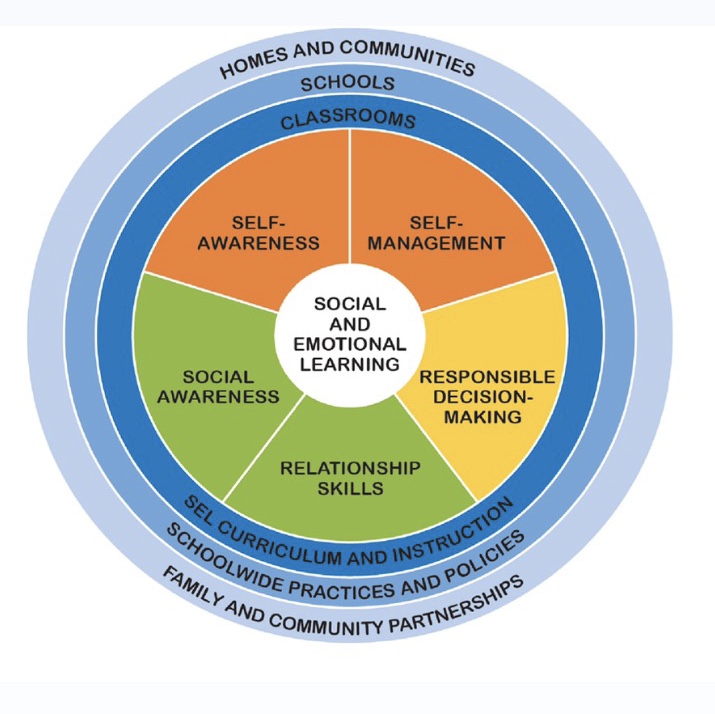
- Self-Awareness
Students learn to recognize their own strengths and limitations, as well as the impact of their actions on others. Coaching and simulation sessions are an example of this in practice, where students notice how various acts influence others so that they can learn how to perceive their own feelings as well as what other people are feeling. - Self-Management
Students learn to control their emotions and actions, which includes stress and time management, motivation, and academic/personal goal setting, all of which are critical skills for youngsters as they grow and need to manage their own schedules and businesses. Older, more experienced students can teach kids about these types of actions.By pairing students in a mentor-mentee relationship, the mentee will learn about vital academic skills as well as how to improve self-esteem and confidence, while the mentor will offer skills learned from experience. This will help the mentee navigate common challenges like imposter syndrome and insecurity. - Social Awareness
Students learn to detect other people’s emotions, grasp social behavioral norms, and empathize with people from various origins and cultures. Introduction and inclusion exercises, in which participants share their favorite interests, fascinating facts about themselves, and so on, are an example of an activity that strengthens this skill. - Relationship Skills
Students learn how to build healthy relationships and communicate clearly with one another and in groups. Participating in a range of activities, such as team sports, games, and group projects, can help them practice this. Active listening, team building, and conflict resolution are all abilities that are useful both inside and beyond the classroom. - Responsible Decision-Making
When it comes to behavior and speech, students learn how to make their own autonomous decisions, whether personal or academic. Students will be able to make polite and well-thought-out judgments by considering societal norms and differences, potential consequences, and safety issues. Students can solve qualitative problems in a number of ways to learn diverse strategies and ways of thinking. This is one way to actively practice responsible decision-making.
Social Emotional Learning Activities
Many schools have begun to teach students how to deal with emotions, make objectives, and get along with others. Parents can also assist their youngster practice these abilities at home.
Here are a few socio-emotional learning activities to assist children regulate emotions and improve social skills while also having fun. These low-tech social-emotional learning activities are really effective. And they are all made to fit into one’s regular routine.
-
Starfish and Tornadoes
The idea is to teach kids how to recognize how much energy they have inside. When they realize they have too much energy, they can either apply self-calming techniques or seek help from a trustworthy adult.
Playing Instructions: Draw a thermometer on a piece of paper. At the bottom, draw a starfish, and at the top, draw a tornado. Inquire whether the youngster is quiet and tranquil, like a starfish, or frantic and agitated, like a tornado. When a youngster is very energetic, mentors can discuss with him or her ways to make him or her feel more like a starfish. For instance, bouncing a ball can assist in the release of some of that energy.Mentors can help the mentee define their energy levels by playing this game at different times of the day.
Points to remember: Self-awareness can aid in the development of a skill called self-regulation in children. It is all about managing one’s own energy when it comes to self-regulation. It aids children in controlling their emotions and body movements in stressful situations. Moreover, it aids their ability to pay attention and learn.
-
Turtle Time
The idea is to assist children in developing their ability to see what is happening around them. Picking up on social signs allows children to get their needs satisfied while also understanding the viewpoints of others.
Playing Instructions: When the mentor and mentee arrive at the playground or other location, they must look around slowly and exaggeratedly like a turtle. They should take turns describing what they see: “All the swings have been taken.” “For the slide, there is a short line.”
The mentor must assist the child in making the connection between his or her observations and the behavior choices he or she makes.Points to remember: Mentors are not required to dress up as turtles. To aid their vision, they may use their pretend binoculars or a special pair of spectacles. A mentor could also participate in a game of “I spy with my little eye.” The mentor and the youngster can take turns observing and reporting social encounters until the other participant finds what they are looking for.
-
“Who am I right now?”
The idea is to help the child develop self-awareness and identify his or her strengths. These abilities can also aid in decision-making and understanding others’ viewpoints.
Playing instructions: The mentor can get some index cards and start playing. Draw drawings of the child doing something positive, such as being a good helper or a good teacher, with them. Consider what additional cards the youngster could create.
Mentors can comment on their child’s positive behaviors to encourage them to come up with ideas: “You just offered to teach your sister a nursery rhyme.” Let us talk about what kind of person you are right now for a second.”
Points to remember: Mentors must remember that many families attempt to teach social-emotional skills by criticizing undesirable behavior. But they must not forget to praise the youngster when he or she does something good. Praise for good behavior frequently leads to more of the same.
Mentors can also purchase these cards or they can find templates online. Children, on the other hand, could enjoy crafting their own cards.
-
Let us Make a Deal
The idea is to assist children in learning to compromise. Practicing how to perceive things from someone else’s point of view will assist the youngster consider the needs of others.
Playing instructions: When the mentor and the youngster cannot agree, the mentor can sing these words to the tune of ‘This Old Man.’ “You want this. That is something I would want. How can we both get what we want?” Then come up with a few ideas and pick the best one for now.
Points to remember: The child may have problems letting go of a notion. Mentors can combine their efforts to select the best of the runner-up ideas and place them in a unique container.
-
Take turns Taking Charge
The idea is to aid in the development of self-awareness, decision-making, and seeing things from other people’s perspectives.
Playing instructions: Mentors can start a custom where they and the child take turns preparing a fun night once a week. They might choose a topic, such as what meal to eat, what movie to watch, or what game to play. Alternatively, they can leave everything open and let the person in control choose.
Points to remember: Making a chart with categories like “Waiting my turn” and “Staying cool when doing something I do not like” might be helpful. The mentor can have everyone rate themselves after the exercise. Then they discuss what has been working well and what they would like to improve.
The Importance of SEL
In today’s ever-diversifying world, the classroom is frequently the first location where children are exposed to people from a variety of backgrounds, hold differing ideas, and possess unique abilities.
Social emotional learning aims to help students — both children and adults — better understand their thoughts and emotions, become more self-aware, and develop more empathy for others in their community and the world around them. Mentors must do this in order to account for these differences and help put all students on an equal footing to succeed.
Students can become better, more productive, self-conscious, and socially aware citizens outside the classroom if these attributes are developed in the classroom.
Image Sources: Daycare vector created by vectorjuice at Freepik
For more information on social emotional learning, visit our blog.
Create. Engage. Inspire.
The post What is SEL (Social Emotional Learning) and How Does it Help Students? appeared first on Test.Evelyn.
]]>The post Stealth Assessment: Meaning, Principles, Design And Model appeared first on Test.Evelyn.
]]>The term “stealth assessment” was first brought into use in 2005 to describe a method of assessing innovation in video games. When a person engages in complicated, goal-oriented tasks while playing video games, the abilities and tactics he employs to overcome hurdles and obstacles are motivated entirely by the thrill of accomplishment. In this regard, the skills used at the time were the most accurate in assessing non-evaluable attributes such as persistence, ingenuity, and strategic thinking. Educators refer to this type of skill evaluation as Stealth Assessment.
What Is Stealth Assessment?
The phrase “stealth assessment” was brought into use by Valerie Shute in 2005 to characterize the automated assessment procedure of a system called Smithtown that was designed to teach microeconomic principles. Valerie Shute and Matthew Ventura study a method for embedding performance-based assessments in digital games in their book Stealth Assessment.
Simply put, stealth assessment is evidence-based evaluation. Educators dub this method of continuously monitoring a person’s progress while offering automatic responses “Stealth assessment.” It is now used in educational games and simulations. Assessors can seamlessly integrate it into the structure of learning experience. Pupils naturally develop rich sequences of actions while accomplishing complicated tasks during gameplay. In doing so, they rely on the precise skills or competencies that educators want to evaluate.
Basic Principles Of Stealth Assessment
Stealth Assessment is when testing is smoothly woven into the fabric of the learning or gaming environment to the point where it is nearly undetectable. This, in turn, blurs the line between learning and evaluation. It is designed to be imperceptible and continuing, to support learning and reduce test anxiety without jeopardizing validity and consistency.
The following are the basic principles of Stealth Assessment:
- The software examines pupils’ actions in a computer game or simulation.
- The system adjusts the game’s structure to help students learn. For instance, it introduces new hurdles and obstacles based on their performance.
- Rather than having distinct stages or tests, the strategy keeps the game running by integrating instruction and assessment within the game.
- The technology creates a dynamic representation of the learners to show their skills and talents.
- By blurring the boundaries between assessment and learning while performing a complete diagnostic, it reduces test anxiety among students.
Design And Model Of Stealth Assessment
Evidence-centered design is the methodology that underpins stealth assessment. Robert Mislevy, Linda Steinberg, and Russell Almond coined the term “evidence-centered design” in the late 1990s to describe an assessment design approach. In general, the goal of any assessment is to gather data that allows an assessor to make accurate conclusions about what students know, think, and can accomplish, and to what extent they can do it. Precise conclusions about competency states improve educational decisions that promote learning.
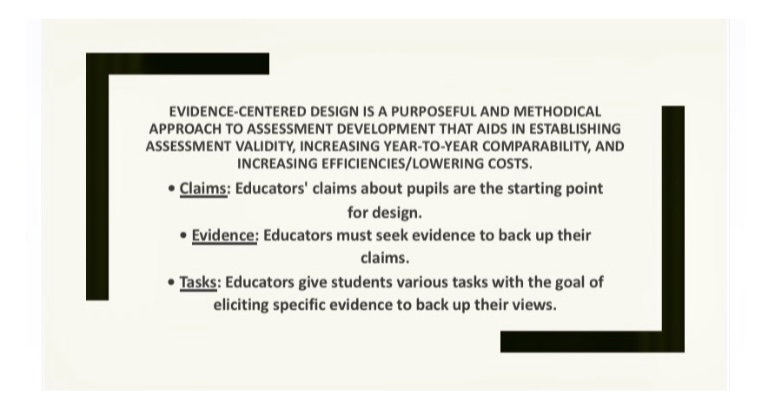
Evidence-based design is a framework that comprises numerous interconnected conceptual and computational models. According to the framework, an assessor must:
– define the claims they make about the abilities of learners.
– determine what constitutes admissible evidence in support of the claim.
– identify the types of tasks or situations that elicit the evidence.
The article will now describe each of these models in detail below:
1. Competency Model
The Competency Model always asks, “What set of knowledge, skills, and other characteristics should be assessed?”
Competencies are broad in scope since they include both technical and necessary skills. Moreover, they include soft skills, such as knowledge, behaviors, and abilities. The competency model comprises a collection of competencies. The variables in the competency model indicate the set of human traits that assessors use to draw conclusions.
2. Evidence Model
The evidence model, on the other hand, asks, “What behaviors or performances should indicate the structures defined and organized in the competency model?”
An evidence model explains how educators can use a student’s interactions with and reactions to a specific challenge to support competency model variables. The evidence model addresses two questions:
(a) How do distinct competencies manifest themselves in actions or performances?
(b) In terms of statistics, what is the link between such behaviors and the competency model variable(s)?
In a nutshell, an evidence model explains why and how we can use observations from a specific task setting (that is, student performance data) to back up claims about competency model variables.
3. Task Model
Finally, the task model always asks, “What are the types of tasks or scenarios that assessors can develop in order to elicit evidence-gathering behaviors?”
A task model is a framework for describing and constructing situations in which a learner might participate in order to provide evidence for particular aspects of knowledge or skill associated with competencies. As they interact with tasks or difficulties during the problem-solving process, learners supply a continuous stream of data to the evidence model. The model converts data (such as scores) into probabilistic assessments of competency. The competency model then updates the assertions about relevant competencies based on the evidence model’s findings.
In short, evidence-centered design is a way for developing assessment tasks that are explicitly related to assertions about human capabilities through a chain of evidence. As a result, they are appropriate for their intended use.
Opportunities And Challenges
When the assessment tactics, game, and simulated world are all built together through an evidence-based design process that includes not only the assessment but also the gameplay, stealth assessment works well. However, adding dynamic assessment to a pre-existing game or simulation is a less successful strategy.
Learners can get rapid feedback on their actions using stealth assessment approaches. Moreover, teachers can get information on how each student is developing inquiry, critical thinking, decision-making, and creativity abilities. This work is still in its early stages, and it is unclear whether stealth assessment methods must be designed from scratch for each game and topic, or whether common design principles may be used.

Stealth Assessment Explained In A Practical Scenario
The non-intrusive nature of stealth assessment, which has roots in gaming, is the key to its success. The idea is that a player’s decisions and strategies inform them of their progress and success on a regular basis. When it comes to education, stealth assessment is an effective way to reduce and eventually close the teaching and learning urgency loop. Because of the stealth assessment principle, current and future technologies should create a fundamental shift in training, not merely a slight tweak.
As previously said, both the teacher and the learner have the ability to observe, provide, and receive rapid feedback. In addition, they are capable of participating in the thoughts, insights, and observations of learning as they happen. The “student as worker, teacher as guide” approach, in which learners are primary architects of their own learning, requires participatory learning and assessment. They co-author, co-construct, and co-produce knowledge, meaning, and application. Furthermore, in the twenty-first century, critical thinking, study, and assessment of ideas, concepts, and structures are necessary abilities.
Educators limit their existing capacity to assess children by basing it on a very small number of test items. They are able to more accurately assess pupils when they move to a seamless assessment paradigm. This is because they have access to a significantly larger collection of pupils’ learning data. Educators can better support student learning across a range of essential educational topics with more accurate evaluations.
Image Sources: Shutterstock
Also Read: Formative Assessment Tools For Classroom Learning
For more information on Stealth Assessment, visit our blog.
Create. Engage. Inspire.
The post Stealth Assessment: Meaning, Principles, Design And Model appeared first on Test.Evelyn.
]]>The post Confirmative Evaluation: Meaning, Scope, Purpose And Model appeared first on Test.Evelyn.
]]>Confirmative evaluation builds on the results and suggestions made during formative and summative evaluations. It allows evaluators to confirm the value of performance improvement packages and performers over time. Moreover, it aids organizations in deciding how to manage ongoing performance improvement activities. This article will go over the confirmative evaluation process, its scope, and purpose in depth. It will determine what it is and is not. Additionally, it will discuss the confirmative evaluation model, as well as how it can help with learning and teaching.

What Is Confirmative Evaluation?
Confirmative evaluation is the process of gathering, analyzing, and interpreting facts and information to evaluate whether learners are still competent or whether the instructional materials are still effective. It urges educators to abandon linear models in favor of incorporating the evaluative process into every phase of the program.
Confirmative assessment is a new approach to continuous quality improvement. Under this approach, students take assessments even after the educator finishes executing the instruction in the classroom. The ultimate purpose of confirmative evaluations is to determine whether the instruction is a success after a year. In addition, it also determines whether the technique the educators are using for teaching is still effective.
Confirmative Evaluation: Its Scope And Purpose
Confirmative evaluation identifies, explains, and confirms the value of a performance improvement program over time. Performance improvement refers to measuring the output of a specific educational process, and then adjusting the process accordingly to enhance its output and increase its efficiency. It is typically conducted after the summative evaluation has been completed for a period of time, with the goal of ensuring that the training is still effective weeks, months, or even years afterward.
Formal schooling rarely does this, and there are a variety of reasons for it, including (but not limited to) practical considerations. The main goal of confirmative evaluation is to ensure that the quality of a performance improvement program is maintained throughout its life cycle. It also aims to figure out how well each learner’s skills have been retained. It also determines if the learner’s competencies are still sufficient or whether they require extra training or some other sort of intervention.
When Should One Use Confirmative Evaluation?
When it comes to confirmative evaluation, there are two schools of thought. The first sees confirmative evaluation as an extension of formative evaluation. On the other hand, the second sees it as a different and independent form of assessment. This form extends beyond formative and summative assessment.
- The first point of view emphasizes the importance of confirmative assessment as “an iterative effort intended to ‘take a pulse’ prior, throughout, and after an intervention is implemented.” Confirmative evaluation must be incorporated into an intervention’s fabric. After the freshly installed intervention has been in place for some time and its novelty has worn off, a long-term formative evaluation is done. This assessment should ideally be done every six months or so.
- The second, more traditional opinion is that the time factor is the most important characteristic that differentiates confirmative evaluation from formative and summative evaluation. Following implementation, educators conduct a confirmative evaluation. Confirmative evaluation should take place six months to a year after the performance improvement package is implemented, according to the rule of thumb.
- The three criteria of criticality, difficulty, and recurrence can also be used to determine when confirmative evaluation is necessary. If the criticality, difficulty, or recurrence of a performance is rated as eight or higher on a scale of one to ten by the performers and the organization, confirmative evaluation of any intervention to improve that performance should be conducted every six months after implementation.
The Confirmative Evaluation Model
The US Department of Health and Human Services’ second annual report, Performance Improvement, documented the evaluation activities of all Health and Human Services agencies and offices. A model of Confirmative Evaluation—a new paradigm for continuous improvement—was published in this report in 1997.
The model divides confirmative evaluation into four phases by the model: planning, doing, assessing, and improving. The concept is based on the principle of continual improvement. The following table lists the tasks that teachers should complete in each phase of the confirmative evaluation model.
| The Phase | The Task |
| Planning | The educator focuses upon and designs the evaluation during this phase. |
| Doing | The second phase deals with the collection of information through a variety of methods, including questionnaires, interviews, observations and focus groups. Educators can also use work samples and performance analysis, context studies, peer-supervisor-self reports, and cost-benefit analysis. |
| Assessing | This phase focuses on data collection and interpretation. |
| Improving | In this phase, educators consider the intervention’s impact, value added, and effectiveness. Following this, they recommend whether to continue, improve, or end the intervention. |
Confirming the Long-Term Effects of a National Reading Program-A Case Study
• Situation
In the 1990s, there was a push to incorporate kindergarten and even preschool reading and writing skills into the K-12 curriculum. This is an instance of how confirmative evaluation contributed to the development of national educational policy. Several school districts around the United States introduced the Listening, Speaking, Reading and Writing (LSRW)/Ginn Beginning Reading Program in their kindergartens in 1973.
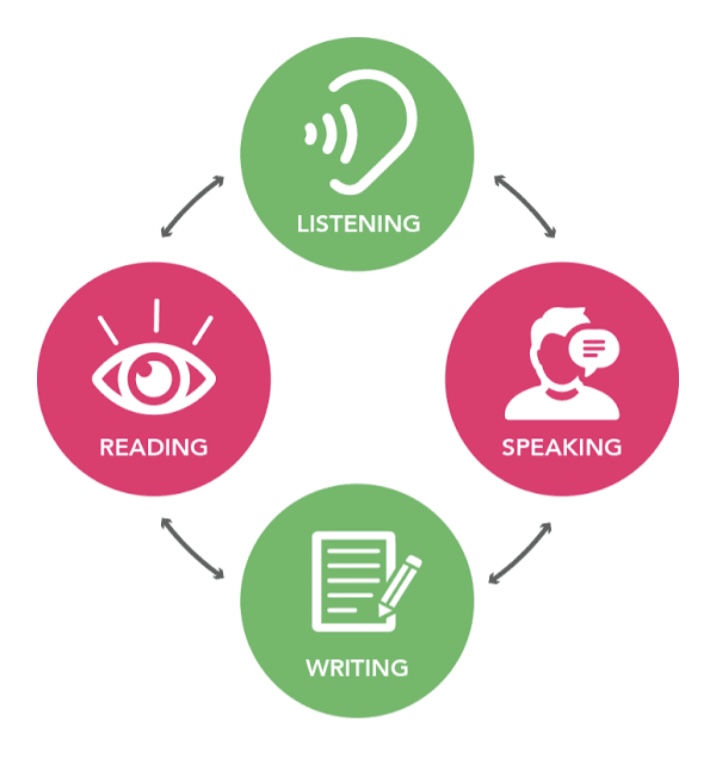
Several years later, Hanson and Siegel published a technical study that detailed how a subset of these pupils compared to the students from the same district who had different kindergarten experiences. The assessment used to compare the pupils was created expressly to assess both existing reading abilities and the kindergarten reading program’s prospective benefits. In addition, the confirmative evaluation was based on significant summative evaluation data collected from a broad national sample of kindergarten teachers who used the curriculum.
• Intervention
Instead of first grade, participating school districts offered a formal beginning reading program in kindergarten. The idea was to improve the reading abilities of K-12 children by introducing them to basic reading concepts and skills at a younger age than that allowed by standard school curricula. Moreover, the program’s goals were to improve reading skills, reduce the need for remediation, and create a good attitude toward reading.
• Results
As a result of receiving regular reading instruction in kindergarten, the high school students demonstrated a clear and consistent trend of enhanced reading ability. Those high school pupils who participated in the kindergarten reading program were better readers than those who did not.
Students who participated in the program also had better grades and greater attendance. In addition, they had a more positive attitude toward reading and less remediation needs. The findings of this confirmative study matched those of similar long-term evaluations of early intervention programs in scientific curricula.
• Deductions
This study supports the use of confirmative assessment to make policy in the field of education. In addition, one can apply it to other settings such as business and industry. The research shed light on a variety of confirmative evaluation goals, including the following:
– It aids policymakers in developing policies that have long-term benefits. This includes the policy of incorporating reading skills into the kindergarten curriculum based on evidence of improved student performance.
– Secondly, it provides a reasonable foundation for program improvement, throughout its life cycle.
– It aids in the resolution of any discrepancies that exist between declared aims and actual outcomes.
– Finally, it improves the cost-benefit ratio. For instance, a school district’s requirement for less remediation may result in lower expenses.
Who Should Perform Confirmative Evaluation?
Confirmative evaluation necessitates a unique perspective as well as excellent analytical abilities. One method is to use a group of impartial evaluators to see if the performers have retained their level of proficiency after the program was implemented and if the program itself still meets the intended outcomes. Another option is to utilize an outside evaluator in conjunction with a subject matter expert who is familiar with the performance or the environment in which the participants work.
Image Sources: Shutterstock and Unsplash
Also Read: Stealth Assessment: Meaning, Design And Model
For more information on Confirmative Evaluation, visit our blog.
Create. Engage. Inspire.
The post Confirmative Evaluation: Meaning, Scope, Purpose And Model appeared first on Test.Evelyn.
]]>The post Flashcards As A Teaching Tool appeared first on Test.Evelyn.
]]>Online flashcards are a vogue these days. Students can utilize flashcard apps on their phones or tablets to learn a variety of subjects in a more engaging manner. They can now create visually stunning and instructive presentations and decks on their own. These apps’ high-tech algorithms enhance learning in ways it has never been done before. This article includes a handful of the many advantages of using flashcards in schooling. In addition, it will go over how to use them in the classroom, how to make flashcards, and to use them in online instruction.
What Is A Flashcard?
Flashcards are cards with a limited amount of information on them, such as words, phrases, questions, photos, numbers, or even a little sketch. All these are usually related to a subject and/or a study topic. They are useful for learning and studying tasks that involve memorizing. This is because they attempt to improve a learner’s active recollection of a topic’s details.
Reading Disentangled (1834), a set of phonics flashcards created by English educator Favell Lee Mortimer, is often acknowledged as the first set of flashcards. Available in both paper and digital formats, a flashcard in its most basic form has two sides- a front side with a question and a rear side with an answer. Students work their way through a deck, answering the questions on the front and validating their answers on the back.
Benefits Of Using Flashcards As A Teaching Tool
Since they are based on active memory, metacognition, and spaced repetition, flashcards are effective. The following are the most significant advantages of utilizing them as a teaching tool.
1) Flashcards Are A Low-cost Option
When it comes to study materials, they are unquestionably one of the most cost-effective options available. To prepare a set of flashcards, educators do not need to purchase a fancy set of cards. Simple index cards (about 3-by-5 inches in size) are more than suitable for use as flashcards.
2) They Are Easily Transportable
Flashcards as a teaching tool are lightweight, portable learning materials that may be carried anywhere. In comparison to textbooks, they are less bulky and may be accessed wherever and whenever one wants. Educators are welcome to bring them in large quantities. They would be completely oblivious to the weight.
3) They Are Effective
Flashcards can take learning to a whole new level by speeding up the process of learning for one’s personal benefit. Their mobility also aids in improving overall learning efficiency. Students are able to make better use of their time and learn something new every day if they carry their decks wherever they go.

4) They Are Adaptable
There is no requirement for educators to use flashcards as a teaching tool exclusively for one subject. Students can use them to learn about almost any subject. History, geography, biology, mathematics, physics, chemistry, foreign languages and vocabulary are all possibilities.
5) Flashcards Help To Make The Entire Learning Process Easier
Whenever educators are designing flashcards, they should always include only the subject’s fundamental underlying concept, something that the brain can absorb in a flash. Educators must make an effort to simplify the material they put on them.
On their flashcards, they should only write the fundamental underlying principles of a subject topic. This assists in simplifying the overall learning process.
Flashcards In Classrooms
Dates, vocabulary, basic facts, historical events, scientific terminology, procedures, and equations can all be swiftly memorized and learned with flashcards. They are not advised for in-depth analysis of a topic, however, because they only provide key facts and not the details of a subject/theme. Inside the classroom, the teacher can utilize flashcards as a supplement to provide an outline at the start or end of the lecture. A flashcard can also be used as a revision tool to assist students in preparing for an examination by allowing them to summarize significant material learnt in the classroom, which can then be examined independently by the learner or in a formal evaluation in the classroom.
It is recommended that when teachers utilize flashcards in the classroom, they be systematic and make it a habit for the students. It will be ineffective to utilize them only once in a while, as repetition is essential for learning new knowledge. As a result, it is more beneficial to introduce them throughout the year and to use them for revision in the classroom on a frequent basis. This is a fantastic review approach because students will have a whole set of flashcards to study for a larger examination by the end of the semester or year.
How To Make Flashcards?
Educators can create paper flashcards by hand or utilize digital tools to create virtual flashcards when it comes to making flashcards. Although it takes longer to make cards by hand than it does to make them online, some students prefer to have actual cards. Both strategies are equally effective, therefore instructors must choose between the two.
• Making Flashcards By Hand
Educators can start using index cards to build their own flashcards by hand. They can cut an ordinary sheet of paper into equal pieces if they do not have index cards. They can then either hand write the material or input it into Microsoft Word or Google Docs and print it. Handwriting flashcards can also help with memory recall.

• Making Flashcards Using Flashcard Apps
Making cards with flashcard applications is simple and quick. Online cards may be more comfortable for pupils who are used to being glued to their laptops or workbooks all day. As a flashcard builder, educators can use a variety of websites and apps. Canva, Quizlet, and Cram are among the most popular.
Benefits Of Using Flashcards In Online Learning
It is critical for educators to assist students in structuring their revision in the most efficient manner feasible. When studying for tests, students frequently feel overwhelmed by the volume of study notes. By enhancing their memory, flashcards let students quickly comprehend the study material. Using these cards as a teaching tool in online teaching improves recall and information retention capabilities.
1) Learning On-the-Go
If each student gets access to an educator’s flashcard deck, they may study it at a time of their choosing, even on the go, using their phone, tablet, or other mobile device – ensuring that they have it with them at all times.
2) Enhance Memory And Retaining Capacity
Flashcards have been shown to boost long-term memory. Students can practice a topic with flashcards and re-visit it at regular intervals to assess themselves. This boosts their capability to recollect crucial data as well as their ability to retain that information. It also ensures that students remember what they have studied when tests approach.
3) Add Interactive Images
Flashcards as a teaching tool are useful for more than just learning a language and memorizing terminology. Educators can add graphics to online flashcards, so they can be used for any subject, such as studying quotes or formulas in their Mathematics class. Students recall facts better if graphics accompany text on cards. The learning material becomes more interactive in this manner.
4) Quickly Assess A Student’s Understanding
Students are better prepared for their exams if they take a lot of online class assessments. Students can use online flashcards for learning and revision and to quickly absorb their notes before a test to refresh their memory. This also provides educators ensure that their students comprehend the curriculum and are prepared for exams.

5) Using Flashcards, Students Can Study In A Variety Of Ways
Flashcards prohibit students from merely memorizing the sequence of the answers in long-list items since educators can mix the order. Educators can flip the flashcards over so that the answers are visible first and students must guess what the questions were.
With the advancement of technology and mobile internet, flashcards as a teaching and learning tool have vastly improved in contrast to their previous state. Thanks to the introduction of mobile internet, students now have the ability and convenience to use online flashcards right at their fingers.
While most of the benefits are similar, there is one benefit in particular that appears to be unmatched by anything else when comparing online flashcards with paper flashcards. For the benefit of the environment, online flashcards help educators save a lot of paper (and trees). The same action can help them reduce their carbon footprints as well.
Image Sources: Shutterstock and Unsplash
Also Read: Preparatory Courses For LSAT
For more information on flashcards as a teaching tool, visit our blog.
Create. Engage. Inspire.
The post Flashcards As A Teaching Tool appeared first on Test.Evelyn.
]]>The post Content Editing: An Itemized Breakdown Of Its Meaning And Levels appeared first on Test.Evelyn.
]]>Editors oversee the final stage of the content creation process before it goes live. So, content editing transforms a piece of academic content writing into a compelling presentation, but where does one begin? Here is a step-by-step guide to content editing, encompassing its meaning and different levels.

What Is Content Editing?
Content editing is a component of the editing process that looks for persuasive, cohesive, and intelligible arguments in written content. The step examines misspellings, comma splices, and poor word choice, apart from other grammar faults. Poor material quality with typos and grammatical errors can erode any faith customers have in your brand. Hence, content editing is essential to the online publication process.
Keyword research and optimization employing structural features such as H2 and H3 headings are all part of high-quality content creation. So are internal links, and a variety of long-tail keywords. However, optimizing content is only the beginning. One should also ensure that the material is easy to read and understand, which is where content editing comes in.
Content Editing vs. Copy Editing
Here is a quick rundown of the distinctions between content and copy editing. Content editing ensures that writing is clear, concise, and effective. This entails examining the argument’s strength and logic, the quality of the sources or examples, the piece’s fit with your brand language, and the piece’s scope.
Copy editing, on the other hand, seeks for and corrects more minor errors. This includes double-checking spelling, grammar, punctuation, syntax, and compliance with style guides. Double-checking graphs, charts, and image placement, as well as proofreading the title, meta descriptions, and captions, are all examples.
Dos And Don’ts Of Content Editing
To become a successful content editor, one must first learn the rules of the game. In light of this, here are a few content editing dos and don’ts for modern creatives.
Dos Of Content Editing
Here are four effective editing tactics for content editing that editors can use to turn their drafts into memorable content.
• Understanding What They Are Up Against
Editors must first assess what they are editing before they begin. Is it a quick SEO post aimed at ranking for a specific keyword? Is it an infographic-enhanced long-form guide? Are they displaying confidential survey results? This will prepare them for what to expect and what to look out for. The word count must also be considered by editors. Content editing is more productive when the editor has a rough notion of what they are altering before they start.
• Making A Style Check
Moving on, editors must identify the client for whom they are editing. As a content editor, you may work with a variety of clients, ranging from lifestyle and wedding magazines to finance and insurance firms, each with their own distinct voice, branding, and style rules.
Some clients prefer the traditional approach, while others supply editors with their own set of rules. Editors must always set aside time to get into the zone for that particular client. If a client is new to the agency or to the editor, the editor will need to spend more time learning about their guidelines.
• Avoiding Cliches, Slang Or Clunky Prose
There will always be a statement that sounds cliched or does not resonate with the audience. This is where a content editor comes in helpful. They might see something that the writer missed since he or she is so close to the work. Editors choose what works and what does not at the first read.
• SEO Retouching
Search engine optimization is one of the last tasks in the proofreading and editing process. When editors develop material for their target audience that is useful, instructive, or entertaining, they want readers to be able to locate it on Google, Bing, or another search engine.
Editors must ensure that they have suitable header tags and that they are employing phrases that their target audience would use – keywords — in step. This is also a good moment to compose the title, URL slug, and metadata, which should include the terms and phrases that your target audience is likely to look for.
Don’ts Of Content Editing
Understanding what not to do is almost as important as learning what to do with online content. With that in mind, here are a few things to avoid in content editing at all costs.
• Using Software For Editing
Editing software, such as the built-in spell-check on an editor’s word processor, are all excellent tools for catching faults in a writer’s work. They should not, however, rely on them to correct all of their errors.
That is not to suggest editors should not utilize them; they are wonderful for saving time and catching errors as they happen so they do not have to correct them later. However, editors should be cautious about how much they rely on them.
• Inconsistency
Readers may not care how a writer refers to someone or something, but they will notice if the writer cannot decide whether to refer to someone or something one way or the other. An editor must always ensure that a piece of writing has one point of view and sticks to it throughout all of the information.
• Excessive Usage Of Pronouns
When writers start mixing and matching pronouns, the meanings are not always obvious, at least in print. Editors must be very careful to identify who or what a pronoun refers to, and to clarify if necessary. Better to have a name repeated twice in the same line than a reader puzzled about who is who.
• Sentences That Are Extremely Long And Wordy
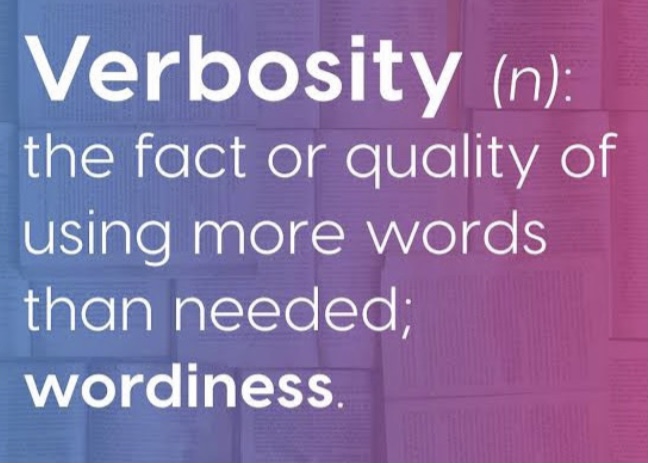
It is possible that sentences with a lot of commas, semicolons, dashes, and conjunctions are excessively long. There is no key word count for what constitutes a run-on sentence, but editors must divide it up if they feel they have been in the same sentence for a long time or have just become lost. In order to connect the new sentences and guide readers from one notion to the next, they must utilize transitional words like hence, nevertheless, or furthermore.
• Assuming The Writer Is Correct At All Times
If copy editors see facts that do not seem quite right while copy editing other writers, they should investigate more. The information is usually correct, but even the most conscientious writers can lose attention for a moment and type something they did not plan to say. Rather than allowing a severe error to appear on the website, editors must send a quick email or leave a note in the copy for review, asking for clarification.
• Common Grammatical Errors
It is likely that a complete post could be written regarding typical use errors that editors can easily spot when modifying. Compliment or complement, effect or affect, and ensure or insure are only a few examples.
Levels of Content Editing
While no single “ideal” version of any piece of writing exists, there are numerous tactics and possibilities for refining a text. Knowing all the ways an editor can respond to a draft is beneficial, since a skilled editor will recognize all the possibilities of content editing–even if the author does not.

So, here is how an editor should determine what a piece of academic content writing requires:
Grammatical Edits (Level 1)
The author is comfortable with the material at this point and simply wants small and obvious faults in spelling, grammar, and punctuation corrected.
Fact Checking (Level 2)
This level of content editing encompasses Level 1 as well as difficulties of consistency and accuracy for some finer aspects. Is the use of numbers and abbreviations coherent, the wording acceptable for the audience, and the structural layout (headings, etc.) consistent and practical?
Stylistic Editing (Level 3)
The editor begins identifying the writer’s style at Level 3 of content editing. Wordiness, overuse of certain words or phrases, shortage of transitional phrases (which highlight the piece’s organizational structure), tone appropriateness, and even sentence rhythm (are all the sentences the same length?) are all examples of this.
If the article is to be published, the publisher may have its own “style manual” or intended style, which can influence sentence length, tone formality, and even grammar formality.
Structural Editing (Level 4)
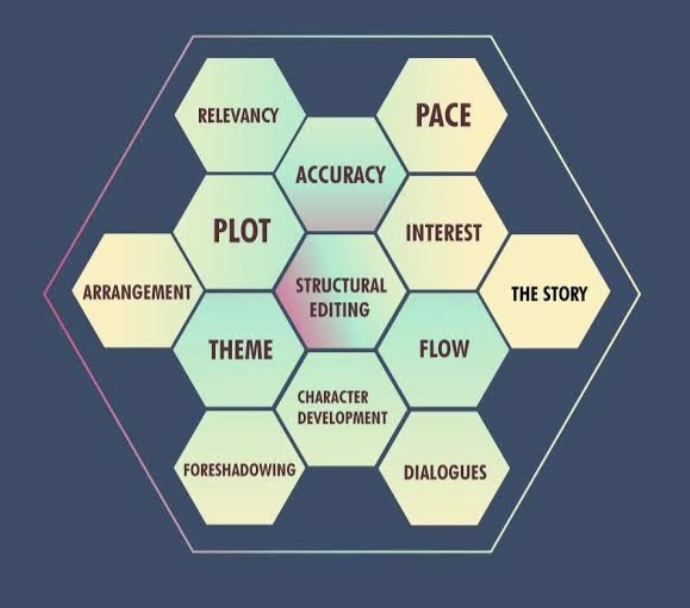
At Level 4, the editor begins to think about the piece beyond the sentence level, which is a significant change. Internal paragraph structures (are ideas thoroughly and rationally explained?), paragraph organization (too many, too few, are transitions appropriately marked?), sequence of material, and type and structure of headings may all be addressed at this level. This includes how things look in the table of contents, if there is one. Nevertheless, the editor is still working with what is already on the page and does not address broader issues that require rewriting at this level.
Substantive Editing (Level 5)
Level 5 talks about the context for a piece of academic content writing, rather than just dealing with what the author has provided on the page:
- Who is the intended audience?
- What is the piece’s point of view?
- When and where will the writer publish it?
- What does the author hope to achieve with the article (which may or may not be the obvious goal)?
At level 5, an editor can remark things regarding additional specifics, illustrations, examples or even incorrect writing approaches. The editor or author may need to undertake some minor rewriting. They could even add a bit of additional substance to what is currently there at this level.
Revision Editing (Level 6)
Since it makes no sense to edit or proofread until a new version is complete, other types of editing come to a halt when a piece requires revision. As an editor, one can prepare a list of questions to ask in response to a piece that needs to be revised, as well as a critique of what works and what does not in the piece as a whole.
The word “re-vision” means “re-seeing,” which implies the author must go back and evaluate decisions made in the first draft. It may necessitate redefining one’s audience or goal, altering the piece’s structure, or substantively rewriting the piece’s content.
Rewriting (Level 7)
An editor’s work at this stage moves from modifying what the author wrote to rewriting it for them. This could entail altering the writing style, tone, structure, or even a significant section of the content. It may be necessary to go back to the original source materials and perform new research. In any case, this is not an attempt to fix the author’s work, but rather a fresh start on it (or a section of it).
Final Proofreading (Level 8)
Proofreading is the process of checking the final draft of a piece of writing for grammar, spelling, punctuation, and formatting consistency and accuracy. Proofreading is the process of identifying little and big errors that were either overlooked or made during the editing process. At this point, editors must guarantee that the document’s final draft is free of grammatical, formatting, and typographical faults (e.g., subject–verb agreement issues, inappropriate word selections, improper punctuation, and erroneous spelling). They must also ensure that the article follows the style guide that has been chosen.
All in all, content editing is the process of going over a piece of online writing to make sure it is clear, succinct, and targeted to the reader’s needs. While this is all there is to it for now, Part-2 of this article will go over the steps of content editing. It will also introduce readers to some of the most effective content editing tools. This will help them turn their drafts into memorable and quality content.
Image Sources: Shutterstock and Unsplash
Also Read: Recent Trends In Educational Publishing
For more information on content editing, visit our blog.
Create. Engage. Inspire.
The post Content Editing: An Itemized Breakdown Of Its Meaning And Levels appeared first on Test.Evelyn.
]]>The post Curriculum Development and Its Importance for the Educators appeared first on Test.Evelyn.
]]>In order to enhance the student learning experience, educators are continually developing new teaching techniques and strategies, such as transformative learning or blended learning. As a result, an institution must have a strategy in place for recognizing these adjustments and then incorporating them into the curriculum. We will discuss what curriculum development is and why it is crucial for educators in this blog. Aside from that, we will also go through three basic types of curricular structures.
What Is Curriculum Development?
The process of designing and constructing structures for formal education instruction is known as curriculum development. It is a step-by-step procedure for making constructive changes to a school’s, college’s, or university’s course offerings. School courses must incorporate new findings as the world continues to evolve.
Curriculum development is based on pedagogical approaches and learning goals. In addition, it covers a broad spectrum from structuring a career program to designing classroom lesson activities.
Categories Of Curriculum Design
The product category and the process category are the two broad categories of current curriculum. The product category focuses on outcomes. The main goal is to get good grades, with the emphasis on the final output rather than the learning process.
The process category, on the other hand, is more open-ended and focuses on how learning progresses over time. When developing curriculum, educators must consider these two categories.
What Is Curriculum Planning?
Curriculum planning is the process of deciding what to learn, why to learn it, and how to organize the teaching and learning process in light of existing curriculum requirements and resources. Curriculum planning frequently results in the creation of a broad curriculum framework as well as a syllabus for each subject that individual schools can use as a guide. It entails creating course and evaluation plans for several disciplines at the school level.
In addition, it entails creating more thorough plans for learning units, individual lessons, and instructional sequences in the classroom. Effective curriculum planning and assessment places students and their learning needs at the center. Teachers can use this principle to create experiences that will help students become lifelong learners and responsible citizens. This enables teachers to include appropriate formative and summative assessment tools into their teaching practices.
What Is Curriculum Design?
The intentional, deliberate, and systematic organizing of curriculum (instructional blocks) inside a class or course is referred to as curriculum design. To put it another way, it is a method for teachers to arrange their lessons. Teachers plan curriculum by determining what will be done, who will execute it, and what schedule will be followed. They create each curriculum with a specific educational goal in mind.
The main purpose of curriculum design is to promote student learning, although there are other reasons to use it. Curriculum planning and assessment should place students and their learning needs at the forefront. Teachers can use this idea to design experiences that will help students become lifelong learners and responsible citizens. This enables teachers to include appropriate formative and summative assessment tools into their classroom practice.
What Are The Different Types Of Curricula?
Curriculum development entails the use of a variety of instructional strategies and organizational methods aimed at producing the best possible student growth and learning outcomes. Each course supervisor at a (higher education) institution will have criteria, principles, and a framework that teachers must use when creating courses. Teachers are responsible for ensuring that their lesson plans match the educational needs of their pupils, the curriculum’s expected results, and that the resources utilized are current and understandable.
Subject-centered, Learner-centered, and Problem-centered designs are the three basic types of curricula.
• Subject-centered Curriculum Design
This kind of a curriculum focuses on a single subject or field, such as e-marketing, research skills, or communication. This form of curriculum design is more concerned with the subject than with the learner. The most typical sort of standardized curriculum found in higher education is this.
In comparison to other types of curriculum designs, Subject-centered curriculum design is not student-centered, and the approach is less concerned with individual learning. This can lead to issues with student involvement and motivation, as well as a drop-off in pupils who are not sensitive to this paradigm.
• Learner-centered Curriculum Design
Learner-centered curriculum is built around the needs, interests, and goals of students. It recognizes that pupils are not all the same and educators should not force them to follow a set curriculum. This strategy tries to give students more control over their education by allowing them to make decisions.
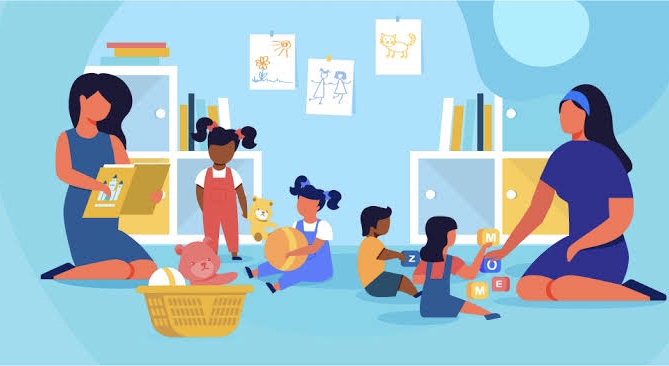
Assignments, teaching and learning experiences, and activities can all be customized with differentiated instructional plans. Students have been shown to be engaged and motivated by this type of curriculum design. This type of curriculum design has the disadvantage of putting pressure on teachers to find materials that are specific to each student’s learning needs. Due to time limits in the classroom, this can be problematic. Balancing individual student interests with the institution’s expected objectives can be difficult.
• Problem-centered Curriculum Design
Students learn how to look at an issue and construct a solution through problem-centered curriculum design. Educators consider it an authentic method of learning since students get exposure to real-life challenges. This model helps students build abilities that are transferable to the real world.
Problem-centered curriculum design improves curriculum relevance and promotes creativity, innovation, and collaboration in the classroom. However, the disadvantage of this style is that it does not always take individual learning into account.
Curriculum development and management plan facilitate the optimal utilization of the available resources by the educators. One can work towards a more promising future by adopting policies that will improve the entire system. Any academic institution’s curriculum serves as its foundation; without it, the institution cannot survive for long.
Since there will not be any specific system objectives, the syllabus would be all over the place. For the curriculum that an institution designs for its students, it needs to have a clear set of goals and objectives. Only then will the learners be able to make progress towards a much better and brighter academic future.
Image Sources: Shutterstock and Unsplash
Also Read: Tips For Creating Effective Assessments
For more information on curriculum development, visit our blog.
Create. Engage. Inspire.
The post Curriculum Development and Its Importance for the Educators appeared first on Test.Evelyn.
]]>